
Identifying Big Ideas Where are We Going Identify
Identifying Big Ideas
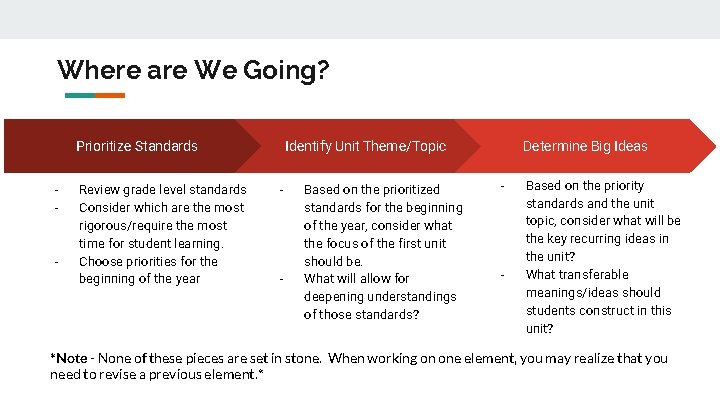
Where are We Going? Identify Unit Theme/Topic Prioritize Standards - - Review grade level standards Consider which are the most rigorous/require the most time for student learning. Choose priorities for the beginning of the year - - Based on the prioritized standards for the beginning of the year, consider what the focus of the first unit should be. What will allow for deepening understandings of those standards? Determine Big Ideas - - Based on the priority standards and the unit topic, consider what will be the key recurring ideas in the unit? What transferable meanings/ideas should students construct in this unit? *Note - None of these pieces are set in stone. When working on one element, you may realize that you need to revise a previous element. *
Identify the First Unit Topic/Theme - Many of you already identified your first topic/theme last week. - Right now you have 5 minutes to come to consensus on that first topic/theme - If you have already reached consensus you can consider other unit topics/themes for the year.

What is a Big Idea? - Grant Wiggins “An idea is “big” if it helps us make sense of lots of confusing experiences and seemingly isolated facts. It’s like the picture that connects the dots or a simple rule of thumb in a complex field. ” Wiggins (2010) retrieved from: "What is a Big Idea? " article
![“…[S]uppose we ask: if you could as teacher alert the student to a key](http://slidetodoc.com/presentation_image_h2/5bd58ec710b2ee96023863c4498b0194/image-5.jpg "“…[S]uppose we ask: if you could as teacher alert the student to a key")
“…[S]uppose we ask: if you could as teacher alert the student to a key recurring idea that can make sense of the learning as well as further it, what would it be? . . . That’s what we’re calling a big idea. ” Wiggins (2010) retrieved from: "What is a Big Idea? " article
![“…[W]e musn’t equate “big idea” with a concept taught as a fact or definition.](http://slidetodoc.com/presentation_image_h2/5bd58ec710b2ee96023863c4498b0194/image-6.jpg "“…[W]e musn’t equate “big idea” with a concept taught as a fact or definition.")
“…[W]e musn’t equate “big idea” with a concept taught as a fact or definition. Only when we help the learner see firsthand that an idea is an inference, and one with power to provide meaning and transfer, does it become a “big idea. ” “A true idea doesn’t end thought, it activates it. It has the power to raise questions and generate learning. So, build your unit around idea[s] with power, idea[s] that help learners make sense of otherwise isolated content and which cannot help but bring inquiry to the fore. ” Wiggins (2010) retrieved from: "What is a Big Idea? " article
On the following slides, there will be two statements related to the same content. Only one is a “big idea. ” Identify which it is!
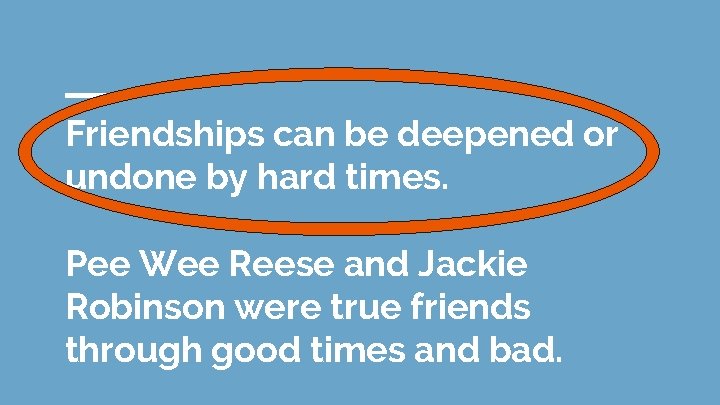
Friendships can be deepened or undone by hard times. Pee Wee Reese and Jackie Robinson were true friends through good times and bad.
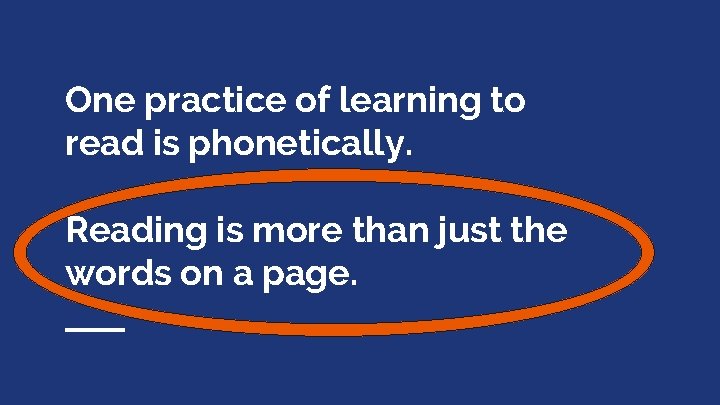
One practice of learning to read is phonetically. Reading is more than just the words on a page.
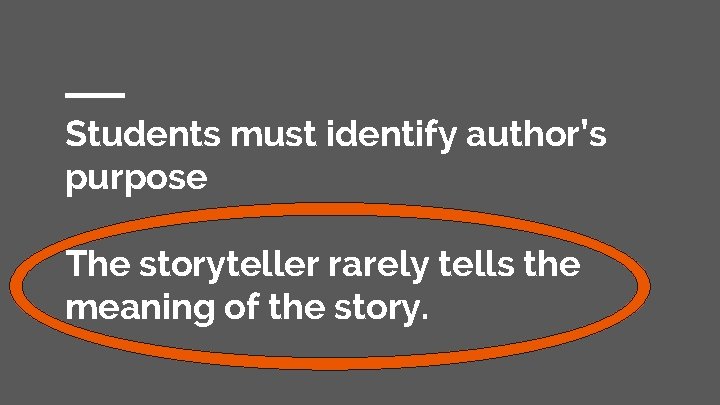
Students must identify author’s purpose The storyteller rarely tells the meaning of the story.
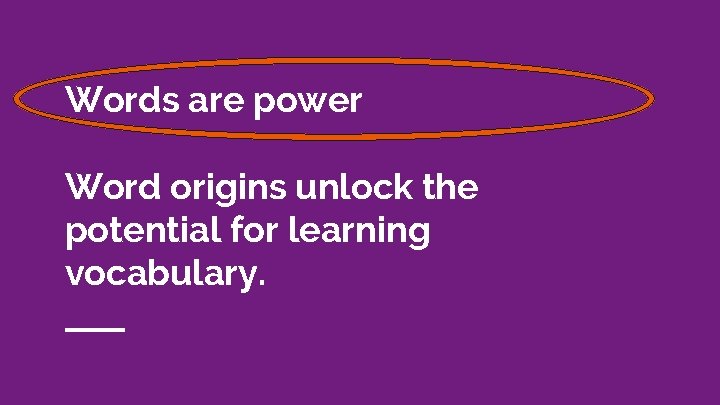
Words are power Word origins unlock the potential for learning vocabulary.
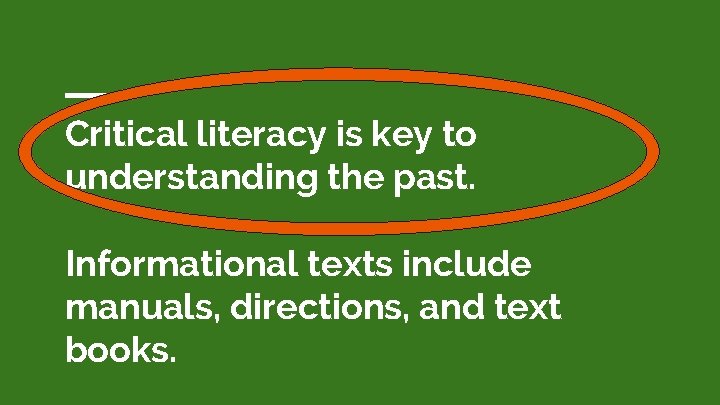
Critical literacy is key to understanding the past. Informational texts include manuals, directions, and text books.
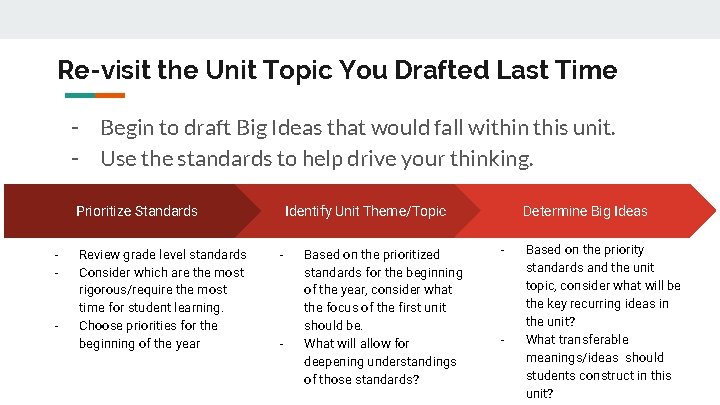
Re-visit the Unit Topic You Drafted Last Time - Begin to draft Big Ideas that would fall within this unit. - Use the standards to help drive your thinking. Identify Unit Theme/Topic Prioritize Standards - - Review grade level standards Consider which are the most rigorous/require the most time for student learning. Choose priorities for the beginning of the year - - Based on the prioritized standards for the beginning of the year, consider what the focus of the first unit should be. What will allow for deepening understandings of those standards? Determine Big Ideas - - Based on the priority standards and the unit topic, consider what will be the key recurring ideas in the unit? What transferable meanings/ideas should students construct in this unit?
- Slides: 13