
Identifying and Teaching Tier 2 Words Presented by
Identifying and Teaching Tier 2 Words Presented by: Lynn Mallory Adapted from: Sheryl White sherylwhite 54@gmail. com
Session Objectives • Identify vocabulary demands in the Common Core State Standards • Define the Tiers of vocabulary • Discuss the importance of direct vocabulary instruction to improve comprehension of text, speaking, listening and writing • Practice instructional strategies that will enhance vocabulary instruction
Common Core Vocabulary • http: //www. corestandards. org/ELA-Literacy • What key words do you see in the Standards that we need to address?
What do we need to do? Vocabulary instruction is a priority in the Common Core. How do we get our students proficient in learning new words?
Vocabulary… Why Do YOU Teach It? • Talk to an elbow partner about the question. • Share your ideas with the others at your table. • Record as many reasons as you can for teaching vocabulary.
Let’s at some of the research related to vocabulary development.
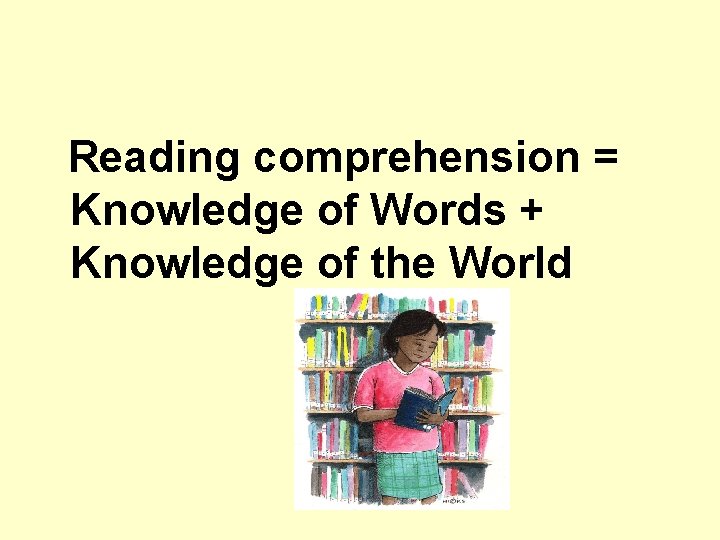
Reading comprehension = Knowledge of Words + Knowledge of the World
What Does Research Say? Homes rich in communication. Children before the age of four have heard 45 million words. Homes that lack rich communication. Children before the age of four have heard 13 million words. (Hart and Risley 1996)
Actual Differences in Quantity of Words Heard In a typical hour at home, the average child would hear: Welfare Working class Professional 616 words 1251 words 2153 words Meaningful Differences in the Everyday Experience of Young American Children, Hart & Risley Now think about the impact of an ELL in poverty.
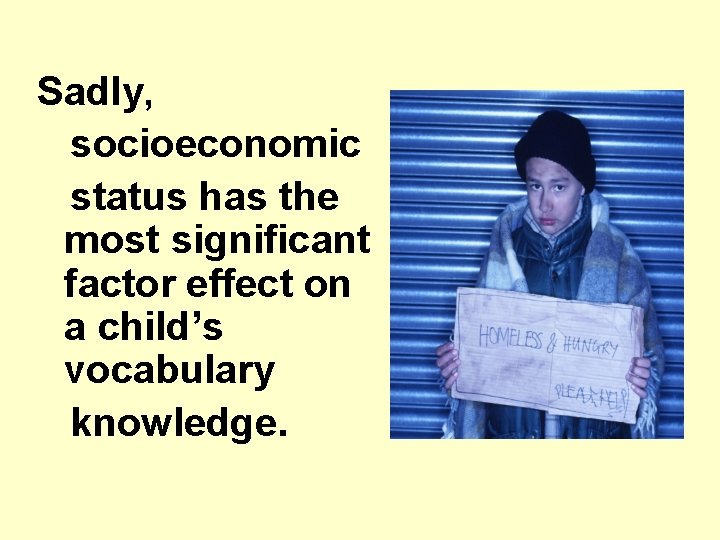
Sadly, socioeconomic status has the most significant factor effect on a child’s vocabulary knowledge.
Effective Approaches to Teaching Vocabulary • Exposure to High-Quality Oral Language • Reading Aloud to Students-Word Consciousness • Explicit Vocabulary Instruction • Word-Learning Strategies • Wide Independent Reading
High-Quality Oral Language • Use high quality vocabulary in the classroom. • Tell students the meaning of words when first used. – “Don’t procrastinate on your work. Procrastinate means to wait to do something you should be doing already. ” – Pair in the meaning of the word by using parallel language. “Please refrain from talking. Please don’t talk. ” COLLEGE TALK
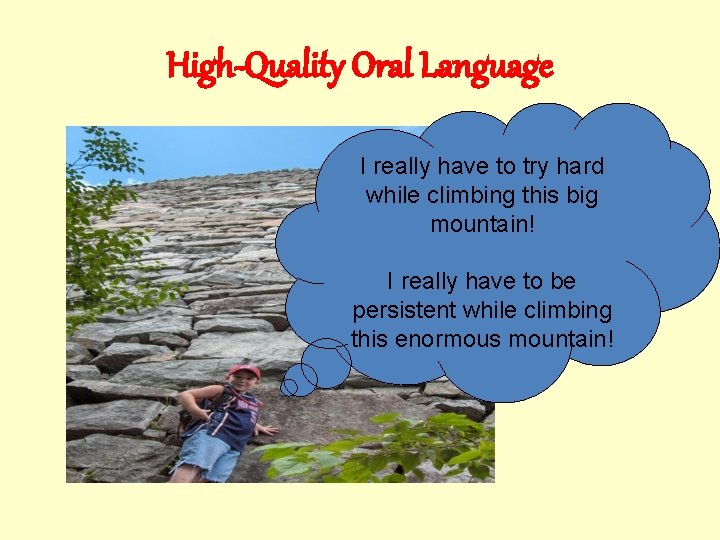
High-Quality Oral Language I really have to try hard while climbing this big mountain! I really have to be persistent while climbing this enormous mountain!
Front-Loading High Quality Oral Language • Students learn more words when we focus on fewer words and use those words in our own speech. -- Kylene Beers (2003) When Kids Can’t Read p. 182. • Be intentional about what words the students need to be successful in that subject/unit/lesson, and use those words in advance! 14
Effective Approaches to Teaching Vocabulary • Exposure to High-Quality Oral Language • Reading Aloud to Students-Word Consciousness • Explicit Vocabulary Instruction
Explicit Vocabulary Instruction • Vocabulary activities specifically designed to teach new words Table Talk With your neighbors, list explicit vocabulary instructional techniques you have used through the years. Star those you feel were successful. Be ready to share. 16
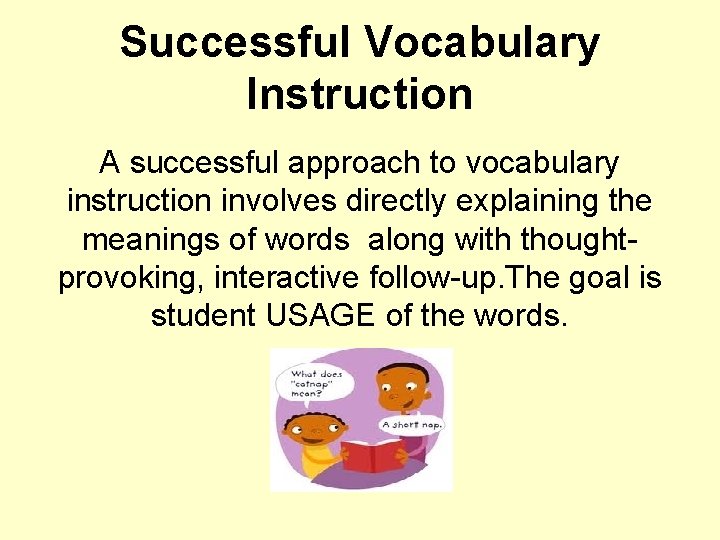
Successful Vocabulary Instruction A successful approach to vocabulary instruction involves directly explaining the meanings of words along with thoughtprovoking, interactive follow-up. The goal is student USAGE of the words.
There are so many words they don’t know! How do I choose which ones to teach?
Common Core and Three Tiers of Vocabulary
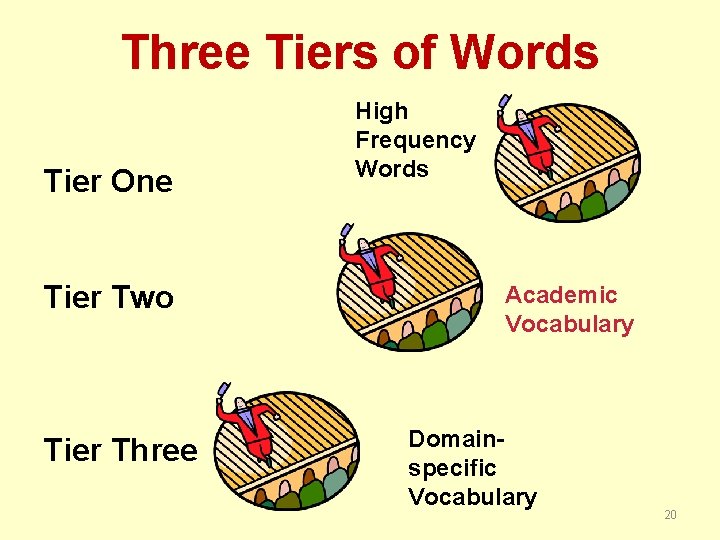
Three Tiers of Words Tier One Tier Two Tier Three High Frequency Words Academic Vocabulary Domainspecific Vocabulary 20
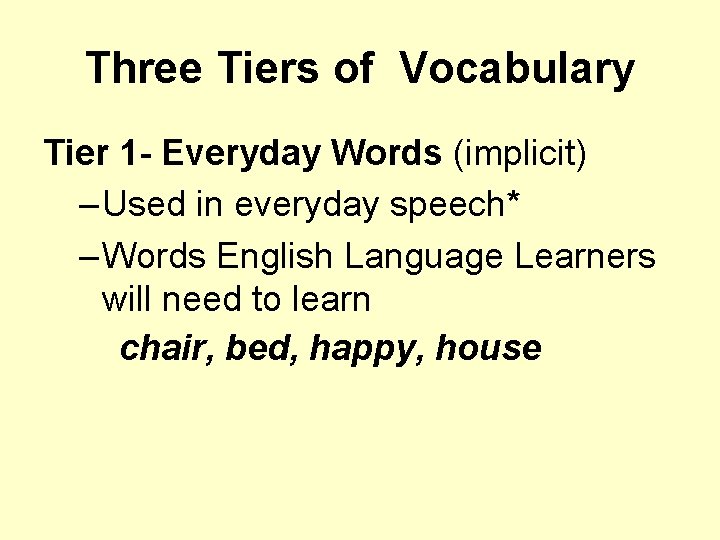
Three Tiers of Vocabulary Tier 1 - Everyday Words (implicit) – Used in everyday speech* – Words English Language Learners will need to learn chair, bed, happy, house
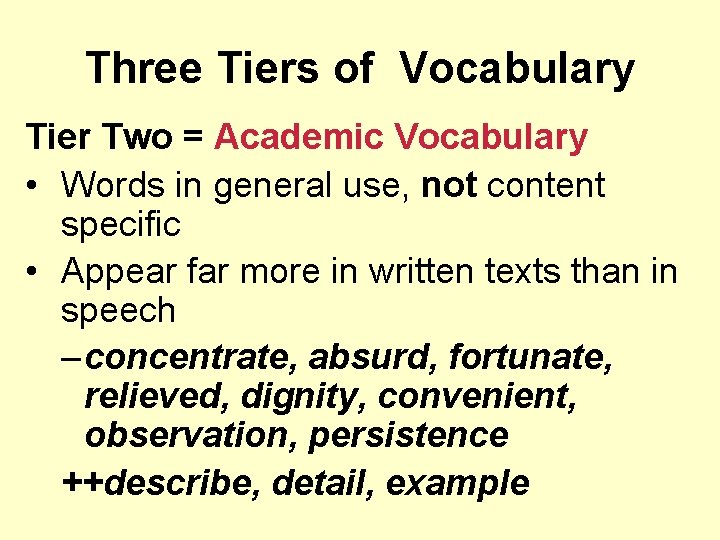
Three Tiers of Vocabulary Tier Two = Academic Vocabulary • Words in general use, not content specific • Appear far more in written texts than in speech – concentrate, absurd, fortunate, relieved, dignity, convenient, observation, persistence ++describe, detail, example
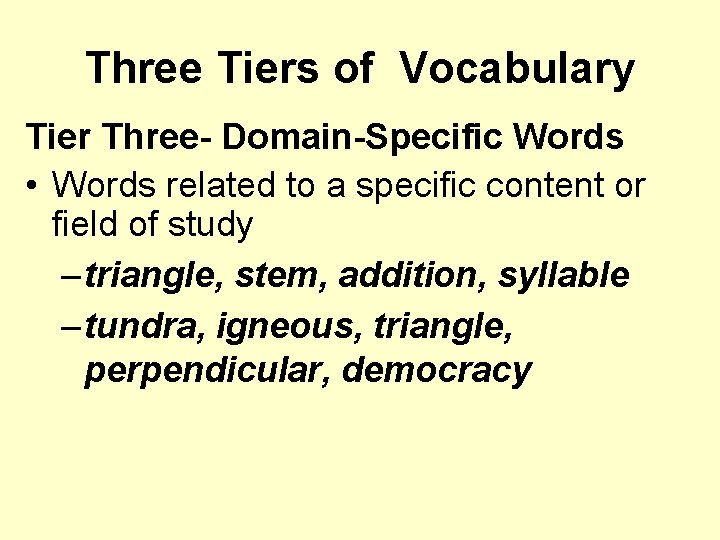
Three Tiers of Vocabulary Tier Three- Domain-Specific Words • Words related to a specific content or field of study – triangle, stem, addition, syllable – tundra, igneous, triangle, perpendicular, democracy
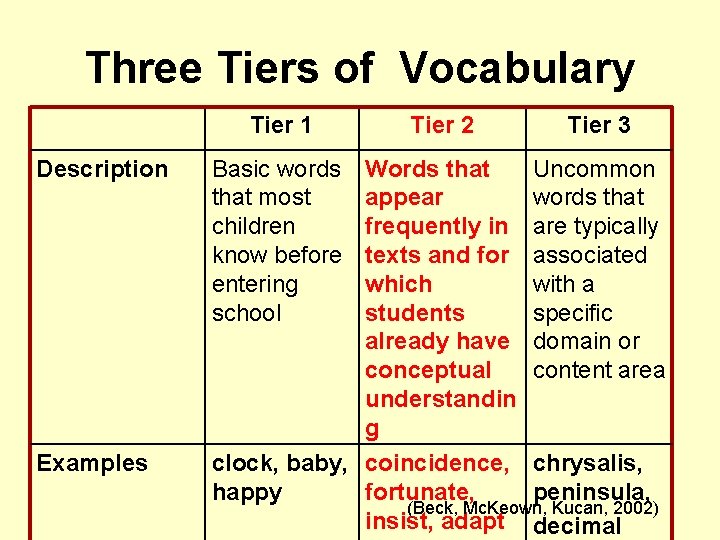
Three Tiers of Vocabulary Tier 1 Description Examples Basic words that most children know before entering school Tier 2 Tier 3 Words that Uncommon appear words that frequently in are typically texts and for associated which with a students specific already have domain or conceptual content area understandin g clock, baby, coincidence, chrysalis, happy fortunate, peninsula, (Beck, Mc. Keown, Kucan, 2002) insist, adapt decimal
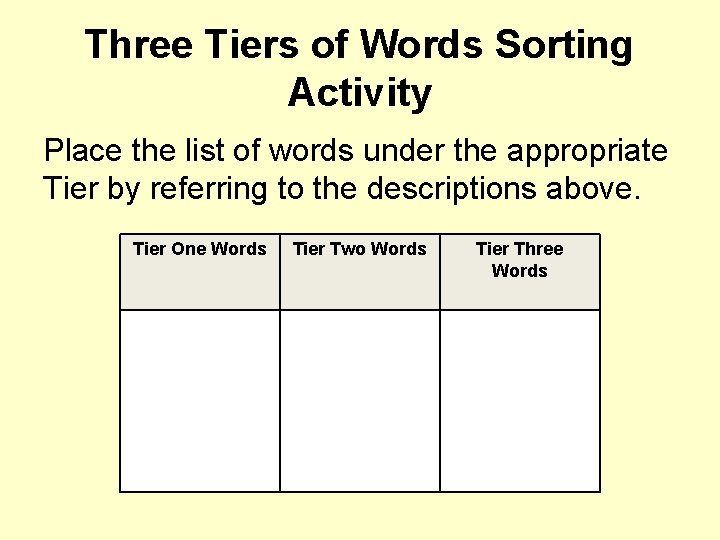
Three Tiers of Words Sorting Activity Place the list of words under the appropriate Tier by referring to the descriptions above. Tier One Words Tier Two Words Tier Three Words
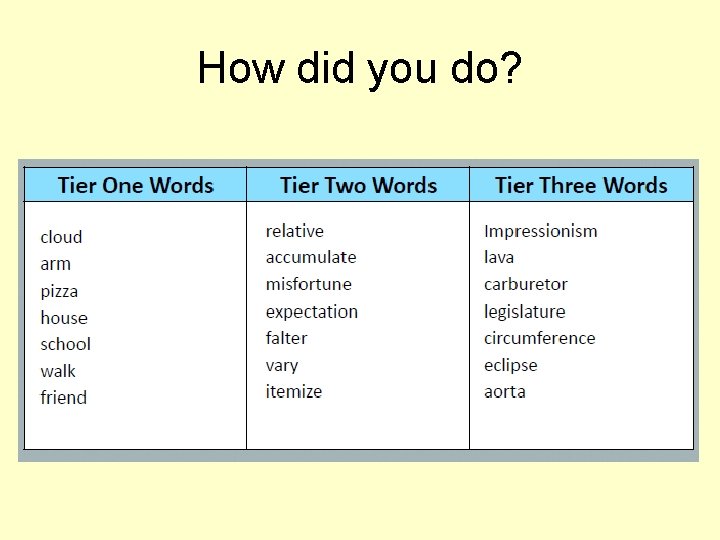
How did you do?
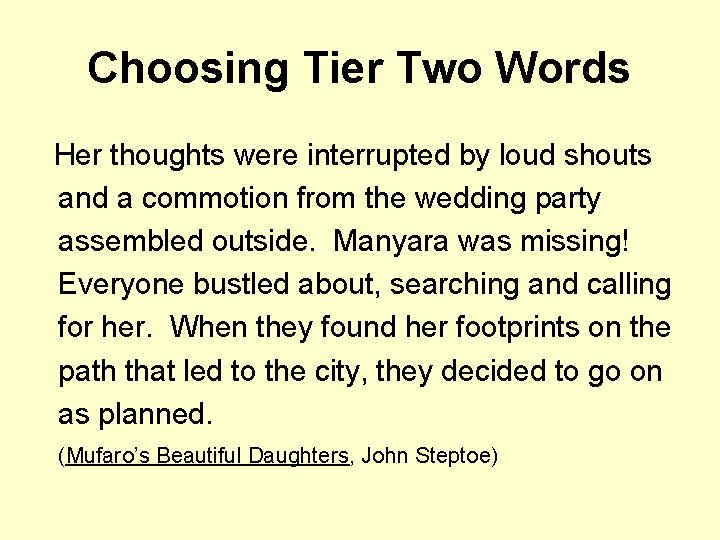
Choosing Tier Two Words Her thoughts were interrupted by loud shouts and a commotion from the wedding party assembled outside. Manyara was missing! Everyone bustled about, searching and calling for her. When they found her footprints on the path that led to the city, they decided to go on as planned. (Mufaro’s Beautiful Daughters, John Steptoe)
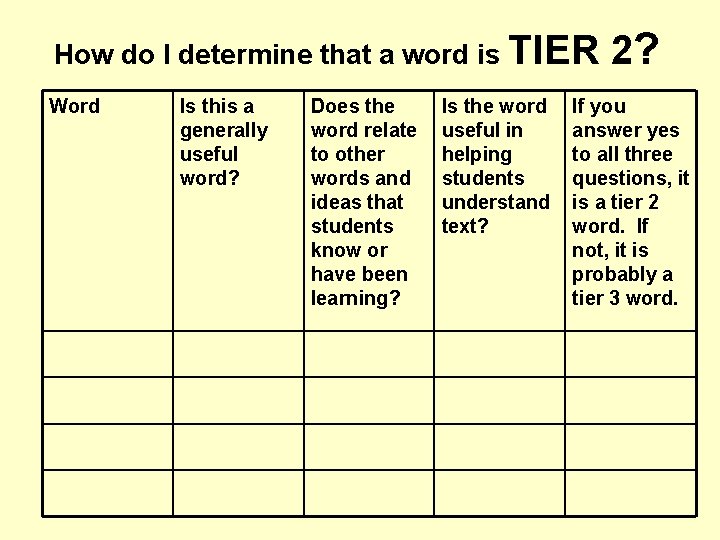
How do I determine that a word is TIER Word Is this a generally useful word? Does the word relate to other words and ideas that students know or have been learning? Is the word useful in helping students understand text? 2? If you answer yes to all three questions, it is a tier 2 word. If not, it is probably a tier 3 word.
Explicit Vocabulary Instruction Sources of Words Sources of words for vocabulary instruction – WORDS from read-aloud books – WORDS from core reading programs – WORDS from reading intervention programs – WORDS from content area instruction and texts • Math • Science • Social studies • Health • Art, PE, music, etc.
Explicit Vocabulary Instruction Selection of Words Select words that : • are likely unfamiliar • are critical to passage understanding. • students are likely to encounter in the future and are generally useful. • are Tier Two words (Academic Vocabulary) • are easily explained to children at their level (Beck & Mc. Keown, 2003) (Stahl, 1986)
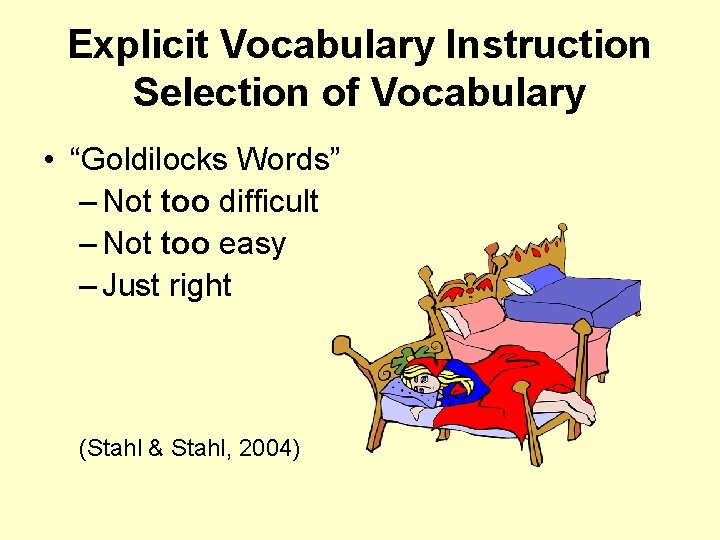
Explicit Vocabulary Instruction Selection of Vocabulary • “Goldilocks Words” – Not too difficult – Not too easy – Just right (Stahl & Stahl, 2004)
Your Turn Selecting Tier 2 Words • At your table, choose one of the texts I have provided. • Identify (4 )Tier 2 words you would teach your students. • Use the selection criteria page to help guide you through this process.
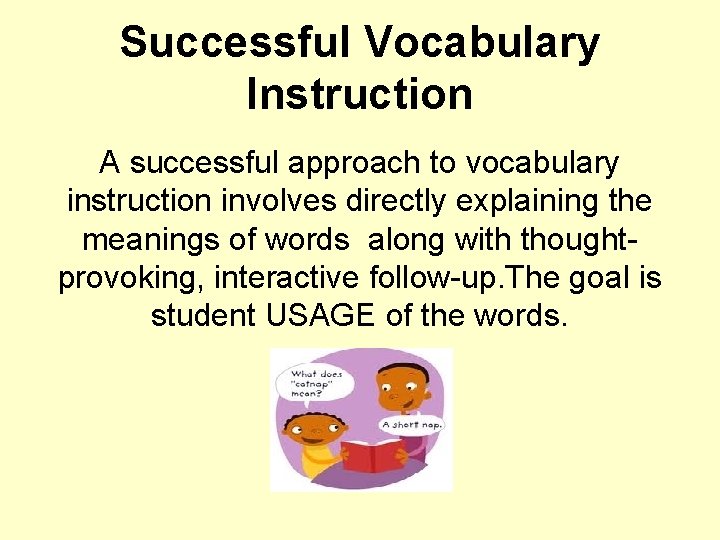
Successful Vocabulary Instruction A successful approach to vocabulary instruction involves directly explaining the meanings of words along with thoughtprovoking, interactive follow-up. The goal is student USAGE of the words.

What Strategies Would You Use to Teach Your Selected Words? Seven Steps is a place to start
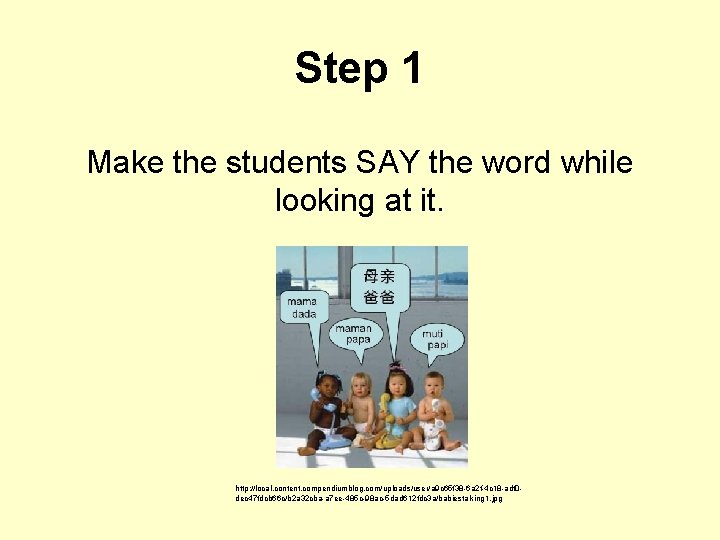
Step 1 Make the students SAY the word while looking at it. http: //local. content. compendiumblog. com/uploads/user/a 9 c 65 f 38 -6 a 2 f-4 c 18 -adf 0 dec 47 fdcb 66 c/b 2 a 32 cba-a 7 ee-485 c-98 ac-5 dad 612 fdc 3 a/babiestalking 1. jpg
Step 2 Use the word in the context from your lesson. • If it’s a read-aloud, read the sentence. • If it’s a reading passage you’ll be working with, highlight that sentence. • If it’s directions on a worksheet, pull out that sentence.
Step 3 Provide a dictionary definition. Pros & Cons
Step 4 Student-Friendly Definitions Providing student-friendly definitions—ones that are accurate and that students will understand —is no mean task. Below is a definition of dazzling from the dictionary and a studentfriendly definition. Beck, Mc. Keown, and Kucan (2003). “bright enough to deprive someone of sight temporarily” “If something is dazzling, that means that it’s so bright that you can hardly look at it. ”
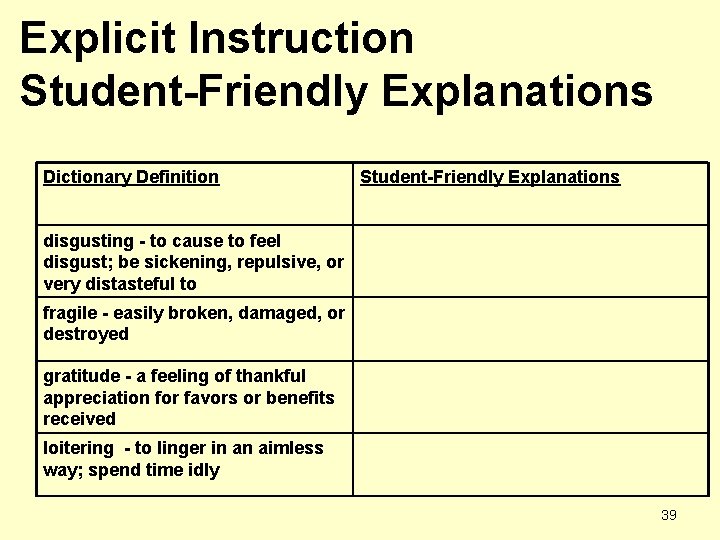
Explicit Instruction Student-Friendly Explanations Dictionary Definition Student-Friendly Explanations disgusting - to cause to feel disgust; be sickening, repulsive, or very distasteful to fragile - easily broken, damaged, or destroyed gratitude - a feeling of thankful appreciation for favors or benefits received loitering - to linger in an aimless way; spend time idly 39
Providing Student-Friendly Definitions TASK: • Partner into A and B • Each partner should choose one word from your earlier selection. • Then take turns providing a studentfriendly definition for your word. THIS TAKES PRACTICE and TIME
Step 5 Highlight something important about that word. • A great time to teach roots. • Spelling rule reminders • Parts of speech • Multiple meanings
Step 6 Give them a chance to USE THE WORD. (This is the fun part. )
Example: 1. Introduce the word. This word is survive. What word? 2. Present a student-friendly explanation. When people or animals don’t die when things are very bad or dangerous, they survive. 3. Illustrate the word with examples. Look at the people on this river. It is very dangerous. However, they don’t get hurt or die, they _____.
Example: 4. Check students’ understanding. (Examples and non-examples) Get ready to tell me if this group would survive. If the winter was very cold and all food was buried under the snow, would whooping cranes survive? ____ Ones, tell your partner why they wouldn’t survive? If whooping cranes had plenty of food and the weather was warm, would they survive? _____ Twos, tell your partner why they would survive? (Deep Processing Questions) If a rabbit was being chased by a coyote, what could the rabbit do to survive?
Applaud if they are being neighborly. • A student picks up a pencil that the person next to them dropped. • Letting your dog poop in someone else’s yard. • Calling the police when the people next door have a party. • Hosting a block party for your street. • Tripping your classmate when he walks to the teacher’s desk.
Making Vocabulary Active TPR- Total Physical Response • recognizes the value of language being associated with physical responses • grammar-based view of language that focuses on meaning, not form • evidence-based strategy for English Language Learners strong
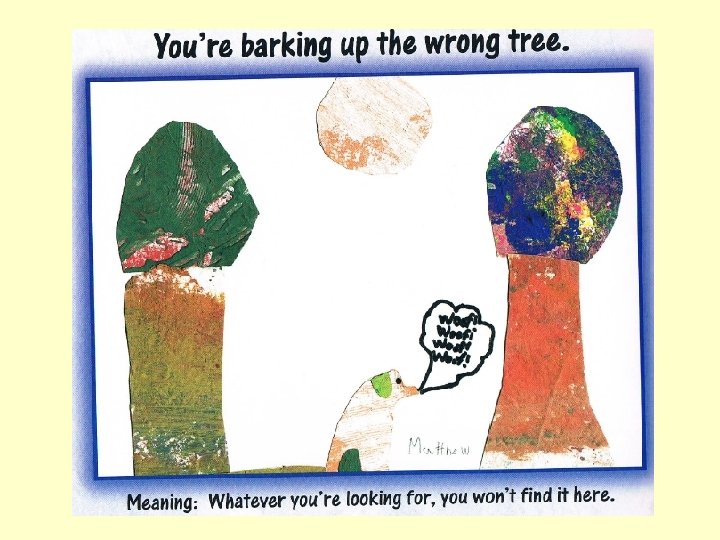
Literal and Nonliteral Meanings Artwork • Have students select a figurative speech phrase such as, “That person is ‘as smart as a whip’” and create a drawing that illustrates it. Label the phrase that accompanies it. • Provide a meaning of the nonliteral words
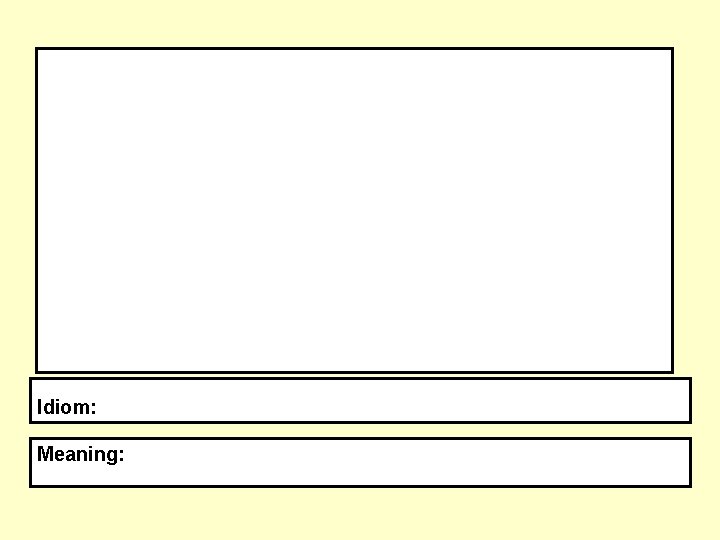
Idiom: Meaning:
Real-life Connections Between Words and Their Use Words are all around us. This standard encourages teachers to help students use language to describe his or her world.
Real-Life connections between words and their use. . Describe using… • words • phrases • sentences • and pictures.
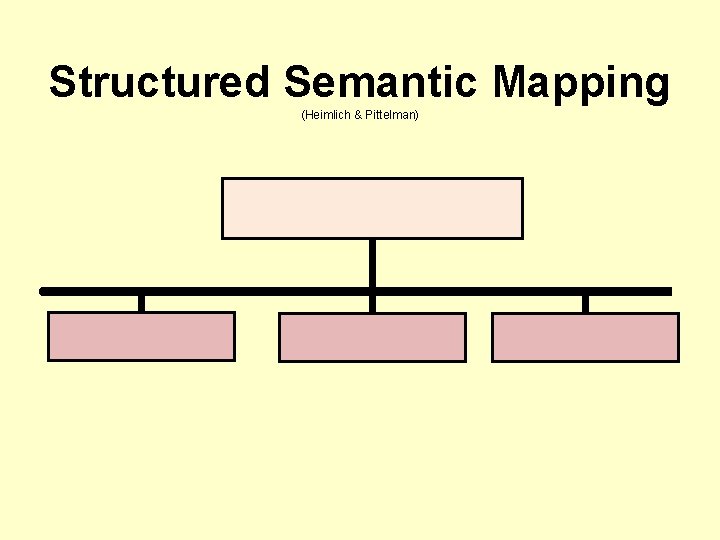
Structured Semantic Mapping (Heimlich & Pittelman)
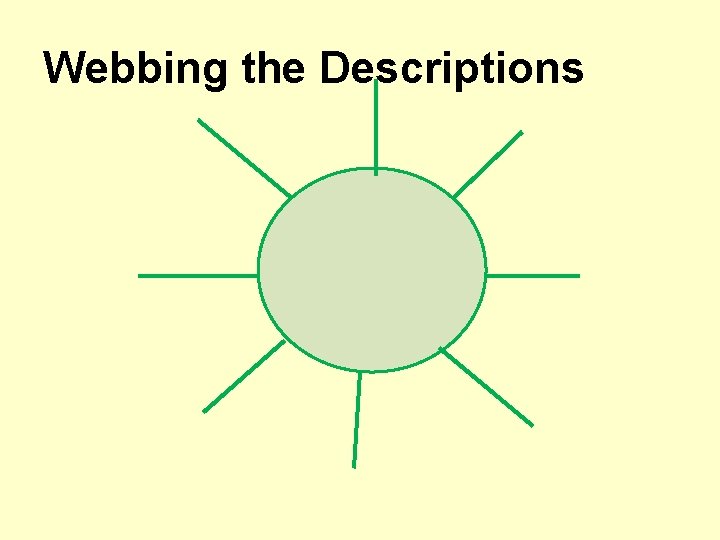
Webbing the Descriptions
Your Turn • Each table will be given a word with which to connect. • Use words, phrases, our sentences that relate to your word. • Tell why! • You may draw a picture to add to it.
Writing • Have students use their descriptions to compose a piece of writing. • The teacher may guide the student to narrow down their writing to one idea that was generated and described. • For example; “Write about one situation that could be very dangerous. Provide details and descriptions to illustrate why it would be dangerous. ”
Shades of Meaning Shades of meaning describe words that have slightly different meanings.
THE BIG IDEA • Shades of Meaning is a phrase used to describe the small, subtle differences in meaning between similar words or phrases. • For example, ‘mad’ and ‘angry’. Both refer to a feeling or showing of anger, but one seems to be more so than the other.
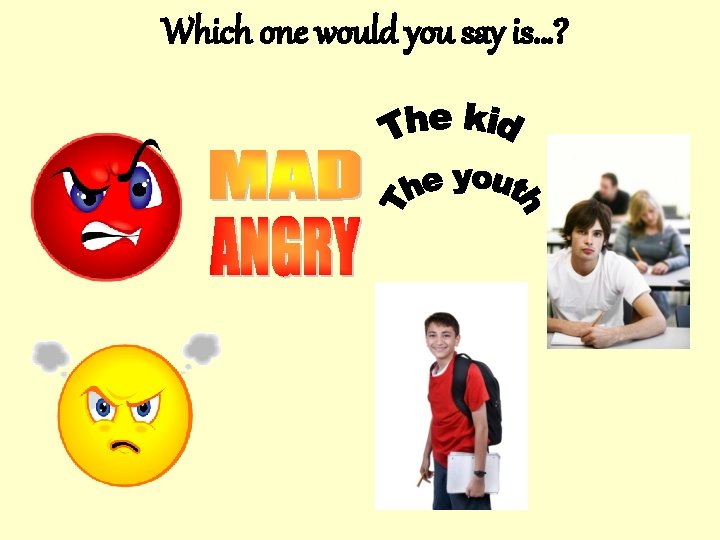
Which one would you say is…?
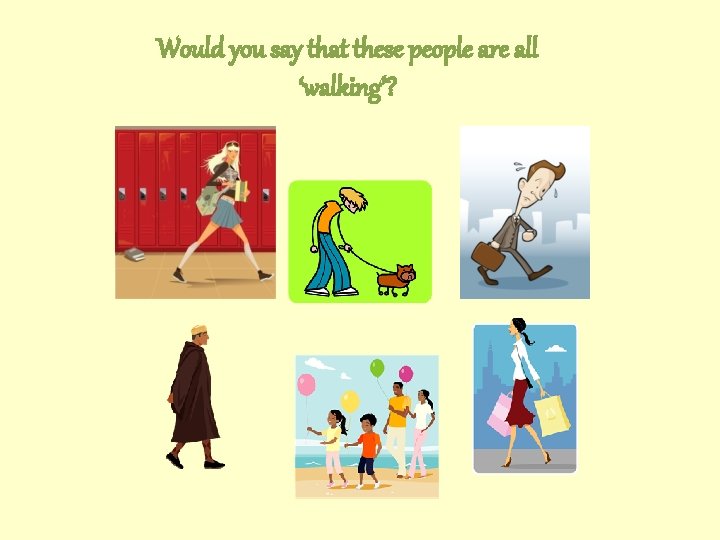
Would you say that these people are all ‘walking’?
Semantic Gradients 1. Select a pair of polar opposite words. 2. Generate at least five synonyms for each of the opposite words. 3. Arrange the words in a way that forms a continuum from one opposite word to the other. Continuums can be done horizontal or vertical, in a ladder-like fashion. 4. Have students discuss their rationale for placing certain words in certain locations. Encourage a conversation about the subtle differences among the words.
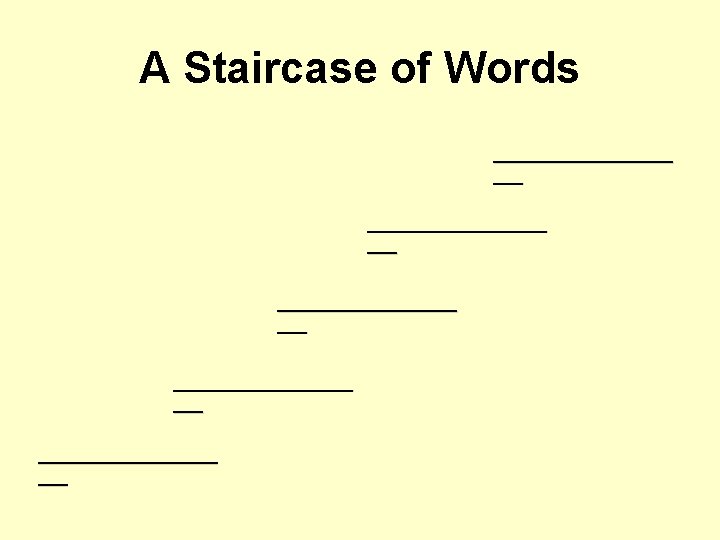
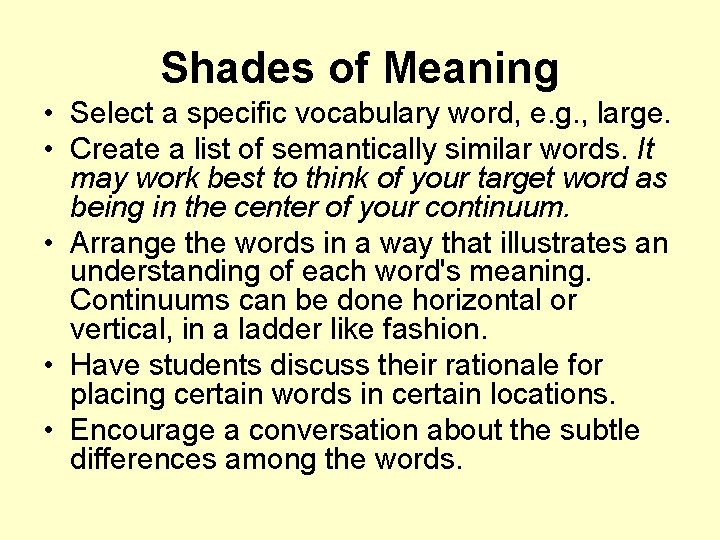
Shades of Meaning • Select a specific vocabulary word, e. g. , large. • Create a list of semantically similar words. It may work best to think of your target word as being in the center of your continuum. • Arrange the words in a way that illustrates an understanding of each word's meaning. Continuums can be done horizontal or vertical, in a ladder like fashion. • Have students discuss their rationale for placing certain words in certain locations. • Encourage a conversation about the subtle differences among the words.
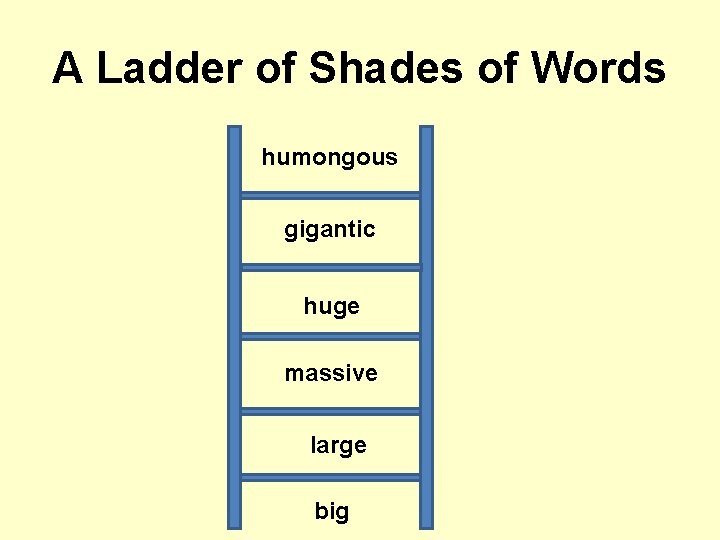
A Ladder of Shades of Words humongous gigantic huge massive large big
A Ladder of Shades of Words
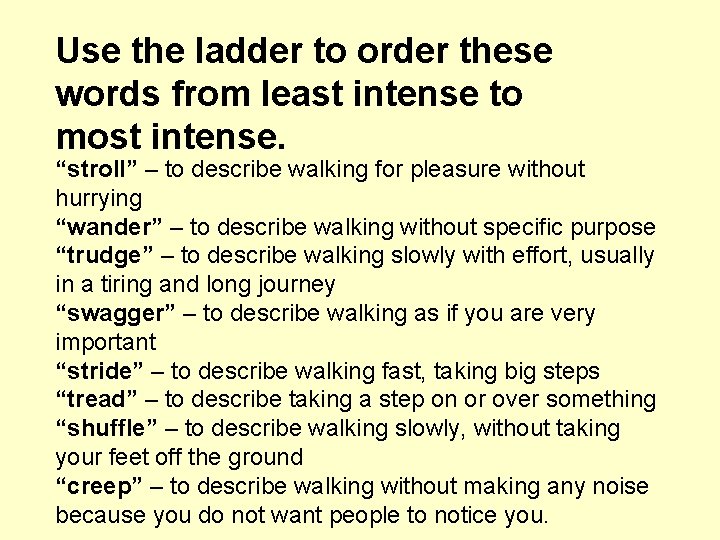
Use the ladder to order these words from least intense to most intense. “stroll” – to describe walking for pleasure without hurrying “wander” – to describe walking without specific purpose “trudge” – to describe walking slowly with effort, usually in a tiring and long journey “swagger” – to describe walking as if you are very important “stride” – to describe walking fast, taking big steps “tread” – to describe taking a step on or over something “shuffle” – to describe walking slowly, without taking your feet off the ground “creep” – to describe walking without making any noise because you do not want people to notice you.
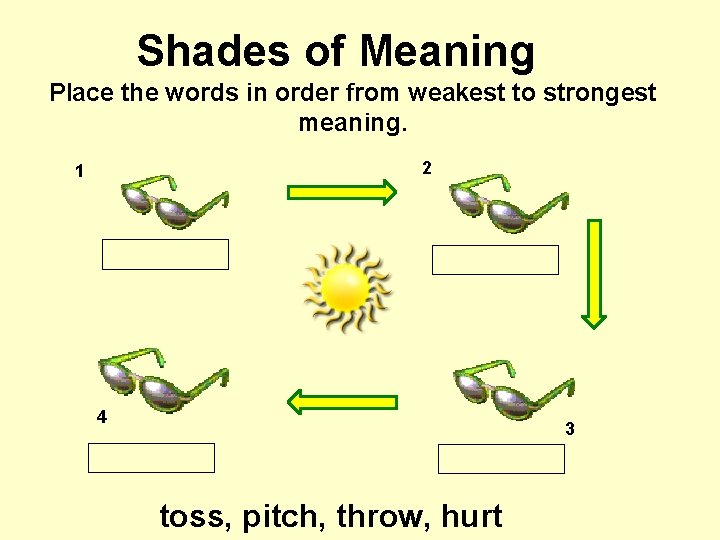
Shades of Meaning Place the words in order from weakest to strongest meaning. 2 1 4 3 toss, pitch, throw, hurt
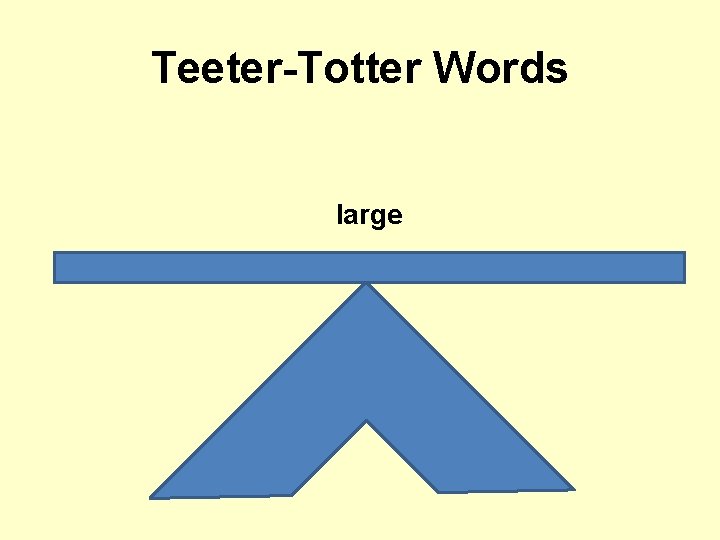
Teeter-Totter Words large
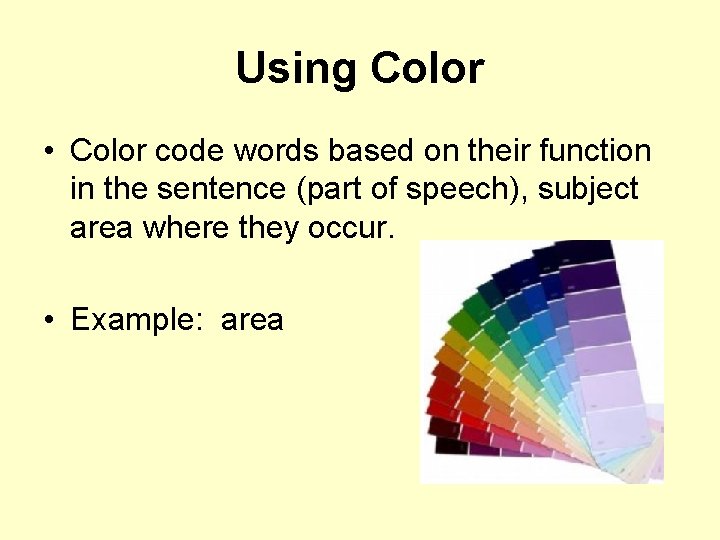
Using Color • Color code words based on their function in the sentence (part of speech), subject area where they occur. • Example: area
Spatial and Temporal Relationships Spatial words and phrases • Where = Location Temporal words and phrases • When = Time
Spatial and Temporal Relationships • • Anchor Charts Sentence Builders Mentor Text Writer’s Notebook
Looking Deeper at Tier Two Words Using the Tier 2 Word List…. • Read the list of words. • Underline or highlight any words you may need to teach your students this year. This is only a sample list of Tier Two words your students may need to learn. There are many others you can select.
3 -2 -1 List 3 Things You Learned: List 2 Things You Will Try: List 1 Question You Have:
- Slides: 72