
Identifying and Supporting Students with Interrupted Formal Education


- Slides: 24
Identifying and Supporting Students with Interrupted Formal Education (SIFEs) Alice Garcia EL Program Coordinator
Objectives Review the criteria to identify a Student with Interrupted Formal Education (SIFE) to gain a better understanding of who these students are. Identify ways to support a Student with Interrupted Formal Education (SIFE). 3
Identifying a Student with Interrupted Formal Education (SIFE)
When should a student be identified as a Student with Interrupted Formal Education (SIFE)? A SIFE is a Student with Interrupted Formal Education. These students: • have been identified as an English Learner (EL); • are age 13 or older, • have two or more years of interrupted education in their native country; and • are two or more grade levels behind in reading and mathematics (when able to assess in their native language). For more SIFE Guidance see the SIFE One-Pager 5
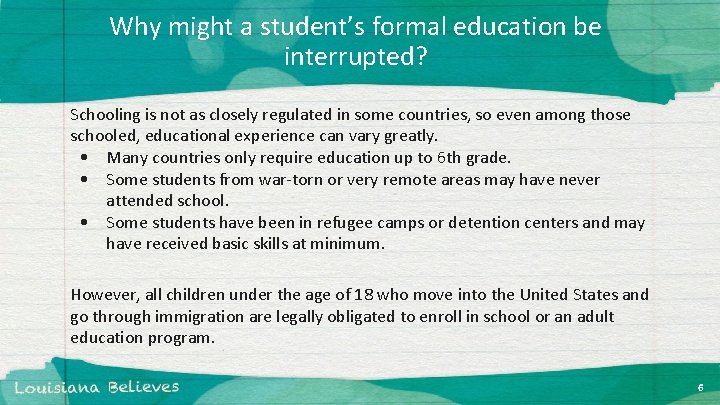
Why might a student’s formal education be interrupted? Schooling is not as closely regulated in some countries, so even among those schooled, educational experience can vary greatly. • Many countries only require education up to 6 th grade. • Some students from war-torn or very remote areas may have never attended school. • Some students have been in refugee camps or detention centers and may have received basic skills at minimum. However, all children under the age of 18 who move into the United States and go through immigration are legally obligated to enroll in school or an adult education program. 6
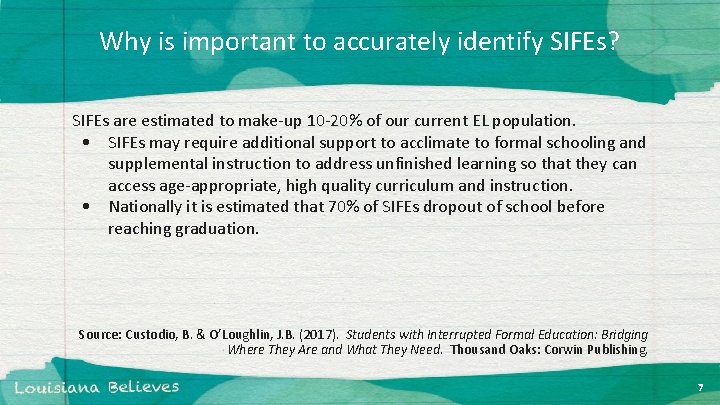
Why is important to accurately identify SIFEs? SIFEs are estimated to make-up 10 -20% of our current EL population. • SIFEs may require additional support to acclimate to formal schooling and supplemental instruction to address unfinished learning so that they can access age-appropriate, high quality curriculum and instruction. • Nationally it is estimated that 70% of SIFEs dropout of school before reaching graduation. Source: Custodio, B. & O’Loughlin, J. B. (2017). Students with Interrupted Formal Education: Bridging Where They Are and What They Need. Thousand Oaks: Corwin Publishing. 7
Poll the Room Based on these identifiers do you have or have you had SIFEs enroll in your school settings? (Yes/No) 8
Supporting SIFEs: Common Obstacles
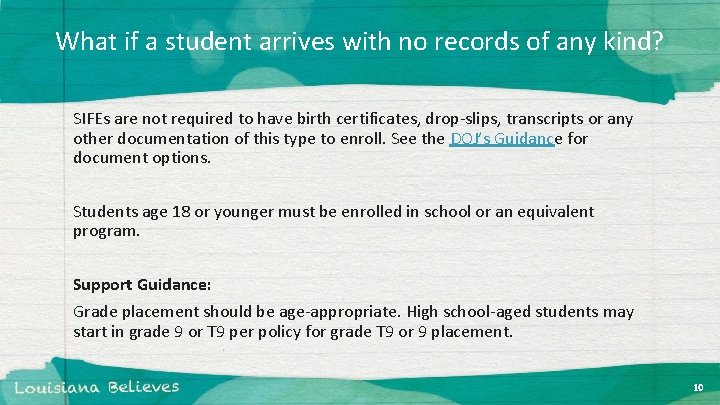
What if a student arrives with no records of any kind? SIFEs are not required to have birth certificates, drop-slips, transcripts or any other documentation of this type to enroll. See the DOJ’s Guidance for document options. Students age 18 or younger must be enrolled in school or an equivalent program. Support Guidance: Grade placement should be age-appropriate. High school-aged students may start in grade 9 or T 9 per policy for grade T 9 or 9 placement. 10
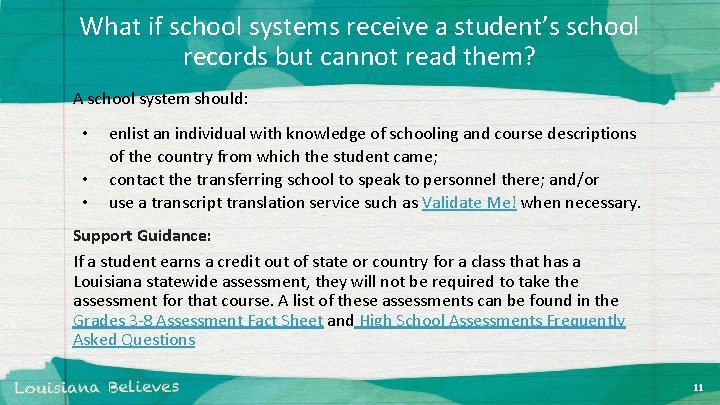
What if school systems receive a student’s school records but cannot read them? A school system should: • • • enlist an individual with knowledge of schooling and course descriptions of the country from which the student came; contact the transferring school to speak to personnel there; and/or use a transcript translation service such as Validate Me! when necessary. Support Guidance: If a student earns a credit out of state or country for a class that has a Louisiana statewide assessment, they will not be required to take the assessment for that course. A list of these assessments can be found in the Grades 3 -8 Assessment Fact Sheet and High School Assessments Frequently Asked Questions 11
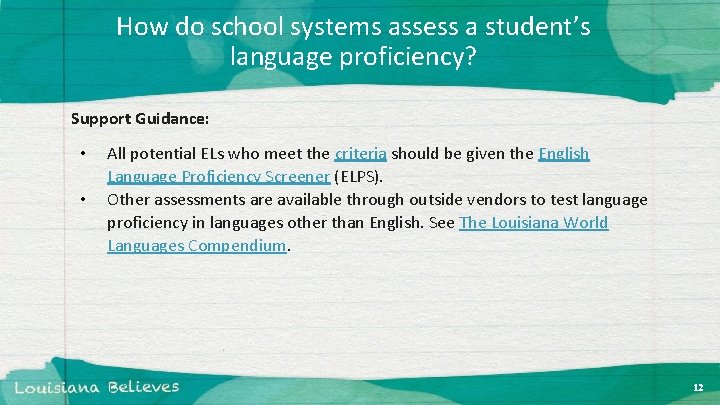
How do school systems assess a student’s language proficiency? Support Guidance: • • All potential ELs who meet the criteria should be given the English Language Proficiency Screener (ELPS). Other assessments are available through outside vendors to test language proficiency in languages other than English. See The Louisiana World Languages Compendium. 12
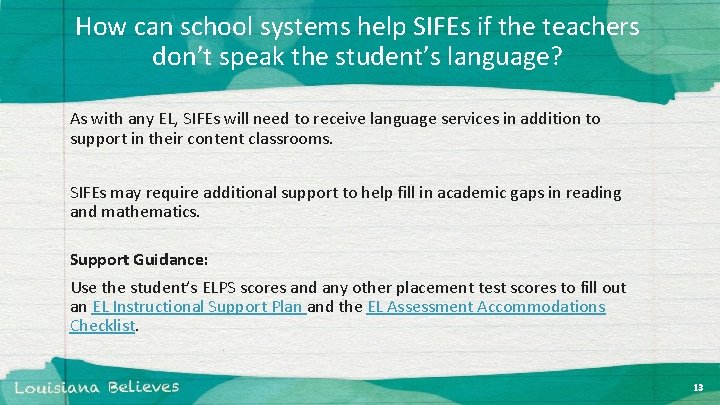
How can school systems help SIFEs if the teachers don’t speak the student’s language? As with any EL, SIFEs will need to receive language services in addition to support in their content classrooms. SIFEs may require additional support to help fill in academic gaps in reading and mathematics. Support Guidance: Use the student’s ELPS scores and any other placement test scores to fill out an EL Instructional Support Plan and the EL Assessment Accommodations Checklist. 13
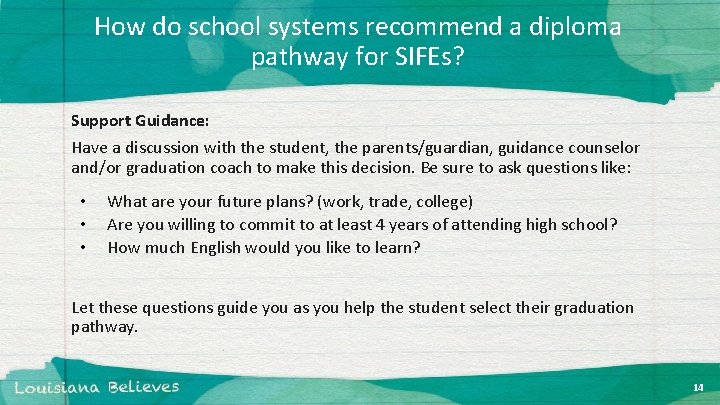
How do school systems recommend a diploma pathway for SIFEs? Support Guidance: Have a discussion with the student, the parents/guardian, guidance counselor and/or graduation coach to make this decision. Be sure to ask questions like: • • • What are your future plans? (work, trade, college) Are you willing to commit to at least 4 years of attending high school? How much English would you like to learn? Let these questions guide you as you help the student select their graduation pathway. 14
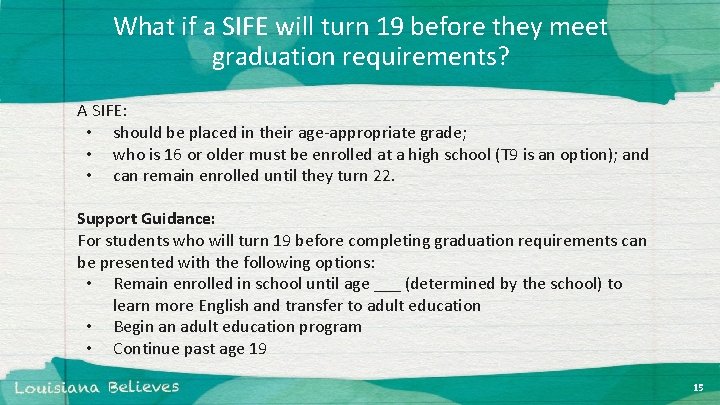
What if a SIFE will turn 19 before they meet graduation requirements? A SIFE: • should be placed in their age-appropriate grade; • who is 16 or older must be enrolled at a high school (T 9 is an option); and • can remain enrolled until they turn 22. Support Guidance: For students who will turn 19 before completing graduation requirements can be presented with the following options: • Remain enrolled in school until age ___ (determined by the school) to learn more English and transfer to adult education • Begin an adult education program • Continue past age 19 15
Example Student Breakouts
Student Examples You will be reading some student examples in your breakout rooms. While you read, think about how to support each of these students as they acquire English and learn the content. Student Example 1: Ricardo Student Example 2: Fahd Student Example 3: David As a team, discuss what types of academic and language supports each student will need to be successful in school. 17
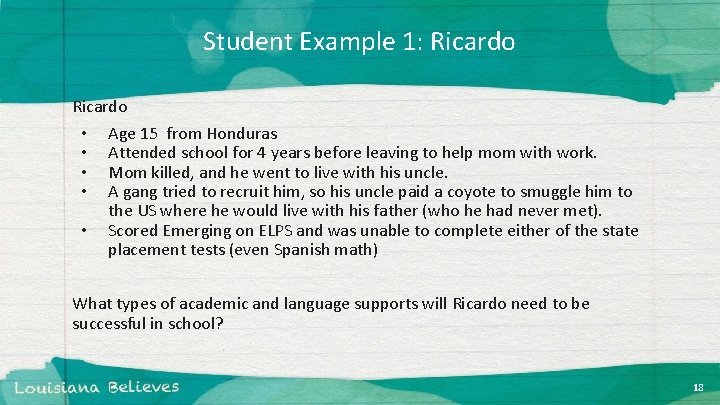
Student Example 1: Ricardo • Age 15 from Honduras • Attended school for 4 years before leaving to help mom with work. • Mom killed, and he went to live with his uncle. • A gang tried to recruit him, so his uncle paid a coyote to smuggle him to the US where he would live with his father (who he had never met). • Scored Emerging on ELPS and was unable to complete either of the state placement tests (even Spanish math) What types of academic and language supports will Ricardo need to be successful in school? 18
Student Example 2: Fahd • Age 16* from Iraq • Moved here with his parents and 10 siblings from an area of Baghdad. • Says he had attended school, but has no records. Since he is a refugee claiming political asylum, we cannot contact anyone in Iraq to verify. • Scored Emerging on ELPS, but is comfortable with technology. • Will be the first Muslim student at this high school. What types of academic and language supports will Fahd need to be successful in school? 19
Student Example 3: David • Age 17 from Mexico • Has some school records, but they appear to only go up to 9 th grade, so he has not been in school for about 3 -4 years. • Scored Emerging on ELPS, but was able to do some of the Spanish math test and likes numbers. • He is eager to enter the workforce and says he doesn’t like school. What types of academic and language supports will David need to be successful in school? 20
Share Out • Were there any common supports your group included for each student? • Did any of these students need specialized supports? • What are the big takeaways from your team’s discussion? 21
Next Steps • Follow the procedures for identifying SIFEs and making program placement decisions. • Individualize instruction and placement decisions based on their specific needs-all SIFEs are not the same. • If your school system has a high number of SIFEs, consider adding a newcomer program, intensive English program, or ESL instruction that also incorporates literacy. See the EL Guidebook for more information. • Most importantly, make SIFEs feel welcomed and wanted! 22
Resources LDOE English Learner Website SIFE One-Pager USED Newcomer Toolkit How to Support ELL Students with Interrupted Formal Education Questions or Concerns? alice. garcia@la. gov 23
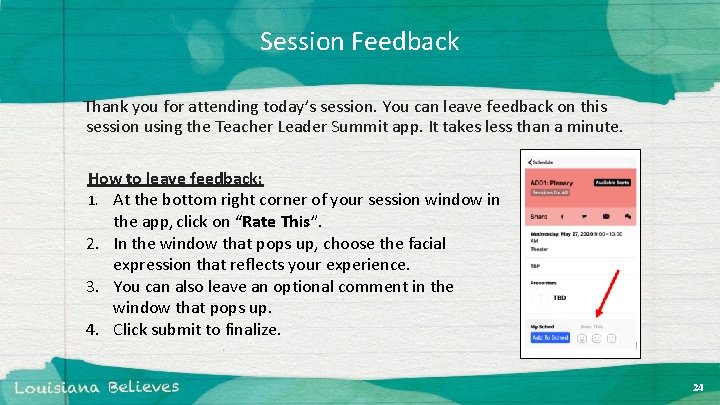
Session Feedback Thank you for attending today’s session. You can leave feedback on this session using the Teacher Leader Summit app. It takes less than a minute. How to leave feedback: 1. At the bottom right corner of your session window in the app, click on “Rate This”. 2. In the window that pops up, choose the facial expression that reflects your experience. 3. You can also leave an optional comment in the window that pops up. 4. Click submit to finalize. 24