
Identifying and Supporting Rigorous Writing in ALL Classrooms
- Slides: 40
Identifying and Supporting Rigorous Writing in ALL Classrooms Red Bluff Opt In Session April 27, 2017 © TNTP 2015
Agenda Page 1 Introduction The Connection between Reading and Learning Defining High Quality Writing Implementing A Strong Writing Task with ALL Students Putting It All Together Consultancy Protocol Individual and District Application Closing /2
Palate Cleanser Page 1 How has the ability to write eloquently and effectively impacted your own life and experience? How has it been valuable? How did you LEARN to write? /3
Essential Questions Page 2 • What is high quality, standards-aligned writing? • What are changes in practice (inputs) necessary to move towards high quality writing, and how do we implement them? • Where can we begin with system change, and how can we collaborate around this goal? /4
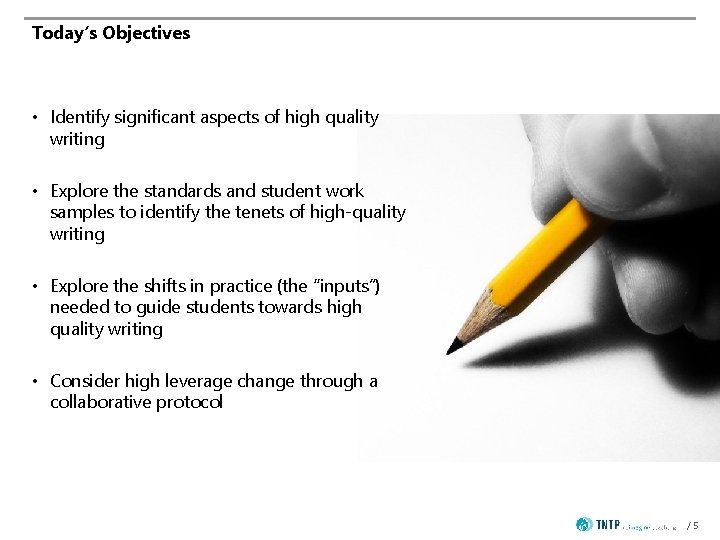
Today’s Objectives • Identify significant aspects of high quality writing • Explore the standards and student work samples to identify the tenets of high-quality writing • Explore the shifts in practice (the “inputs”) needed to guide students towards high quality writing • Consider high leverage change through a collaborative protocol /5
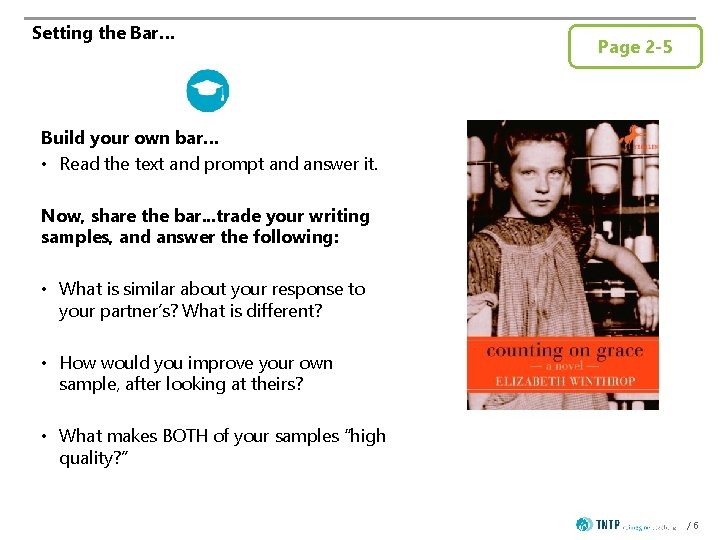
Setting the Bar… Page 2 -5 Build your own bar… • Read the text and prompt and answer it. Now, share the bar. . . trade your writing samples, and answer the following: • What is similar about your response to your partner’s? What is different? • How would you improve your own sample, after looking at theirs? • What makes BOTH of your samples “high quality? ” /6
Agenda Introduction The Connection between Writing and Learning Defining High Quality Writing Implementing A Strong Writing Task with ALL Students Putting It All Together Consultancy Protocol Individual and District Application Closing /7
Why is writing important? • What is the purpose of taking the time to write about what we have read – for example, what is the purpose of writing about the previous prompt? • Why do we want students to write well? /8
Writing is essential to mental processing, and to access. Page 8 • Writing allows us to process information, supports different learning styles, and activates different parts of our brain, including syntactical and wordbased learning. • Formal and informal writing is essential to diverse classrooms, providing access and processing time, as well as the best way to formatively and summatively assess progress. “Writing is how students connect the dots in their knowledge. ” National Writing Commission, 2003 /9
Students need to learn to use writing to accomplish wide communication styles and abilities. “…students need to learn to use writing as a way of offering and supporting opinions, demonstrating understanding of the subjects they are studying, and conveying real and imagined experiences and events. They learn to appreciate that a key purpose of writing is to communicate clearly to an external, sometimes unfamiliar audience, and they begin to adapt the form and content of their writing to accomplish a task and purpose. They develop the capacity to build knowledge on a subject through research projects and to respond analytically to literary and informational sources. To meet these goals, students must devote significant time and effort to writing, producing numerous pieces over short and extended time frames throughout the year. ” / 10
Agenda Introduction The Connection between Writing and Learning Defining High Quality Writing Implementing A Strong Writing Task with ALL Students Putting It All Together Consultancy Protocol Individual and District Application Closing / 11
Not all writing is created equal. What differentiates high quality classroom writing from ineffective writing? How can we attune teachers, and students, to the most important aspects of writing? / 12
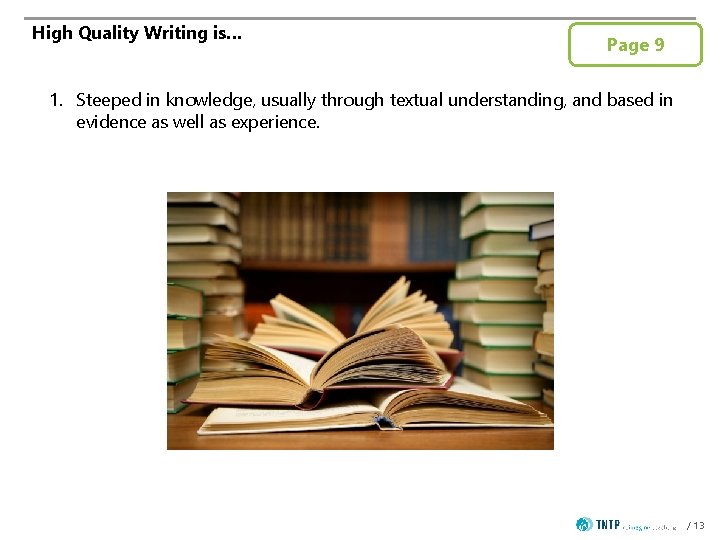
High Quality Writing is… Page 9 1. Steeped in knowledge, usually through textual understanding, and based in evidence as well as experience. / 13
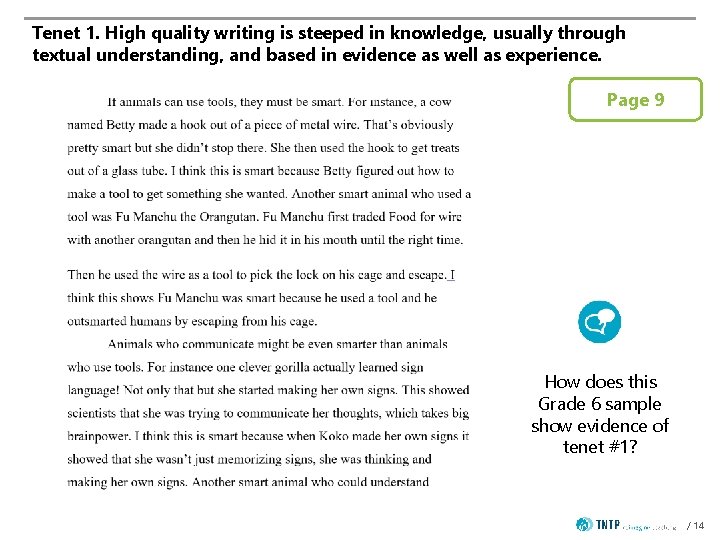
Tenet 1. High quality writing is steeped in knowledge, usually through textual understanding, and based in evidence as well as experience. Page 9 How does this Grade 6 sample show evidence of tenet #1? / 14
High Quality Writing is… Page 10 2. Written to a purpose and audience / 15
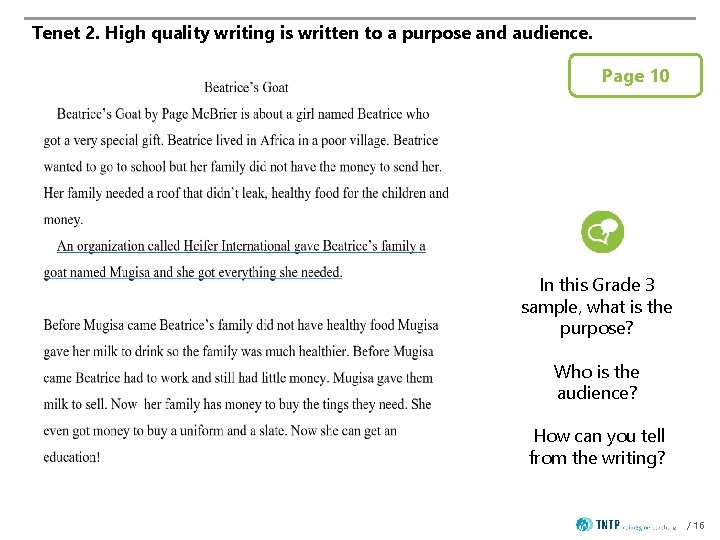
Tenet 2. High quality writing is written to a purpose and audience. Page 10 In this Grade 3 sample, what is the purpose? Who is the audience? How can you tell from the writing? / 16
High Quality Writing… Page 11 3. Appropriately aligned to the standards The standards call for • A balance of three types of writing • Research even in early grades • Writing to sources • Increased sophistication “Each year in their writing, students should demonstrate increasing sophistication in all aspects of language use, from vocabulary and syntax to the development and organization of ideas, and they should address increasingly demanding content and sources. ” – CCSS / 17
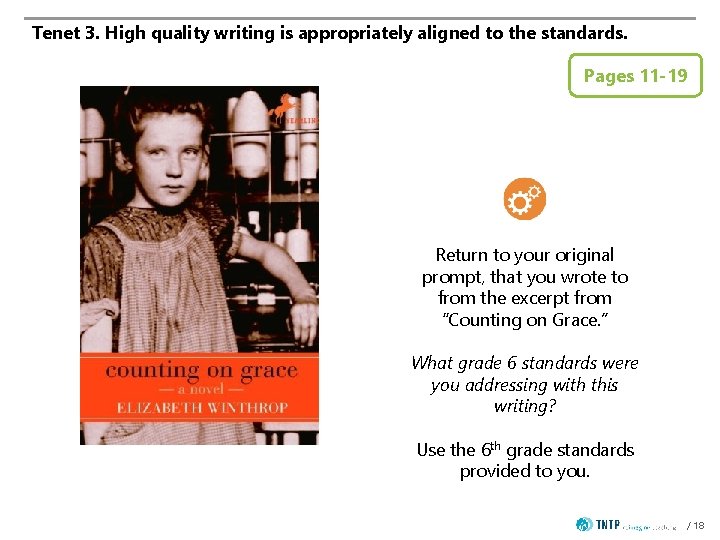
Tenet 3. High quality writing is appropriately aligned to the standards. Pages 11 -19 Return to your original prompt, that you wrote to from the excerpt from “Counting on Grace. ” What grade 6 standards were you addressing with this writing? Use the 6 th grade standards provided to you. / 18
High Quality Writing… Page 20 4. Reveals development on the part of the student / 19
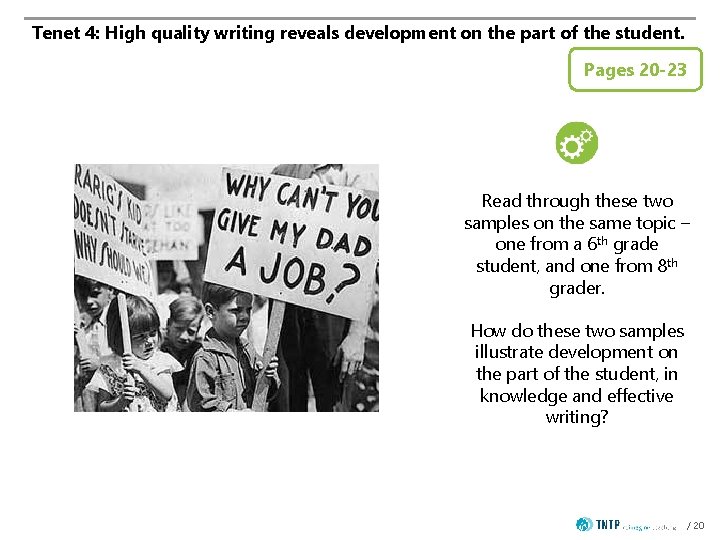
Tenet 4: High quality writing reveals development on the part of the student. Pages 20 -23 Read through these two samples on the same topic – one from a 6 th grade student, and one from 8 th grader. How do these two samples illustrate development on the part of the student, in knowledge and effective writing? / 20
High Quality Writing… Page 24 5. Strategically addresses language standards appropriate to the grade / 21
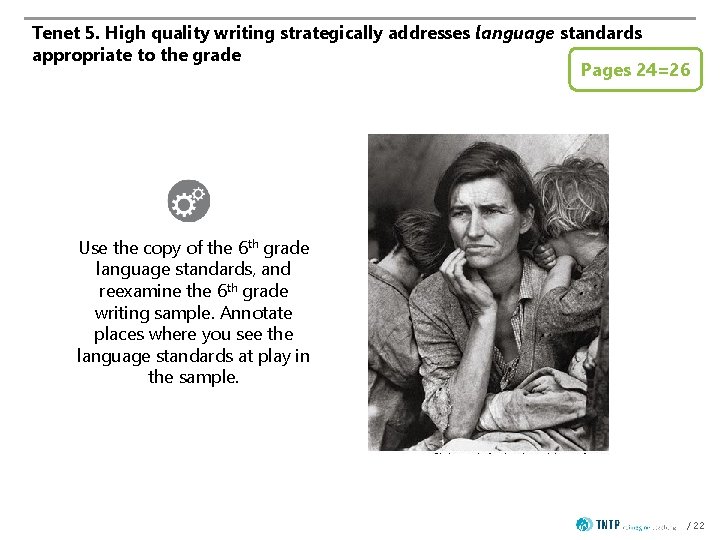
Tenet 5. High quality writing strategically addresses language standards appropriate to the grade Pages 24=26 Use the copy of the 6 th grade language standards, and reexamine the 6 th grade writing sample. Annotate places where you see the language standards at play in the sample. / 22
High Quality Writing… 1. Steeped in knowledge, usually through textual understanding, and based in evidence as well as experience 2. Written to a purpose and audience 3. Appropriately aligned to the standards § A balance of three types of writing § Research even in early grades § Writing to sources § Increased sophistication 4. Reveals development on the part of the student 5. Strategically address language standards appropriate to the grade High quality prompts have these same 5 tenets! / 23
Practice: Pages 27 -32 With a partner, select a sample - either narrative, expository, or argumentative writing. Read the sample, and answer the following: • What makes these writing samples high quality? • Which of the 5 tenets do you see in play in these samples? And how? • Don’t forget to use the standards for the grade! / 24
Reflect • What do you NOT see present here, that we often focus on when looking at student samples? • How does this lens strengthen our eye when looking at student writing? / 25
Agenda Introduction The Connection between Writing and Learning Defining High Quality Writing Implementing A Strong Writing Task with ALL Students Putting It All Together Consultancy Protocol Individual and District Application Closing / 26
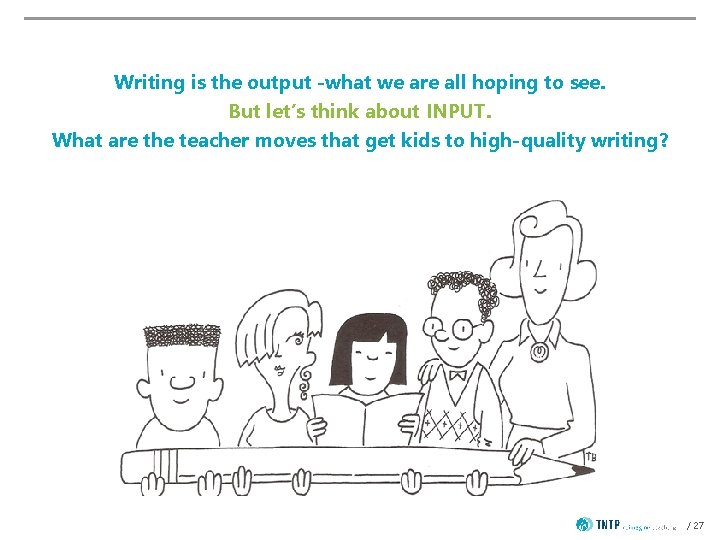
Writing is the output -what we are all hoping to see. But let’s think about INPUT. What are the teacher moves that get kids to high-quality writing? / 27
Practice: Pages 39 -46 • As Sara conducts a think aloud, identify how she thinks about the questions under each step for implementing high quality writing in this teacher’s planning template. / 28
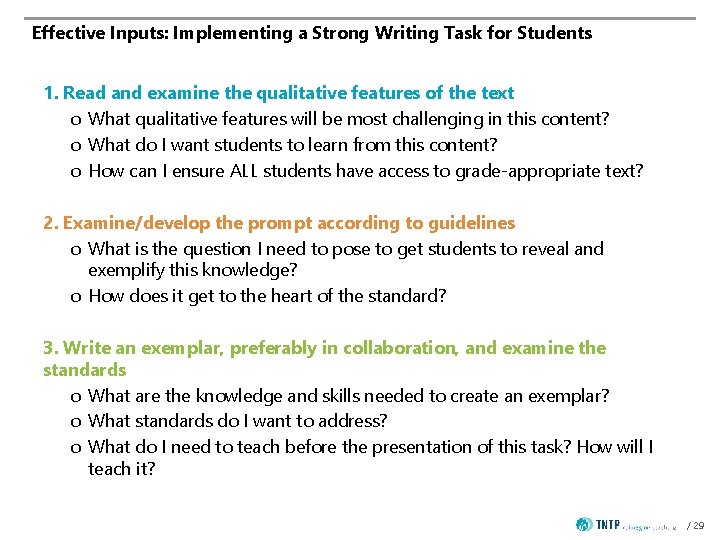
Effective Inputs: Implementing a Strong Writing Task for Students 1. Read and examine the qualitative features of the text o What qualitative features will be most challenging in this content? o What do I want students to learn from this content? o How can I ensure ALL students have access to grade-appropriate text? 2. Examine/develop the prompt according to guidelines o What is the question I need to pose to get students to reveal and exemplify this knowledge? o How does it get to the heart of the standard? 3. Write an exemplar, preferably in collaboration, and examine the standards o What are the knowledge and skills needed to create an exemplar? o What standards do I want to address? o What do I need to teach before the presentation of this task? How will I teach it? / 29
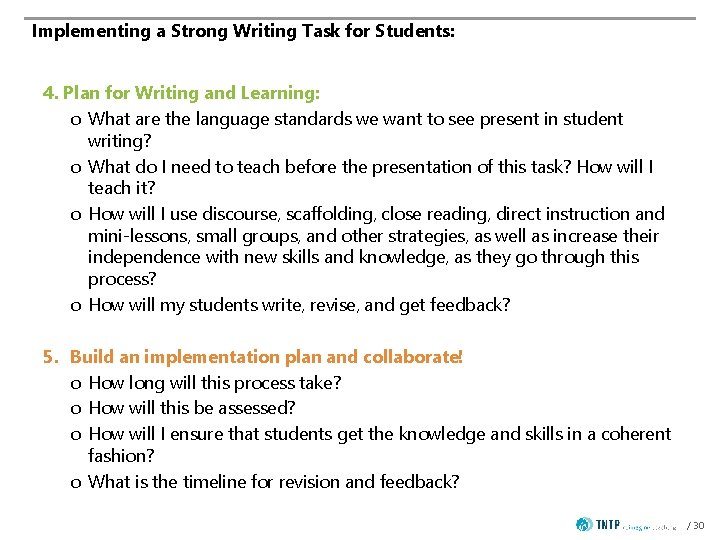
Implementing a Strong Writing Task for Students: 4. Plan for Writing and Learning: o What are the language standards we want to see present in student writing? o What do I need to teach before the presentation of this task? How will I teach it? o How will I use discourse, scaffolding, close reading, direct instruction and mini-lessons, small groups, and other strategies, as well as increase their independence with new skills and knowledge, as they go through this process? o How will my students write, revise, and get feedback? 5. Build an implementation plan and collaborate! o How long will this process take? o How will this be assessed? o How will I ensure that students get the knowledge and skills in a coherent fashion? o What is the timeline for revision and feedback? / 30
Agenda Introduction The Connection between Writing and Learning Defining High Quality Writing Implementing A Strong Writing Task with ALL Students Putting It All Together Consultancy Protocol Individual and District Application Closing / 31
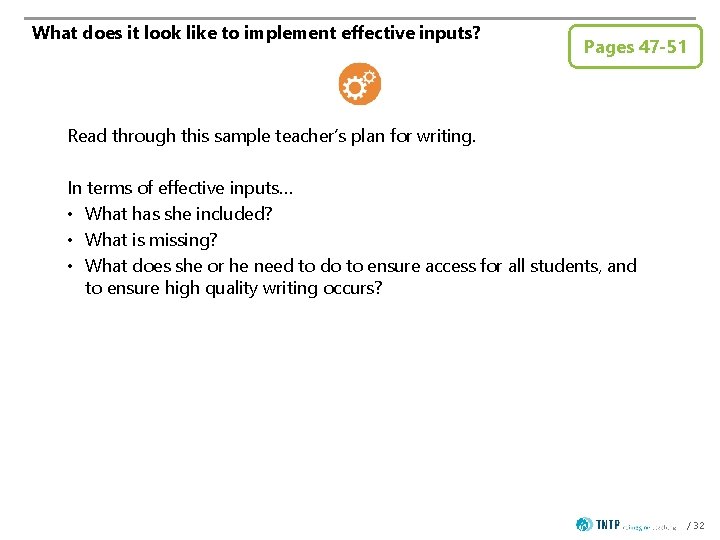
What does it look like to implement effective inputs? Pages 47 -51 Read through this sample teacher’s plan for writing. In terms of effective inputs… • What has she included? • What is missing? • What does she or he need to do to ensure access for all students, and to ensure high quality writing occurs? / 32
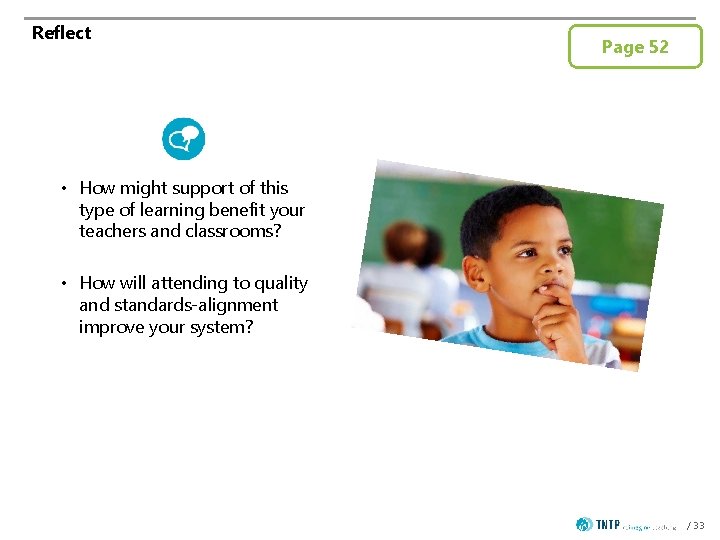
Reflect Page 52 • How might support of this type of learning benefit your teachers and classrooms? • How will attending to quality and standards-alignment improve your system? / 33
Agenda Introduction The Connection between Writing and Learning Defining High Quality Writing Implementing A Strong Writing Task with ALL Students Putting It All Together Collaborative Protocol Individual and District Application Closing / 34
Collaborative Discussion Protocol Page 53 http: //bit. ly/2 o. Yaj. Zf Discuss the guiding questions for 5 -7 minutes each. Ensure all members of the group have an opportunity to talk. Take notes on each question in your googledoc. q What structures are currently in place to support teachers in identifying and supporting students in producing high quality writing? q What structures are you planning to implement this year to support high quality writing in all classrooms? q Where do you currently see gaps in developing this capacity throughout your district? How can the community support your efforts? / 35
Agenda Introduction The Connection between Writing and Learning Defining High Quality Writing Implementing A Strong Writing Task with ALL Students Putting It All Together Consultancy Protocol Individual and District Application Closing / 36
Individual and District Application Use the googledoc to capture your thinking around each of the following categories: o Learnings: What information or ideas do you want to take back to your district? o Commitments: What actions do you or your team want to take? o Alignment: How are your commitments aligned to your CALLI objectives? o Accountability: What supports will you need to take your actions? http: //bit. ly/2 o. Ei. V 4 C / 37
Agenda Introduction The Connection between Writing and Learning Defining High Quality Writing Implementing A Strong Writing Task with ALL Students Putting It All Together Consultancy Protocol Individual and District Application Closing / 38
Wrapping it up! May 8 th – Virtual Call: Placer’s Tools to Identify and Measure Structured Collaborative Discussions Virtual Call May 17 th – Site Visit: Using PLCs and Video to Build Teacher’s Capacity in the Five Skills Which Focus and Deepen Academic Conversations in Santa Paula Unified May 30 th – Virtual Call: Cultivating Academic Discourse through Azusa’s Teacher Prototype June 20 th – Summer Summit (all team members) June 21 st – Summer Summit (leads) / 39
Connect with us. Kaycee. Eckhardt@tntp. org Sara. Bokhari@tntp. org facebook. com/thenewteacherproject twitter. com/tntp linkedin. com/company/tntp / 40