
Identifying and Eliminating the 7 Wastes T I

- Slides: 2
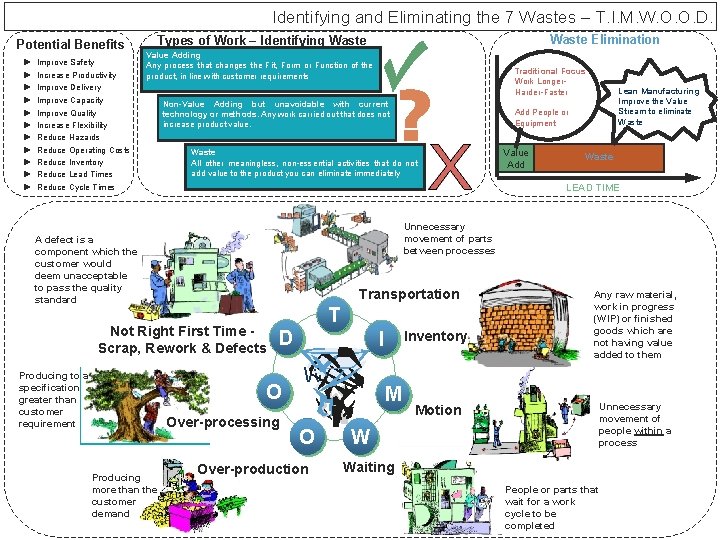
Identifying and Eliminating the 7 Wastes – T. I. M. W. O. O. D. Potential Benefits ► ► ► Improve Safety Increase Productivity Improve Delivery Waste Elimination Types of Work – Identifying Waste Value Adding Any process that changes the Fit, Form or Function of the product, in line with customer requirements Improve Capacity Improve Quality Increase Flexibility Reduce Hazards Reduce Operating Costs Reduce Inventory Reduce Lead Times Reduce Cycle Times Non-Value Adding but unavoidable with current technology or methods. Any work carried out that does not increase product value. Value Add Waste LEAD TIME Unnecessary movement of parts between processes Transportation Not Right First Time Scrap, Rework & Defects Any raw material, work in progress (WIP) or finished goods which are not having value added to them T D O Over-processing Producing more than the customer demand Lean Manufacturing Improve the Value Stream to eliminate Waste Add People or Equipment Waste All other meaningless, non-essential activities that do not add value to the product you can eliminate immediately A defect is a component which the customer would deem unacceptable to pass the quality standard Producing to a specification greater than customer requirement Traditional Focus Work Longer. Harder-Faster I WAST E O Over-production Inventory M Unnecessary movement of people within a process Motion W Waiting People or parts that wait for a work cycle to be completed © S A Partners 17 October 2021
© S A Partners 17 October 2021