
Identifying and developing sporting talent What do we



- Slides: 40
Identifying and developing sporting talent: What do we know and why should we care? Dr. Joe Baker Lifespan Health and Performance Laboratory York University
‘Talent’ is the most important concept in high performance sport today.
Francis Galton A man must inherit good health, a love of mental work, a strong purpose and considerable ambition, in order to achieve successes of the high order of which we are speaking. The deficiency of any one of these qualities would certainly be injurious, and probably be fatal to his chance of obtaining great distinction.
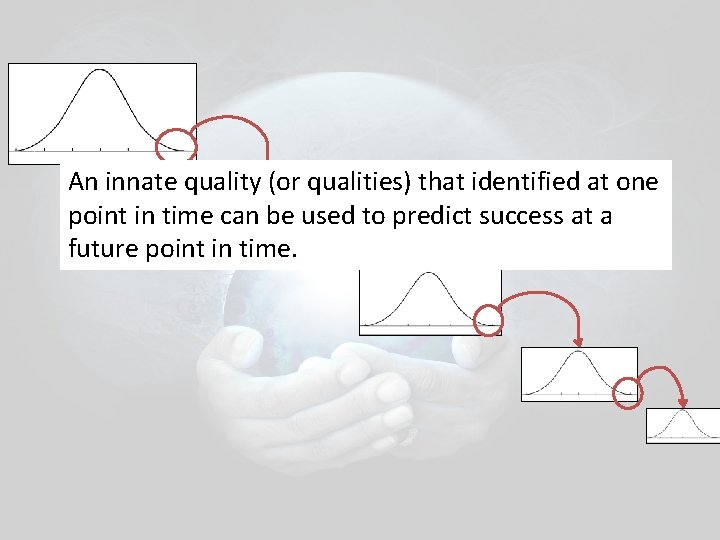
An innate quality (or qualities) that identified at one point in time can be used to predict success at a future point in time.
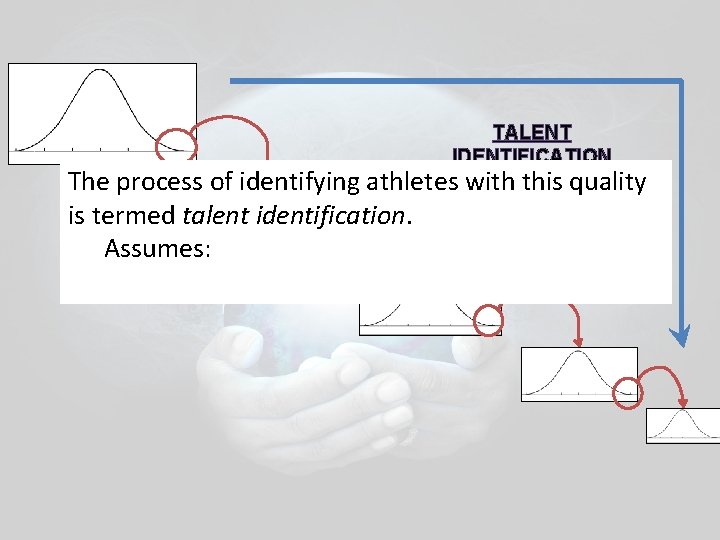
TALENT IDENTIFICATION The process of identifying athletes with this quality is termed talent identification. Assumes:
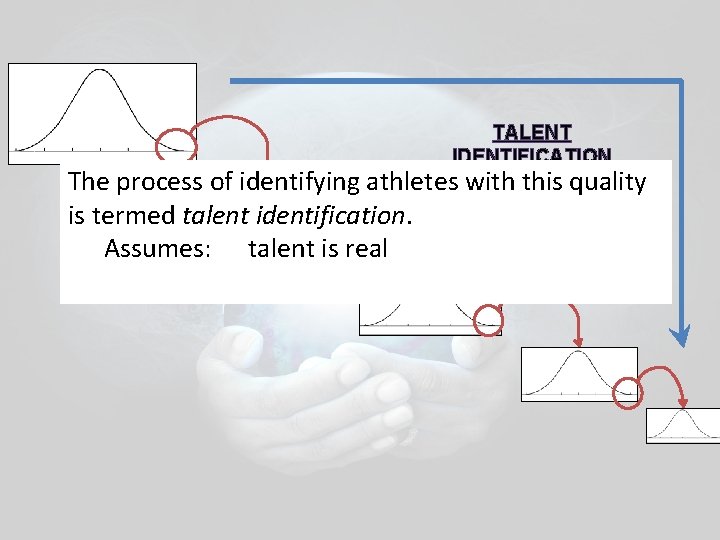
TALENT IDENTIFICATION The process of identifying athletes with this quality is termed talent identification. Assumes: talent is real
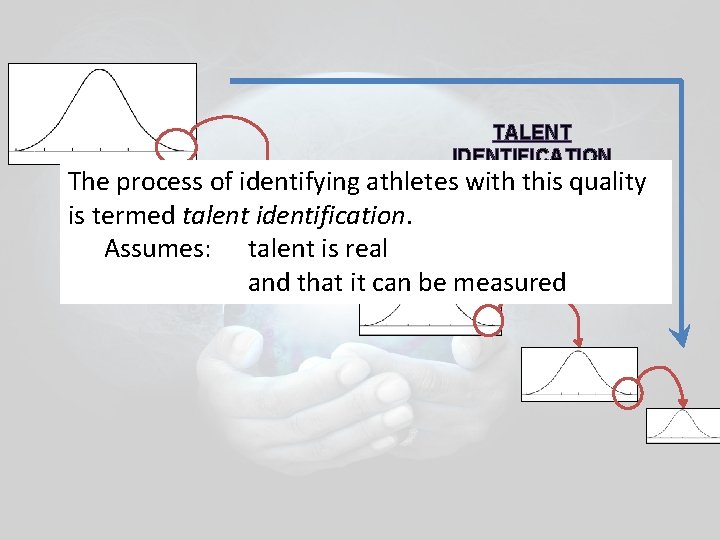
TALENT IDENTIFICATION The process of identifying athletes with this quality is termed talent identification. Assumes: talent is real and that it can be measured
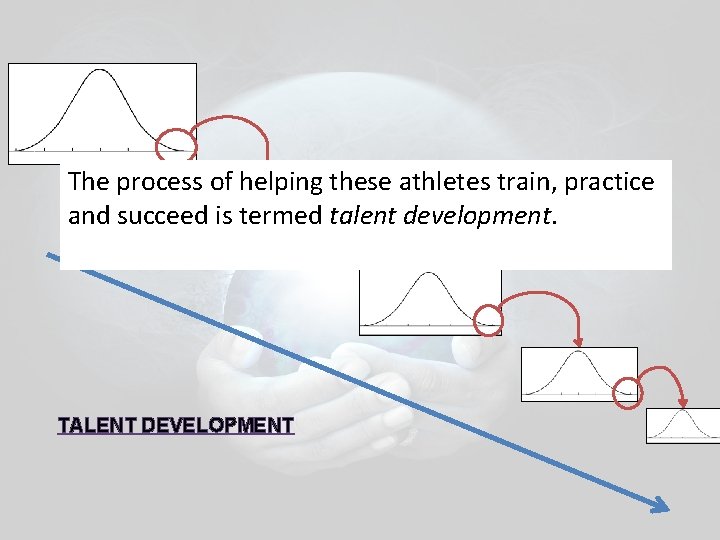
The process of helping these athletes train, practice and succeed is termed talent development. TALENT DEVELOPMENT
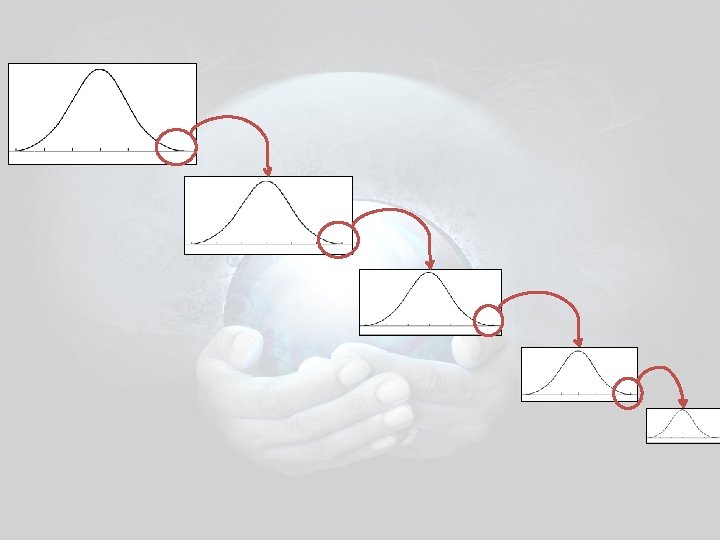
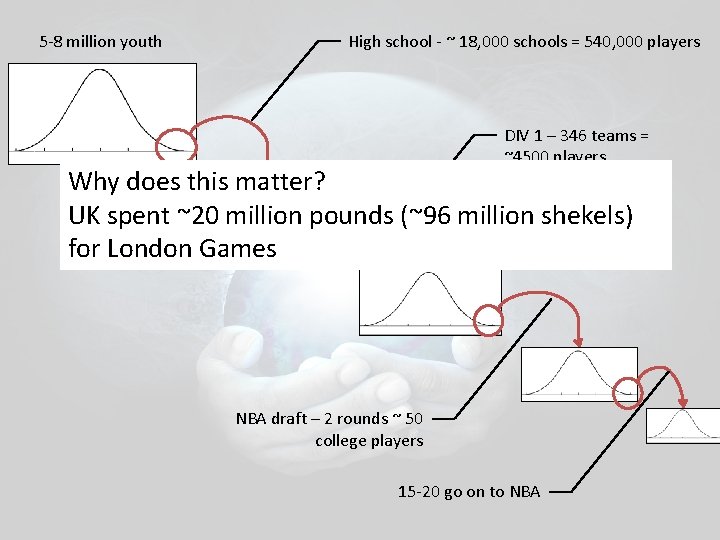
5 -8 million youth High school - ~ 18, 000 schools = 540, 000 players DIV 1 – 346 teams = ~4500 players Why does this matter? UK spent ~20 million pounds (~96 million shekels) for London Games NBA draft – 2 rounds ~ 50 college players 15 -20 go on to NBA
Interesting Factors that Seem to Predict Sporting Talent 1. Birthdate
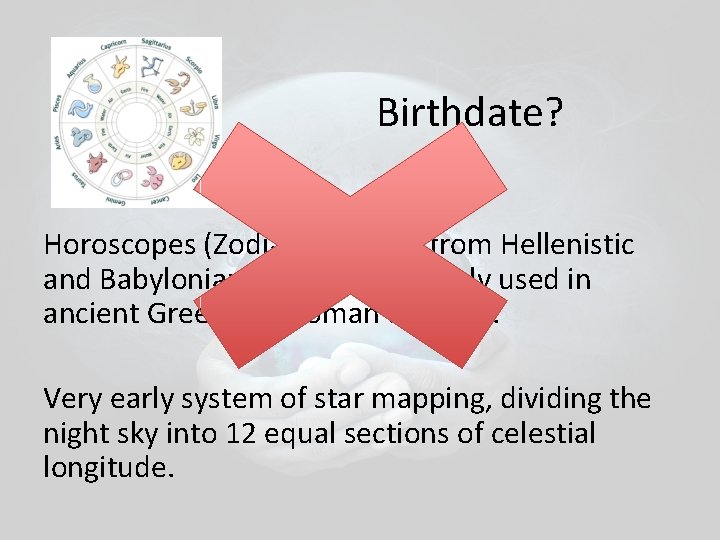
Birthdate? Horoscopes (Zodiac) – comes from Hellenistic and Babylonian astronomy, widely used in ancient Greek and Roman cultures. Very early system of star mapping, dividing the night sky into 12 equal sections of celestial longitude.
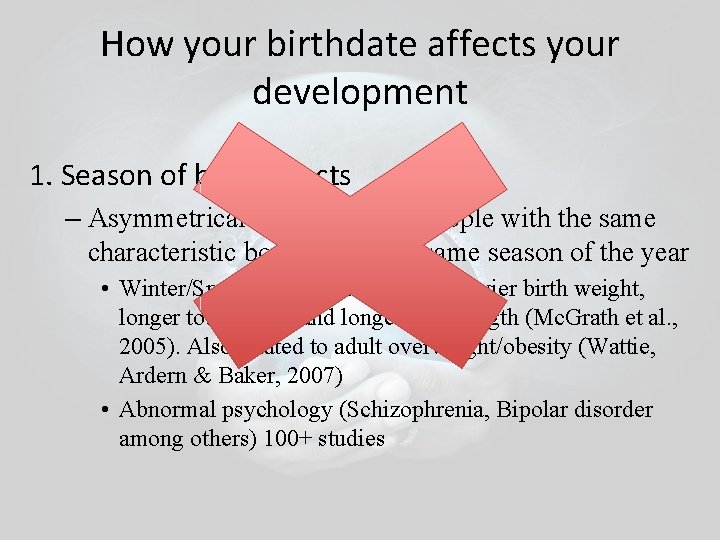
How your birthdate affects your development 1. Season of birth effects – Asymmetrical distribution of people with the same characteristic born during the same season of the year • Winter/Spring births demonstrate heavier birth weight, longer total length and longer limb length (Mc. Grath et al. , 2005). Also related to adult overweight/obesity (Wattie, Ardern & Baker, 2007) • Abnormal psychology (Schizophrenia, Bipolar disorder among others) 100+ studies
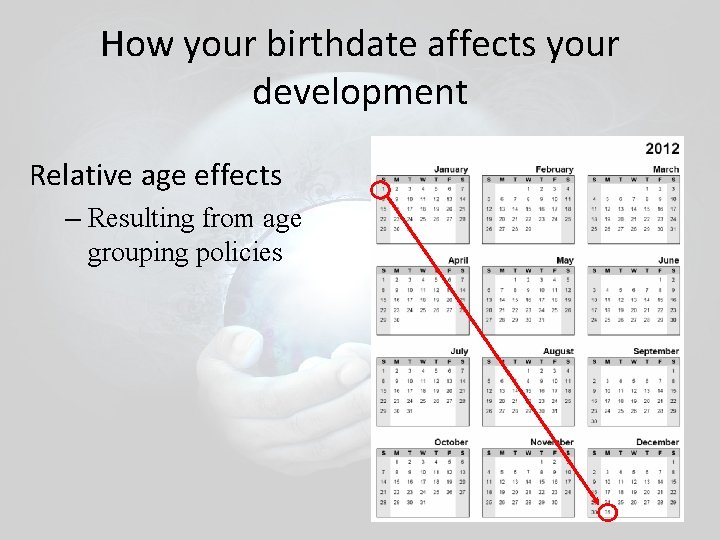
How your birthdate affects your development Relative age effects – Resulting from age grouping policies
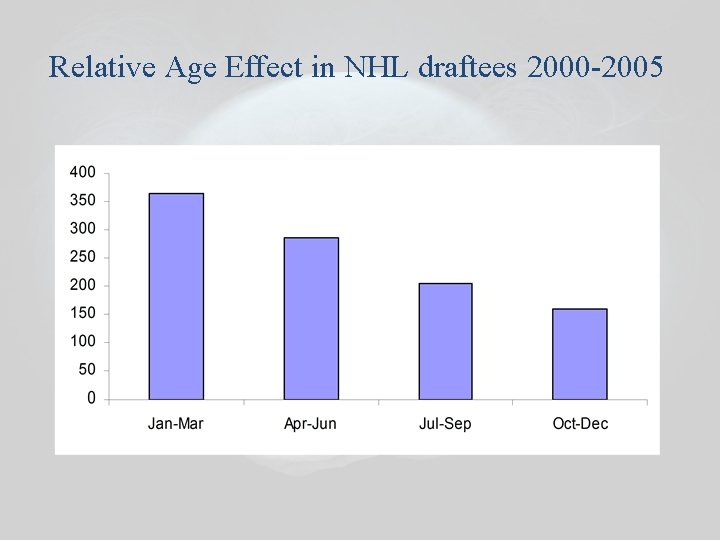
Relative Age Effect in NHL draftees 2000 -2005
RAE has been found in a range of sports – soccer, ice and field hockey, cricket, baseball, handball… Possible explanations 1. ‘Older’ athletes experience more success. 2. ‘Older’ athletes more likely to be seen as gifted.
Interesting Factors that Seem to Predict Sporting Talent 1. Birthdate 2. Handedness
Handedness • Between 9 -12% of population is left-handed • Proportion in many sports is much higher – Tennis – Handball – Volleyball – Left orientations in ice-hockey, combat sports (fencing, judo, MMA)
Handedness Why? – Two hypotheses: • Neuroanatomical advantage • Frequency dependent advantage • Can be reversed! (Schorer, Loffing, Hagemann & Baker, 2012)
Interesting Factors that Seem to Predict Sporting Talent 1. Birthdate 2. Handedness 3. Genes
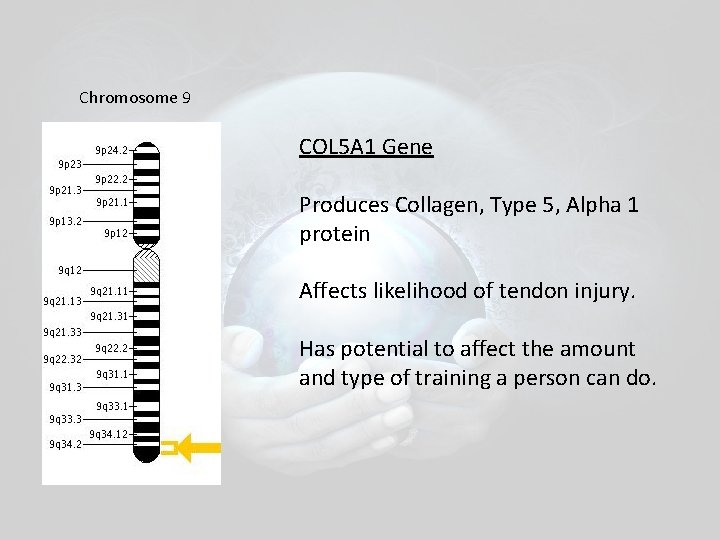
Chromosome 9 COL 5 A 1 Gene Produces Collagen, Type 5, Alpha 1 protein Affects likelihood of tendon injury. Has potential to affect the amount and type of training a person can do.
Interesting Factors that Seem to Predict Sporting Talent 1. 2. 3. 4. Birthdate Handedness Genes Personality
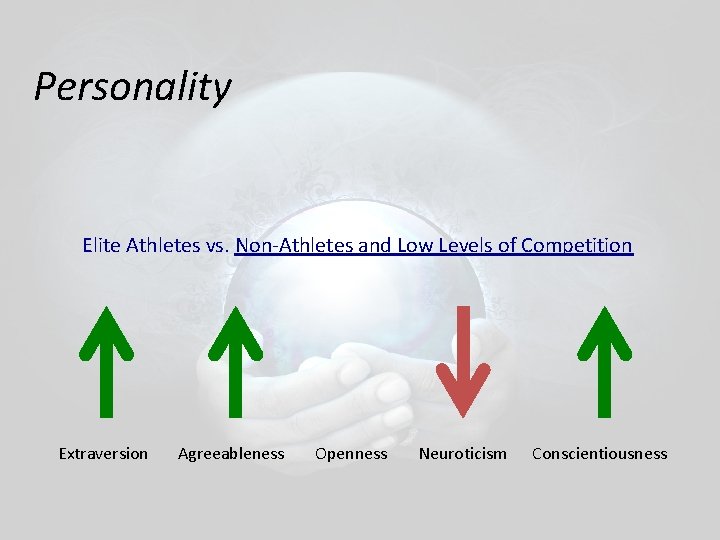
Personality Elite Athletes vs. Non-Athletes and Low Levels of Competition Extraversion Agreeableness Openness Neuroticism Conscientiousness
Personality Self-regulation: More skilled performers are better able to regulate their own learning
Personality Self-regulation: More skilled performers are better able to regulate their own learning Increased “planning” and “reflection” was associated with greater training volume (Elferink. Gemser et al. , 2015) “Self-monitoring” was positively related to time spent in deliberate practice (Bartulovic, Mc. Cardle, Baker & Young, under review).
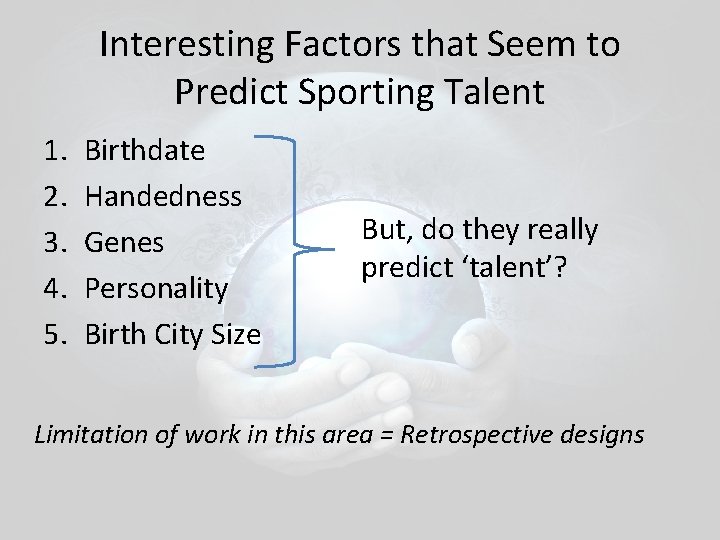
Interesting Factors that Seem to Predict Sporting Talent 1. 2. 3. 4. 5. Birthdate Handedness Genes Personality Birth City Size But, do they really predict ‘talent’? Limitation of work in this area = Retrospective designs
Systematic Review Robinson, Wattie, Schorer & Baker, under review • Search terms “talent”, “expertise”, “giftedness”, AND “sport” • Web of Science, Sport Discus • Timeframe 1990 -2015 • 1696 articles
Systematic Review Robinson, Wattie, Schorer & Baker, under review • 20 studies – Prospective (1 year) with skill-based comparisons • Recent (all published since 2004) • 65% males only • Mostly soccer (n=7) followed by rugby league (n=3), gymnastics (n=3) • Largely from Europe (n=16) • Mostly physical variables (n=12) with only 4 considering a mix of variables
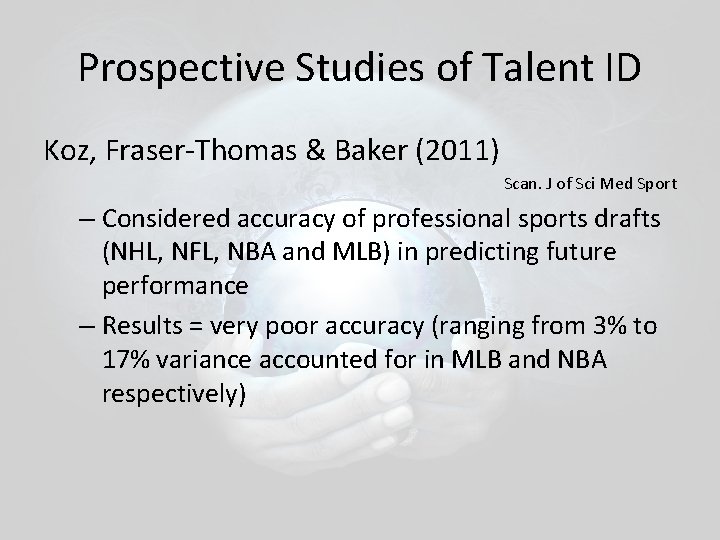
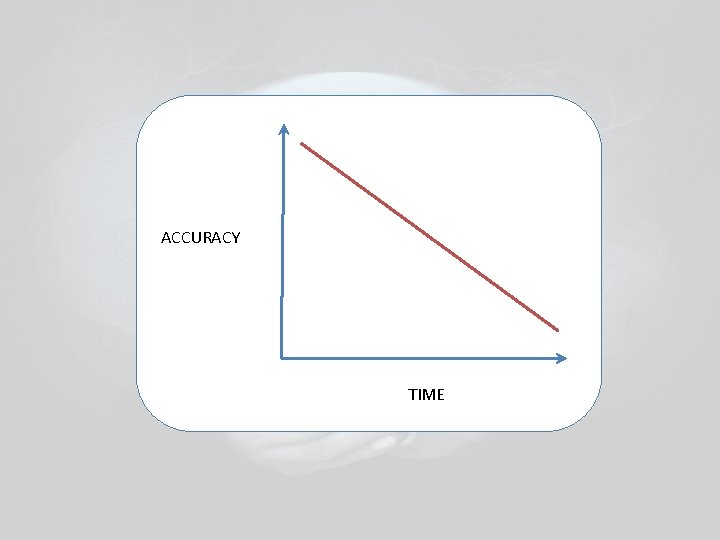
Prospective Studies of Talent ID Koz, Fraser-Thomas & Baker (2011) Scan. J of Sci Med Sport – Considered accuracy of professional sports drafts (NHL, NFL, NBA and MLB) in predicting future performance – Results = very poor accuracy (ranging from 3% to 17% variance accounted for in MLB and NBA respectively)
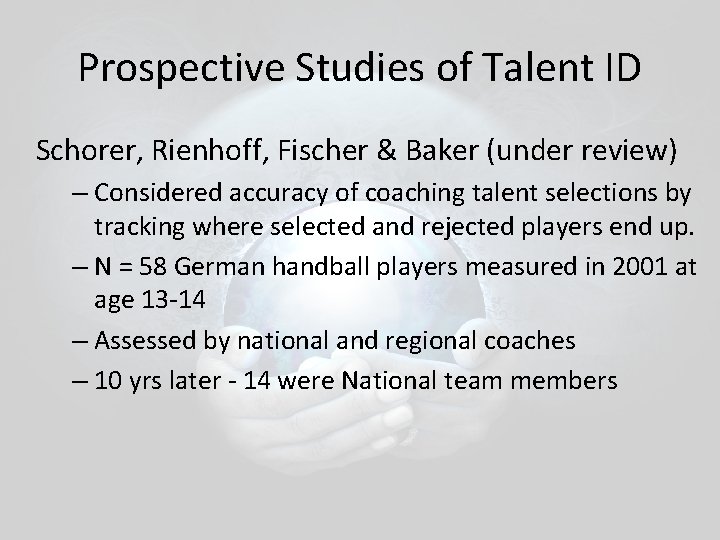
Prospective Studies of Talent ID Schorer, Rienhoff, Fischer & Baker (under review) – Considered accuracy of coaching talent selections by tracking where selected and rejected players end up. – N = 58 German handball players measured in 2001 at age 13 -14 – Assessed by national and regional coaches – 10 yrs later - 14 were National team members
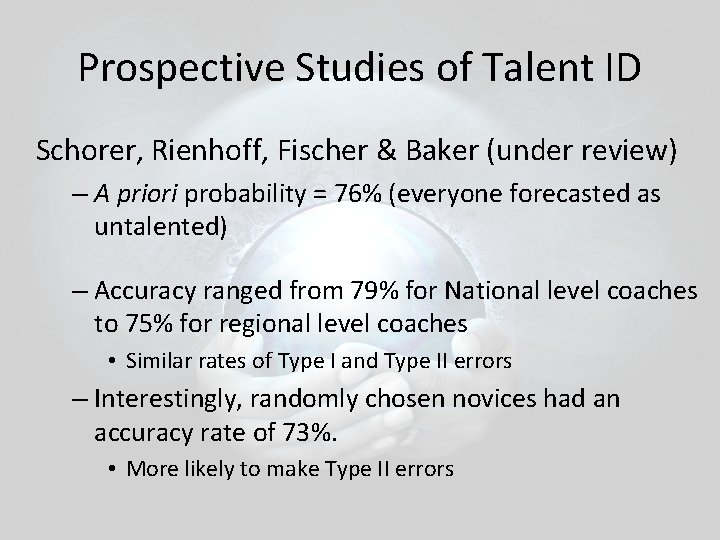
Prospective Studies of Talent ID Schorer, Rienhoff, Fischer & Baker (under review) – A priori probability = 76% (everyone forecasted as untalented) – Accuracy ranged from 79% for National level coaches to 75% for regional level coaches • Similar rates of Type I and Type II errors – Interestingly, randomly chosen novices had an accuracy rate of 73%. • More likely to make Type II errors
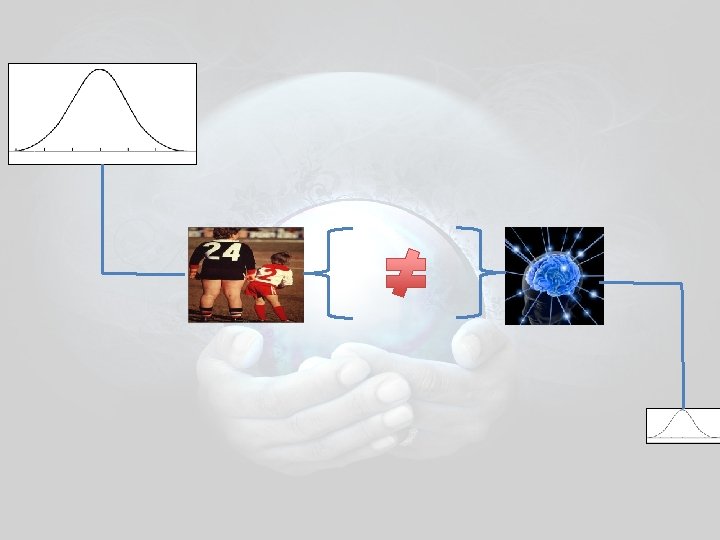
ACCURACY TIME
Beliefs about talent matter! • How do you explain/attribute your capabilities? – Beliefs about talent and its development affect motivation, learning and performance Fixed/Implicit = natural ability, nature over nurture, Growth/Acquirable = hard work, nurture over nature
Beliefs about talent matter! • How do you explain/attribute your capabilities? – Beliefs about talent and its development affect motivation, learning and performance Fixed/Inherent mindsets are associated with: Decreased motivation, less practice, learned helplessness
‘Talent’ is the most important concept in high performance sport today. Systems are still designed with this concept as the foundation Funding is based on the assumption that talent is real and coaches can/should identify it This approach has high costs re: early de-selection and dropout
Key Messages 1. Forget about talent – If it exists, we don’t know how to measure it. 2. Your messages about talent may be harmful – Foster a growth mindset but be realistic 3. Focus on quality of training/practice – This is where your greatest impact will be
Thank You! Questions? FOR MORE INFO: Email: bakerj@yorku. ca Web: www. yorku. ca/bakerj Twitter: bakerjyorku