
Identifying AGRRA Corals Part 1 Mound and Boulder
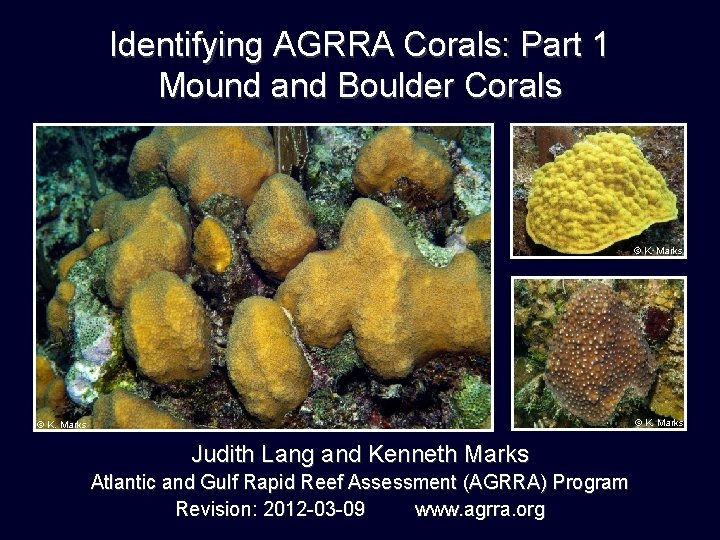
Identifying AGRRA Corals: Part 1 Mound and Boulder Corals © K. Marks Judith Lang and Kenneth Marks Atlantic and Gulf Rapid Reef Assessment (AGRRA) Program Revision: 2012 -03 -09 www. agrra. org

The following images are Copyright © by New World Publications and by other photographers. Permission is granted to use the photographs and slides in this presentation with the AGRRA Program and, with attribution, for other valid educational purposes. . All other uses are strictly prohibited. For images used in Part 1, our special thanks to: P. Humann, B. Kakuk, R. Mc. Call, C. Rogers, C. Sheppard, E. Shinn, R. Steneck, T. Turner
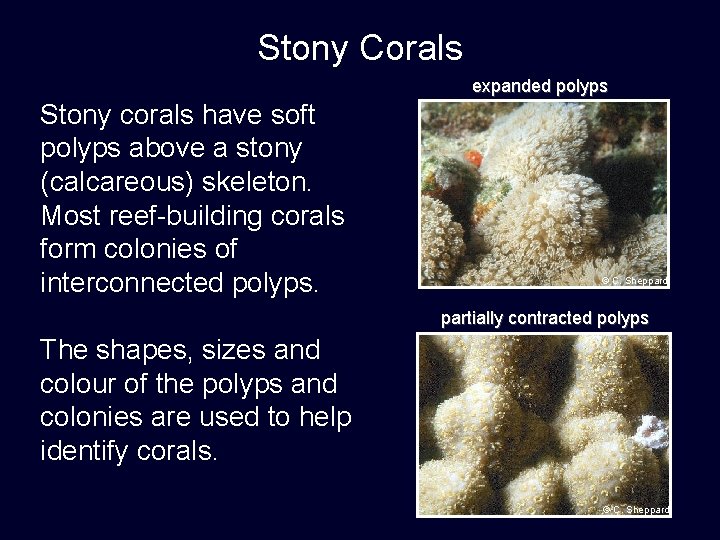
Stony Corals expanded polyps Stony corals have soft polyps above a stony (calcareous) skeleton. Most reef-building corals form colonies of interconnected polyps. © C. Sheppard partially contracted polyps The shapes, sizes and colour of the polyps and colonies are used to help identify corals. © C. Sheppard
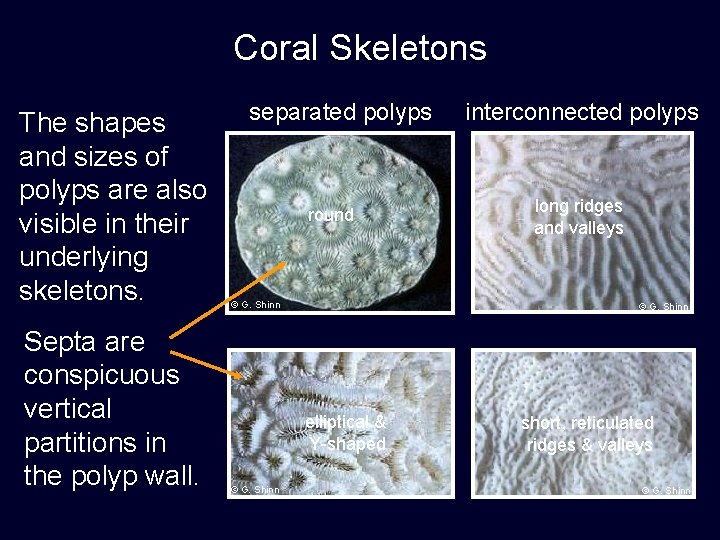
Coral Skeletons The shapes and sizes of polyps are also visible in their underlying skeletons. Septa are conspicuous vertical partitions in the polyp wall. separated polyps round © G. Shinn long ridges and valleys © G. Shinn elliptical & Y-shaped © G. Shinn interconnected polyps short, reticulated ridges & valleys © G. Shinn
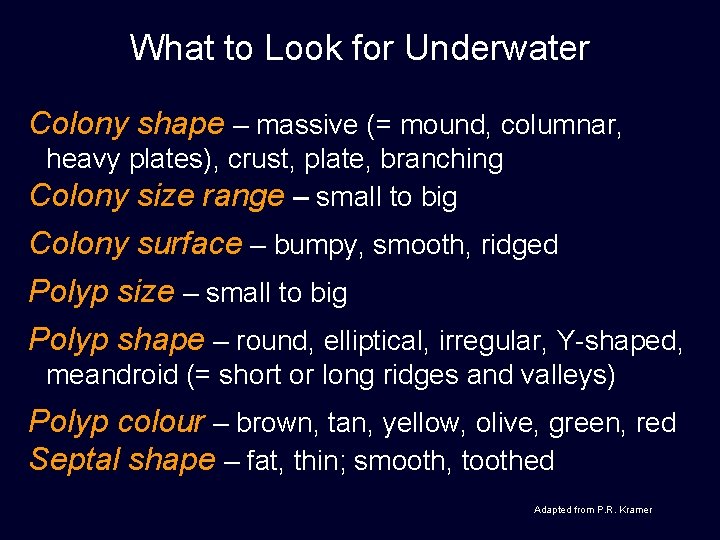
What to Look for Underwater Colony shape – massive (= mound, columnar, heavy plates), crust, plate, branching Colony size range – small to big Colony surface – bumpy, smooth, ridged Polyp size – small to big Polyp shape – round, elliptical, irregular, Y-shaped, meandroid (= short or long ridges and valleys) Polyp colour – brown, tan, yellow, olive, green, red Septal shape – fat, thin; smooth, toothed Adapted from P. R. Kramer
AGRRA Coral Species The stony corals illustrated here are limited to species that are found in the wider Caribbean at depths (<20 m) that are typical of most AGRRA surveys. The names of some corals are changing as a result of modern research. Expect updates! For each species: (number in m and ft = maximum colony size)

Coding Corals in AGRRA Surveys Use the CARICOMP-based coral codes. The coral code for a genus is the first 4 letters of its genus name. ACRO = Acropora Use the genus code whenever you are unsure of a coral’s species identity. The coral code for a species is the first letter of the genus name followed by the first 3 letters of its species name. APAL = Acropora palmata
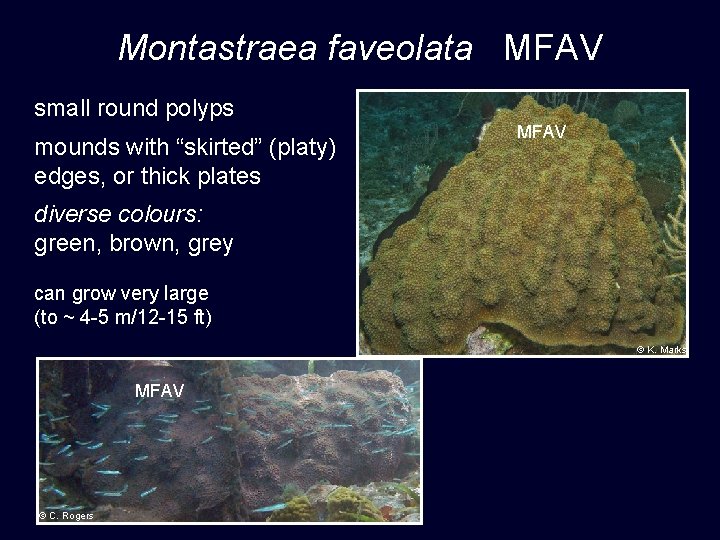
Montastraea faveolata MFAV small round polyps mounds with “skirted” (platy) edges, or thick plates MFAV diverse colours: green, brown, grey can grow very large (to ~ 4 -5 m/12 -15 ft) © K. Marks MFAV © C. Rogers
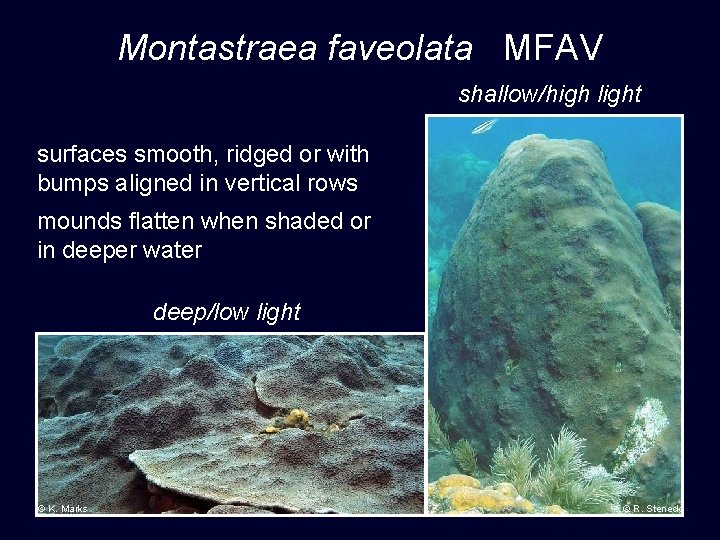
Montastraea faveolata MFAV shallow/high light surfaces smooth, ridged or with bumps aligned in vertical rows mounds flatten when shaded or in deeper water deep/low light © K. Marks © R. Steneck
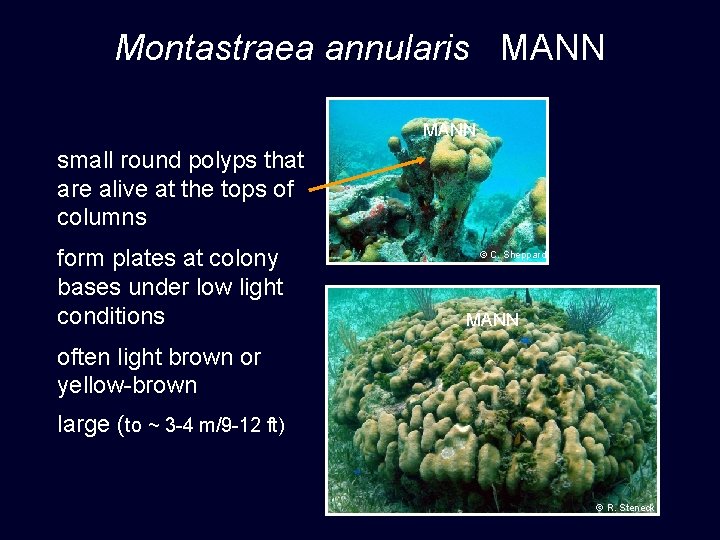
Montastraea annularis MANN small round polyps that are alive at the tops of columns form plates at colony bases under low light conditions © C. Sheppard MANN often light brown or yellow-brown large (to ~ 3 -4 m/9 -12 ft) © R. Steneck
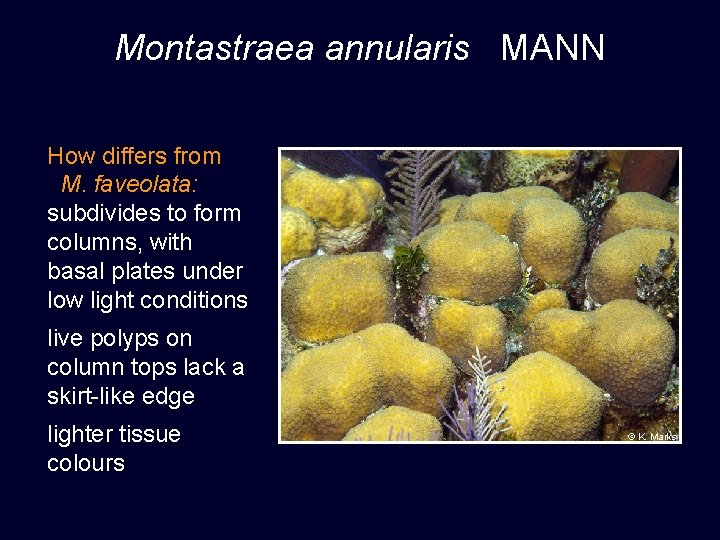
Montastraea annularis MANN How differs from M. faveolata: subdivides to form columns, with basal plates under low light conditions live polyps on column tops lack a skirt-like edge lighter tissue colours © K. Marks
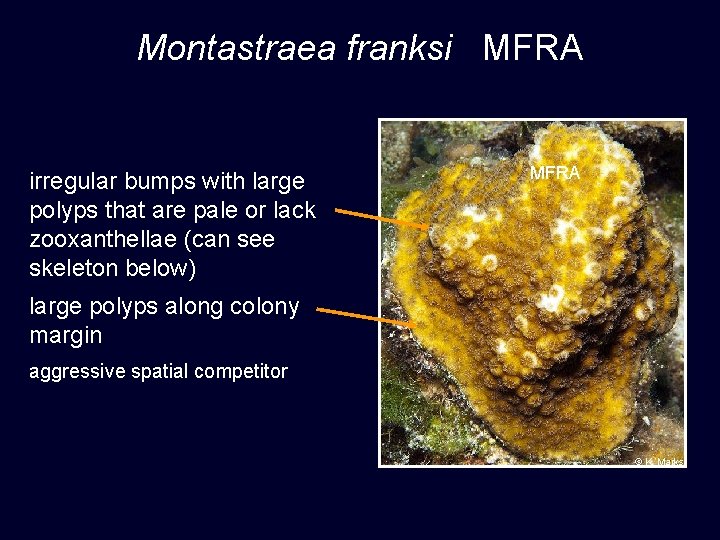
Montastraea franksi MFRA irregular bumps with large polyps that are pale or lack zooxanthellae (can see skeleton below) MFRA © P. Humann large polyps along colony margin aggressive spatial competitor © K. Marks
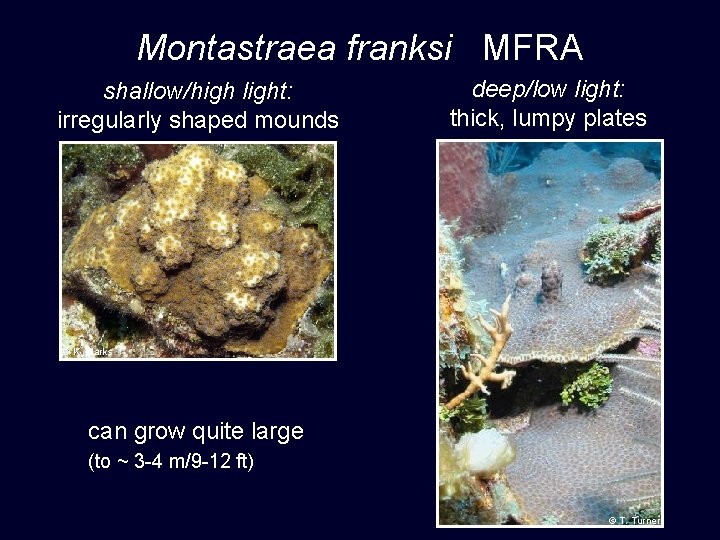
Montastraea franksi MFRA shallow/high light: irregularly shaped mounds deep/low light: thick, lumpy plates © K. Marks can grow quite large (to ~ 3 -4 m/9 -12 ft) © T. Turner
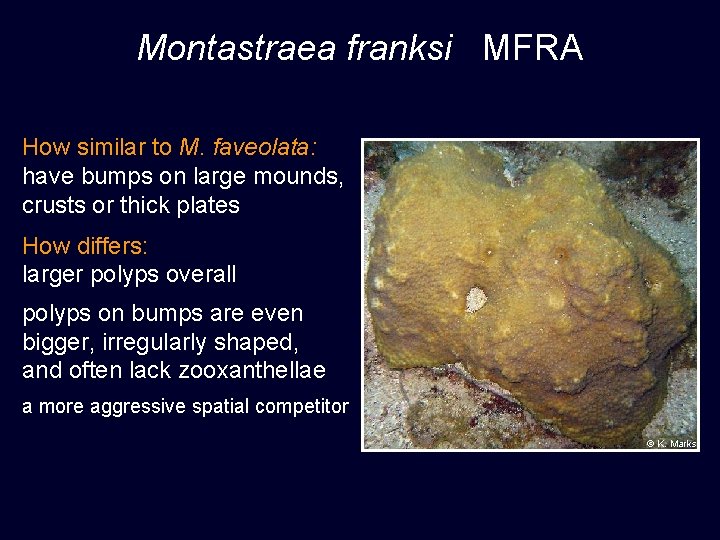
Montastraea franksi MFRA How similar to M. faveolata: have bumps on large mounds, crusts or thick plates How differs: larger polyps overall polyps on bumps are even bigger, irregularly shaped, and often lack zooxanthellae a more aggressive spatial competitor © K. Marks
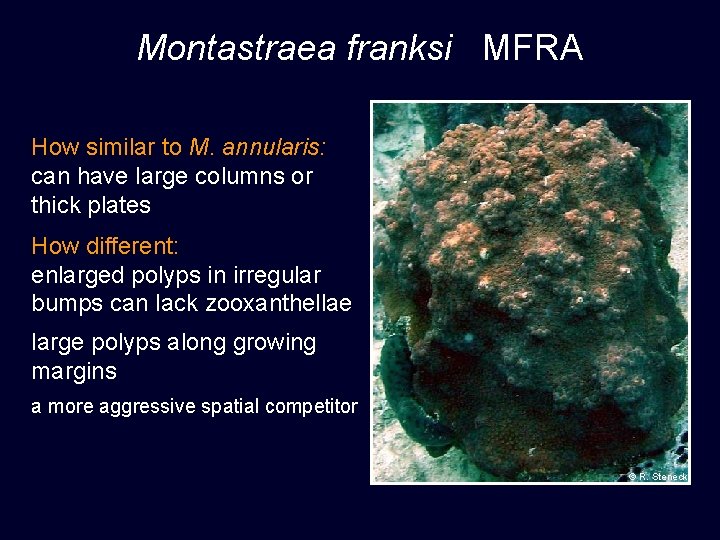
Montastraea franksi MFRA How similar to M. annularis: can have large columns or thick plates How different: enlarged polyps in irregular bumps can lack zooxanthellae large polyps along growing margins a more aggressive spatial competitor © R. Steneck
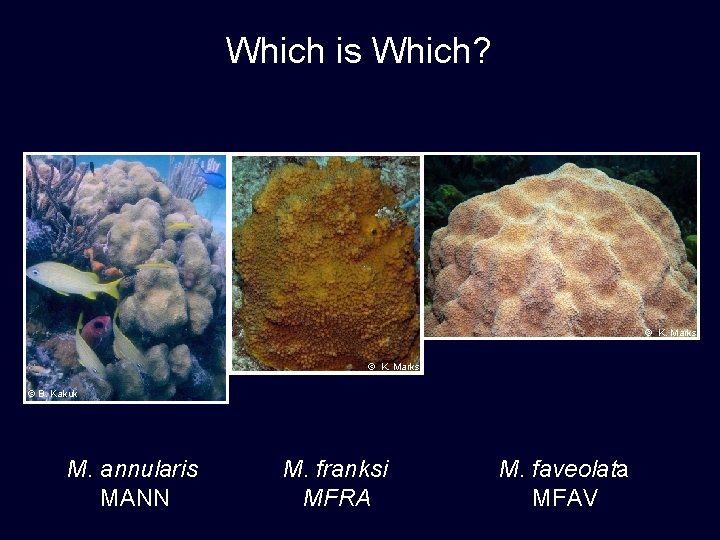
Which is Which? © K. Marks © B. Kakuk M. annularis MANN M. franksi MFRA M. faveolata MFAV
Complications! Some colonies look like “intermediates” of M. franksi, M. annularis and M. faveolata. If unsure of species identity, code as Montastraea MONT “In general, the genetic and morphological data suggest a north to south* hybridization gradient, with evidence for introgression strongest in the north. However, reproductive data show no such trend, with intrinsic barriers to gene flow comparable or stronger in the north. ” Fukami et al. (2004) Evolution 58: 324 -337. *north to south = Bahamas versus Panama
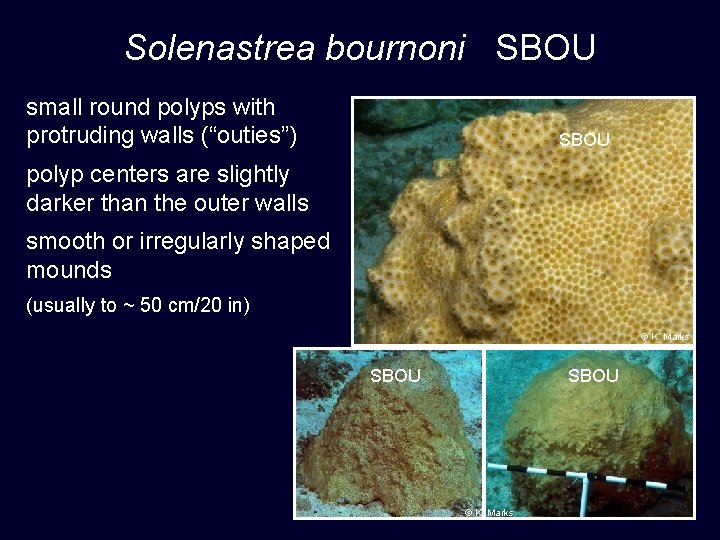
Solenastrea bournoni SBOU small round polyps with protruding walls (“outies”) SBOU polyp centers are slightly darker than the outer walls smooth or irregularly shaped mounds (usually to ~ 50 cm/20 in) © K. Marks SBOU 1 m © K. Marks
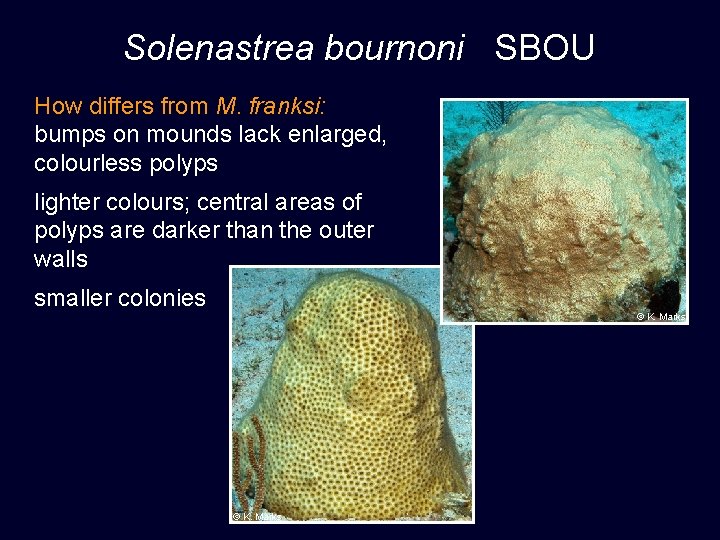
Solenastrea bournoni SBOU How differs from M. franksi: bumps on mounds lack enlarged, colourless polyps lighter colours; central areas of polyps are darker than the outer walls smaller colonies © K. Marks
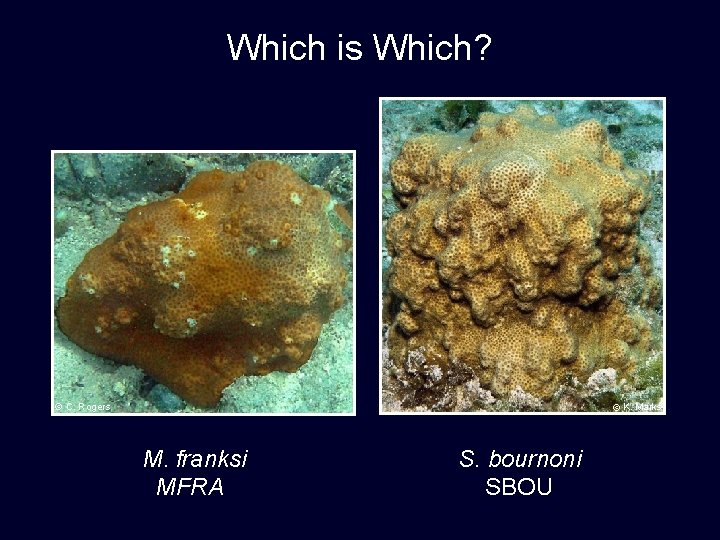
Which is Which? © C. Rogers © K. Marks M. franksi MFRA S. bournoni SBOU
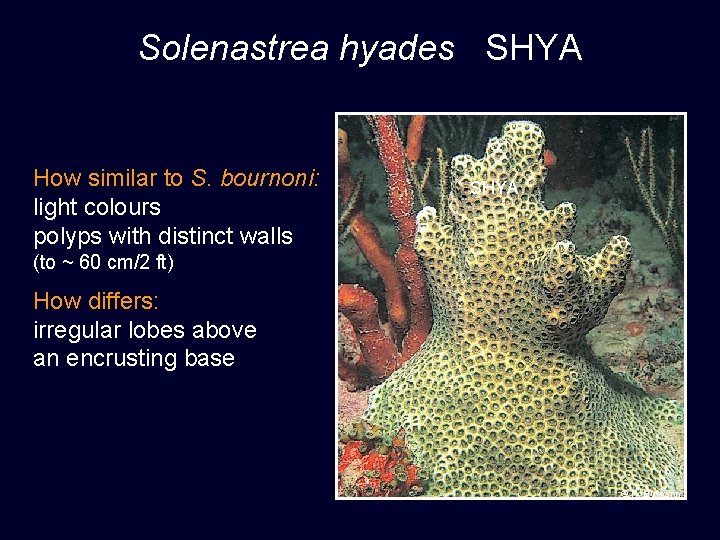
Solenastrea hyades SHYA How similar to S. bournoni: light colours polyps with distinct walls SHYA (to ~ 60 cm/2 ft) How differs: irregular lobes above an encrusting base © P. Humann
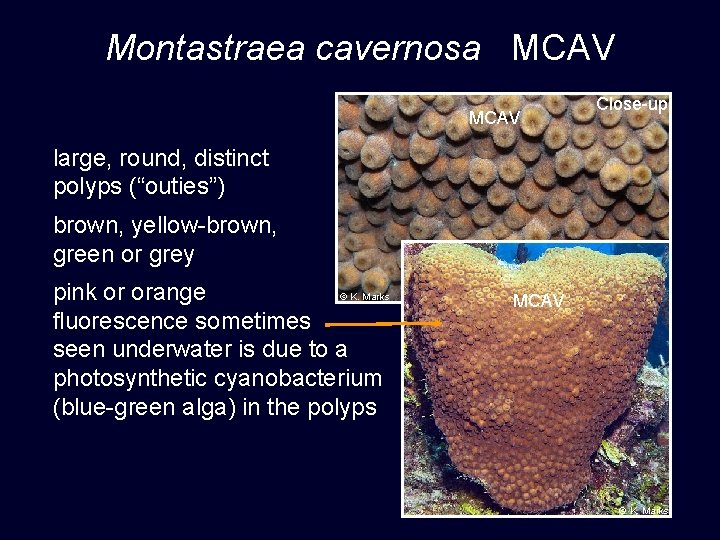
Montastraea cavernosa MCAV Close-up large, round, distinct polyps (“outies”) brown, yellow-brown, green or grey © K. Marks pink or orange fluorescence sometimes seen underwater is due to a photosynthetic cyanobacterium (blue-green alga) in the polyps MCAV © K. Marks
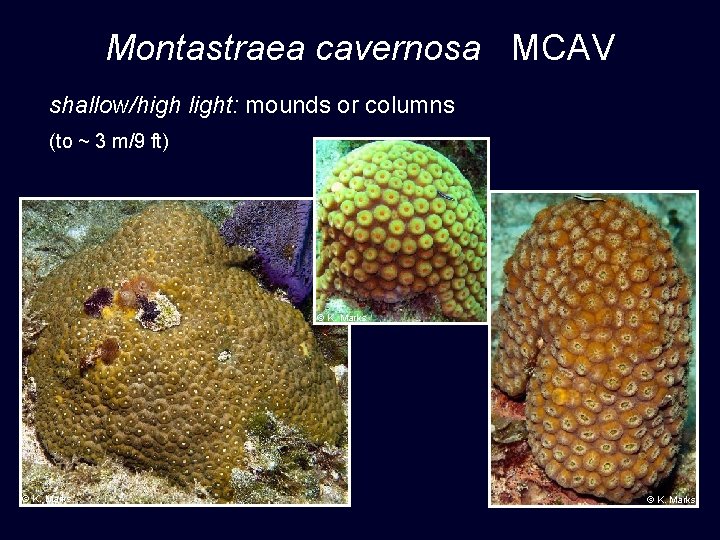
Montastraea cavernosa MCAV shallow/high light: mounds or columns (to ~ 3 m/9 ft) © K. Marks
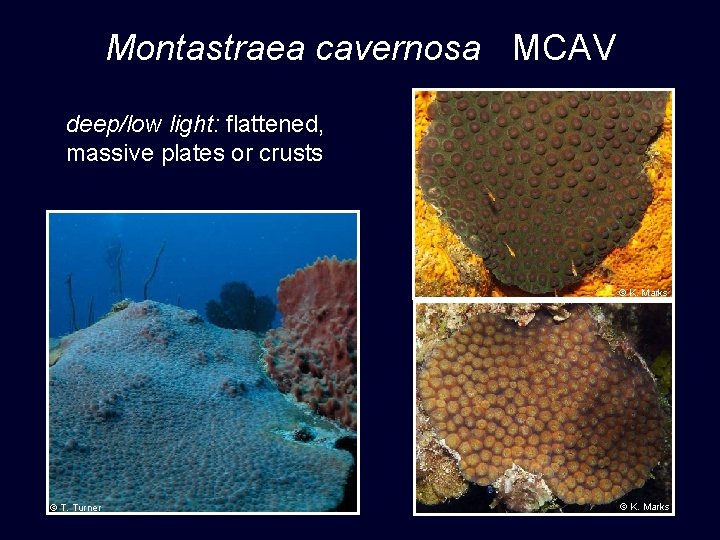
Montastraea cavernosa MCAV deep/low light: flattened, massive plates or crusts © K. Marks © T. Turner © K. Marks
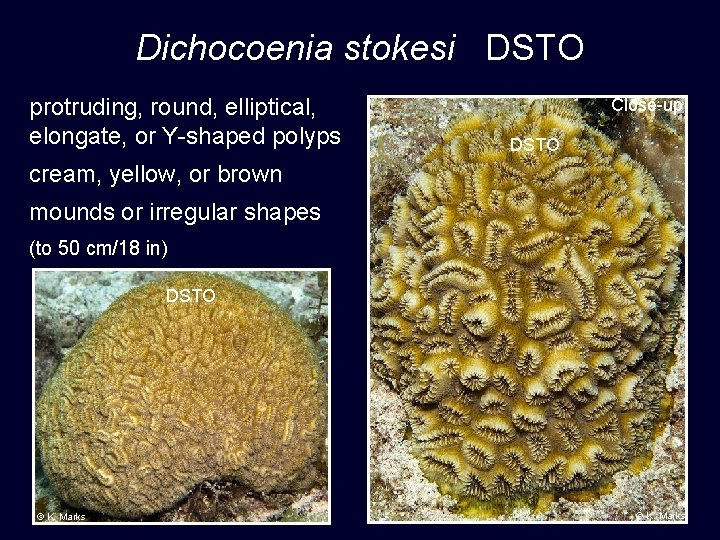
Dichocoenia stokesi DSTO protruding, round, elliptical, elongate, or Y-shaped polyps Close-up DSTO cream, yellow, or brown mounds or irregular shapes (to 50 cm/18 in) DSTO © K. Marks
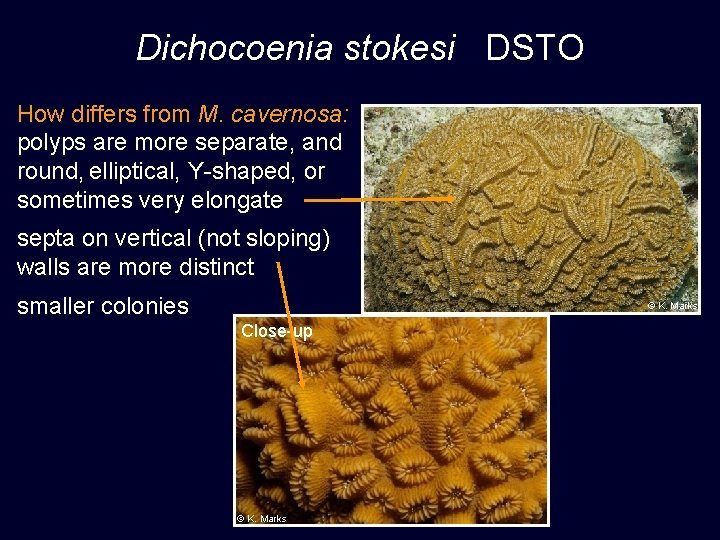
Dichocoenia stokesi DSTO How differs from M. cavernosa: polyps are more separate, and round, elliptical, Y-shaped, or sometimes very elongate septa on vertical (not sloping) walls are more distinct smaller colonies © K. Marks Close-up © K. Marks
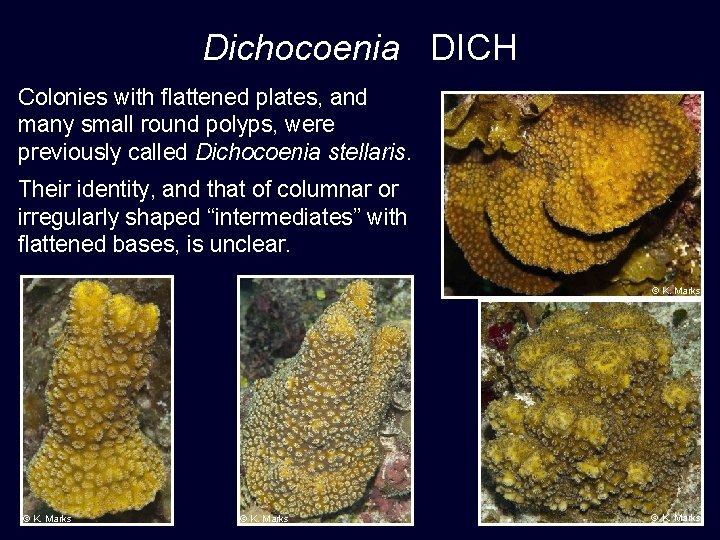
Dichocoenia DICH Colonies with flattened plates, and many small round polyps, were previously called Dichocoenia stellaris. Their identity, and that of columnar or irregularly shaped “intermediates” with flattened bases, is unclear. © K. Marks
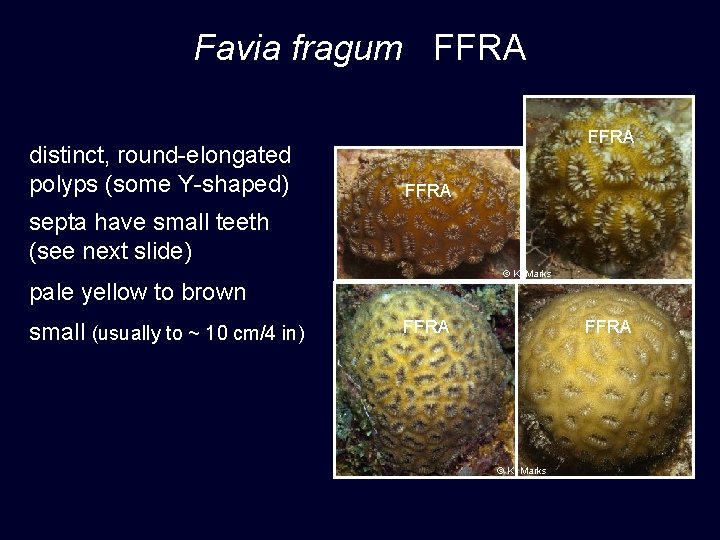
Favia fragum FFRA distinct, round-elongated polyps (some Y-shaped) FFRA septa have small teeth (see next slide) © K. Marks pale yellow to brown small (usually to ~ 10 cm/4 in) FFRA © K. Marks
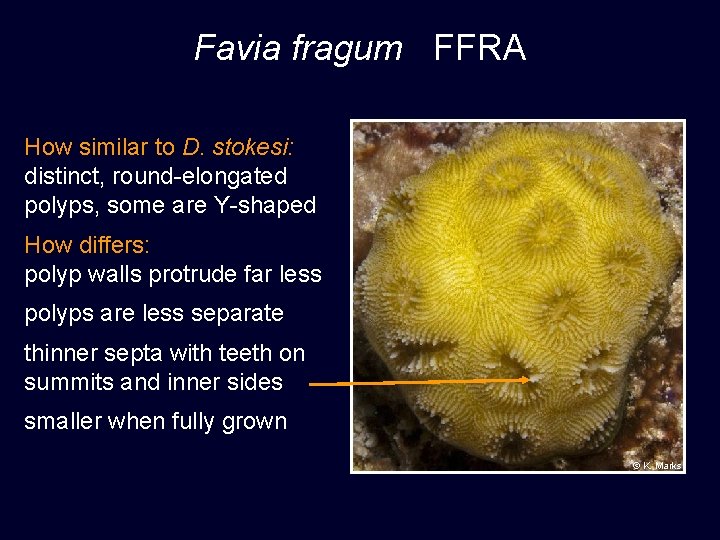
Favia fragum FFRA How similar to D. stokesi: distinct, round-elongated polyps, some are Y-shaped How differs: polyp walls protrude far less polyps are less separate thinner septa with teeth on summits and inner sides smaller when fully grown © K. Marks
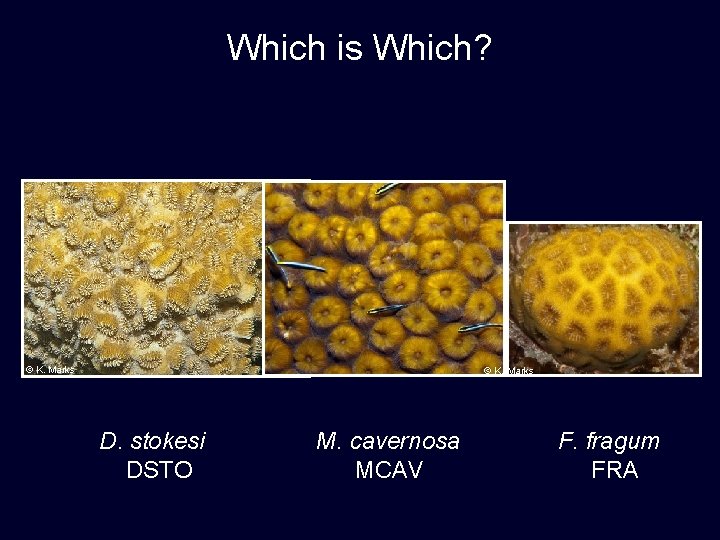
Which is Which? © K. Marks D. stokesi DSTO M. cavernosa MCAV F. fragum FRA
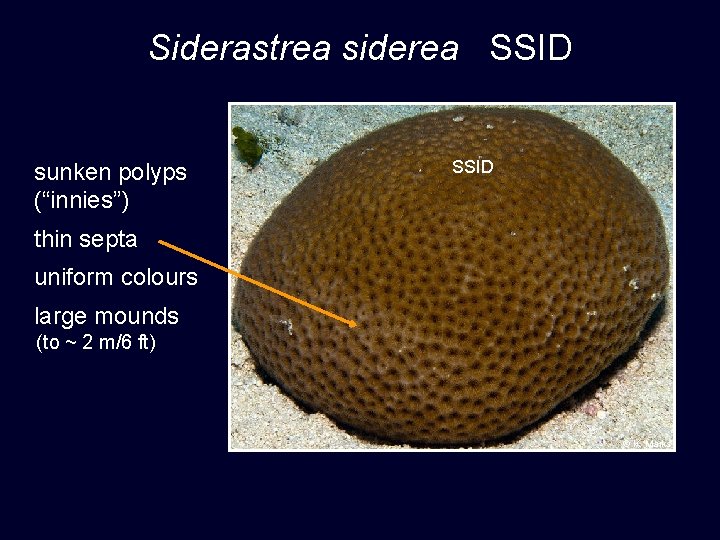
Siderastrea siderea SSID sunken polyps (“innies”) SSID thin septa uniform colours large mounds (to ~ 2 m/6 ft) © K. Marks
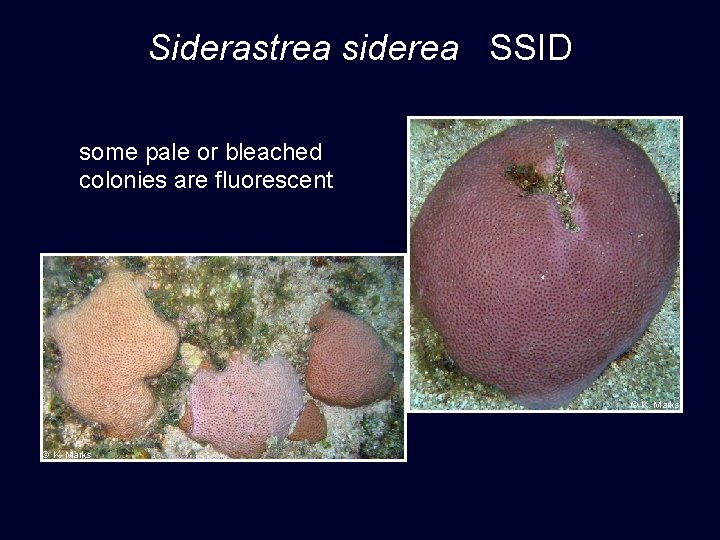
Siderastrea siderea SSID some pale or bleached colonies are fluorescent © K. Marks
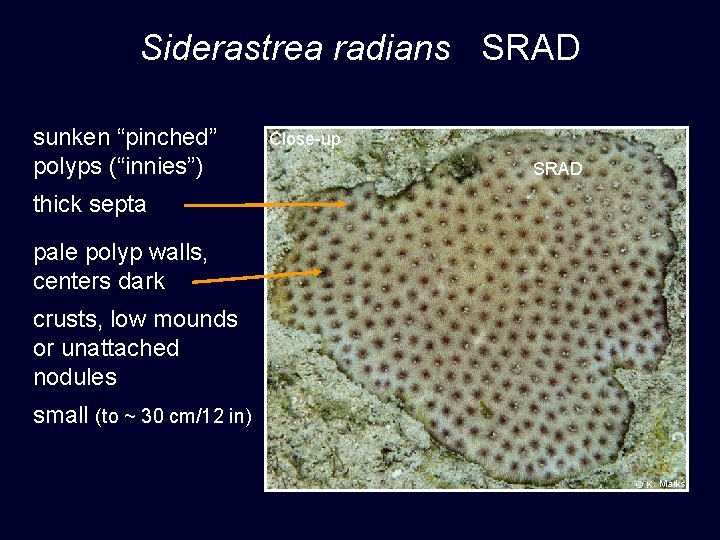
Siderastrea radians SRAD sunken “pinched” polyps (“innies”) Close-up SRAD thick septa pale polyp walls, centers dark crusts, low mounds or unattached nodules small (to ~ 30 cm/12 in) © K. Marks
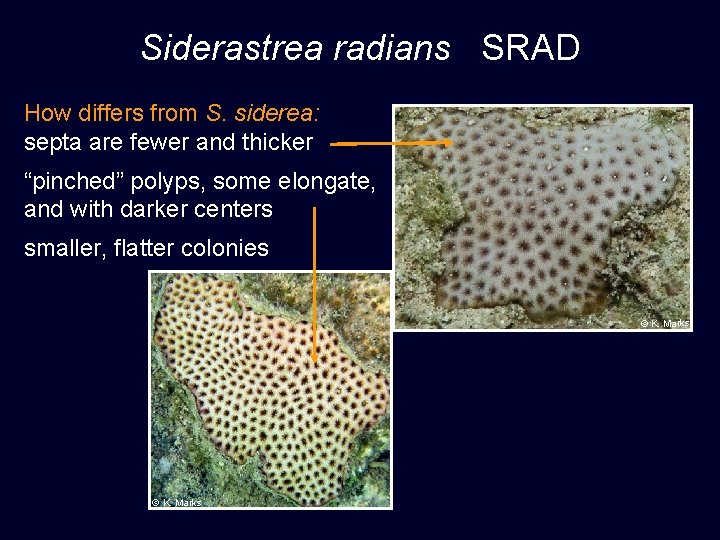
Siderastrea radians SRAD How differs from S. siderea: septa are fewer and thicker “pinched” polyps, some elongate, and with darker centers smaller, flatter colonies © K. Marks
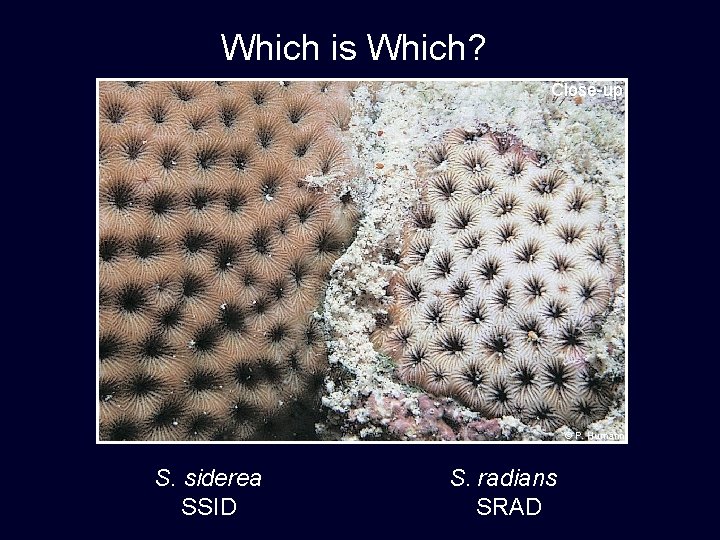
Which is Which? Close-up © P. Humann S. siderea SSID S. radians SRAD
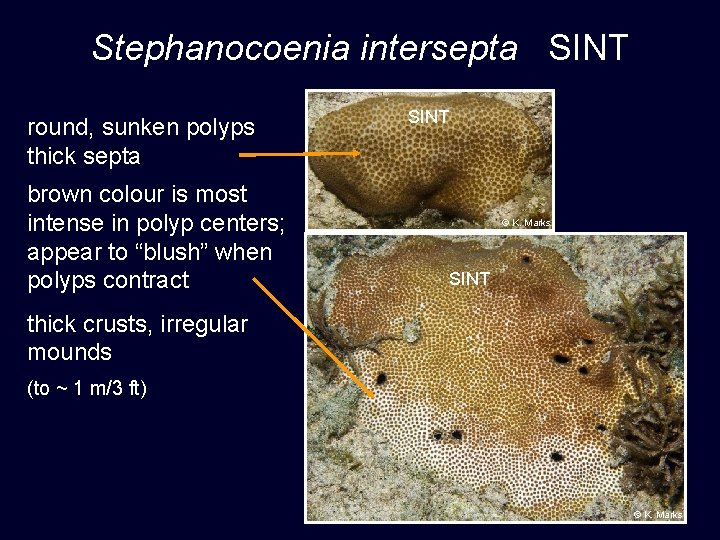
Stephanocoenia intersepta SINT round, sunken polyps thick septa brown colour is most intense in polyp centers; appear to “blush” when polyps contract SINT © K. Marks SINT thick crusts, irregular mounds (to ~ 1 m/3 ft) © K. Marks
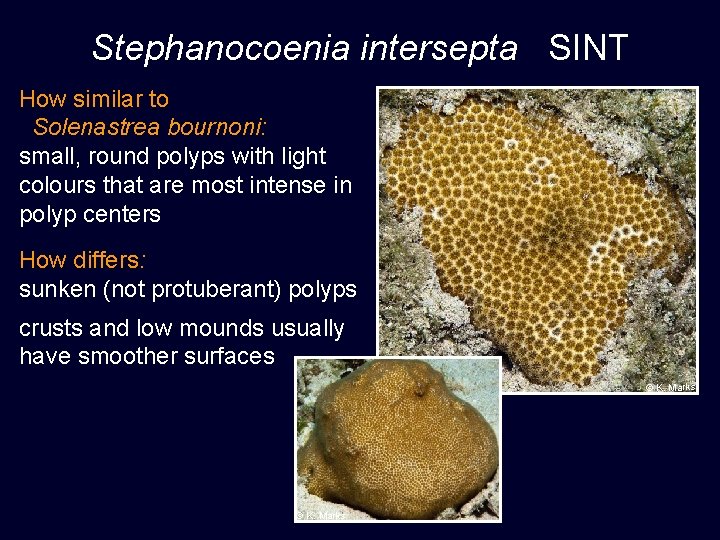
Stephanocoenia intersepta SINT How similar to Solenastrea bournoni: small, round polyps with light colours that are most intense in polyp centers How differs: sunken (not protuberant) polyps crusts and low mounds usually have smoother surfaces © K. Marks
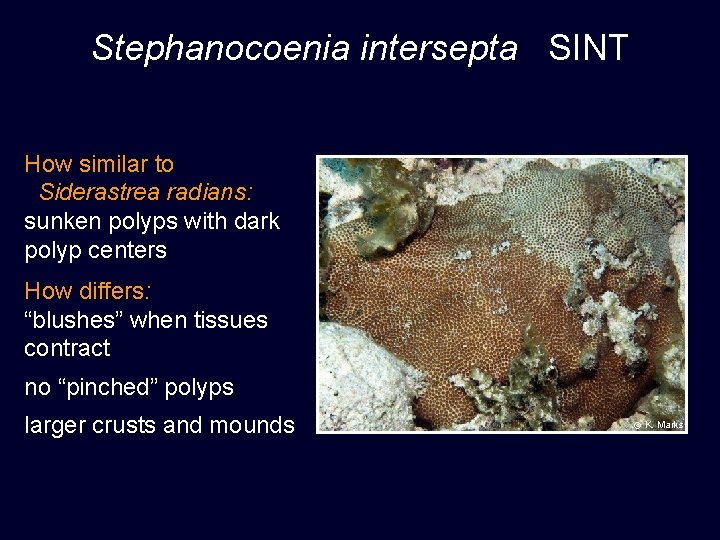
Stephanocoenia intersepta SINT How similar to Siderastrea radians: sunken polyps with dark polyp centers How differs: “blushes” when tissues contract no “pinched” polyps larger crusts and mounds © K. Marks
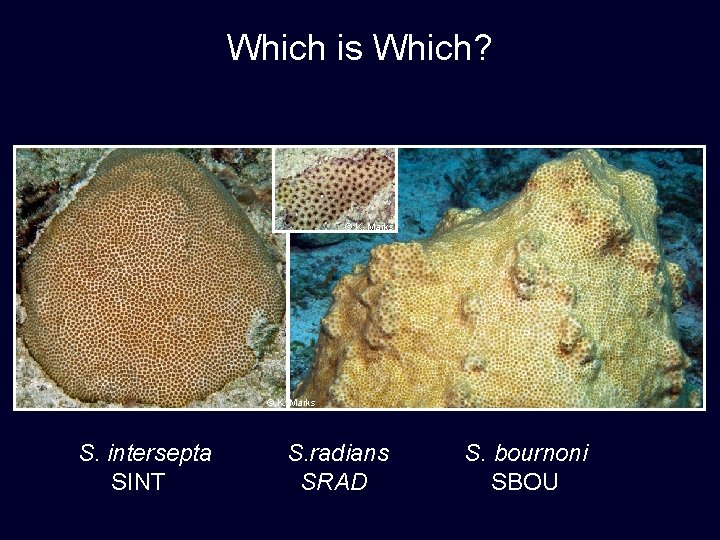
Which is Which? © K. Marks S. intersepta SINT S. radians SRAD S. bournoni SBOU
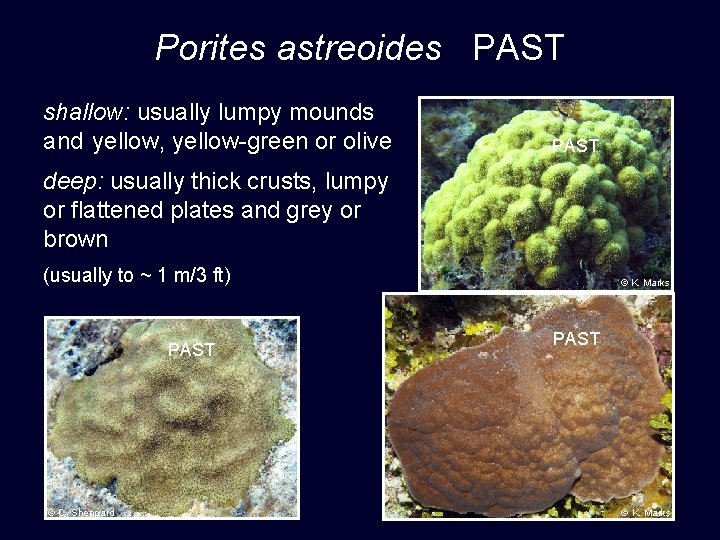
Porites astreoides PAST shallow: usually lumpy mounds and yellow, yellow-green or olive PAST deep: usually thick crusts, lumpy or flattened plates and grey or brown (usually to ~ 1 m/3 ft) PAST © C. Sheppard © K. Marks PAST © K. Marks
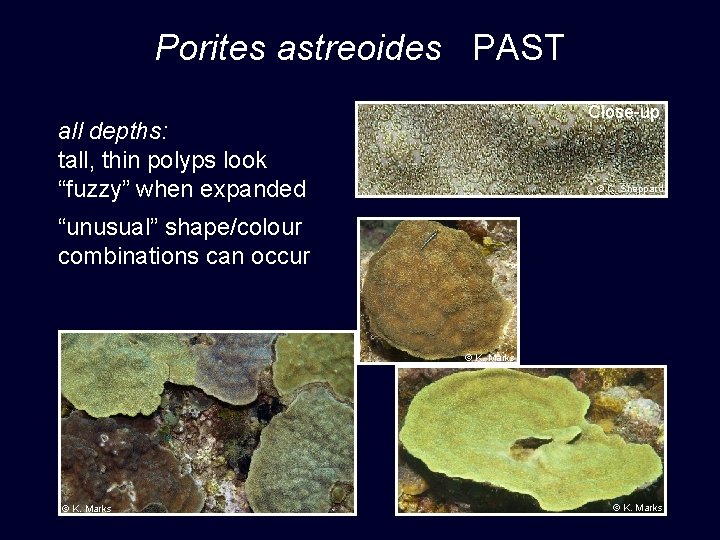
Porites astreoides PAST Close-up all depths: tall, thin polyps look “fuzzy” when expanded © C. Sheppard “unusual” shape/colour combinations can occur © K. Marks
- Slides: 41