
Identify these Hindu terms Brahman Atman karma dharma
Identify these Hindu terms: Brahman, Atman, karma, dharma, guru, yoga, reincarnation and moksha. Identify key Hindu texts: the Vedas, the Upanishads and the Bhagavad-Gita. Explore the belief systems of Buddhism including : nirvana, 4 Noble Truths, the Eightfold Path to Enlightenment, and the life and teachings of Siddhartha Gautama, (Buddha). Compare and contrast the religion of Hinduism with Buddhism.
• The dominant religion in India is Hinduism which was brought in by the original Aryan invaders.
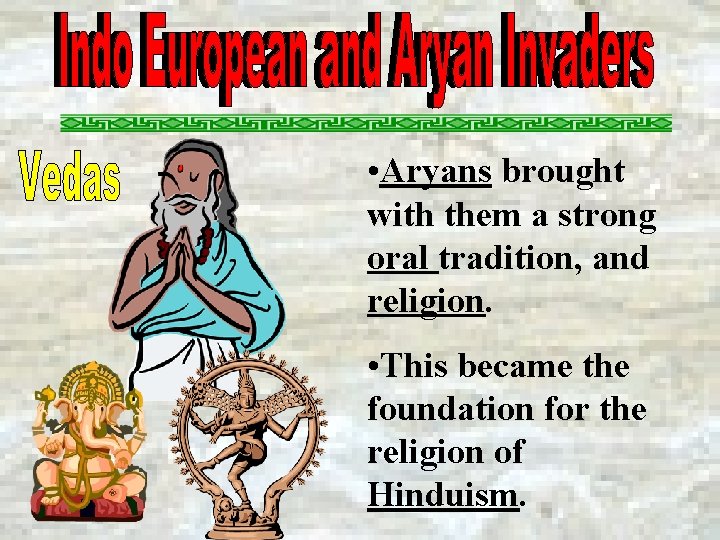
• Aryans brought with them a strong oral tradition, and religion. • This became the foundation for the religion of Hinduism.
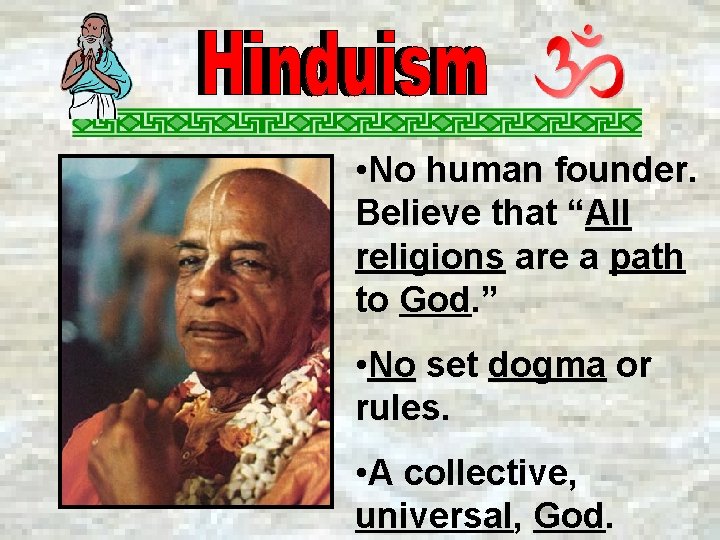
• No human founder. Believe that “All religions are a path to God. ” • No set dogma or rules. • A collective, universal, God.
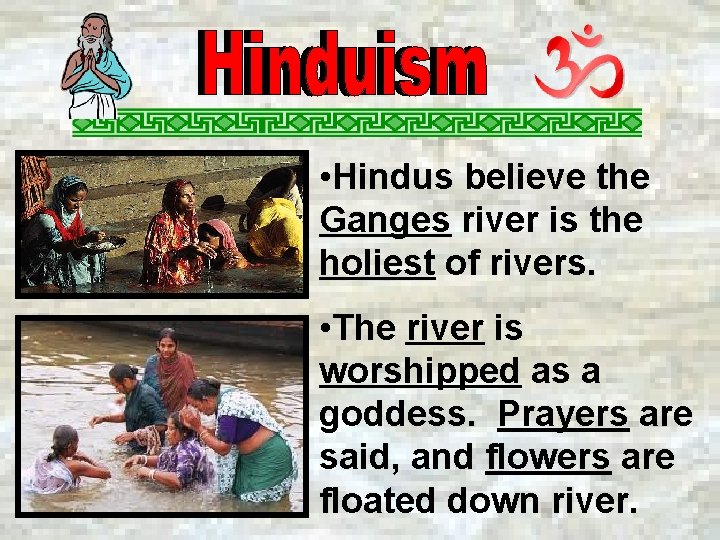
• Hindus believe the Ganges river is the holiest of rivers. • The river is worshipped as a goddess. Prayers are said, and flowers are floated down river.
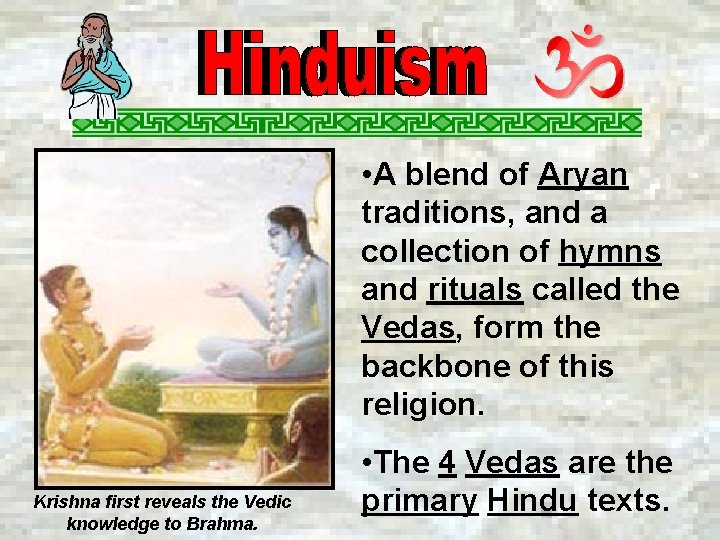
• A blend of Aryan traditions, and a collection of hymns and rituals called the Vedas, form the backbone of this religion. Krishna first reveals the Vedic knowledge to Brahma. • The 4 Vedas are the primary Hindu texts.
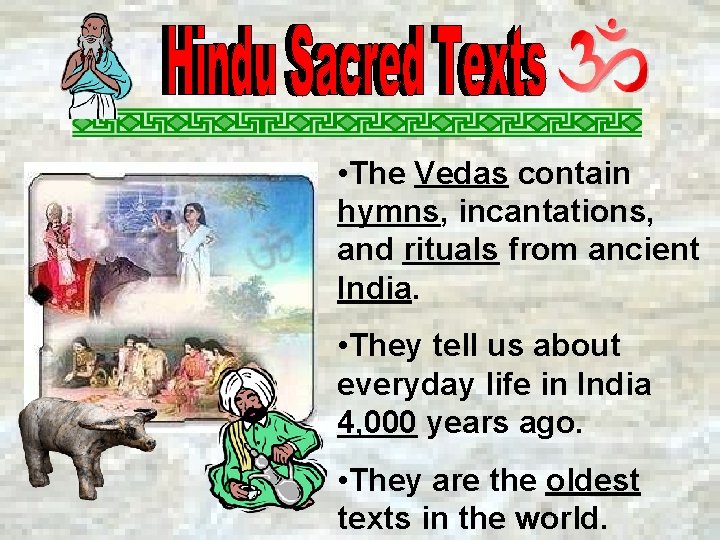
• The Vedas contain hymns, incantations, and rituals from ancient India. • They tell us about everyday life in India 4, 000 years ago. • They are the oldest texts in the world.
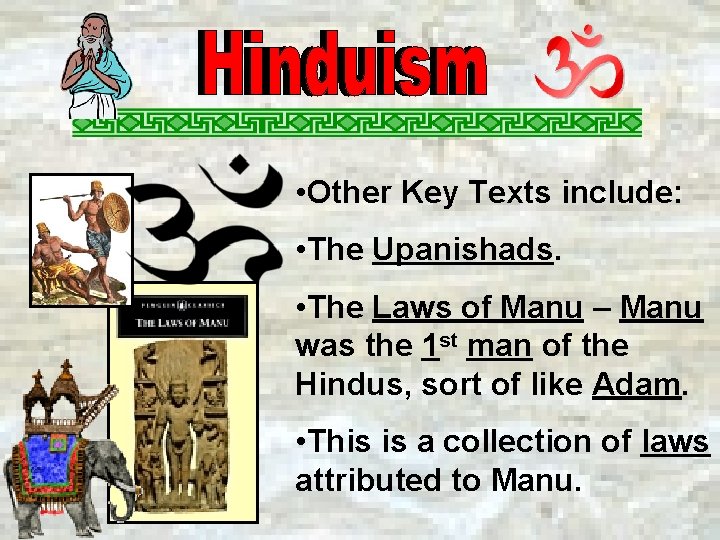
• Other Key Texts include: • The Upanishads. • The Laws of Manu – Manu was the 1 st man of the Hindus, sort of like Adam. • This is a collection of laws attributed to Manu.
1. Which two religions began in India? 2. What is the holiest of rivers to the Hindus? 3. Is there a human founder for Hinduism? 4. What are the primary scriptures or religious texts of the Hindus? 5. Who was the “Hindu Adam? ”
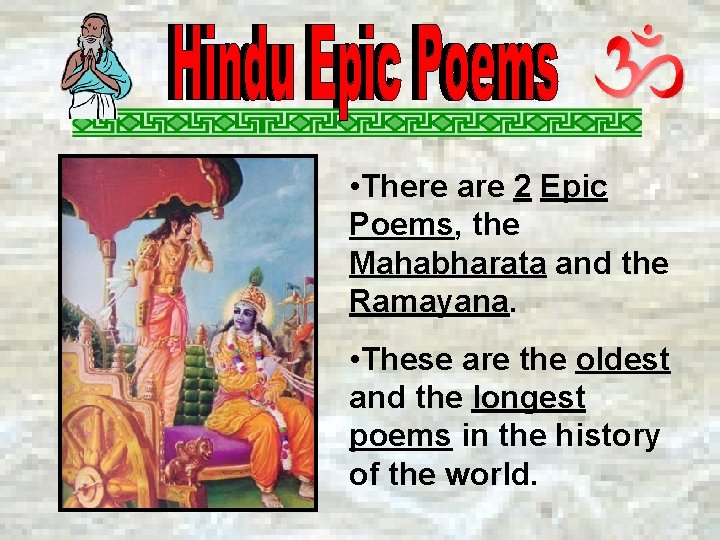
• There are 2 Epic Poems, the Mahabharata and the Ramayana. • These are the oldest and the longest poems in the history of the world.
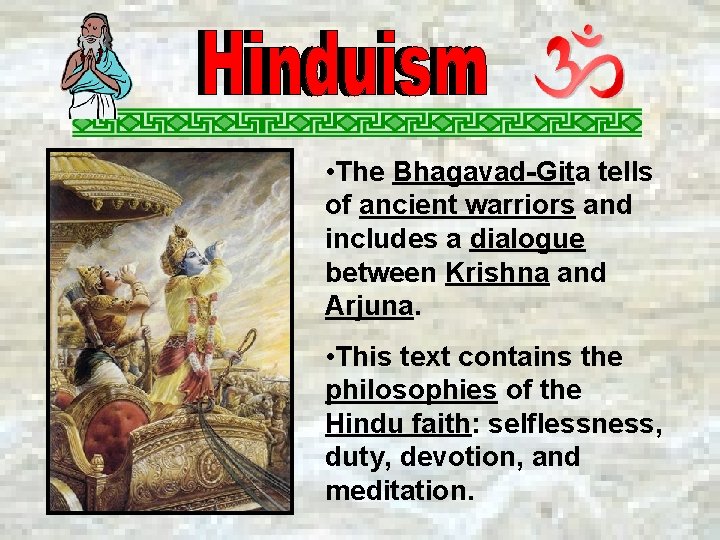
• The Bhagavad-Gita tells of ancient warriors and includes a dialogue between Krishna and Arjuna. • This text contains the philosophies of the Hindu faith: selflessness, duty, devotion, and meditation.
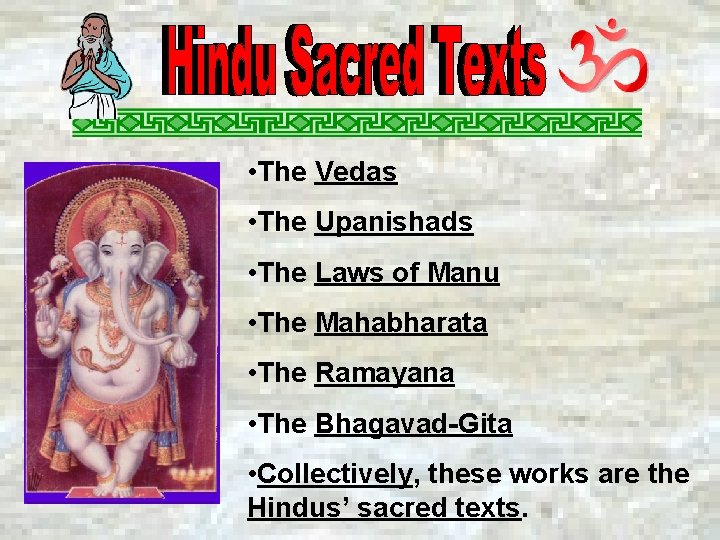
• The Vedas • The Upanishads • The Laws of Manu • The Mahabharata • The Ramayana • The Bhagavad-Gita • Collectively, these works are the Hindus’ sacred texts.
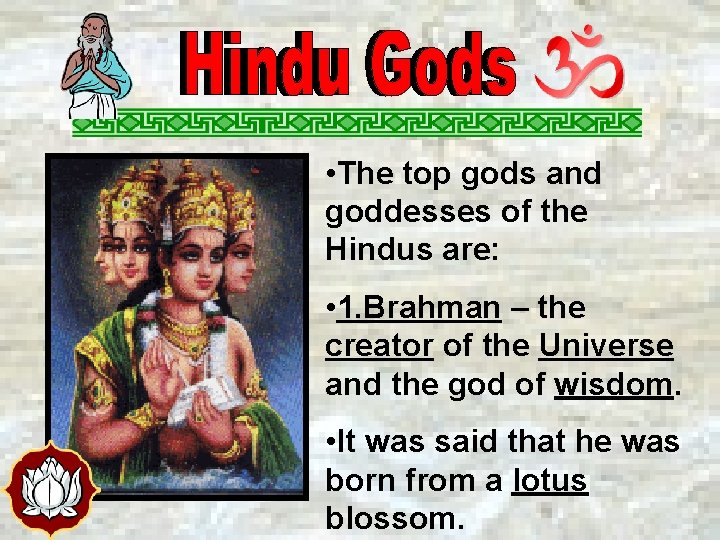
• The top gods and goddesses of the Hindus are: • 1. Brahman – the creator of the Universe and the god of wisdom. • It was said that he was born from a lotus blossom.
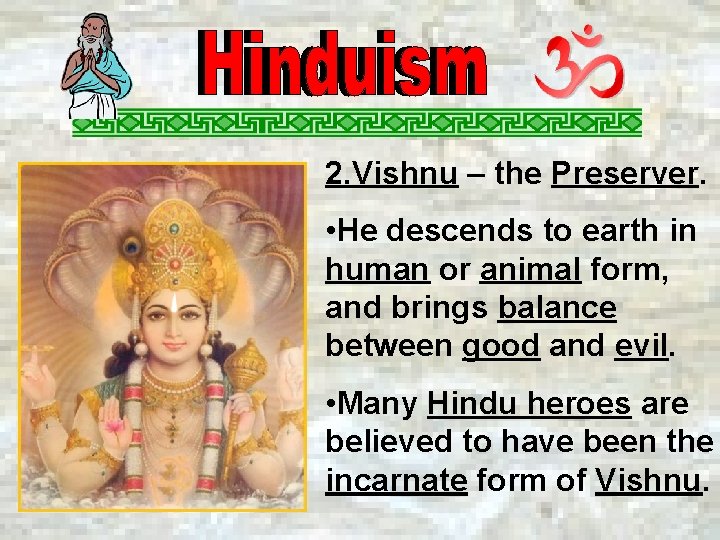
2. Vishnu – the Preserver. • He descends to earth in human or animal form, and brings balance between good and evil. • Many Hindu heroes are believed to have been the incarnate form of Vishnu.
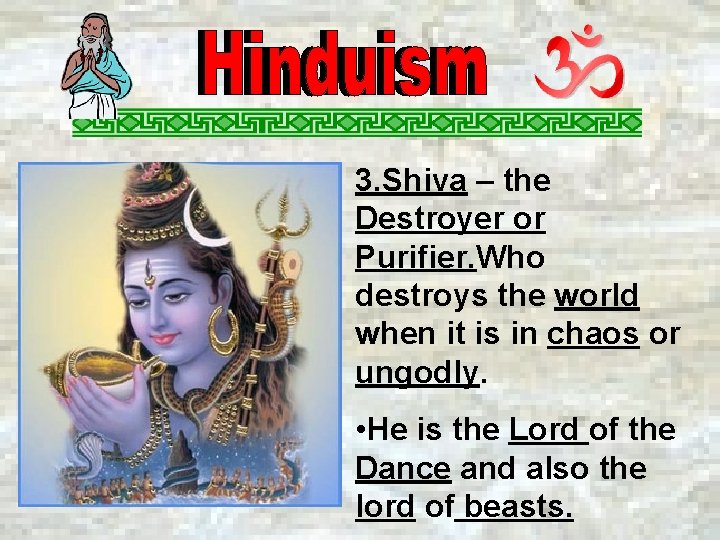
3. Shiva – the Destroyer or Purifier. Who destroys the world when it is in chaos or ungodly. • He is the Lord of the Dance and also the lord of beasts.
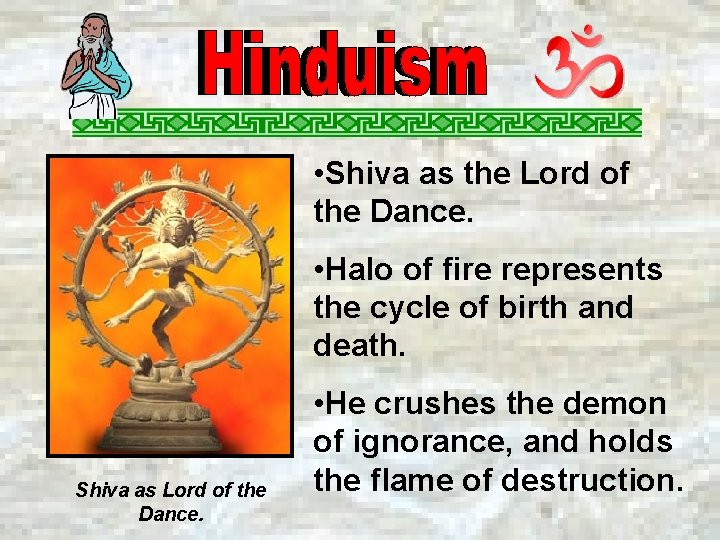
• Shiva as the Lord of the Dance. • Halo of fire represents the cycle of birth and death. Shiva as Lord of the Dance. • He crushes the demon of ignorance, and holds the flame of destruction.
List the top 3 Hindu gods here… 1.
1. What is unique about the epic poems, the Mahabharata and the Ramayana? 2. Who is dialoging in the Bhagavad-Gita? 3. List a Hindu value taught in the Bhagavad-Gita. 4. Who are the top 3 Hindu gods? 5. Which one is the “Lord of the Dance? ”
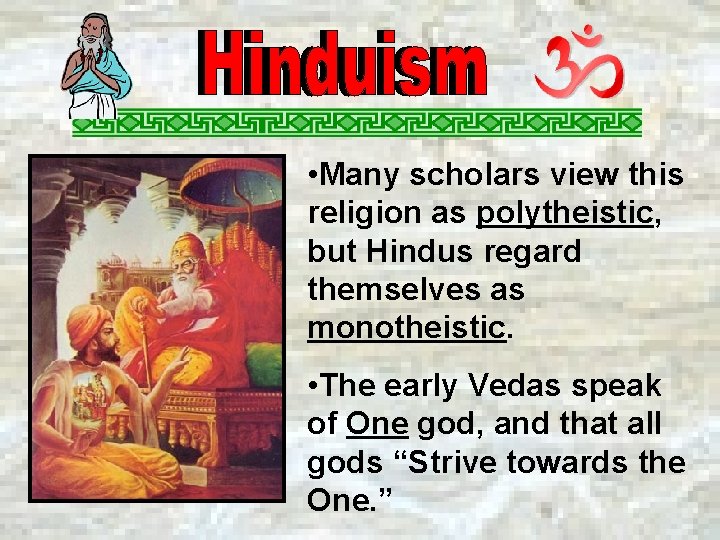
• Many scholars view this religion as polytheistic, but Hindus regard themselves as monotheistic. • The early Vedas speak of One god, and that all gods “Strive towards the One. ”
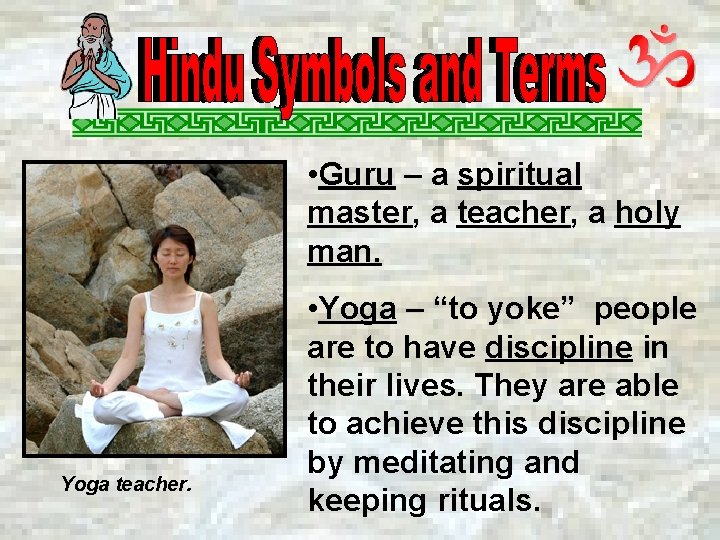
• Guru – a spiritual master, a teacher, a holy man. Yoga teacher. • Yoga – “to yoke” people are to have discipline in their lives. They are able to achieve this discipline by meditating and keeping rituals.
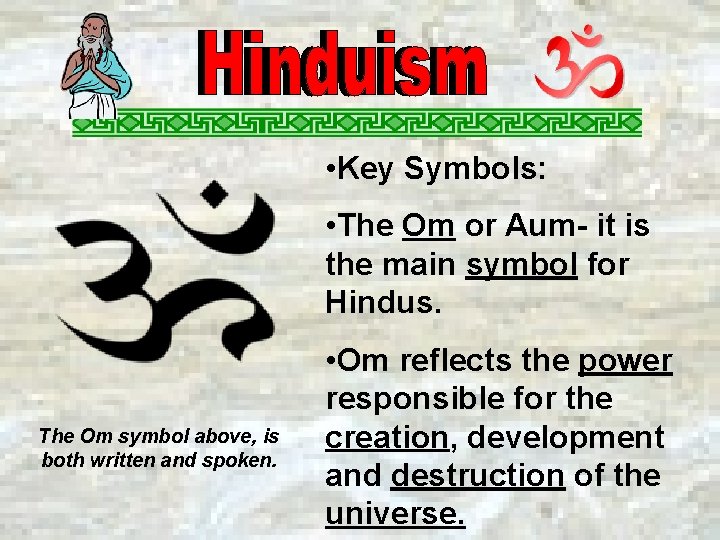
• Key Symbols: • The Om or Aum- it is the main symbol for Hindus. The Om symbol above, is both written and spoken. • Om reflects the power responsible for the creation, development and destruction of the universe.
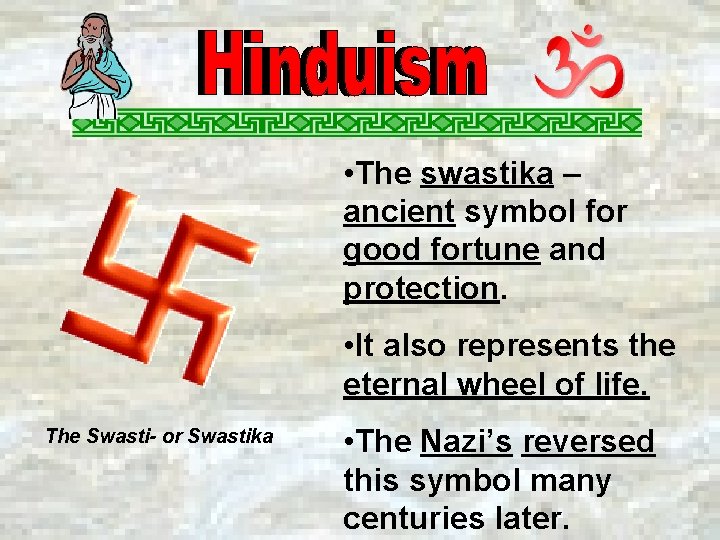
• The swastika – ancient symbol for good fortune and protection. • It also represents the eternal wheel of life. The Swasti- or Swastika • The Nazi’s reversed this symbol many centuries later.
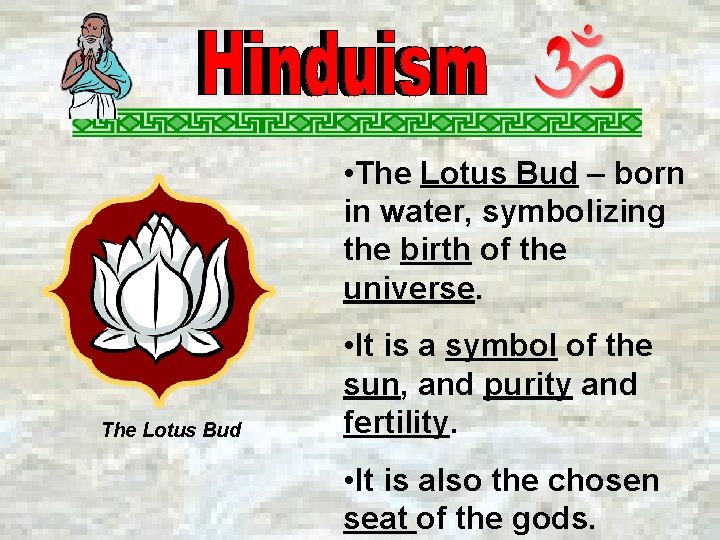
• The Lotus Bud – born in water, symbolizing the birth of the universe. The Lotus Bud • It is a symbol of the sun, and purity and fertility. • It is also the chosen seat of the gods.
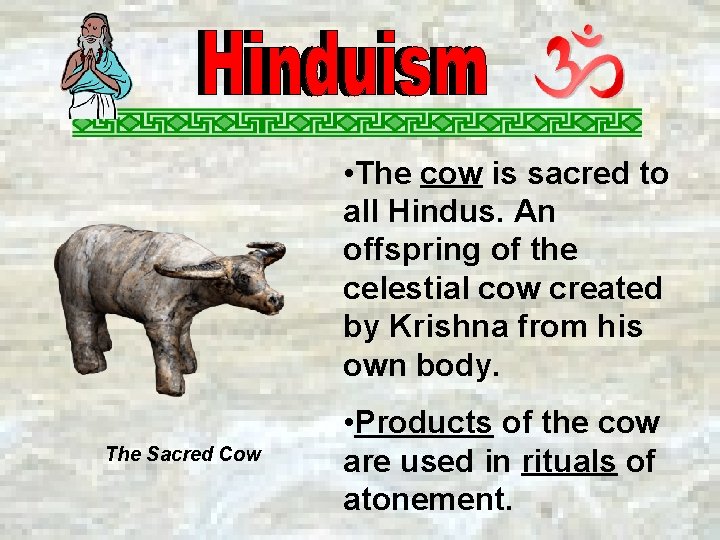
• The cow is sacred to all Hindus. An offspring of the celestial cow created by Krishna from his own body. The Sacred Cow • Products of the cow are used in rituals of atonement.
1. What is a guru? 2. What does yoga mean? 3. What is the primary Hindu symbol? 4. What did the swastika originally mean? 5. Which animal is sacred to the Hindus?

• Key Vocabulary: • Atman – the innermost self, or soul, tries to unite with the ultimate truth, Brahman. The creator god, Brahman. • To unite with the universal soul, one must meditate and have good karma.
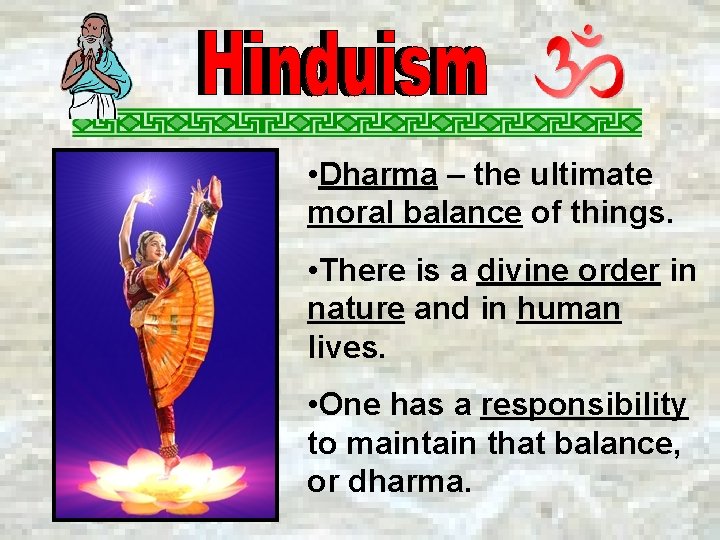
• Dharma – the ultimate moral balance of things. • There is a divine order in nature and in human lives. • One has a responsibility to maintain that balance, or dharma.
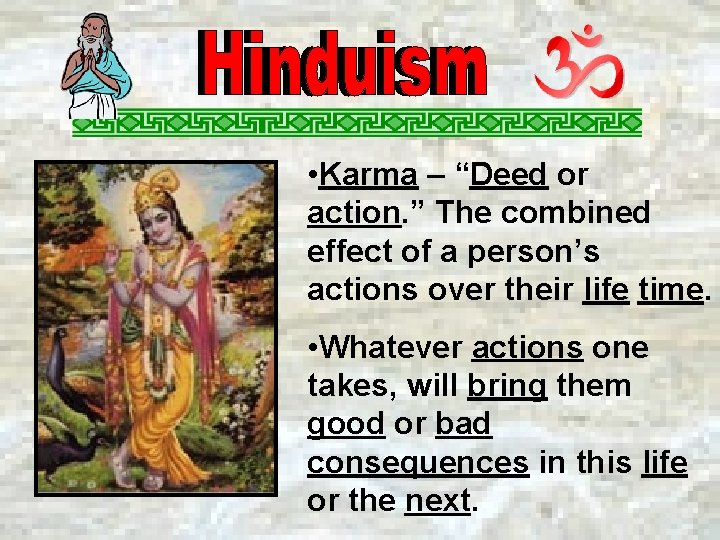
• Karma – “Deed or action. ” The combined effect of a person’s actions over their life time. • Whatever actions one takes, will bring them good or bad consequences in this life or the next.
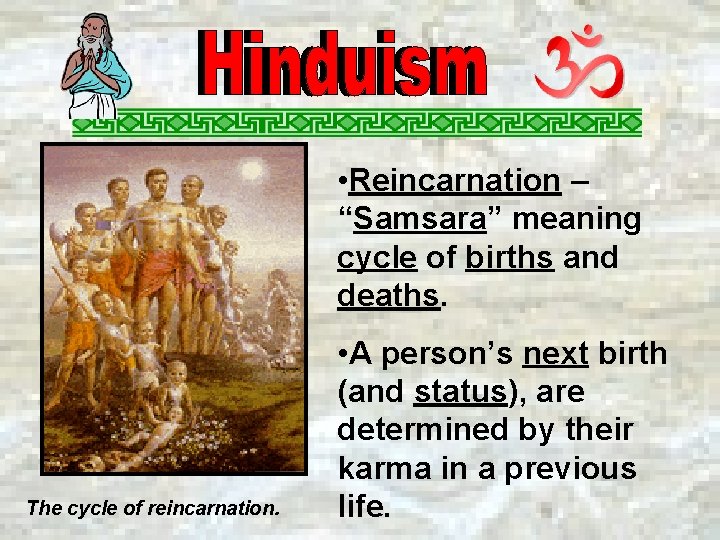
• Reincarnation – “Samsara” meaning cycle of births and deaths. The cycle of reincarnation. • A person’s next birth (and status), are determined by their karma in a previous life.
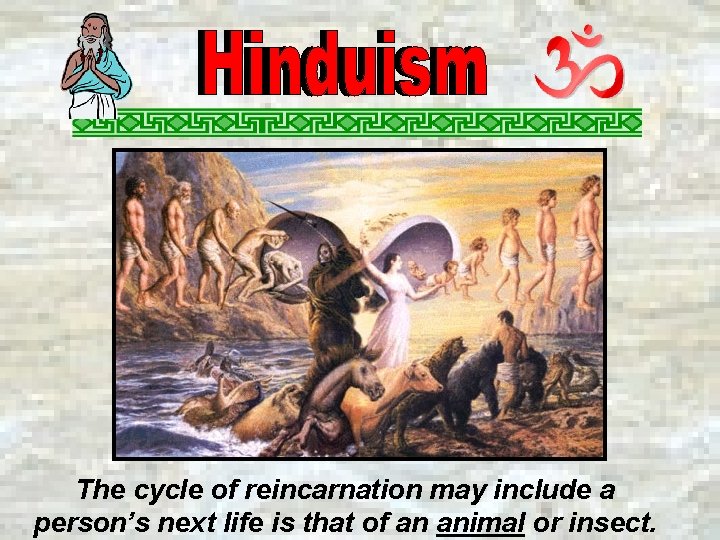
The cycle of reincarnation may include a person’s next life is that of an animal or insect.
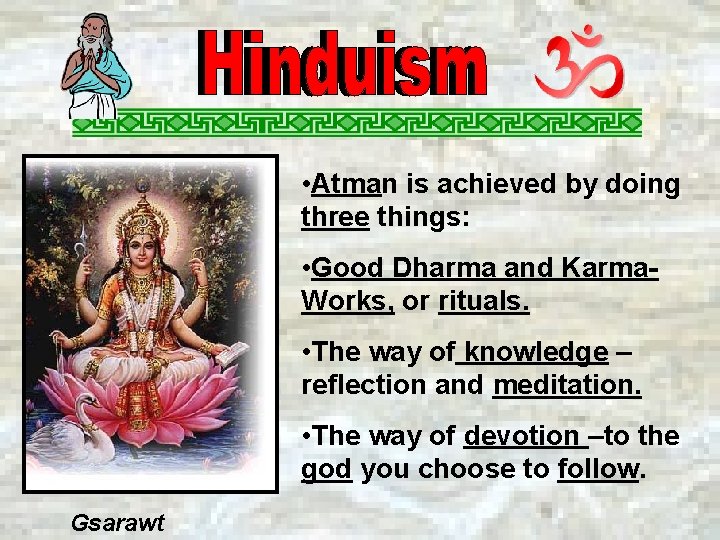
• Atman is achieved by doing three things: • Good Dharma and Karma. Works, or rituals. • The way of knowledge – reflection and meditation. • The way of devotion –to the god you choose to follow. Gsarawt
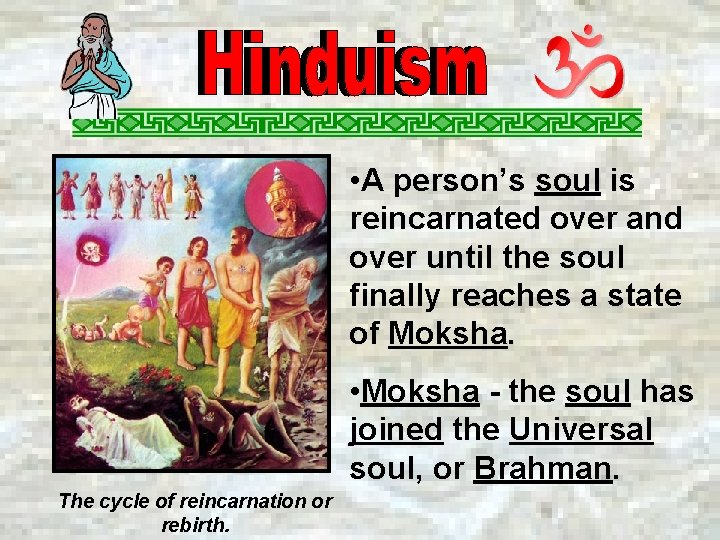
• A person’s soul is reincarnated over and over until the soul finally reaches a state of Moksha. • Moksha - the soul has joined the Universal soul, or Brahman. The cycle of reincarnation or rebirth.
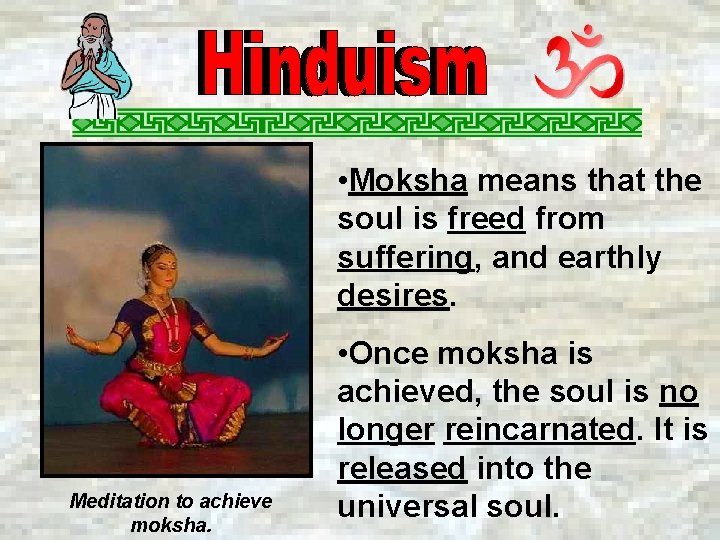
• Moksha means that the soul is freed from suffering, and earthly desires. Meditation to achieve moksha. • Once moksha is achieved, the soul is no longer reincarnated. It is released into the universal soul.
1. What is the Hindu term for a person’s soul? 2. This is the ultimate moral balance… 3. Define karma. 4. Define reincarnation or samsara. 5. If a Hindu’s soul has achieved this, they are no longer reincarnated….
- Slides: 35