
IDENTIFY THE 8 PARTSOFSPEECH NOUNS PRONOUNS ADJECTIVES VERBS
IDENTIFY THE 8 PARTS-OFSPEECH • • NOUNS PRONOUNS ADJECTIVES VERBS ADVERBS PREPOSITIONS CONJUNCTIONS INTERJECTIONS
Identify all of the nouns in the following sentence: • The lively team mascot of the Kansas City Chiefs, a professional football team, tackled the obnoxious fan who ran onto the field during the game.
NOUNS • What is a noun? • A noun is a person, place, thing, or idea. • What are the two main types of nouns? • proper nouns and common nouns
Common Nouns • What is a common noun? • A common noun is a general word that names a person, place, thing, or idea • Common nouns are not capitalized. • Examples: desk, chair, pen, paper
PROPER NOUNS • What is a proper noun? • A proper noun is a word that names a specific person, place, thing or idea. • Proper nouns are always capitalized • Examples: Mr. Vezina, North Haven High School, Alicia, Austin
CONCRETE & ABSTRACT NOUNS • Nouns can also be concrete or abstract. • What is a concrete noun? • A concrete noun names a person, place, or thing that can be perceived by one or more of the senses • Examples: water, Mr. Vezina, car, island, gas • What is an abstract noun? • An abstract noun names an idea, a feeling, a quality, or a characteristic. • Examples: happiness, love, courage, faith, freedom
CONCRETE/ABSTRACT NOUNS • Underline all of the concrete nouns, and circle all of the abstract nouns. • fog, enthusiasm, joy, milk, lightning, anger, ambition, barrel, love, sky, candy, dirt, fear
COMPOUND NOUNS • What is a compound noun? • A compound noun consists of two or more words used together as a single noun. • The parts of a compound noun may be written as one word: • Examples: newspaper, footprint • The parts of a compound noun may also be written as two or more words: • Examples: high school, League of Nations • The parts of a compound noun may also be written as a hyphenated word: • Examples: great-grandmother, left-hander, vice-president
Examples: • The Boston Red Sox clinched the American League East Division Title as a result of their win on Friday night and the loss by the New York Yankees. • The New York Mets failed to make a playoff spot, and, as a result, most of the players will be fly-fishing this week.
PRONOUNS • What is a pronoun? • A pronoun is a word that is used in place of one or more nouns or pronouns. • Example: • The class is hungry. They will soon be going to lunch. • • What is the pronoun? they What noun is being replaced by the pronoun? class (word that gives meaning to the pronoun they) • The word that a pronoun stands for or refers to is called the antecedent of the pronoun. • The pronoun may appear in the same sentence as its antecedent or in a nearby sentence.
PERSONAL PRONOUNS • A personal pronoun refers to the one speaking (first person), the one spoken to (second person), or the one spoken about (third person). • What are the first person pronouns? • I, me, mine, we, us, ours • What are the second person pronouns? • you, yours • What are third person pronouns? • He, him, his, she, hers, its, they, them, theirs
OTHER TYPES OF PRONOUNS • A reflexive pronoun refers to the subject of a sentence and functions as a complement or as an object of a preposition. • An intensive pronoun emphasizes its antecedent and has no grammatical function. • Reflexive and intensive pronouns- PLEASE MEMORIZE! • myself, ourselves, yourself, yourselves, himself, herself, itself, themselves • Examples: • I [personal] consider myself [reflexive] fortunate to have such good friends. • They [personal] made the costumes themselves [intensive].
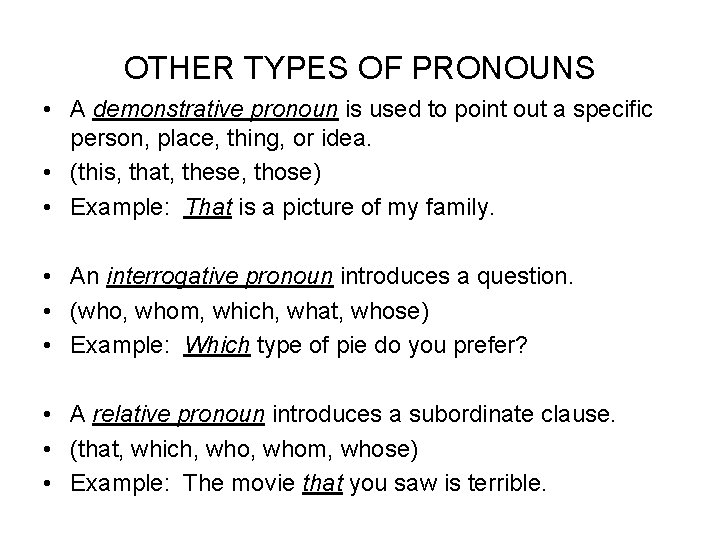
OTHER TYPES OF PRONOUNS • A demonstrative pronoun is used to point out a specific person, place, thing, or idea. • (this, that, these, those) • Example: That is a picture of my family. • An interrogative pronoun introduces a question. • (who, whom, which, what, whose) • Example: Which type of pie do you prefer? • A relative pronoun introduces a subordinate clause. • (that, which, whom, whose) • Example: The movie that you saw is terrible.
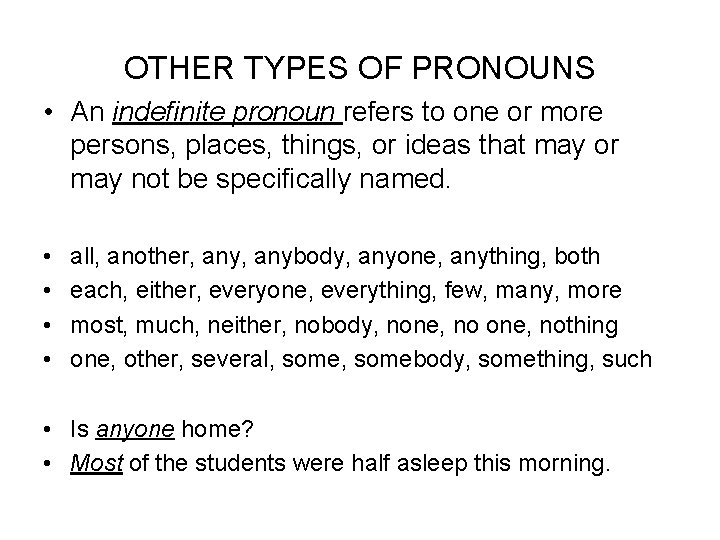
OTHER TYPES OF PRONOUNS • An indefinite pronoun refers to one or more persons, places, things, or ideas that may or may not be specifically named. • • all, another, anybody, anyone, anything, both each, either, everyone, everything, few, many, more most, much, neither, nobody, none, nothing one, other, several, somebody, something, such • Is anyone home? • Most of the students were half asleep this morning.
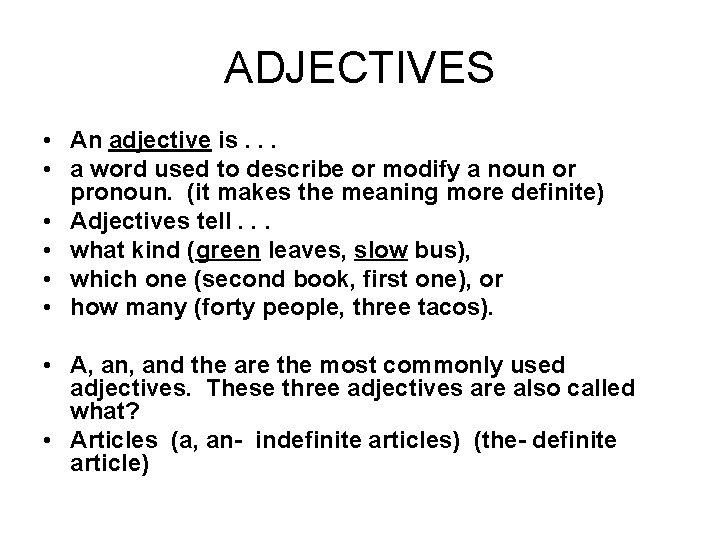
ADJECTIVES • An adjective is. . . • a word used to describe or modify a noun or pronoun. (it makes the meaning more definite) • Adjectives tell. . . • what kind (green leaves, slow bus), • which one (second book, first one), or • how many (forty people, three tacos). • A, and the are the most commonly used adjectives. These three adjectives are also called what? • Articles (a, an- indefinite articles) (the- definite article)
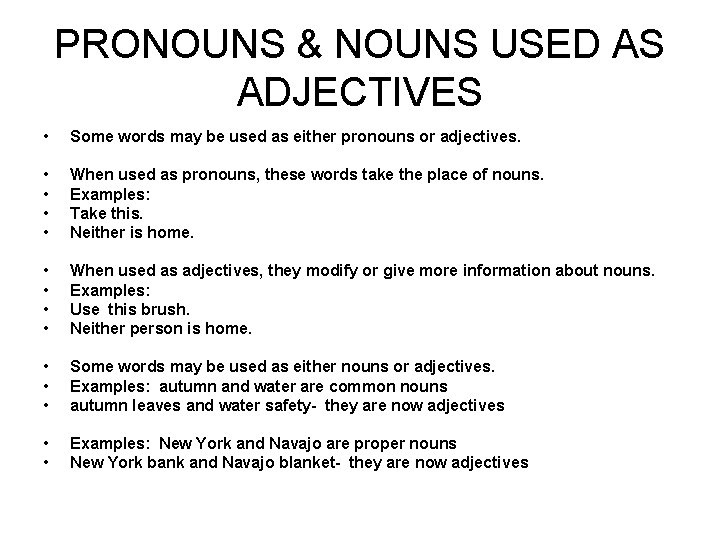
PRONOUNS & NOUNS USED AS ADJECTIVES • Some words may be used as either pronouns or adjectives. • • When used as pronouns, these words take the place of nouns. Examples: Take this. Neither is home. • • When used as adjectives, they modify or give more information about nouns. Examples: Use this brush. Neither person is home. • • • Some words may be used as either nouns or adjectives. Examples: autumn and water are common nouns autumn leaves and water safety- they are now adjectives • • Examples: New York and Navajo are proper nouns New York bank and Navajo blanket- they are now adjectives
- Slides: 16