
Identify notation denoting fractions decimals percentages and ratio
- Slides: 18
Identify notation denoting fractions, decimals, percentages and ratio. Calculate fractions, percentages and ratios of amounts. Order and compare common fractions, decimals and percentages (equivalencies). E 2 Read and write halves and quarters of quantities, write fractions as words, numbers and symbols, find halves and quarters of shapes and quantities, state the number of halves and quarters it takes to make one whole, compare halves and quarters of quantities. E 3 Define numerator and denominator, identify and use equivalent fractions in everyday contexts. Read and write decimals to two decimal places, write common measures and money in decimal form, identify place value, use a calculator to solve and check problems using whole numbers and decimals. L 1 Read and write mixed numbers, state everyday situations where common fractions and mixed numbers are used, write and calculate halves, quarters, thirds, fifths, tenths. Order, arrange and compare fractions and mixed numbers using < and >. Know equivalencies between common fractions, percentages and decimals, work out simple ratio and direct proportion, use simple ratio expressed in the form of three parts to one part, scale quantities by a factor of two. Read, write, order and compare decimal numbers up to three places, recognise decimals in everyday situations, use < and > to describe decimals, add, subtract, multiply and divide decimals up to two places using calculator and non-calculator methods, multiply and divide decimals by 10 and 100 without calculator, divide decimals up to 2 decimal places by single digit whole numbers using non-calculator and calculator methods, approximate decimals by rounding, round decimals to wholes and two decimal places. Recognise, read, write and compare percentages and identify everyday uses, use < and > to describe percentages, calculate simple percentage increase and decreases with and without calculator and state everyday uses, find whole number percentage parts of quantities and measurements with and without calculator. L 2 Use fractions to compare amounts and quantities, use factors to reduce fractions to simplest form, use fractions with same and different denominators to order amounts, use FDP equivalences to order fractions, decimals and percentages, calculate parts of whole numbers, evaluate one number as a fraction of another and simplify, use fractions to add and subtract amounts and quantities with and without calculator, calculator check calculations, calculate ratio and direct proportion. Add and subtract fractions. Calculate the number of parts in a ratio, use ratio in the form a: b: c. Round numbers with three decimal places to two, one and whole numbers, round calculator answers to appropriate degree of accuracy. Add, subtract, multiply, divide, read and order decimals up to three places with and without calculator. Order percentages, evaluate one number as percentage of another.
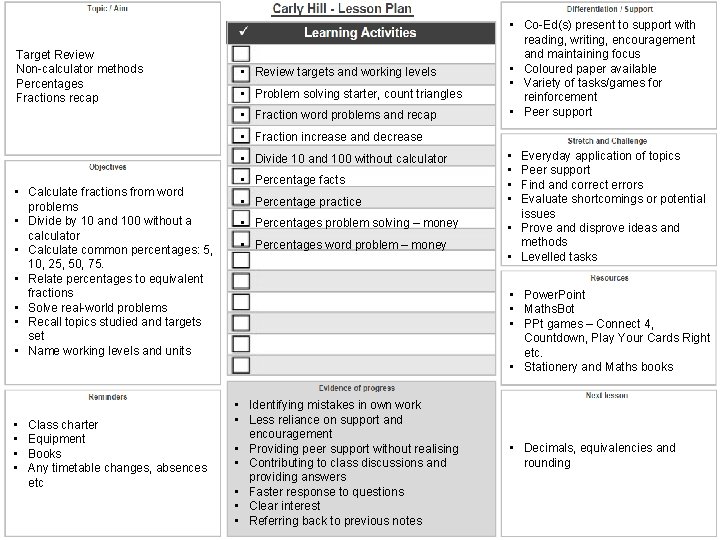
Target Review Non-calculator methods Percentages Fractions recap • Review targets and working levels • Problem solving starter, count triangles • Fraction word problems and recap • Co-Ed(s) present to support with reading, writing, encouragement and maintaining focus • Coloured paper available • Variety of tasks/games for reinforcement • Peer support • Fraction increase and decrease • Divide 10 and 100 without calculator • Calculate fractions from word problems • Divide by 10 and 100 without a calculator • Calculate common percentages: 5, 10, 25, 50, 75. • Relate percentages to equivalent fractions • Solve real-world problems • Recall topics studied and targets set • Name working levels and units • • Class charter Equipment Books Any timetable changes, absences etc • Percentage facts • Percentage practice • Percentages problem solving – money • Percentages word problem – money • • Everyday application of topics Peer support Find and correct errors Evaluate shortcomings or potential issues • Prove and disprove ideas and methods • Levelled tasks • Power. Point • Maths. Bot • PPt games – Connect 4, Countdown, Play Your Cards Right etc. • Stationery and Maths books • Identifying mistakes in own work • Less reliance on support and encouragement • Providing peer support without realising • Contributing to class discussions and providing answers • Faster response to questions • Clear interest • Referring back to previous notes • Decimals, equivalencies and rounding
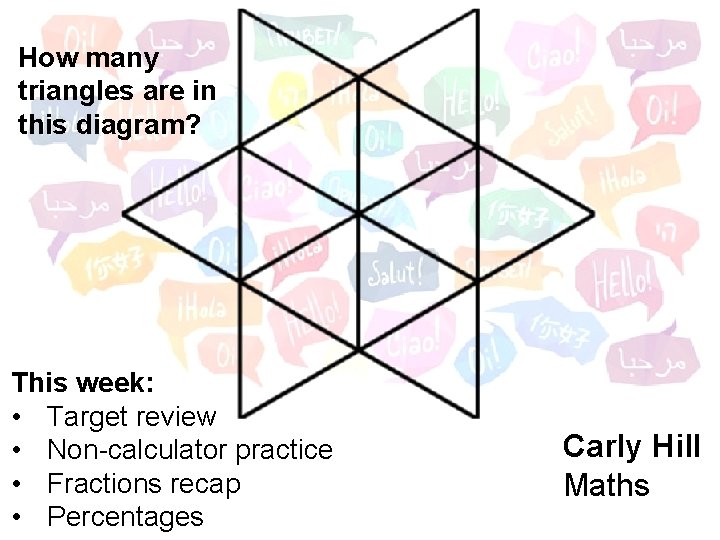
How many triangles are in this diagram? This week: • Target review • Non-calculator practice • Fractions recap • Percentages Carly Hill Maths
Why do I need to know this? • Also helps to understand fractions and decimals • Helps understand equivalencies between fractions, decimals and percentages • Multiplying and dividing by 10 and 100 When will I need to use this? • Rounding and estimating • Working with money • Calculating price increases and decreases
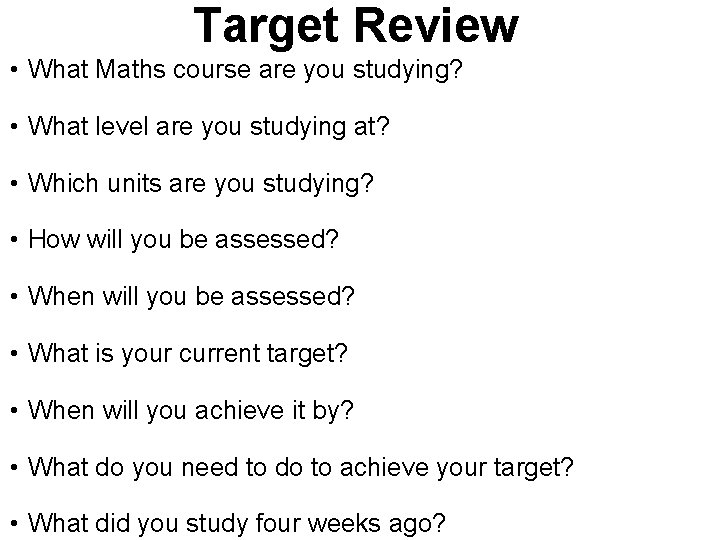
Target Review • What Maths course are you studying? • What level are you studying at? • Which units are you studying? • How will you be assessed? • When will you be assessed? • What is your current target? • When will you achieve it by? • What do you need to do to achieve your target? • What did you study four weeks ago?
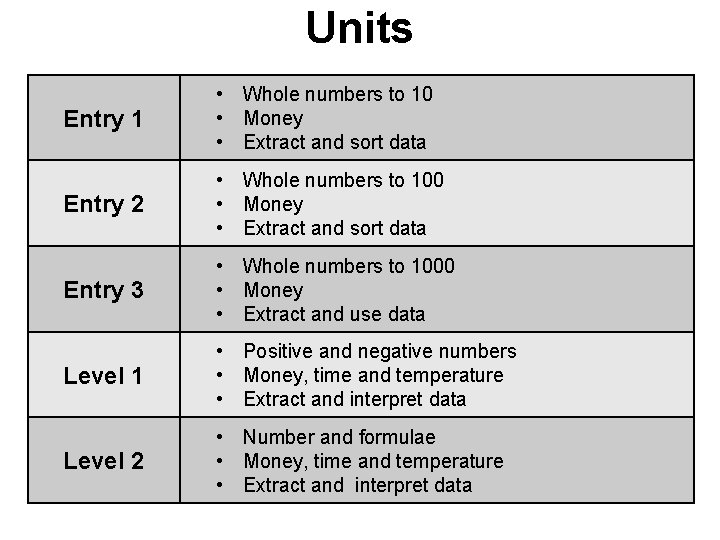
Units Entry 1 • Whole numbers to 10 • Money • Extract and sort data Entry 2 • Whole numbers to 100 • Money • Extract and sort data Entry 3 • Whole numbers to 1000 • Money • Extract and use data Level 1 • Positive and negative numbers • Money, time and temperature • Extract and interpret data Level 2 • Number and formulae • Money, time and temperature • Extract and interpret data
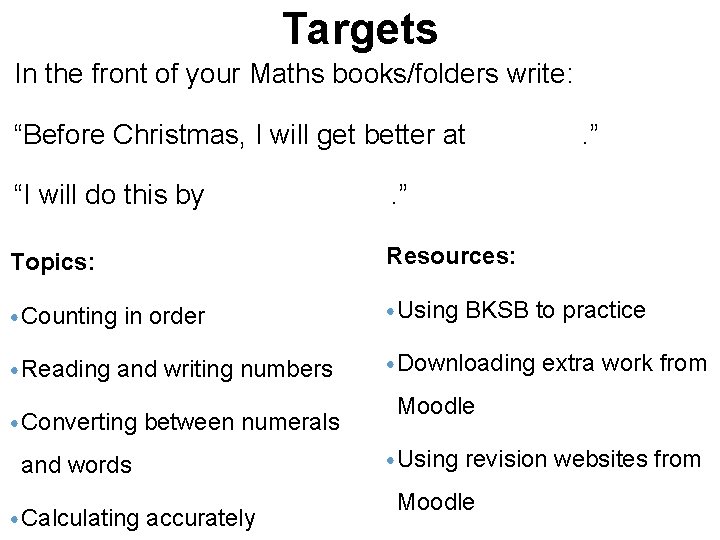
Targets In the front of your Maths books/folders write: “Before Christmas, I will get better at . ” “I will do this by . ” Topics: Resources: • Counting in order • Using BKSB to practice • Reading and writing numbers • Downloading extra work from • Converting between numerals and words • Calculating accurately Moodle • Using revision websites from Moodle
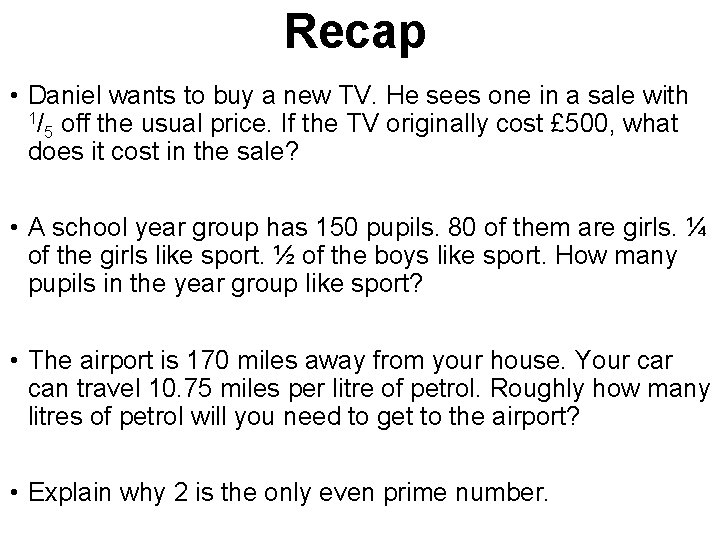
Recap • Daniel wants to buy a new TV. He sees one in a sale with 1/ off the usual price. If the TV originally cost £ 500, what 5 does it cost in the sale? • A school year group has 150 pupils. 80 of them are girls. ¼ of the girls like sport. ½ of the boys like sport. How many pupils in the year group like sport? • The airport is 170 miles away from your house. Your can travel 10. 75 miles per litre of petrol. Roughly how many litres of petrol will you need to get to the airport? • Explain why 2 is the only even prime number.
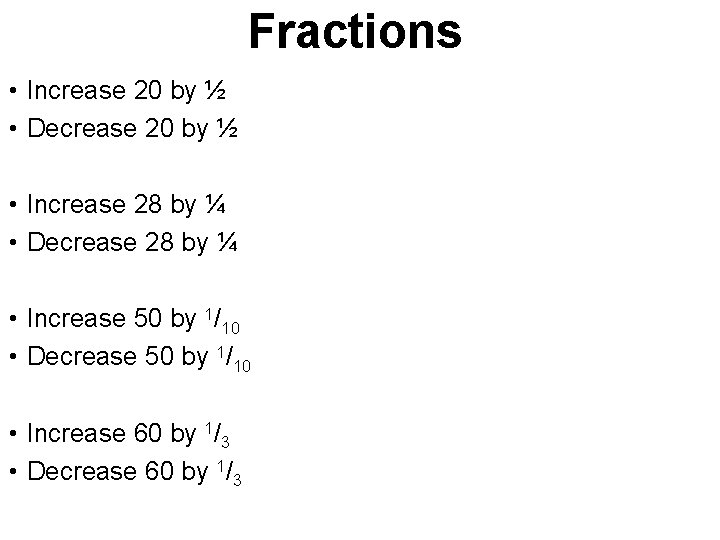
Fractions • Increase 20 by ½ • Decrease 20 by ½ • Increase 28 by ¼ • Decrease 28 by ¼ • Increase 50 by 1/10 • Decrease 50 by 1/10 • Increase 60 by 1/3 • Decrease 60 by 1/3
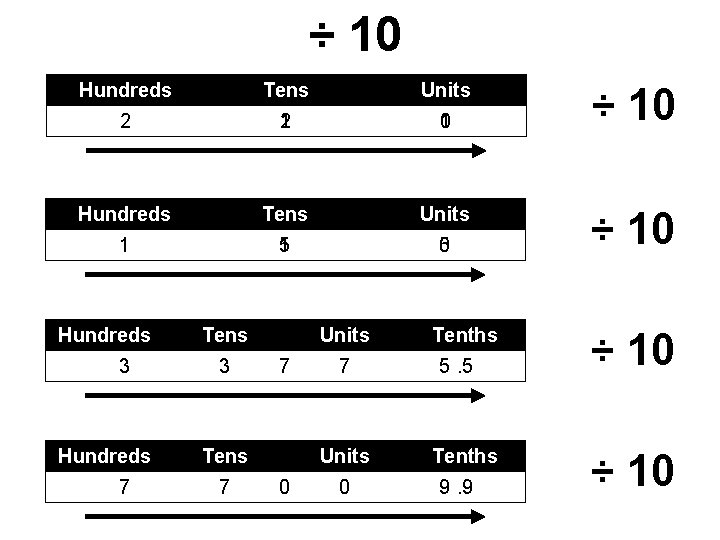
÷ 10 Hundreds Tens Units 2 1 2 0 1 Hundreds Tens Units 1 5 1 0 5 Hundreds 3 Hundreds 7 Tens Units 3 7 7 Tens Units 7 0 0 Units Tenths 5. 5 Units Tenths 9. 9 ÷ 10
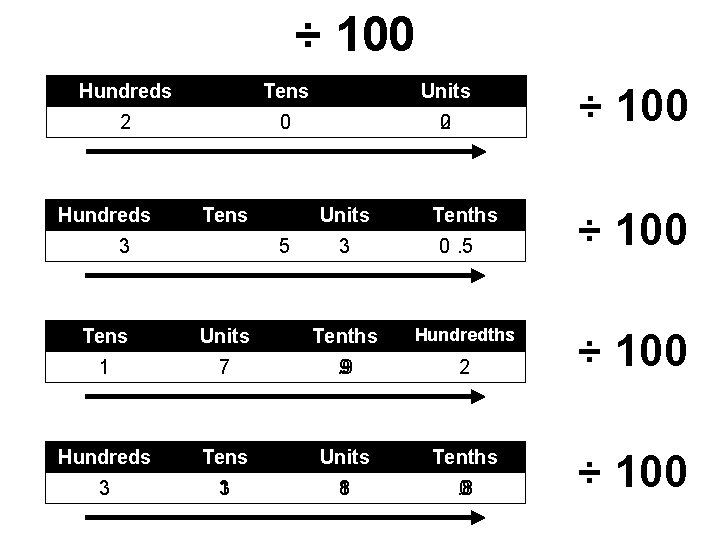
÷ 100 Hundreds Tens Units 2 0 0 2 Hundreds Tens Units Tenths 5 0. 5 3 3 Thousands Tens Hundreds Units Tenths Tens Hundredths Units 1 7 . 9 9 2 Thousands Hundreds Tens Hundreds Units Tenths Units 3 3 1 1 8 . 8 0 ÷ 100
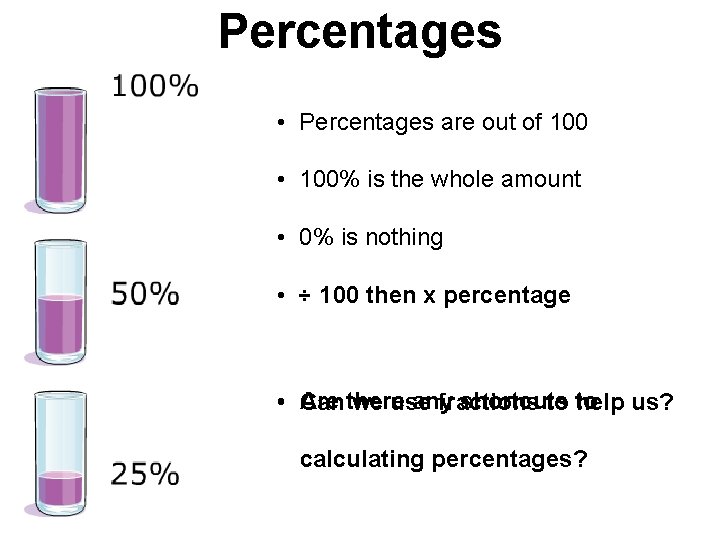
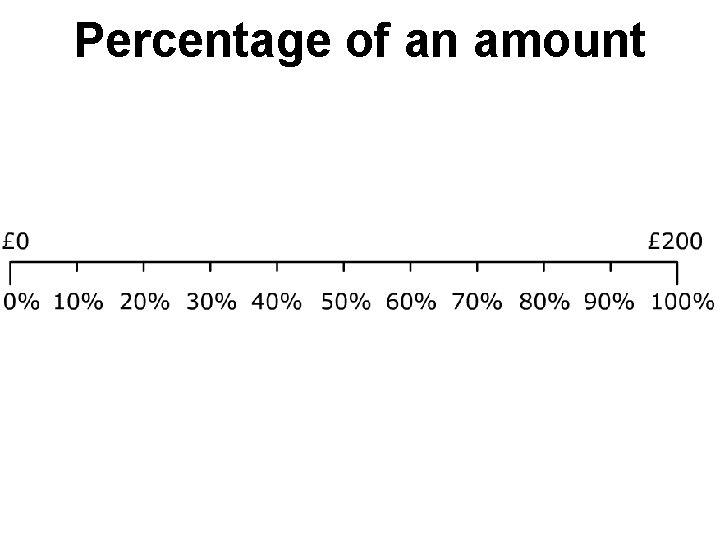
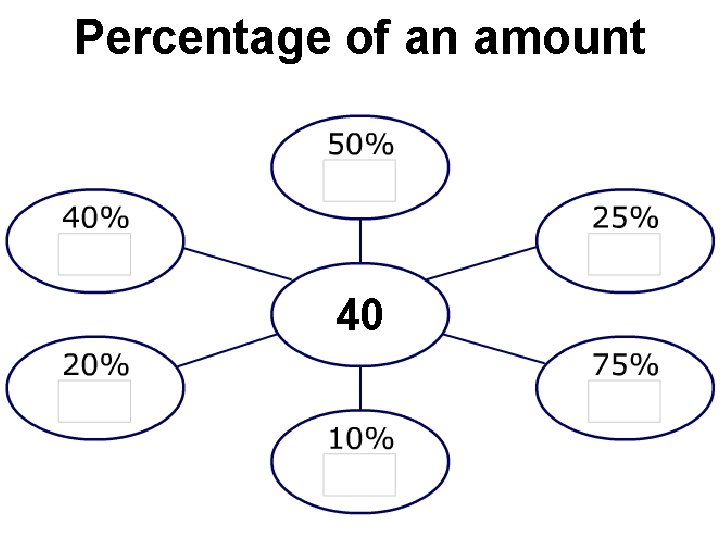
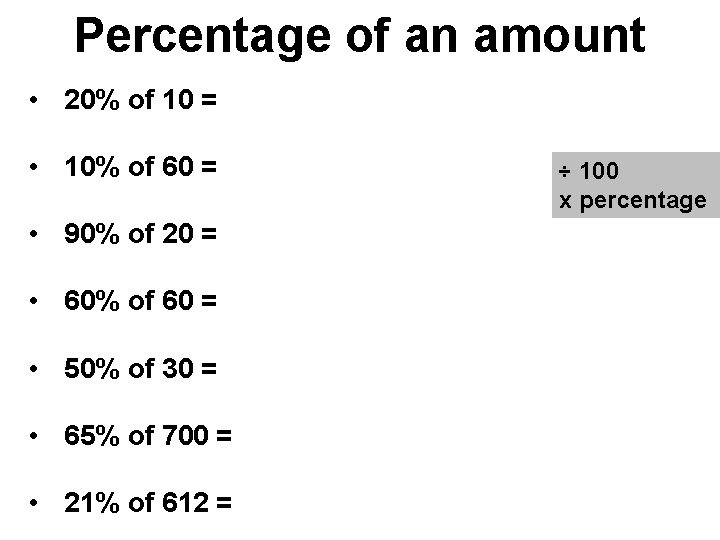
Percentages • Percentages are out of 100 • 100% is the whole amount • 0% is nothing • ÷ 100 then x percentage • Are any shortcuts Can there we use fractions to to help us? calculating percentages?
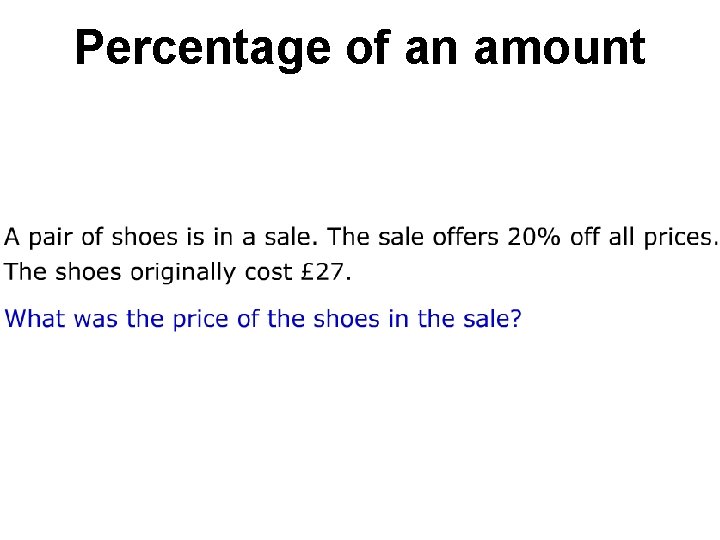
Percentage of an amount
Percentage of an amount 40
Percentage of an amount • 20% of 10 = • 10% of 60 = • 90% of 20 = • 60% of 60 = • 50% of 30 = • 65% of 700 = • 21% of 612 = ÷ 100 x percentage
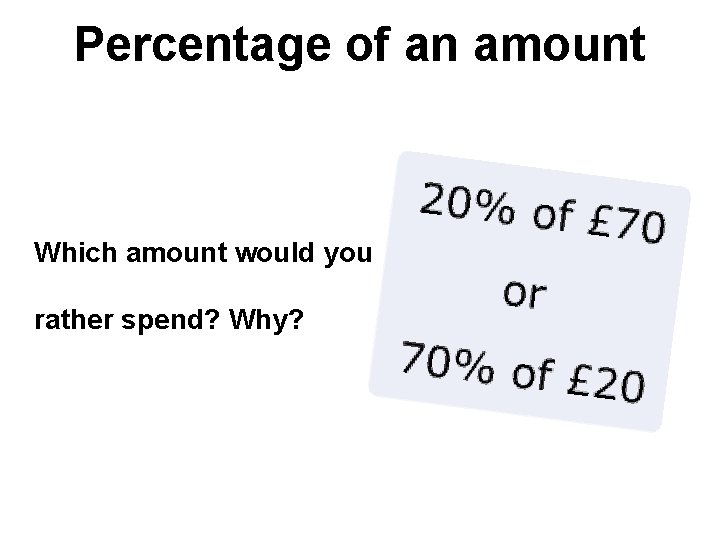
Percentage of an amount Which amount would you rather spend? Why?
Percentage of an amount
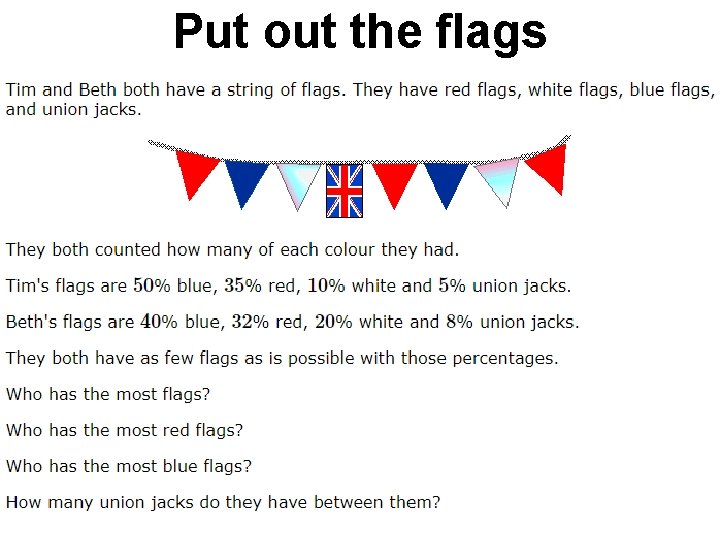
Put out the flags