
Identify factors that limit population growth Differentiate between
• Identify factors that limit population growth. • Differentiate between density-dependent and density-independent limiting factors Chapter 5 Section 2: Limits to Population Growth
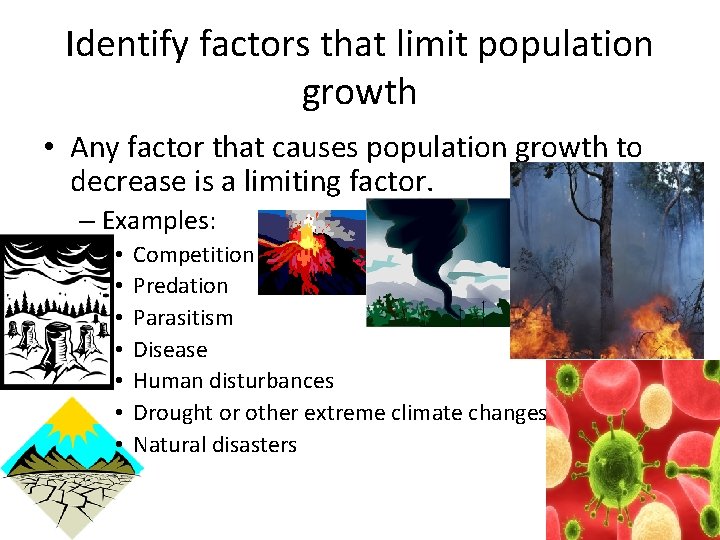
Identify factors that limit population growth • Any factor that causes population growth to decrease is a limiting factor. – Examples: • • Competition Predation Parasitism Disease Human disturbances Drought or other extreme climate changes Natural disasters
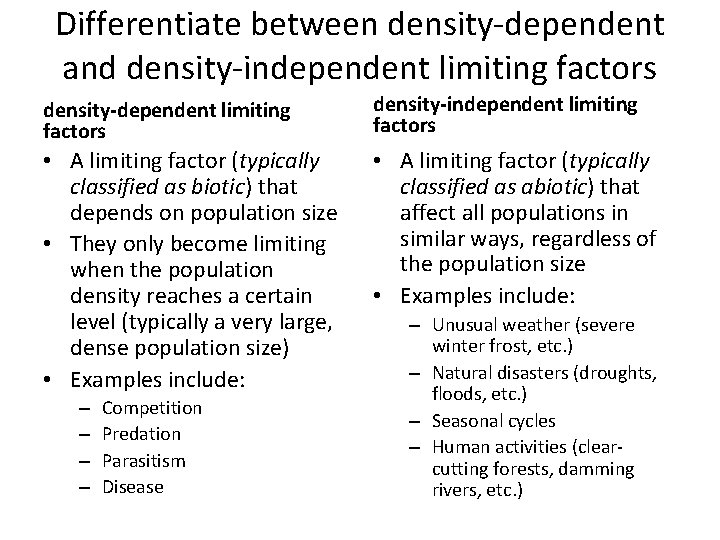
Differentiate between density-dependent and density-independent limiting factors • A limiting factor (typically classified as biotic) that depends on population size • They only become limiting when the population density reaches a certain level (typically a very large, dense population size) • Examples include: • A limiting factor (typically classified as abiotic) that affect all populations in similar ways, regardless of the population size • Examples include: – – Competition Predation Parasitism Disease – Unusual weather (severe winter frost, etc. ) – Natural disasters (droughts, floods, etc. ) – Seasonal cycles – Human activities (clearcutting forests, damming rivers, etc. )
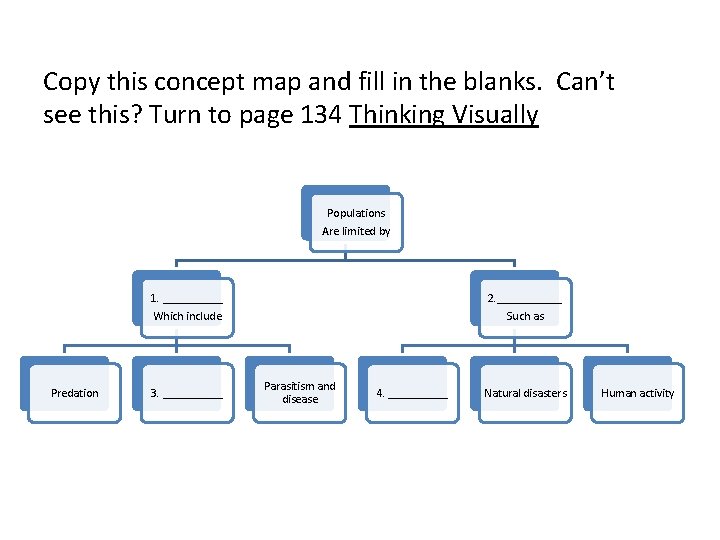
Copy this concept map and fill in the blanks. Can’t see this? Turn to page 134 Thinking Visually Populations Are limited by 1. _____ Which include Predation 3. _____ 2. ______ Such as Parasitism and disease 4. _____ Natural disasters Human activity
Post Notes Assignment • Write the questions numbered 1 – 3 on page 127 and answer them. • Then write the definitions for the vocabulary found only in section 2 • • Limiting factor Density-dependent limiting factor Density-independent limiting factor Predator-prey relationship
- Slides: 5