
Identify Arithmetic Sequences A Determine whether the sequence
- Slides: 29
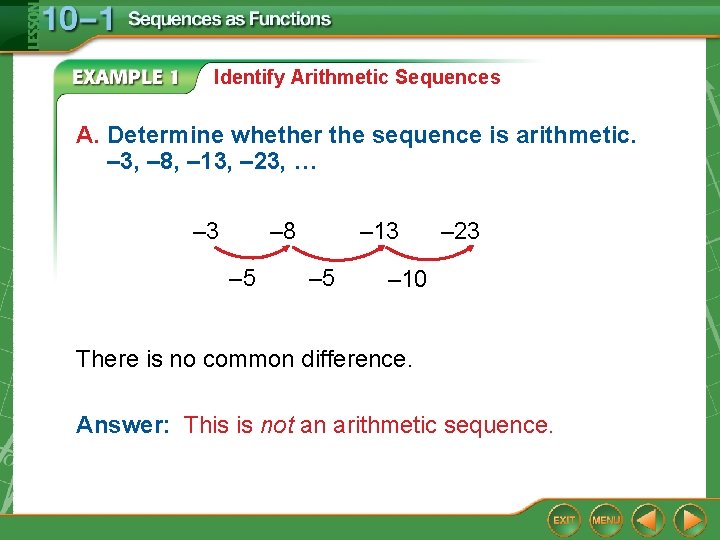
Identify Arithmetic Sequences A. Determine whether the sequence is arithmetic. – 3, – 8, – 13, – 23, … – 3 – 8 – 5 – 13 – 5 – 23 – 10 There is no common difference. Answer: This is not an arithmetic sequence.
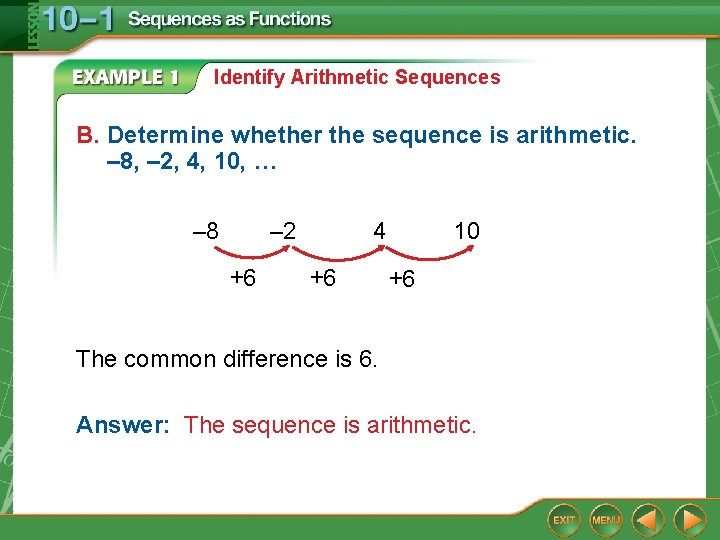
Identify Arithmetic Sequences B. Determine whether the sequence is arithmetic. – 8, – 2, 4, 10, … – 8 – 2 +6 4 +6 10 +6 The common difference is 6. Answer: The sequence is arithmetic.
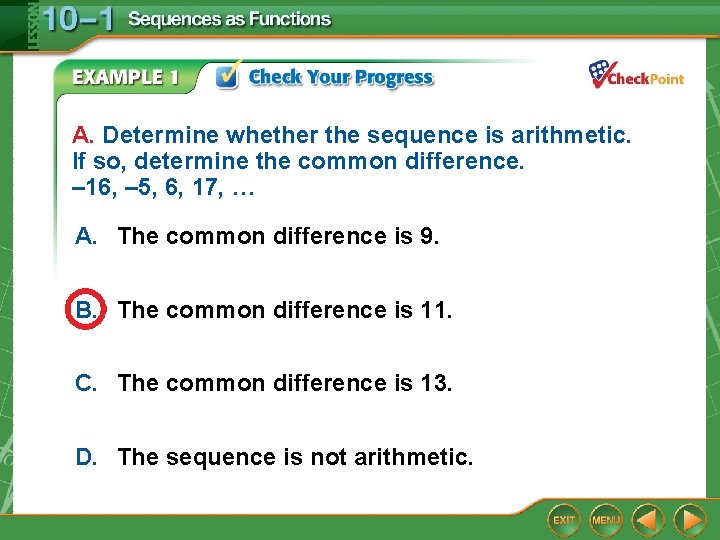
A. Determine whether the sequence is arithmetic. If so, determine the common difference. – 16, – 5, 6, 17, … A. The common difference is 9. B. The common difference is 11. C. The common difference is 13. D. The sequence is not arithmetic.
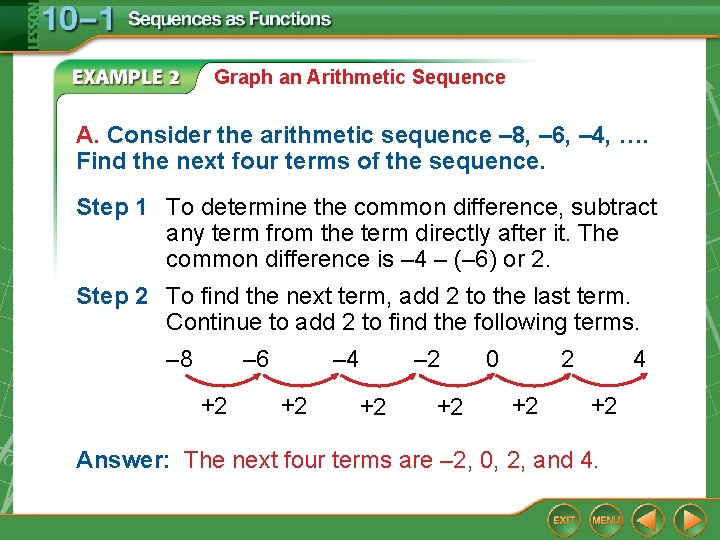
Graph an Arithmetic Sequence A. Consider the arithmetic sequence – 8, – 6, – 4, …. Find the next four terms of the sequence. Step 1 To determine the common difference, subtract any term from the term directly after it. The common difference is – 4 – (– 6) or 2. Step 2 To find the next term, add 2 to the last term. Continue to add 2 to find the following terms. – 8 – 6 +2 – 4 +2 +2 – 2 +2 0 2 +2 4 +2 Answer: The next four terms are – 2, 0, 2, and 4.
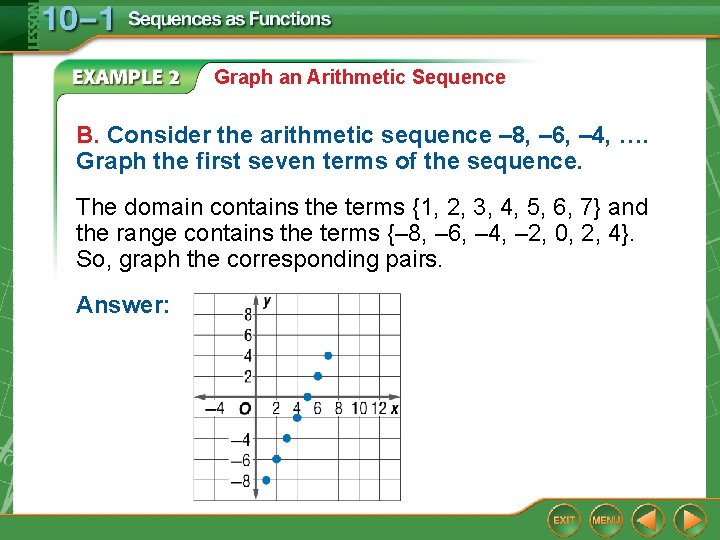
Graph an Arithmetic Sequence B. Consider the arithmetic sequence – 8, – 6, – 4, …. Graph the first seven terms of the sequence. The domain contains the terms {1, 2, 3, 4, 5, 6, 7} and the range contains the terms {– 8, – 6, – 4, – 2, 0, 2, 4}. So, graph the corresponding pairs. Answer:
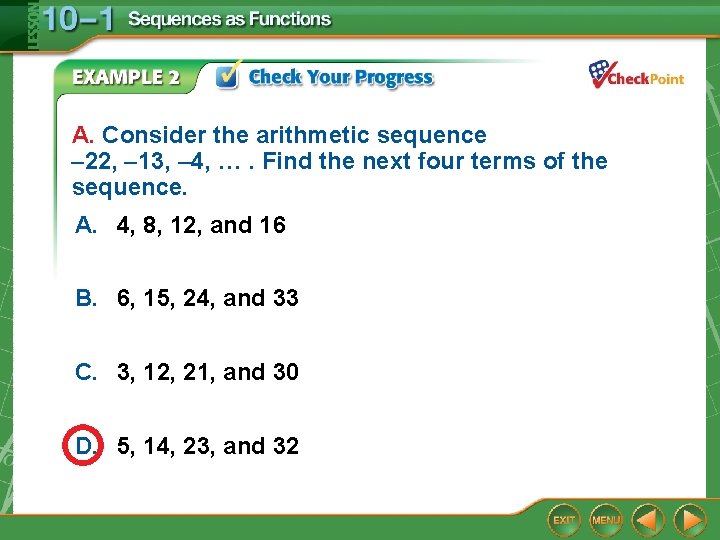
A. Consider the arithmetic sequence 22, 13, 4, …. Find the next four terms of the sequence. A. 4, 8, 12, and 16 B. 6, 15, 24, and 33 C. 3, 12, 21, and 30 D. 5, 14, 23, and 32
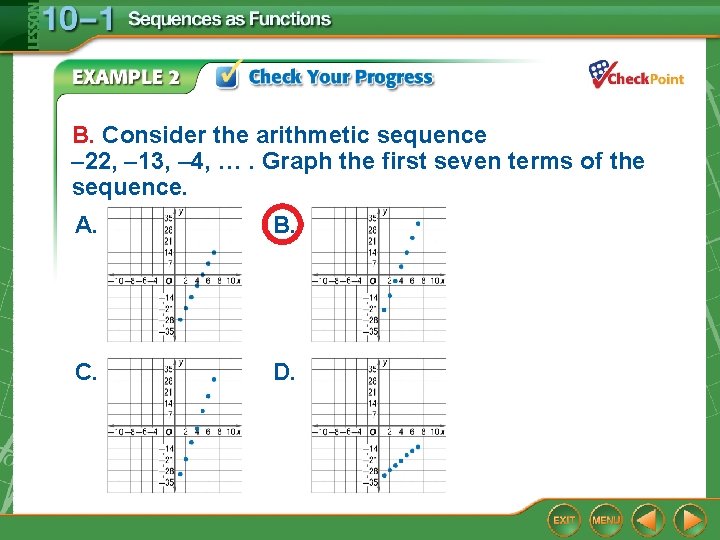
B. Consider the arithmetic sequence 22, 13, 4, …. Graph the first seven terms of the sequence. A. B. C. D.
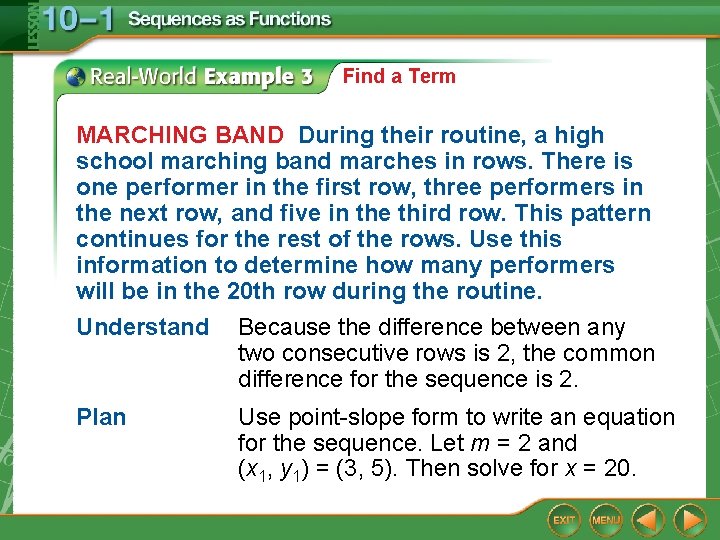
Find a Term MARCHING BAND During their routine, a high school marching band marches in rows. There is one performer in the first row, three performers in the next row, and five in the third row. This pattern continues for the rest of the rows. Use this information to determine how many performers will be in the 20 th row during the routine. Understand Because the difference between any two consecutive rows is 2, the common difference for the sequence is 2. Plan Use point-slope form to write an equation for the sequence. Let m = 2 and (x 1, y 1) = (3, 5). Then solve for x = 20.
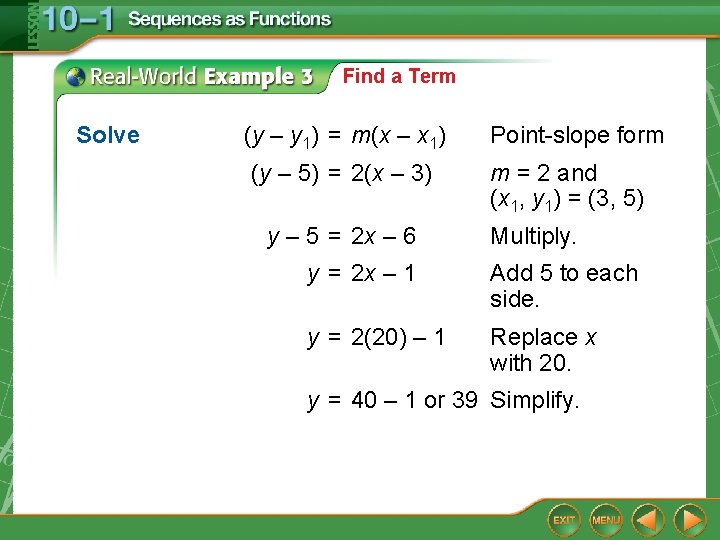
Find a Term Solve (y – y 1) = m(x – x 1) (y – 5) = 2(x – 3) y – 5 = 2 x – 6 Point-slope form m = 2 and (x 1, y 1) = (3, 5) Multiply. y = 2 x – 1 Add 5 to each side. y = 2(20) – 1 Replace x with 20. y = 40 – 1 or 39 Simplify.
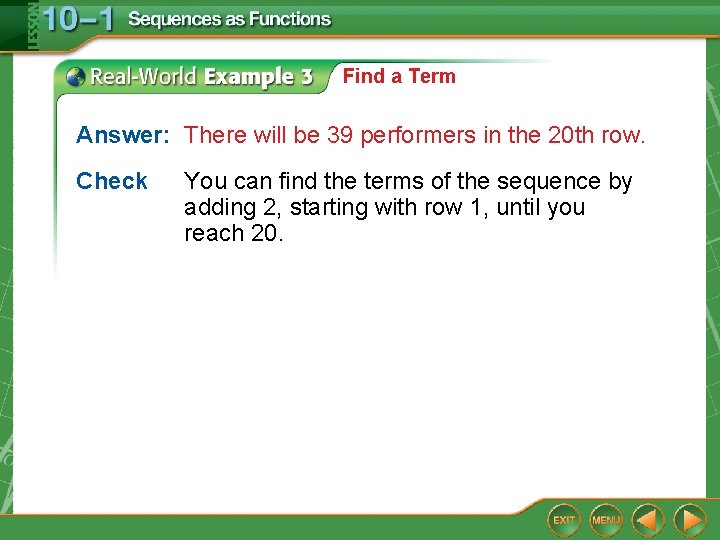
Find a Term Answer: There will be 39 performers in the 20 th row. Check You can find the terms of the sequence by adding 2, starting with row 1, until you reach 20.
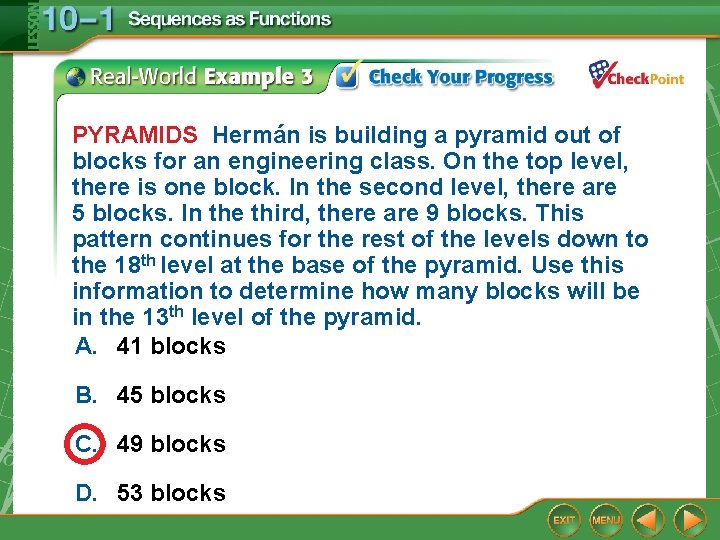
PYRAMIDS Hermán is building a pyramid out of blocks for an engineering class. On the top level, there is one block. In the second level, there are 5 blocks. In the third, there are 9 blocks. This pattern continues for the rest of the levels down to the 18 th level at the base of the pyramid. Use this information to determine how many blocks will be in the 13 th level of the pyramid. A. 41 blocks B. 45 blocks C. 49 blocks D. 53 blocks
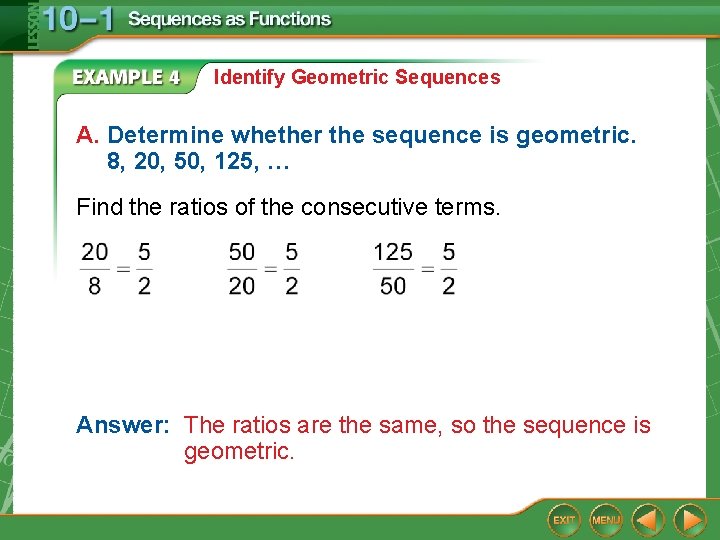
Identify Geometric Sequences A. Determine whether the sequence is geometric. 8, 20, 50, 125, … Find the ratios of the consecutive terms. Answer: The ratios are the same, so the sequence is geometric.
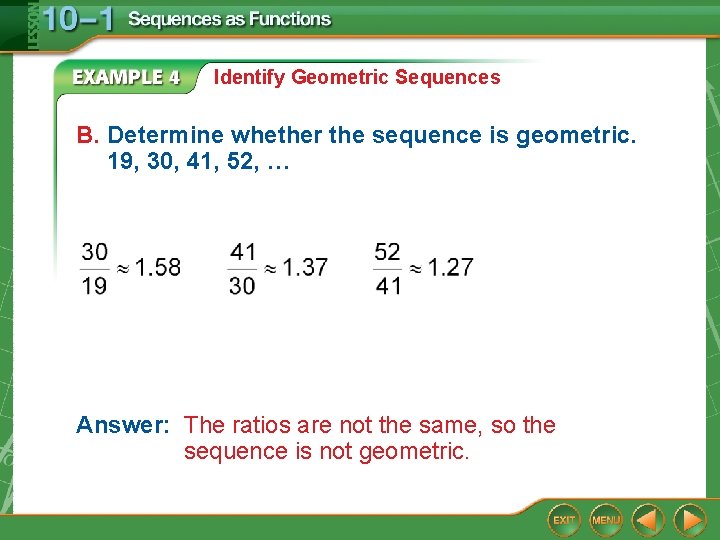
Identify Geometric Sequences B. Determine whether the sequence is geometric. 19, 30, 41, 52, … Answer: The ratios are not the same, so the sequence is not geometric.
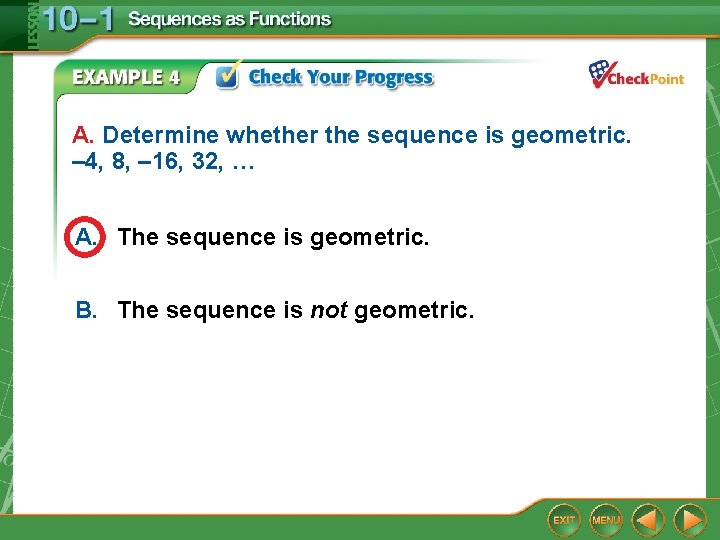
A. Determine whether the sequence is geometric. – 4, 8, – 16, 32, … A. The sequence is geometric. B. The sequence is not geometric. A. A B. B
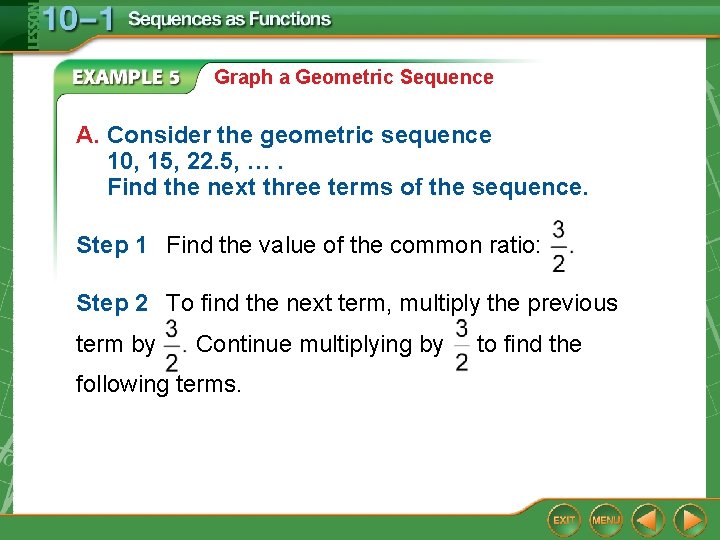
Graph a Geometric Sequence A. Consider the geometric sequence 10, 15, 22. 5, …. Find the next three terms of the sequence. Step 1 Find the value of the common ratio: Step 2 To find the next term, multiply the previous term by Continue multiplying by following terms. to find the
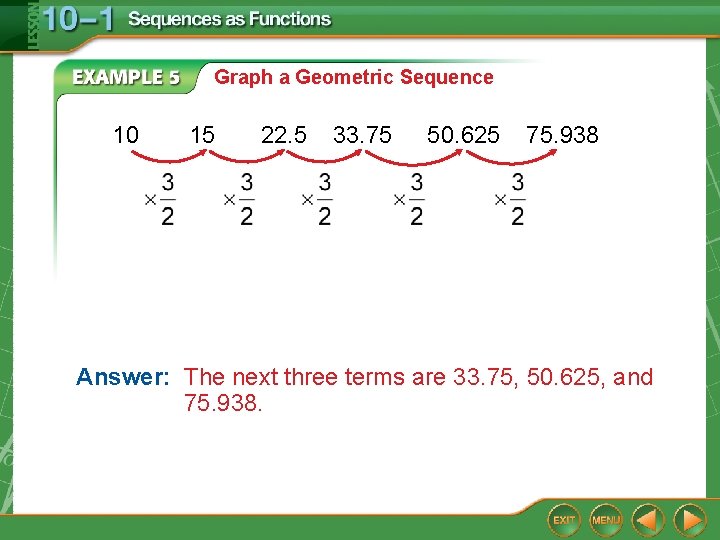
Graph a Geometric Sequence 10 15 22. 5 33. 75 50. 625 75. 938 Answer: The next three terms are 33. 75, 50. 625, and 75. 938.
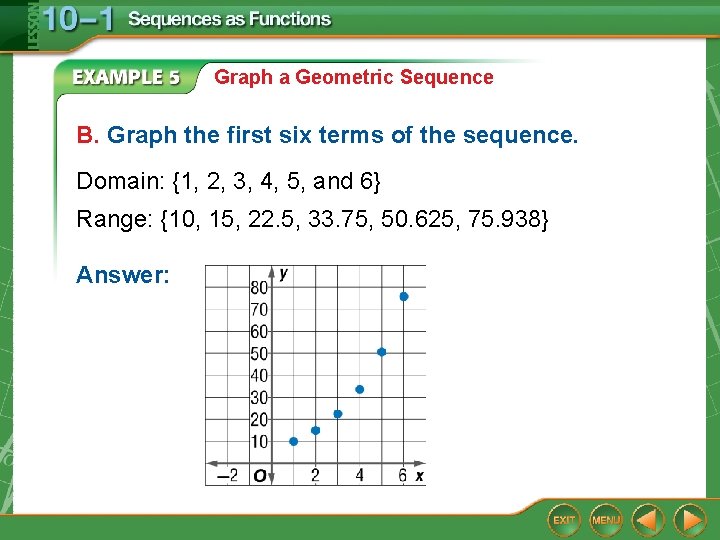
Graph a Geometric Sequence B. Graph the first six terms of the sequence. Domain: {1, 2, 3, 4, 5, and 6} Range: {10, 15, 22. 5, 33. 75, 50. 625, 75. 938} Answer:
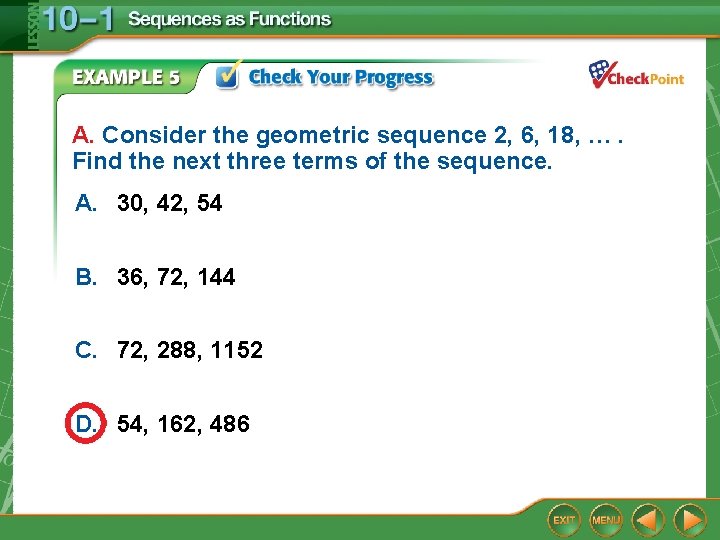
A. Consider the geometric sequence 2, 6, 18, …. Find the next three terms of the sequence. A. 30, 42, 54 B. 36, 72, 144 C. 72, 288, 1152 D. 54, 162, 486
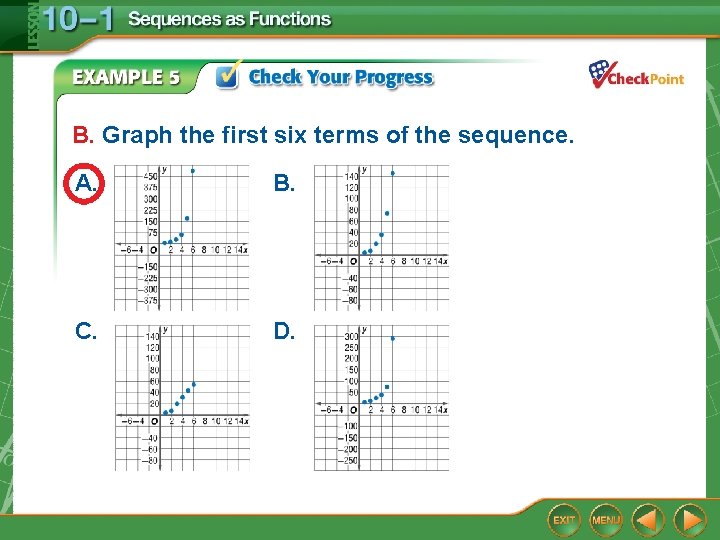
B. Graph the first six terms of the sequence. A. B. C. D.
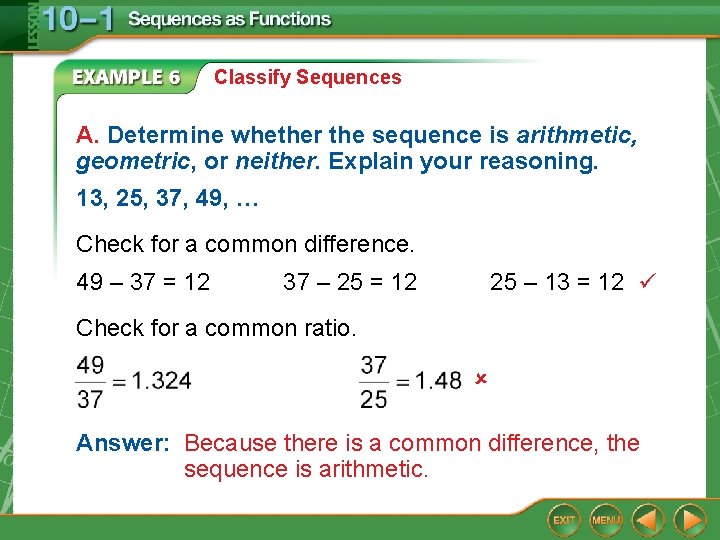
Classify Sequences A. Determine whether the sequence is arithmetic, geometric, or neither. Explain your reasoning. 13, 25, 37, 49, … Check for a common difference. 49 – 37 = 12 37 – 25 = 12 25 – 13 = 12 Check for a common ratio. Answer: Because there is a common difference, the sequence is arithmetic.
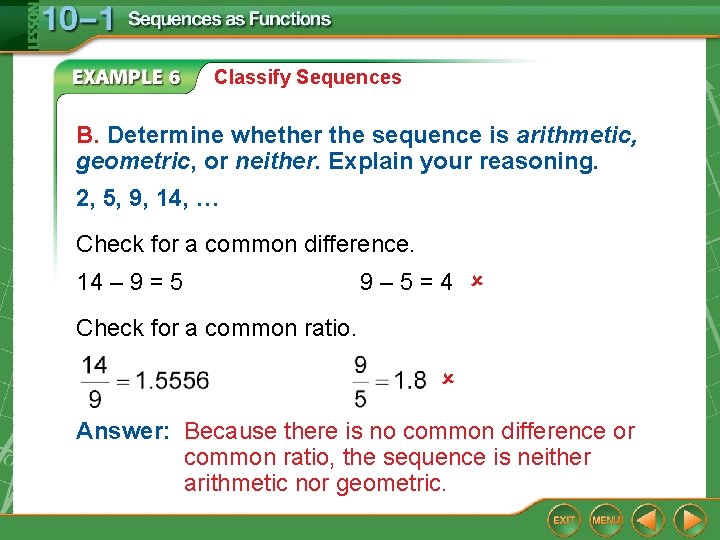
Classify Sequences B. Determine whether the sequence is arithmetic, geometric, or neither. Explain your reasoning. 2, 5, 9, 14, … Check for a common difference. 14 – 9 = 5 9– 5=4 Check for a common ratio. Answer: Because there is no common difference or common ratio, the sequence is neither arithmetic nor geometric.
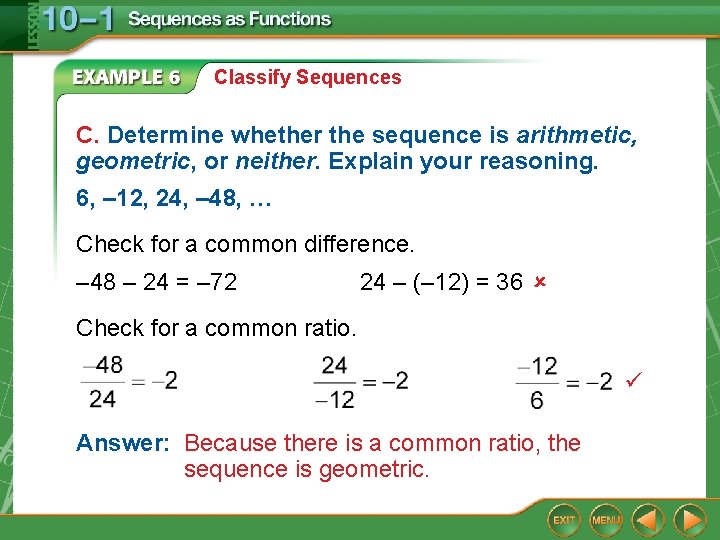
Classify Sequences C. Determine whether the sequence is arithmetic, geometric, or neither. Explain your reasoning. 6, – 12, 24, – 48, … Check for a common difference. – 48 – 24 = – 72 24 – (– 12) = 36 Check for a common ratio. Answer: Because there is a common ratio, the sequence is geometric.
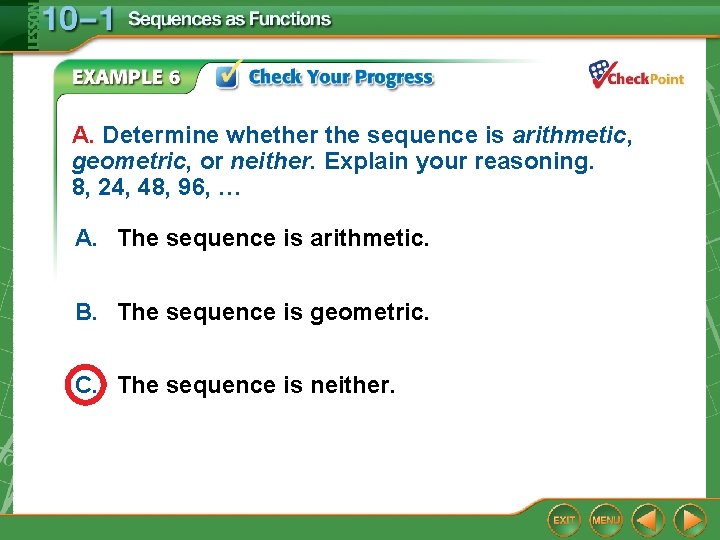
A. Determine whether the sequence is arithmetic, geometric, or neither. Explain your reasoning. 8, 24, 48, 96, … A. The sequence is arithmetic. B. The sequence is geometric. C. The sequence is neither.
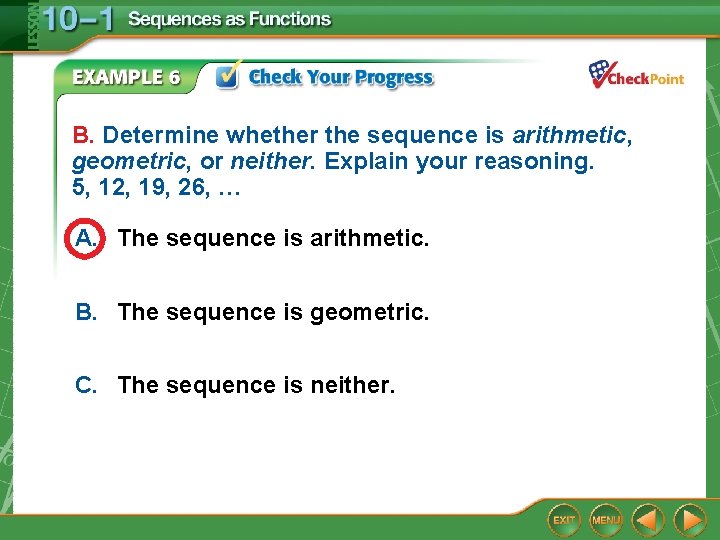
B. Determine whether the sequence is arithmetic, geometric, or neither. Explain your reasoning. 5, 12, 19, 26, … A. The sequence is arithmetic. B. The sequence is geometric. C. The sequence is neither.
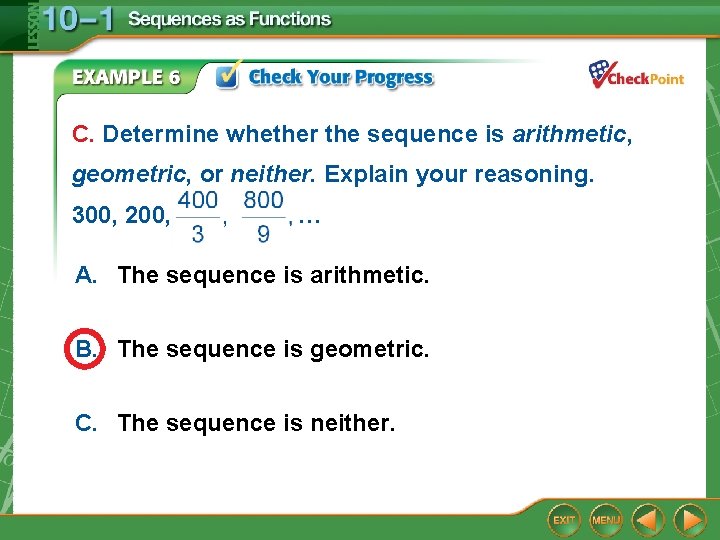
C. Determine whether the sequence is arithmetic, geometric, or neither. Explain your reasoning. 300, 200, … A. The sequence is arithmetic. B. The sequence is geometric. C. The sequence is neither.
Homework P. 663 # 1 – 7 odd, 12 – 48 (x 3)