
Identify and name polygons Find perimeter circumference and
- Slides: 30
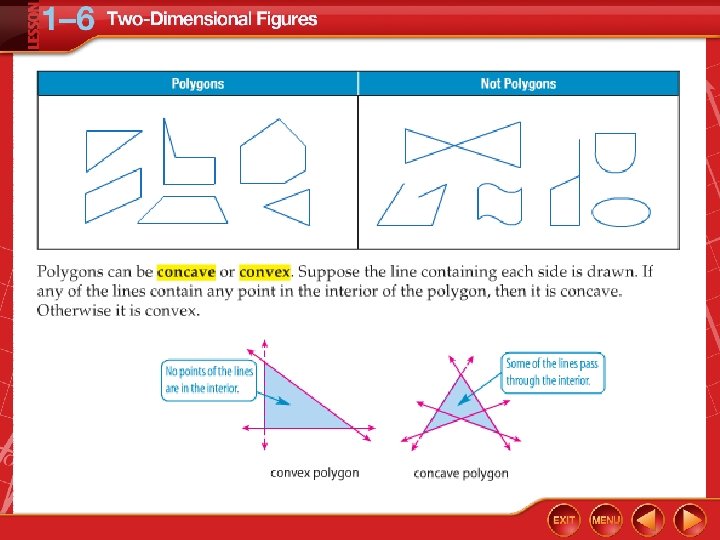
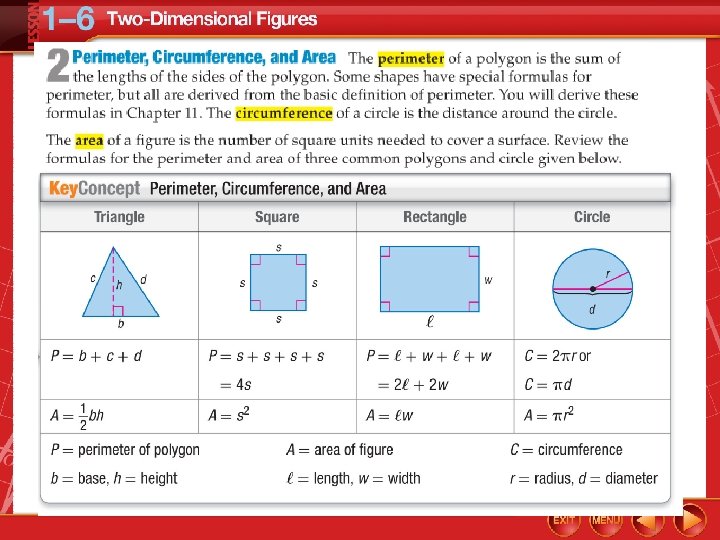
• Identify and name polygons. • Find perimeter, circumference, and area of two-dimensional figures.
Content Standards G. GPE. 7 Use coordinates to compute perimeters of polygons and areas of triangles and rectangles, e. g. , using the distance formula. Mathematical Practices 2 Reason abstractly and quantitatively. 6 Attend to precision.
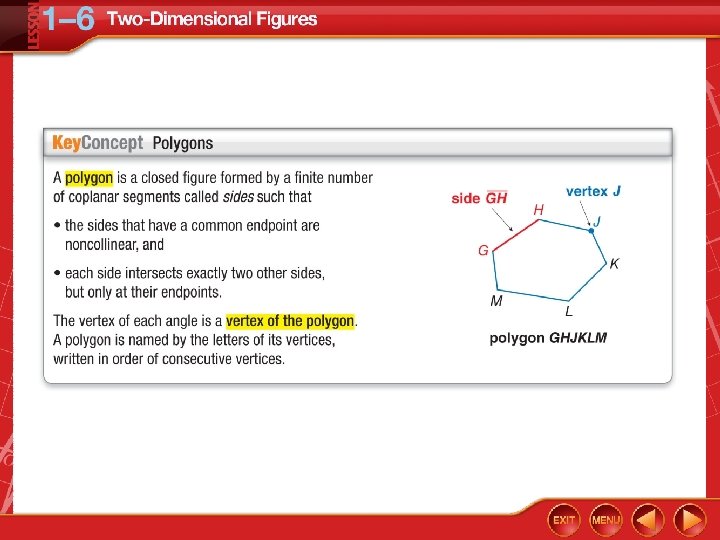
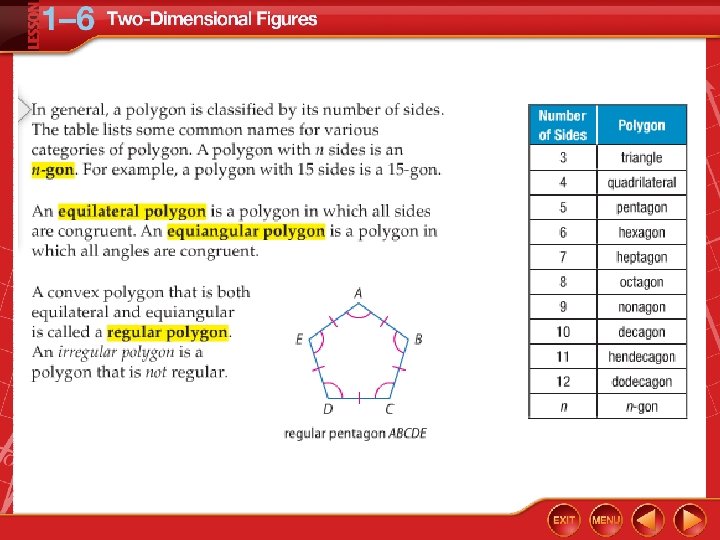
• polygon • equiangular polygon • vertex of a polygon • regular polygon • concave • convex • n-gon • equilateral polygon • perimeter • circumference • area
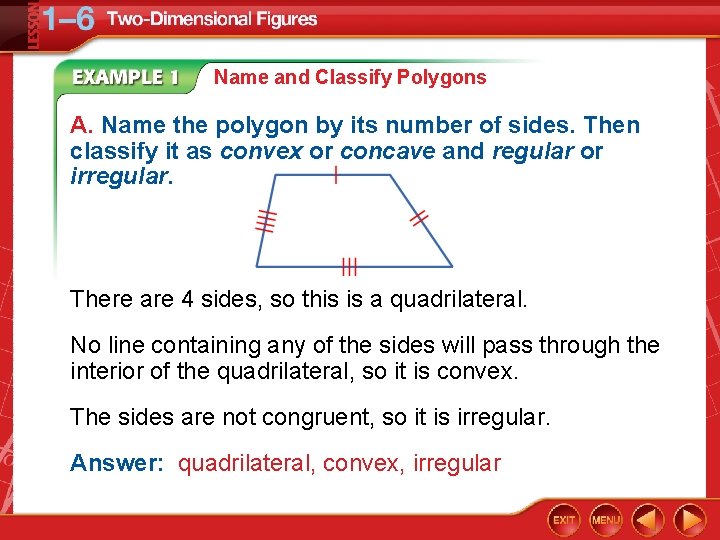
Name and Classify Polygons A. Name the polygon by its number of sides. Then classify it as convex or concave and regular or irregular. There are 4 sides, so this is a quadrilateral. No line containing any of the sides will pass through the interior of the quadrilateral, so it is convex. The sides are not congruent, so it is irregular. Answer: quadrilateral, convex, irregular
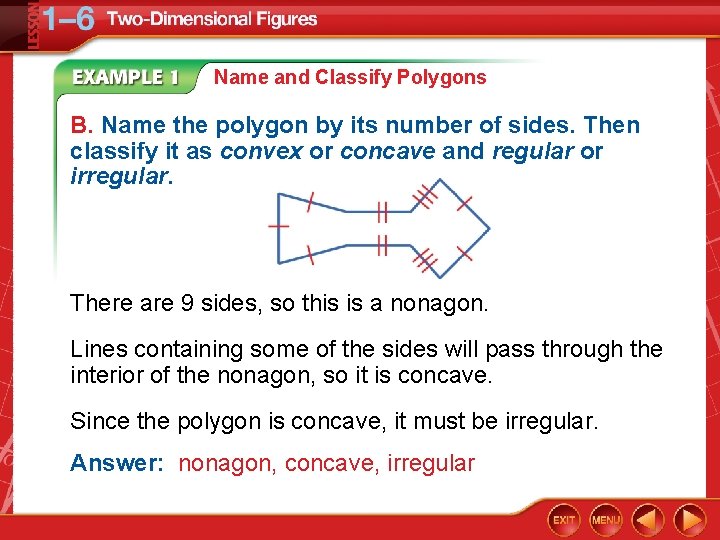
Name and Classify Polygons B. Name the polygon by its number of sides. Then classify it as convex or concave and regular or irregular. There are 9 sides, so this is a nonagon. Lines containing some of the sides will pass through the interior of the nonagon, so it is concave. Since the polygon is concave, it must be irregular. Answer: nonagon, concave, irregular
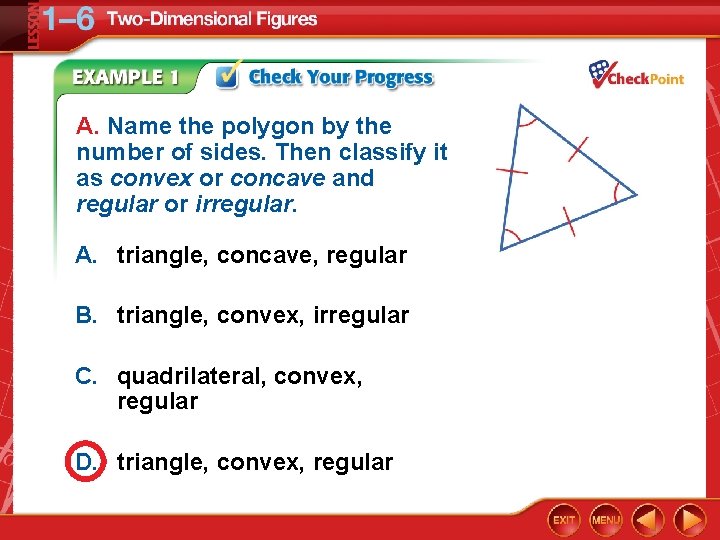
A. Name the polygon by the number of sides. Then classify it as convex or concave and regular or irregular. A. triangle, concave, regular B. triangle, convex, irregular C. quadrilateral, convex, regular D. triangle, convex, regular
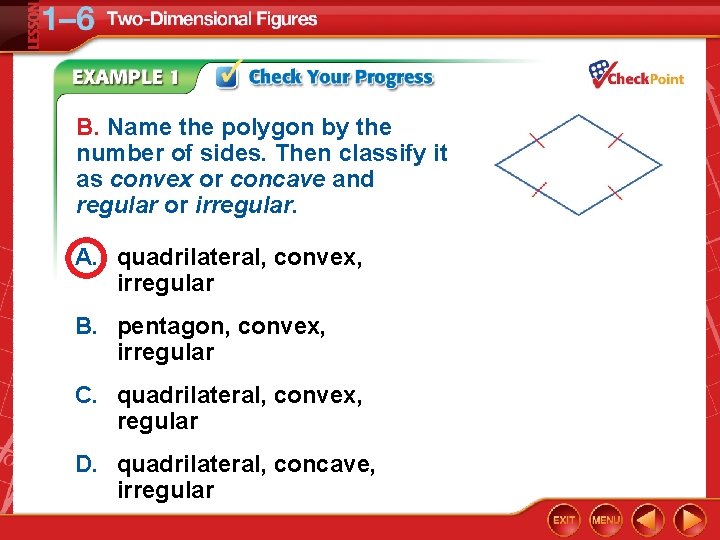
B. Name the polygon by the number of sides. Then classify it as convex or concave and regular or irregular. A. quadrilateral, convex, irregular B. pentagon, convex, irregular C. quadrilateral, convex, regular D. quadrilateral, concave, irregular
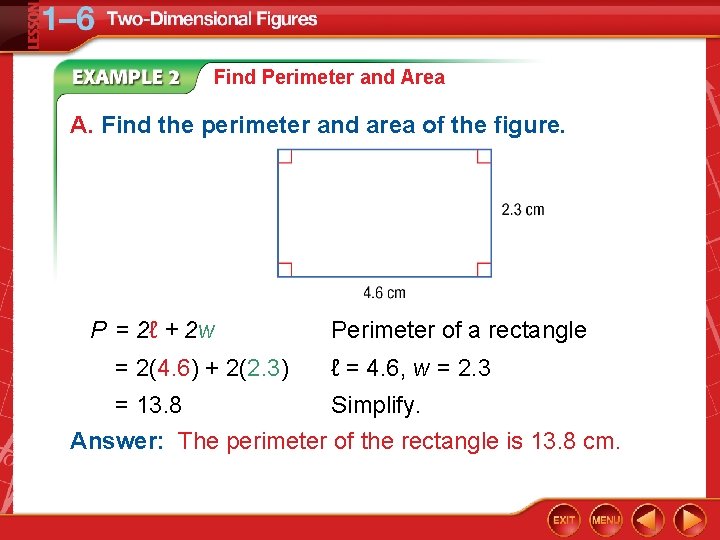
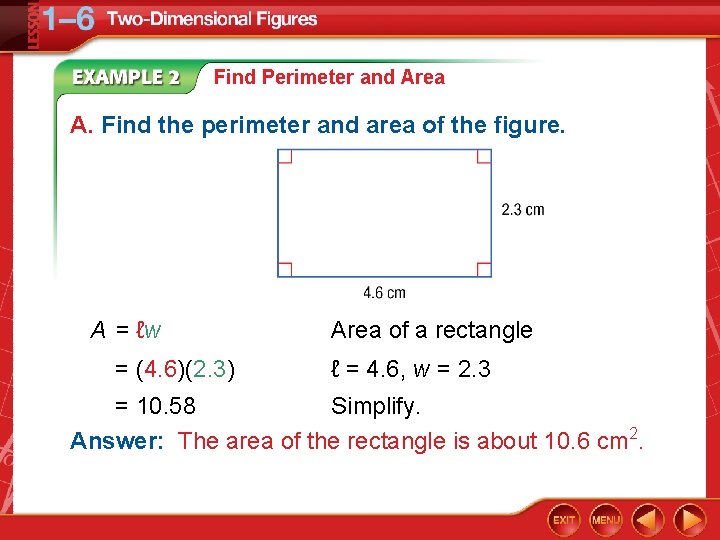
Find Perimeter and Area A. Find the perimeter and area of the figure. P = 2ℓ + 2 w = 2(4. 6) + 2(2. 3) Perimeter of a rectangle ℓ = 4. 6, w = 2. 3 = 13. 8 Simplify. Answer: The perimeter of the rectangle is 13. 8 cm.
Find Perimeter and Area A. Find the perimeter and area of the figure. A = ℓw = (4. 6)(2. 3) Area of a rectangle ℓ = 4. 6, w = 2. 3 = 10. 58 Simplify. Answer: The area of the rectangle is about 10. 6 cm 2.
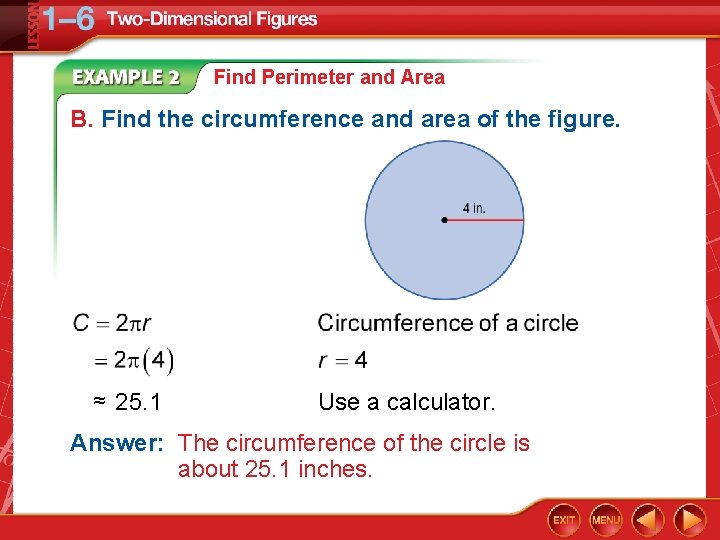
Find Perimeter and Area B. Find the circumference and area of the figure. ≈ 25. 1 Use a calculator. Answer: The circumference of the circle is about 25. 1 inches.
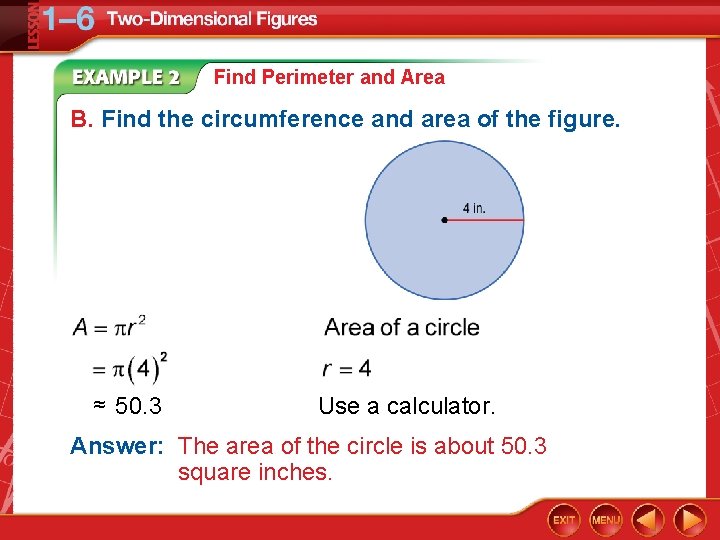
Find Perimeter and Area B. Find the circumference and area of the figure. ≈ 50. 3 Use a calculator. Answer: The area of the circle is about 50. 3 square inches.
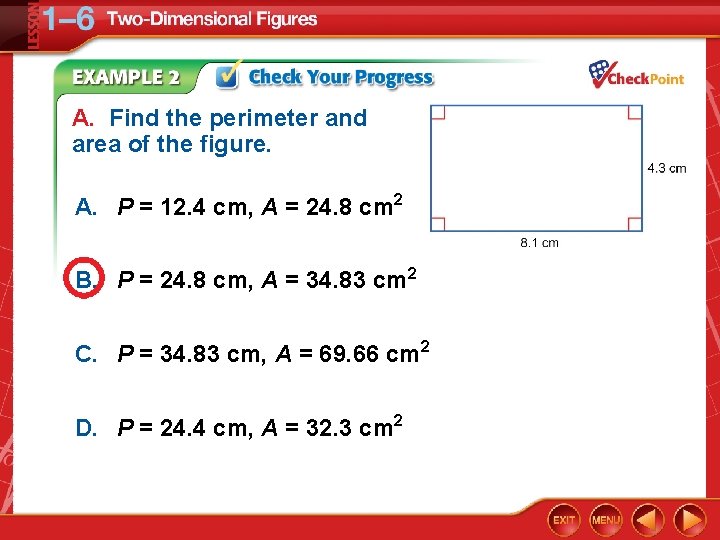
A. Find the perimeter and area of the figure. A. P = 12. 4 cm, A = 24. 8 cm 2 B. P = 24. 8 cm, A = 34. 83 cm 2 C. P = 34. 83 cm, A = 69. 66 cm 2 D. P = 24. 4 cm, A = 32. 3 cm 2
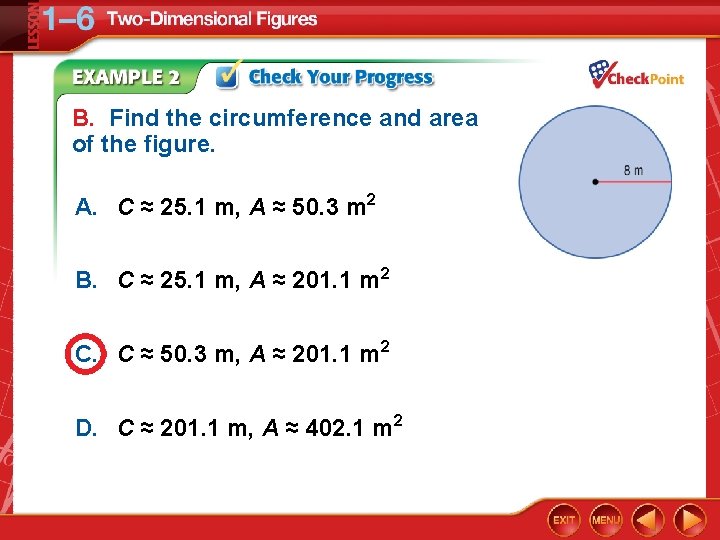
B. Find the circumference and area of the figure. A. C ≈ 25. 1 m, A ≈ 50. 3 m 2 B. C ≈ 25. 1 m, A ≈ 201. 1 m 2 C. C ≈ 50. 3 m, A ≈ 201. 1 m 2 D. C ≈ 201. 1 m, A ≈ 402. 1 m 2
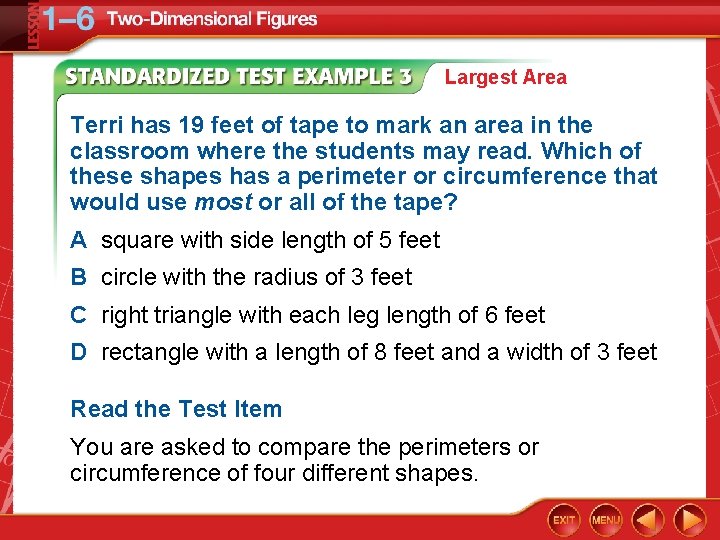
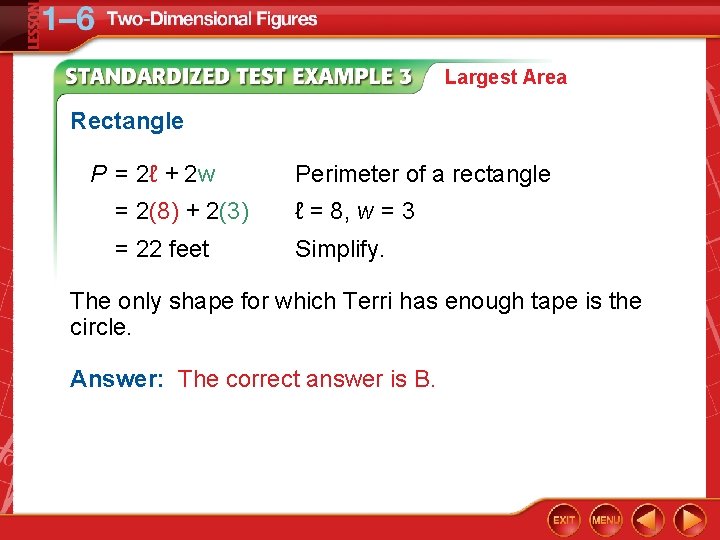
Largest Area Terri has 19 feet of tape to mark an area in the classroom where the students may read. Which of these shapes has a perimeter or circumference that would use most or all of the tape? A square with side length of 5 feet B circle with the radius of 3 feet C right triangle with each leg length of 6 feet D rectangle with a length of 8 feet and a width of 3 feet Read the Test Item You are asked to compare the perimeters or circumference of four different shapes.
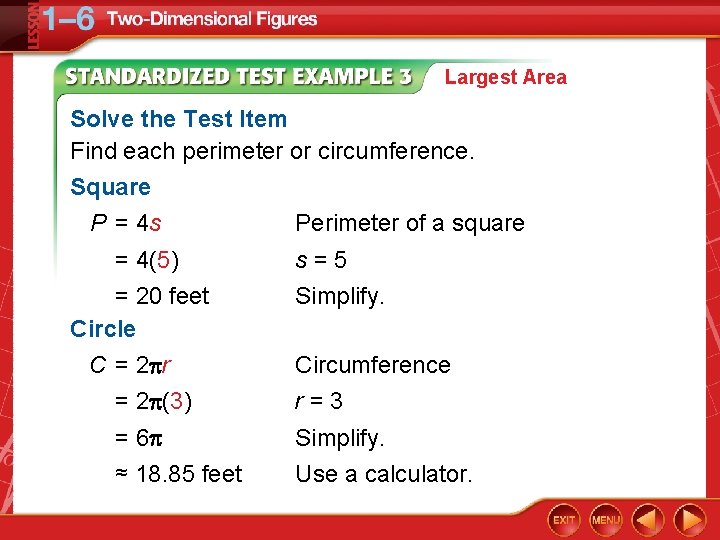
Largest Area Solve the Test Item Find each perimeter or circumference. Square P = 4 s = 4(5) = 20 feet Circle C = 2 r Perimeter of a square s=5 Simplify. Circumference = 2 (3) r=3 = 6 Simplify. ≈ 18. 85 feet Use a calculator.
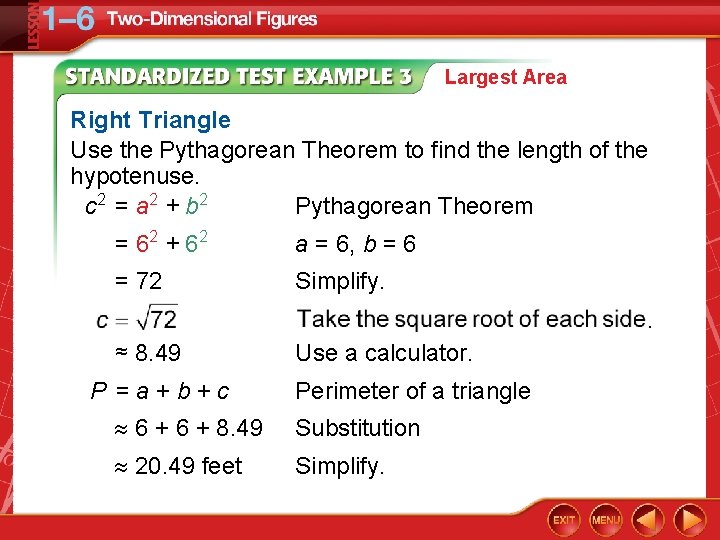
Largest Area Right Triangle Use the Pythagorean Theorem to find the length of the hypotenuse. c 2 = a 2 + b 2 Pythagorean Theorem = 62 + 62 a = 6, b = 6 = 72 Simplify. . ≈ 8. 49 P =a+b+c Use a calculator. Perimeter of a triangle 6 + 8. 49 Substitution 20. 49 feet Simplify.
Largest Area Rectangle P = 2ℓ + 2 w Perimeter of a rectangle = 2(8) + 2(3) ℓ = 8, w = 3 = 22 feet Simplify. The only shape for which Terri has enough tape is the circle. Answer: The correct answer is B.
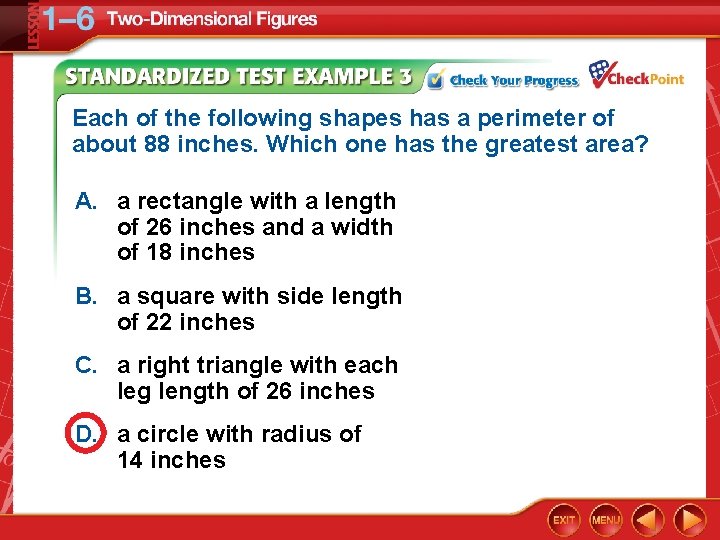
Each of the following shapes has a perimeter of about 88 inches. Which one has the greatest area? A. a rectangle with a length of 26 inches and a width of 18 inches B. a square with side length of 22 inches C. a right triangle with each leg length of 26 inches D. a circle with radius of 14 inches
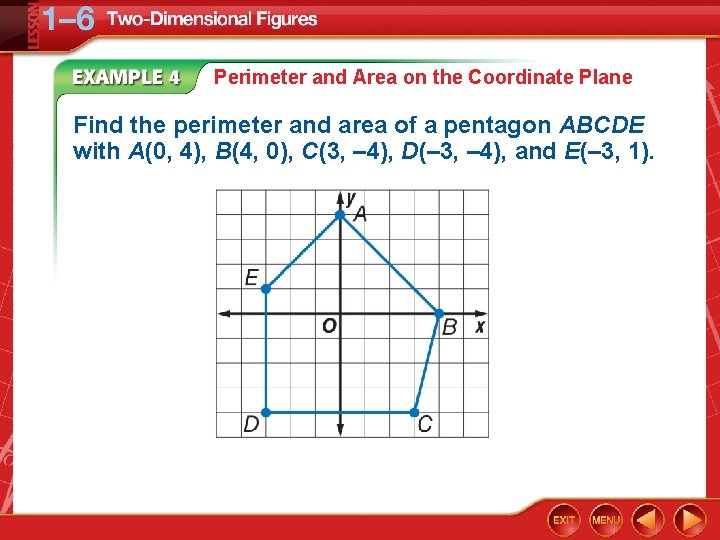
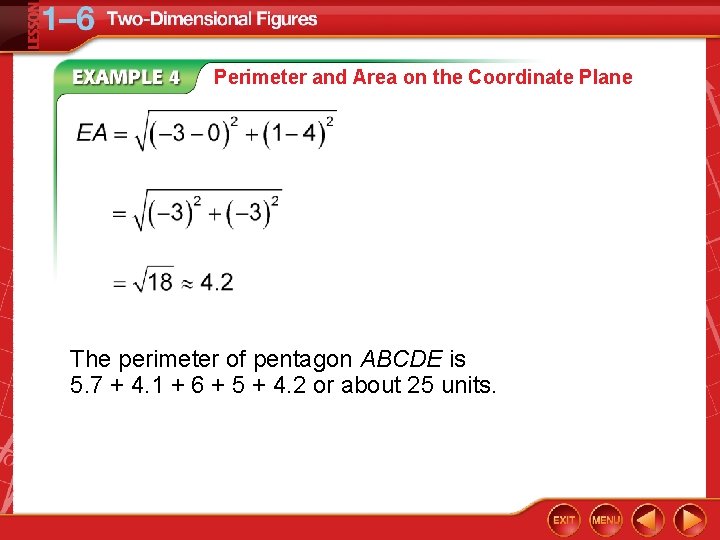
Perimeter and Area on the Coordinate Plane Find the perimeter and area of a pentagon ABCDE with A(0, 4), B(4, 0), C(3, – 4), D(– 3, – 4), and E(– 3, 1).
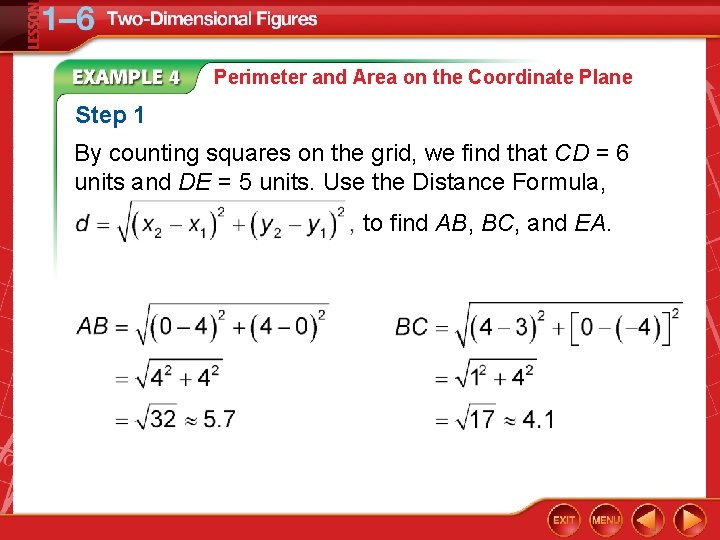
Perimeter and Area on the Coordinate Plane Step 1 By counting squares on the grid, we find that CD = 6 units and DE = 5 units. Use the Distance Formula, to find AB, BC, and EA.
Perimeter and Area on the Coordinate Plane The perimeter of pentagon ABCDE is 5. 7 + 4. 1 + 6 + 5 + 4. 2 or about 25 units.
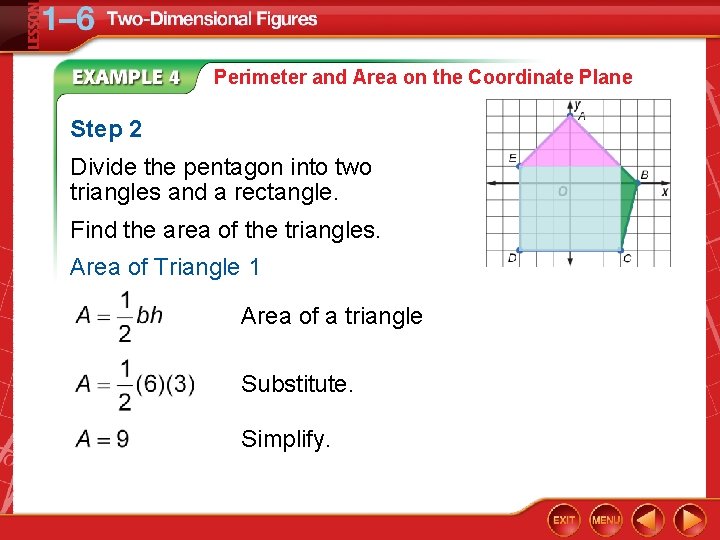
Perimeter and Area on the Coordinate Plane Step 2 Divide the pentagon into two triangles and a rectangle. Find the area of the triangles. Area of Triangle 1 Area of a triangle Substitute. Simplify.
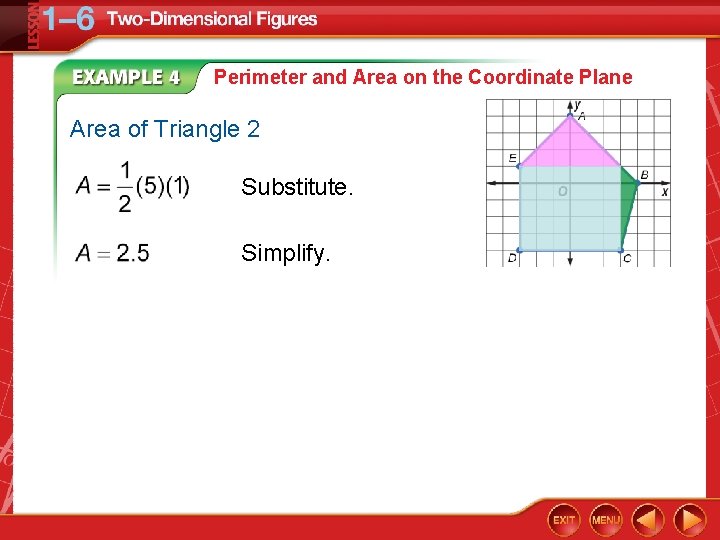
Perimeter and Area on the Coordinate Plane Area of Triangle 2 Substitute. Simplify.
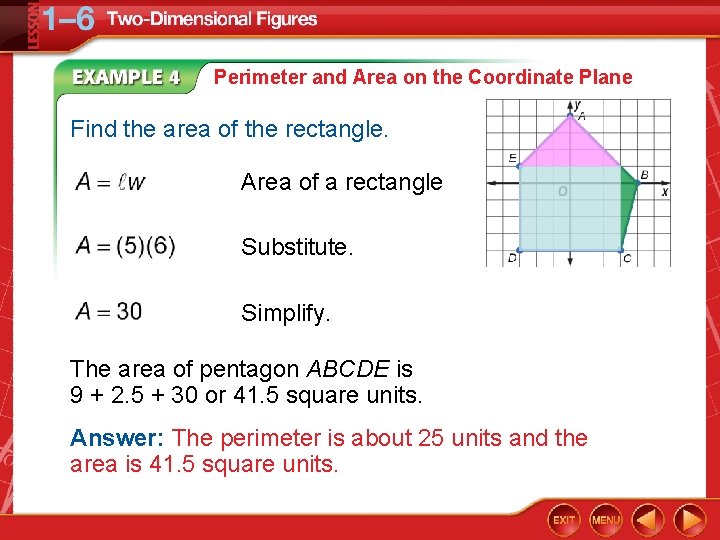
Perimeter and Area on the Coordinate Plane Find the area of the rectangle. Area of a rectangle Substitute. Simplify. The area of pentagon ABCDE is 9 + 2. 5 + 30 or 41. 5 square units. Answer: The perimeter is about 25 units and the area is 41. 5 square units.
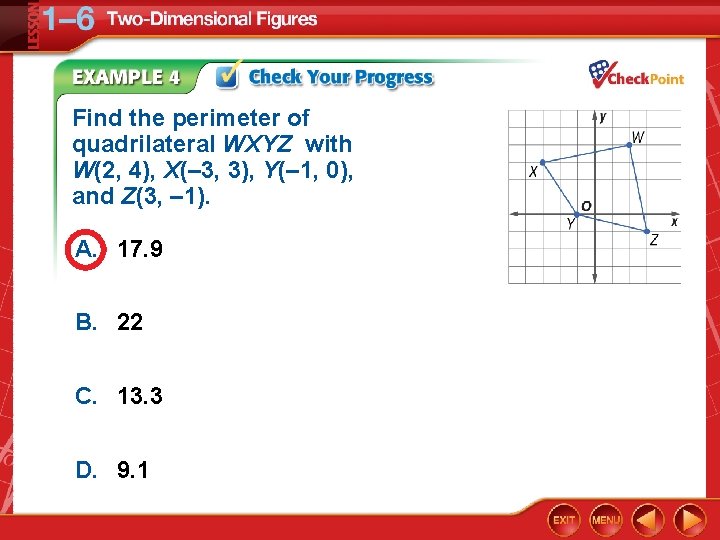
Find the perimeter of quadrilateral WXYZ with W(2, 4), X(– 3, 3), Y(– 1, 0), and Z(3, – 1). A. 17. 9 B. 22 C. 13. 3 D. 9. 1
Homework Page 61 (11 -22, 25, 29, 30, 31) Page 63 (34 -39)