
Identification of Paint Resistance and Deposition Model Parameters


- Slides: 23
Identification of Paint Resistance and Deposition Model Parameters for Electrodeposition Coating Simulation Ayaka SHIMURA, Yuki ONISHI, Kenji AMAYA Tokyo Institute of Technology (Japan) WCCM 2016 P. 1
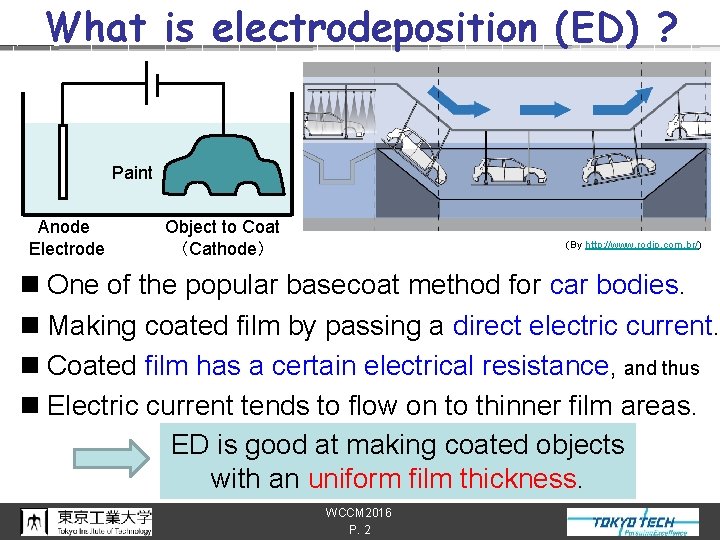
What is electrodeposition (ED) ? Paint Anode Electrode Object to Coat (Cathode) (By http: //www. rodip. com. br/) n One of the popular basecoat method for car bodies. n Making coated film by passing a direct electric current. n Coated film has a certain electrical resistance, and thus n Electric current tends to flow on to thinner film areas. ED is good at making coated objects with an uniform film thickness. WCCM 2016 P. 2
Photos of ED process line 2. water rinse process 1. dipping and deposition process We focus on this. 3. baking process WCCM 2016 P. 3
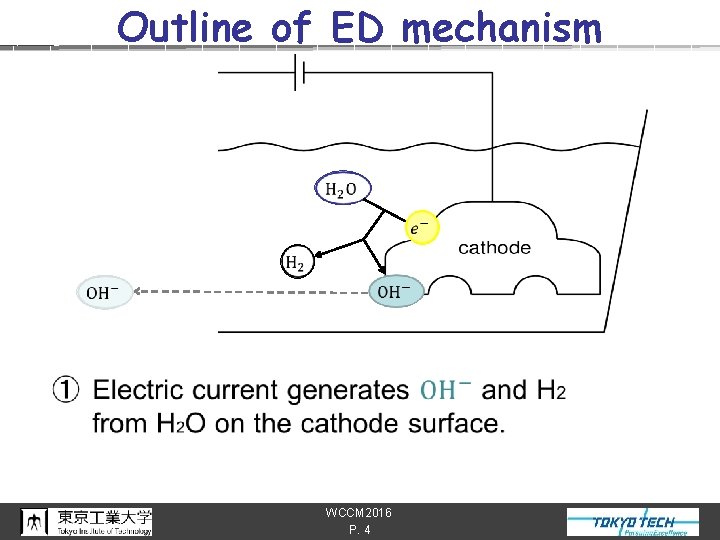
n Outline of ED mechanism WCCM 2016 P. 4
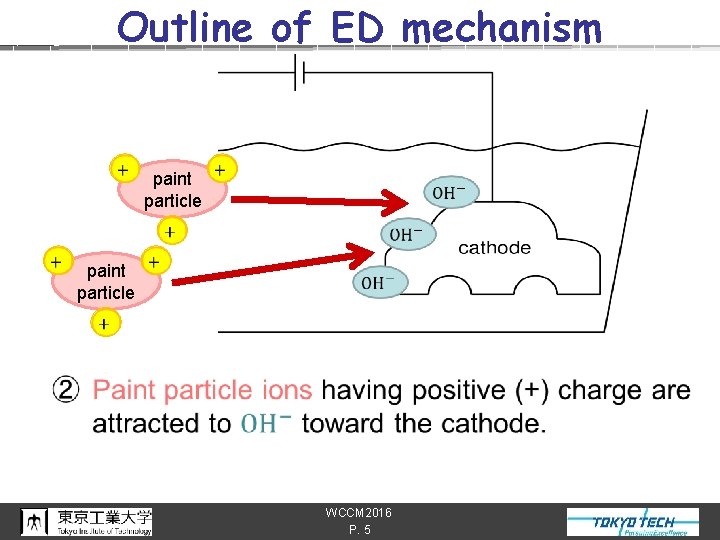
n Outline of ED mechanism paint particle WCCM 2016 P. 5
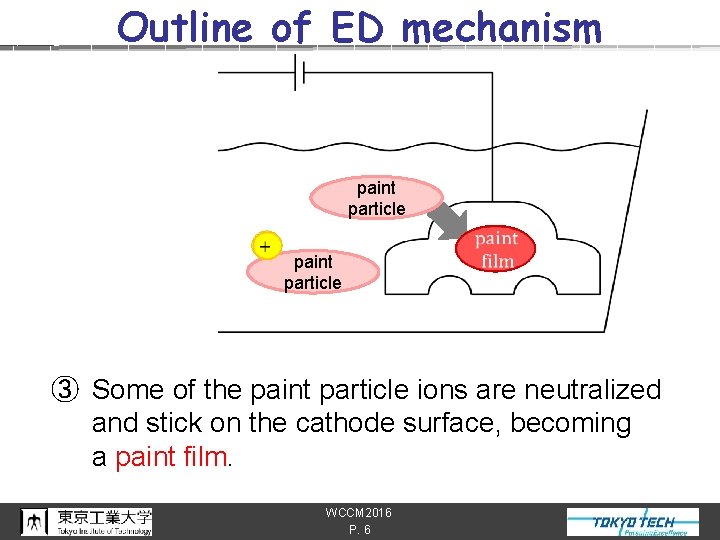
Outline of ED mechanism paint particle カソード ③ Some of the paint particle ions are neutralized and stick on the cathode surface, becoming a paint film. WCCM 2016 P. 6
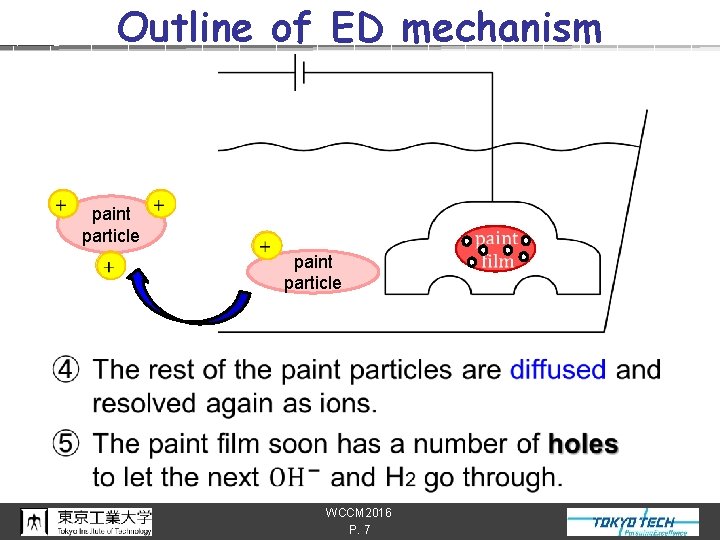
n Outline of ED mechanism paint particle WCCM 2016 P. 7 カソード
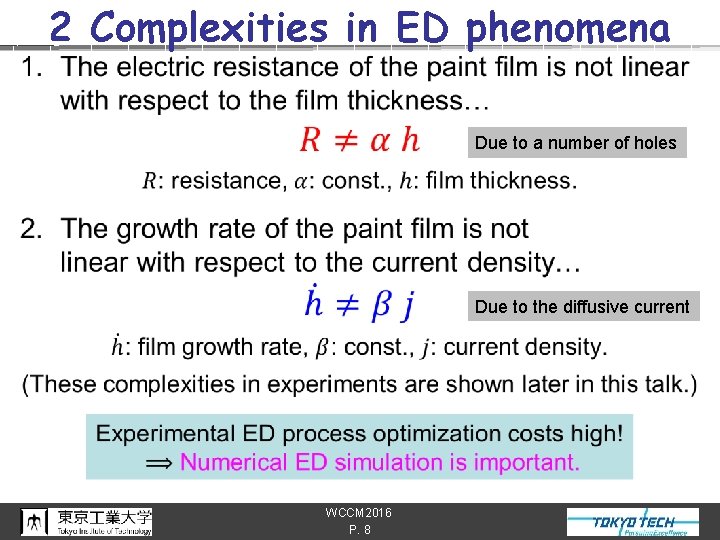
n 2 Complexities in ED phenomena Due to a number of holes Due to the diffusive current WCCM 2016 P. 8
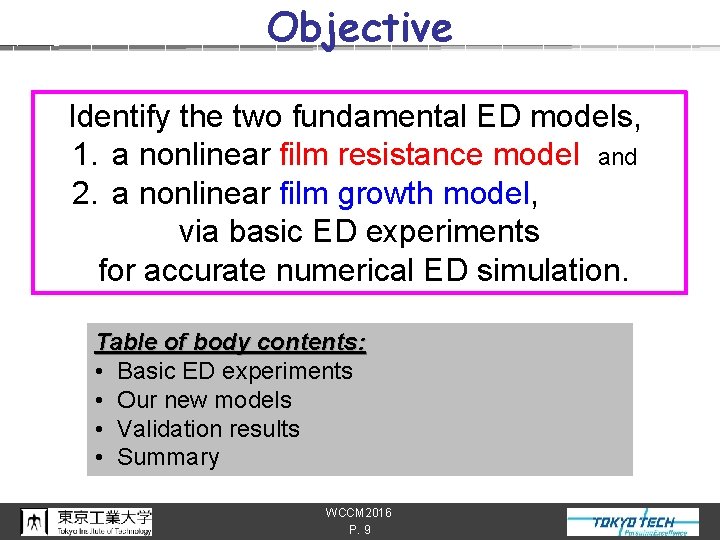
Objective Identify the two fundamental ED models, 1. a nonlinear film resistance model and 2. a nonlinear film growth model, via basic ED experiments for accurate numerical ED simulation. Table of body contents: • Basic ED experiments • Our new models • Validation results • Summary WCCM 2016 P. 9
Basic ED Experiments WCCM 2016 P. 10
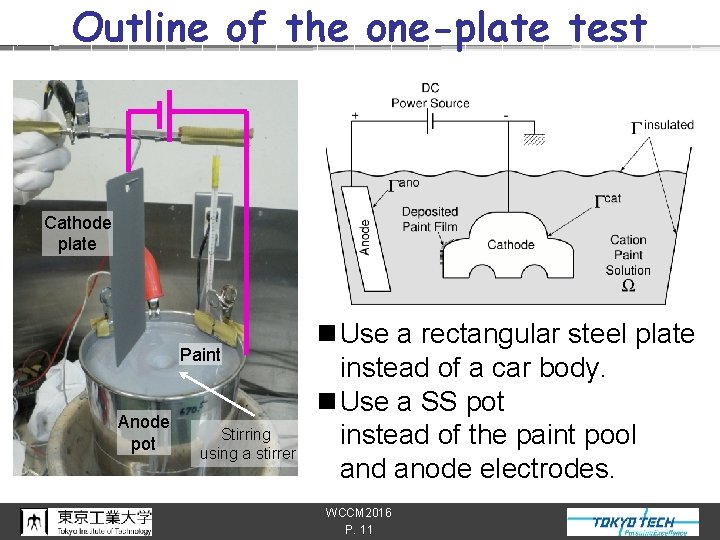
Outline of the one-plate test Cathode plate Paint Anode pot Stirring using a stirrer n Use a rectangular steel plate instead of a car body. n Use a SS pot instead of the paint pool and anode electrodes. WCCM 2016 P. 11
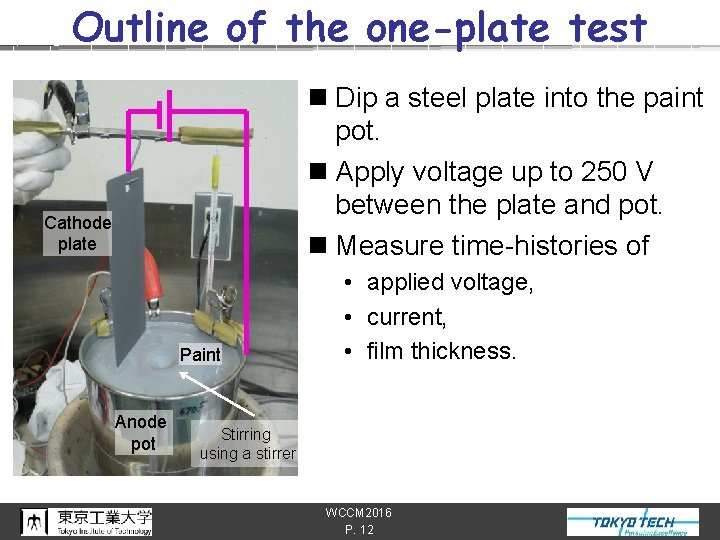
Outline of the one-plate test n Dip a steel plate into the paint pot. n Apply voltage up to 250 V between the plate and pot. n Measure time-histories of Cathode plate Paint Anode pot • applied voltage, • current, • film thickness. Stirring using a stirrer WCCM 2016 P. 12
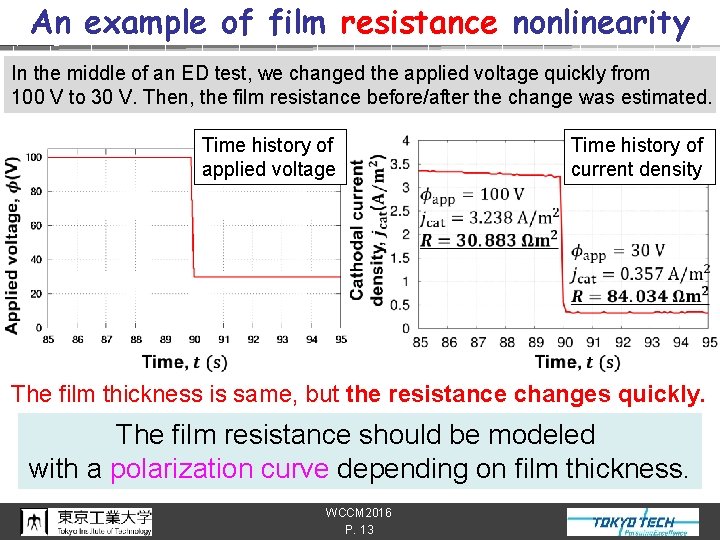
An example of film resistance nonlinearity In the middle of an ED test, we changed the applied voltage quickly from 100 V to 30 V. Then, the film resistance before/after the change was estimated. Time history of applied voltage Time history of current density The film thickness is same, but the resistance changes quickly. The film resistance should be modeled with a polarization curve depending on film thickness. WCCM 2016 P. 13
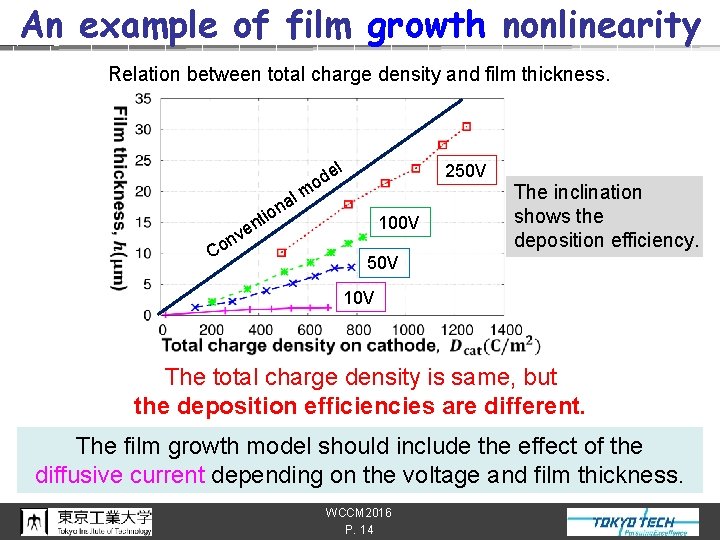
An example of film growth nonlinearity Relation between total charge density and film thickness. tio n ve n Co l na de o m l 250 V 100 V The inclination shows the deposition efficiency. 50 V 10 V The total charge density is same, but the deposition efficiencies are different. The film growth model should include the effect of the diffusive current depending on the voltage and film thickness. WCCM 2016 P. 14
Our new models WCCM 2016 P. 15
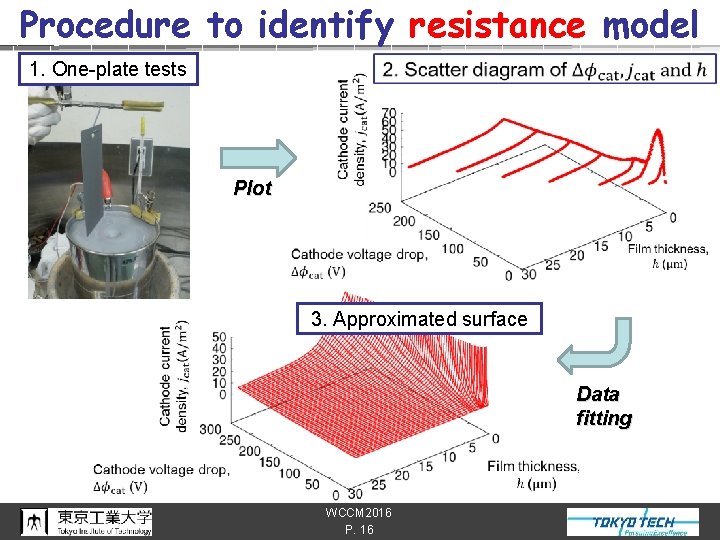
Procedure to identify resistance model 1. One-plate tests Plot 3. Approximated surface Data fitting WCCM 2016 P. 16
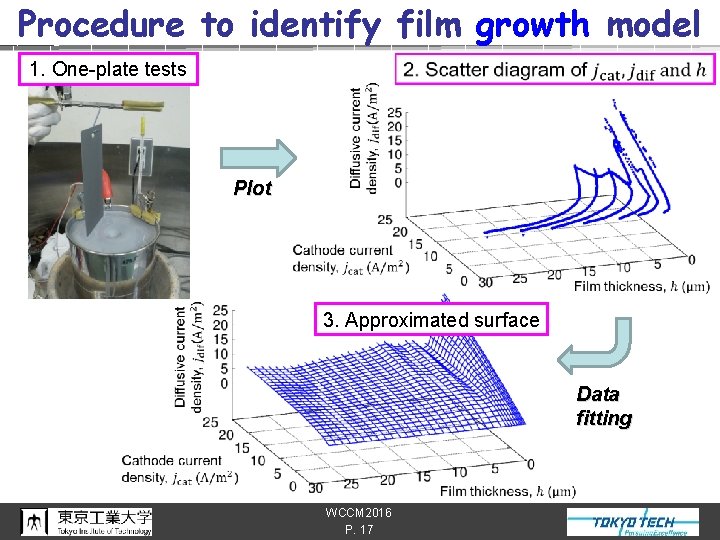
Procedure to identify film growth model 1. One-plate tests Plot 3. Approximated surface Data fitting WCCM 2016 P. 17
Validation Results WCCM 2016 P. 18
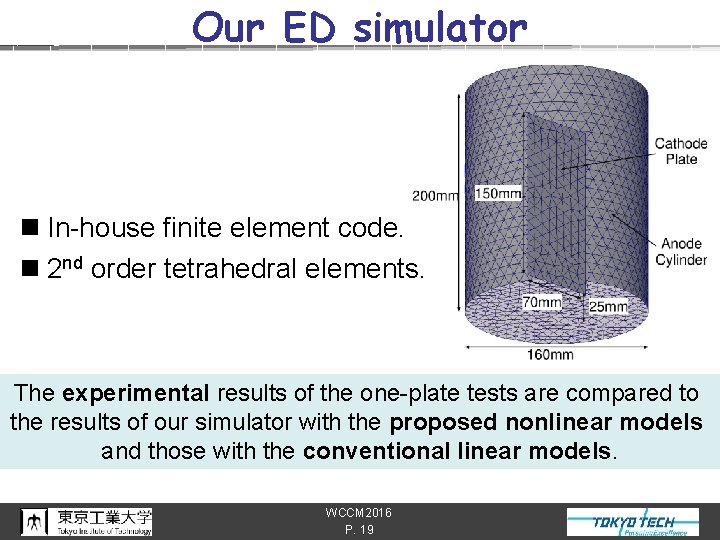
Our ED simulator n In-house finite element code. n 2 nd order tetrahedral elements. The experimental results of the one-plate tests are compared to the results of our simulator with the proposed nonlinear models and those with the conventional linear models. WCCM 2016 P. 19
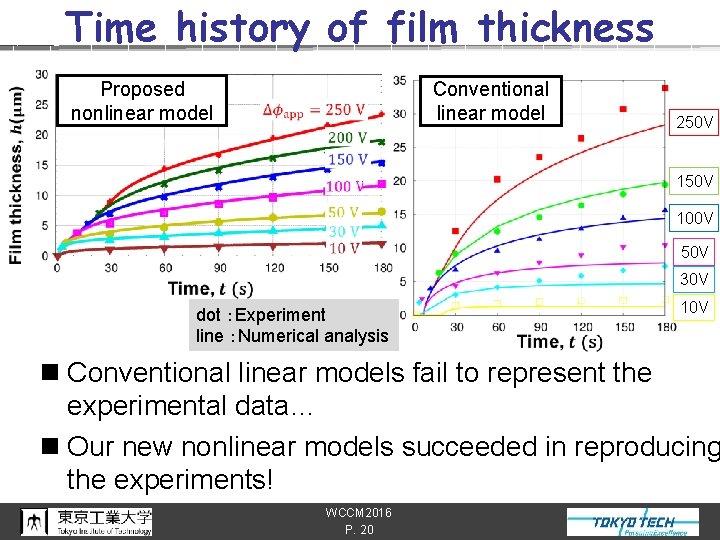
Time history of film thickness Proposed nonlinear model Conventional linear model 250 V 100 V 50 V 30 V dot :Experiment line :Numerical analysis 10 V n Conventional linear models fail to represent the experimental data… n Our new nonlinear models succeeded in reproducing the experiments! WCCM 2016 P. 20
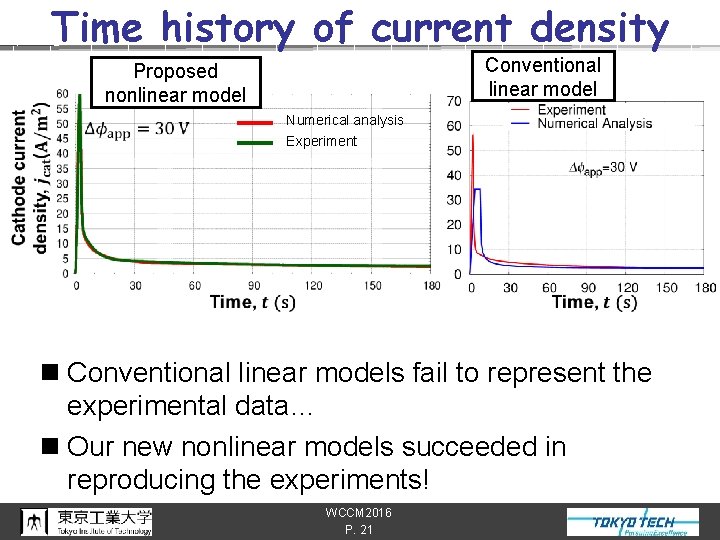
Time history of current density Conventional linear model Proposed nonlinear model Numerical analysis Experiment n Conventional linear models fail to represent the experimental data… n Our new nonlinear models succeeded in reproducing the experiments! WCCM 2016 P. 21
Summary WCCM 2016 P. 22
Summary n A new nonlinear film resistance model and film growth model for accurate electrodeposition (ED) simulation were proposed. n The model parameters were identified via the oneplate ED tests. n Our new models improved the accuracy in time histories of the film thickness and current density compared to the conventional linear models. Thank you for your kind attention. WCCM 2016 P. 23