
Identification of heat recovery on chiller condenser and







- Slides: 39
Identification of heat recovery on chiller condenser and reversible air conditioning opportunities in office buildings Philippe ANDRE, Stéphane BERTAGNOLIO – ULg Laurent SARRADE – CEA INES Pascal STABAT – Ecole des Mines de Paris Workshop « Commissioning and auditing of buildings and HVAC systems » » of buildings and Brussels, January 28 th, 2008
Presentation overview n n n Introduction Specifications of the identification method Methodology Development of the method Validation Comité de suivi IEA 48 Namur - 10/01/2008
Introduction Comité de suivi IEA 48 Namur - 10/01/2008
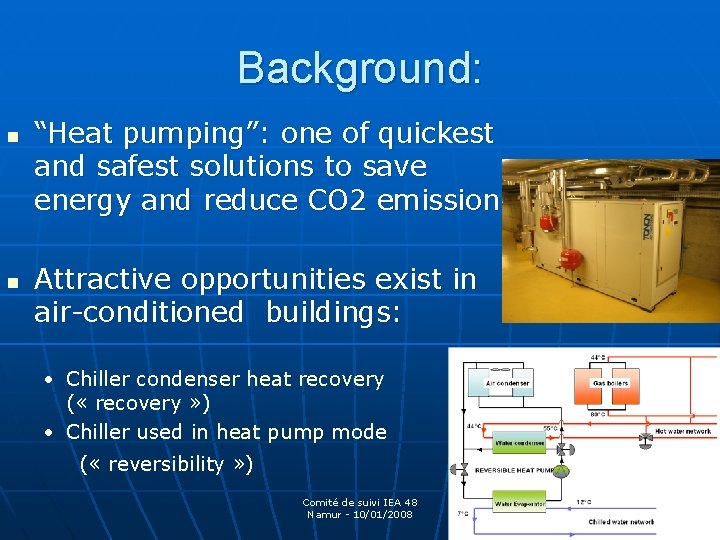
Background: n “Heat pumping”: one of quickest and safest solutions to save energy and reduce CO 2 emission n Attractive opportunities exist in air-conditioned buildings: • Chiller condenser heat recovery ( « recovery » ) • Chiller used in heat pump mode ( « reversibility » ) Comité de suivi IEA 48 Namur - 10/01/2008
General objective n n n To quantify the heat recovery and/or the chiller reversibility potential in a given (office) building To identify the feasible technologies in that building To assess the energy, environmental (and economical) performance of a selected technology in a given building Comité de suivi IEA 48 Namur - 10/01/2008
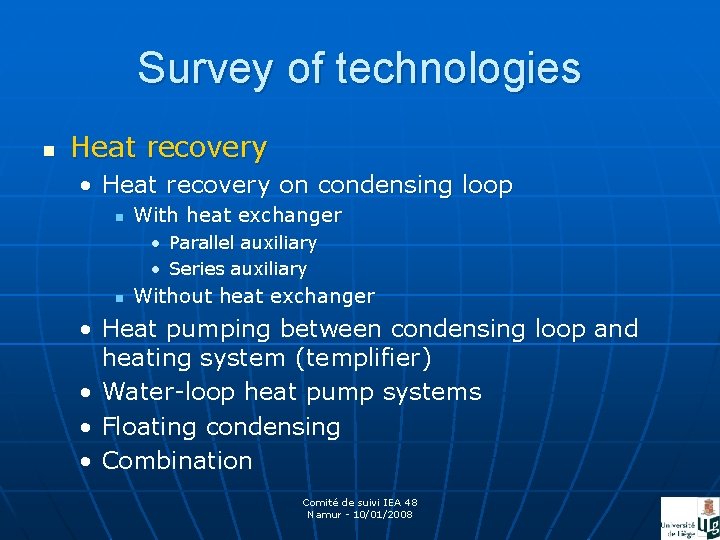
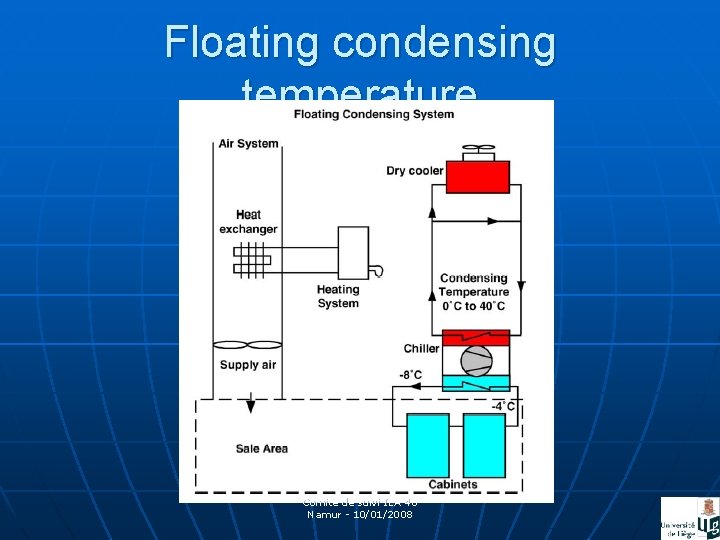
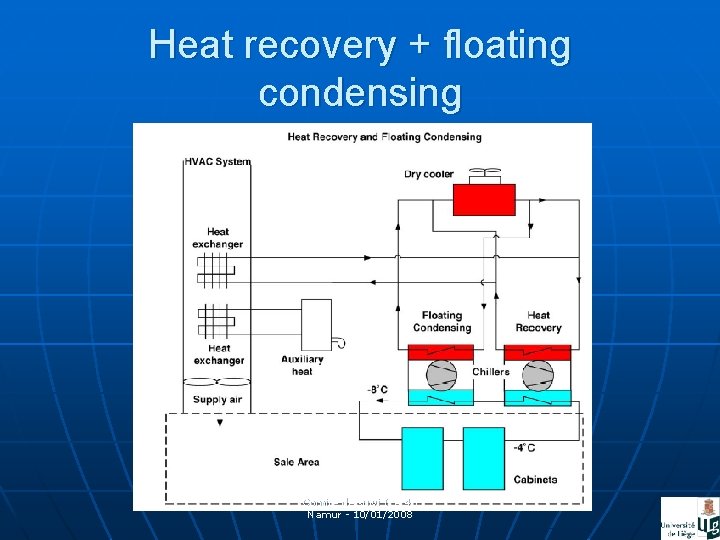
Survey of technologies n Heat recovery • Heat recovery on condensing loop n With heat exchanger • Parallel auxiliary • Series auxiliary n Without heat exchanger • Heat pumping between condensing loop and heating system (templifier) • Water-loop heat pump systems • Floating condensing • Combination Comité de suivi IEA 48 Namur - 10/01/2008
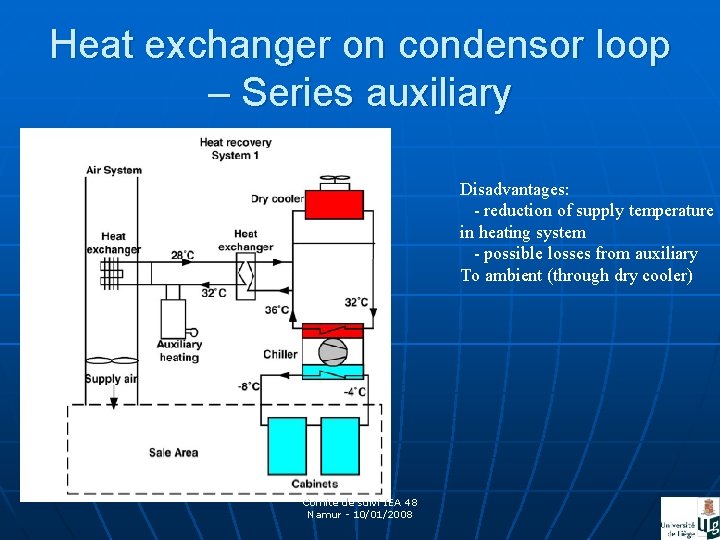
Heat exchanger on condensor loop – Series auxiliary Disadvantages: - reduction of supply temperature in heating system - possible losses from auxiliary To ambient (through dry cooler) Comité de suivi IEA 48 Namur - 10/01/2008
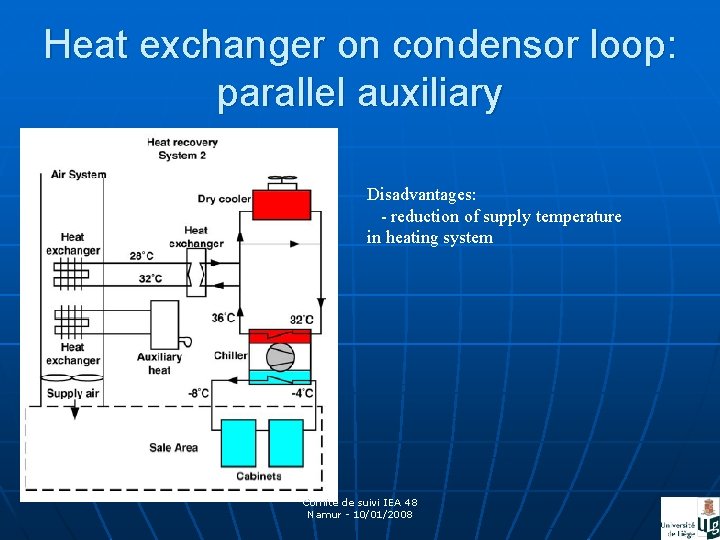
Heat exchanger on condensor loop: parallel auxiliary Disadvantages: - reduction of supply temperature in heating system Comité de suivi IEA 48 Namur - 10/01/2008
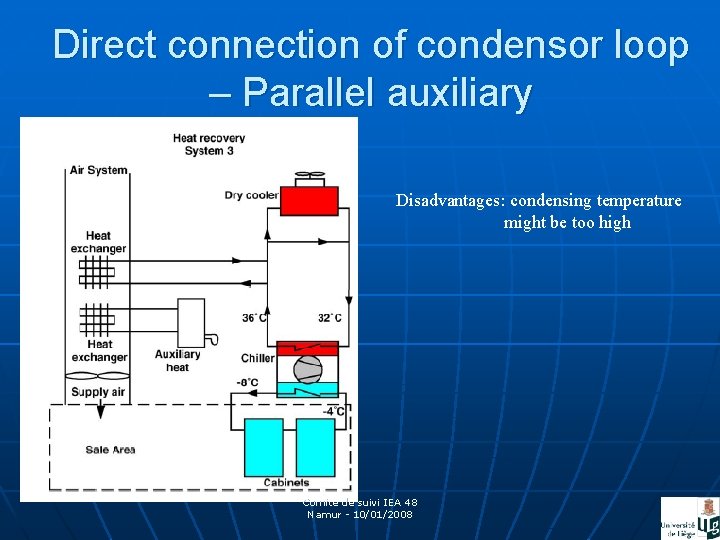
Direct connection of condensor loop – Parallel auxiliary Disadvantages: condensing temperature might be too high Comité de suivi IEA 48 Namur - 10/01/2008
Floating condensing temperature Comité de suivi IEA 48 Namur - 10/01/2008
Heat recovery + floating condensing Comité de suivi IEA 48 Namur - 10/01/2008
Specifications of the identification tool Comité de suivi IEA 48 Namur - 10/01/2008
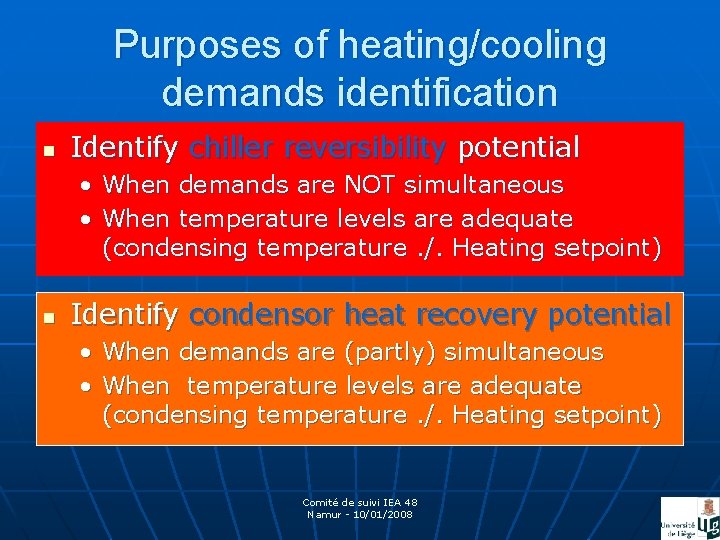
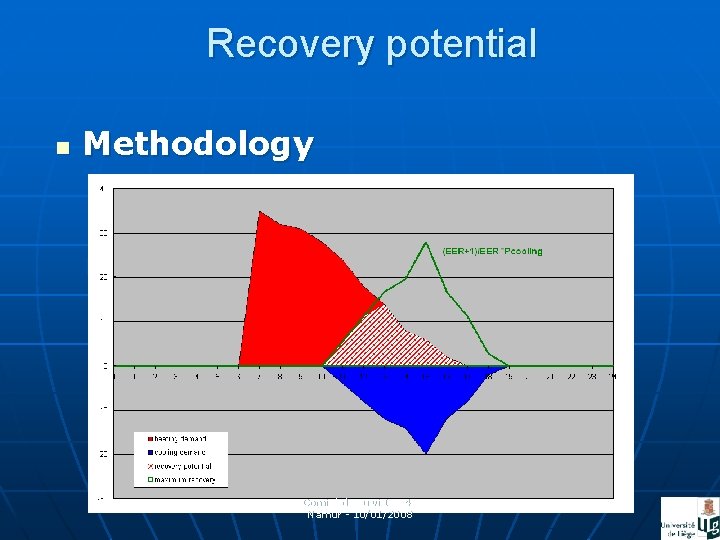
Purposes of heating/cooling demands identification n Identify chiller reversibility potential • When demands are NOT simultaneous • When temperature levels are adequate (condensing temperature. /. Heating setpoint) n Identify condensor heat recovery potential • When demands are (partly) simultaneous • When temperature levels are adequate (condensing temperature. /. Heating setpoint) Comité de suivi IEA 48 Namur - 10/01/2008
Reversibility potential n Methodology Comité de suivi IEA 48 Namur - 10/01/2008
Recovery potential n Methodology Comité de suivi IEA 48 Namur - 10/01/2008
How to assess this potential? Development of an identification method Comité de suivi IEA 48 Namur - 10/01/2008
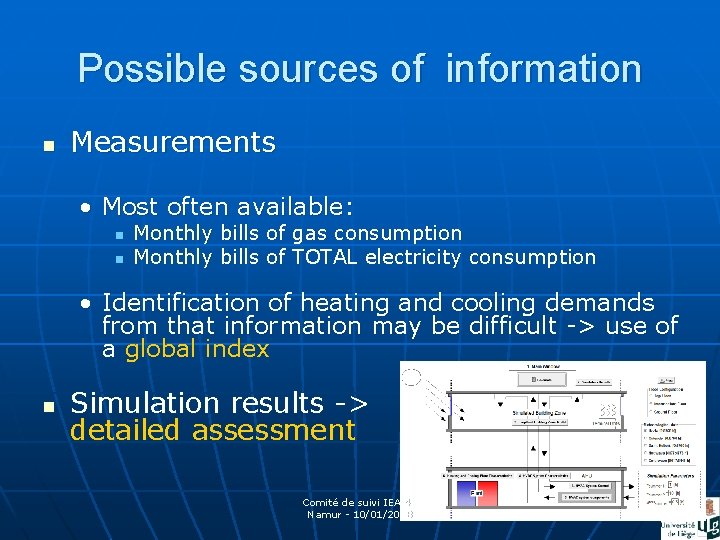
Possible sources of information n Measurements • Most often available: n n Monthly bills of gas consumption Monthly bills of TOTAL electricity consumption • Identification of heating and cooling demands from that information may be difficult -> use of a global index n Simulation results -> detailed assessment Comité de suivi IEA 48 Namur - 10/01/2008
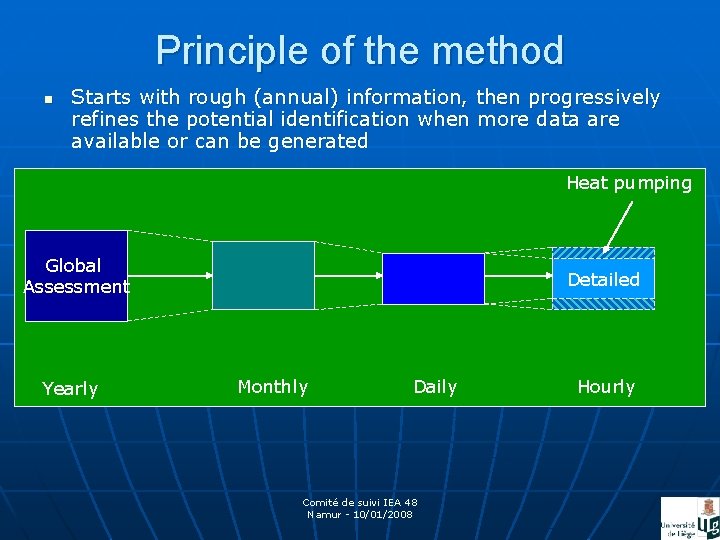
Principle of the method n Starts with rough (annual) information, then progressively refines the potential identification when more data are available or can be generated Heat pumping Global Assessment Yearly Detailed Monthly Daily Comité de suivi IEA 48 Namur - 10/01/2008 Hourly
Detailed assessment n n n Definition of typical buildings corresponding to the buildings stock (in France) Detailed hourly simulations to calculate heating and cooling demands Calculation of reversibility potentials Comité de suivi IEA 48 Namur - 10/01/2008
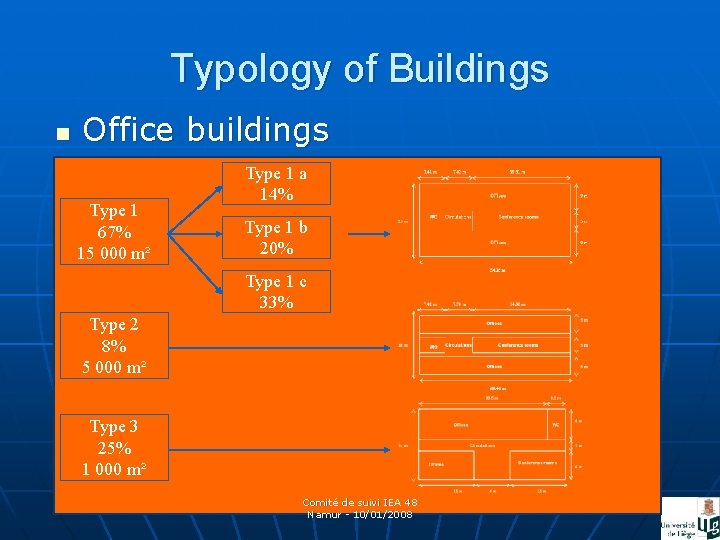
Typology of Buildings n Office buildings Type 1 67% 15 000 m² Type 1 a 14% Type 1 b 20% Type 1 c 33% Type 2 8% 5 000 m² Type 3 25% 1 000 m² Comité de suivi IEA 48 Namur - 10/01/2008
Typology of Buildings n Health care buildings 138, 5 m bedrooms Type 1: Large hospital 40% ~30 000 m² 4 m Circulations 46, 8 m courtyard 9, 3 m Operations room 6, 6 m courtyard Laboratories 20, 8 m 9, 3 m 3, 2 m 4 m bedrooms 5, 4 m 5, 2 m 5 m Type 2 : Rest home 60% ~4 000 m² Comité de suivi IEA 48 Namur - 10/01/2008 25, 7 m 46, 1 m 4 m 5 m 25, 7 m 10, 2 m
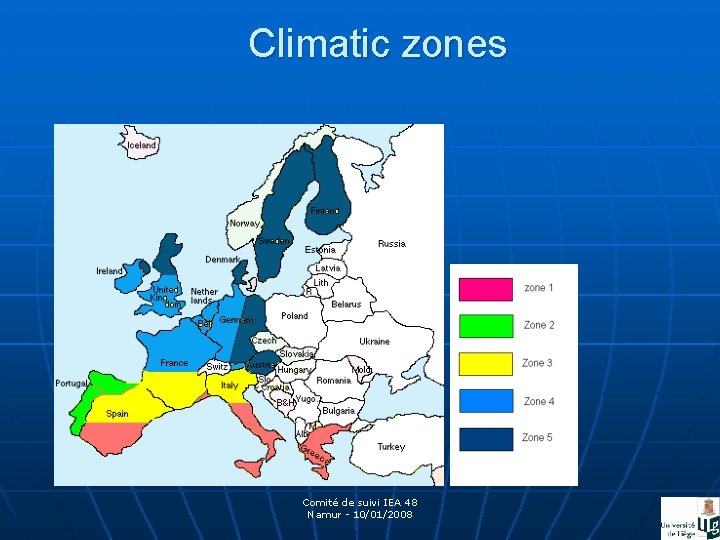
Climatic zones Comité de suivi IEA 48 Namur - 10/01/2008
Example of results: Heating & Cooling demands in different climatic zones Offices – Type 1 A – Low solar factor – Low ventilation rate – 5 climates Consoclim simulations Comité de suivi IEA 48 Namur - 10/01/2008
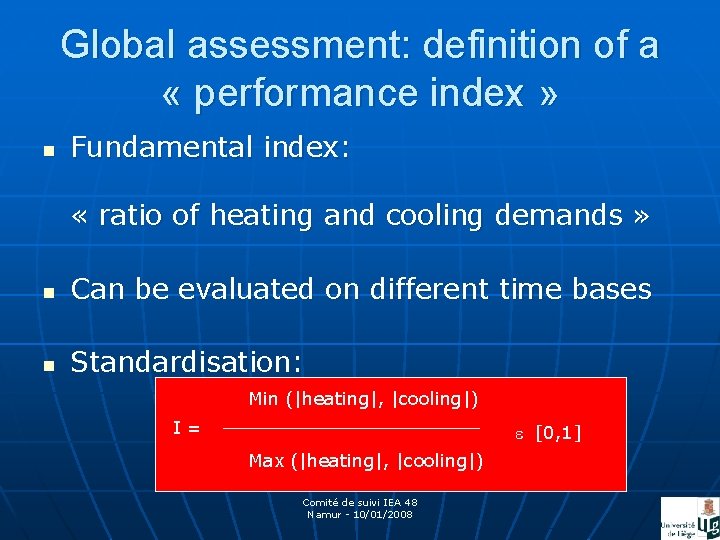
Global assessment: definition of a « performance index » n Fundamental index: « ratio of heating and cooling demands » n Can be evaluated on different time bases n Standardisation: Min (|heating|, |cooling|) I = e [0, 1] Max (|heating|, |cooling|) Comité de suivi IEA 48 Namur - 10/01/2008
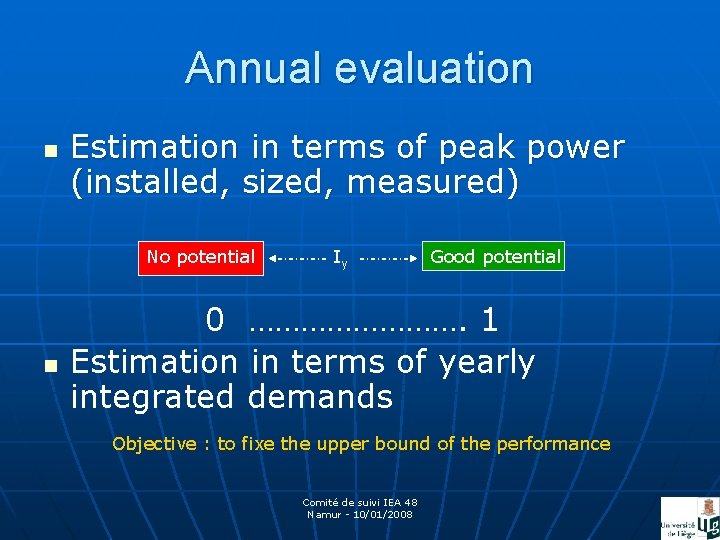
Annual evaluation n Estimation in terms of peak power (installed, sized, measured) No potential n Iy Good potential 0 …………. 1 Estimation in terms of yearly integrated demands Objective : to fixe the upper bound of the performance Comité de suivi IEA 48 Namur - 10/01/2008
Two options n Assessment of reversibility: n Assessment of heat recovery Comité de suivi IEA 48 Namur - 10/01/2008
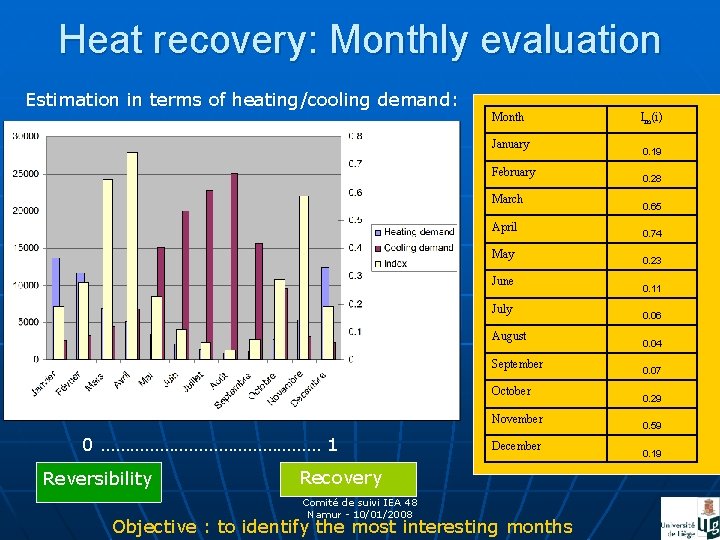
Heat recovery: Monthly evaluation Estimation in terms of heating/cooling demand: Month January February March April May June July August September October November 0 …………………… 1 Reversibility December Recovery Comité de suivi IEA 48 Namur - 10/01/2008 Objective : to identify the most interesting months Im(i) 0. 19 0. 28 0. 65 0. 74 0. 23 0. 11 0. 06 0. 04 0. 07 0. 29 0. 59 0. 19
Chiller reversibility assessment Comité de suivi IEA 48 Namur - 10/01/2008
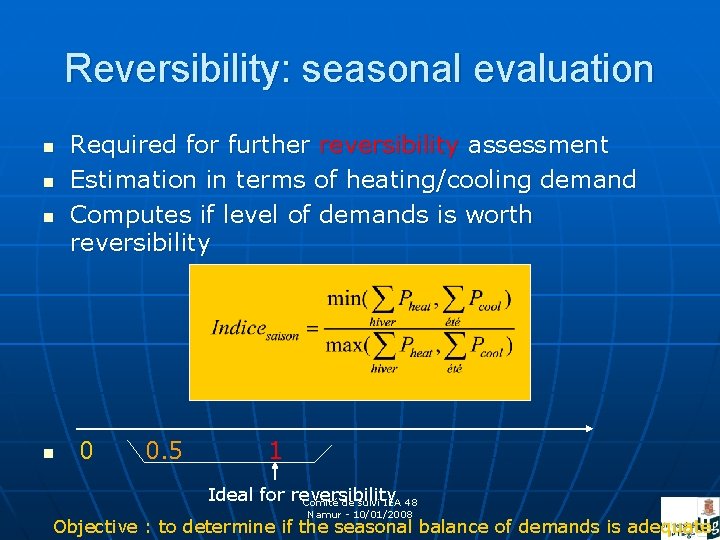
Reversibility: seasonal evaluation n Required for further reversibility assessment Estimation in terms of heating/cooling demand Computes if level of demands is worth reversibility n 0 0. 5 1 Ideal for reversibility Comité de suivi IEA 48 Namur - 10/01/2008 Objective : to determine if the seasonal balance of demands is adequate
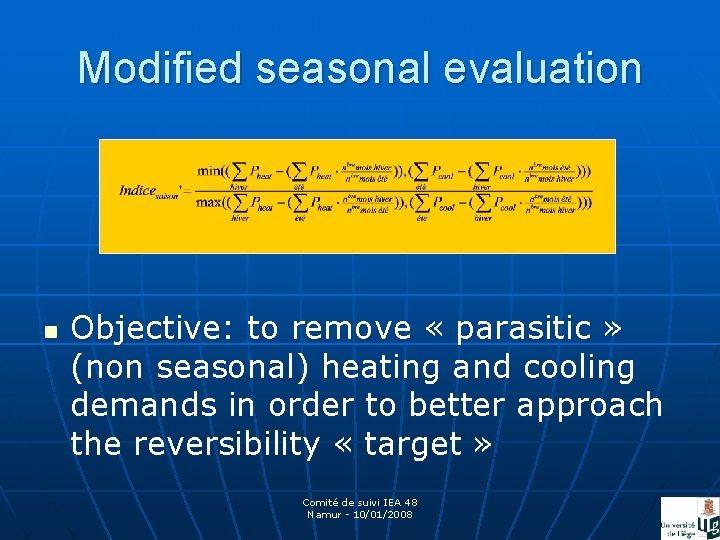
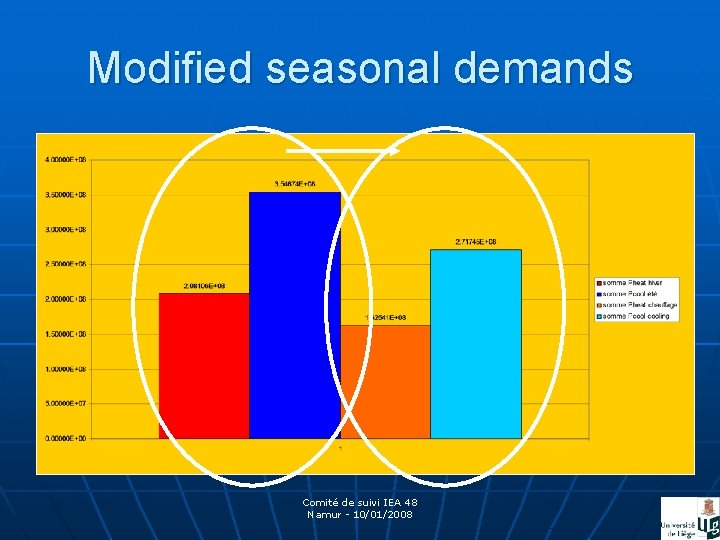
Modified seasonal evaluation n Objective: to remove « parasitic » (non seasonal) heating and cooling demands in order to better approach the reversibility « target » Comité de suivi IEA 48 Namur - 10/01/2008
Modified seasonal demands Comité de suivi IEA 48 Namur - 10/01/2008
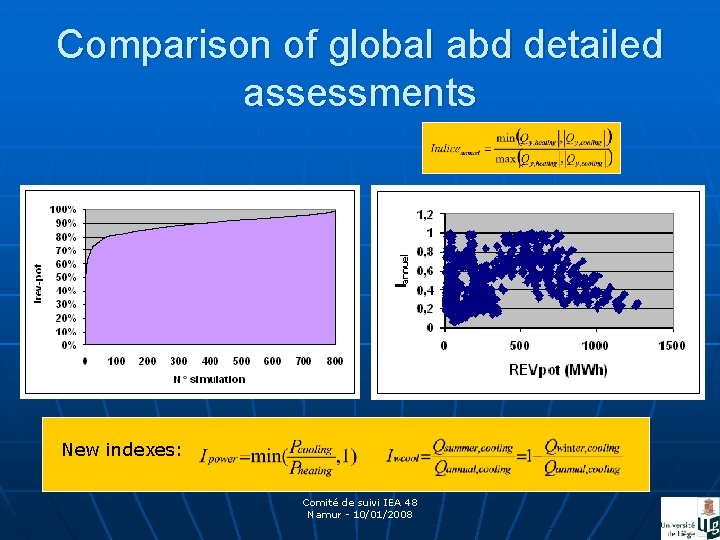
Comparison of global abd detailed assessments New indexes: Comité de suivi IEA 48 Namur - 10/01/2008
Correlation reversibility potential – combined index Comité de suivi IEA 48 Namur - 10/01/2008
Heat Recovery potential assessment Comité de suivi IEA 48 Namur - 10/01/2008
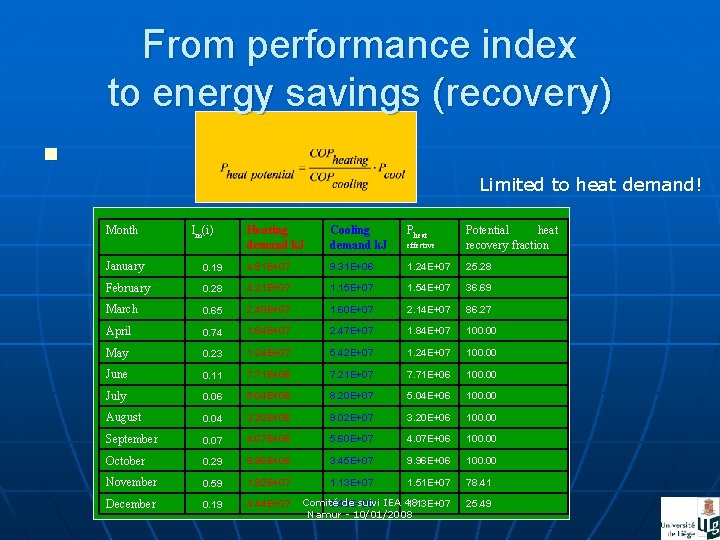
From performance index to energy savings (recovery) n Limited to heat demand! Month Im(i) Heating demand k. J Cooling demand k. J Pheat effective Potential heat recovery fraction January 0. 19 4. 91 E+07 9. 31 E+06 1. 24 E+07 25. 28 February 0. 28 4. 21 E+07 1. 15 E+07 1. 54 E+07 36. 69 March 0. 65 2. 49 E+07 1. 60 E+07 2. 14 E+07 86. 27 April 0. 74 1. 84 E+07 2. 47 E+07 1. 84 E+07 100. 00 May 0. 23 1. 24 E+07 5. 42 E+07 1. 24 E+07 100. 00 June 0. 11 7. 71 E+06 7. 21 E+07 7. 71 E+06 100. 00 July 0. 06 5. 04 E+06 8. 20 E+07 5. 04 E+06 100. 00 August 0. 04 3. 20 E+06 9. 02 E+07 3. 20 E+06 100. 00 September 0. 07 4. 07 E+06 5. 60 E+07 4. 07 E+06 100. 00 October 0. 29 9. 96 E+06 3. 45 E+07 9. 96 E+06 100. 00 November 0. 59 1. 92 E+07 1. 13 E+07 1. 51 E+07 78. 41 December 0. 19 4. 44 E+07 Comité de suivi IEA 48 8. 49 E+06 1. 13 E+07 Namur - 10/01/2008 25. 49
Heat recovery vs heat demand Comité de suivi IEA 48 Namur - 10/01/2008
Heat recovery index vs potential heat recovery fraction Comité de suivi IEA 48 Namur - 10/01/2008
Next step n Integration of technological constraints • Feasible technologies • Temperature levels Comité de suivi IEA 48 Namur - 10/01/2008
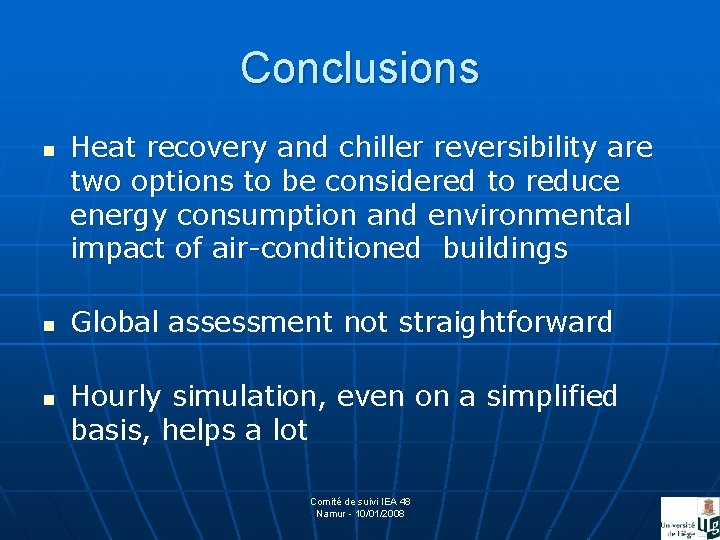
Conclusions n n n Heat recovery and chiller reversibility are two options to be considered to reduce energy consumption and environmental impact of air-conditioned buildings Global assessment not straightforward Hourly simulation, even on a simplified basis, helps a lot Comité de suivi IEA 48 Namur - 10/01/2008