
Identification of Children with Specific Learning Disabilities This
Identification of Children with Specific Learning Disabilities
This module looks at: · · IDEA’s definition of “specific learning disabilities” (SLD) at § 300. 8(c)(10) IDEA’s additional procedures for identifying children with SLD Evaluation series… l l l Intro to evaluation Initial evaluation & reevaluation Identification of children with specific learning disabilities

Definition of Specific Learning Disability Learning disability or specific learning disability? Defined at § 300. 8(c)(10) as… A disorder in one or more of the basic psychological processes involved in understanding or in using language, spoken or written…
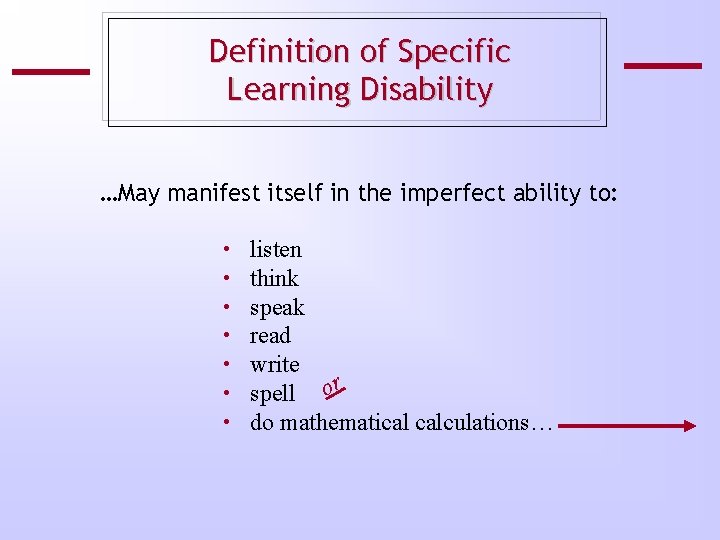
Definition of Specific Learning Disability …May manifest itself in the imperfect ability to: • • listen think speak read write spell or do mathematical calculations…
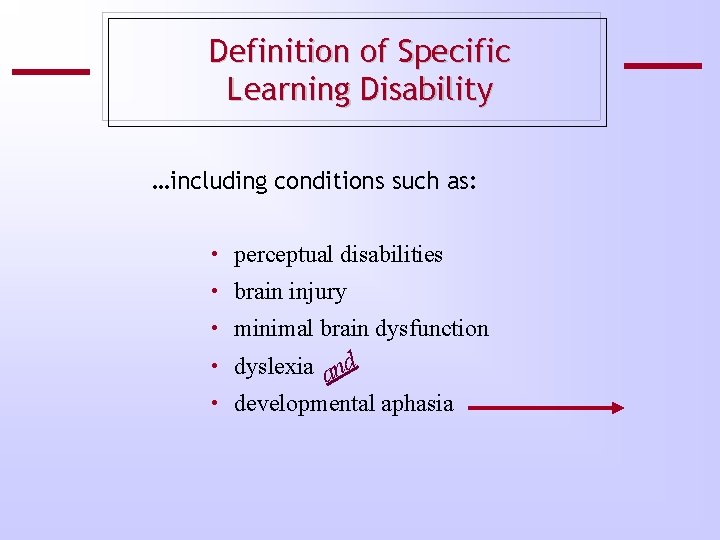
Definition of Specific Learning Disability …including conditions such as: • perceptual disabilities • brain injury • minimal brain dysfunction • dyslexia and • developmental aphasia
Definition of Specific Learning Disability Does not include learning problems that are primarily the result of: • visual, hearing, or motor disabilities • mental retardation • emotional disturbance or • of environmental, cultural, or economic disadvantage
Determining SLD IDEA includes additional procedures for determining SLD. Where shall § 300. 307 we begin?
A Close Look at § 300. 307 State must adopt criteria* for determining whether a child has an SLD as defined in IDEA Public agencies must use State criteria in determining whether a child has an SLD * Consistent with § 300. 309 of Part B
A Close Look at § 300. 307 State criteria may not require use of severe discrepancy between intellectual ability and achievement for determining whether a child has an SLD.
A Close Look at § 300. 307 State criteria must permit use of a process based on the child's response to scientific, research-based intervention.
A Close Look at § 300. 307 State criteria may permit use of other alternative research-based procedures.
Group Determining SLD Determination of SLD is made by child’s parents and a team of qualified professionals, which must include: Child’s regular teacher If child does not have a regular teacher: A regular classroom teacher qualified to teach a child of his or her age If child is less than school age: An individual qualified by SEA to teach a child of his or her age d an
Group Determining SLD At least one person qualified to conduct individual diagnostic examinations of children… Such as… üschool psychologist üspeech-language pathologist üremedial reading teacher
Determining SLD Factors involved: Child’s achievement levels in 1 (or more) of 8 specified areas üOral expression üListening comprehension üWritten expression üBasic reading skill üReading fluency skills üReading comprehension üMath calculation üMath problem solving and…
Determining SLD Child’s progress in 1 (or more) of these 8 areas is not sufficient to meet age or State-approved grade level standards when his or her response to scientific, researchbased intervention is part of determination process or Child exhibits a pattern of strengths and weaknesses in performance, achievement, or both: age Relative to: State-approved grade level standards, or intellectual development …that group determines is relevant and… to identification of SLD
Determining SLD Group determines that its findings are not primarily the result of: üVisual, hearing, or motor disability üMental retardation üEmotional üCultural disturbance factors üEnvironmental or or economic disadvantage üLimited English proficiency or
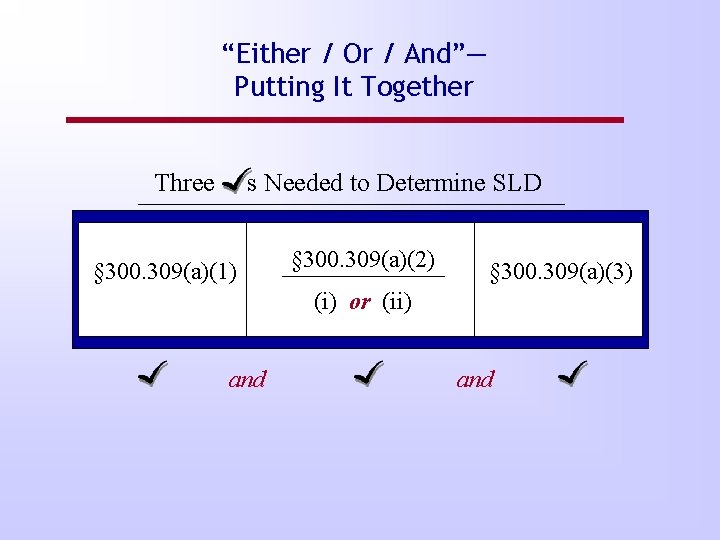
“Either / Or / And”— Putting It Together Three s Needed to Determine SLD § 300. 309(a)(1) § 300. 309(a)(2) § 300. 309(a)(3) (i) or (ii) and
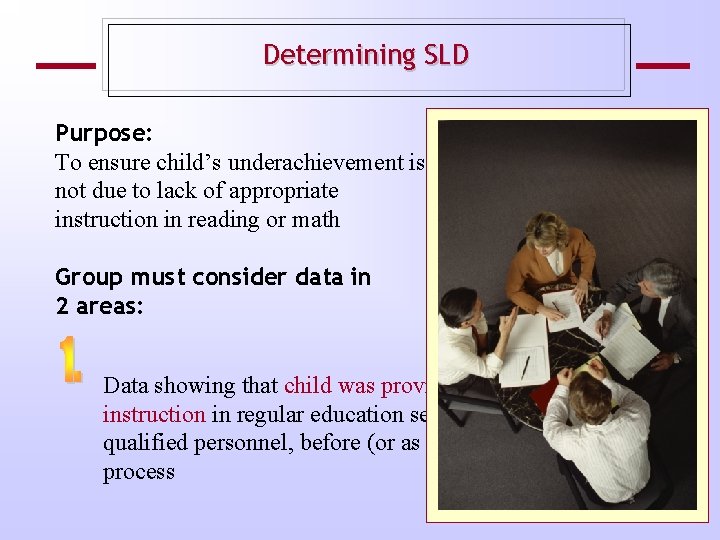
Determining SLD Purpose: To ensure child’s underachievement is not due to lack of appropriate instruction in reading or math Group must consider data in 2 areas: Data showing that child was provided appropriate instruction in regular education settings, delivered by qualified personnel, before (or as part of) referral process and…
Determining SLD Data-based documentation that child’s achievement was repeatedly assessed at reasonable intervals This documentation: ü Reflects formal assessment of student progress during instruction ü Was provided to the child's parents
Determining SLD Public agency must promptly request parent consent for evaluation: Whenever child is referred for evaluation If, before referral for evaluation, child has not made adequate progress… ü after appropriate period of time ü when provided appropriate instruction by qualified personnel
Determining SLD Public agency must adhere* to timeframes for evaluation: or 1. IDEA: 60 days from receiving parent consent for evaluation 2. Timeframe established by State * …unless timeframe is extended by mutual written agreement of the child's parents and group of qualified professionals. Exceptions also exist at § 300. 301(d) and (e).
Observation in SLD Determination Public agency must ensure: ü Child is observed in his or her learning environment (including the regular classroom setting) to document child's academic performance and behavior in the areas of difficulty
Observation in SLD Determination Group must decide whether to: or Use information from observation done before child was referred for an evaluation ü routine classroom instruction ü monitoring of child's performance Have at least one group member conduct observation after child has been referred for evaluation and parental ü child’s academic consent performance in regular classroom
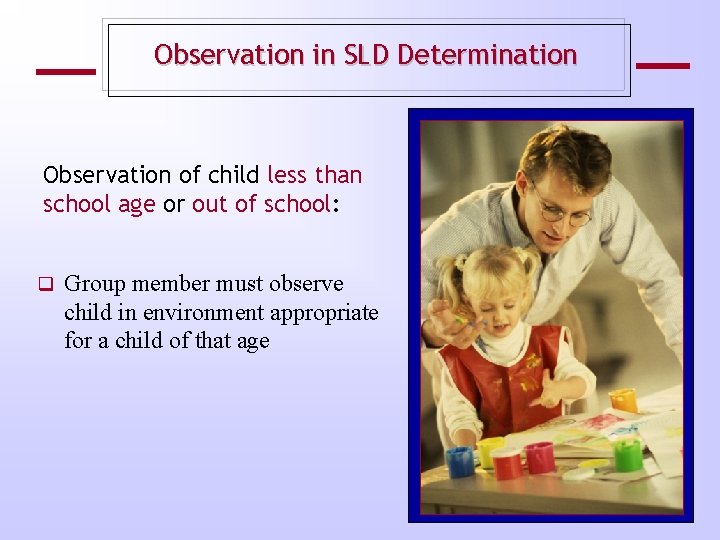
Observation in SLD Determination Observation of child less than school age or out of school: Group member must observe child in environment appropriate for a child of that age
Documenting the Determination of Eligibility For a child suspected of having SLD, documentation of determination of eligibility must contain a statement of 7 elements: 1. Whether child has a specific learning disability 2. Basis for making the determination* and… * …including assurance that qualified professionals and child’s parent determined child was a “child with a disability” and his or her educational needs
Documenting the Determination of Eligibility 3. Relevant behavior (if any) noted during observation of child and relationship of that behavior to child's academic functioning 4. Educationally relevant medical findings (if any) and…
Documenting the Determination of Eligibility 5. Whether child does not achieve adequately: ü for the child's age, or ü to meet State-approved grade-level standards* and… * Consistent with § 300. 309(a)(1)
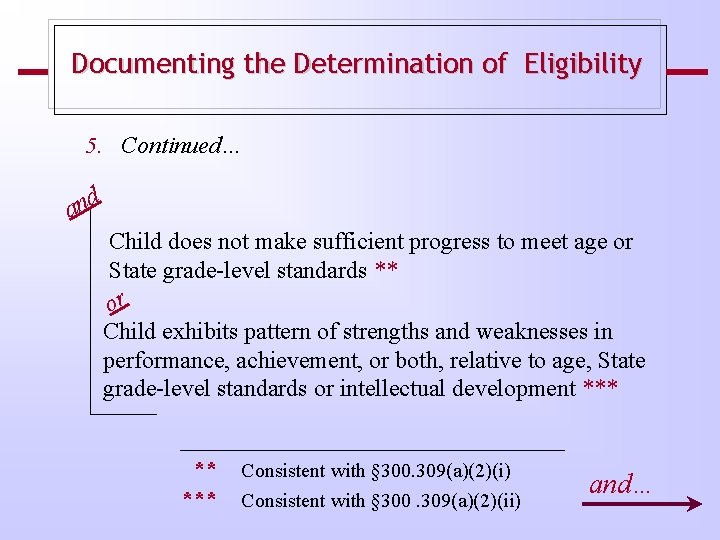
Documenting the Determination of Eligibility 5. Continued… d an Child does not make sufficient progress to meet age or State grade-level standards ** or Child exhibits pattern of strengths and weaknesses in performance, achievement, or both, relative to age, State grade-level standards or intellectual development *** ** *** Consistent with § 300. 309(a)(2)(i) Consistent with § 300. 309(a)(2)(ii) and…
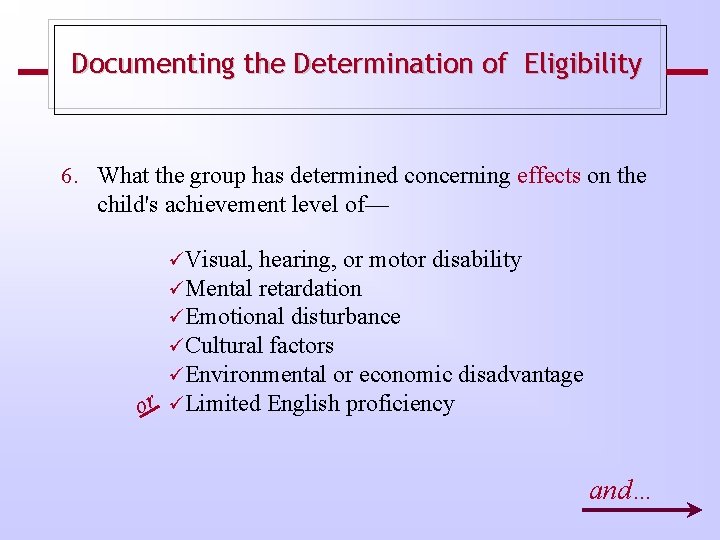
Documenting the Determination of Eligibility 6. What the group has determined concerning effects on the child's achievement level of— or üVisual, hearing, or motor disability üMental retardation üEmotional disturbance üCultural factors üEnvironmental or economic disadvantage üLimited English proficiency and…
Documenting the Determination of Eligibility 7. If child has participated in a process assessing his or her response to scientific, research-based intervention— ü instructional strategies used and student-centered data collected; and ü documentation that child's parents were notified about 3 things, as follows…
Documenting the Determination of Eligibility …that child's parents were notified about— d an ü State's policies regarding amount and nature of student performance data that would be collected and general education services that would be provided ü Strategies for increasing the child's rate of learning ü Parents' right to request an evaluation
Documenting the Determination of Eligibility Each member of group must certify in writing whether report reflects the member's conclusion If report does not: Member must submit a separate statement presenting his or her conclusions

- Slides: 33