
Identification of an Unknown Bacterial Specimen Introduction Case

Identification of an Unknown Bacterial Specimen (Introduction)
Case Study: A patient presents with a fever, shortness of breath, and a persistent cough. What do you do? Option 1: Prescribe a broad-spectrum antibiotic and discharge the patient Option 2: Obtain a sputum sample and send it to the lab for identification. Prescribe an antibiotic (or maybe not) when results come back from the lab. Which option is the more responsible one? Why?
Purpose of Unknown Analysis To identify microorganisms in a clinical specimen and test the organisms susceptibility to antibiotics. So you know which antibiotic to effectively treat the patient with!
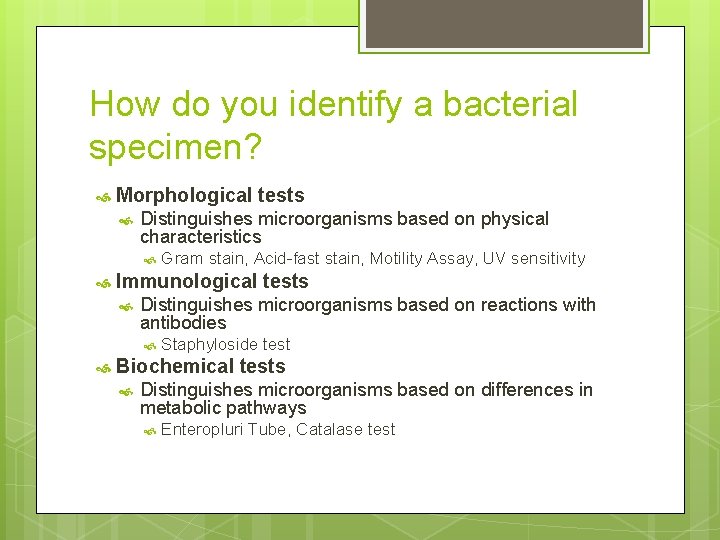
How do you identify a bacterial specimen? Morphological tests Distinguishes microorganisms based on physical characteristics Immunological tests Distinguishes microorganisms based on reactions with antibodies Gram stain, Acid-fast stain, Motility Assay, UV sensitivity Staphyloside test Biochemical tests Distinguishes microorganisms based on differences in metabolic pathways Enteropluri Tube, Catalase test
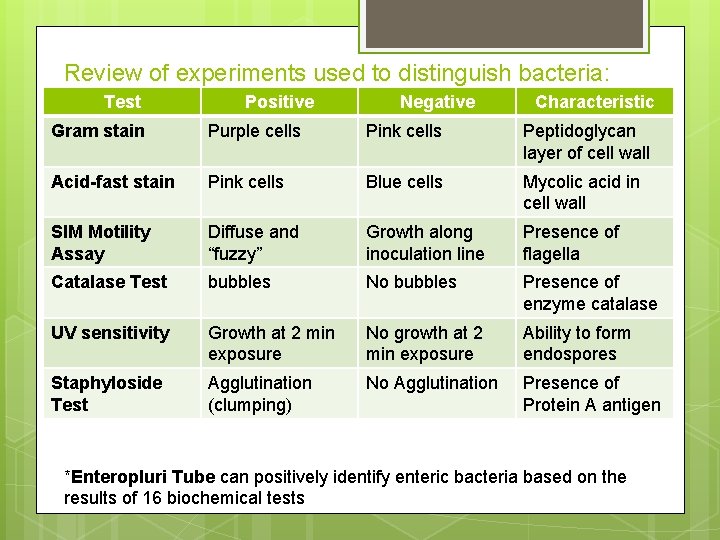
Review of experiments used to distinguish bacteria: Test Positive Negative Characteristic Gram stain Purple cells Pink cells Peptidoglycan layer of cell wall Acid-fast stain Pink cells Blue cells Mycolic acid in cell wall SIM Motility Assay Diffuse and “fuzzy” Growth along inoculation line Presence of flagella Catalase Test bubbles No bubbles Presence of enzyme catalase UV sensitivity Growth at 2 min exposure No growth at 2 min exposure Ability to form endospores Staphyloside Test Agglutination (clumping) No Agglutination Presence of Protein A antigen *Enteropluri Tube can positively identify enteric bacteria based on the results of 16 biochemical tests
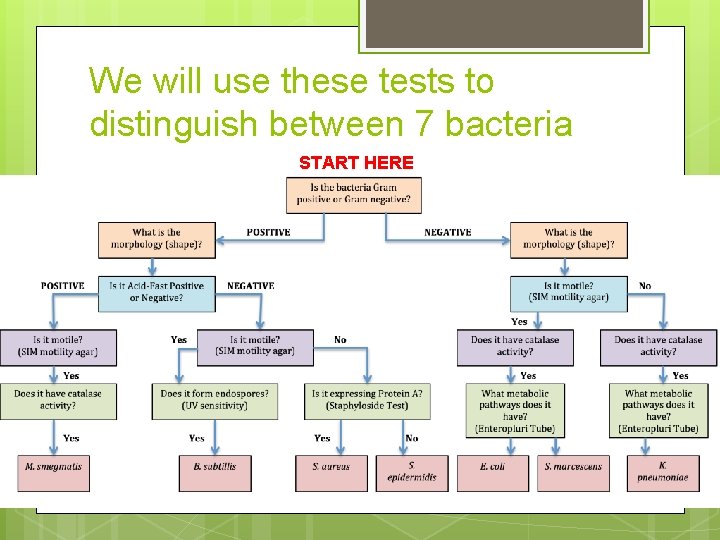
We will use these tests to distinguish between 7 bacteria START HERE
This Week in Lab: Everyone is given an “unknown” broth culture and the same unknown bacteria on a plate to identify. Everyone will perform a Gram stain. You will evaluate your Gram stain and decide what the next test needs to be. To stay on track and get the exercise done, you need to perform 3 tests this week
How will you be graded? Two 1. 2. Assessments: (Each worth 50 points) An open book/open note test to be completed on Blackboard. It is DUE at 11: 59 PM on November 17 th. A guided write-up of the unknown analysis. It will be the same questions as the worksheet you have been given. There is a sample write-up on Blackboard. The answers to the questions do not have to be lengthy. It is DUE at 11: 59 PM on November 29.
Identification of an Unknown Bacterial Specimen (Week 1)
Purpose: To identify the bacteria in your “unknown” culture. How to accomplish this: Follow the flow chart! What does everyone start by doing? Goal for today: Complete (or set-up) the first 3 experiments on the flowchart. Fill out the worksheet in your packet as you complete the experiments and evaluate the results *WARNING: Your neighbors have different unknowns than you have. You must rely on your own judgment.
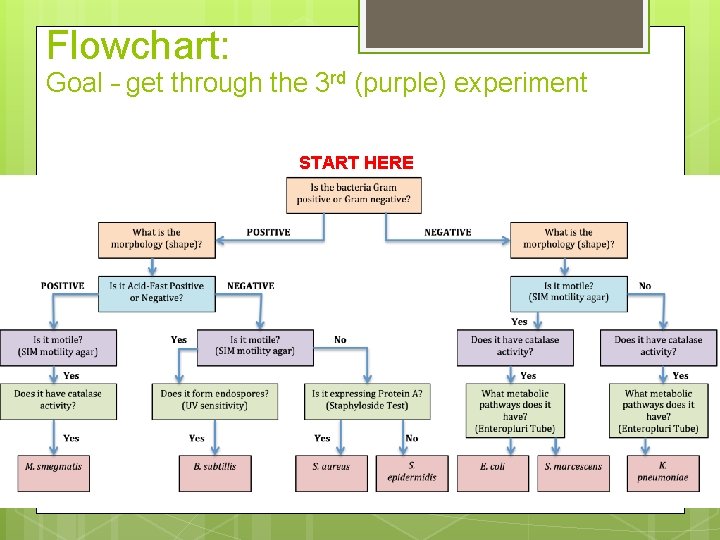
Flowchart: Goal – get through the 3 rd (purple) experiment START HERE
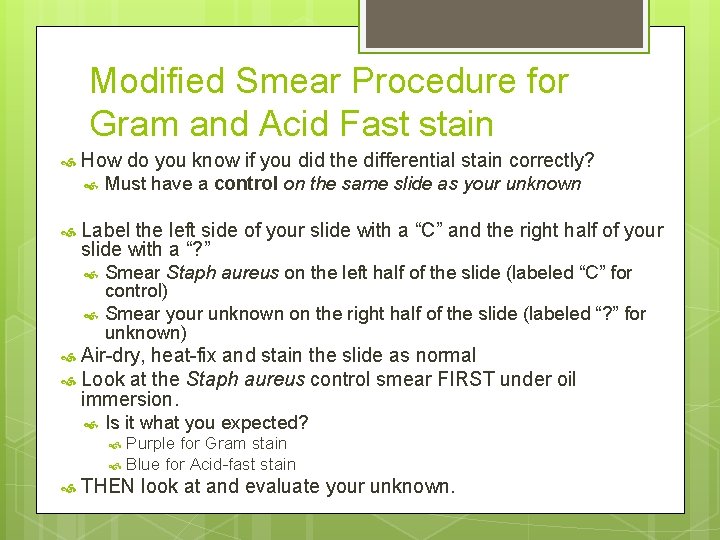
Modified Smear Procedure for Gram and Acid Fast stain How do you know if you did the differential stain correctly? Must have a control on the same slide as your unknown Label the left side of your slide with a “C” and the right half of your slide with a “? ” Smear Staph aureus on the left half of the slide (labeled “C” for control) Smear your unknown on the right half of the slide (labeled “? ” for unknown) Air-dry, heat-fix and stain the slide as normal Look at the Staph aureus control smear FIRST under oil immersion. Is it what you expected? Purple for Gram stain Blue for Acid-fast stain THEN look at and evaluate your unknown.
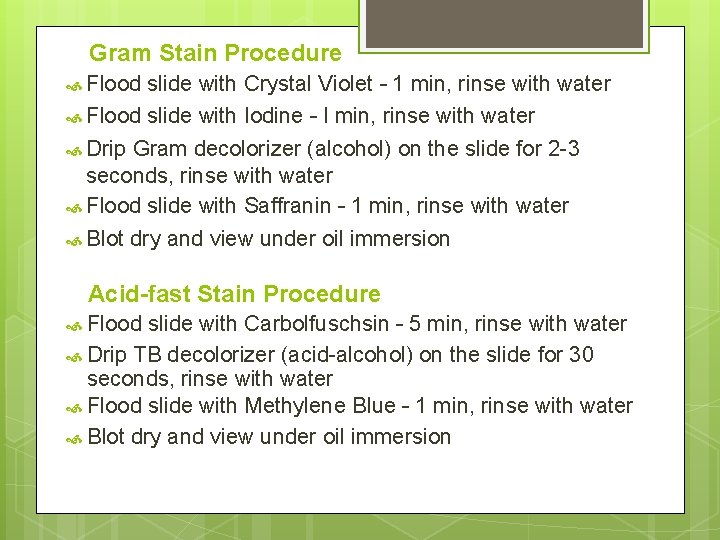
Gram Stain Procedure slide with Crystal Violet – 1 min, rinse with water Flood slide with Iodine – I min, rinse with water Flood Drip Gram decolorizer (alcohol) on the slide for 2 -3 seconds, rinse with water Flood slide with Saffranin – 1 min, rinse with water Blot dry and view under oil immersion Acid-fast Stain Procedure slide with Carbolfuschsin – 5 min, rinse with water Drip TB decolorizer (acid-alcohol) on the slide for 30 seconds, rinse with water Flood slide with Methylene Blue – 1 min, rinse with water Blot dry and view under oil immersion Flood
SIM Motility Assay Use the BROTH culture of your unknown. Label the SIM agar tube with your initials, class, and unknown number Sterilize your stab needle Dip the needle into your broth culture Inoculate the SIM agar by going into the agar and out the same way Sterilize your needle
Catalase Test Use the AGAR plate culture of your unknown Pick a colony of your unknown off the plate and spread on a clean slide Place one drop of hydrogen peroxide on the slide Look for production of bubbles (positive result)
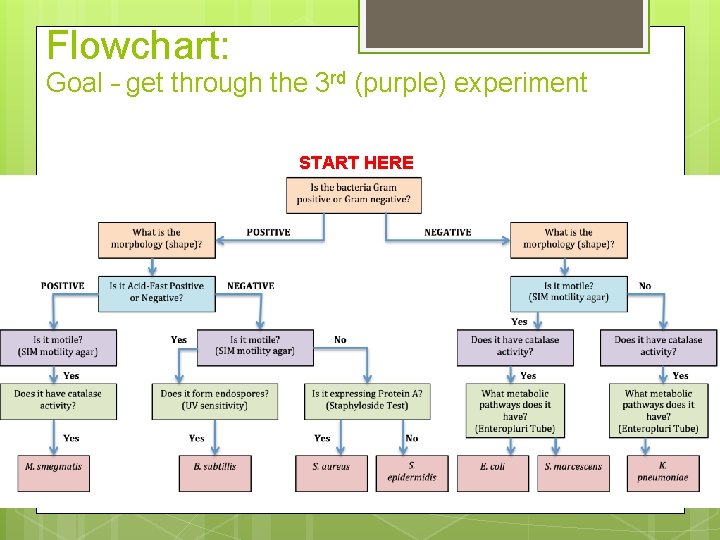
Flowchart: Goal – get through the 3 rd (purple) experiment START HERE
Identification of an Unknown Bacterial Specimen (Week 2)
This Week: Evaluate your SIM motility assay results from last week Complete your identification of your unknown bacterial specimen

Flowchart: Goal – Identify your organism START HERE
Catalase Test Use the AGAR plate culture of your unknown Pick a colony of your unknown off the plate and spread on a clean slide Place one drop of hydrogen peroxide on the slide Look for production of bubbles (positive result)
Staphyloside Test Use the AGAR plate culture of your unknown. Drop one drop of the test latex onto the Staphyloside card Use a sterile toothpick to pick one colony from your unknown agar plate and inoculate it into the test latex Gently rock the card and look for agglutination (positive result)
UV Sensitivity DEMO Locate the UV plate that corresponds to your unknown number. It has been exposed to UV light for 2 minutes Evaluate the growth on the exposed side of the plate and determine whether or not this bacteria produces endospores (as evident by a tolerance to UV light)
Enteropluri Tube Test DEMO Locate the Enteropluri Tube that corresponds to your unknown number Determine whether each compartment in the test is “positive” or “negative” and use the key to code the test Look up the code you generated and identify you bacteria.
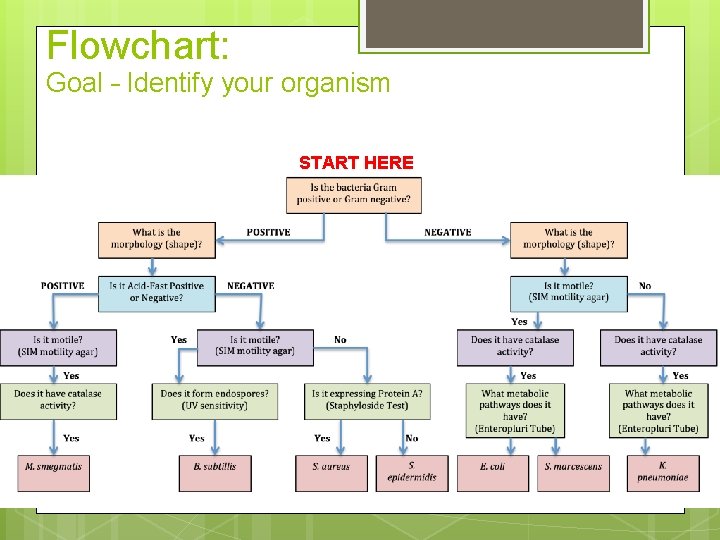
Flowchart: Goal – Identify your organism START HERE
- Slides: 24