
Identification and Initial Characterization of a Mouse with
- Slides: 1
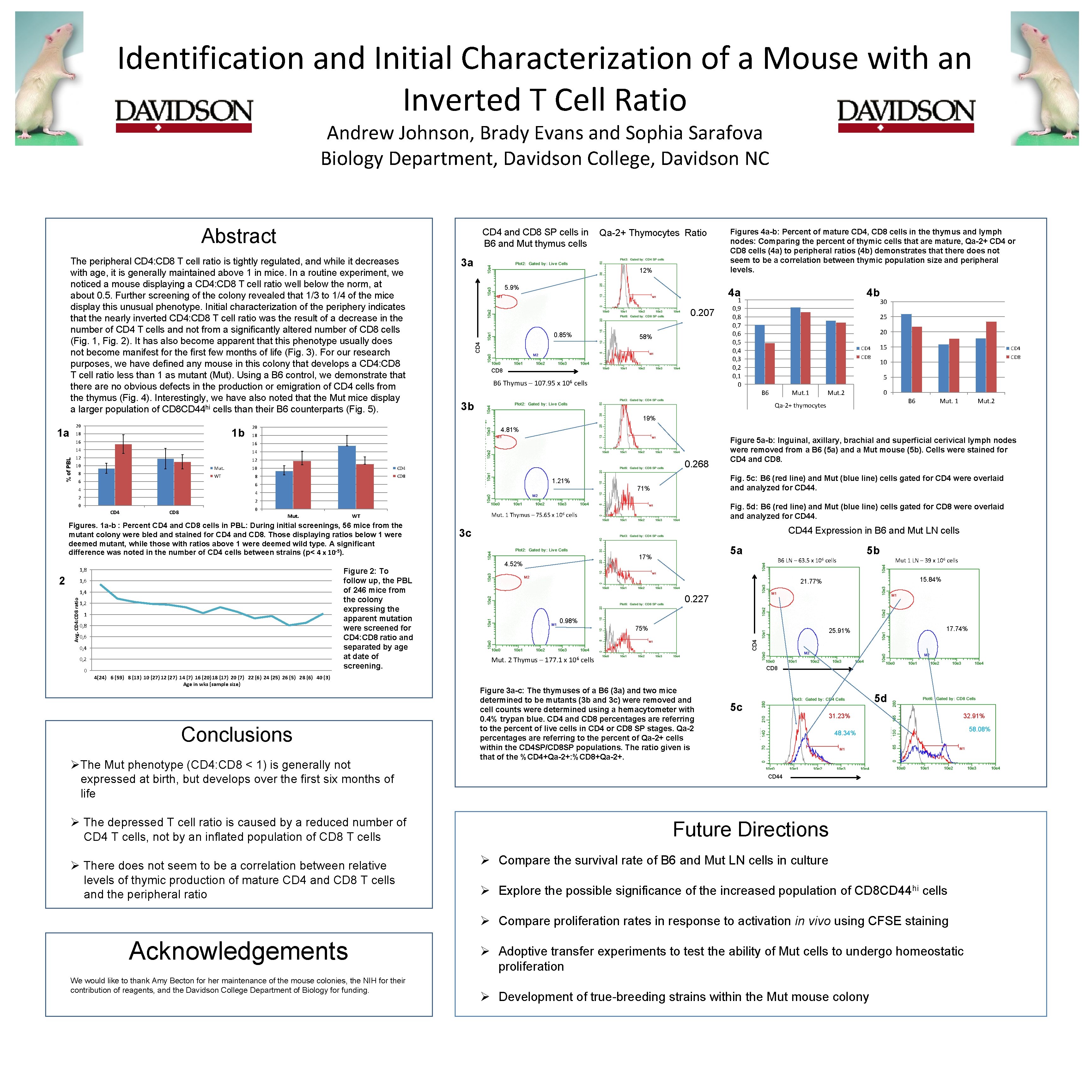
Identification and Initial Characterization of a Mouse with an Inverted T Cell Ratio Andrew Johnson, Brady Evans and Sophia Sarafova Biology Department, Davidson College, Davidson NC Abstract CD 4 and CD 8 SP cells in B 6 and Mut thymus cells 3 a 12% 5. 9% Figures 4 a-b: Percent of mature CD 4, CD 8 cells in the thymus and lymph nodes: Comparing the percent of thymic cells that are mature, Qa-2+ CD 4 or CD 8 cells (4 a) to peripheral ratios (4 b) demonstrates that there does not seem to be a correlation between thymic population size and peripheral levels. 4 a 0. 207 0. 85% 58% CD 4 The peripheral CD 4: CD 8 T cell ratio is tightly regulated, and while it decreases with age, it is generally maintained above 1 in mice. In a routine experiment, we noticed a mouse displaying a CD 4: CD 8 T cell ratio well below the norm, at about 0. 5. Further screening of the colony revealed that 1/3 to 1/4 of the mice display this unusual phenotype. Initial characterization of the periphery indicates that the nearly inverted CD 4: CD 8 T cell ratio was the result of a decrease in the number of CD 4 T cells and not from a significantly altered number of CD 8 cells (Fig. 1, Fig. 2). It has also become apparent that this phenotype usually does not become manifest for the first few months of life (Fig. 3). For our research purposes, we have defined any mouse in this colony that develops a CD 4: CD 8 T cell ratio less than 1 as mutant (Mut). Using a B 6 control, we demonstrate that there are no obvious defects in the production or emigration of CD 4 cells from the thymus (Fig. 4). Interestingly, we have also noted that the Mut mice display a larger population of CD 8 CD 44 hi cells than their B 6 counterparts (Fig. 5). Qa-2+ Thymocytes Ratio CD 8 B 6 Thymus – 107. 95 x 106 cells 4 b 1 0, 9 0, 8 0, 7 0, 6 0, 5 0, 4 0, 3 0, 2 0, 1 0 30 25 20 15 CD 4 CD 8 10 5 B 6 3 b Mut. 1 0 Mut. 2 Qa-2+ thymocytes B 6 Mut. 1 Mut. 2 19% 20 1 b 16 18 16 14 % of PBL 4. 81% 14 12 12 10 8 6 Mut. 10 CD 4 WT 8 CD 8 71% 4 2 2 0 CD 4 CD 8 0 Mut. 1, 8 Figure 2: To follow up, the PBL of 246 mice from the colony expressing the apparent mutation were screened for CD 4: CD 8 ratio and separated by age at date of screening. 1, 6 1, 4 1, 2 1 0, 8 0, 6 0, 4 0, 2 0 4(24) 6 (59) 8 (13) 10 (27) 12 (27) 14 (7) 16 (20) 18 (17) 20 (7) 22 (6) 24 (25) 26 (5) 28 (6) 40 (3) Age in wks (sample size) Conclusions ØThe Mut phenotype (CD 4: CD 8 < 1) is generally not expressed at birth, but develops over the first six months of life Ø The depressed T cell ratio is caused by a reduced number of CD 4 T cells, not by an inflated population of CD 8 T cells Ø There does not seem to be a correlation between relative levels of thymic production of mature CD 4 and CD 8 T cells and the peripheral ratio Fig. 5 d: B 6 (red line) and Mut (blue line) cells gated for CD 8 were overlaid analyzed for CD 44. Mut. 1 Thymus – 75. 65 x 106 cells WT Figures. 1 a-b : Percent CD 4 and CD 8 cells in PBL: During initial screenings, 56 mice from the mutant colony were bled and stained for CD 4 and CD 8. Those displaying ratios below 1 were deemed mutant, while those with ratios above 1 were deemed wild type. A significant difference was noted in the number of CD 4 cells between strains (p< 4 x 10 -5). Avg. CD 4: CD 8 ratio Fig. 5 c: B 6 (red line) and Mut (blue line) cells gated for CD 4 were overlaid analyzed for CD 44. 1. 21% 6 4 2 0. 268 Figure 5 a-b: Inguinal, axillary, brachial and superficial cerivical lymph nodes were removed from a B 6 (5 a) and a Mut mouse (5 b). Cells were stained for CD 4 and CD 8. CD 44 Expression in B 6 and Mut LN cells 3 c 5 a 17% 4. 52% 5 b B 6 LN – 63. 5 x 10⁶ cells Mut 1 LN – 39 x 106 cells 15. 84% 21. 77% 0. 227 0. 98% 75% 17. 74% 25. 91% CD 4 1 a 18 20 Mut. 2 Thymus – 177. 1 x 10⁶ cells CD 8 Figure 3 a-c: The thymuses of a B 6 (3 a) and two mice determined to be mutants (3 b and 3 c) were removed and cell counts were determined using a hemacytometer with 0. 4% trypan blue. CD 4 and CD 8 percentages are referring to the percent of live cells in CD 4 or CD 8 SP stages. Qa-2 percentages are referring to the percent of Qa-2+ cells within the CD 4 SP/CD 8 SP populations. The ratio given is that of the %CD 4+Qa-2+: %CD 8+Qa-2+. 5 d 5 c 31. 23% 32. 91% 48. 34% CD 44 Future Directions Ø Compare the survival rate of B 6 and Mut LN cells in culture Ø Explore the possible significance of the increased population of CD 8 CD 44 hi cells Ø Compare proliferation rates in response to activation in vivo using CFSE staining Acknowledgements We would like to thank Amy Becton for her maintenance of the mouse colonies, the NIH for their contribution of reagents, and the Davidson College Department of Biology for funding. Ø Adoptive transfer experiments to test the ability of Mut cells to undergo homeostatic proliferation Ø Development of true-breeding strains within the Mut mouse colony 58. 08%