
Identification and Assessment of Gifted and Talented Students

- Slides: 25
Identification and Assessment of Gifted and Talented Students Hope Pierce Gifted and Talented Coordinator Ashdown School District Fall 2014 Adapted from a presentation created by Terilyn Moore, GT Program Coodinator, Comal ISD; November 2012
According to the Program Approval Standards for the Gifted and Talented, the Arkansas Department of Education defines a gifted/talented student as… …“those of high potential or ability whose learning characteristics and educational needs require qualitatively differentiated educational experiences and/or services. …will be evidenced through an interaction of above average intellectual ability, task commitment and /or motivation, and creative ability. ”
Statistically… …between 3% and 5% of the student population is gifted/talented.
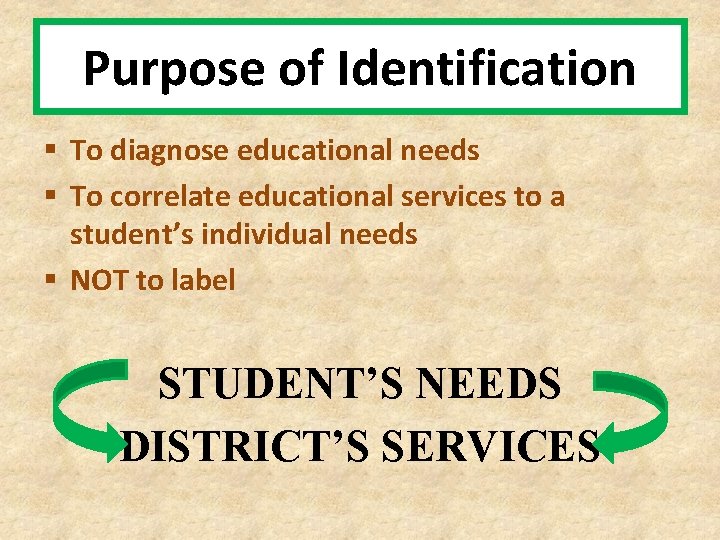
Purpose of Identification § To diagnose educational needs § To correlate educational services to a student’s individual needs § NOT to label STUDENT’S NEEDS DISTRICT’S SERVICES
Success isn’t about labels; it’s about learning! Dr. Carole S. Dweck - Mindset
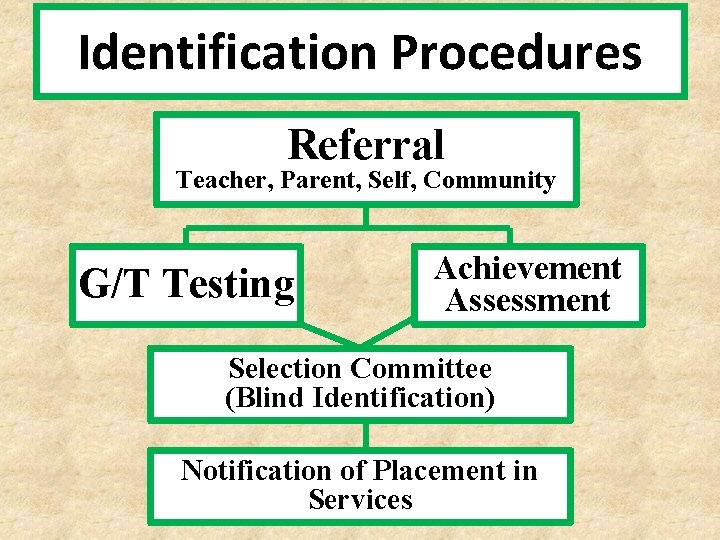
Identification Procedures Referral Teacher, Parent, Self, Community G/T Testing Achievement Assessment Selection Committee (Blind Identification) Notification of Placement in Services
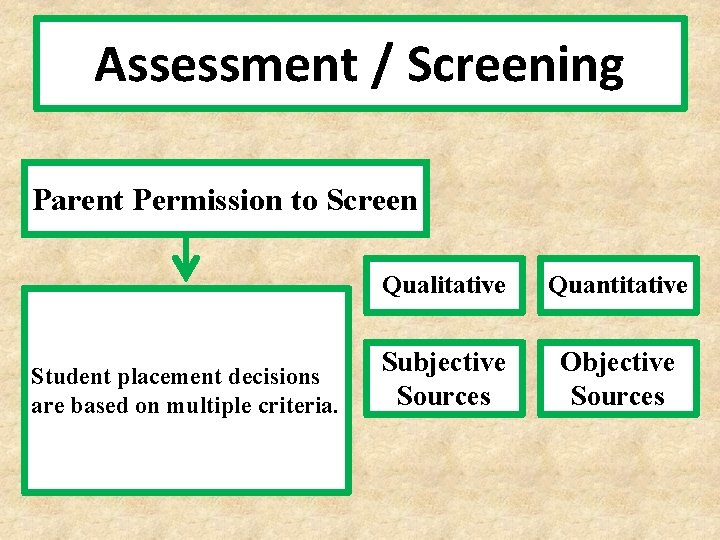
Assessment / Screening Parent Permission to Screen Student placement decisions are based on multiple criteria. Qualitative Quantitative Subjective Sources Objective Sources
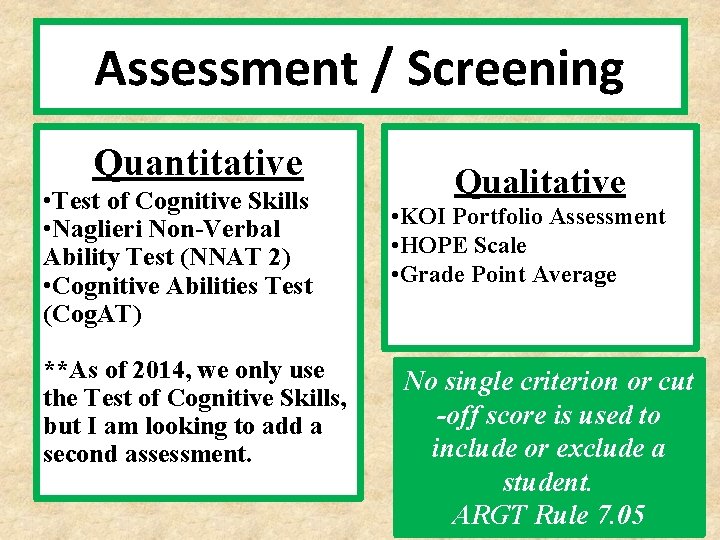
Assessment / Screening Quantitative • Test of Cognitive Skills • Naglieri Non-Verbal Ability Test (NNAT 2) • Cognitive Abilities Test (Cog. AT) **As of 2014, we only use the Test of Cognitive Skills, but I am looking to add a second assessment. Qualitative • KOI Portfolio Assessment • HOPE Scale • Grade Point Average No single criterion or cut -off score is used to include or exclude a student. ARGT Rule 7. 05
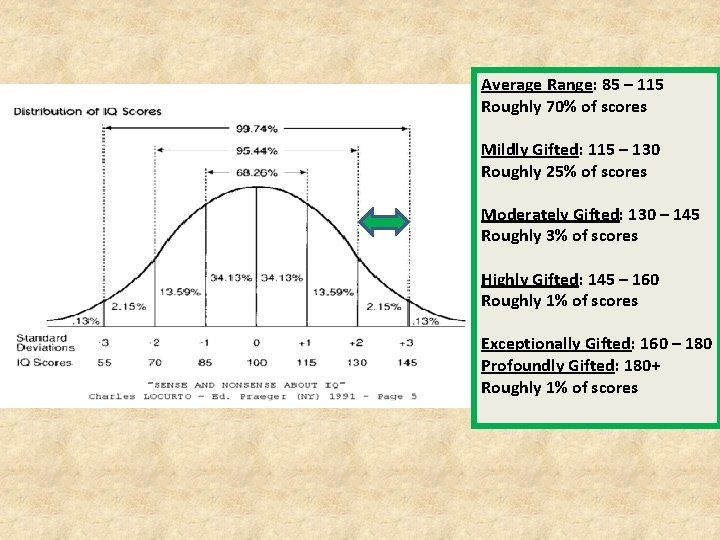
Average Range: 85 – 115 Roughly 70% of scores Mildly Gifted: 115 – 130 Roughly 25% of scores Moderately Gifted: 130 – 145 Roughly 3% of scores Highly Gifted: 145 – 160 Roughly 1% of scores Exceptionally Gifted: 160 – 180 Profoundly Gifted: 180+ Roughly 1% of scores
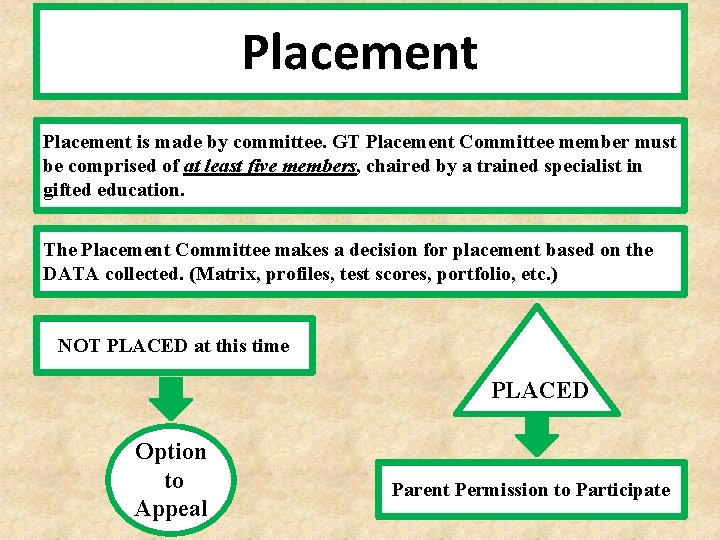
Placement is made by committee. GT Placement Committee member must be comprised of at least five members, chaired by a trained specialist in gifted education. The Placement Committee makes a decision for placement based on the DATA collected. (Matrix, profiles, test scores, portfolio, etc. ) NOT PLACED at this time PLACED Option to Appeal Parent Permission to Participate
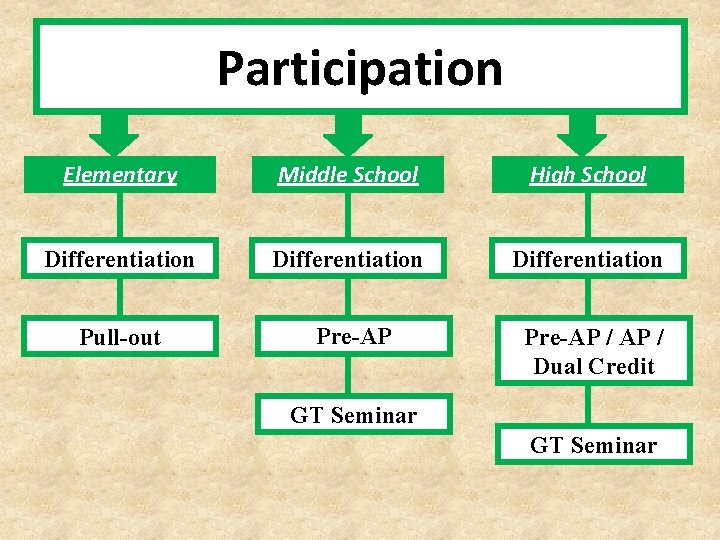
Participation Elementary Middle School High School Differentiation Pull-out Pre-AP / Dual Credit GT Seminar
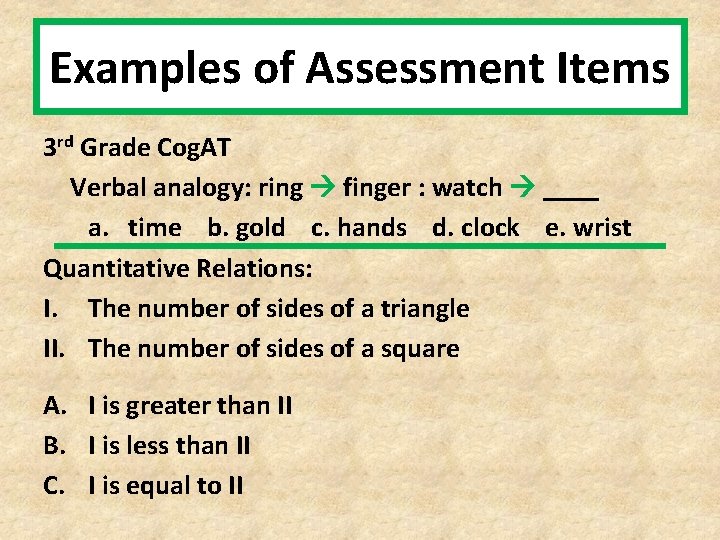
Examples of Assessment Items 3 rd Grade Cog. AT Verbal analogy: ring finger : watch ____ a. time b. gold c. hands d. clock e. wrist Quantitative Relations: I. The number of sides of a triangle II. The number of sides of a square A. I is greater than II B. I is less than II C. I is equal to II
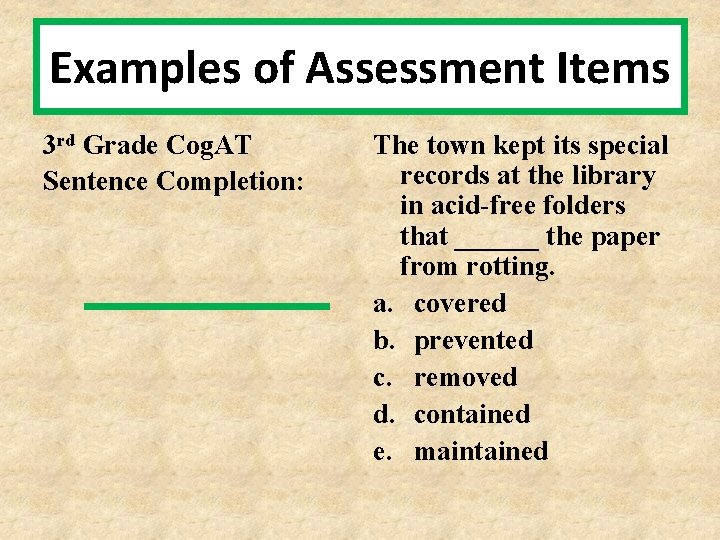
Examples of Assessment Items 3 rd Grade Cog. AT Sentence Completion: The town kept its special records at the library in acid-free folders that ______ the paper from rotting. a. covered b. prevented c. removed d. contained e. maintained
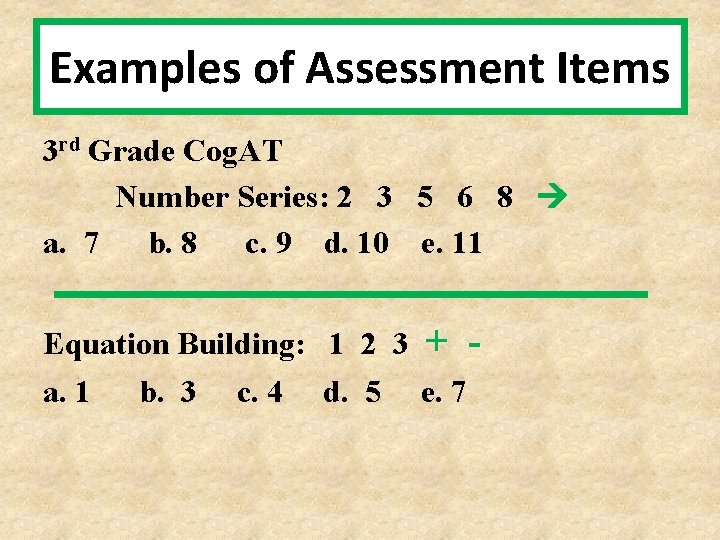
Examples of Assessment Items 3 rd Grade Cog. AT Number Series: 2 3 5 6 8 a. 7 b. 8 c. 9 d. 10 e. 11 Equation Building: 1 2 3 + a. 1 b. 3 c. 4 d. 5 e. 7
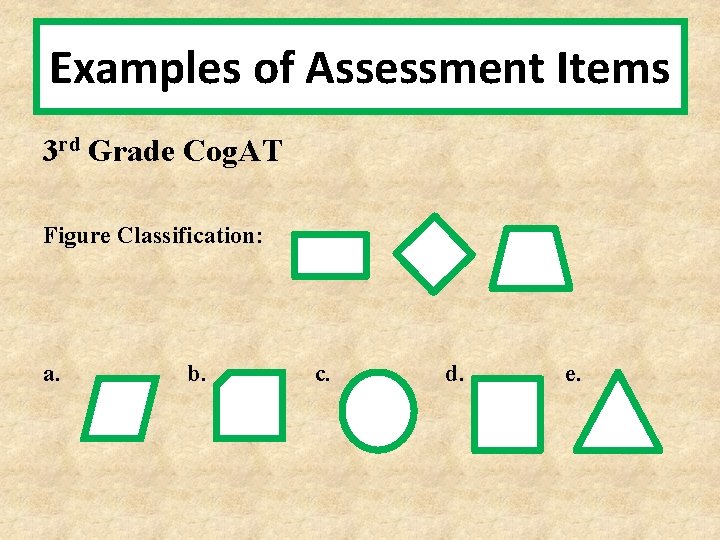
Examples of Assessment Items 3 rd Grade Cog. AT Figure Classification: a. b. c. d. e.
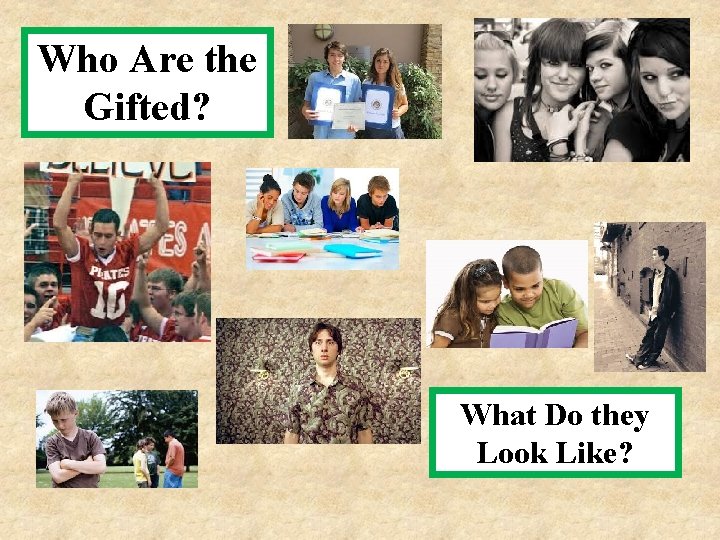
Who Are the Gifted? What Do they Look Like?
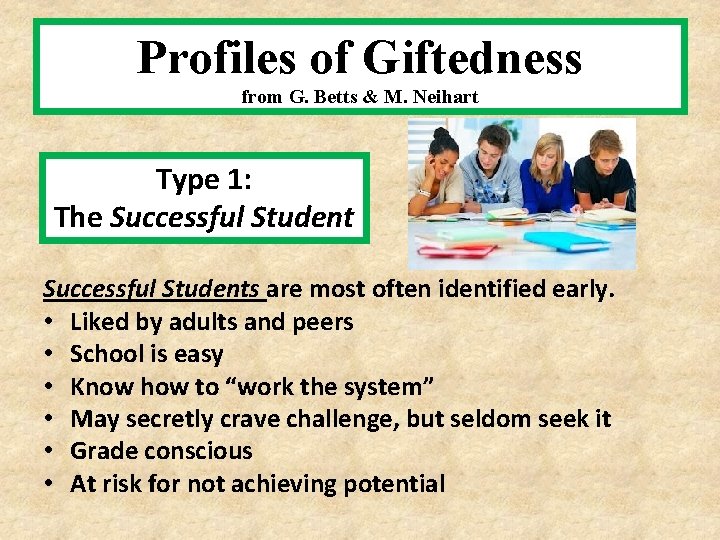
Profiles of Giftedness from G. Betts & M. Neihart Type 1: The Successful Students are most often identified early. • Liked by adults and peers • School is easy • Know how to “work the system” • May secretly crave challenge, but seldom seek it • Grade conscious • At risk for not achieving potential
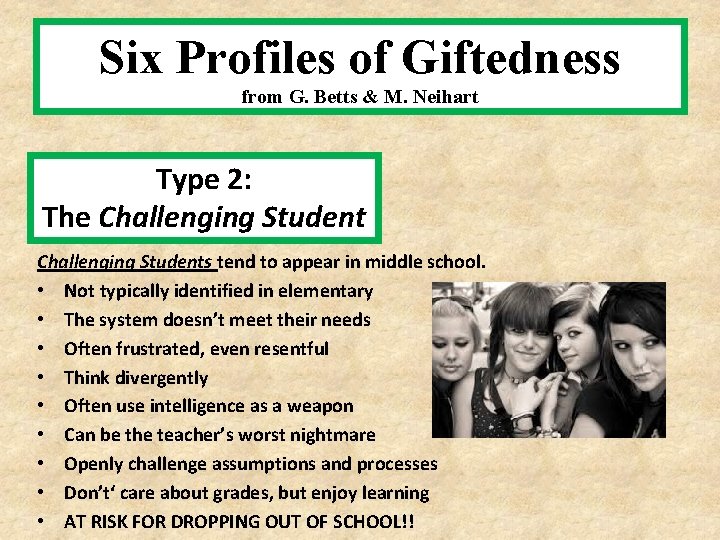
Six Profiles of Giftedness from G. Betts & M. Neihart Type 2: The Challenging Students tend to appear in middle school. • Not typically identified in elementary • The system doesn’t meet their needs • Often frustrated, even resentful • Think divergently • Often use intelligence as a weapon • Can be the teacher’s worst nightmare • Openly challenge assumptions and processes • Don’t‘ care about grades, but enjoy learning • AT RISK FOR DROPPING OUT OF SCHOOL!!
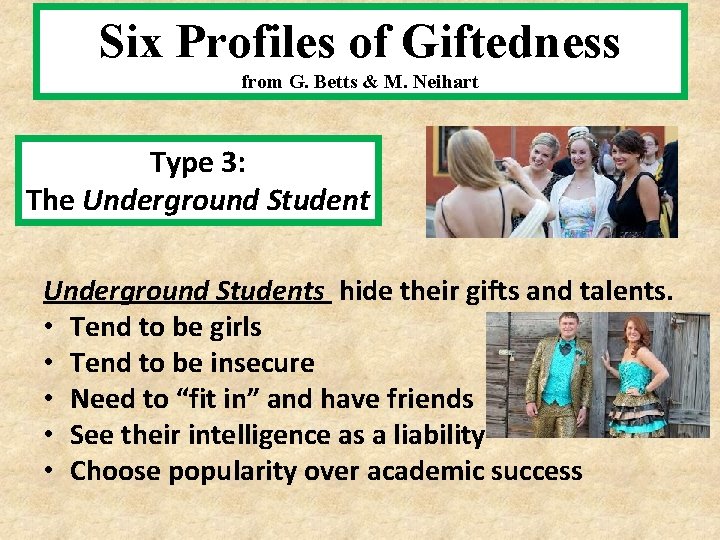
Six Profiles of Giftedness from G. Betts & M. Neihart Type 3: The Underground Students hide their gifts and talents. • Tend to be girls • Tend to be insecure • Need to “fit in” and have friends • See their intelligence as a liability • Choose popularity over academic success
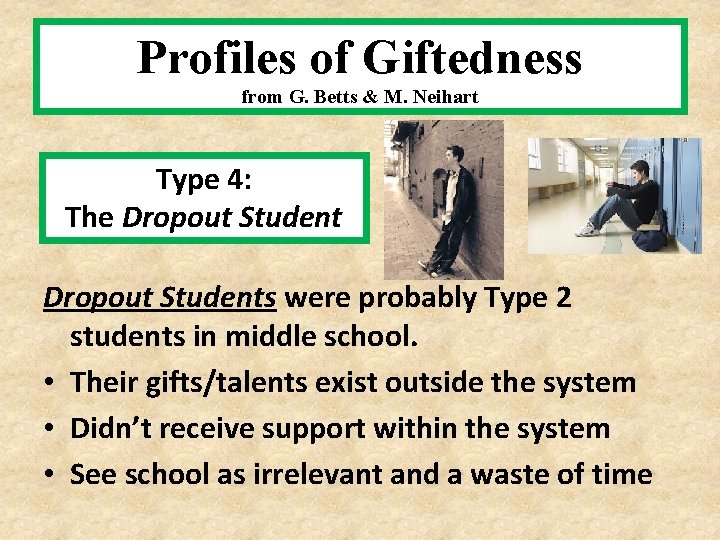
Profiles of Giftedness from G. Betts & M. Neihart Type 4: The Dropout Students were probably Type 2 students in middle school. • Their gifts/talents exist outside the system • Didn’t receive support within the system • See school as irrelevant and a waste of time
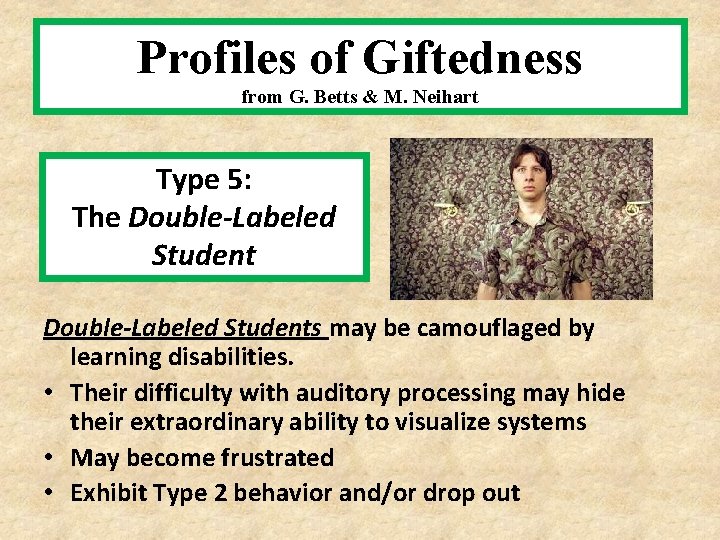
Profiles of Giftedness from G. Betts & M. Neihart Type 5: The Double-Labeled Students may be camouflaged by learning disabilities. • Their difficulty with auditory processing may hide their extraordinary ability to visualize systems • May become frustrated • Exhibit Type 2 behavior and/or drop out
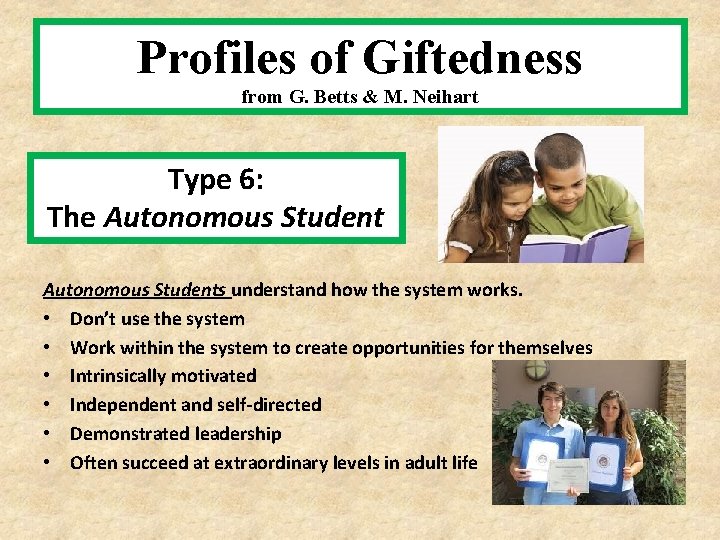
Profiles of Giftedness from G. Betts & M. Neihart Type 6: The Autonomous Students understand how the system works. • Don’t use the system • Work within the system to create opportunities for themselves • Intrinsically motivated • Independent and self-directed • Demonstrated leadership • Often succeed at extraordinary levels in adult life
Important Info We will accept REFERRALS for Gifted / Talented placement Testing throughout the year, Grades K – 12. However, our major push for identification testing will be in the Spring.
Contact Information Hope Pierce Gifted / Talented Coordinator 870 -898 -4445 hpierce@ashdownschools. org Gifted / Talented Webpage: www. ata-targets. wikispaces. org