
IDEM Drinking Water Program Water Resources Study Committee



- Slides: 16
IDEM Drinking Water Program Water Resources Study Committee
Background • Federal Safe Drinking Water Act: – In 1974 EPA promulgated National Primary Drinking Water Regulations which apply to public water systems – Provided for State implementation (primacy) – Act was amended in 1986 and 1996 strengthening and increasing regulatory requirements
Background • Indiana Code 13 -18 -16 -9 provides: – IDEM is the agency with responsibility concerning the Federal Safe Drinking Water Act – IDEM take necessary actions to secure the benefits of the Safe Drinking Water Act for Indiana
IDEM Drinking Water Program • Since 1991 IDEM has responsibility for implementing the Federal Safe Drinking Water Act and for ensuring that public water systems provide Hoosiers with a safe and adequate supply of drinking water • The agency carries out this responsibility by: – Establishing requirements for owners/operators of public water systems – Monitoring compliance and enforcing Safe Drinking Water Act and other applicable requirements – Providing assistance to public water systems
IDEM Drinking Water Program • Focus of program is public water systems • What is a public water system? • How many are there? • How are they regulated?
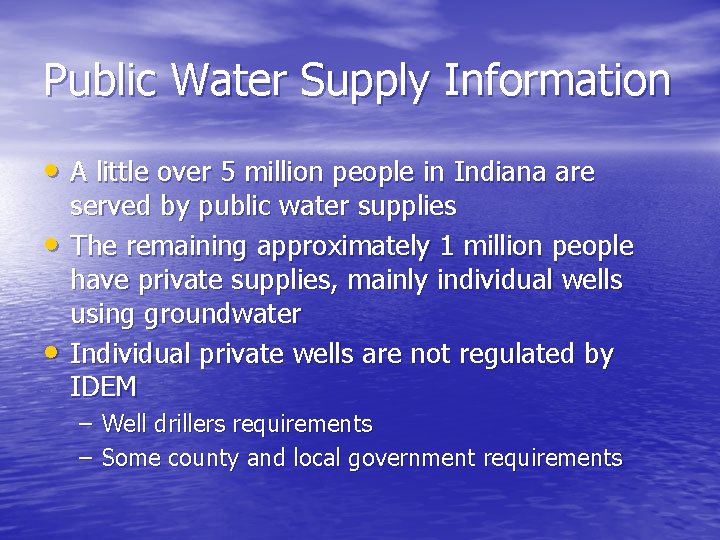
Public Water Supply Information • A little over 5 million people in Indiana are • • served by public water supplies The remaining approximately 1 million people have private supplies, mainly individual wells using groundwater Individual private wells are not regulated by IDEM – Well drillers requirements – Some county and local government requirements
Public Water Supply Information • 96% of all Public Water Supplies utilize ground water as their source • Approximately 52% of the population served by public water systems is served by systems utilizing ground water • The remaining population is served by systems using surface water - mostly very large systems
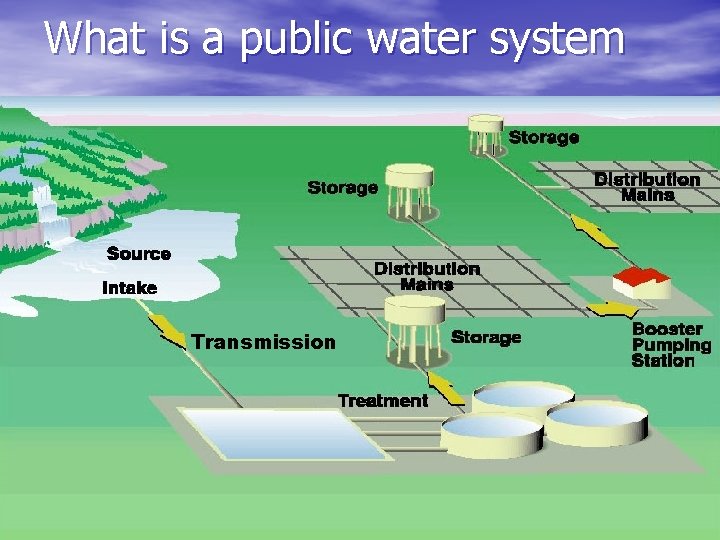
What is a public water system Transmission
What is a public water system • Types of Public Water Systems: – Community - serves at least 15 service connections used by year-round residents or regularly serves at least 25 year-round residents. Examples: cities, towns, mobile home parks, subdivisions (home owner associations) – Nontransient noncommunity - regularly serves the same 25 or more nonresident individuals daily for at least 60 days/year. Examples: industries, businesses, schools, daycares, etc. with their own supply of water
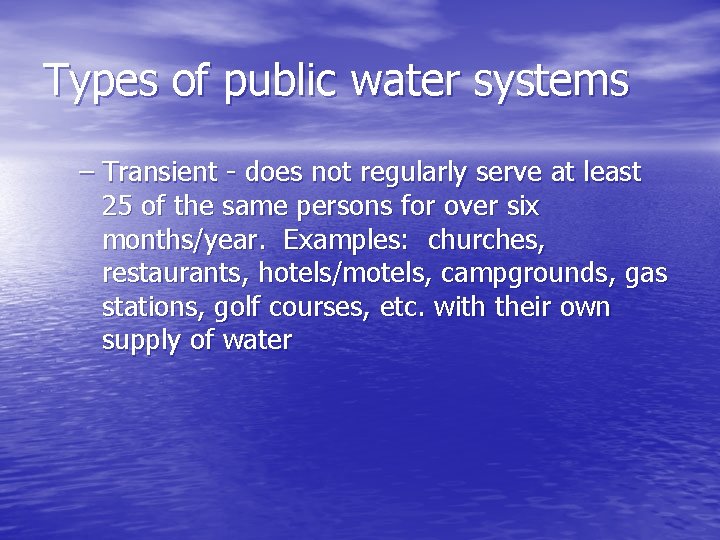
Types of public water systems – Transient - does not regularly serve at least 25 of the same persons for over six months/year. Examples: churches, restaurants, hotels/motels, campgrounds, gas stations, golf courses, etc. with their own supply of water
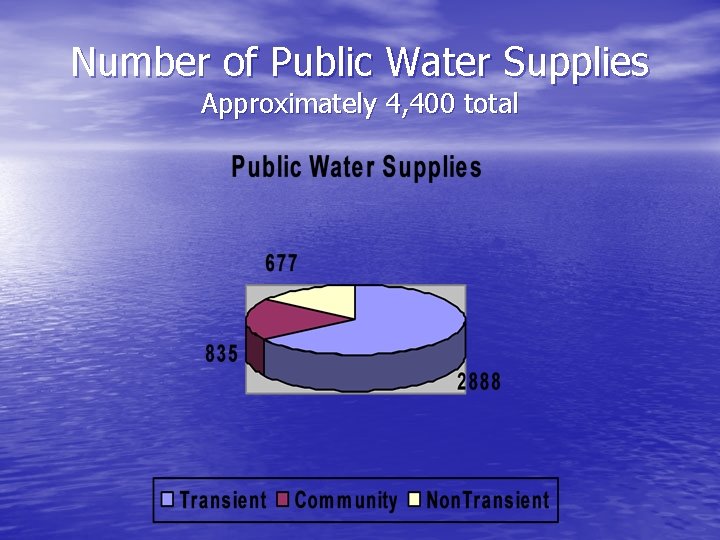
Number of Public Water Supplies Approximately 4, 400 total
Public Water Supply Requirements • Public water systems must perform routine • • sampling to ensure quality Community and nontransient noncommunity systems must have certified operators All systems must have infrastructure components approved - construction permits All systems are required to take corrective action if quality requirements are not met All system are required to notify customers if sampling indicates a problem with the quality of the water
Public Water System Requirements • EPA establishes Maximum Contaminant Levels • • • (MCLs) There approximately 90 different contaminants that have MCLs and health effects established Samples are collected on a frequency determined by IDEM based on the contaminant, size and type of system, past detections, etc Samples must be analyzed by State certified laboratory
Public Water System Requirements • IDEM ensures that systems meet the MCLs and that water is safe – Performing Inspections – Reviewing monitoring and compliance data – Providing assistance to – Ensuring public water systems correct deficiencies – Implementing source water protection – Making sure public is notified if there is problem – Approving infrastructure components
Public Water System Requirements • IDEM’s Drinking Water Program is primarily focused on the quality of water provided by public water supplies • Volume and Pressure requirements – 20 psi minimum pressure in the distribution system – IDEM can impose a connection ban on a system that does not have the ability to meet consumer demand
Bioterrorism and Security • Public water systems are “critical infrastructure” • Public water systems serving over 3, 300 population were required by federal law to: – Perform Vulnerability Assessments – Complete Emergency Response Plans