
IDEF Partie 1 IDEF What is IDEF n
- Slides: 42
IDEF Partie 1 IDEF
What is IDEF? n n n Definition: IDEF is the common name referring to classes of enterprise modeling languages. Objective: IDEF is used for modeling activities necessary to support system analysis, design, improvement or integration. Originally, IDEF was developed to enhance communication among people trying to understand the system. Now, IDEF is being used for documentation, understanding, design, analysis, planning, and Integration.
IDEF History n In the 1970’s, IDEF 0 originated in the U. S. Air Force under the Integrated Computer Aided Manufacturing(ICAM) program from a well-established graphical language, the Structured Analysis and Design Technique (SADT).
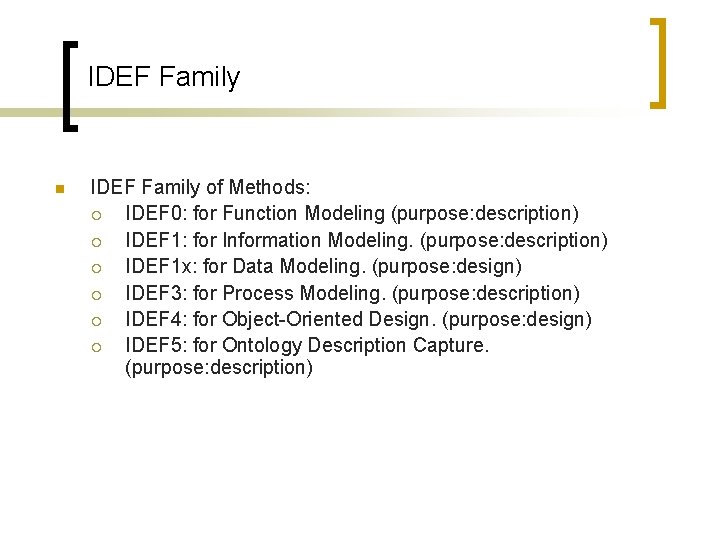
IDEF Family n IDEF Family of Methods: ¡ IDEF 0: for Function Modeling (purpose: description) ¡ IDEF 1: for Information Modeling. (purpose: description) ¡ IDEF 1 x: for Data Modeling. (purpose: design) ¡ IDEF 3: for Process Modeling. (purpose: description) ¡ IDEF 4: for Object-Oriented Design. (purpose: design) ¡ IDEF 5: for Ontology Description Capture. (purpose: description)
IDEF 0 - Function Modeling Method n n n IDEF 0 models the decisions, actions, and activities of an organization or system, in order to communicate the functional perspective of a system. IDEF 0 models are created as one of the first tasks of a system development effort because they describe: ¡ the functions that are performed, ¡ what is needed to perform those functions, IDEF 0 was released as a standard for Function Modeling by the Computer Systems Laboratory of the National Institute of Standards and Technology. (1993)
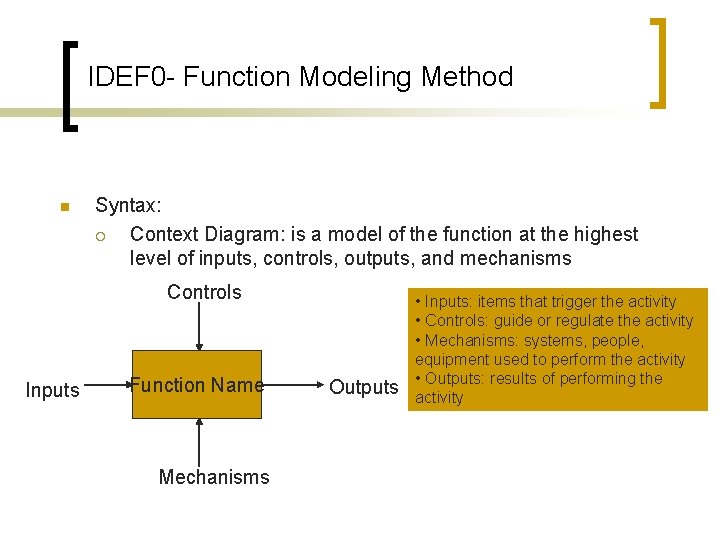
IDEF 0 - Function Modeling Method n Syntax: ¡ Context Diagram: is a model of the function at the highest level of inputs, controls, outputs, and mechanisms Controls Inputs Function Name Mechanisms Outputs • Inputs: items that trigger the activity • Controls: guide or regulate the activity • Mechanisms: systems, people, equipment used to perform the activity • Outputs: results of performing the activity
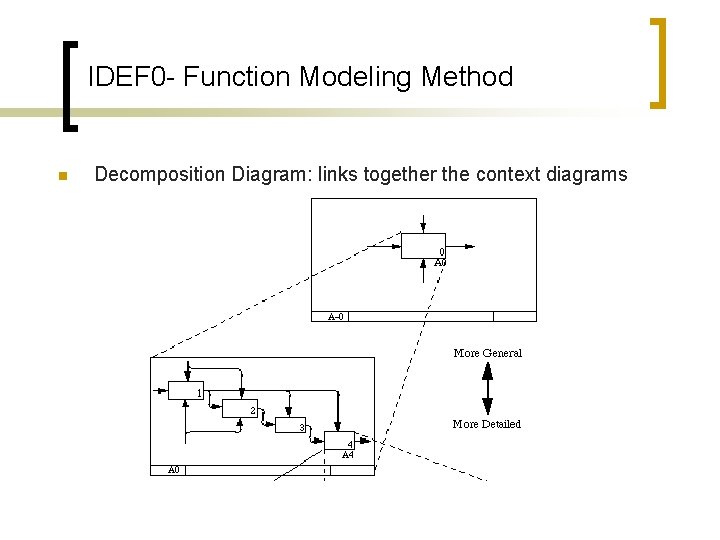
IDEF 0 - Function Modeling Method n Decomposition Diagram: links together the context diagrams
IDEF 1 - Information Modeling Method n n IDEF 1 is a method for both analyzing and communicating the structure and semantics of information within a system. IDEF 1 models are used to: ¡ Identify what information is currently managed in a real-world system, both automated system components, and nonautomated objects (e. g. people). ¡ Identify the rules for managing the information. ¡ Identify deficiencies in the current management of the information. ¡ Specify what information will be managed in a TO-BE implementation. (TO-BE implementation: Design of the functional architecture)
IDEF 1 - Information Modeling Method n STRENGTHS ¡ IDEF 1 requires active participation of the information users, which serves to accurately model where and how the information is used and managed. ¡ An effective method for documenting the informational requirements of an enterprise, providing a foundation for database design. ¡ IDEF 1 enforces a modularity that eliminates the incompleteness, imprecision, inconsistencies, and inaccuracies found in the modeling process.
IDEF 1 x- Data Modeling Method n n IDEF 1 X is a method for designing relational databases. IDEF 1 X Model: Graphical and Textual depiction of “What must I know to do what I do? ” IDEF 1 X is most useful for logical database design after the information requirements are known and the decision to implement a relational database has been made. IDEF 1 X was released as a standard for Data Modeling by the Computer Systems Laboratory of the National Institute of Standards and Technology. (1993)
IDEF 1 x- Data Modeling Method n n STRENGTHS ¡ Powerful tool for data modeling. ¡ IDEF 1 X don’t have numerous variants, unlike ER. ¡ Depicts the rules governing the management of information. ¡ Used to validate the concepts in the associated IDEF 0 model. ¡ Helps to discover underlying causes for problems. WEAKNESSES ¡ The modeler must be experienced in order to create good models. ¡ Not suited to serve as an AS-IS analysis tool.
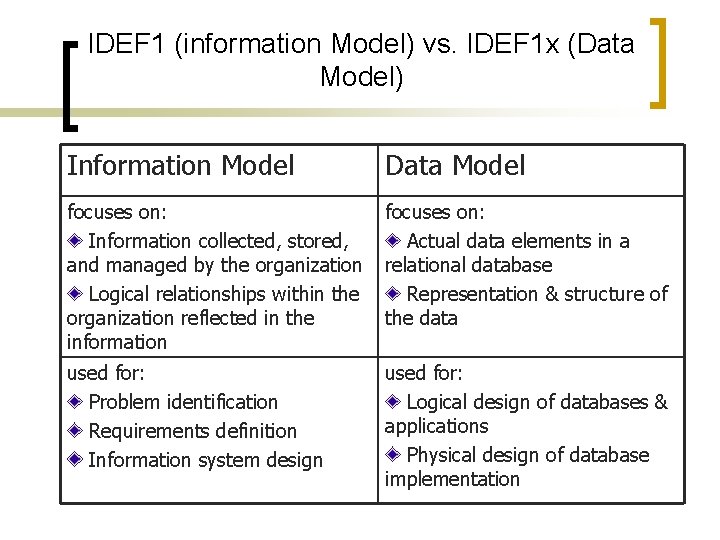
IDEF 1 (information Model) vs. IDEF 1 x (Data Model) Information Model Data Model focuses on: Information collected, stored, and managed by the organization Logical relationships within the organization reflected in the information focuses on: Actual data elements in a relational database Representation & structure of the data used for: Problem identification Requirements definition Information system design used for: Logical design of databases & applications Physical design of database implementation
IDEF 1 Partie 2 Entity – relation model
Introduction n Scope IDEF 1 is used to produce a graphical information model which represents the structure and semantics of information within an environment or system.
Introduction n Purpose IDEF 1 is used to model data in a standard, consistent, predictable manner in order to manage it as a resource. The primary objectives of this standard are: 1. 2. 3. 4. 5. To provide a means for completely understanding and analyzing an organization’s data resources; To provide a common means of representing and communicating the complexity of data; To provide a method for presenting an overall view of the data required to run an enterprise; To provide a means for defining an application-independent view of data which can be validated by users and transformed into a physical database design; To provide a method for deriving an integrated data definition from existing data resources.
Introduction n Several appellations ¡ ¡ ¡ Model entity – association Model entity – relationship Model object – relationship n First publication by Dr. Pin-Shan (Peter) Chen (陳品山) 1976 n Top down approach: from the discourse universe towards the model The diagrams created using this approach are called ER diagrams. n
IDEF 1 - Information Modeling Method n Main IDEF 1 Concepts ¡ Entity: The representation of a set of real or abstract things (people, objects, places, events, ideas, combination of things, etc. ) that are recognized as the same type because they share the same characteristics and can participate in the same relationships. ¡ Entity Instance: One of a set of real or abstract things represented by an entity. The instance of an entity can be specifically identified by the value of the attribute(s) participating in its primary key.
IDEF 1 - Information Modeling Method n Main IDEF 1 Concepts ¡ Attribute: A property or characteristic that is common to some or all of the instances of an entity. An attribute represents the use of a domain in the context of an entity. ¡ Key, Candidate: An attribute, or combination of attributes, of an entity whose values uniquely identify each entity instance. ¡ Key, Composite: A key comprised of two or more attributes. ¡ Attribute, Non-key: An attribute that is not the primary or a part of a composite primary key of an entity. A non-key attribute may be a foreign key or alternate key attribute.
IDEF 1 - Information Modeling Method n Main IDEF 1 Concepts ¡ Relationship: An association between two entities or between instances of the same entity. ¡ Relationship Name: A verb or verb phrase which reflects the meaning of the relationship expressed between the two entities shown on the diagram on which the name appears. ¡ Verb Phrase: A phrase used to name a relationship, which consists of a verb and words which comprise the object of the phrase. ¡ Relationship Cardinality: The number of entity instances that can be associated with each other in a relationship.
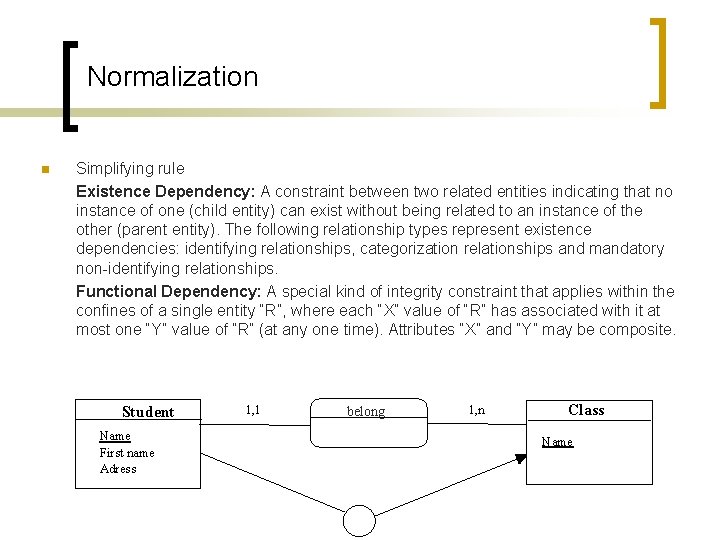
IDEF 1 - Information Modeling Method n Main IDEF 1 Concepts ¡ Constraint, Cardinality: A limit on the number of entity instances that can be associated with each other in a relationship. ¡ Existence Dependency: A constraint between two related entities indicating that no instance of one (child entity) can exist without being related to an instance of the other (parent entity). The following relationship types represent existence dependencies: identifying relationships, categorization relationships and mandatory non-identifying relationships. ¡ Functional Dependency: A special kind of integrity constraint that applies within the confines of a single entity “R”, where each “X” value of “R” has associated with it at most one “Y” value of “R” (at any one time). Attributes “X” and “Y” may be composite.
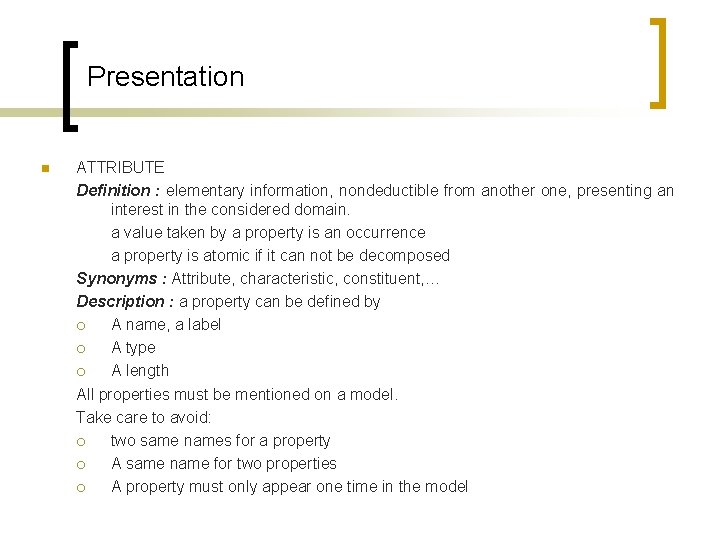
Presentation n ATTRIBUTE Definition : elementary information, nondeductible from another one, presenting an interest in the considered domain. a value taken by a property is an occurrence a property is atomic if it can not be decomposed Synonyms : Attribute, characteristic, constituent, … Description : a property can be defined by ¡ A name, a label ¡ A type ¡ A length All properties must be mentioned on a model. Take care to avoid: ¡ two same names for a property ¡ A same name for two properties ¡ A property must only appear one time in the model
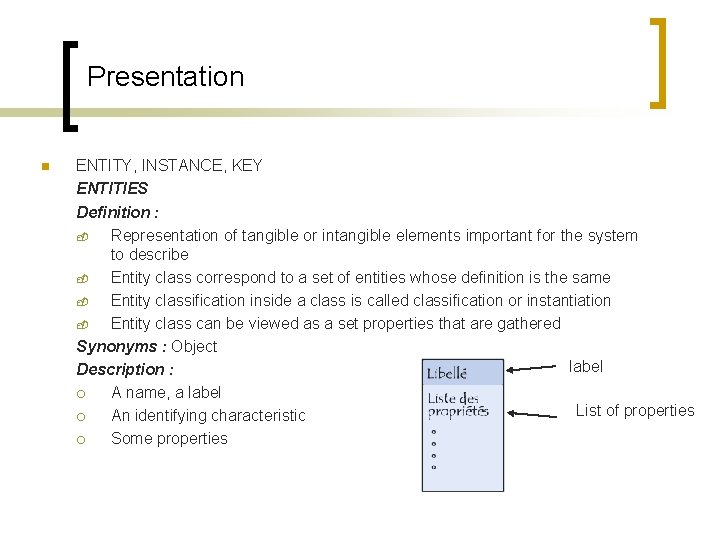
Presentation n ENTITY, INSTANCE, KEY ENTITIES Definition : Representation of tangible or intangible elements important for the system to describe Entity class correspond to a set of entities whose definition is the same Entity classification inside a class is called classification or instantiation Entity class can be viewed as a set properties that are gathered Synonyms : Object label Description : ¡ ¡ ¡ A name, a label An identifying characteristic Some properties List of properties
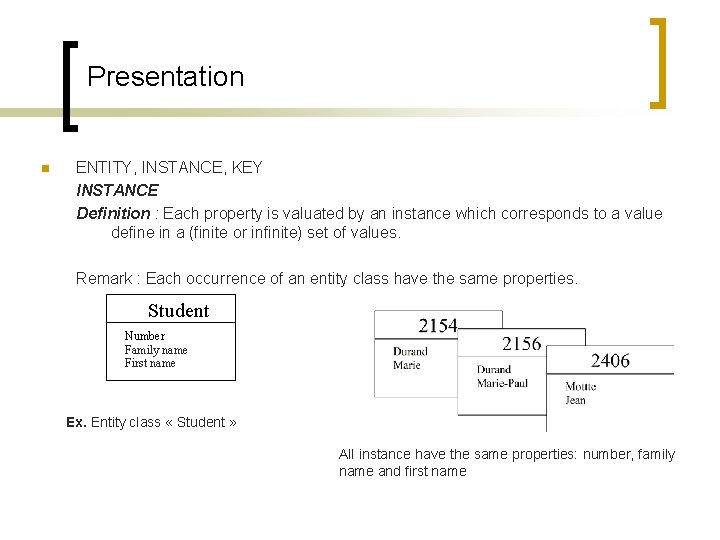
Presentation n ENTITY, INSTANCE, KEY INSTANCE Definition : Each property is valuated by an instance which corresponds to a value define in a (finite or infinite) set of values. Remark : Each occurrence of an entity class have the same properties. Student Number Family name First name Ex. Entity class « Student » All instance have the same properties: number, family name and first name
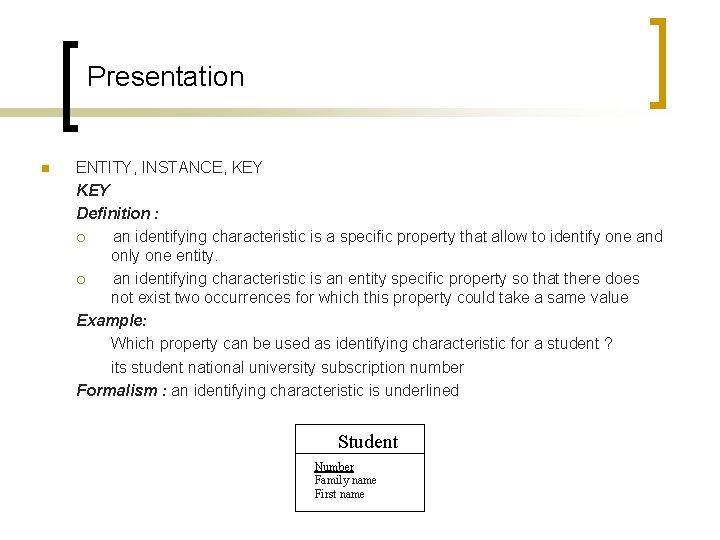
Presentation n ENTITY, INSTANCE, KEY Definition : ¡ an identifying characteristic is a specific property that allow to identify one and only one entity. ¡ an identifying characteristic is an entity specific property so that there does not exist two occurrences for which this property could take a same value Example: Which property can be used as identifying characteristic for a student ? its student national university subscription number Formalism : an identifying characteristic is underlined Student Number Family name First name
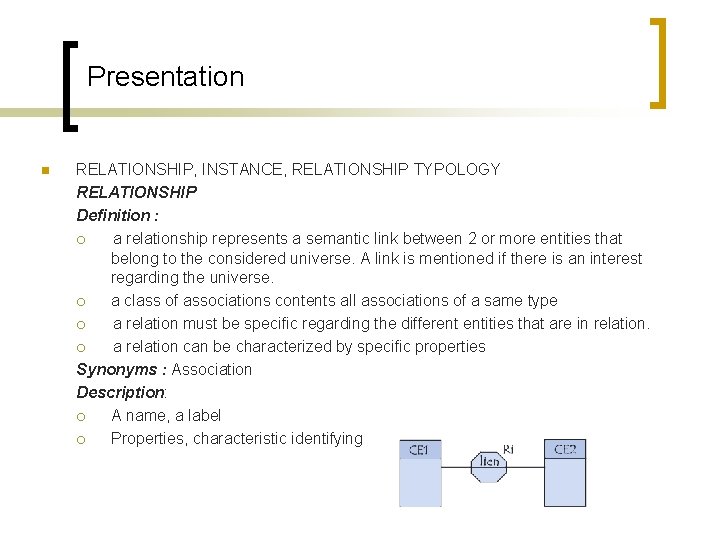
Presentation n RELATIONSHIP, INSTANCE, RELATIONSHIP TYPOLOGY RELATIONSHIP Definition : ¡ a relationship represents a semantic link between 2 or more entities that belong to the considered universe. A link is mentioned if there is an interest regarding the universe. ¡ a class of associations contents all associations of a same type ¡ a relation must be specific regarding the different entities that are in relation. ¡ a relation can be characterized by specific properties Synonyms : Association Description: ¡ A name, a label ¡ Properties, characteristic identifying
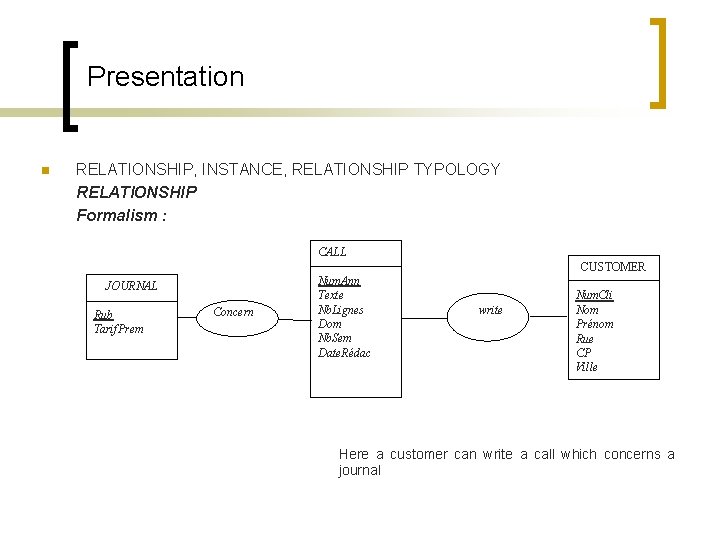
Presentation n RELATIONSHIP, INSTANCE, RELATIONSHIP TYPOLOGY RELATIONSHIP Formalism : CALL CUSTOMER JOURNAL Rub Tarif. Prem Concern Num. Ann Texte Nb. Lignes Dom Nb. Sem Date. Rédac write Num. Cli Nom Prénom Rue CP Ville Here a customer can write a call which concerns a journal
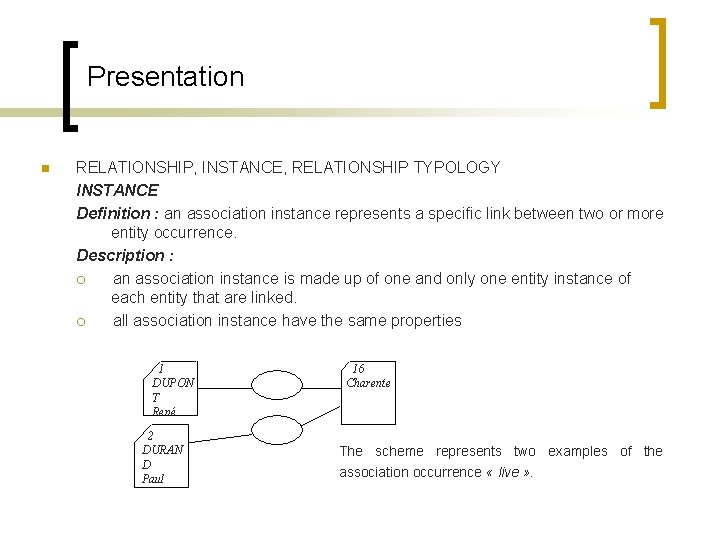
Presentation n RELATIONSHIP, INSTANCE, RELATIONSHIP TYPOLOGY INSTANCE Definition : an association instance represents a specific link between two or more entity occurrence. Description : ¡ an association instance is made up of one and only one entity instance of each entity that are linked. ¡ all association instance have the same properties 1 DUPON T René 2 DURAN D Paul 16 Charente The scheme represents two examples of the association occurrence « live » .
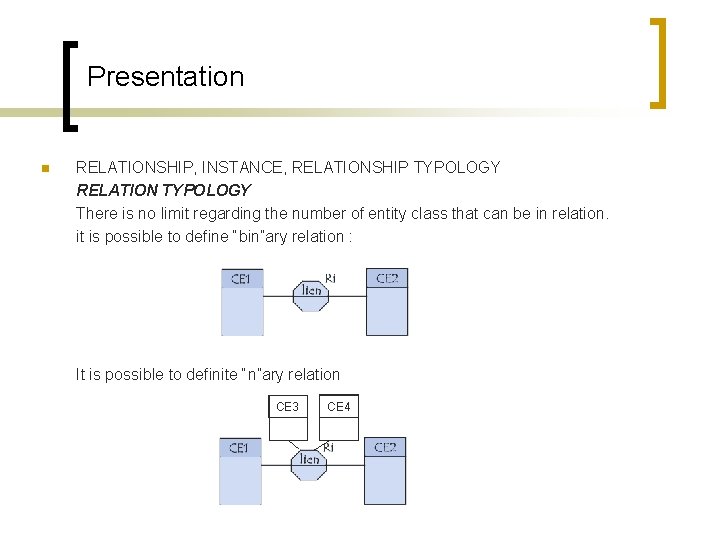
Presentation n RELATIONSHIP, INSTANCE, RELATIONSHIP TYPOLOGY RELATION TYPOLOGY There is no limit regarding the number of entity class that can be in relation. it is possible to define “bin”ary relation : It is possible to definite “n”ary relation CE 3 CE 4
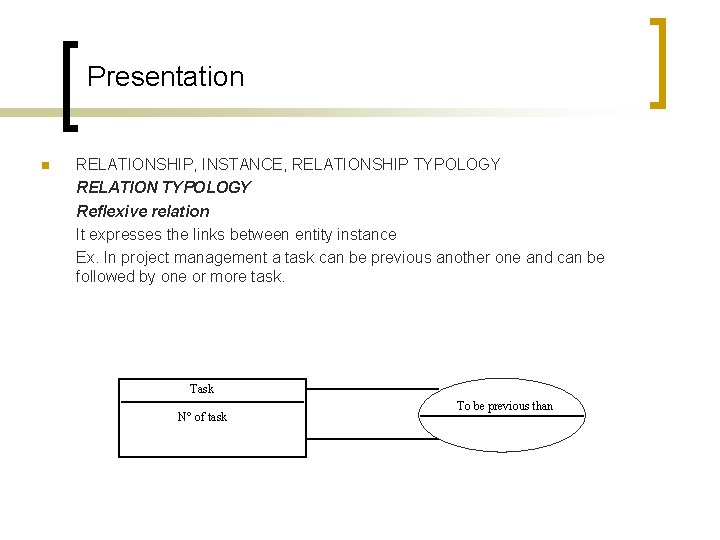
Presentation n RELATIONSHIP, INSTANCE, RELATIONSHIP TYPOLOGY RELATION TYPOLOGY Reflexive relation It expresses the links between entity instance Ex. In project management a task can be previous another one and can be followed by one or more task. Task N° of task To be previous than
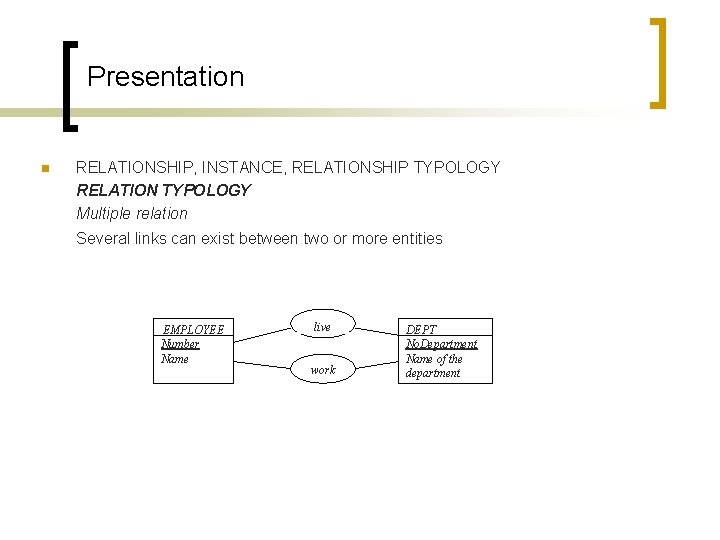
Presentation n RELATIONSHIP, INSTANCE, RELATIONSHIP TYPOLOGY RELATION TYPOLOGY Multiple relation Several links can exist between two or more entities EMPLOYEE Number Name live work DEPT No. Department Name of the department
Presentation n RELATIONSHIP, INSTANCE, RELATIONSHIP TYPOLOGY RELATION TYPOLOGY Remark: relationship primary key ¡ 1 ) Primary key of a relationship is obtained by associating the primary keys of each entity participating in the relation. ¡ 2) Each occurrence of the relationship is concerned by one and only one value of the primary key.
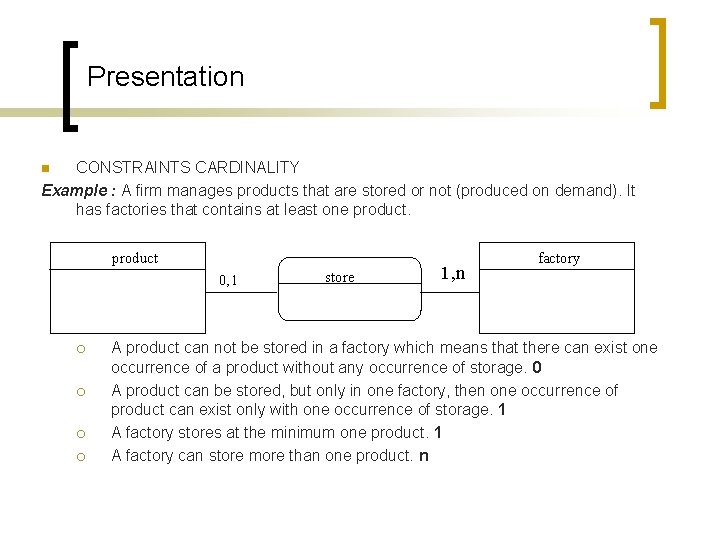
Presentation n CONSTRAINTS CARDINALITY Definition : The cardinality of a link between an entity and an association precise the minimum and maximum number of time that an entity instance is concerned by the association Formalism : Cardinality is noted using two numbers “ m, M ”. “ m ” is the minimal cardinality and “ M ” the maximal cardinality n Minimal cardinality: is the minus number of time for which an entity occurrence can participate to the relation (0 or 1). n Maximal cardinality: is the major number of time for which an entity occurrence can participate to the relation (1 or N).
Presentation CONSTRAINTS CARDINALITY Example : A firm manages products that are stored or not (produced on demand). It has factories that contains at least one product. n product 0, 1 ¡ ¡ store 1, n factory A product can not be stored in a factory which means that there can exist one occurrence of a product without any occurrence of storage. 0 A product can be stored, but only in one factory, then one occurrence of product can exist only with one occurrence of storage. 1 A factory stores at the minimum one product. 1 A factory can store more than one product. n
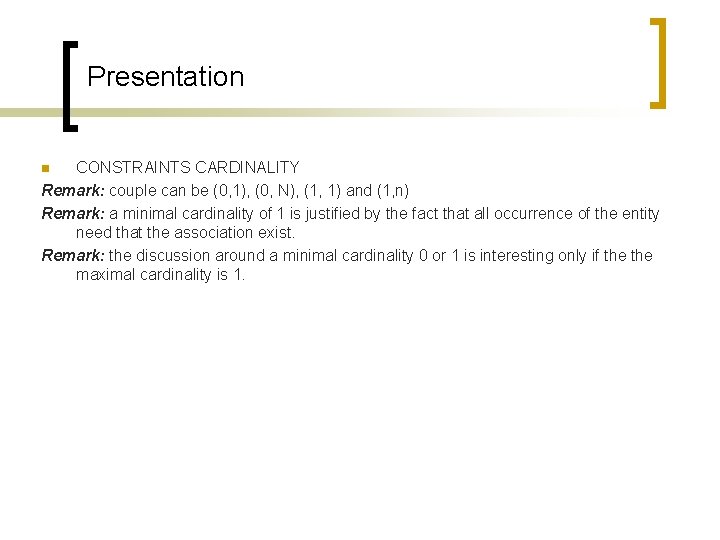
Presentation CONSTRAINTS CARDINALITY Remark: couple can be (0, 1), (0, N), (1, 1) and (1, n) Remark: a minimal cardinality of 1 is justified by the fact that all occurrence of the entity need that the association exist. Remark: the discussion around a minimal cardinality 0 or 1 is interesting only if the maximal cardinality is 1. n
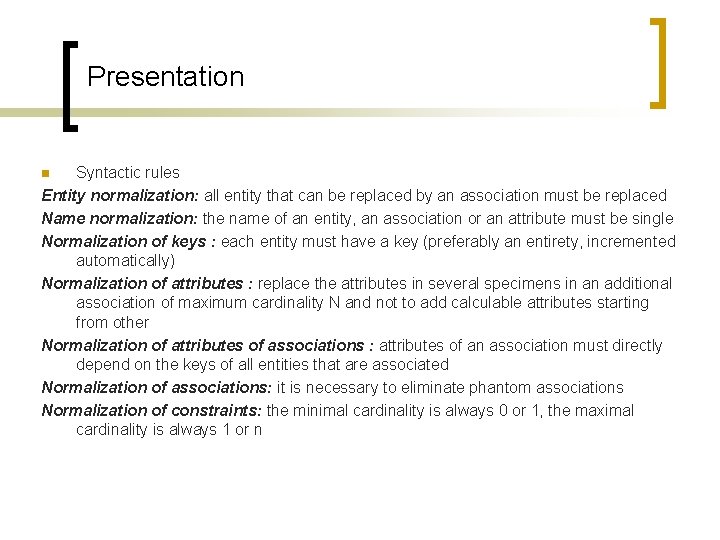
Presentation Syntactic rules Entity normalization: all entity that can be replaced by an association must be replaced Name normalization: the name of an entity, an association or an attribute must be single Normalization of keys : each entity must have a key (preferably an entirety, incremented automatically) Normalization of attributes : replace the attributes in several specimens in an additional association of maximum cardinality N and not to add calculable attributes starting from other Normalization of attributes of associations : attributes of an association must directly depend on the keys of all entities that are associated Normalization of associations: it is necessary to eliminate phantom associations Normalization of constraints: the minimal cardinality is always 0 or 1, the maximal cardinality is always 1 or n n
Normalization Normal forms
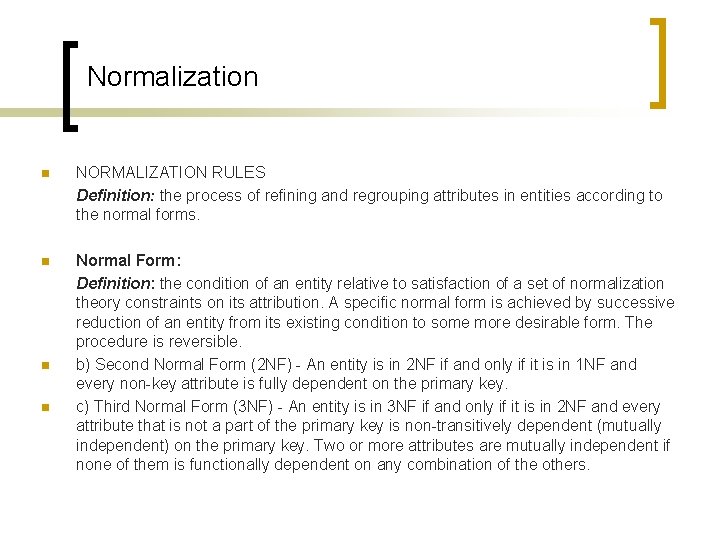
Normalization n NORMALIZATION RULES Definition: the process of refining and regrouping attributes in entities according to the normal forms. n Normal Form: Definition: the condition of an entity relative to satisfaction of a set of normalization theory constraints on its attribution. A specific normal form is achieved by successive reduction of an entity from its existing condition to some more desirable form. The procedure is reversible. b) Second Normal Form (2 NF) - An entity is in 2 NF if and only if it is in 1 NF and every non-key attribute is fully dependent on the primary key. c) Third Normal Form (3 NF) - An entity is in 3 NF if and only if it is in 2 NF and every attribute that is not a part of the primary key is non-transitively dependent (mutually independent) on the primary key. Two or more attributes are mutually independent if none of them is functionally dependent on any combination of the others. n n
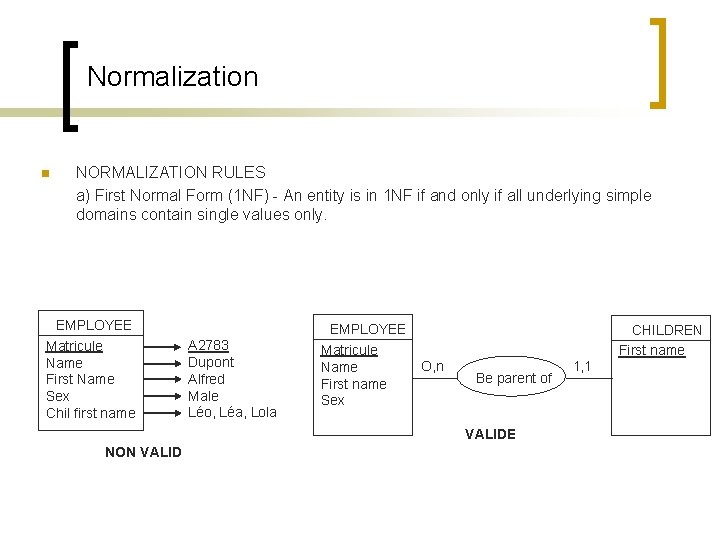
Normalization n NORMALIZATION RULES a) First Normal Form (1 NF) - An entity is in 1 NF if and only if all underlying simple domains contain single values only. EMPLOYEE Matricule Name First Name Sex Chil first name A 2783 Dupont Alfred Male Léo, Léa, Lola EMPLOYEE Matricule Name First name Sex CHILDREN First name O, n Be parent of VALIDE NON VALID 1, 1
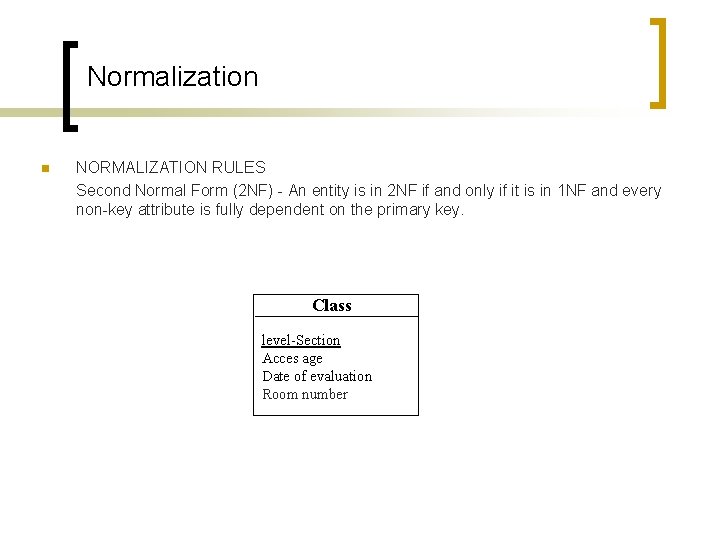
Normalization n NORMALIZATION RULES Second Normal Form (2 NF) - An entity is in 2 NF if and only if it is in 1 NF and every non-key attribute is fully dependent on the primary key. Class level-Section Acces age Date of evaluation Room number
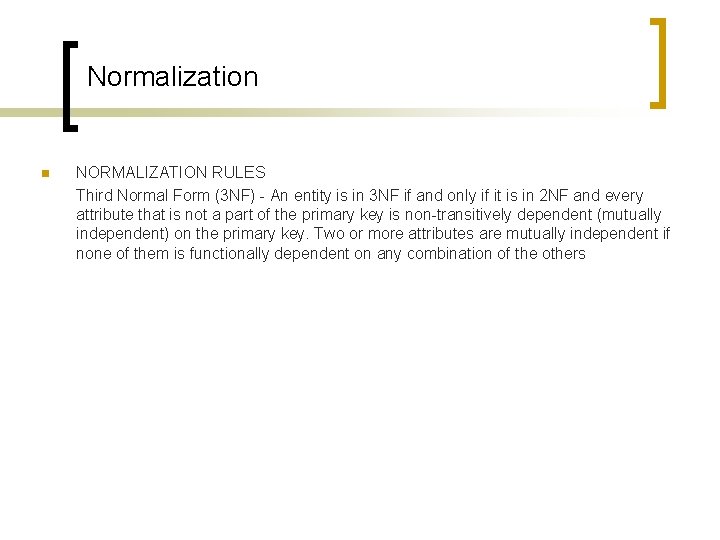
Normalization n NORMALIZATION RULES Third Normal Form (3 NF) - An entity is in 3 NF if and only if it is in 2 NF and every attribute that is not a part of the primary key is non-transitively dependent (mutually independent) on the primary key. Two or more attributes are mutually independent if none of them is functionally dependent on any combination of the others
Normalization n Simplifying rule Existence Dependency: A constraint between two related entities indicating that no instance of one (child entity) can exist without being related to an instance of the other (parent entity). The following relationship types represent existence dependencies: identifying relationships, categorization relationships and mandatory non-identifying relationships. Functional Dependency: A special kind of integrity constraint that applies within the confines of a single entity “R”, where each “X” value of “R” has associated with it at most one “Y” value of “R” (at any one time). Attributes “X” and “Y” may be composite. Student Name First name Adress 1, 1 belong 1, n Class Name
MCD elaboration n The steps ¡ To draw up a list of the data starting from the documents of the company, and more generally of all the carriers data ¡ To classify it these data alphabetically in order to sweep all on the regroupings properties ¡ To carry out a priori the purification of the polysemes, the synonyms and the redundancies. ¡ To locate the identifiers existing to release the natural objects ¡ To attach to these objects the properties in functional dependence of their identifier ¡ To place the relations and to attach if need be the functional properties in dependence to them several identifiers ¡ To consider the remaining properties in order to gather them into object for which one will create the not formalized identifiers ¡ To study the cardinalities of each couple entity-association, ¡ Simplifier the model using the constraints of functional integrity, ¡ Checking the model using the rules