
Ideas that shaped Colonial views on Government Chapter


- Slides: 24
Ideas that shaped Colonial views on Government Chapter 3 Section 2
Religious and Classical Roots of Colonial Ideas About Government Strong influence by ethical ideas shared by the Judeo-Christian religious traditions Justice for example was rooted in principles of ancient Judaism which stressed that people should seek to create a just society based on respect for the law Natural law-the belief that there exists, beyond the framework of human laws, a universal set of moral principles that can be applied to any culture or system of justice. This was a deeply held Christian belief and colonists believed any human law that violated natural law should be changed. Direct democracy or decision making by all citizens came from the Greek city -state of Athens and took root in New England’s town meetings
Religious and Classical Roots of Colonial Ideas About Government From the Roman Republic came the idea of republicanism, or representative government which refers to decision making by officials elected from the citizenry Many colonists also admired the Roman idea of civic virtue
English Roots of American Government English common law- a system based on a set of laws, customs, and practices that limited the powers of government and guaranteed the people certain basic rights Magna Carta-rule of law Petition of Right-limited government English Bill of Rights-reaffirmed the principle of individual rights (petition, bear arms and freedom from cruel and unusual punishments)
English Enlightenment influences-science and reason for studying human society and government Hobbes-social contract theory and idea of exchanging freedom for some protection Locke-social contract theory and Natural Rights (rights people have by virtue of being human)
French Enlightenment Montesquieu- 3 branches of government and separation of powers Rousseau-popular sovereignty (general will of the people for a government to be legitimate)
FROM IDEAS TO INDEPENDENCE Chapter 3 Section 3
Create a timeline Create a timeline, plot the events that follow with correct year. Provide a brief description for each event. Then explain how each event influenced the development of American government.
1215 Magna Carta This agreement between King John and his rebellious barons listed rights granted by the kind to all the freemen. Some of the rights established a system of justice based on due process of law. Under such a system a government cannot deprive a person of life, liberty or property except according to rules established by law King agreed to make no demands for $ without consent of barons (leading later to a legislature) People cannot be taxed except by representatives No one is above the law
1619 Virginia House of Burgesses The first elected assemply in the colonies. Later the other colonies formed elected assemblies. These assemblies held the “power of the purse” or the power to approve new taxes or spending. These assemblies were not authentically democratic because in most cases only white, male landowners were allowed to vote. These assemblies did reflect a belief in self government and affirmed that the colonists couldn’t be taxed except by their elected reps
1620 Mayflower Compact Agreement for the governing of the new colony They agreed to obey “just and equal laws” enacted by reps of their choosing “for the general good of the colony” First written framework for self government in the colonies
1689 English Bill of Rights In England a bitter struggle between King James II and Parliament for control of the English government took place in 1688 The king was forced to flee England after a change of power The throne was offered to a Dutch prince William of Orange and wife, Princess Mary of England Parliament then enacted the English Bill of Rights which limited the power of the monarch This act confirmed that the power to tax rested only with Parliament The act set forth individual rights: trial by jury, petition of gov. and protected against cruel and unusual punishment
1735 Zenger Trial In the colonies newspaper publishers who criticized governors risked being jailed. In their defense, publishers argued that “there can be no such thing as public liberty, without freedom of speech” In 1734 Zenger was arrested for publishing rebellious statements that are false of damaging about the NY governor Jury found Zenger not guilty and he was freed Helped promote the idea that the press should have the freedom to print the truth, and that this freedom is a right that should be protected
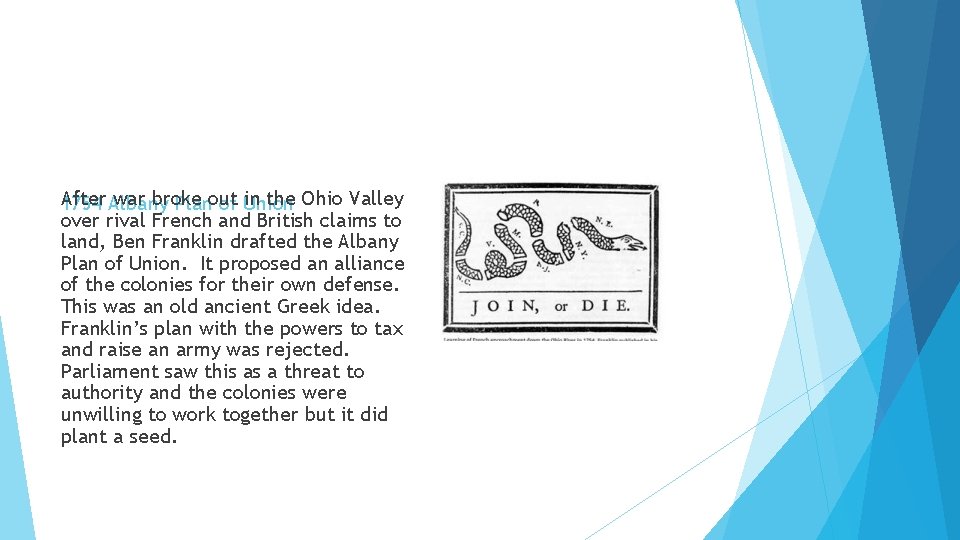
After Albany war broke in the Ohio Valley 1754 Planout of Union over rival French and British claims to land, Ben Franklin drafted the Albany Plan of Union. It proposed an alliance of the colonies for their own defense. This was an old ancient Greek idea. Franklin’s plan with the powers to tax and raise an army was rejected. Parliament saw this as a threat to authority and the colonies were unwilling to work together but it did plant a seed.
French and Indian War 1763 A war fought against France and its Indian allies on North American soil. Britain won the war and as a result gained control of Canada and the Ohio Valley. To defend the territory Britain had to station more troops. The British government argued that the colonies should pay some of the cost of this added defense. This led to Parliament enacting the Stamp Act in 1765
The Stamp Act 1765 Americans must buy stamps to place on their deeds, mortgages, liquor licenses, playing cards, almanacs and newspapers Stamps were a form of taxation to the American colonists. As British citizens they believed only their elected reps could tax them. Because they had no representation in Parliament the taxes were seen by them as illegal
Battles of Lexington and Concord 1775 The first militia (groups of armed citizens) troops skirmish with British soldiers at Lexington and Concord, Massachusetts beginning the American Revolution.
Declaration of Independence 1776 Jefferson set forth a vision of a new kind of nation. Unalienable rights- life, liberty and the pursuit of happiness Governments derive “their just powers from the consent of the governed” If government fails to preserve rights of the people. . the people should abolish that government and form a new one
Chapter 3 Section 4 How did State Constitutions lay the groundwork for the U. S. Constitution? Commitment to idea that government should be based on a set of principles: popular sovereignty, limited government, rule of law, majority rule and separation of powers All state constitutions began with a statement of individual rights Power was derived from the people
Weaknesses of Articles of Confederation Only a legislative branch No executive for enforcement and no judicial for resolving disputes No power to impose taxes No army to provide for common defense
What did the weaknesses of the Articles mean for the national government? Failure Had to borrow heavily to fund Revolution Lacked power to control trade Shay’s Rebellion which revealed how little Congress could really do (discuss this further)
Three major challenges Convention delegates faced (read and discuss as class) Representation Slavery/commerce 1 head of government or many
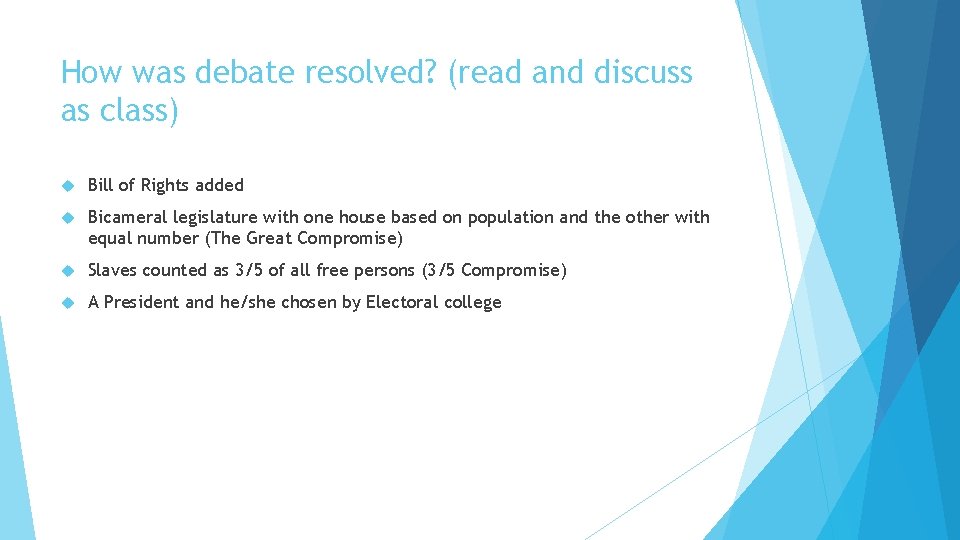
How was debate resolved? (read and discuss as class) Bill of Rights added Bicameral legislature with one house based on population and the other with equal number (The Great Compromise) Slaves counted as 3/5 of all free persons (3/5 Compromise) A President and he/she chosen by Electoral college
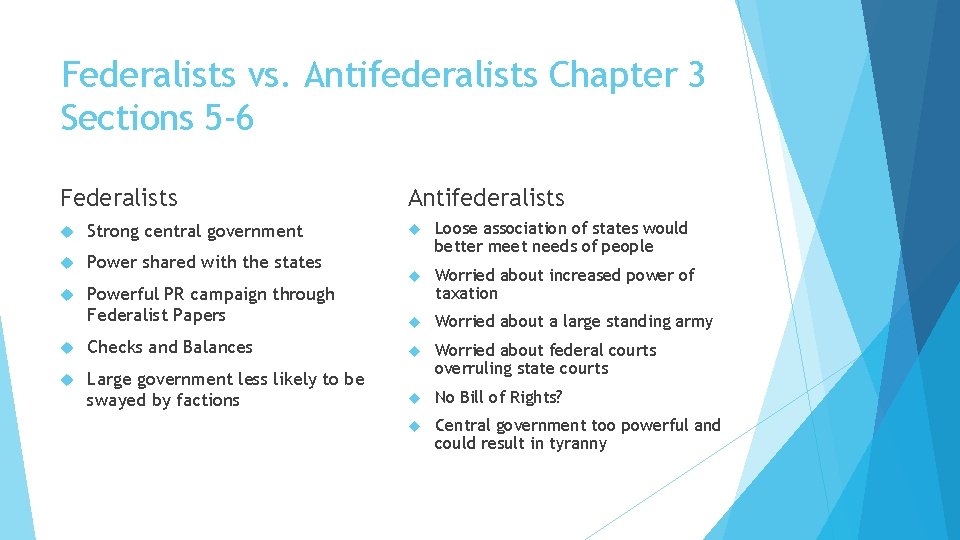
Federalists vs. Antifederalists Chapter 3 Sections 5 -6 Federalists Strong central government Power shared with the states Powerful PR campaign through Federalist Papers Antifederalists Loose association of states would better meet needs of people Worried about increased power of taxation Worried about a large standing army Checks and Balances Large government less likely to be swayed by factions Worried about federal courts overruling state courts No Bill of Rights? Central government too powerful and could result in tyranny