
Ideas from the Ancient World Pythagoras and Plato






- Slides: 15
Ideas from the Ancient World Pythagoras and Plato (427 -347 B. C. E) The perfect form was the circle – and the need to find the “perfect reality” behind the world of appearances
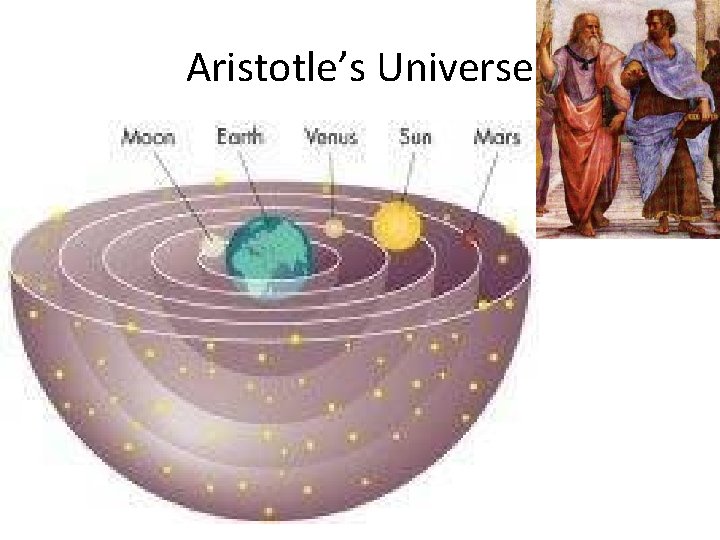
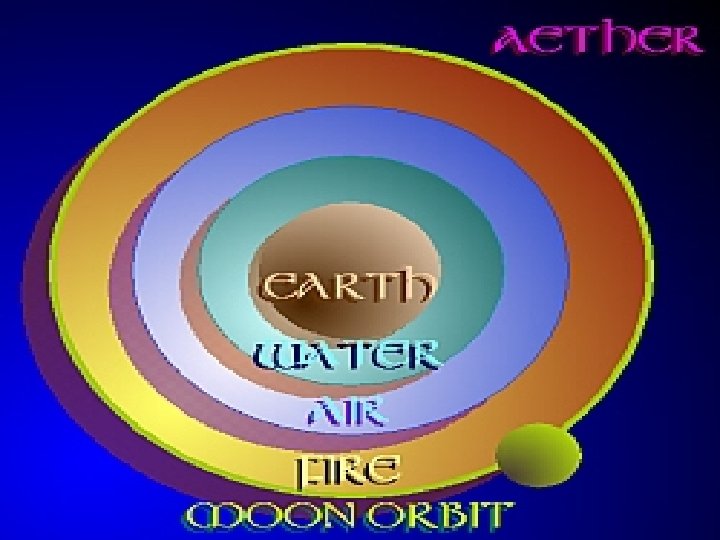
Aristotle’s Universe
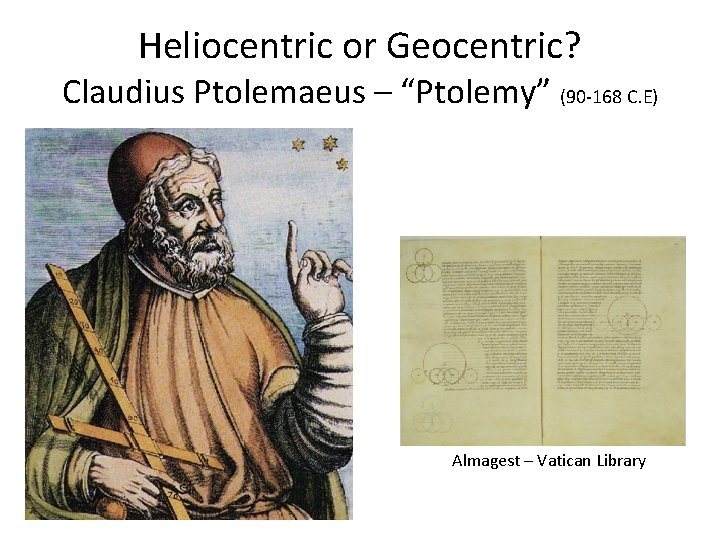
Heliocentric or Geocentric? Claudius Ptolemaeus – “Ptolemy” (90 -168 C. E) Almagest – Vatican Library
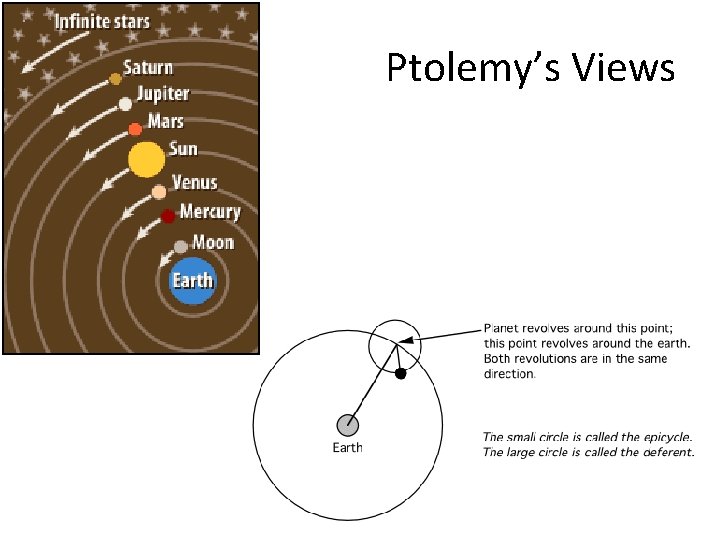
Ptolemy’s Views
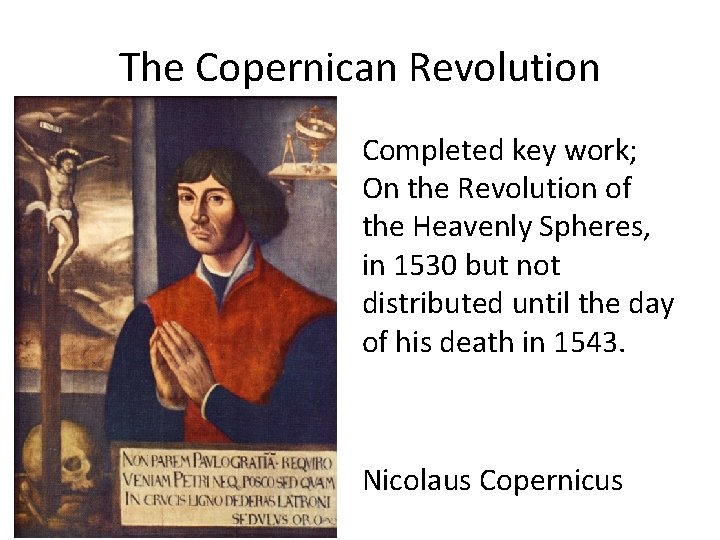
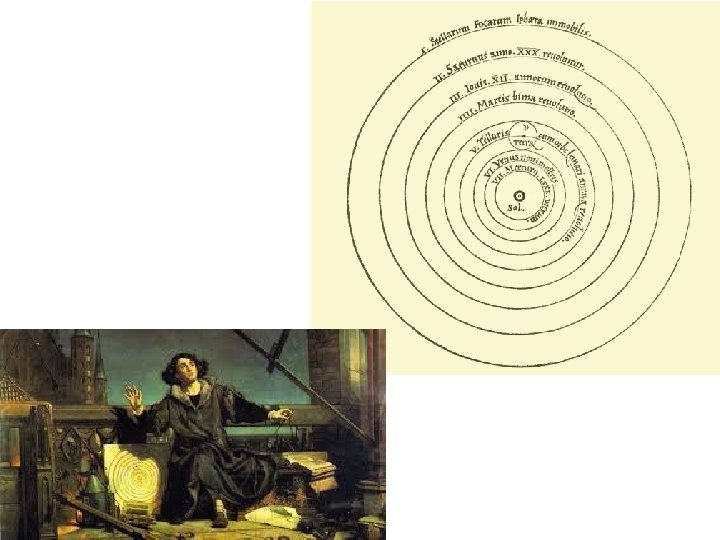
The Copernican Revolution Completed key work; On the Revolution of the Heavenly Spheres, in 1530 but not distributed until the day of his death in 1543. Nicolaus Copernicus
Tycho Brahe In 1578 – Brahe begins working in a newly constructed observatory in Denmark – under the sponsorship of the Danish King (telescope not invented until 1608)
Sextant: An instrument for determining the angle between the horizon and a celestial body such as the Sun, the Moon, or a star, used in celestial navigation to determine latitude and longitude.
Brahe’s scheme tries to answer the problem in the Copernican theory – Tychonic theory – planets orbit Sun – Sun and Moon orbit the earth – remainder of the stars were fixed in the heavenly sphere centred on the Earth
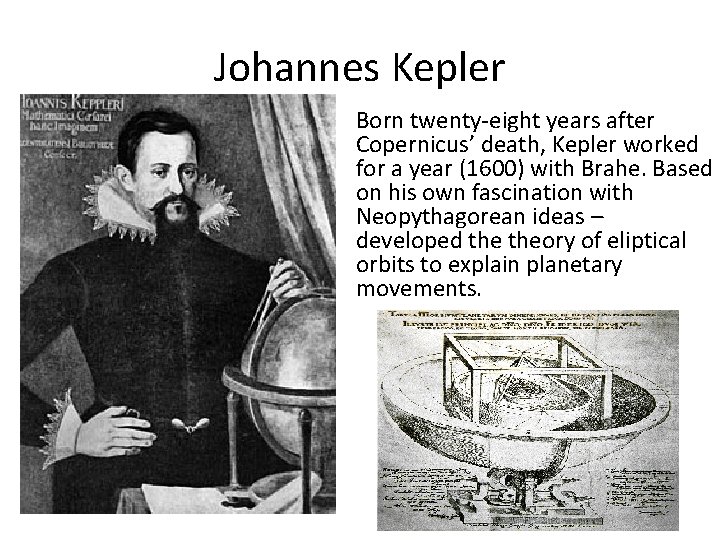
Johannes Kepler Born twenty-eight years after Copernicus’ death, Kepler worked for a year (1600) with Brahe. Based on his own fascination with Neopythagorean ideas – developed theory of eliptical orbits to explain planetary movements.
The planets travel around the sun in elliptical orbits, with the sun at one focus
Kepler’s 2 nd Law: A planet’s orbit is such that a line from the planet to the sun covers equal areas in equal times Kepler’s 3 rd Law: The ratio of the squares of the revolutionary periods for two planets is equal to the ratio of the cubes of their mean distances from the sun (i. e. their semi-major axes. )
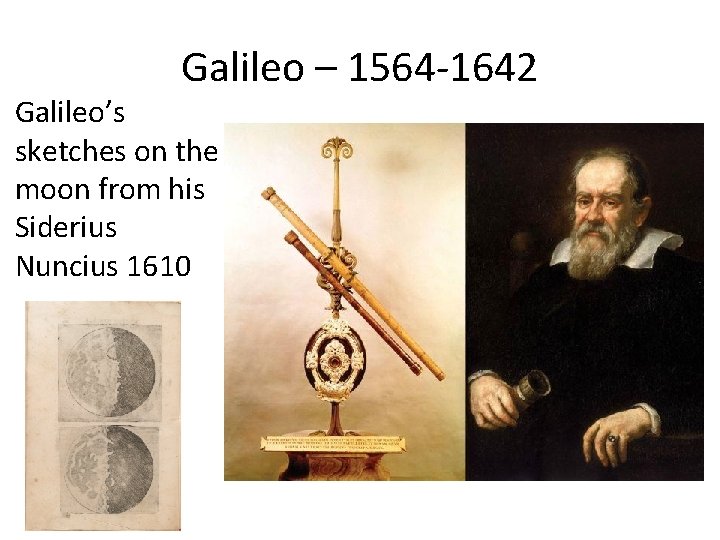
Galileo – 1564 -1642 Galileo’s sketches on the moon from his Siderius Nuncius 1610