
Ideal Learning Environment Foundation for a Love of

![References Armario, C. (2013, April 15). English Learning Students [Photograph]. Retrieved from http: //www.](https://slidetodoc.com/presentation_image_h2/3282cdda70f60adf682310616209c58d/image-20.jpg "References Armario, C. (2013, April 15). English Learning Students [Photograph]. Retrieved from http: //www.")
- Slides: 22
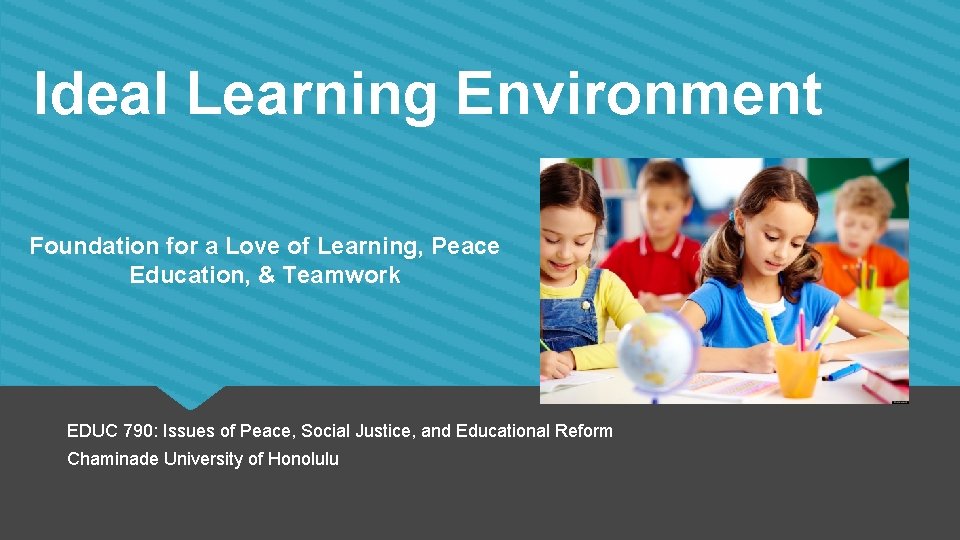
Ideal Learning Environment Foundation for a Love of Learning, Peace Education, & Teamwork EDUC 790: Issues of Peace, Social Justice, and Educational Reform Chaminade University of Honolulu
Theoretical/Conceptual Framework � Our ideal learning environment operates with the following as its foundation: � Ecological Framework � All members of the school community (teachers, staff, students, etc. ) address the human dimension of education � Focus on more than academic achievement – goals cannot be accomplished without considering all factors that affect the individual � Have a solid understanding of the interrelated structures that influence the success of each child’s education � Work to build meaningful relationships between our institution, families, the community, and all individuals in order to work towards a common goal – the child � Social Justice � Advocate for community involvement (both give to the community and ask of the community) � Shed light on real-life issues and explore viable solutions � Peace � Daily exploration of different cultural views, religious practices, and activities/procedures of other communities and schools � Address current events around the world (problems and highlights)
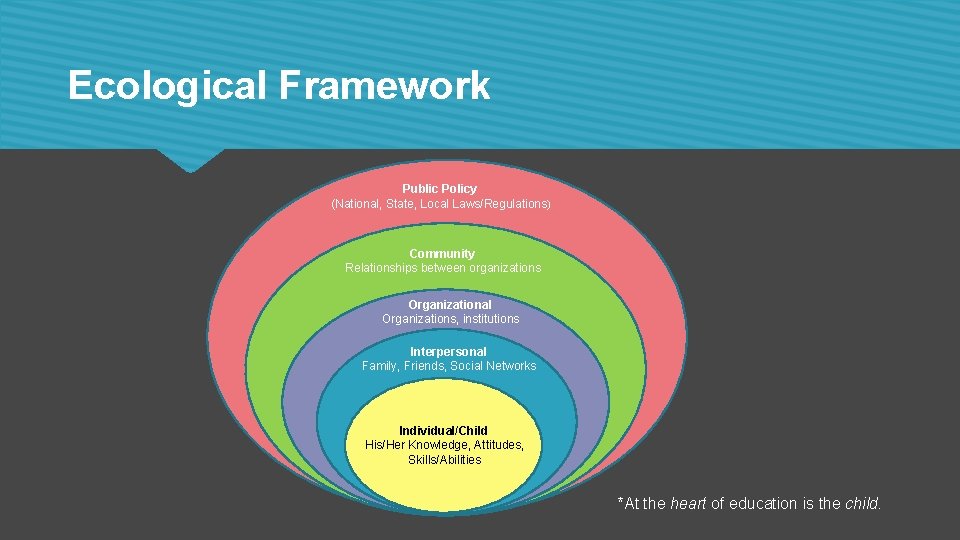
Ecological Framework Public Policy (National, State, Local Laws/Regulations) Community Relationships between organizations Organizational Organizations, institutions Interpersonal Family, Friends, Social Networks Individual/Child His/Her Knowledge, Attitudes, Skills/Abilities *At the heart of education is the child.
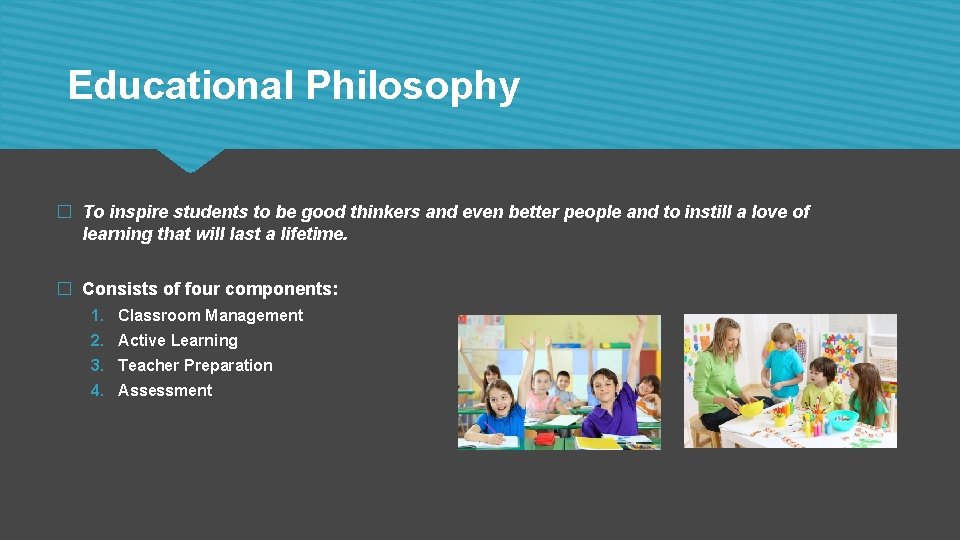
Educational Philosophy � To inspire students to be good thinkers and even better people and to instill a love of learning that will last a lifetime. � Consists of four components: 1. Classroom Management 2. Active Learning 3. Teacher Preparation 4. Assessment
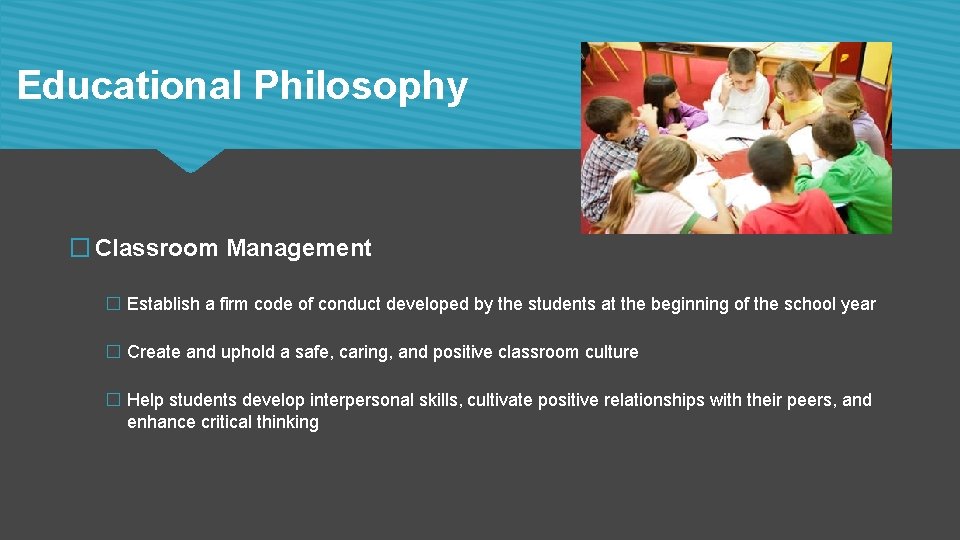
Educational Philosophy � Classroom Management � Establish a firm code of conduct developed by the students at the beginning of the school year � Create and uphold a safe, caring, and positive classroom culture � Help students develop interpersonal skills, cultivate positive relationships with their peers, and enhance critical thinking
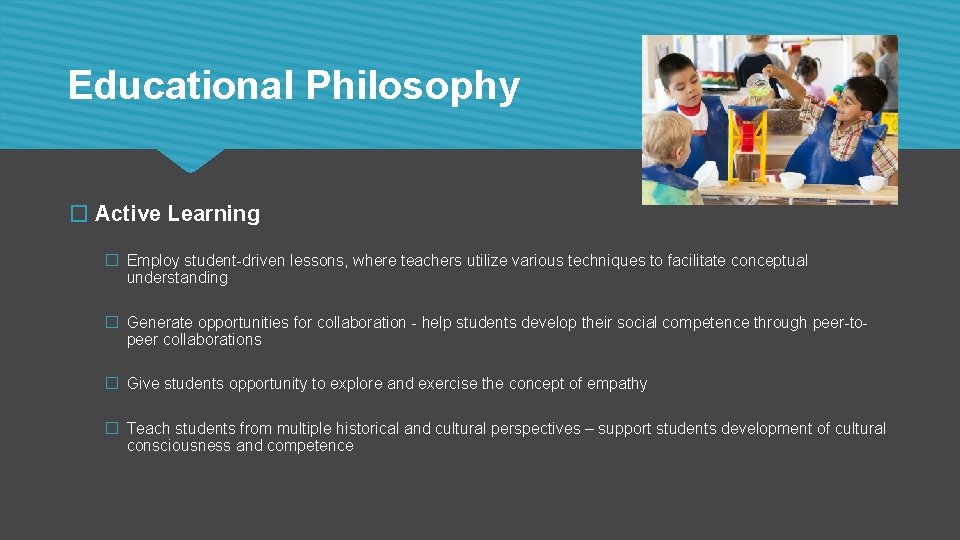
Educational Philosophy � Active Learning � Employ student-driven lessons, where teachers utilize various techniques to facilitate conceptual understanding � Generate opportunities for collaboration - help students develop their social competence through peer-topeer collaborations � Give students opportunity to explore and exercise the concept of empathy � Teach students from multiple historical and cultural perspectives – support students development of cultural consciousness and competence
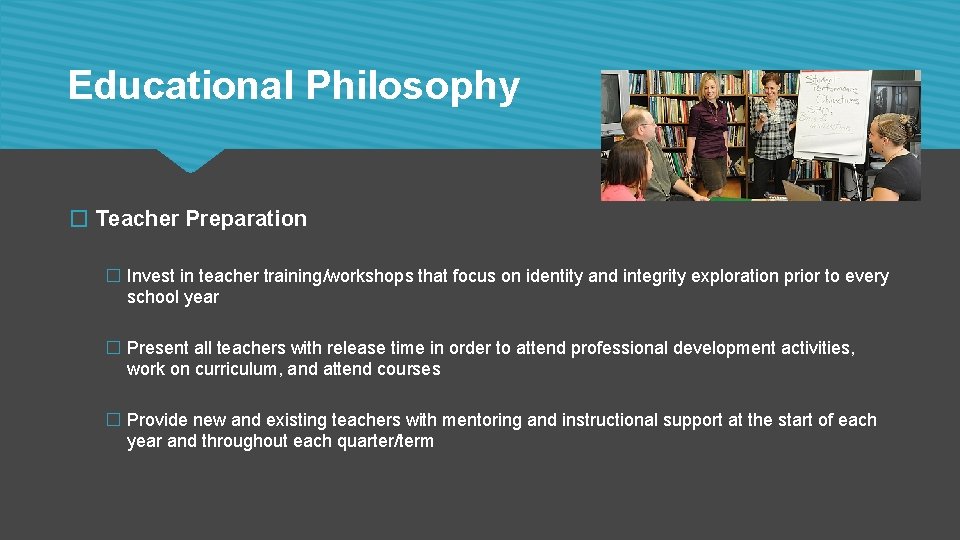
Educational Philosophy � Teacher Preparation � Invest in teacher training/workshops that focus on identity and integrity exploration prior to every school year � Present all teachers with release time in order to attend professional development activities, work on curriculum, and attend courses � Provide new and existing teachers with mentoring and instructional support at the start of each year and throughout each quarter/term
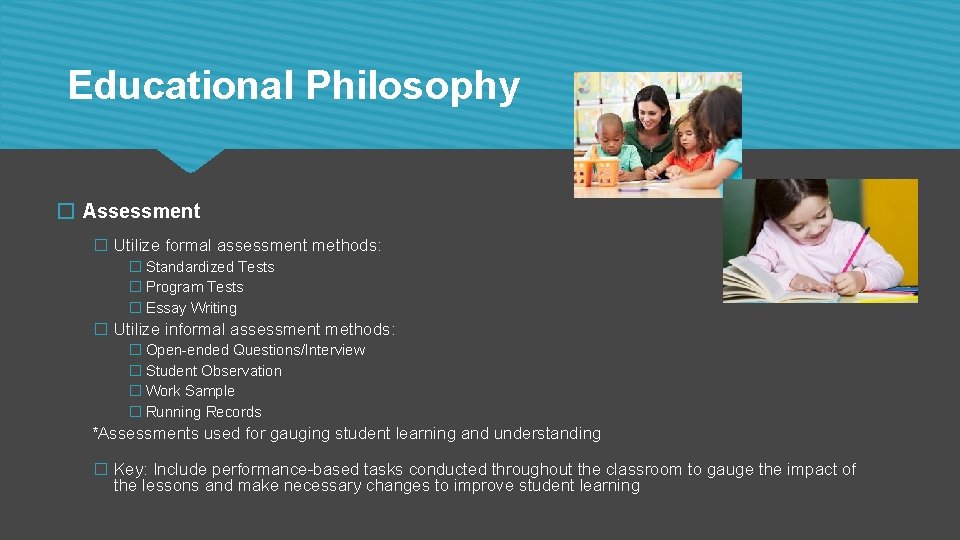
Educational Philosophy � Assessment � Utilize formal assessment methods: � Standardized Tests � Program Tests � Essay Writing � Utilize informal assessment methods: � Open-ended Questions/Interview � Student Observation � Work Sample � Running Records *Assessments used for gauging student learning and understanding � Key: Include performance-based tasks conducted throughout the classroom to gauge the impact of the lessons and make necessary changes to improve student learning
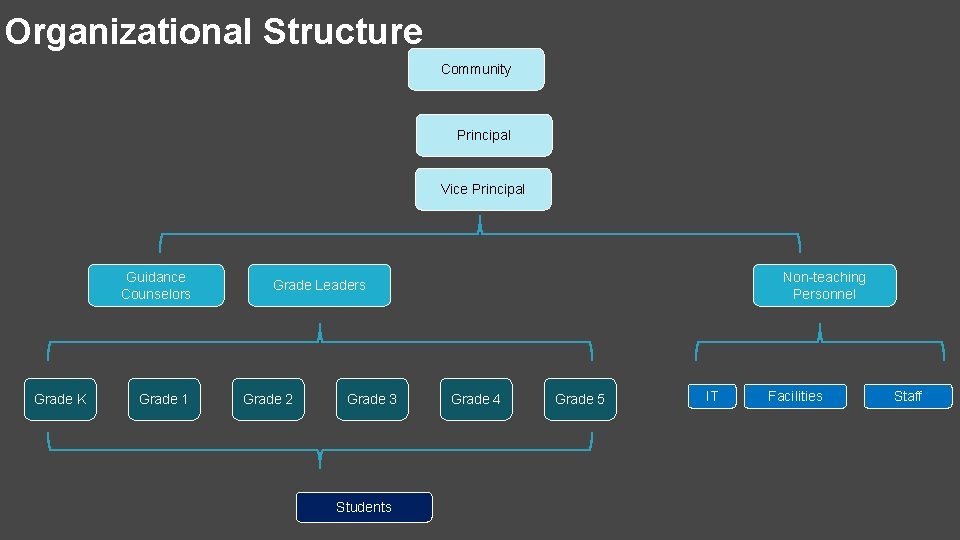
Organizational Structure Community Principal Vice Principal Guidance Counselors Grade K Grade 1 Non-teaching Personnel Grade Leaders Grade 2 Grade 3 Students Grade 4 Grade 5 IT Facilities Staff
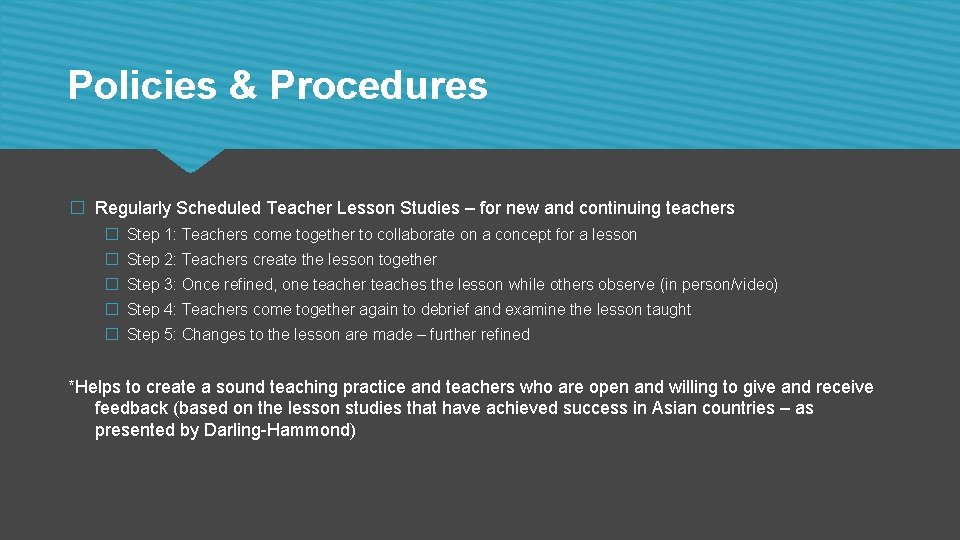
Policies & Procedures � Regularly Scheduled Teacher Lesson Studies – for new and continuing teachers � Step 1: Teachers come together to collaborate on a concept for a lesson � Step 2: Teachers create the lesson together � Step 3: Once refined, one teacher teaches the lesson while others observe (in person/video) � Step 4: Teachers come together again to debrief and examine the lesson taught � Step 5: Changes to the lesson are made – further refined *Helps to create a sound teaching practice and teachers who are open and willing to give and receive feedback (based on the lesson studies that have achieved success in Asian countries – as presented by Darling-Hammond)
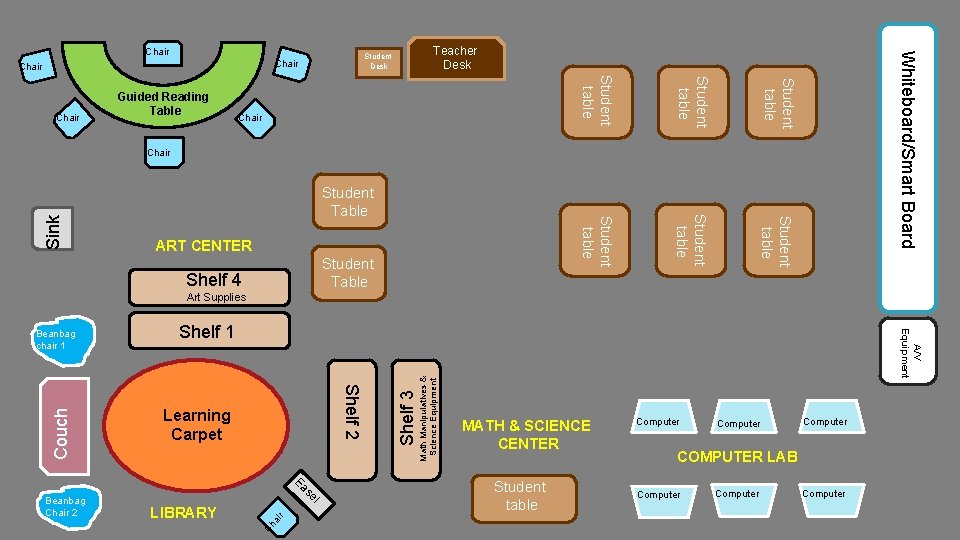
Chair Student table Chair Guided Reading Table Teacher Desk Student Desk Chair Whiteboard/Smart Board Chair Student Table Shelf 4 Student table ART CENTER Student table Student Table Student table Sink Chair Art Supplies Ea se LIBRARY r l Ch ai Beanbag Chair 2 Shelf 3 Learning Carpet Math Manipulatives & Science Equipment Shelf 2 Couch Shelf 1 A/V Equipment Beanbag chair 1 MATH & SCIENCE CENTER Student table Computer COMPUTER LAB Computer
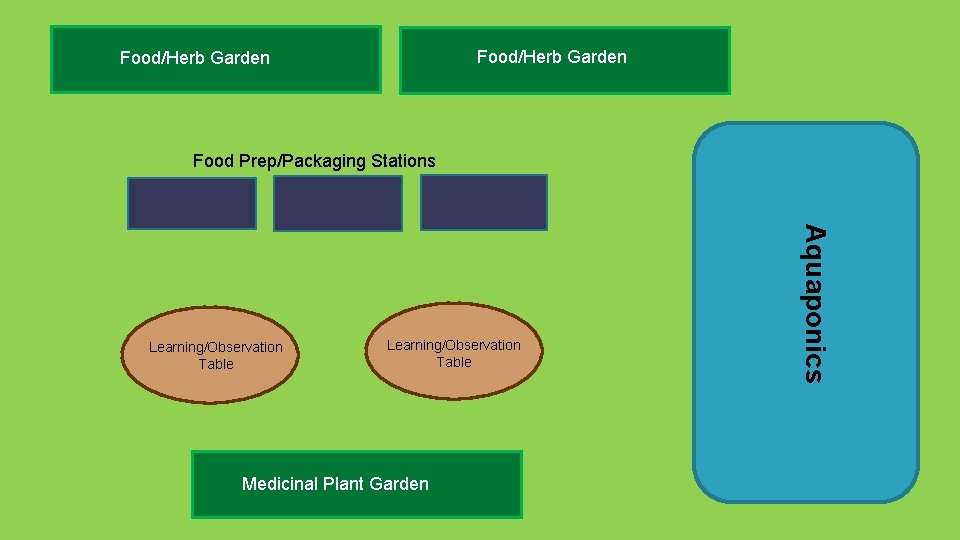
Food/Herb Garden Food Prep/Packaging Stations Learning/Observation Table Medicinal Plant Garden Aquaponics Learning/Observation Table
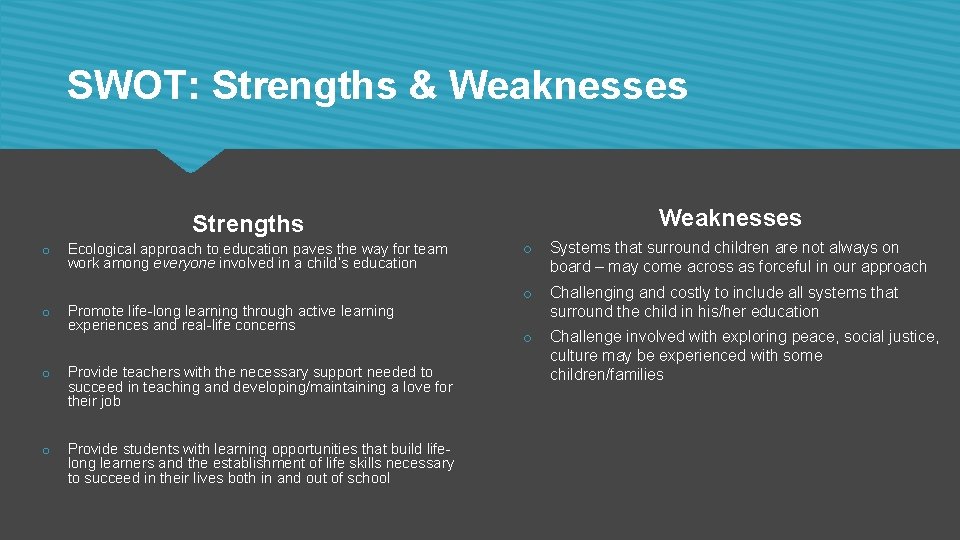
SWOT: Strengths & Weaknesses Strengths o o Ecological approach to education paves the way for team work among everyone involved in a child’s education Promote life-long learning through active learning experiences and real-life concerns o Provide teachers with the necessary support needed to succeed in teaching and developing/maintaining a love for their job o Provide students with learning opportunities that build lifelong learners and the establishment of life skills necessary to succeed in their lives both in and out of school o Systems that surround children are not always on board – may come across as forceful in our approach o Challenging and costly to include all systems that surround the child in his/her education o Challenge involved with exploring peace, social justice, culture may be experienced with some children/families
SWOT: Opportunities & Threats Opportunities o Introduces an ecological approach in philosophy of education that brings to life a team behind each and every child o Promote community involvement – opportunities for partnerships between school and outside organizations o Presents students with opportunities to participate in activities that get them involved in building relationships with their own communities Threats o Cost involved with expansion both inside and outside the school o Overall space needed for classroom and outside work areas o Community organizations not willing to participate in partnerships with the school o Lack of involvement from child’s family/support system at home
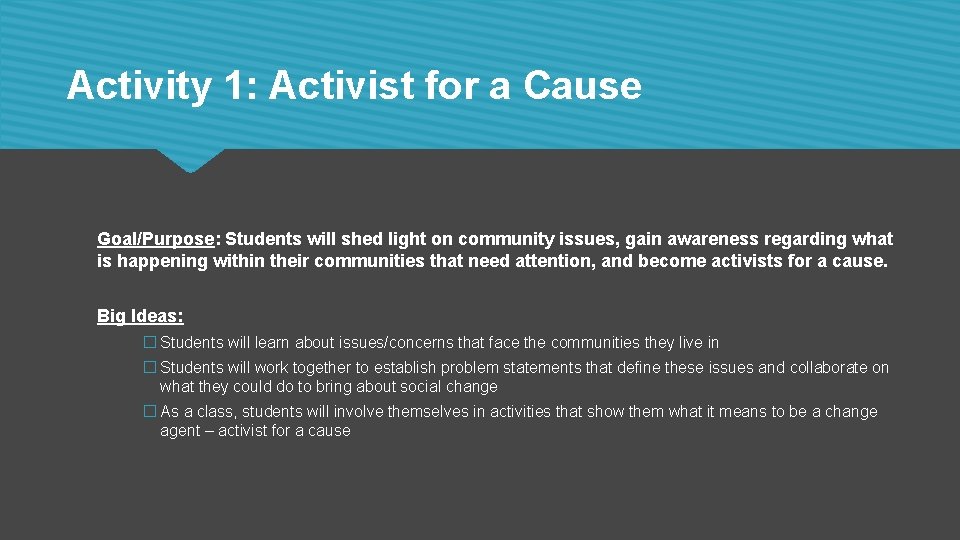
Activity 1: Activist for a Cause Goal/Purpose: Students will shed light on community issues, gain awareness regarding what is happening within their communities that need attention, and become activists for a cause. Big Ideas: � Students will learn about issues/concerns that face the communities they live in � Students will work together to establish problem statements that define these issues and collaborate on what they could do to bring about social change � As a class, students will involve themselves in activities that show them what it means to be a change agent – activist for a cause
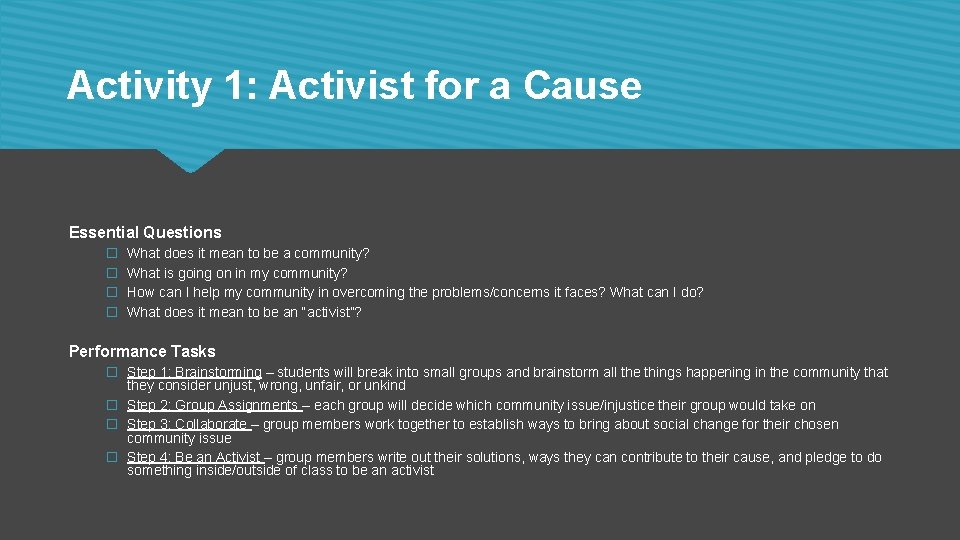
Activity 1: Activist for a Cause Essential Questions � � What does it mean to be a community? What is going on in my community? How can I help my community in overcoming the problems/concerns it faces? What can I do? What does it mean to be an “activist”? Performance Tasks � Step 1: Brainstorming – students will break into small groups and brainstorm all the things happening in the community that they consider unjust, wrong, unfair, or unkind � Step 2: Group Assignments – each group will decide which community issue/injustice their group would take on � Step 3: Collaborate – group members work together to establish ways to bring about social change for their chosen community issue � Step 4: Be an Activist – group members write out their solutions, ways they can contribute to their cause, and pledge to do something inside/outside of class to be an activist
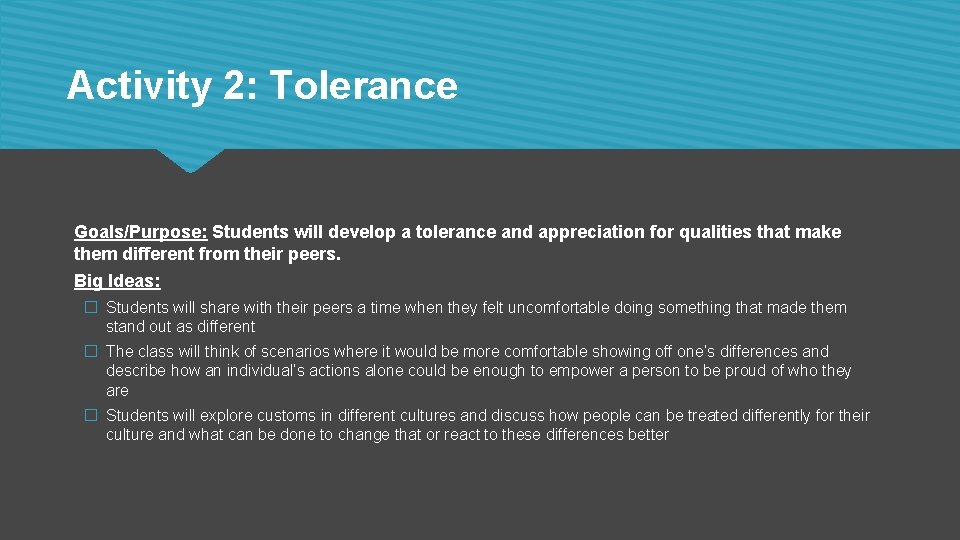
Activity 2: Tolerance Goals/Purpose: Students will develop a tolerance and appreciation for qualities that make them different from their peers. Big Ideas: � Students will share with their peers a time when they felt uncomfortable doing something that made them stand out as different � The class will think of scenarios where it would be more comfortable showing off one’s differences and describe how an individual’s actions alone could be enough to empower a person to be proud of who they are � Students will explore customs in different cultures and discuss how people can be treated differently for their culture and what can be done to change that or react to these differences better
Activity 2: Tolerance � Essential Questions • How am I different and the same as my peers? • How do I respond when I am uncomfortable about doing something that other children may view as “different”? • How can I make someone feel more comfortable about his or her cultural differences? • What are some traditions practiced in cultures different than my own? � Performance Tasks • Students will present information about their family’s traditions and culture • Students will reflect on concept of culture and how differences among people is actually something that can unite them. • Students will be able to write about or discuss a new culture they learned from listening to their peers’ presentations
Activity 3: What is Culture? Goals/Big Ideas � Students will explore the concept of culture individually and as a group. Students will reflect on their own ideas of what defines culture by studying their own family’s culture and traditions. Students will also be introduced to cultures unique to their own by learning about their peers’ culture. Students will learn that culture gives people a sense of who they are and where they come from. � Essential Questions • What is culture? • Why is it important to know your own culture and the culture of others? • What is tradition? � Performance Tasks • Students will present information about their family’s traditions and culture • Students will reflect on concept of culture and how differences among people is actually something that can unite them.
References Armario, C. (2013, April 15). English Learning Students [Photograph]. Retrieved from http: //www. huffingtonpost. com/2013/04/15/english-learning-student-_n_3084141. html Choi, Y. (2003). The name jar. Decorah, IA: Dragonfly Books. Darling-Hammond, L. (2010). The Flat World and Education: How America’s Commitment to Equity Will Determine Our Future. Teachers College Press. New York, NY. Darling-Hammond, L. , Chung Wei, R. , Andree, A. , Richardson, N. , & Orphanos, S. (2009, February). A Status Report on Teacher Development in the United States and Abroad. National Staff Development Council. David O. Mckay School of Education. (2012). Curriculum: What is Multicultural Education. Retreived from http: //education. byu. edu/diversity/curriculum. html Education World. (2012). Everyone is unique: A lesson in respect for others. Retrieved from http: //www. educationworld. com/a_lesson/03/lp 294 -05. shtml Gallery. (2015). Young Children Raising Hands [Photograph]. Retrieved from http: //imgarcade. com/1/ young-children-raising-hands/
References Girls only toolkit. (2011) San Diego District Attorney. Retrieved from http: //www. sdcda. org/office/girlsonlytoolkit/got-12 -culture. pdf Gould, R. (2007, June). An Ecological Approach to National Education Reform. Retrieved March 18, 2015, from Nationa Center for Youth Law website: http: //www. youthlaw. org/publications/yln/2007/ april_june_2007/an_ecological_approach_to_national_education_reform/ High. Scope. (2015). A Model of Active Learning [Photograph]. Retrieved from http: //www. highscope. org/ Content. asp? Content. Id=109 Hunter, K. (n. d. ). Empathy in education. Retrieved from http: //empathyed. org/index. php option=com_content&view=category&id=37&Itemid=63 Kessler, R. (2000). The Soul of Education: Helping Students Find Connection, Compassion, and Character at School. Alexandria, VA. : Association for Supervision and Curriculum Development. Kompany Kids. (2015). Active Learning [Photograph]. Retrieved from http: //kompanykids. com/Curriculum/ tabid/222/language/en-US/Default. aspx Marzano, R. , Marzano, J. , & Pickering, D. (2003) Chapter 1: The Critical Role of Classroom Management. In Classroom Management that Works. Retrieved from http: //www. ascd. org/publications/books/103027/chapters/the-critical-role-of-classroom-management. aspx Mascott, A. (2015). Mini-Writing Centers [Photograph]. Retrieved from http: //www. scholastic. com/ parents/resources/article/creativity-play/mini-writing-centers Montgomery County Board of Education. (2007). Framework and structure of early childhood and elementary education. Retrieved from https: //www. montgomeryschoolsmd. org/departments/policy/pdf/iea. pdf
References National Association for the Education of Young Children. (1993). A Conceptual Framework for Early Childhood Professional Development. NAEYC, 2 -12. Oswego State University. (2015). Vocational Teacher Preparation [Photograph]. Retrieved from http: //www. oswego. edu/view/vocationalteacherpreparation. html Palmer, P. (2007). The Courage to Teach: Exploring the Inner Landscape of a Teacher’s Life , 10 th Anniversary Edition. San Francisco, CA: Jossey-Bass. Peace Corps. (n. d. ). Everyone has culture – everyone is different. Retrieved from http: //www. peacecorps. gov/wws/lesson-plans/everyone-hasculture-everyone-different/ RAND Coporation. (2015). Elementary Education [Photograph]. Retrieved from http: //www. rand. org/ topics/elementary-education. html Sheboygan Leadership Academy. (2015). Challenging Curriculum [Photograph]. Retrieved from http: //www. leadership-academy. us/curriculum Uegaki, C. (2005). Suki’s kimono. Toronto, CAN: Kids Can Press.