
Ideal Gases AP Video 5 1 Objectives You

Ideal Gases AP Video 5. 1
Objectives �You should already be able to. . . �Identify gases and explain their properties based on their intermolecular forces of attraction. �Calculate the pressure, volume, or temperature of a gas using the combined gas law. �Memorize and utilize STP values. �By the end of this video you should be able to. . . �Explain properties of an ideal gas. �Convert pressure units. �Calculate the pressure, volume, temperature, or moles of an ideal gas.
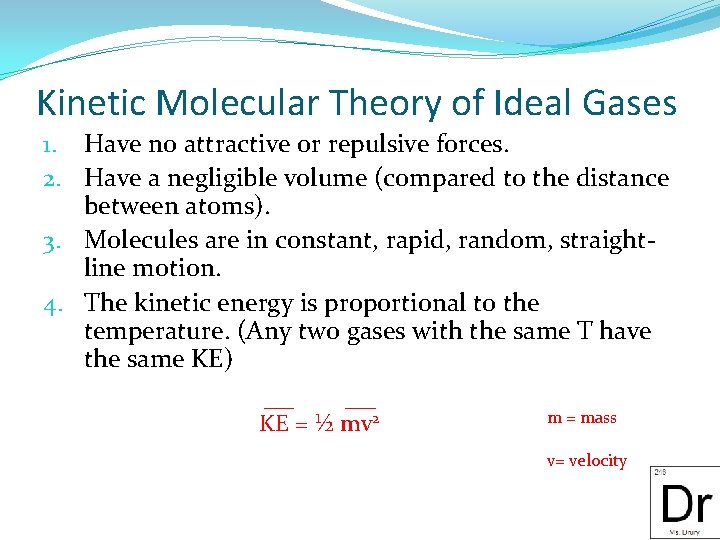
Kinetic Molecular Theory of Ideal Gases 1. Have no attractive or repulsive forces. 2. Have a negligible volume (compared to the distance between atoms). 3. Molecules are in constant, rapid, random, straightline motion. 4. The kinetic energy is proportional to the temperature. (Any two gases with the same T have the same KE) KE = ½ mv 2 m = mass v= velocity
�When do real gases behave like ideal gases? �At low pressure and high temperatures, because then they are spread out with low forces and negligible volumes. Also, low masses help make them more ideal.
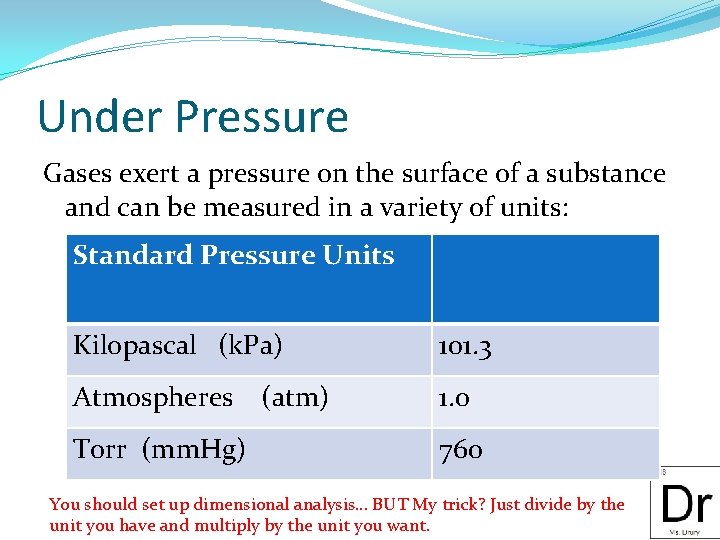
Under Pressure Gases exert a pressure on the surface of a substance and can be measured in a variety of units: Standard Pressure Units Kilopascal (k. Pa) 101. 3 Atmospheres 1. 0 Torr (mm. Hg) (atm) 760 You should set up dimensional analysis… BUT My trick? Just divide by the unit you have and multiply by the unit you want.

Pressure: convert the following: 1. 2. 3. 4. 5. 6. 850 mm. Hg = 560 mm. Hg 3. 43 atm 1. 97 atm 103 k. Pa 1008 k. Pa = = = 1. 10 _______ atm 75 _______ k. Pa 2610 _______ mm. Hg 200. _______ k. Pa 1. 02 _______ atm 7562 ____ mm. Hg
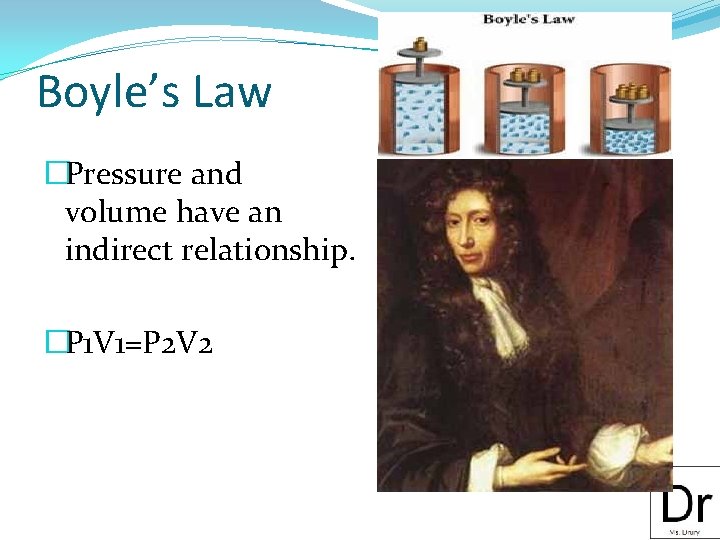
Boyle’s Law �Pressure and volume have an indirect relationship. �P 1 V 1=P 2 V 2
Charles’ Law �Volume and temperature have a direct relationship. �V 1/T 1 = V 2/T 2
Gay Lussac’s law �Pressure and temperature have a direct relationship. �P 1/T 1 = P 2/T 2
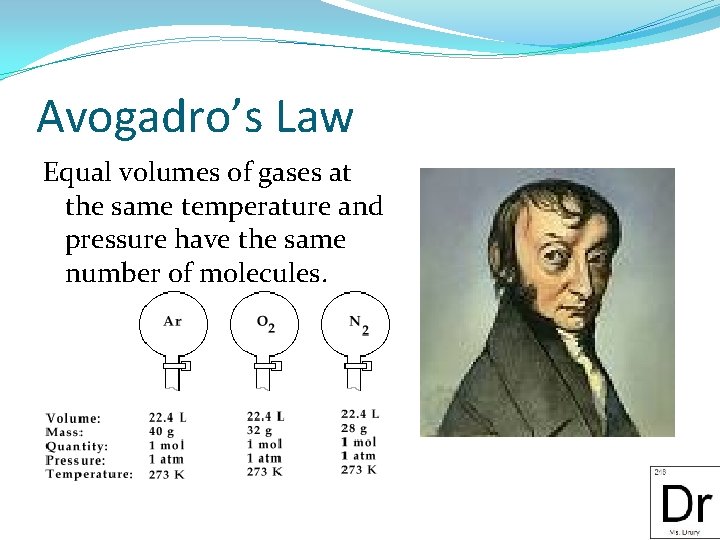
Avogadro’s Law Equal volumes of gases at the same temperature and pressure have the same number of molecules.
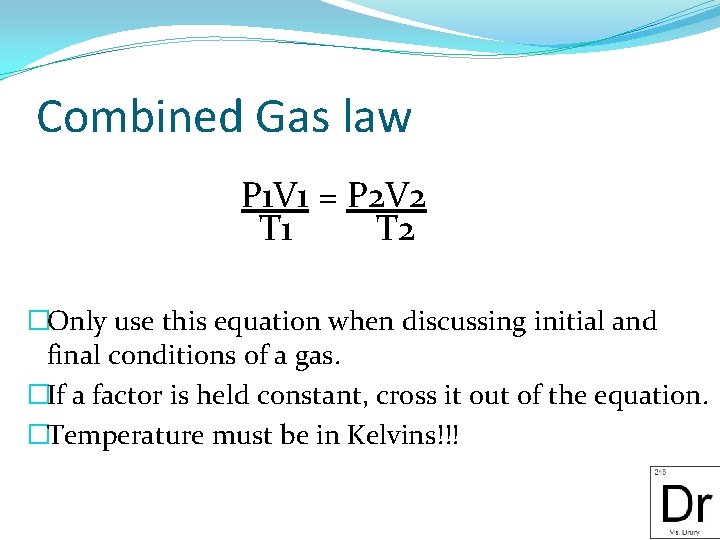
Combined Gas law P 1 V 1 = P 2 V 2 T 1 T 2 �Only use this equation when discussing initial and final conditions of a gas. �If a factor is held constant, cross it out of the equation. �Temperature must be in Kelvins!!!
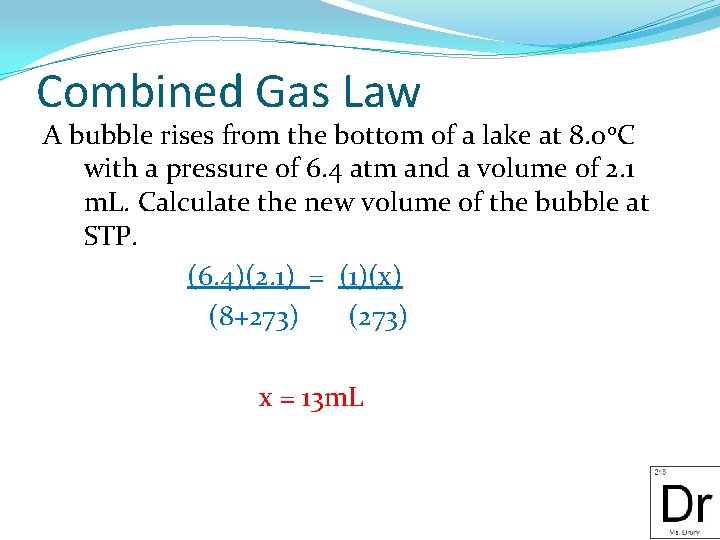
Combined Gas Law A bubble rises from the bottom of a lake at 8. 0 o. C with a pressure of 6. 4 atm and a volume of 2. 1 m. L. Calculate the new volume of the bubble at STP. (6. 4)(2. 1) = (1)(x) (8+273) (273) x = 13 m. L
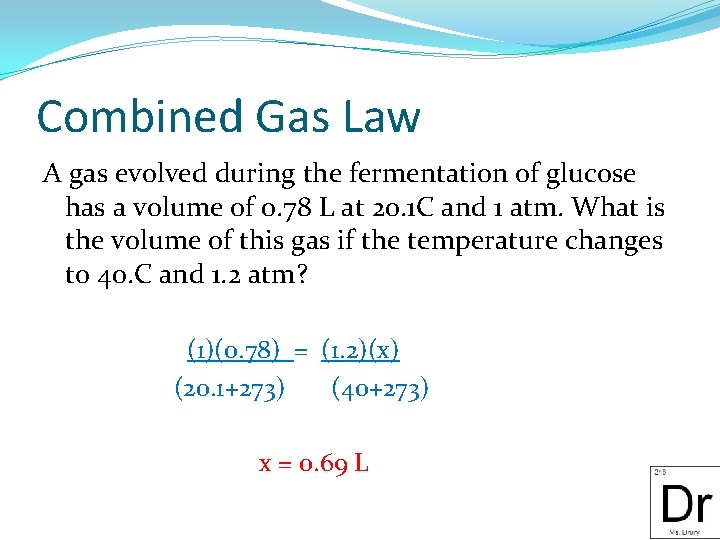
Combined Gas Law A gas evolved during the fermentation of glucose has a volume of 0. 78 L at 20. 1 C and 1 atm. What is the volume of this gas if the temperature changes to 40. C and 1. 2 atm? (1)(0. 78) = (1. 2)(x) (20. 1+273) (40+273) x = 0. 69 L
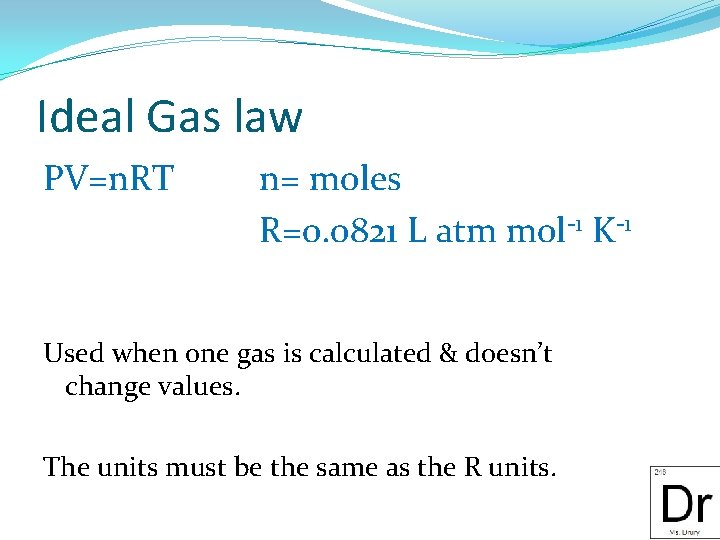
Ideal Gas law PV=n. RT n= moles R=0. 0821 L atm mol-1 K-1 Used when one gas is calculated & doesn’t change values. The units must be the same as the R units.
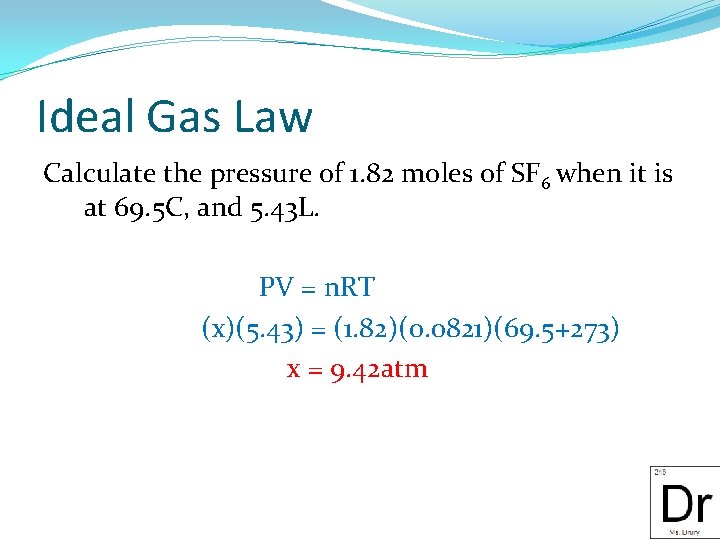
Ideal Gas Law Calculate the pressure of 1. 82 moles of SF 6 when it is at 69. 5 C, and 5. 43 L. PV = n. RT (x)(5. 43) = (1. 82)(0. 0821)(69. 5+273) x = 9. 42 atm
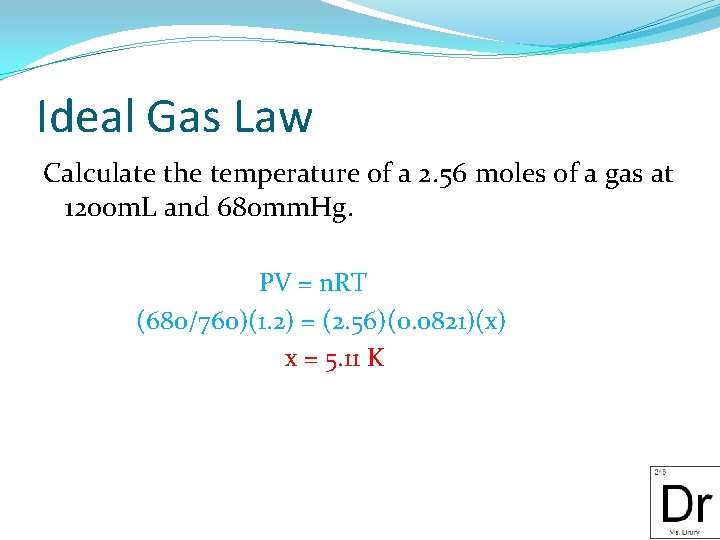
Ideal Gas Law Calculate the temperature of a 2. 56 moles of a gas at 1200 m. L and 680 mm. Hg. PV = n. RT (680/760)(1. 2) = (2. 56)(0. 0821)(x) x = 5. 11 K
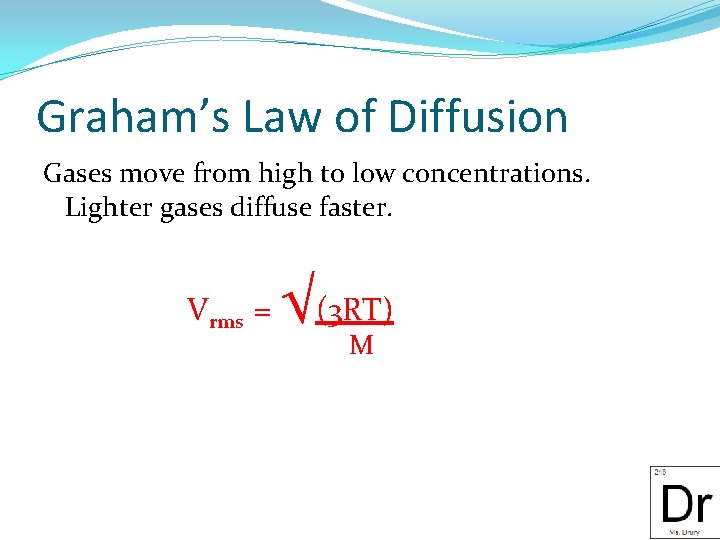
Graham’s Law of Diffusion Gases move from high to low concentrations. Lighter gases diffuse faster. Vrms = √(3 RT) M
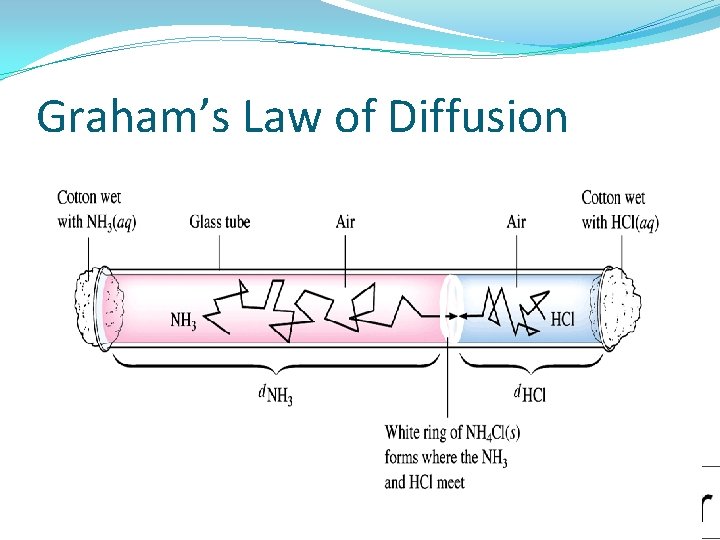
Graham’s Law of Diffusion
Graham’s Law of Diffusion Which diffuses the fastest: He or N 2? He because it is lighter
Graham’s Law of Diffusion �Compare the speeds of Gases using: KE = ½ mv 2 Gases at the same temperature will have the same KE therefore the equation becomes ½ mv 2=1/2 mv 2 And the ½ drops and becomes mv 2 = mv 2
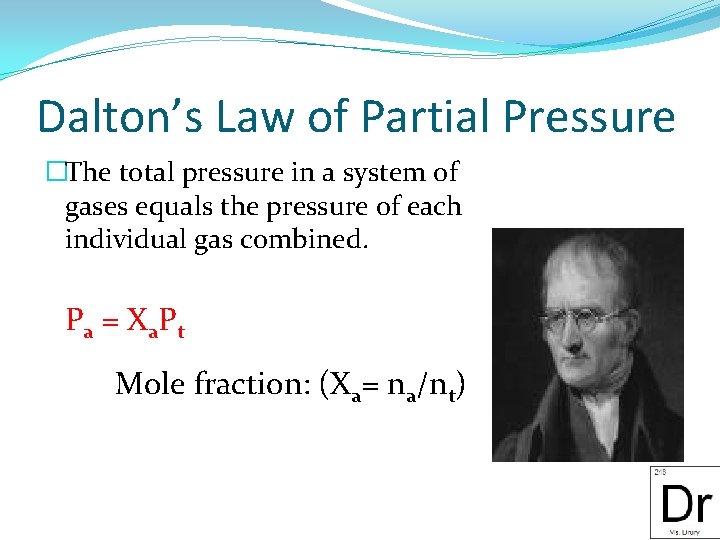
Dalton’s Law of Partial Pressure �The total pressure in a system of gases equals the pressure of each individual gas combined. Pa = X a. Pt Mole fraction: (Xa= na/nt)
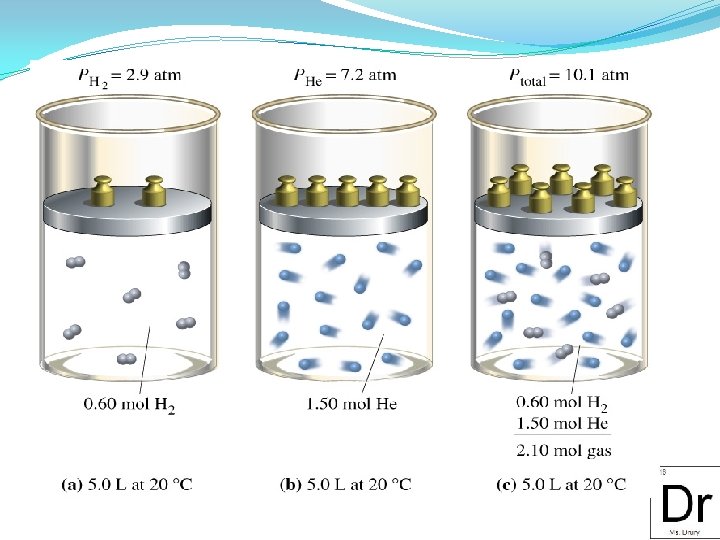
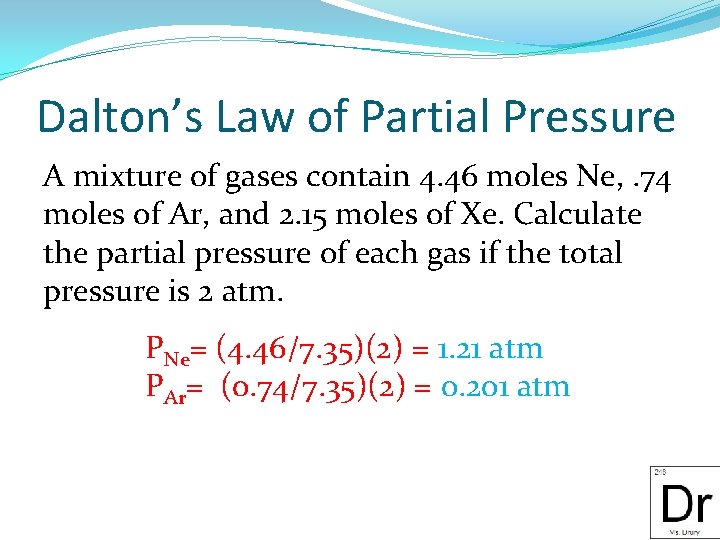
Dalton’s Law of Partial Pressure A mixture of gases contain 4. 46 moles Ne, . 74 moles of Ar, and 2. 15 moles of Xe. Calculate the partial pressure of each gas if the total pressure is 2 atm. PNe= (4. 46/7. 35)(2) = 1. 21 atm PAr= (0. 74/7. 35)(2) = 0. 201 atm
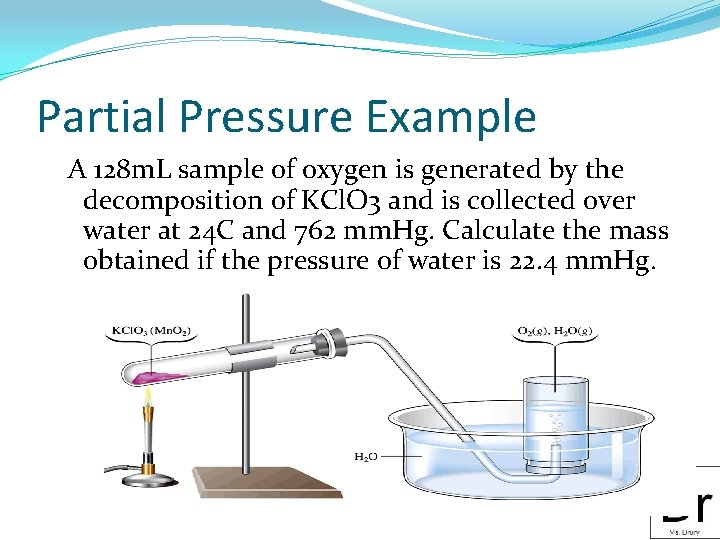
Partial Pressure Example A 128 m. L sample of oxygen is generated by the decomposition of KCl. O 3 and is collected over water at 24 C and 762 mm. Hg. Calculate the mass obtained if the pressure of water is 22. 4 mm. Hg.
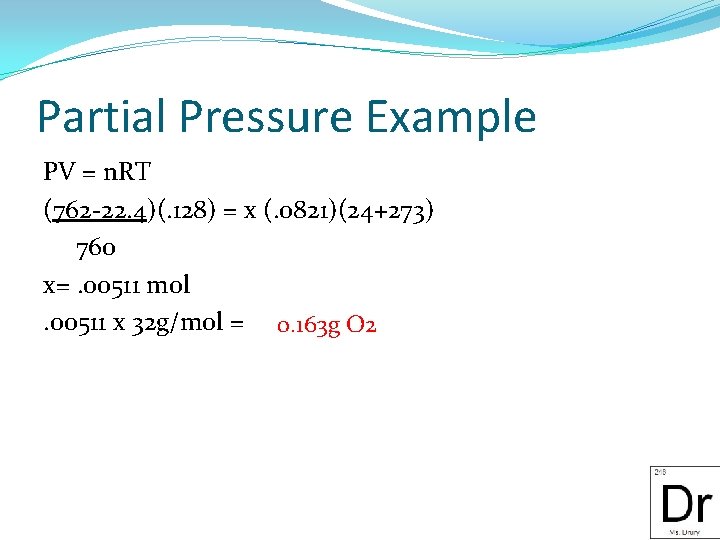
Partial Pressure Example PV = n. RT (762 -22. 4)(. 128) = x (. 0821)(24+273) 760 x=. 00511 mol. 00511 x 32 g/mol = 0. 163 g O 2
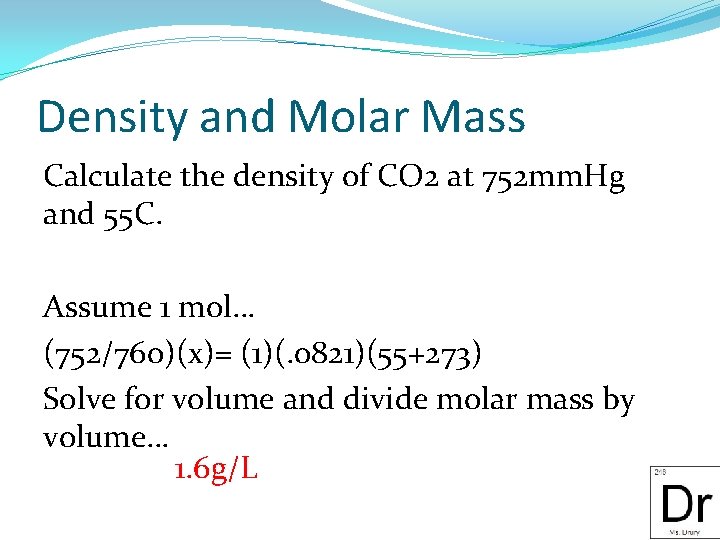
Density and Molar Mass Calculate the density of CO 2 at 752 mm. Hg and 55 C. Assume 1 mol… (752/760)(x)= (1)(. 0821)(55+273) Solve for volume and divide molar mass by volume… 1. 6 g/L
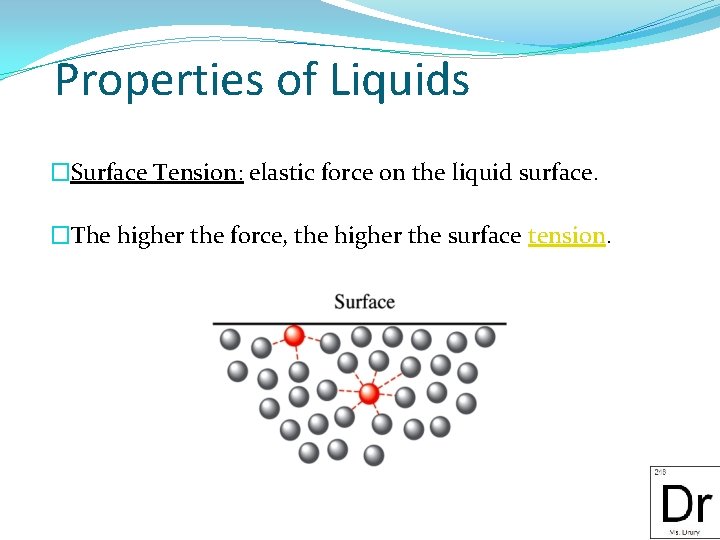
Properties of Liquids �Surface Tension: elastic force on the liquid surface. �The higher the force, the higher the surface tension.
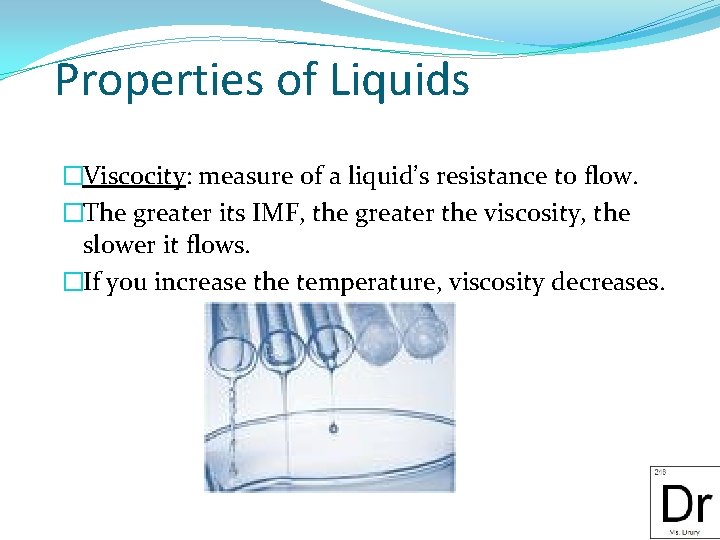
Properties of Liquids �Viscocity: measure of a liquid’s resistance to flow. �The greater its IMF, the greater the viscosity, the slower it flows. �If you increase the temperature, viscosity decreases.
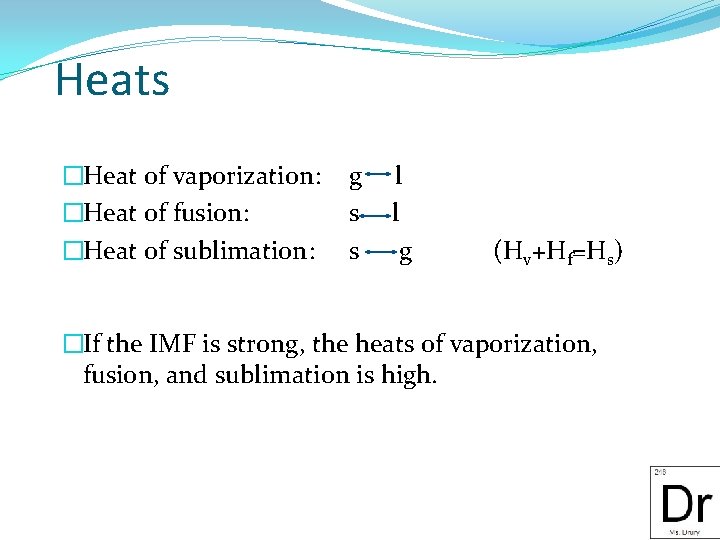
Heats �Heat of vaporization: �Heat of fusion: �Heat of sublimation: g s s l l g (Hv+Hf=Hs) �If the IMF is strong, the heats of vaporization, fusion, and sublimation is high.
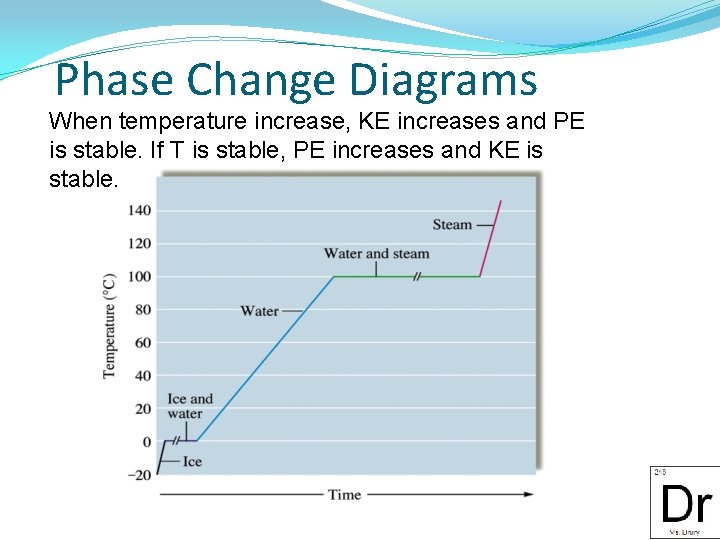
Phase Change Diagrams When temperature increase, KE increases and PE is stable. If T is stable, PE increases and KE is stable.
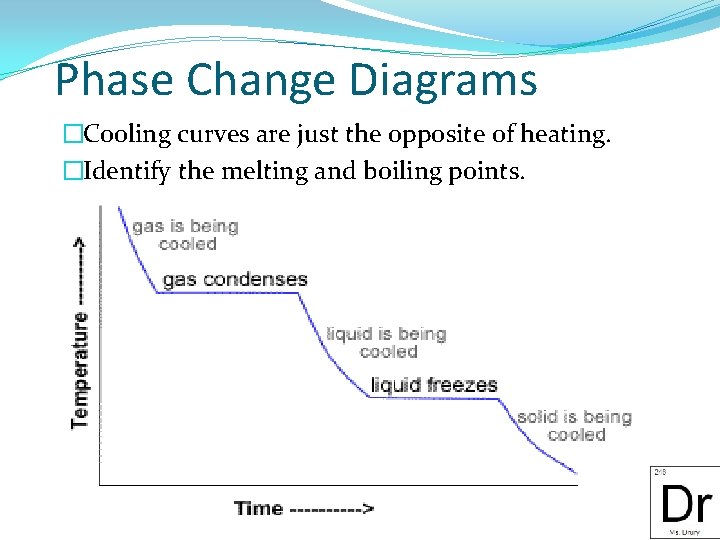
Phase Change Diagrams �Cooling curves are just the opposite of heating. �Identify the melting and boiling points.
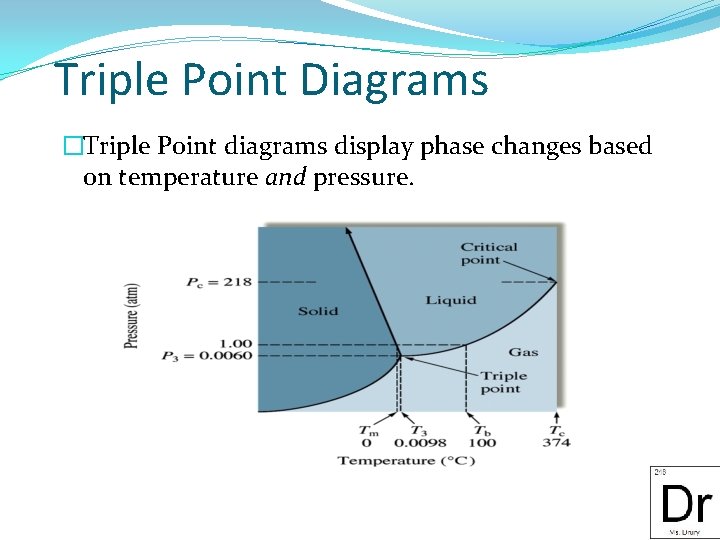
Triple Point Diagrams �Triple Point diagrams display phase changes based on temperature and pressure.
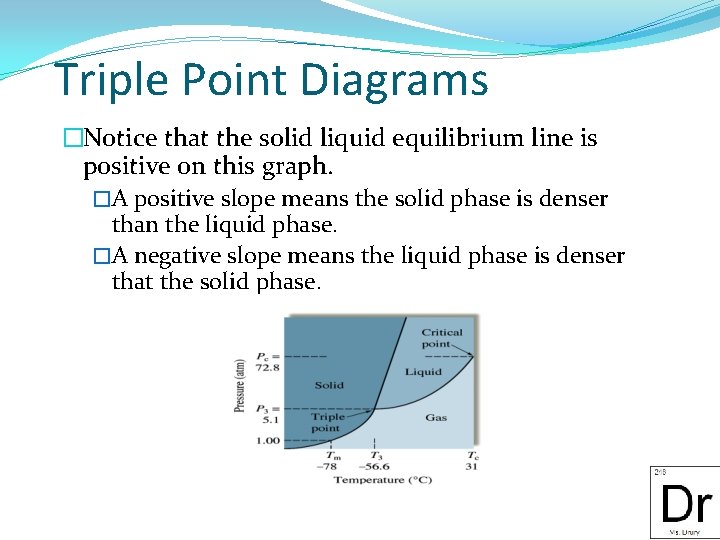
Triple Point Diagrams �Notice that the solid liquid equilibrium line is positive on this graph. �A positive slope means the solid phase is denser than the liquid phase. �A negative slope means the liquid phase is denser that the solid phase.
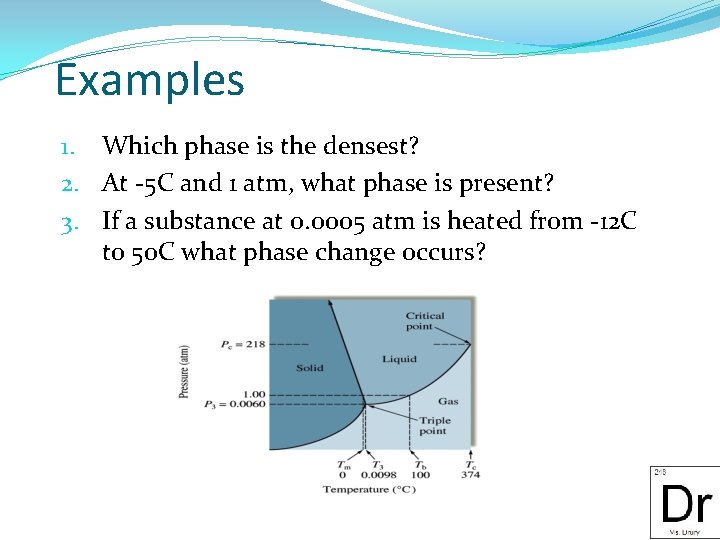
Examples 1. Which phase is the densest? 2. At -5 C and 1 atm, what phase is present? 3. If a substance at 0. 0005 atm is heated from -12 C to 50 C what phase change occurs?
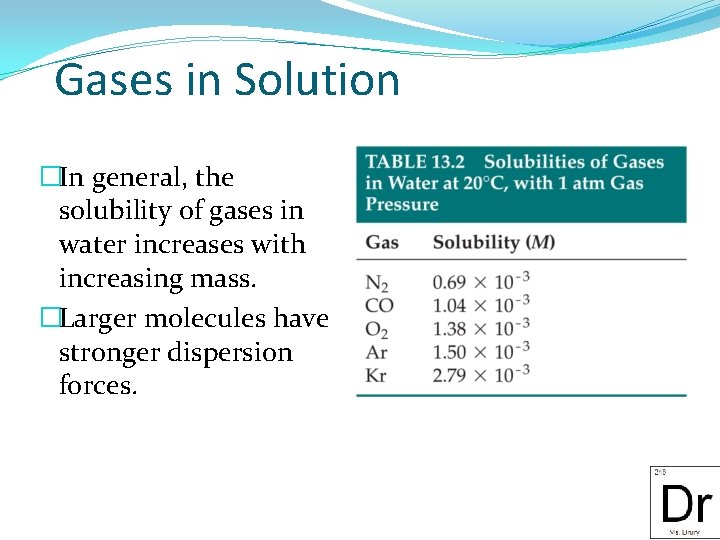
Gases in Solution �In general, the solubility of gases in water increases with increasing mass. �Larger molecules have stronger dispersion forces.
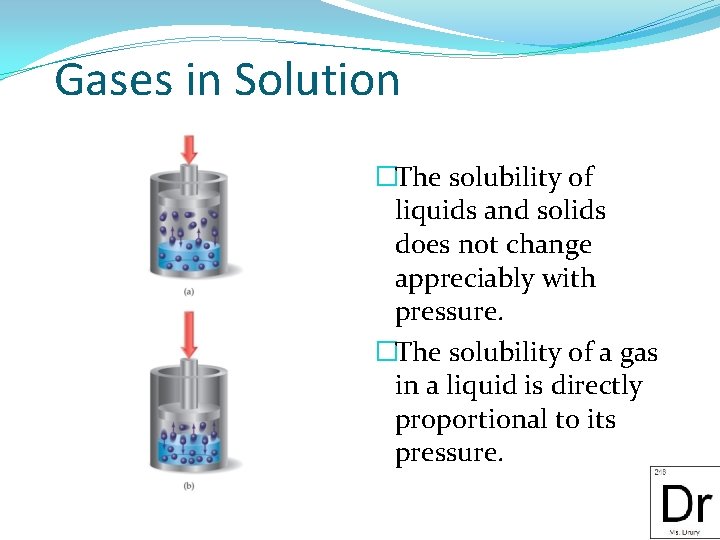
Gases in Solution �The solubility of liquids and solids does not change appreciably with pressure. �The solubility of a gas in a liquid is directly proportional to its pressure.
Gases in solutions �Why do soda bottles fizz when opened? �The pressure is decreased, so gas is less soluble and come out of solution. �If you heat a gas in solution does it become more or less soluble? �Less soluble, think of heating soda.
Colligative Properties �Changes in colligative properties depend only on the number of solute particles present, not on the identity of the solute particles.
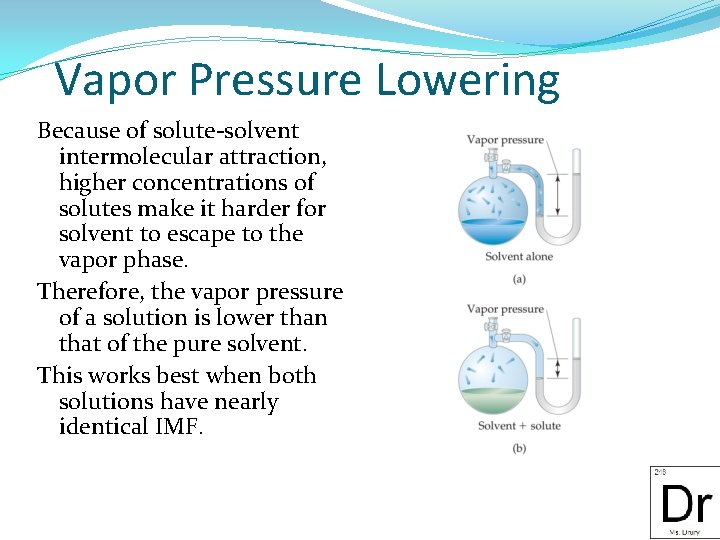
Vapor Pressure Lowering Because of solute-solvent intermolecular attraction, higher concentrations of solutes make it harder for solvent to escape to the vapor phase. Therefore, the vapor pressure of a solution is lower than that of the pure solvent. This works best when both solutions have nearly identical IMF.

Raoult’s Law where PA = XAP A • XA is the mole fraction of compound A • P A is the normal vapor pressure of A at that temperature, in a pure form NOTE: Make sure you have the vapor pressure of the solvent. Therefore, have the X of the solvent. Otherwise, this is the same formula as partial pressures of gases.
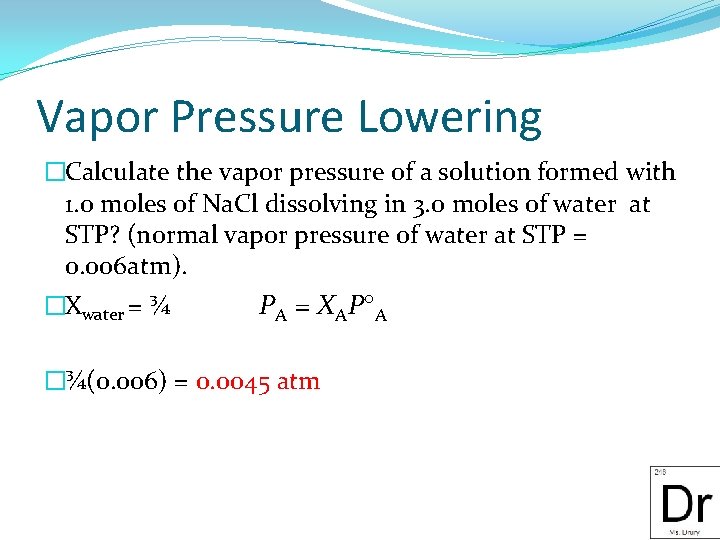
Vapor Pressure Lowering �Calculate the vapor pressure of a solution formed with 1. 0 moles of Na. Cl dissolving in 3. 0 moles of water at STP? (normal vapor pressure of water at STP = 0. 006 atm). �Xwater = ¾ PA = XAP A �¾(0. 006) = 0. 0045 atm
- Slides: 41