
Ideal Gas Law METHOD INTRODUCTION Ideal Gas Law
- Slides: 1
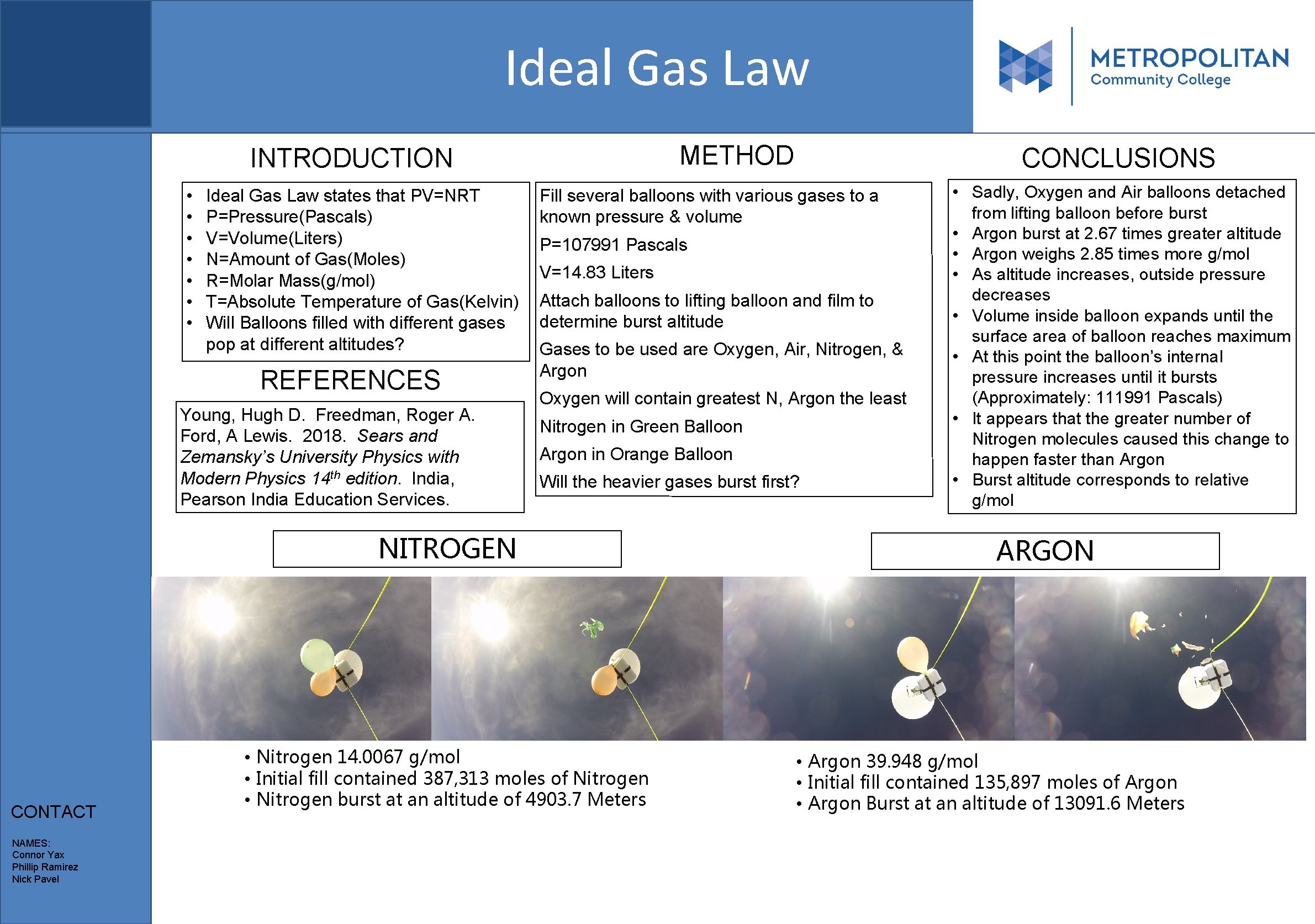
Ideal Gas Law METHOD INTRODUCTION • • Ideal Gas Law states that PV=NRT P=Pressure(Pascals) V=Volume(Liters) N=Amount of Gas(Moles) R=Molar Mass(g/mol) T=Absolute Temperature of Gas(Kelvin) Will Balloons filled with different gases pop at different altitudes? REFERENCES Young, Hugh D. Freedman, Roger A. Ford, A Lewis. 2018. Sears and Zemansky’s University Physics with Modern Physics 14 th edition. India, Pearson India Education Services. Fill several balloons with various gases to a known pressure & volume P=107991 Pascals V=14. 83 Liters Attach balloons to lifting balloon and film to determine burst altitude Gases to be used are Oxygen, Air, Nitrogen, & Argon Oxygen will contain greatest N, Argon the least Nitrogen in Green Balloon Argon in Orange Balloon Will the heavier gases burst first? NITROGEN CONTACT NAMES: Connor Yax Phillip Ramirez Nick Pavel CONCLUSIONS • Nitrogen 14. 0067 g/mol • Initial fill contained 387, 313 moles of Nitrogen • Nitrogen burst at an altitude of 4903. 7 Meters • Sadly, Oxygen and Air balloons detached from lifting balloon before burst • Argon burst at 2. 67 times greater altitude • Argon weighs 2. 85 times more g/mol • As altitude increases, outside pressure decreases • Volume inside balloon expands until the surface area of balloon reaches maximum • At this point the balloon’s internal pressure increases until it bursts (Approximately: 111991 Pascals) • It appears that the greater number of Nitrogen molecules caused this change to happen faster than Argon • Burst altitude corresponds to relative g/mol ARGON • Argon 39. 948 g/mol • Initial fill contained 135, 897 moles of Argon • Argon Burst at an altitude of 13091. 6 Meters