
Ideal Gas Law Kinetic Molecular Theory We will
- Slides: 24
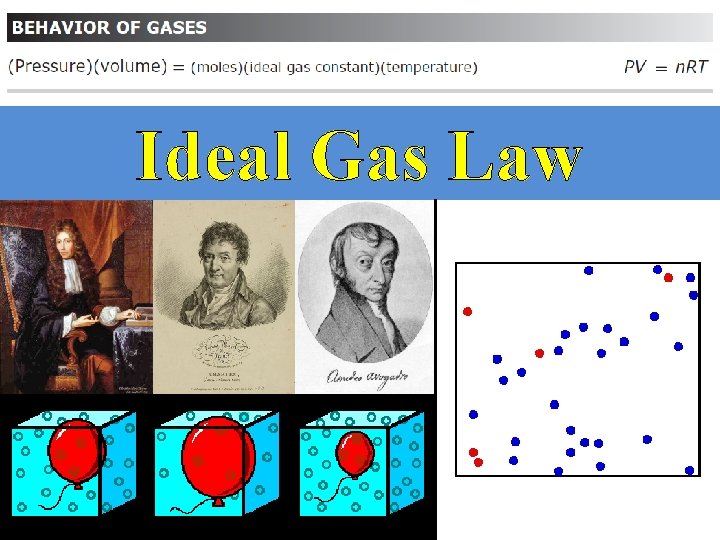
Ideal Gas Law
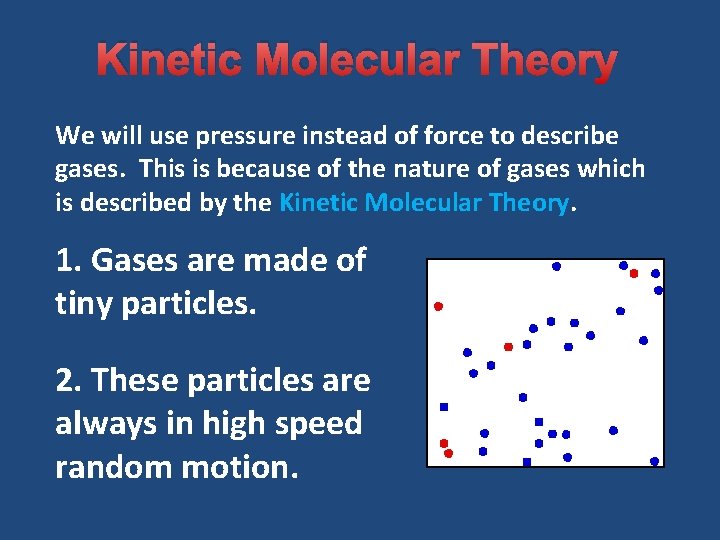
Kinetic Molecular Theory We will use pressure instead of force to describe gases. This is because of the nature of gases which is described by the Kinetic Molecular Theory. 1. Gases are made of tiny particles. 2. These particles are always in high speed random motion.
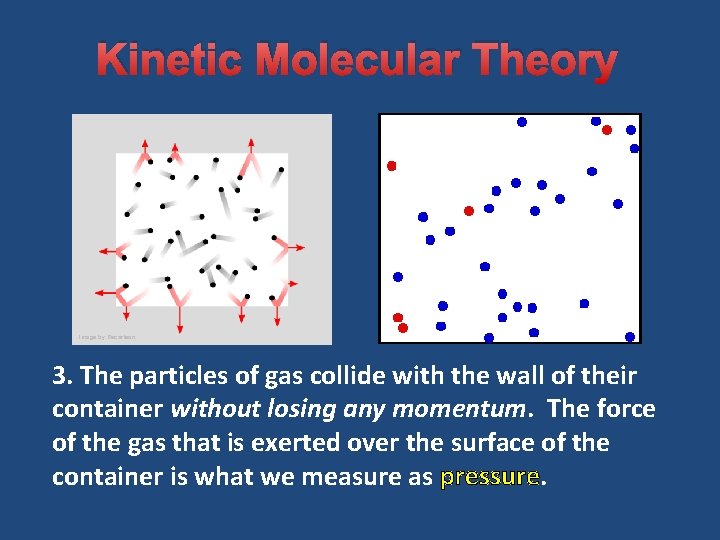
Kinetic Molecular Theory Image by Becarlson 3. The particles of gas collide with the wall of their container without losing any momentum. The force of the gas that is exerted over the surface of the container is what we measure as pressure.
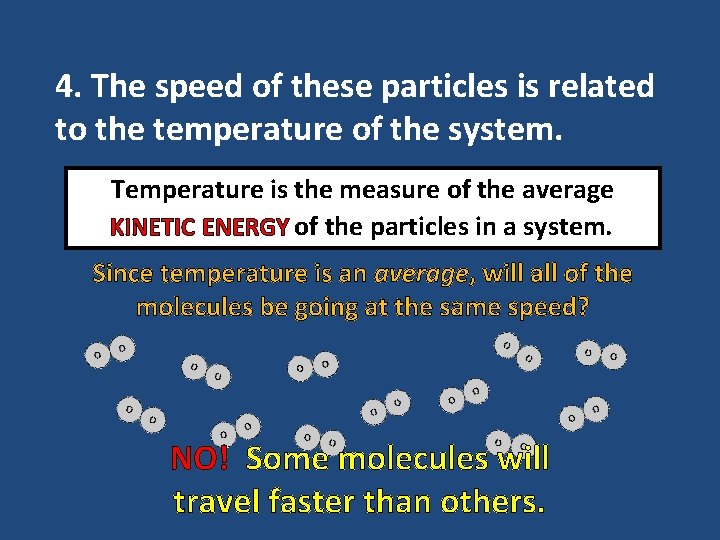
4. The speed of these particles is related to the temperature of the system. Temperature is the measure of the average KINETIC ENERGY of the particles in a system. Since temperature is an average, will all of the molecules be going at the same speed? NO! Some molecules will travel faster than others.
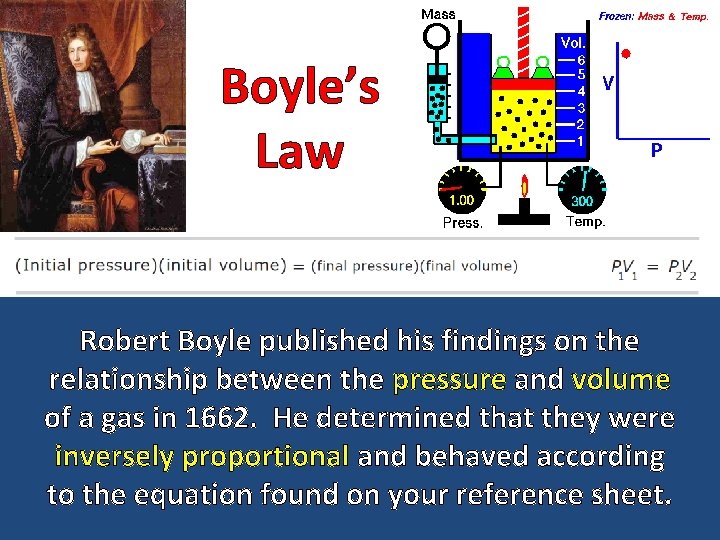
Boyle’s Law Robert Boyle published his findings on the relationship between the pressure and volume of a gas in 1662. He determined that they were inversely proportional and behaved according to the equation found on your reference sheet.
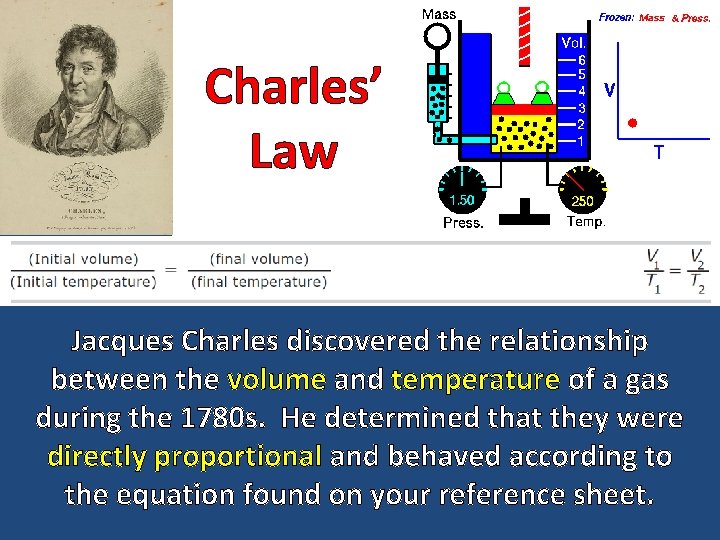
Charles’ Law Jacques Charles discovered the relationship between the volume and temperature of a gas during the 1780 s. He determined that they were directly proportional and behaved according to the equation found on your reference sheet.
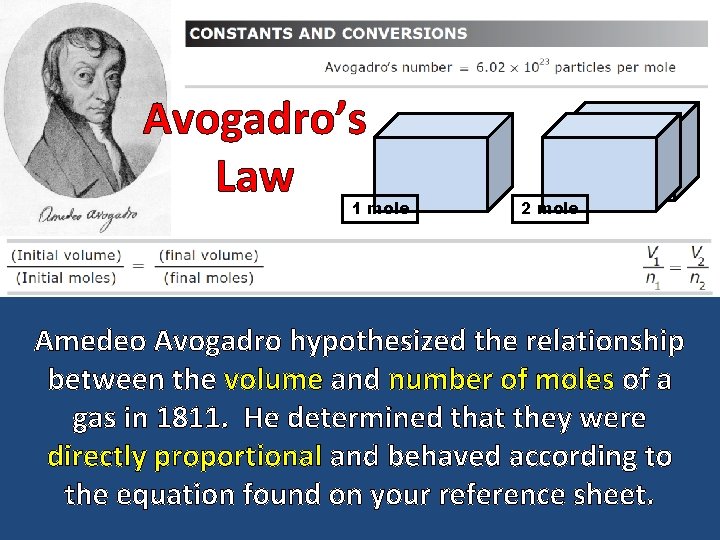
Avogadro’s Law 1 mole 2 mole Amedeo Avogadro hypothesized the relationship between the volume and number of moles of a gas in 1811. He determined that they were directly proportional and behaved according to the equation found on your reference sheet.
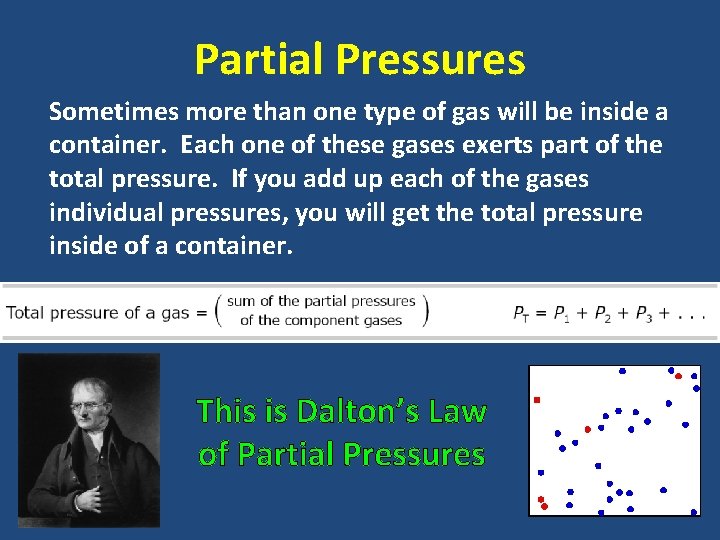
Partial Pressures Sometimes more than one type of gas will be inside a container. Each one of these gases exerts part of the total pressure. If you add up each of the gases individual pressures, you will get the total pressure inside of a container. This is Dalton’s Law of Partial Pressures
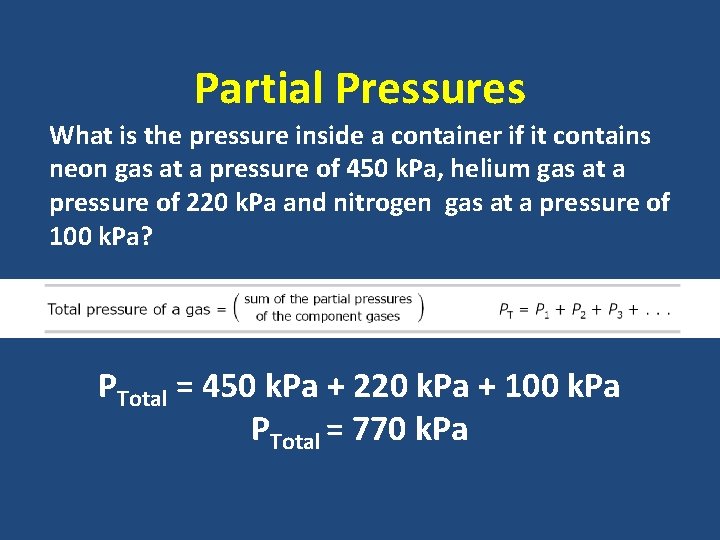
Partial Pressures What is the pressure inside a container if it contains neon gas at a pressure of 450 k. Pa, helium gas at a pressure of 220 k. Pa and nitrogen gas at a pressure of 100 k. Pa? PTotal = 450 k. Pa + 220 k. Pa + 100 k. Pa PTotal = 770 k. Pa
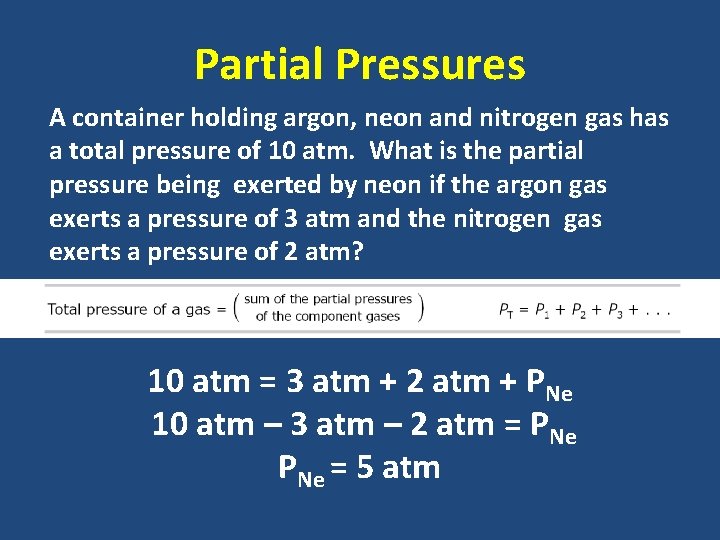
Partial Pressures A container holding argon, neon and nitrogen gas has a total pressure of 10 atm. What is the partial pressure being exerted by neon if the argon gas exerts a pressure of 3 atm and the nitrogen gas exerts a pressure of 2 atm? 10 atm = 3 atm + 2 atm + PNe 10 atm – 3 atm – 2 atm = PNe = 5 atm
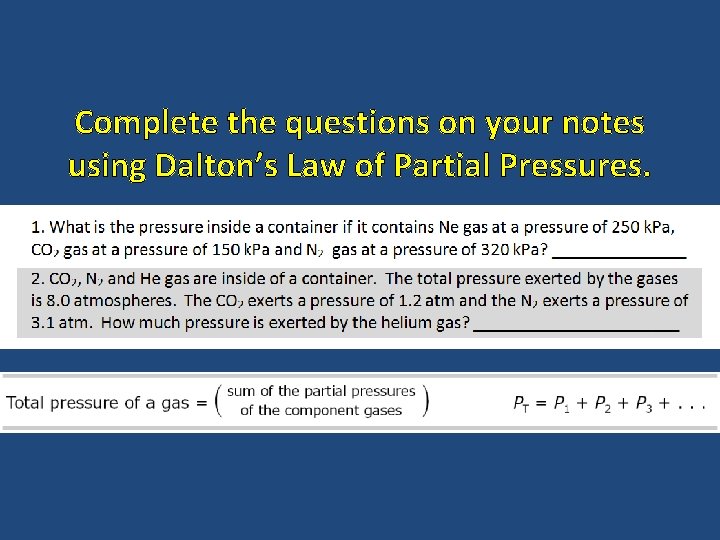
Complete the questions on your notes using Dalton’s Law of Partial Pressures.
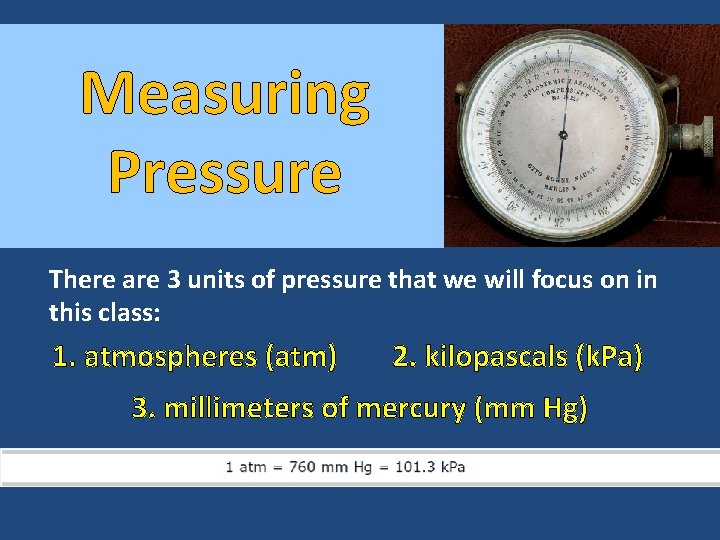
Measuring Pressure There are 3 units of pressure that we will focus on in this class: 1. atmospheres (atm) 2. kilopascals (k. Pa) 3. millimeters of mercury (mm Hg)
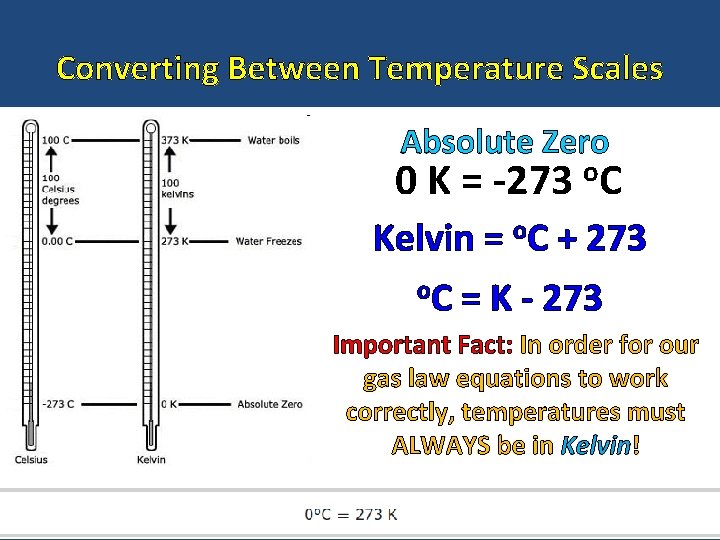
Converting Between Temperature Scales Absolute Zero 0 K = -273 o. C Kelvin = o. C + 273 o. C = K - 273 Important Fact: In order for our gas law equations to work correctly, temperatures must ALWAYS be in Kelvin!
Ideal Gas Both the Combined Gas Law and the Ideal Gas Law is based on the idea of an ideal gas. An ideal gas is a gas that: (1) does not take up any space (2) its particles do not interact with each other. While there is no such thing as an ideal gas, most gases behave very closely to ideal when they are at low pressures and low temperatures. This allows us to make predictions that are very close to the truth.
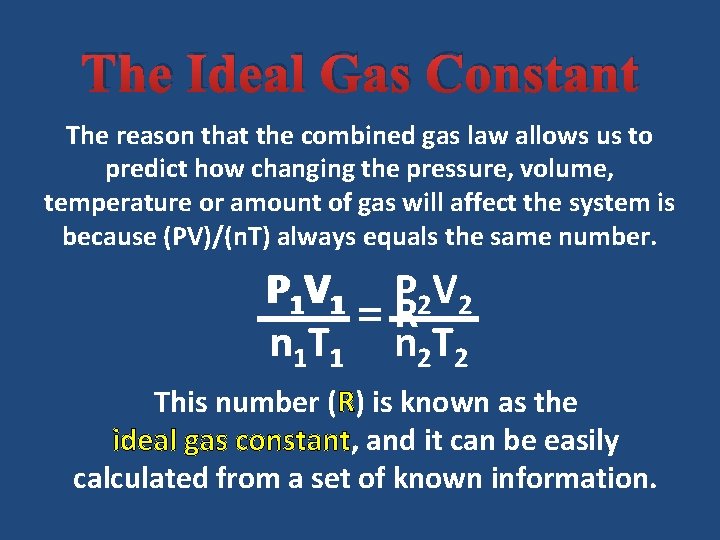
The Ideal Gas Constant The reason that the combined gas law allows us to predict how changing the pressure, volume, temperature or amount of gas will affect the system is because (PV)/(n. T) always equals the same number. P 1 V 1 P 2 V 2 =R n 1 T 1 n 2 This number (R) is known as the ideal gas constant, and it can be easily calculated from a set of known information.
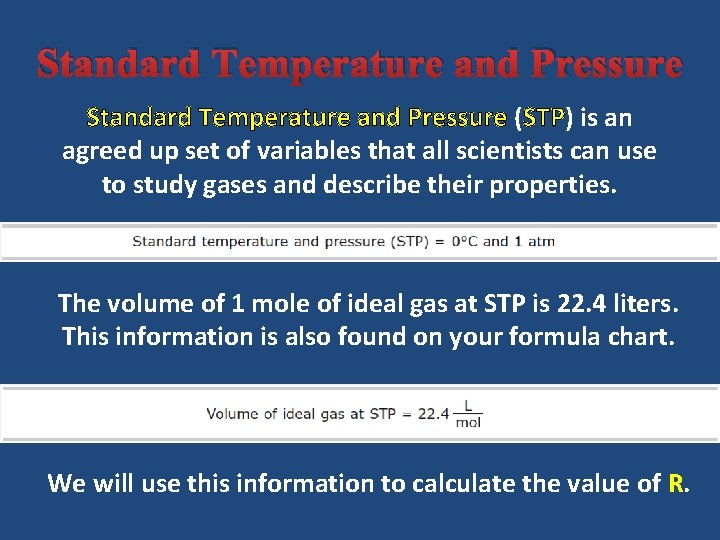
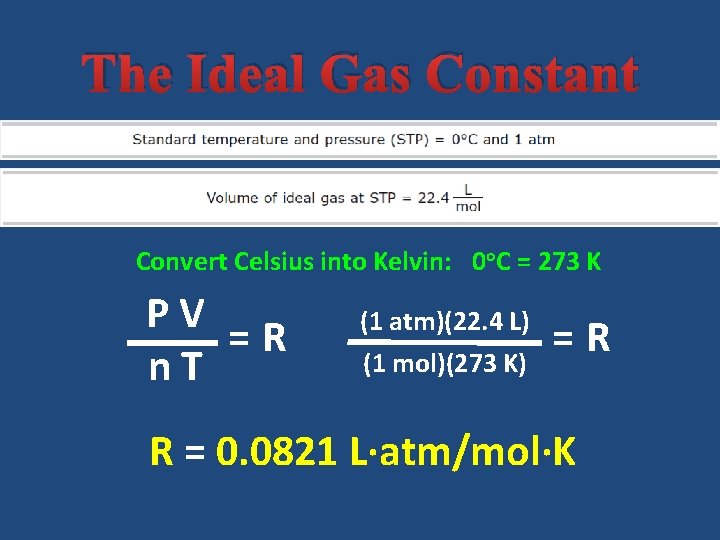
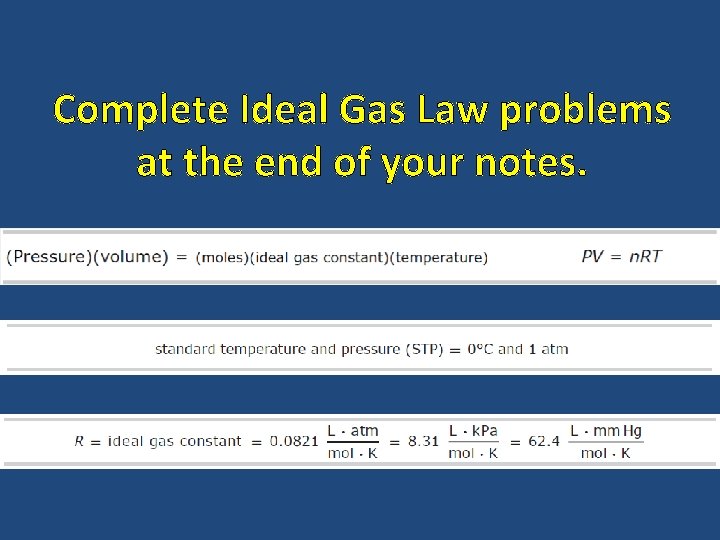
Standard Temperature and Pressure (STP) is an agreed up set of variables that all scientists can use to study gases and describe their properties. The volume of 1 mole of ideal gas at STP is 22. 4 liters. This information is also found on your formula chart. We will use this information to calculate the value of R.
The Ideal Gas Constant Convert Celsius into Kelvin: 0 o. C = 273 K PV =R n. T (1 atm)(22. 4 L) (1 mol)(273 K) =R R = 0. 0821 L·atm/mol·K
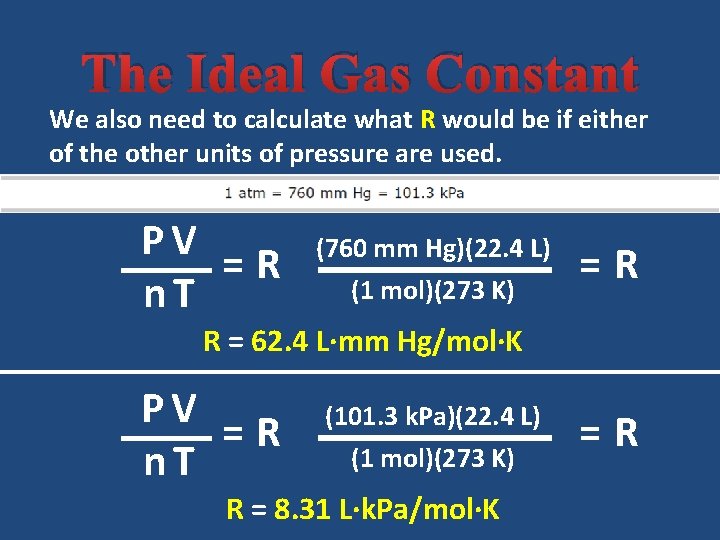
The Ideal Gas Constant We also need to calculate what R would be if either of the other units of pressure are used. PV =R n. T (760 mm Hg)(22. 4 L) (1 mol)(273 K) =R R = 62. 4 L·mm Hg/mol·K PV =R n. T (101. 3 k. Pa)(22. 4 L) (1 mol)(273 K) R = 8. 31 L·k. Pa/mol·K =R
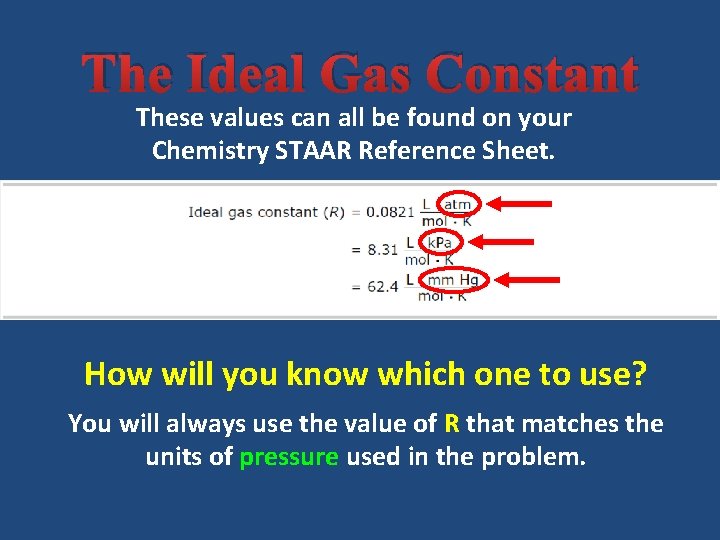
The Ideal Gas Constant These values can all be found on your Chemistry STAAR Reference Sheet. How will you know which one to use? You will always use the value of R that matches the units of pressure used in the problem.
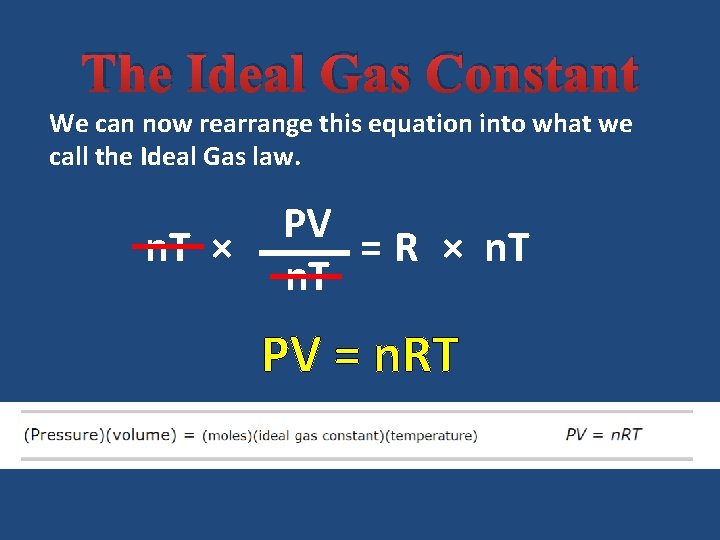
The Ideal Gas Constant We can now rearrange this equation into what we call the Ideal Gas law. n. T × PV = R × n. T PV = n. RT
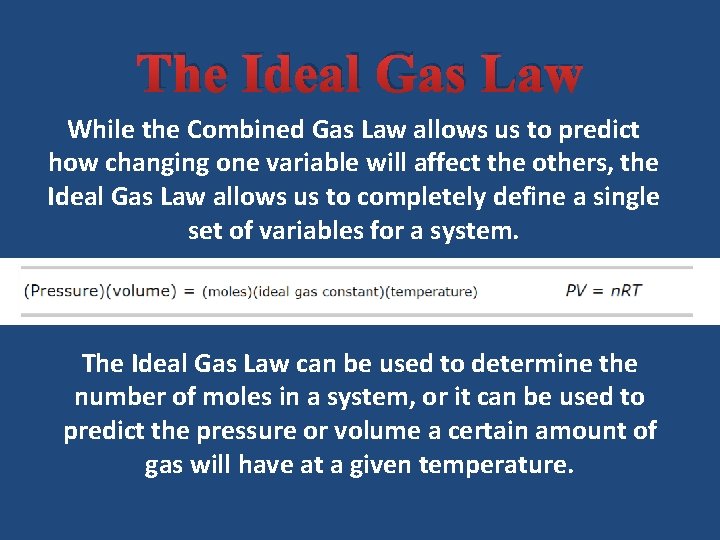
The Ideal Gas Law While the Combined Gas Law allows us to predict how changing one variable will affect the others, the Ideal Gas Law allows us to completely define a single set of variables for a system. The Ideal Gas Law can be used to determine the number of moles in a system, or it can be used to predict the pressure or volume a certain amount of gas will have at a given temperature.
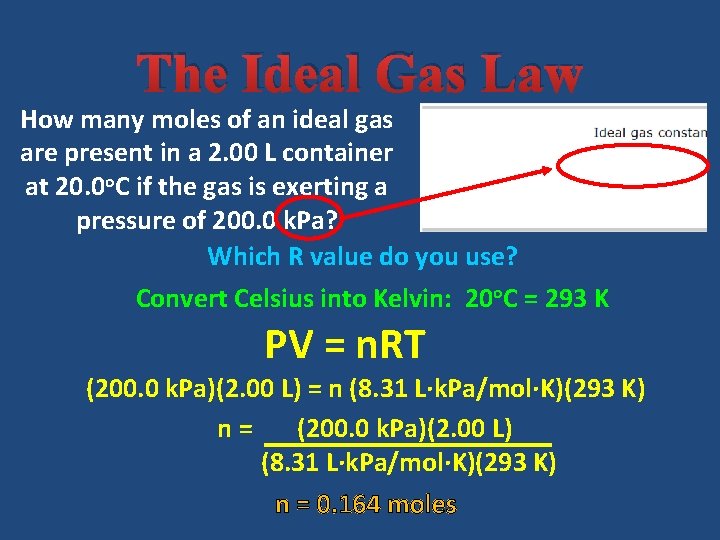
The Ideal Gas Law How many moles of an ideal gas are present in a 2. 00 L container at 20. 0 o. C if the gas is exerting a pressure of 200. 0 k. Pa? Which R value do you use? Convert Celsius into Kelvin: 20 o. C = 293 K PV = n. RT (200. 0 k. Pa)(2. 00 L) = n (8. 31 L·k. Pa/mol·K)(293 K) n= (200. 0 k. Pa)(2. 00 L) (8. 31 L·k. Pa/mol·K)(293 K) n = 0. 164 moles
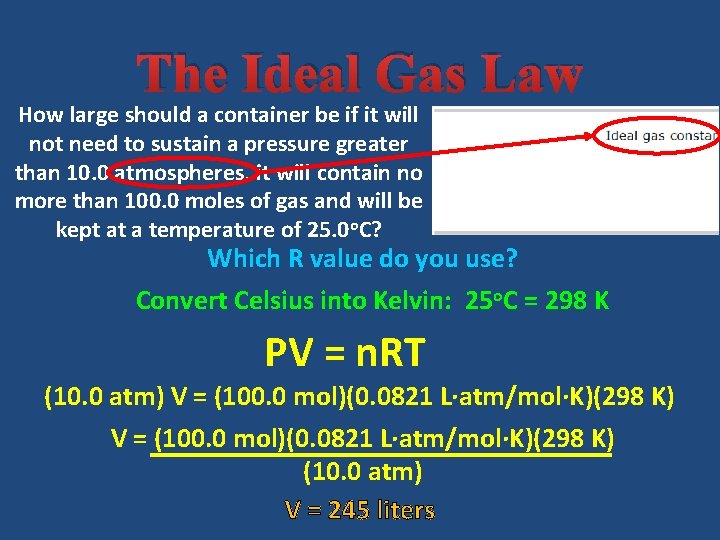
The Ideal Gas Law How large should a container be if it will not need to sustain a pressure greater than 10. 0 atmospheres, it will contain no more than 100. 0 moles of gas and will be kept at a temperature of 25. 0 o. C? Which R value do you use? Convert Celsius into Kelvin: 25 o. C = 298 K PV = n. RT (10. 0 atm) V = (100. 0 mol)(0. 0821 L·atm/mol·K)(298 K) (10. 0 atm) V = 245 liters
Complete Ideal Gas Law problems at the end of your notes.