
Ideal Clinic 5 years Gauteng Province 26 February
Ideal Clinic 5 years Gauteng Province 26 February 2020 Morwa Molebatsi
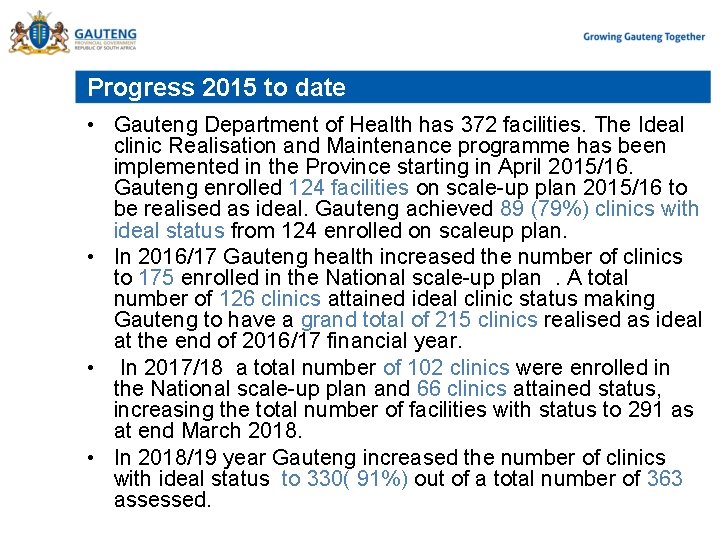
Progress 2015 to date • Gauteng Department of Health has 372 facilities. The Ideal clinic Realisation and Maintenance programme has been implemented in the Province starting in April 2015/16. Gauteng enrolled 124 facilities on scale-up plan 2015/16 to be realised as ideal. Gauteng achieved 89 (79%) clinics with ideal status from 124 enrolled on scaleup plan. • In 2016/17 Gauteng health increased the number of clinics to 175 enrolled in the National scale-up plan . A total number of 126 clinics attained ideal clinic status making Gauteng to have a grand total of 215 clinics realised as ideal at the end of 2016/17 financial year. • In 2017/18 a total number of 102 clinics were enrolled in the National scale-up plan and 66 clinics attained status, increasing the total number of facilities with status to 291 as at end March 2018. • In 2018/19 year Gauteng increased the number of clinics with ideal status to 330( 91%) out of a total number of 363 assessed.
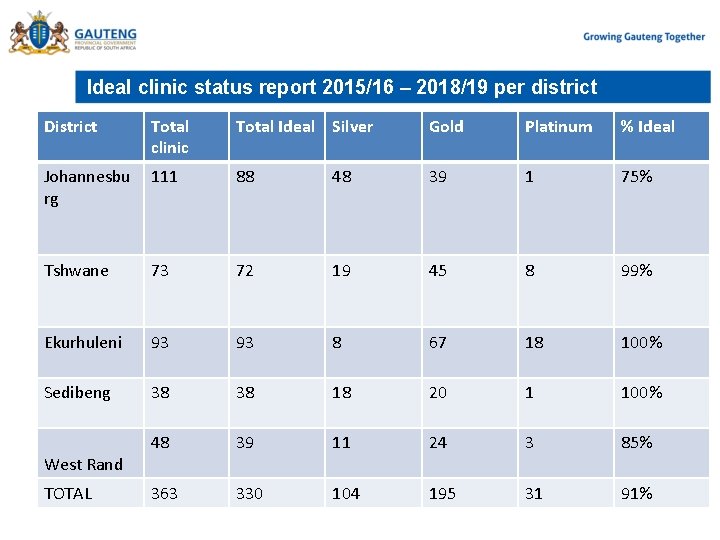
Ideal clinic status report 2015/16 – 2018/19 per district District Total clinic Total Ideal Silver Gold Platinum % Ideal Johannesbu rg 111 88 48 39 1 75% Tshwane 73 72 19 45 8 99% Ekurhuleni 93 93 8 67 18 100% Sedibeng 38 38 18 20 1 100% 48 39 11 24 3 85% 363 330 104 195 31 91% West Rand TOTAL
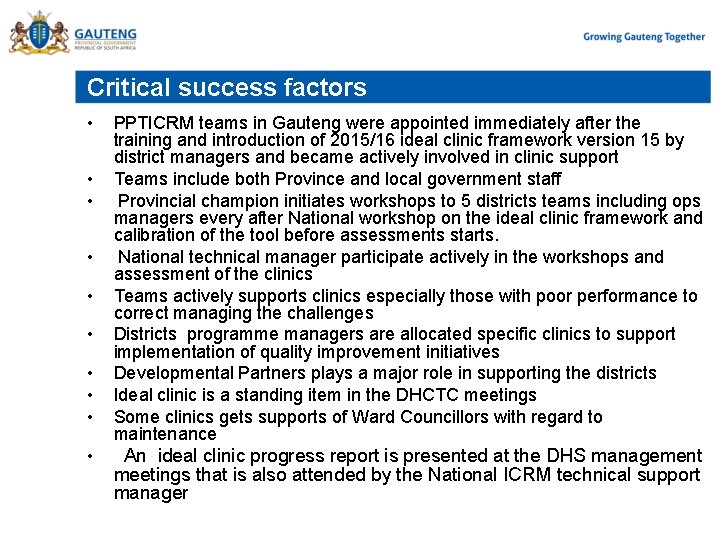
Critical success factors • • • PPTICRM teams in Gauteng were appointed immediately after the training and introduction of 2015/16 ideal clinic framework version 15 by district managers and became actively involved in clinic support Teams include both Province and local government staff Provincial champion initiates workshops to 5 districts teams including ops managers every after National workshop on the ideal clinic framework and calibration of the tool before assessments starts. National technical manager participate actively in the workshops and assessment of the clinics Teams actively supports clinics especially those with poor performance to correct managing the challenges Districts programme managers are allocated specific clinics to support implementation of quality improvement initiatives Developmental Partners plays a major role in supporting the districts Ideal clinic is a standing item in the DHCTC meetings Some clinics gets supports of Ward Councillors with regard to maintenance An ideal clinic progress report is presented at the DHS management meetings that is also attended by the National ICRM technical support manager
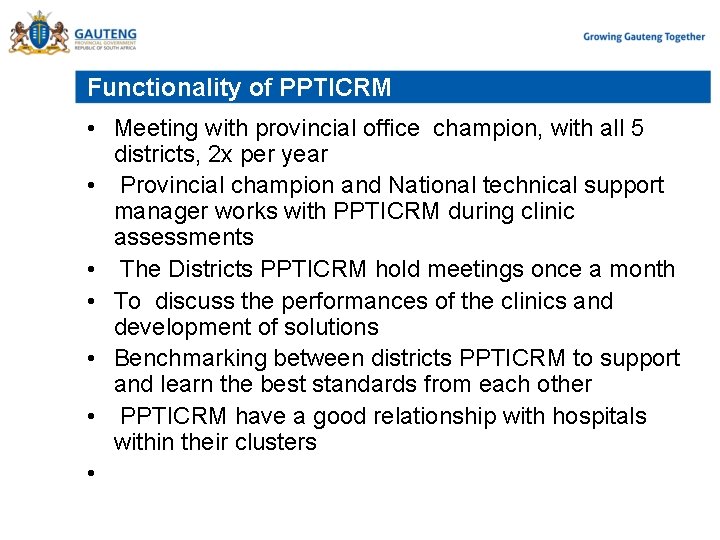
Functionality of PPTICRM • Meeting with provincial office champion, with all 5 districts, 2 x per year • Provincial champion and National technical support manager works with PPTICRM during clinic assessments • The Districts PPTICRM hold meetings once a month • To discuss the performances of the clinics and development of solutions • Benchmarking between districts PPTICRM to support and learn the best standards from each other • PPTICRM have a good relationship with hospitals within their clusters •
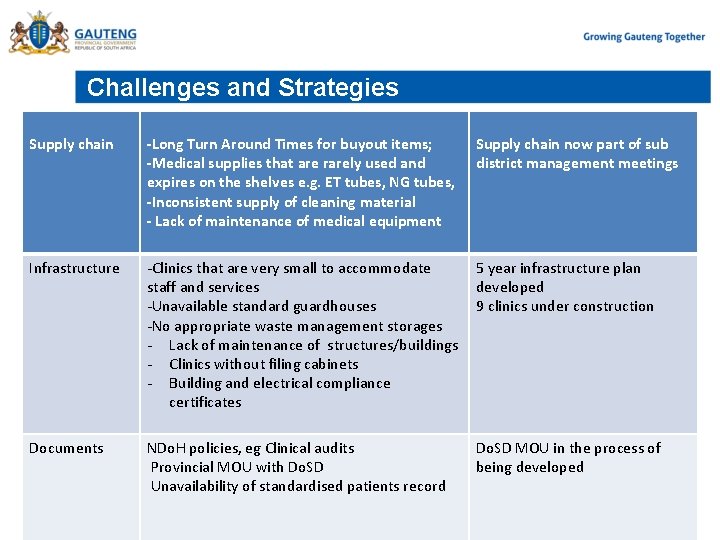
Challenges and Strategies Supply chain -Long Turn Around Times for buyout items; -Medical supplies that are rarely used and expires on the shelves e. g. ET tubes, NG tubes, -Inconsistent supply of cleaning material - Lack of maintenance of medical equipment Supply chain now part of sub district management meetings Infrastructure -Clinics that are very small to accommodate staff and services -Unavailable standard guardhouses -No appropriate waste management storages - Lack of maintenance of structures/buildings - Clinics without filing cabinets - Building and electrical compliance certificates 5 year infrastructure plan developed 9 clinics under construction Documents NDo. H policies, eg Clinical audits Provincial MOU with Do. SD Unavailability of standardised patients record Do. SD MOU in the process of being developed
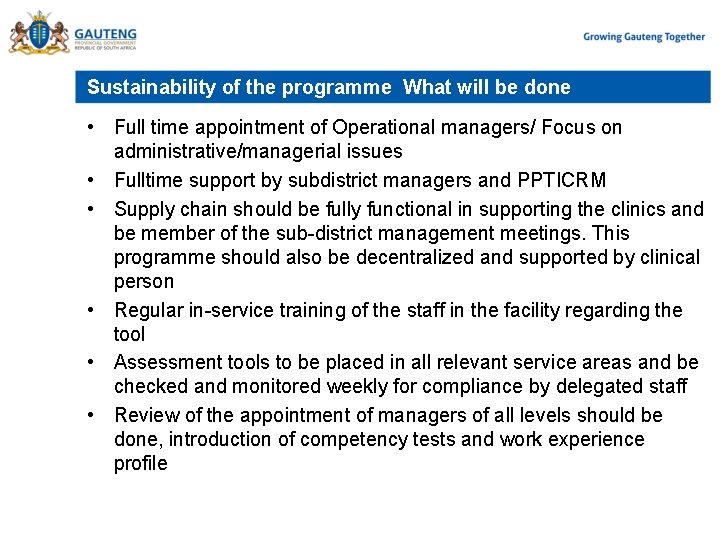
Sustainability of the programme What will be done • Full time appointment of Operational managers/ Focus on administrative/managerial issues • Fulltime support by subdistrict managers and PPTICRM • Supply chain should be fully functional in supporting the clinics and be member of the sub-district management meetings. This programme should also be decentralized and supported by clinical person • Regular in-service training of the staff in the facility regarding the tool • Assessment tools to be placed in all relevant service areas and be checked and monitored weekly for compliance by delegated staff • Review of the appointment of managers of all levels should be done, introduction of competency tests and work experience profile
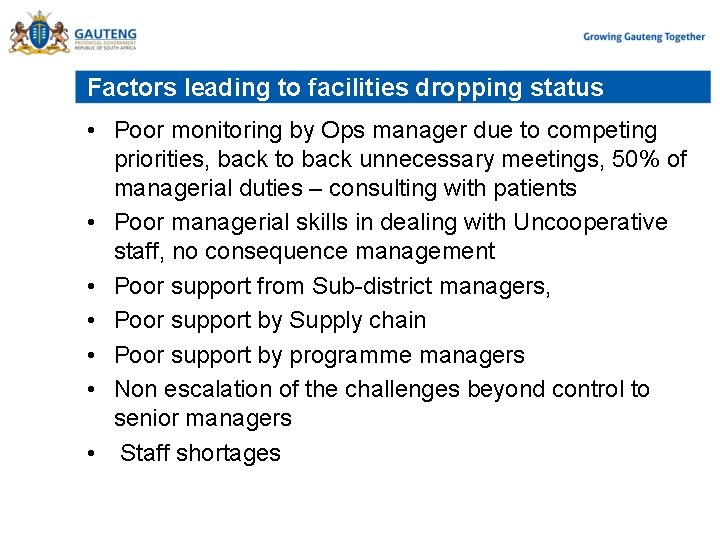
Factors leading to facilities dropping status • Poor monitoring by Ops manager due to competing priorities, back to back unnecessary meetings, 50% of managerial duties – consulting with patients • Poor managerial skills in dealing with Uncooperative staff, no consequence management • Poor support from Sub-district managers, • Poor support by Supply chain • Poor support by programme managers • Non escalation of the challenges beyond control to senior managers • Staff shortages
Role of Clinic Supervisors – Area managers • Must be a member of the District PPTICRM • Must have a monthly schedule of clinics that she/he supervises, signed by the sub-district manager and adhere to the schedule • To utilize the ideal clinic tool when doing support visits, select components to focus on specific visits • Work together as a team with programme managers and support staff in supporting the clinics • To assist the clinic in fast racking the acquirement of equipment ordered • To have a meeting with the clinic staff in correcting the challenges on regular basis, eg staffing and equipment • Identify challenges that are beyond the clinic managers scope and assist clinic to be compliant • Give report to sub-district manager on a monthly basis • Advocate for the clinics
Key lessons learnt • • • • Ops managers afraid to reprimand staff and do consequence management Poor supervisory and monitoring skills Rotation of ops managers interrupts the continuity of managerial pattern Disturbance of focus of Ops managers on managerial and supervisory duties Lack of detailed understating of the requirements of the tool by other staff members making them to faulter during assessments No regular In-service training Poor support by District managers, sub-district managers, and programme managers Lack of objective self assessment and QIP implementations Relinguishing of continuous monitoring by Ops managers Procastination Poor holding of staff meetings Facilities without an Appointed Ops managers poses poor performance Need of more staffing at operational level instead of district and Provincial level Failure of Ops managers in escalation of challenges to immediate superviser
Critical Role Players • All clinic staff members • District, sub-district, programme and supply chain managers • PPTICRM • Provincial team • HIS • PHC committee
How ensure objectivity in assessments • Baseline Self Determination to be conducted strictly by PPTICRM of sister district and not Ops manager and or District PPTICRM • Peer Review assessment to be done by Province to avoid subjectivity
Relationship Ideal Clinic and OHSC • They are the same quality improvement tools that prepares the clinics for NHI roll-out • Ideal clinic tool is appropriate quality preparation of clinics for OHSC inspection • The difference is ICRM has a detailed manual that gives guidance when doing assessment whereas the OHSC does not have • The OHSC inspectors triangulate the SOPs • The measures in OHSC are aligned to elements in the ICRM tool, however the version 18 used to prepare the clinics for inspection did not have changes made. • The OHSC tool does not have weightings such as eg NNVs, essentials etc, they only identified on the report after assessment
Relationship Ideal clinic and NHI • It’s a good tool to use in preparation for NHI roll-out. • The tool has made strides in terms of quality improvement when comparing the period prior its inception •
Thank you
- Slides: 15