
Idea Generation and Evaluation for New Venture Creation

- Slides: 35
Idea Generation and Evaluation for New Venture Creation
Idea Generation and Evaluation Ÿ Identifying and evaluating new ideas Ÿ Avoiding the wrong ideas Ÿ Some interesting trends and ideas Ÿ Using brainstorming to generate ideas
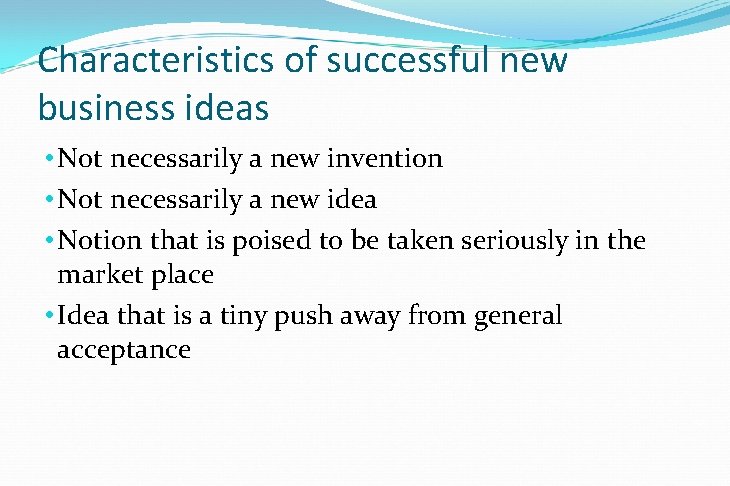
Characteristics of successful new business ideas • Not necessarily a new invention • Not necessarily a new idea • Notion that is poised to be taken seriously in the market place • Idea that is a tiny push away from general acceptance
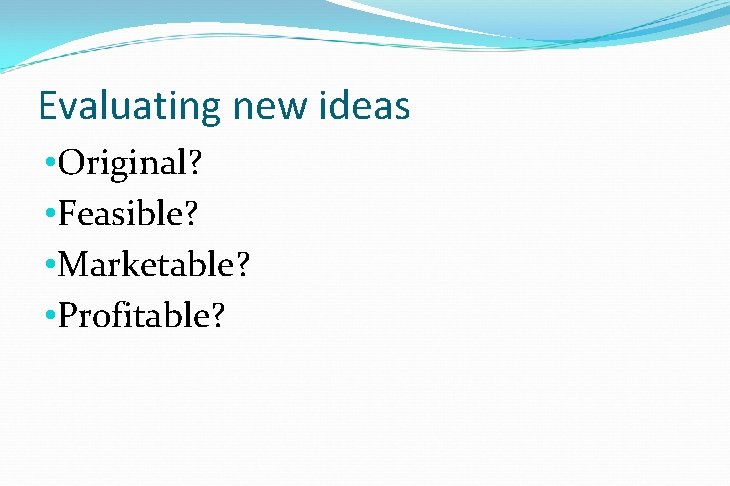
Evaluating new ideas • Original? • Feasible? • Marketable? • Profitable?
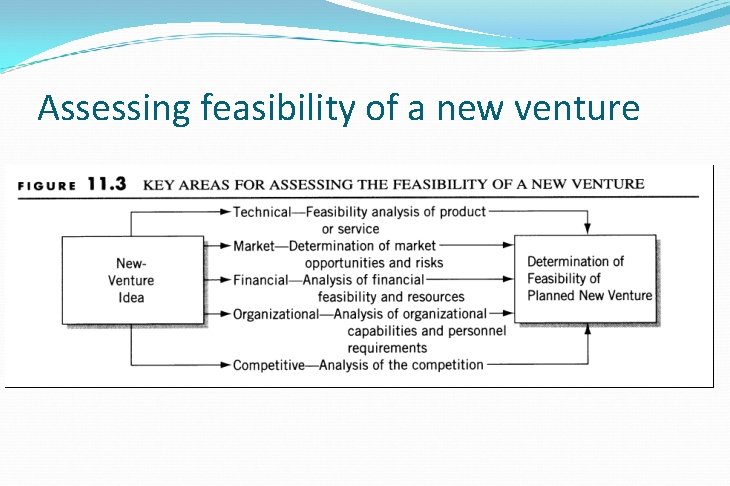
Assessing feasibility of a new venture
Analyze strengths and weaknesses 1. Is the venture proprietary? 2. Are the initial production costs realistic? 3. Are the initial marketing costs realistic? 4. Does the product have potential for high margins? 5. Is the time required to get to the market and to reach the break-even point realistic?
Look at both internal and external factors • Is the potential market large? • Is the product the first of a growing family? • Does an initial customer exist? • Are the development costs and calendar times realistic? • Is this a growing industry? • Can the product and the need for it be understood by the financial community?
Evaluate technical feasibility • Functional design and attractiveness • Flexibility, durability, reliability • Product safety • Ease and low cost of maintenance • Ease of processing and manufacturing • User friendliness
Evaluate marketability • Investigate the full market potential and identifying customers • Analyzing the extent to which the potential market can be exploited • Determine opportunities and risks • Information sources include - General economic trends - Market data - Pricing data - Competitive data
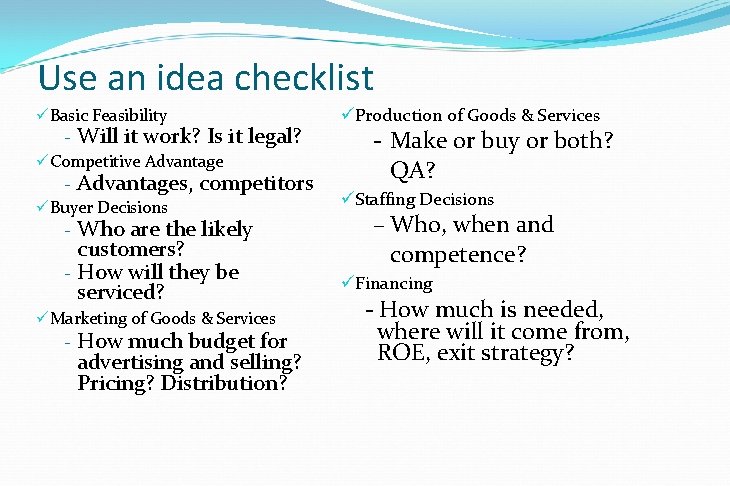
Use an idea checklist ü Basic Feasibility - Will it work? Is it legal? ü Competitive Advantage - Advantages, competitors ü Buyer Decisions - Who are the likely customers? - How will they be serviced? ü Marketing of Goods & Services - How much budget for advertising and selling? Pricing? Distribution? üProduction of Goods & Services - Make or buy or both? QA? üStaffing Decisions – Who, when and competence? üFinancing - How much is needed, where will it come from, ROE, exit strategy?
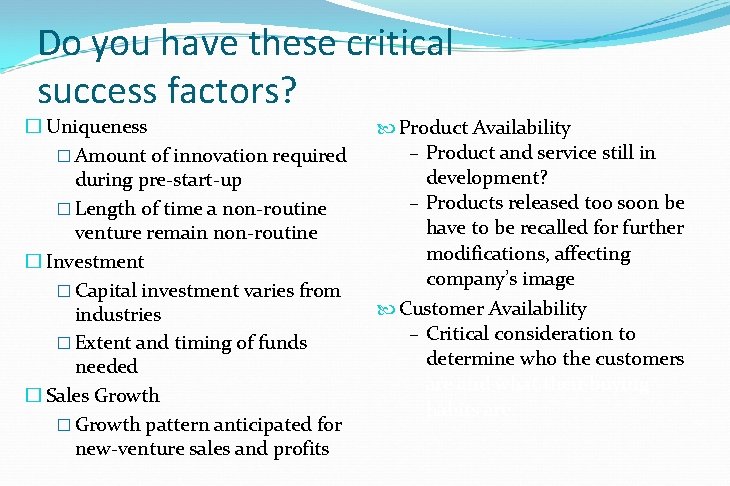
Do you have these critical success factors? � Uniqueness � Amount of innovation required during pre-start-up � Length of time a non-routine venture remain non-routine � Investment � Capital investment varies from industries � Extent and timing of funds needed � Sales Growth � Growth pattern anticipated for new-venture sales and profits Product Availability – Product and service still in development? – Products released too soon be have to be recalled for further modifications, affecting company’s image Customer Availability – Critical consideration to determine who the customers are and what their buying habits are.
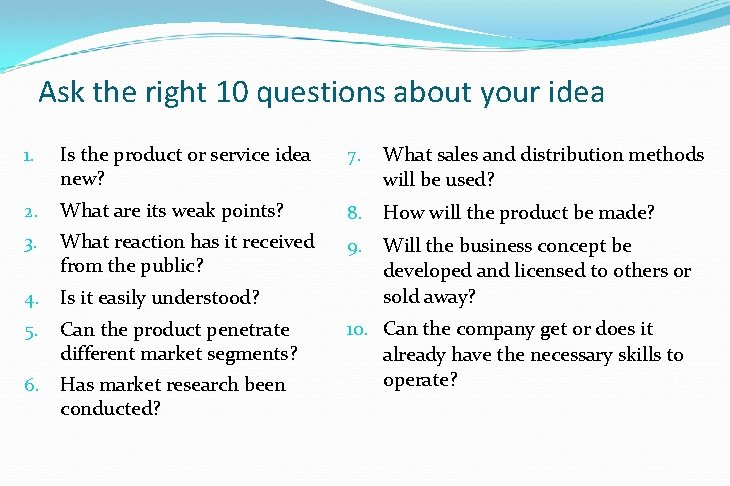
Ask the right 10 questions about your idea 1. Is the product or service idea new? 7. What sales and distribution methods will be used? 2. What are its weak points? 8. How will the product be made? 3. What reaction has it received from the public? 9. 4. Is it easily understood? Will the business concept be developed and licensed to others or sold away? 5. Can the product penetrate different market segments? 6. Has market research been conducted? 10. Can the company get or does it already have the necessary skills to operate?
Idea generation and evaluation Ÿ Identifying and evaluating new ideas Ÿ Avoiding the wrong ideas Ÿ Some interesting trends and ideas Ÿ Using brainstorming to generate ideas
Pitfalls in selecting new ventures • Pitfalls • Ways to avoid • Lack of objective • Subject all ideas to evaluation • No real insight into the market • Inadequate understanding of technical requirements rigorous study and investigation • Project the life cycle of the product; timing is critical • Study the project thoroughly before initiating it
More pitfalls in selecting new ventures • Pitfalls • Ways to avoid • Poor financial understanding • Do not underestimate • Lack of venture uniqueness • Ignorance of legal issues development costs • Ensure customer awareness of product superiority through product differentiation • Patents, trademarks and copyrights to protect one’s inventions
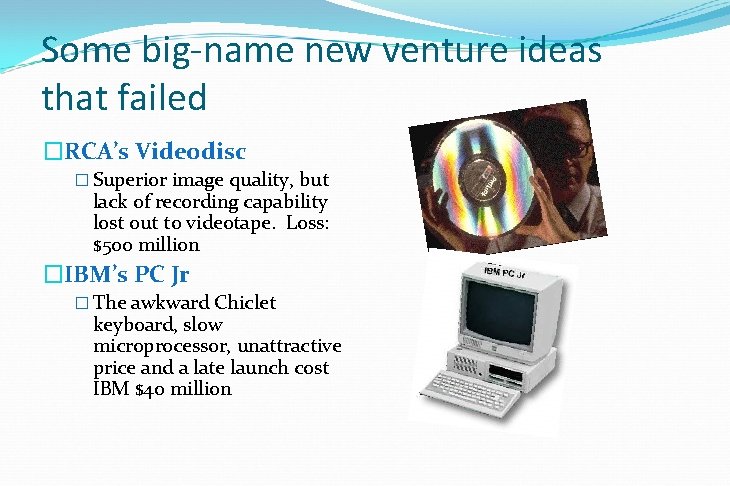
Some big-name new venture ideas that failed �RCA’s Videodisc � Superior image quality, but lack of recording capability lost out to videotape. Loss: $500 million �IBM’s PC Jr � The awkward Chiclet keyboard, slow microprocessor, unattractive price and a late launch cost IBM $40 million
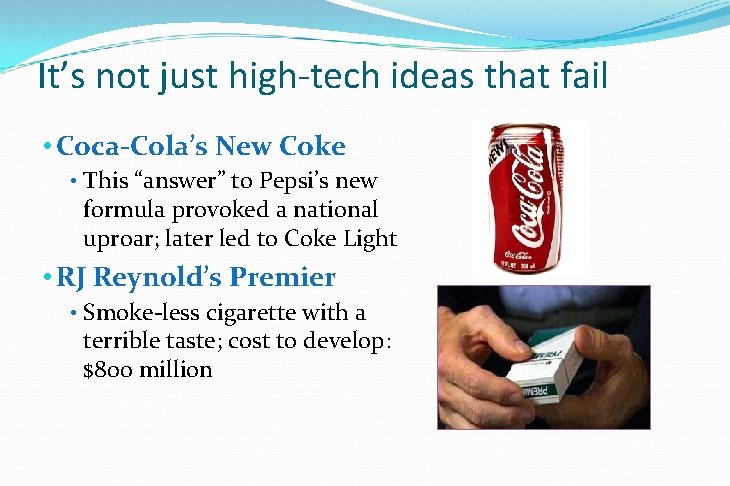
It’s not just high-tech ideas that fail • Coca-Cola’s New Coke • This “answer” to Pepsi’s new formula provoked a national uproar; later led to Coke Light • RJ Reynold’s Premier • Smoke-less cigarette with a terrible taste; cost to develop: $800 million
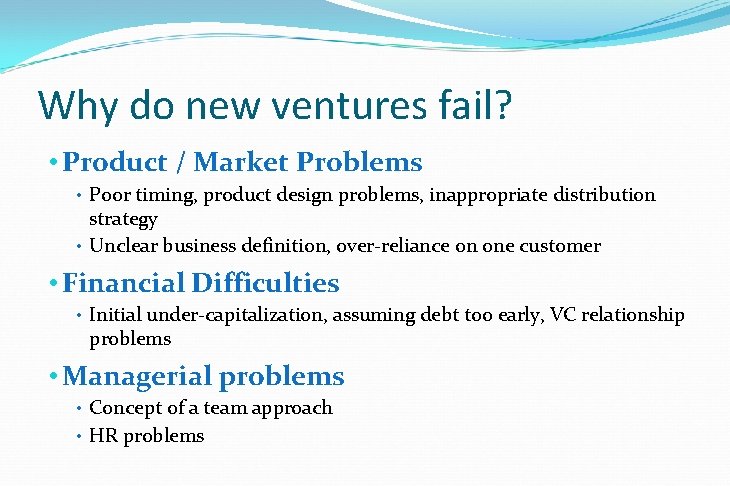
Why do new ventures fail? • Product / Market Problems • Poor timing, product design problems, inappropriate distribution strategy • Unclear business definition, over-reliance on one customer • Financial Difficulties • Initial under-capitalization, assuming debt too early, VC relationship problems • Managerial problems • Concept of a team approach • HR problems
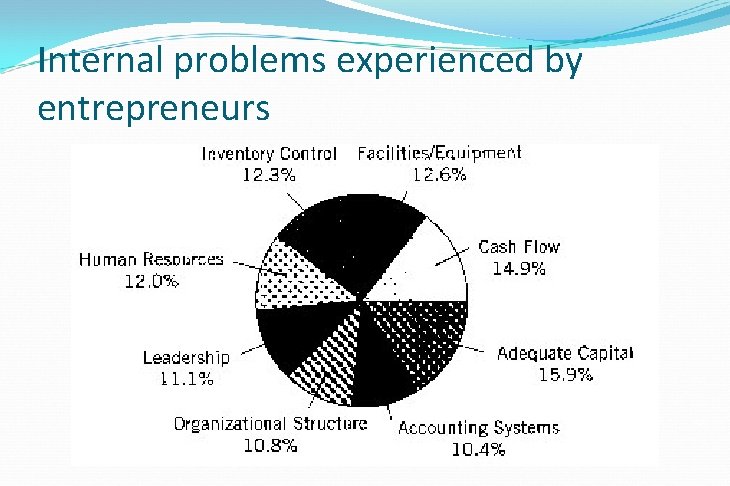
Internal problems experienced by entrepreneurs
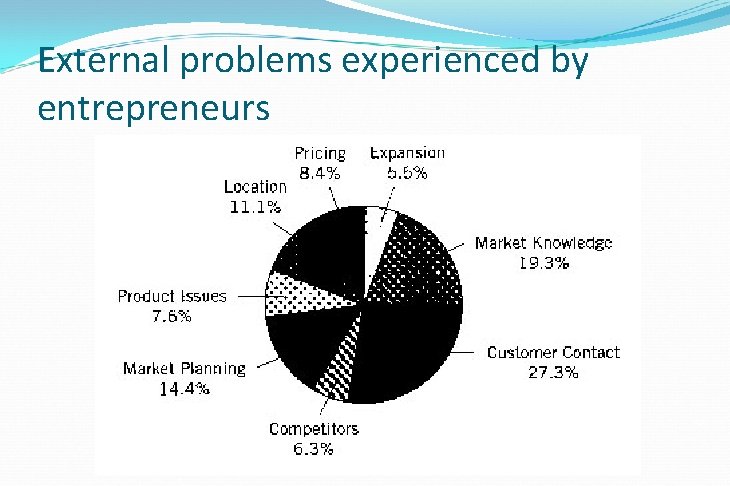
External problems experienced by entrepreneurs
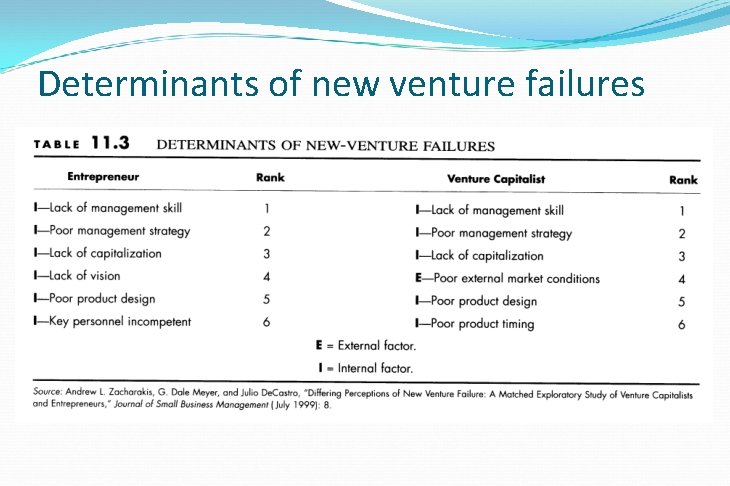
Determinants of new venture failures
Idea generation and evaluation Ÿ Identifying and evaluating new ideas Ÿ Avoiding the wrong ideas Ÿ Some interesting trends and ideas Ÿ Using brainstorming to generate ideas
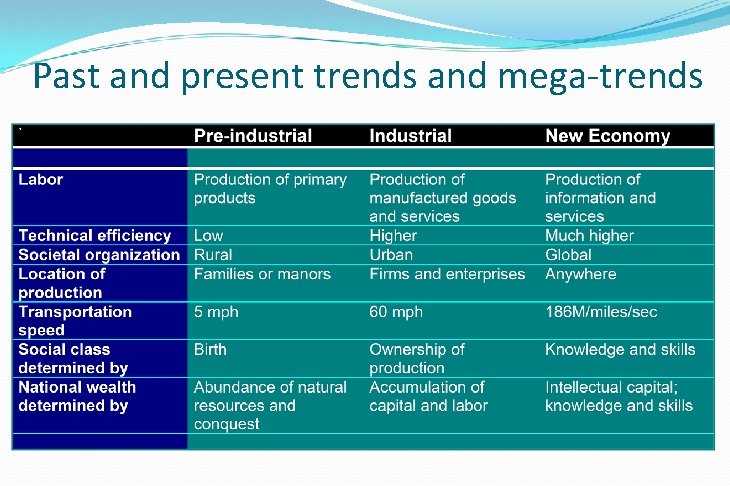
Past and present trends and mega-trends
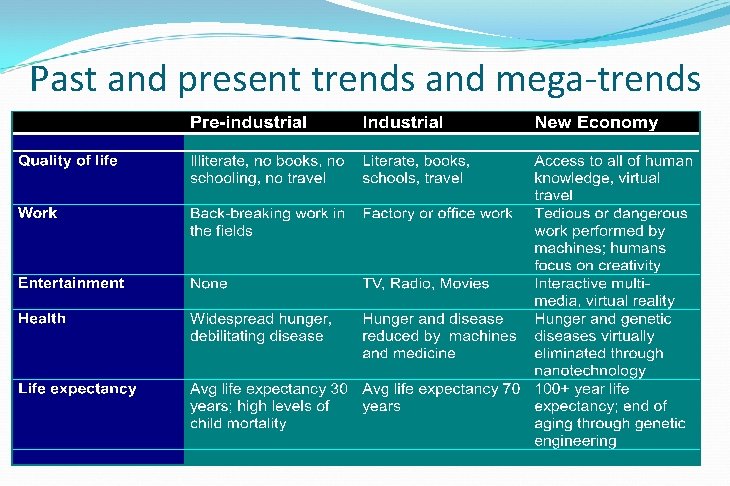
Past and present trends and mega-trends
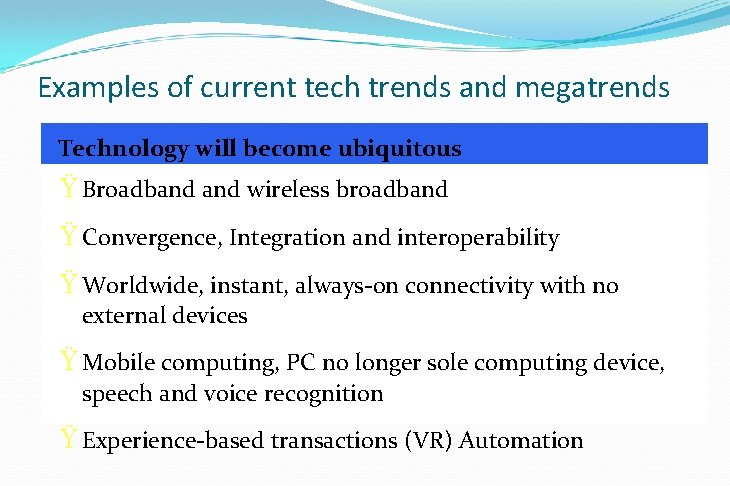
Examples of current tech trends and megatrends Technology will become ubiquitous Ÿ Broadband wireless broadband Ÿ Convergence, Integration and interoperability Ÿ Worldwide, instant, always-on connectivity with no external devices Ÿ Mobile computing, PC no longer sole computing device, speech and voice recognition Ÿ Experience-based transactions (VR) Automation
Examples of current tech trends and megatrends Computers will move beyond silicon chips Ÿ 20 -ghz nano-silicon chips with 1 billion transistors Ÿ 3 -dimensional chips Ÿ Optical computers Ÿ DNA computers Ÿ Nanotube computers Ÿ Quantum computing
Examples of current tech trends and megatrends Technology and biology will merge • Micro-machines and Nano-technology • Biometric security • Bio-informatics • Exponential growth of machine intelligence leads to intelligent, conscious (? ) machines • Neural implants to extend human intellectual capability • Merging of human and machine intelligence creates substrate-independent minds
Products that could be • Snap. Flat screen • A detachable, interchangeable flat panel that you can move from gadget to gadget. • The I-Podule • A digital camera with an i. Pod slot: you could take thousands of pictures without running out of film and slip the i. Pod into your computer to transfer them. Then you'd snap the i. Pod into a camcorder for capturing video, from there to your cellphone to send files or photos to a friend, and maybe even into a cash machine for a quick download of your statement.
Idea generation and evaluation Ÿ Identifying and evaluating new ideas Ÿ Avoiding the wrong ideas Ÿ Some interesting trends and ideas Ÿ Using brainstorming to generate ideas
Brainstorming - no criticism • Designed to produce as many ideas as possible • Key ground rule: Postpone all criticism and evaluation of ideas • Invent ideas with no fear of looking foolish • Wild ideas are explicitly encouraged
Before brainstorming • Define your purpose • Choose the right number of participants • Change the environment • Design an informal atmosphere • Choose a facilitator
During brainstorming • Seat the participants side by side facing the problem • Clarify the ground rules, especially the no-criticism rule • Brainstorm • Record the ideas in full view
After brainstorming • Star the most promising ideas • Invent improvements for promising ideas • Set up a time to evaluate ideas and decide
Brainstorming tips • Allow enough time to get below the surface of your thinking • 20 -30 participants are ideal. Large but not too large group • Divide the group into teams of four to six people for more diverse thought and to dilute the impact of those who know all the answers • Invite a wide variety of people to participate and go outside the core group • Do a warm-up mental exercise to break the ice • Brainstorm in bursts
Brainstorming tips • Have everyone write their own ideas on sticky notes • People should stand while ideating • Push for quantity and you will get quality • Distill the output periodically