
IDEA for a measurement of the Pion Structure


- Slides: 25
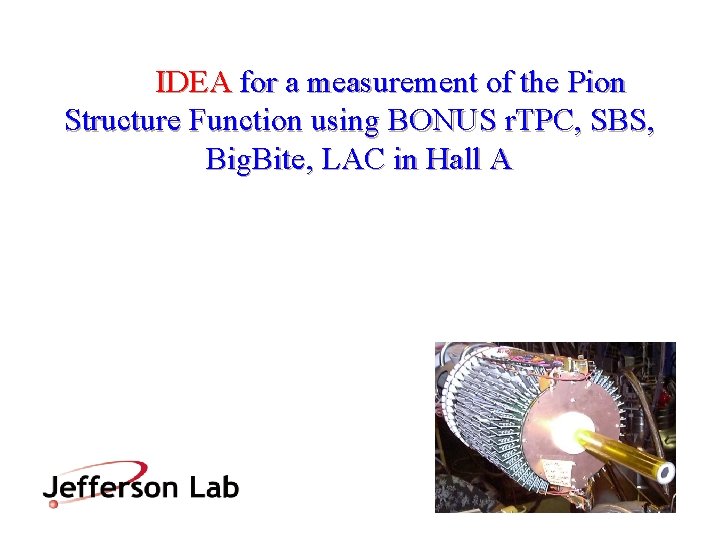
IDEA for a measurement of the Pion Structure Function using BONUS r. TPC, SBS, Big. Bite, LAC in Hall A
Motivation in a Nutshell • Pion is the simplest hadron with only two valence quarks. – • Knowledge of the pion structure function is very limited due to the lack of stable pion target. – – • theory predictions, QCD testing ground some Drell-Yan data at large x and HERA, ZEUS data at low x compare to 5+ orders of magnitude in x, Q 2 measurements of nucleon structure function at DESY, SLAC, NMC, BCDMS, JLab, …. Many questions, for instance what is the origin of the d(bar) – u(bar) flavor asymmetry? – asymmetry in anti-quarks generated from pion valence distribution? • The pion exchange (Sullivan) process can be used to measure the pion structure function. • The JLab 12 Ge. V upgrade allows phase space for |t| <0. 2, Q 2 > 1 and Mx>1. 0 and enables us to measure the pion structure function in the valence and intermediate xp region.
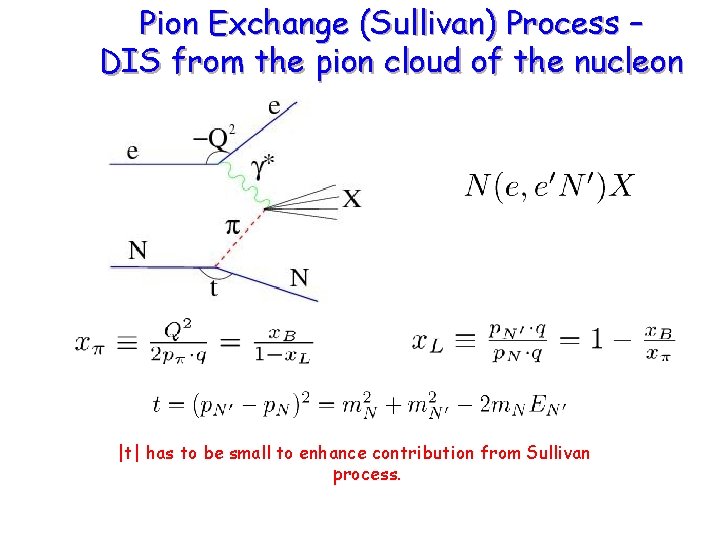
Pion Exchange (Sullivan) Process – DIS from the pion cloud of the nucleon |t| has to be small to enhance contribution from Sullivan process.
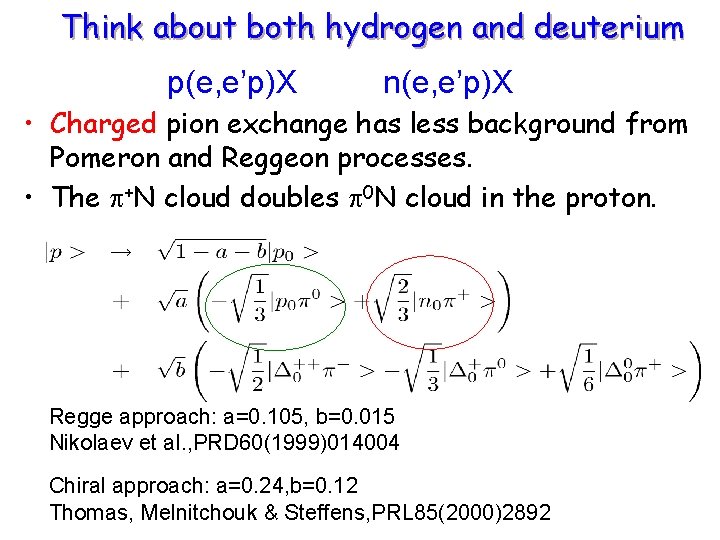
Think about both hydrogen and deuterium p(e, e’p)X n(e, e’p)X • Charged pion exchange has less background from Pomeron and Reggeon processes. • The p+N cloud doubles p 0 N cloud in the proton. Regge approach: a=0. 105, b=0. 015 Nikolaev et al. , PRD 60(1999)014004 Chiral approach: a=0. 24, b=0. 12 Thomas, Melnitchouk & Steffens, PRL 85(2000)2892
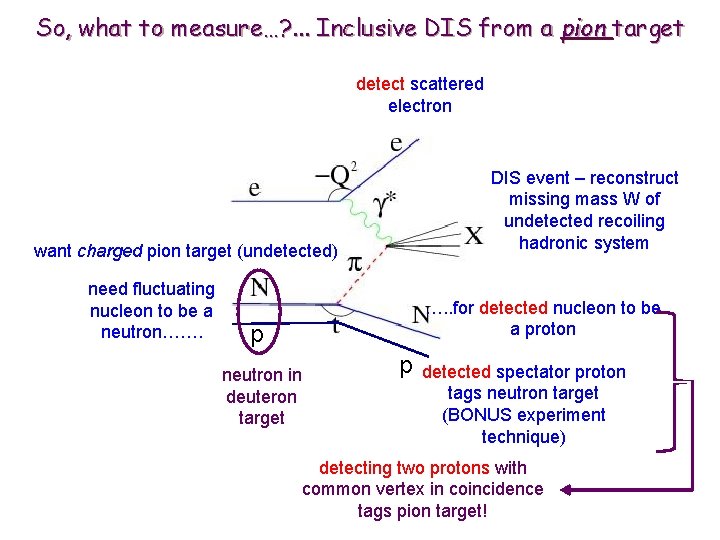
So, what to measure…? . . . Inclusive DIS from a pion target detect scattered electron DIS event – reconstruct missing mass W of undetected recoiling hadronic system want charged pion target (undetected) need fluctuating nucleon to be a neutron……. …. . for detected nucleon to be a proton p neutron in deuteron target p detected spectator proton tags neutron target (BONUS experiment technique) detecting two protons with common vertex in coincidence tags pion target!
First, how to detect high E electrons (so as to get to high W, Q 2 DIS kinematics)?
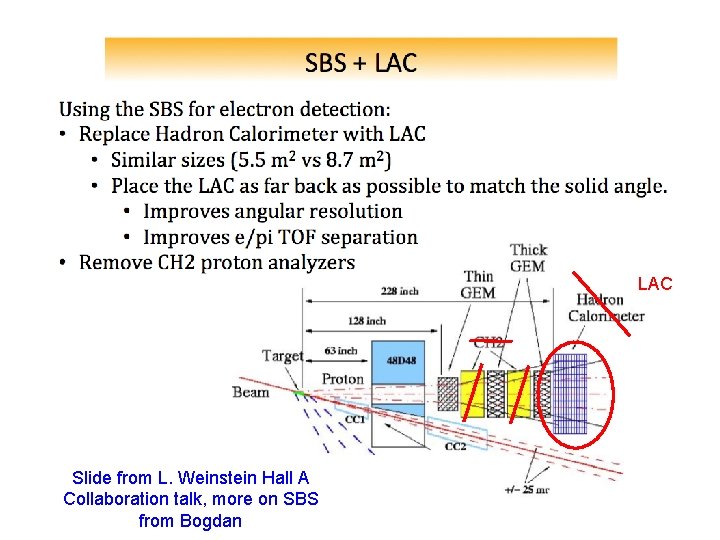
LAC Slide from L. Weinstein Hall A Collaboration talk, more on SBS from Bogdan
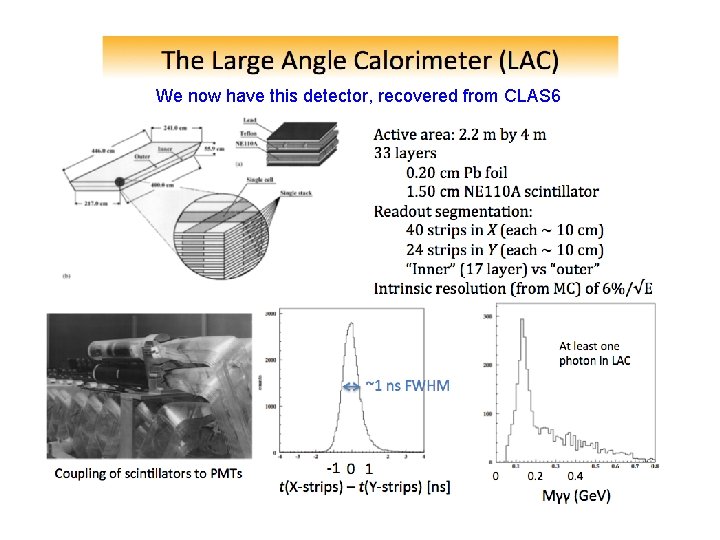
We now have this detector, recovered from CLAS 6
Can also use Big. Bite for additional electron detection Next, how to detect protons?
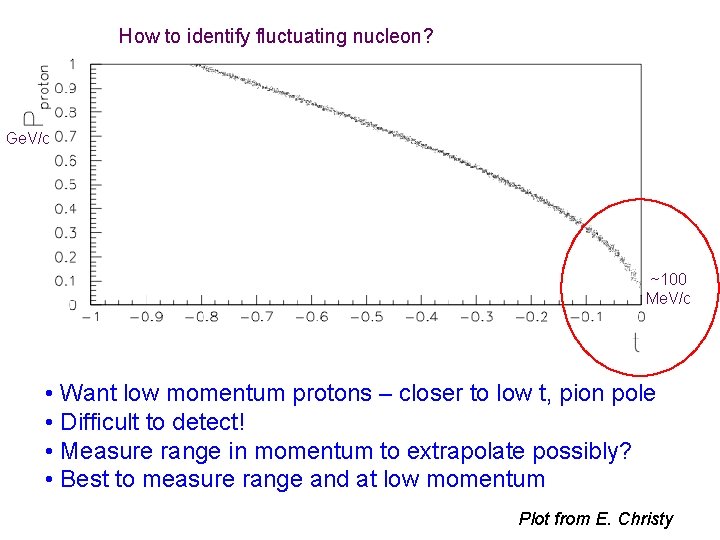
How to identify fluctuating nucleon? ? Ge. V/c ~100 Me. V/c • Want low momentum protons – closer to low t, pion pole • Difficult to detect! • Measure range in momentum to extrapolate possibly? • Best to measure range and at low momentum Plot from E. Christy
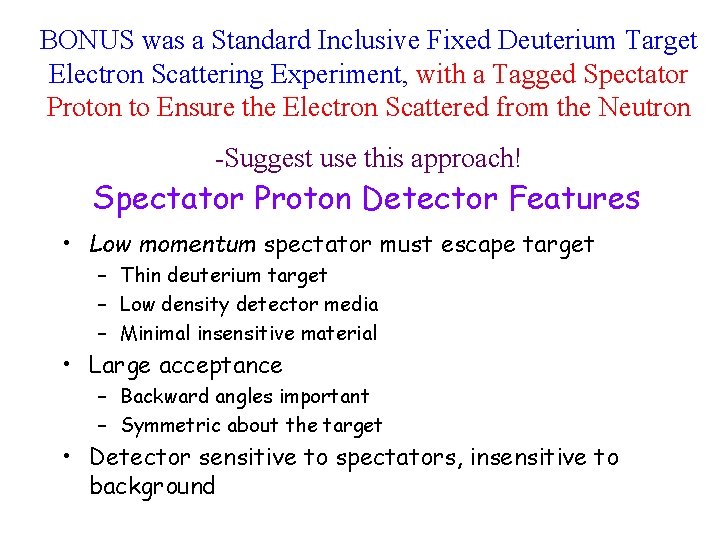
BONUS was a Standard Inclusive Fixed Deuterium Target Electron Scattering Experiment, with a Tagged Spectator Proton to Ensure the Electron Scattered from the Neutron -Suggest use this approach! Spectator Proton Detector Features • Low momentum spectator must escape target – Thin deuterium target – Low density detector media – Minimal insensitive material • Large acceptance – Backward angles important – Symmetric about the target • Detector sensitive to spectators, insensitive to background
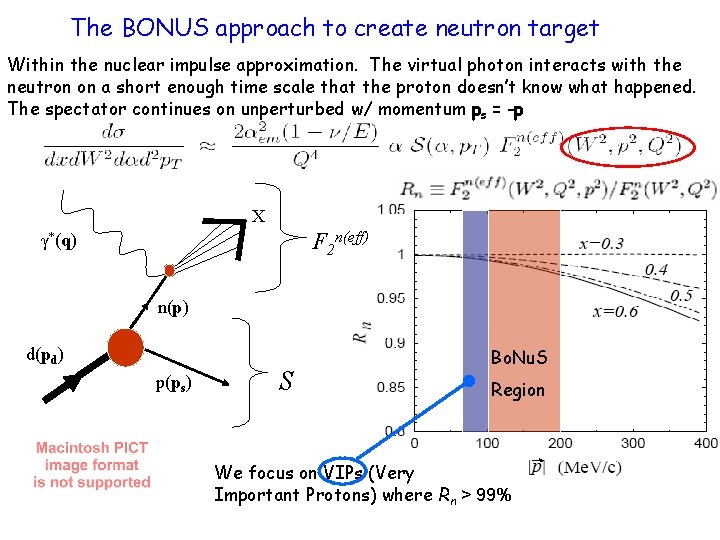
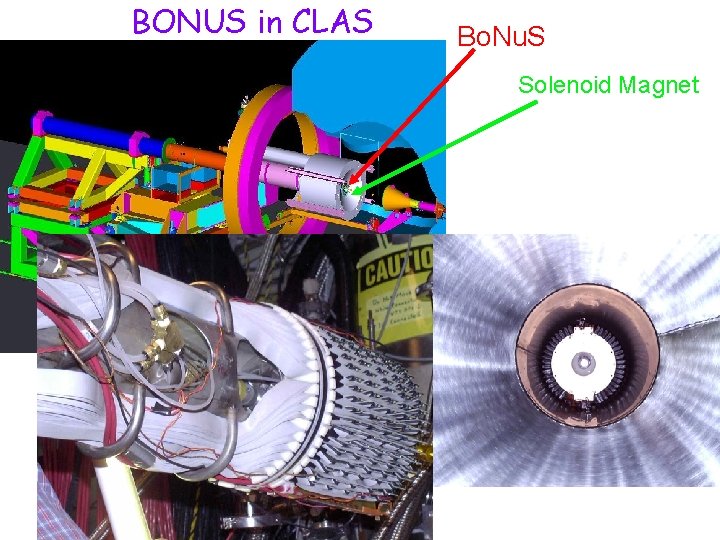
The BONUS approach to create neutron target Within the nuclear impulse approximation. The virtual photon interacts with the neutron on a short enough time scale that the proton doesn’t know what happened. The spectator continues on unperturbed w/ momentum ps = -p X F 2 n(eff) γ*(q) n(p) d(pd) p(ps) S Bo. Nu. S Region We focus on VIPs (Very Important Protons) where Rn > 99%
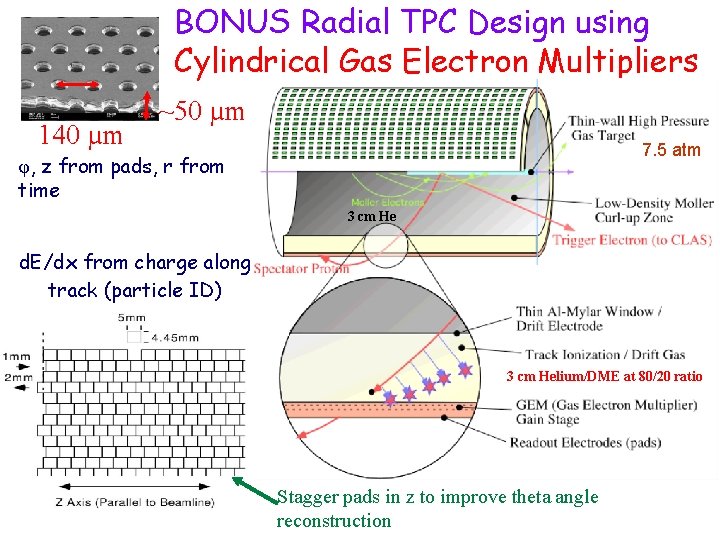
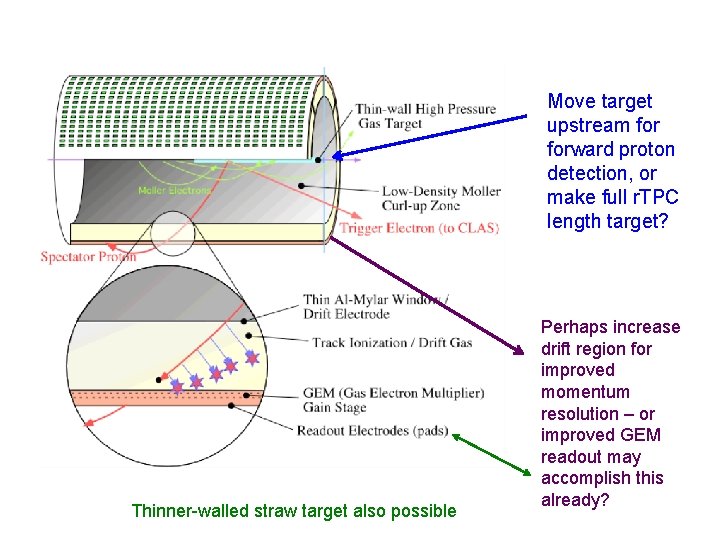
BONUS Radial TPC Design using Cylindrical Gas Electron Multipliers 140 µm ~50 µm 7. 5 atm φ, z from pads, r from time 3 cm He d. E/dx from charge along track (particle ID) 3 cm Helium/DME at 80/20 ratio Stagger pads in z to improve theta angle reconstruction
BONUS in CLAS Bo. Nu. S Solenoid Magnet
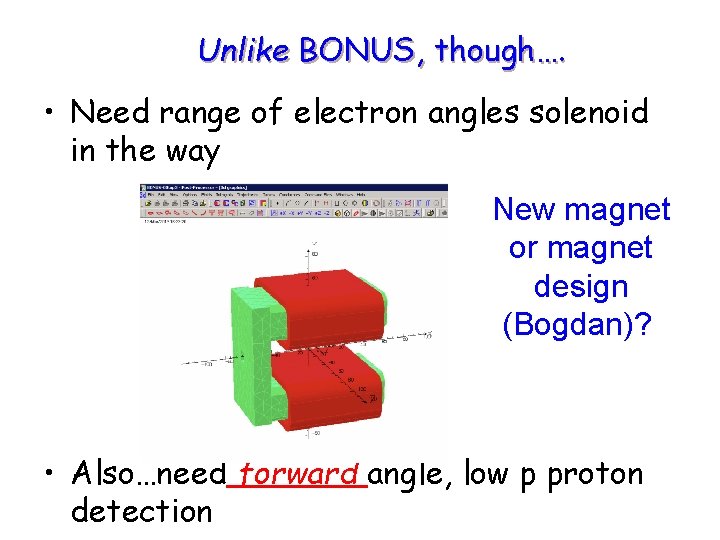
Unlike BONUS, though…. • Need range of electron angles solenoid in the way New magnet or magnet design (Bogdan)? • Also…need forward angle, low p proton detection
Move target upstream forward proton detection, or make full r. TPC length target? Thinner-walled straw target also possible Perhaps increase drift region for improved momentum resolution – or improved GEM readout may accomplish this already?
CLAS 12 has much larger acceptance – we will need higher current! – instrument to get beam through straw (Arne guesstimates 3 mm over 20 cm OK) - collimate BUT, one potential major plus using SBS++ as compared to CLAS 12…. (besides running a lot earlier)…
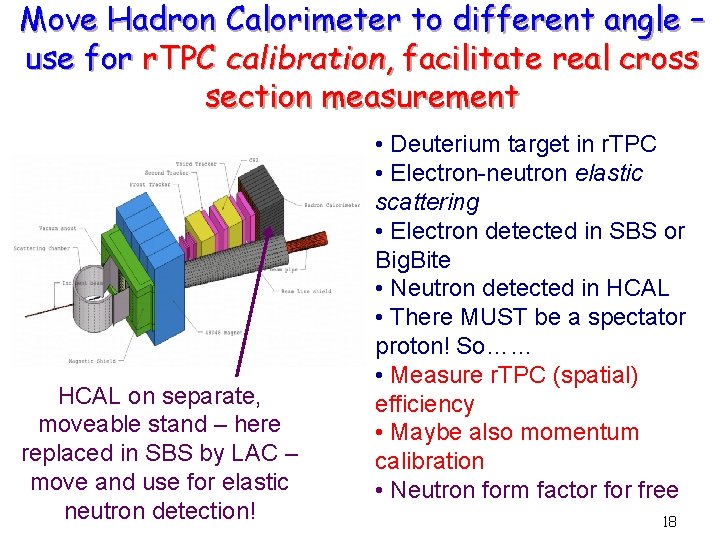
Move Hadron Calorimeter to different angle – use for r. TPC calibration, facilitate real cross section measurement HCAL on separate, moveable stand – here replaced in SBS by LAC – move and use for elastic neutron detection! 10/13/2011 • Deuterium target in r. TPC • Electron-neutron elastic scattering • Electron detected in SBS or Big. Bite • Neutron detected in HCAL • There MUST be a spectator proton! So…… • Measure r. TPC (spatial) efficiency • Maybe also momentum calibration • Neutron form factor free 18
Other (potential) pluses • Actually get F 2 n/F 2 p for free if make full length target for deuterium run – Pion structure function requires one forward angle + one backward angle proton – F 2 n requires just one backward angle proton – Maps Sullivan contribution to F 2 n • Raising current might mean don’t need 7. 5 atm target –> maybe push down minimum momentum measureable in r. TPC, get closer to pole!
Conclusion: Lots of work to do, but this could be an exciting program for SBS: • Deuteron target pi- structure function • Proton target pi 0 structure function • Deuteron target F 2 n • Detect also pion to measure pion form factor at pole (excellent complement to Hall C L/T) • DVCS (detecting proton in coincidence should remove ~15% background from (e, e’D)g, (e, e’p)g, …) • Helium target SRC experiments? • Look for Lambda -> p pi- decay to measure p -> K+ Lambda kaon cloud of the nucleon? ?
Other Useful Slides
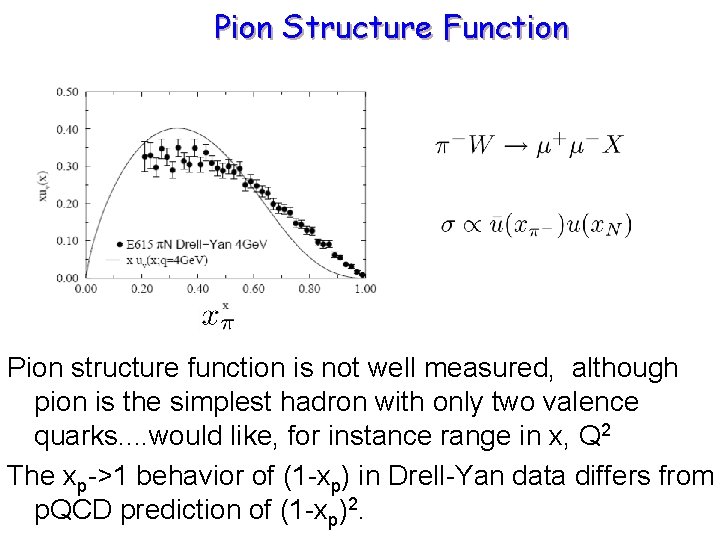
Pion Structure Function Pion structure function is not well measured, although pion is the simplest hadron with only two valence 2 FThe xp->1 behavior of (1 -x data differs from in p. QCD prediction of (1 quarks. . would like, for instance range x, Q p) in Drell-Yan xp)2. The xp->1 behavior of (1 -xp) in Drell-Yan data differs from p. QCD prediction of (1 -xp)2.
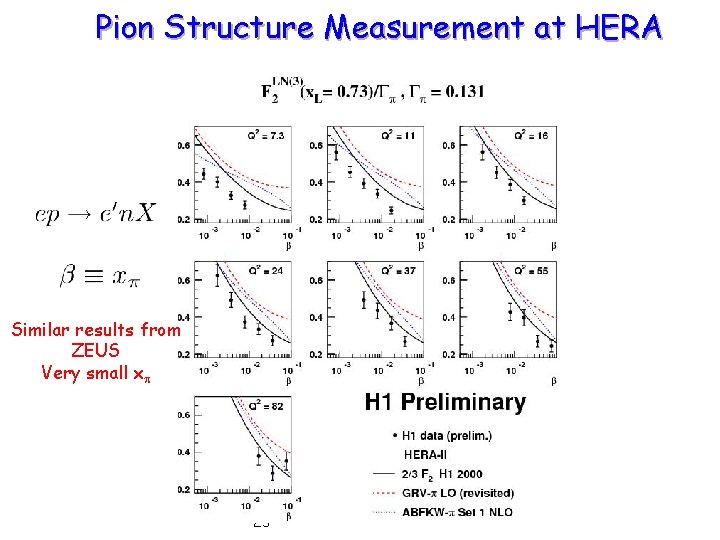
Pion Structure Measurement at HERA Similar results from ZEUS Very small xp 23
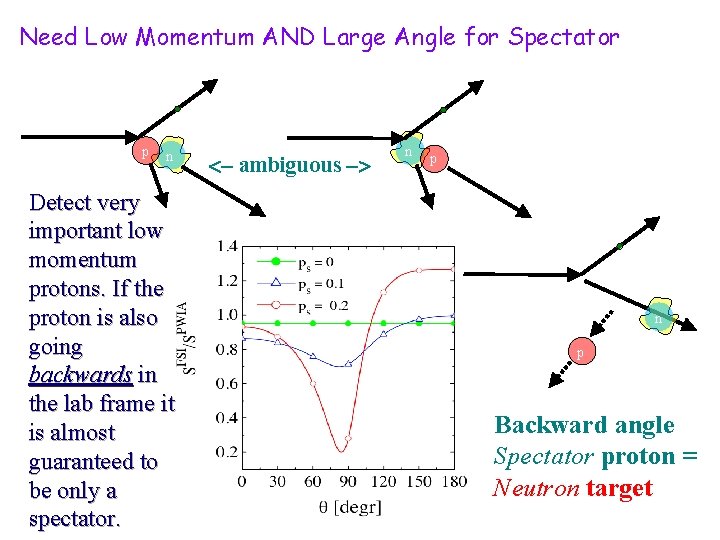
Need Low Momentum AND Large Angle for Spectator e p n Detect very important low momentum protons. If the proton is also going backwards in the lab frame it is almost guaranteed to be only a spectator. e ambiguous e- n p e n e- p Backward angle Spectator proton = Neutron target
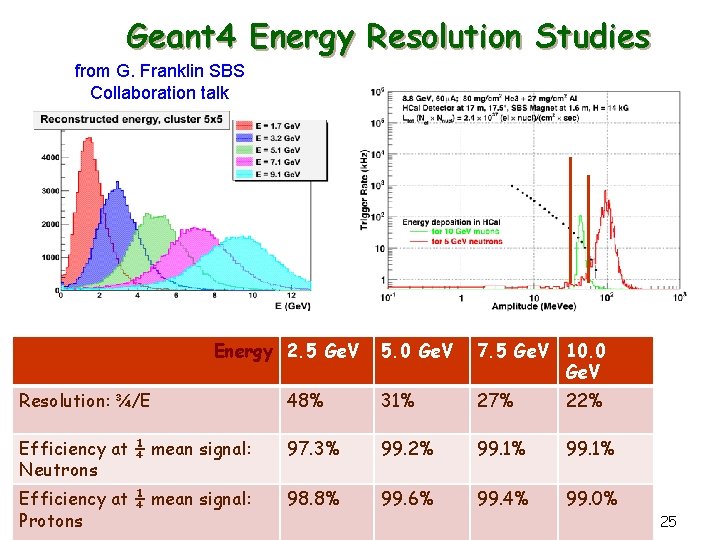
Geant 4 Energy Resolution Studies from G. Franklin SBS Collaboration talk ¼ signal thresh. ½ signal thresh. Energy 2. 5 Ge. V 5. 0 Ge. V 7. 5 Ge. V 10. 0 Ge. V Resolution: ¾/E 48% 31% 27% 22% Efficiency at ¼ mean signal: Neutrons 97. 3% 99. 2% 99. 1% Efficiency at ¼ mean signal: Protons 98. 8% 99. 6% 99. 4% 99. 0% 25