
IDEA and FERPA Privacy Provisions Understanding the Basics
IDEA and FERPA Privacy Provisions — Understanding the Basics CEC DIVISION FOR EARLY CHILDHOOD'S ANNUAL INTERNATIONAL CONFERENCE ON YOUNG CHILDREN WITH SPECIAL NEEDS AND THEIR FAMILIES October 9, 2015 Ross Lemke, IDC Sharon Walsh, Da. Sy
Some Questions for You 2
Different Laws, Similar Rules IDEA Part C IDEA Part B FERPA Who? When? What?
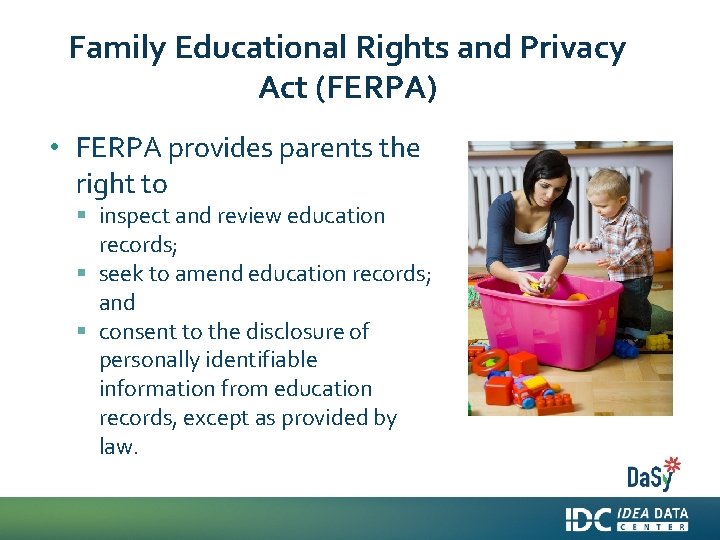
Family Educational Rights and Privacy Act (FERPA) • FERPA provides parents the right to § inspect and review education records; § seek to amend education records; and § consent to the disclosure of personally identifiable information from education records, except as provided by law.

Part B of the Individuals with Disabilities Education Act (IDEA) § 300. 610 Confidentiality of Information “The Secretary takes appropriate action, in accordance with section 444 of GEPA [FERPA], to ensure the protection of the confidentiality of any personally identifiable data, information, and records collected or maintained by the Secretary and by SEAs and LEAs pursuant to Part B of the Act, and consistent with §§ 300. 611 through 300. 627. ”
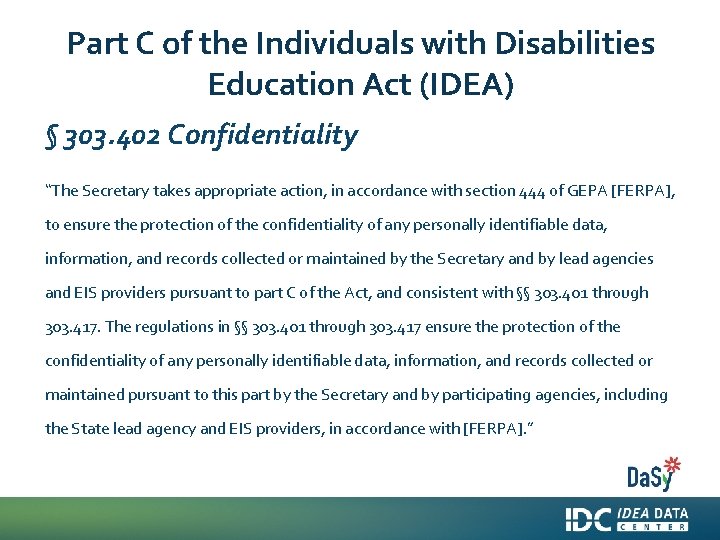
Part C of the Individuals with Disabilities Education Act (IDEA) § 303. 402 Confidentiality “The Secretary takes appropriate action, in accordance with section 444 of GEPA [FERPA], to ensure the protection of the confidentiality of any personally identifiable data, information, and records collected or maintained by the Secretary and by lead agencies and EIS providers pursuant to part C of the Act, and consistent with §§ 303. 401 through 303. 417. The regulations in §§ 303. 401 through 303. 417 ensure the protection of the confidentiality of any personally identifiable data, information, and records collected or maintained pursuant to this part by the Secretary and by participating agencies, including the State lead agency and EIS providers, in accordance with [FERPA]. ”
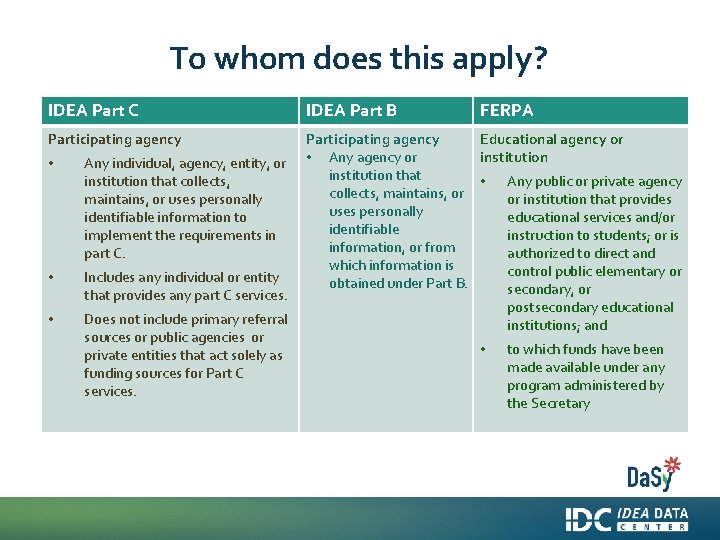
To whom does this apply? IDEA Part C IDEA Part B Participating agency Educational agency or • Any agency or institution that • Any public or private agency collects, maintains, or or institution that provides uses personally educational services and/or identifiable instruction to students; or is information, or from authorized to direct and which information is control public elementary or obtained under Part B. secondary, or postsecondary educational institutions; and • Any individual, agency, entity, or institution that collects, maintains, or uses personally identifiable information to implement the requirements in part C. • Includes any individual or entity that provides any part C services. • Does not include primary referral sources or public agencies or private entities that act solely as funding sources for Part C services. FERPA • to which funds have been made available under any program administered by the Secretary
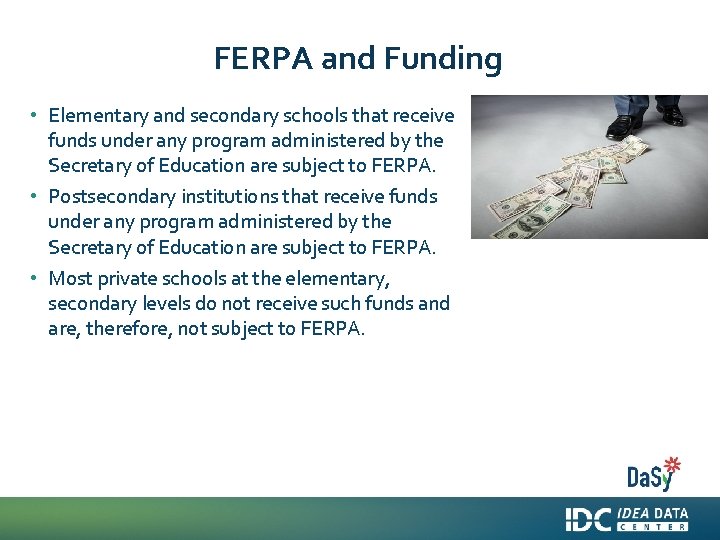
FERPA and Funding • Elementary and secondary schools that receive funds under any program administered by the Secretary of Education are subject to FERPA. • Postsecondary institutions that receive funds under any program administered by the Secretary of Education are subject to FERPA. • Most private schools at the elementary, secondary levels do not receive such funds and are, therefore, not subject to FERPA.
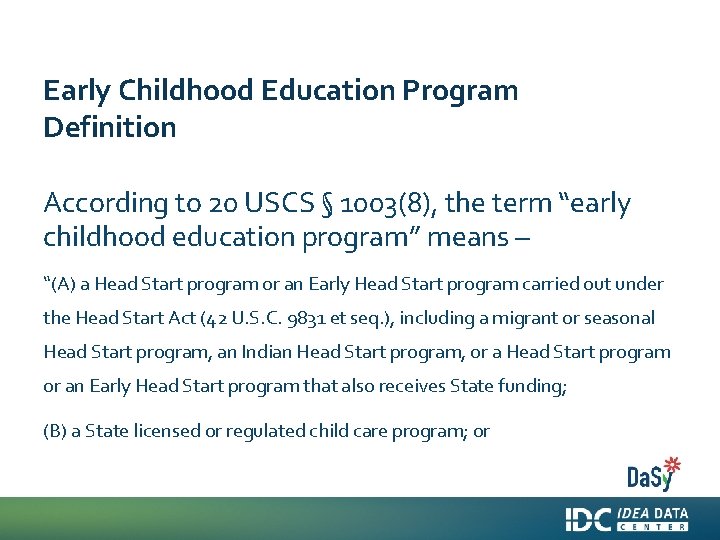
Early Childhood Education Program Definition According to 20 USCS § 1003(8), the term “early childhood education program” means – “(A) a Head Start program or an Early Head Start program carried out under the Head Start Act (42 U. S. C. 9831 et seq. ), including a migrant or seasonal Head Start program, an Indian Head Start program, or a Head Start program or an Early Head Start program that also receives State funding; (B) a State licensed or regulated child care program; or 9
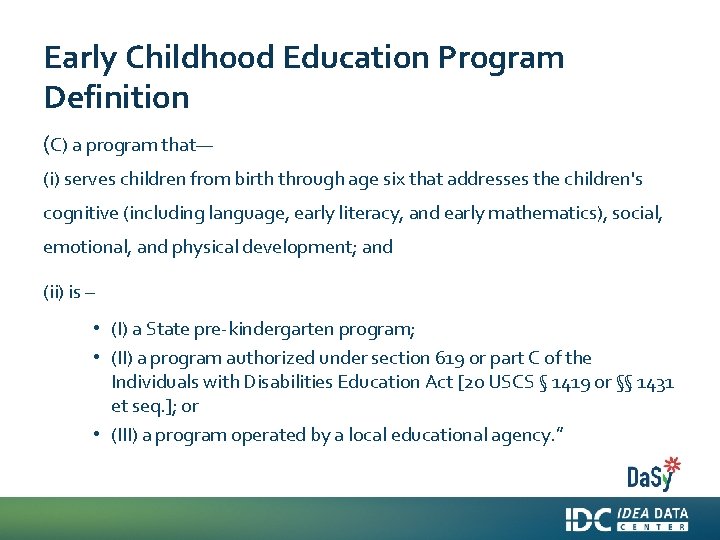
Early Childhood Education Program Definition (C) a program that— (i) serves children from birth through age six that addresses the children's cognitive (including language, early literacy, and early mathematics), social, emotional, and physical development; and (ii) is – • (I) a State pre-kindergarten program; • (II) a program authorized under section 619 or part C of the Individuals with Disabilities Education Act [20 USCS § 1419 or §§ 1431 et seq. ]; or • (III) a program operated by a local educational agency. ” 10
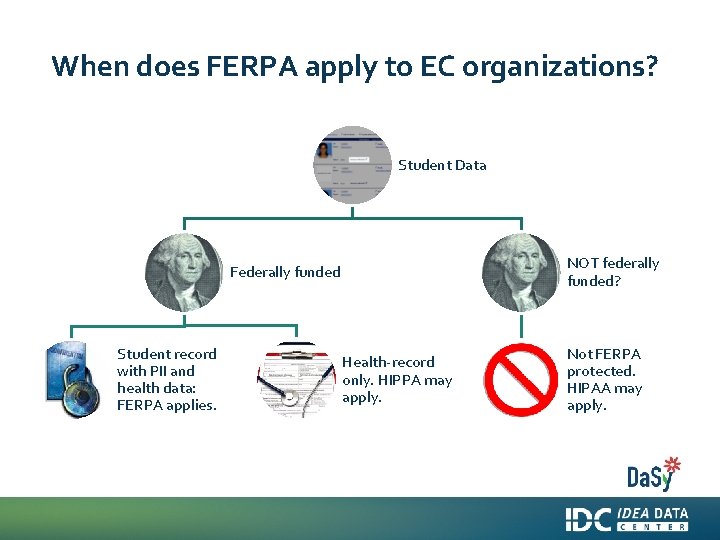
When does FERPA apply to EC organizations? Student Data NOT federally funded? Federally funded Student record with PII and health data: FERPA applies. Health-record only. HIPPA may apply. Not FERPA protected. HIPAA may apply.
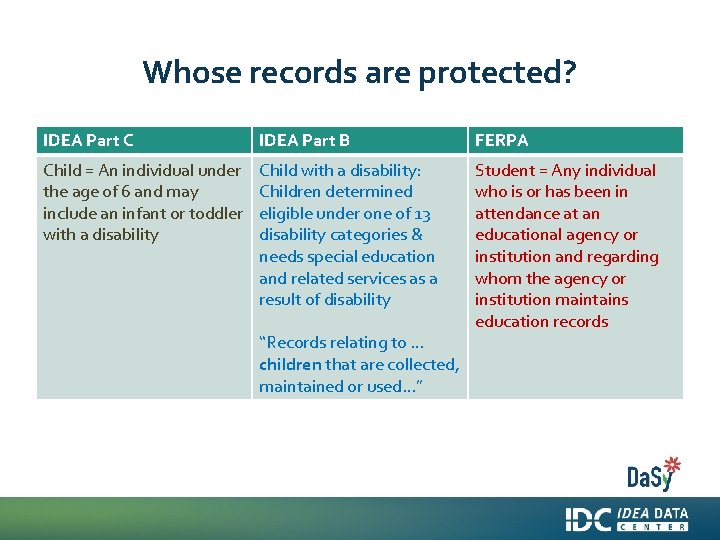
Whose records are protected? IDEA Part C IDEA Part B FERPA Child = An individual under the age of 6 and may include an infant or toddler with a disability Child with a disability: Children determined eligible under one of 13 disability categories & needs special education and related services as a result of disability Student = Any individual who is or has been in attendance at an educational agency or institution and regarding whom the agency or institution maintains education records “Records relating to … children that are collected, maintained or used…”
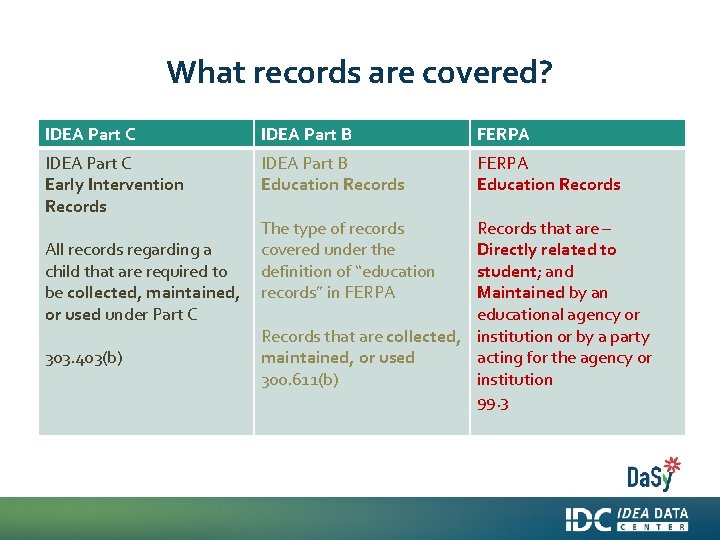
What records are covered? IDEA Part C IDEA Part B FERPA IDEA Part C Early Intervention Records IDEA Part B Education Records FERPA Education Records All records regarding a child that are required to be collected, maintained, or used under Part C 303. 403(b) The type of records covered under the definition of “education records” in FERPA Records that are – Directly related to student; and Maintained by an educational agency or Records that are collected, institution or by a party maintained, or used acting for the agency or 300. 611(b) institution 99. 3
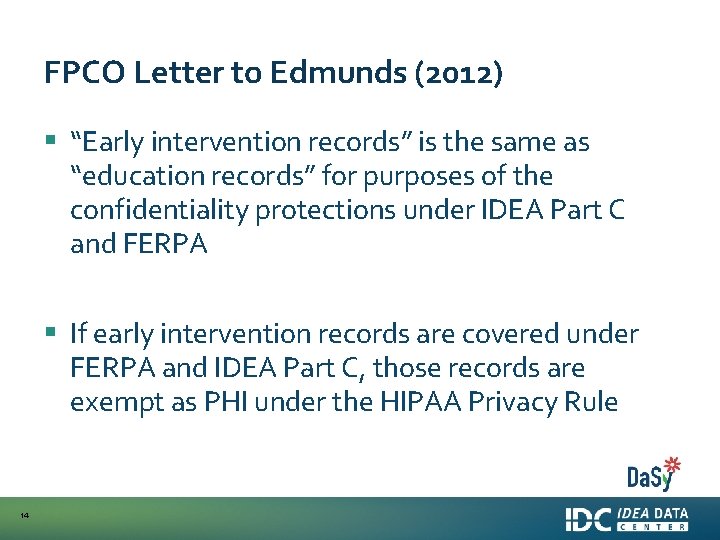
FPCO Letter to Edmunds (2012) § “Early intervention records” is the same as “education records” for purposes of the confidentiality protections under IDEA Part C and FERPA § If early intervention records are covered under FERPA and IDEA Part C, those records are exempt as PHI under the HIPAA Privacy Rule 14
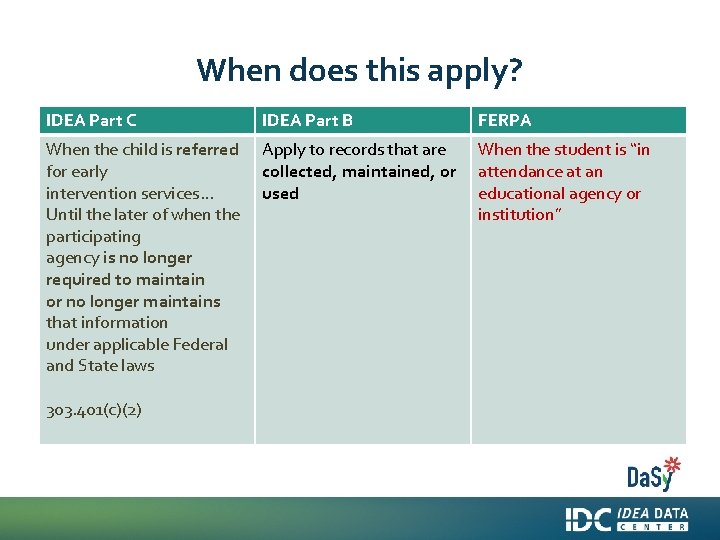
When does this apply? IDEA Part C IDEA Part B FERPA When the child is referred for early intervention services. . . Until the later of when the participating agency is no longer required to maintain or no longer maintains that information under applicable Federal and State laws Apply to records that are collected, maintained, or used When the student is “in attendance at an educational agency or institution” 303. 401(c)(2)
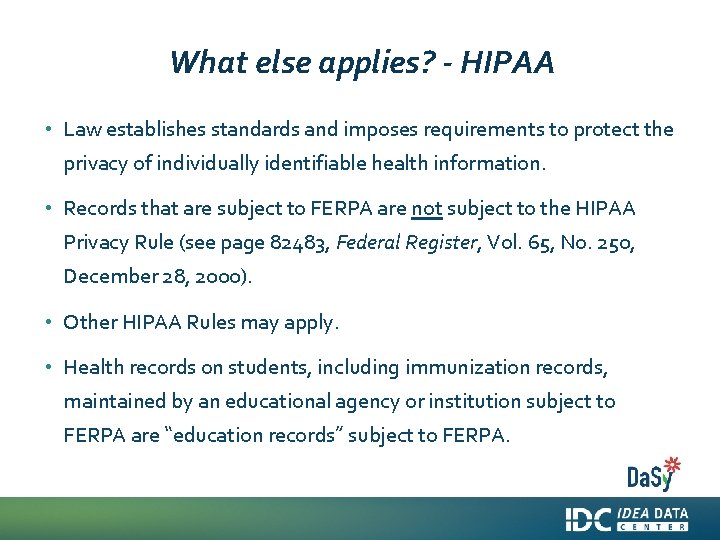
What else applies? - HIPAA • Law establishes standards and imposes requirements to protect the privacy of individually identifiable health information. • Records that are subject to FERPA are not subject to the HIPAA Privacy Rule (see page 82483, Federal Register, Vol. 65, No. 250, December 28, 2000). • Other HIPAA Rules may apply. • Health records on students, including immunization records, maintained by an educational agency or institution subject to FERPA are “education records” subject to FERPA.
Pop Quiz Robert is an elementary school teacher. He wants to post the results of a math test so he runs a report that has the names, scores, gender, Special Education status, and race/ethnicity of the students. Robert wants to preserve the privacy of his students so he deletes the column with student name. Is Robert’s approach ok?
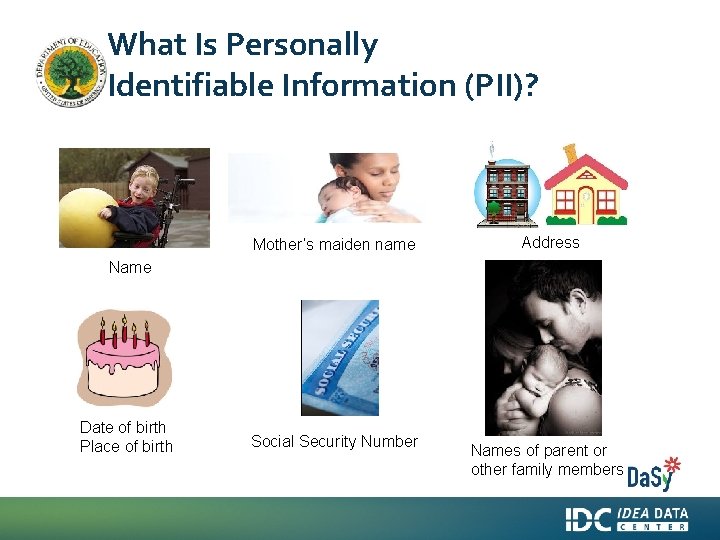
What Is Personally Identifiable Information (PII)? Mother’s maiden name Address Name Date of birth Place of birth Social Security Number Names of parent or other family members
What is Personally Identifiable Information (PII) under FERPA? • PII is information from education records that would make the student’s identity easily recognized (by itself or in combination with other factors). • Some examples of PII: § Full Name § Student ID Number § Grade Level AND Race/Ethnicity
What Else Is Personally Identifiable Information (PII)? FERPA - 99. 3 (PII) § Info. that, alone or in combination, is linkable to a specific student that would allow a reasonable person in the school community, who does not have personal knowledge of the relevant circumstances, to identify the student with reasonable certainty. § Info. requested by a person who the educational agency or institution reasonably believes knows the identity of the student to whom the education record relates.
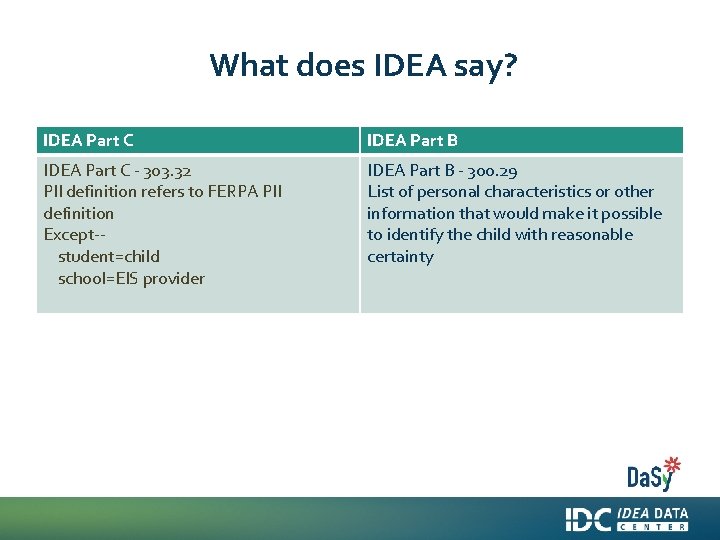
What does IDEA say? IDEA Part C IDEA Part B IDEA Part C - 303. 32 PII definition refers to FERPA PII definition Except-- student=child school=EIS provider IDEA Part B - 300. 29 List of personal characteristics or other information that would make it possible to identify the child with reasonable certainty
Inspection and Review of Education Records - FERPA • School must comply with request within 45 days. • Schools are generally required to give copies only if failure to do so would effectively deny access or make other arrangements to inspect and review – example would be a parent or student who does not live within commuting distance. • School may not destroy records if request for access is pending.
Inspection and Review - FERPA (cont. ) May an educational agency or institution charge a fee for copies of education records? • Yes – unless imposing a fee effectively prevents a parent or eligible student from exercising his or her right to inspect and review education records. What limitations exist on the right to inspect and review education records? • If the records contain information on more than one student, the requesting parent or eligible student may inspect, review, or be informed of only the specific information about his or her child’s records.
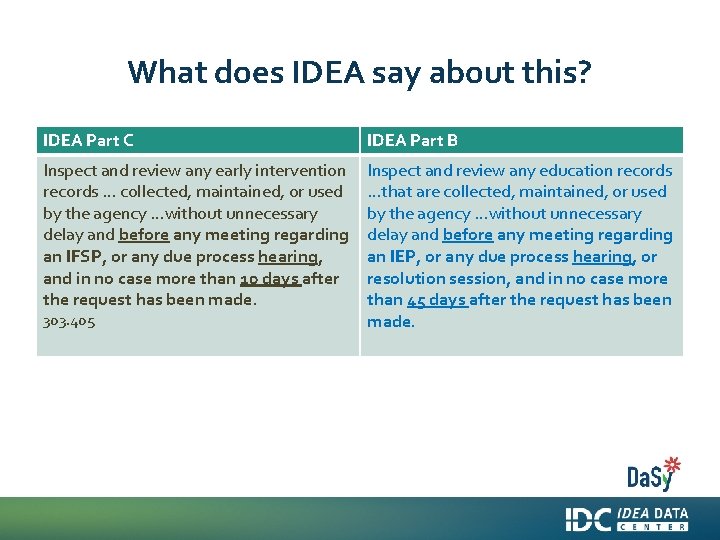
What does IDEA say about this? IDEA Part C IDEA Part B Inspect and review any early intervention records … collected, maintained, or used by the agency …without unnecessary delay and before any meeting regarding an IFSP, or any due process hearing, and in no case more than 10 days after the request has been made. Inspect and review any education records …that are collected, maintained, or used by the agency …without unnecessary delay and before any meeting regarding an IEP, or any due process hearing, or resolution session, and in no case more than 45 days after the request has been made. 303. 405
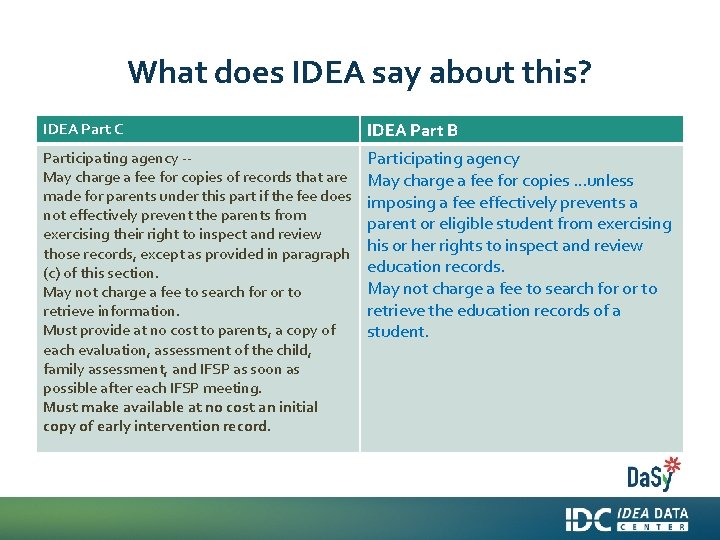
What does IDEA say about this? IDEA Part C IDEA Part B Participating agency -May charge a fee for copies of records that are made for parents under this part if the fee does not effectively prevent the parents from exercising their right to inspect and review those records, except as provided in paragraph (c) of this section. May not charge a fee to search for or to retrieve information. Must provide at no cost to parents, a copy of each evaluation, assessment of the child, family assessment, and IFSP as soon as possible after each IFSP meeting. Must make available at no cost an initial copy of early intervention record. Participating agency May charge a fee for copies …unless imposing a fee effectively prevents a parent or eligible student from exercising his or her rights to inspect and review education records. May not charge a fee to search for or to retrieve the education records of a student.
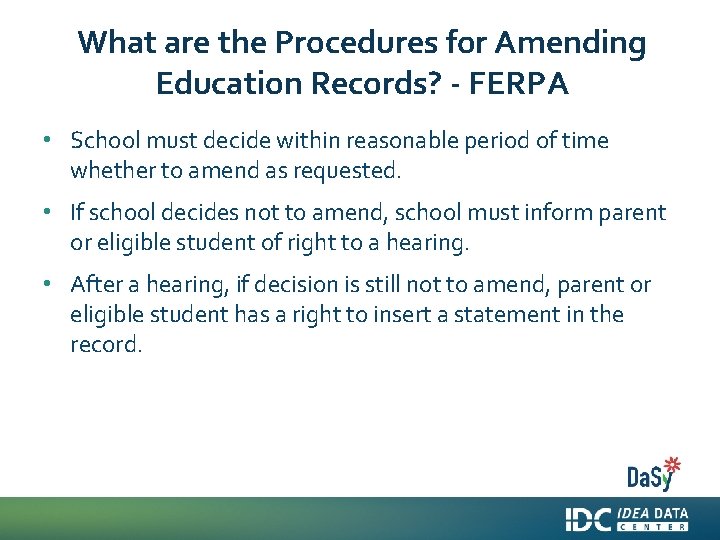
What are the Procedures for Amending Education Records? - FERPA • School must decide within reasonable period of time whether to amend as requested. • If school decides not to amend, school must inform parent or eligible student of right to a hearing. • After a hearing, if decision is still not to amend, parent or eligible student has a right to insert a statement in the record.
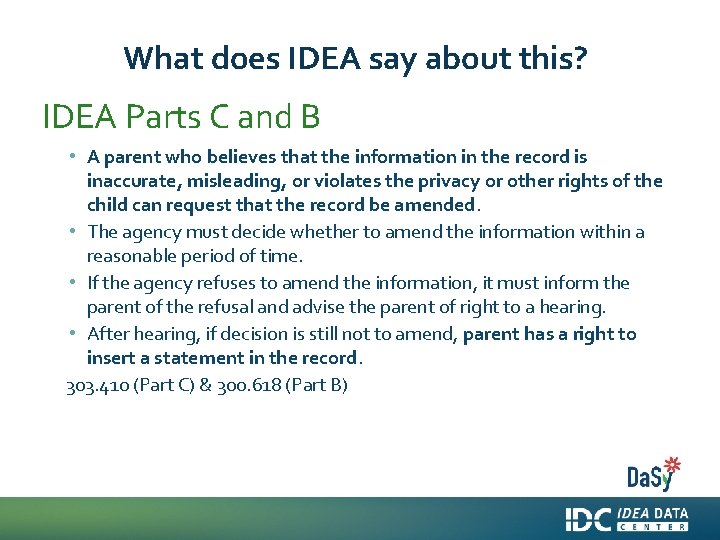
What does IDEA say about this? IDEA Parts C and B • A parent who believes that the information in the record is inaccurate, misleading, or violates the privacy or other rights of the child can request that the record be amended. • The agency must decide whether to amend the information within a reasonable period of time. • If the agency refuses to amend the information, it must inform the parent of the refusal and advise the parent of right to a hearing. • After hearing, if decision is still not to amend, parent has a right to insert a statement in the record. 303. 410 (Part C) & 300. 618 (Part B)
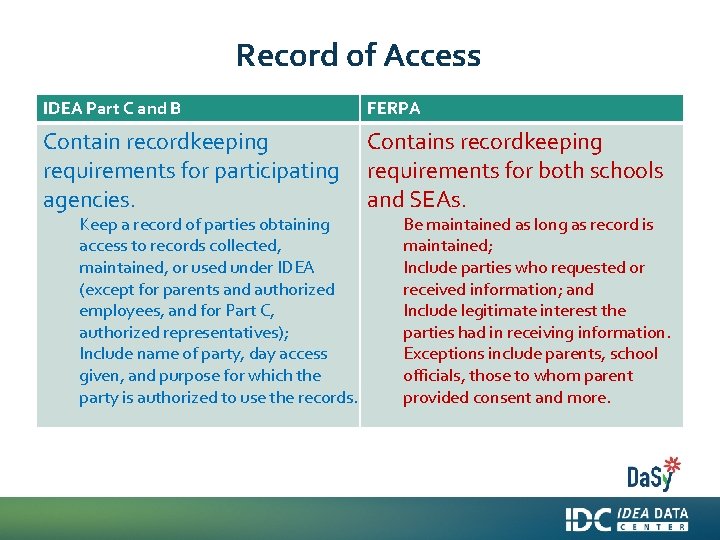
Record of Access IDEA Part C and B FERPA Contain recordkeeping Contains recordkeeping requirements for participating requirements for both schools agencies. and SEAs. Keep a record of parties obtaining access to records collected, maintained, or used under IDEA (except for parents and authorized employees, and for Part C, authorized representatives); Include name of party, day access given, and purpose for which the party is authorized to use the records. Be maintained as long as record is maintained; Include parties who requested or received information; and Include legitimate interest the parties had in receiving information. Exceptions include parents, school officials, those to whom parent provided consent and more.
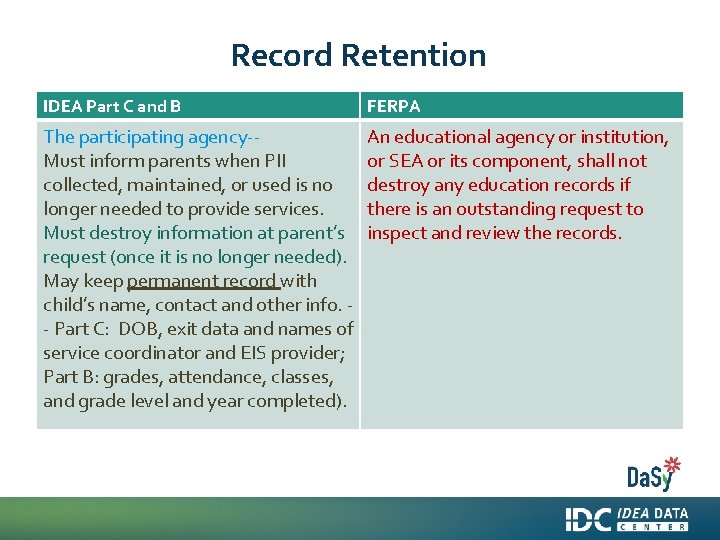
Record Retention IDEA Part C and B FERPA The participating agency-Must inform parents when PII collected, maintained, or used is no longer needed to provide services. Must destroy information at parent’s request (once it is no longer needed). May keep permanent record with child’s name, contact and other info. - Part C: DOB, exit data and names of service coordinator and EIS provider; Part B: grades, attendance, classes, and grade level and year completed). An educational agency or institution, or SEA or its component, shall not destroy any education records if there is an outstanding request to inspect and review the records.
Right to Consent to Disclosures Under FERPA: Except for specific exceptions, a parent or eligible student shall provide a signed and dated written consent before a school may disclose education records. The consent must: • specify records that may be disclosed; • state purpose of disclosure; and • identify party or class of parties to whom disclosure may be made.
FERPA - What are the exceptions to general consent? • To school officials with legitimate educational interests (defined in annual notification); • To schools in which a student seeks or intends to enroll; • To state and local officials pursuant to a state statute in connection with serving the student under the juvenile justice system; • To comply with a judicial order or subpoena (reasonable effort to notify parent or student at last known address); • To accrediting organizations;
What are the exceptions to general consent? (cont. ) • To parents of a dependent student; • To authorized representatives of federal, state, and local educational authorities conducting an audit, evaluation, or enforcement of education programs; • To organizations conducting studies for specific purposes on behalf of schools; • In a health or safety emergency; • To child welfare agency or tribal organization for those children in foster care; and • Directory information.
Uninterrupted Scholars Act (USA) New exception to the general consent rule under FERPA enacted on January 14, 2013: § Permits disclosure of PII from education records of children in foster care to: “agency caseworker or other representative” of a State or local child welfare agency (CWA) who has the right to access a student’s case plan under State or tribal law § Disclosure permitted when: the CWA is “legally responsible… for the care and protection of the student” § Provisions for tribal organizations as well 33
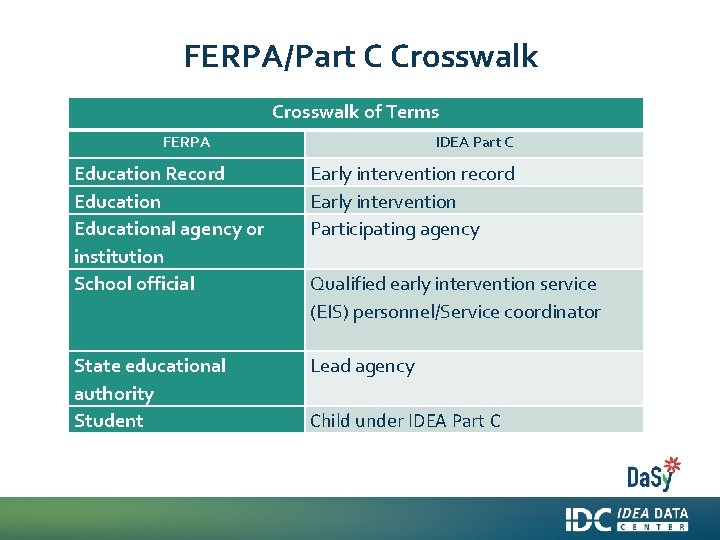
FERPA/Part C Crosswalk of Terms FERPA IDEA Part C Education Record Educational agency or institution School official Early intervention record Early intervention Participating agency State educational authority Student Lead agency Qualified early intervention service (EIS) personnel/Service coordinator Child under IDEA Part C
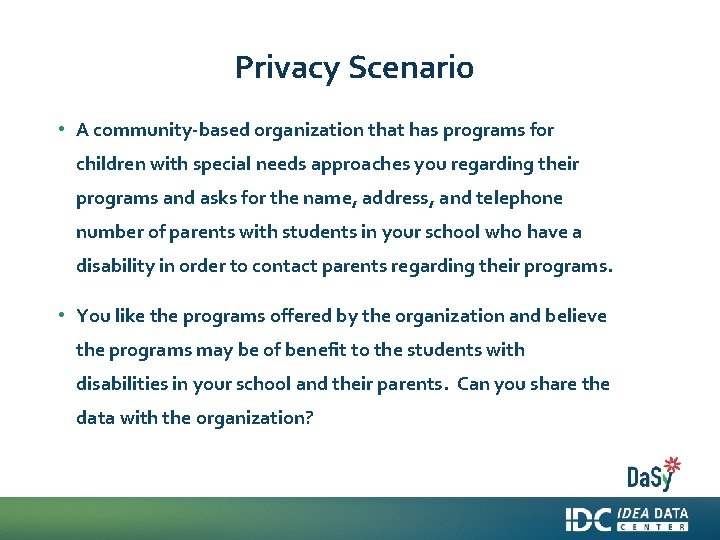
Privacy Scenario • A community-based organization that has programs for children with special needs approaches you regarding their programs and asks for the name, address, and telephone number of parents with students in your school who have a disability in order to contact parents regarding their programs. • You like the programs offered by the organization and believe the programs may be of benefit to the students with disabilities in your school and their parents. Can you share the data with the organization?
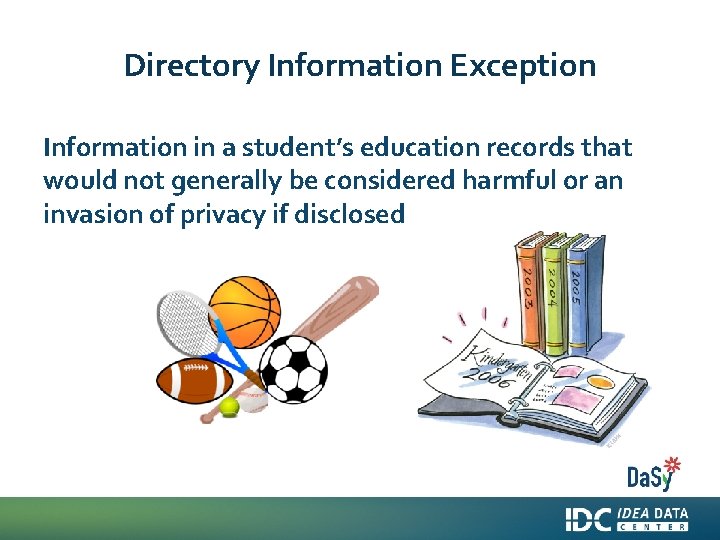
Directory Information Exception Information in a student’s education records that would not generally be considered harmful or an invasion of privacy if disclosed
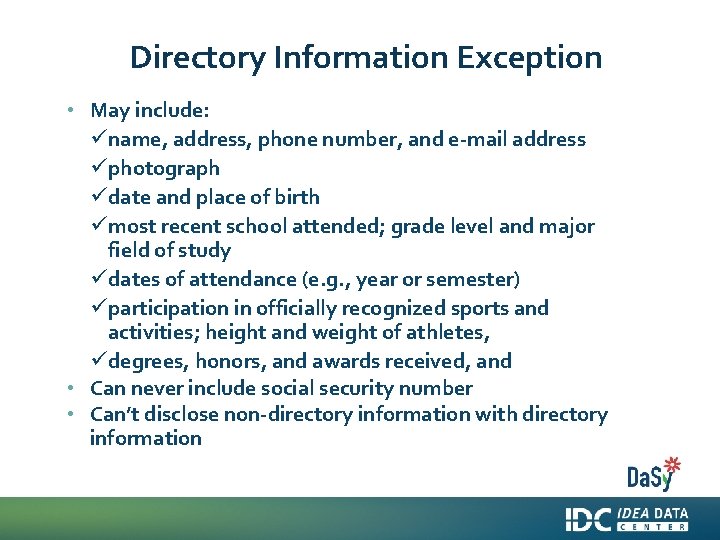
Directory Information Exception • May include: ü name, address, phone number, and e-mail address ü photograph ü date and place of birth ü most recent school attended; grade level and major field of study ü dates of attendance (e. g. , year or semester) ü participation in officially recognized sports and activities; height and weight of athletes, ü degrees, honors, and awards received, and • Can never include social security number • Can’t disclose non-directory information with directory information
Directory Information • Public notice must be given to parents of students in attendance and eligible students in attendance. • Parents may choose to “opt-out” of the disclosure of directory information on their child. • School may adopt a limited directory information policy that allows for the disclosure of directory information to specific parties, for specific purposes, or for both.
Pop Quiz Mr. Gray is a parent volunteer in your Kindergarten class. Mr. Gray’s assignment is to work with a small group of children on literacy. You provide him with reading assessments for the children that he is working with. Is it permissible for you to share this information with Mr. Gray without the consent or knowledge of the parents of the children?
School Official Exception • Schools may disclose PII from education records without consent if the disclosure is to other school officials, including teachers, within the school whom the school has determined to have legitimate educational interest. • Annual notification of FERPA rights must include criteria for determining who constitutes a school official and what constitutes a legitimate educational interest.
School Official Exception (cont. ) • Outsourcing services under school official exception § Schools may outsource institutional services or functions that involve the disclosure of education records to contractors, consultants, volunteers, or other third parties provided certain conditions are met. § If these outside parties meet the conditions for outsourcing, they may have access to education records.
School Official Exception (cont. ) • Conditions for outsourcing: § Performs an institutional service or function for which the agency or institution would otherwise use employees; § Is under the direct control of the agency or institution with respect to the use and maintenance of education records; § PII from education records may be used only for the purposes for which the disclosure was made; § Meets the criteria specified in the school, LEA, or institution’s annual notification of FERPA rights for being a school official with a legitimate educational interest in the education records.
Audit or Evaluation Exception • Federal, State, and local officials listed under § 9. 31(a)(3), or their authorized representative, may have access to education records only – § in connection with an audit or evaluation of federal or state supported education programs; or § for the enforcement of or compliance with federal legal requirements which relate to those programs. • The information must be: § protected in a manner that does not permit disclosure of PII to anyone; and § destroyed when no longer needed for the purposes listed above.
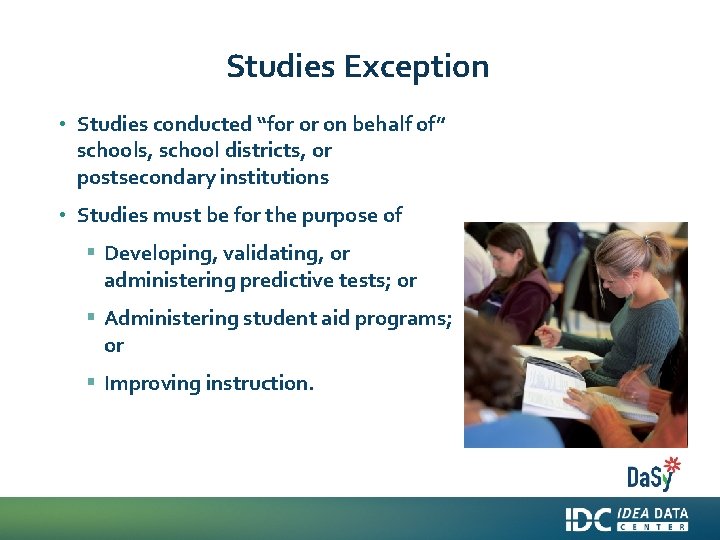
Studies Exception • Studies conducted “for or on behalf of” schools, school districts, or postsecondary institutions • Studies must be for the purpose of § Developing, validating, or administering predictive tests; or § Administering student aid programs; or § Improving instruction.
Note on the Studies Exception § The "Audit/Evaluation” exception in 34 CFR §§ 99. 31(a)(3) and 99. 35 is the most appropriate exception under IDEA and FERPA for data sharing arrangements for the IDEA early childhood community. In the very limited instance in which IDEA Part C or IDEA Part B section 619 agencies or programs propose to consider using the “Studies” exception under FERPA, such agencies and programs will want to consult with the Department’s Office of Special Education Programs (OSEP) and Family Policy Compliance Office (FPCO) regarding how the proposed data sharing would meet the requirements in 34 CFR §§ 99. 31(a)(6) and 303. 414 (for IDEA Part C) and 34 CFR §§ 99. 31(a)(6) and 300. 622 (for IDEA Part B Section 619). 45
What Is a Data Sharing Agreement? § Can be called many different names: MOU, MOA, Contract, Written Agreement, etc. § The mandatory elements of the agreement vary slightly between the two exceptions § The data sharing checklist delineates the minimum requirements under the Studies and the Audit or Evaluation exceptions 46
Key Points to Remember § Properly de-identified data can be shared without any FERPA considerations and should be your FIRST option as it limits the risk of unauthorized PII disclosure § In most cases, consent is the best approach for sharing PII with nonprofit organizations § Directory Information is often misunderstood. Opt-out provisions do not prevent data from being shared under the Audit/Evaluation or School Official exceptions 47
Frequently Asked Question On your ED federally funded preschool’s enrollment card, there is a question asking whether the child has health insurance. If the parent answers “no, ” the preschool sends a letter home informing the parent about Medicaid and CHIP and providing a toll-free number to call to get help with an application. DOES THIS VIOLATE FERPA? A: This is perfectly acceptable. It raises no FERPA concerns because the preschool has not disclosed personally identifiable information (PII) from a child’s education records to an outside entity. 48
Frequently Asked Question On the ED federally funded preschool enrollment card, there is a question asking whether the child has health insurance. If the parent answers “no, ” the preschool calls to inform the parent about Medicaid and CHIP. She asks if it is OK to share the parent’s phone number with the school social worker, who can provide application assistance. Is a consent form needed to allow the nurse to pass the parent’s phone number to the social worker – both school employees – or is oral consent necessary? 49
Frequently Asked Question A: In this scenario, no consent is required for the school nurse to disclose PII from education records to another school official with a legitimate educational interest (i. e. , the school social worker). A “legitimate educational interest” typically means that the school official needs to see the education records in order to perform their professional duties. Remember: Annual notification requirement – Defining WHO, WHAT, and “legitimate educational interest” 50
Frequently Asked Question On the ED federally funded preschool’s enrollment card, there is a question asking whether the child has health insurance. If the parent answers “no, ” staff from a community-based organization that works with the preschool calls the parent to talk about the availability of Medicaid and CHIP and to offer application assistance. (FYI, the community-based organization might be a local community health center, a children’s health advocacy organization, or a local health department. ) Can the preschool provide this information to the community-based organization? 51
Frequently Asked Question A: FERPA does not generally permit schools to disclose PII from children's’ education records to a communitybased organization without the consent of the parent, or unless the disclosure meets one of the exceptions to the general consent requirement. Exceptions: Directory Information (as defined) But… Because this type of information (eligibility) is considered PII, it cannot be considered directory information and requires parental consent. 52
Where do I go for help?
Contact Information Telephone: Email: (650) 859 -3881 dasycenter@sri. com Website: http: //dasycenter. org Telephone: Email: (855) 249 -3072 privacy. TA@ed. gov Website: http: //ptac. ed. gov Telephone: (888) 819 -7024 Email: ideadata@westat. com Website: https: //www. ideadata. org/
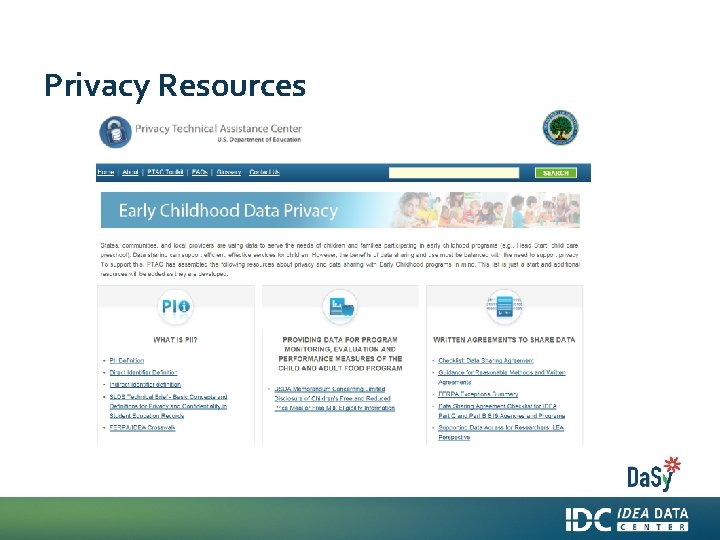
Privacy Resources
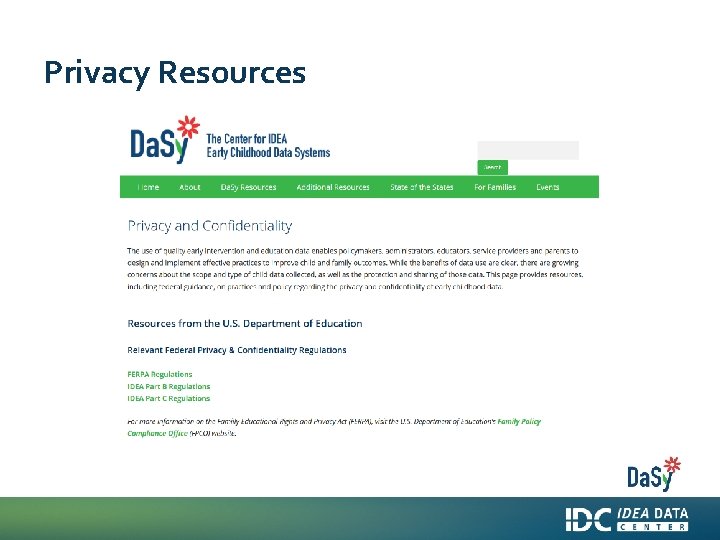
Privacy Resources
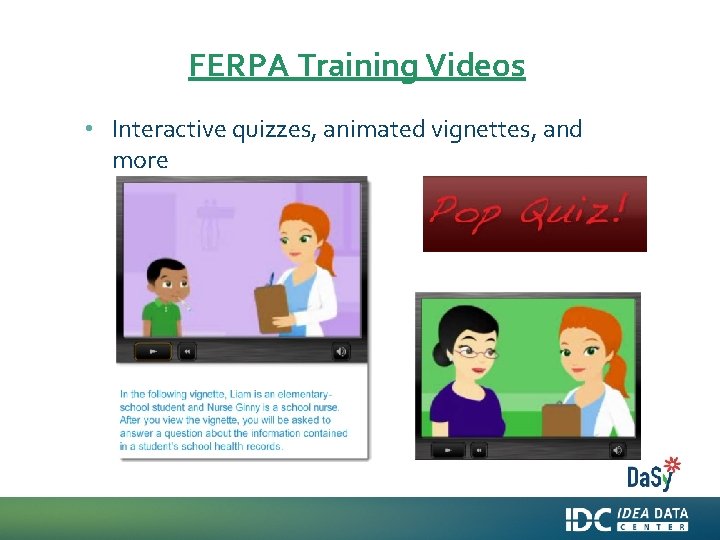
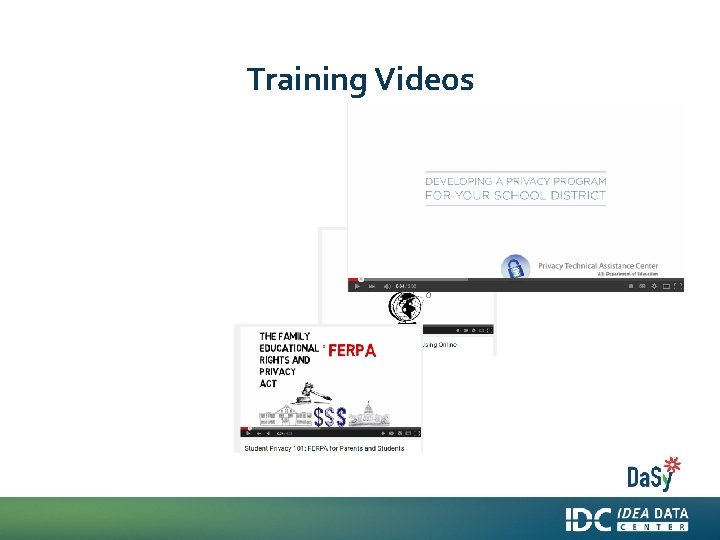
FERPA Training Videos • Interactive quizzes, animated vignettes, and more
Training Videos
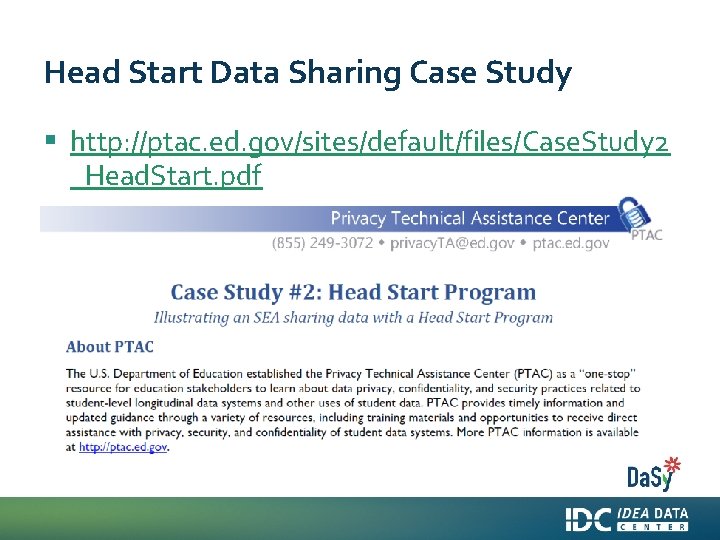
Head Start Data Sharing Case Study § http: //ptac. ed. gov/sites/default/files/Case. Study 2 _Head. Start. pdf
Questions?
For More Information - IDC Visit the IDC website http: //ideadata. org/ Follow us on Twitter https: //twitter. com/ideadatacenter
For More Information - Da. Sy Visit the Da. Sy website at: http: //dasycenter. org/ Like us on Facebook: https: //www. facebook. com/dasycenter Follow us on Twitter: @Da. Sy. Center
The contents of this presentation were developed under a grant from the U. S. Department of Education, #H 373 Y 130002. However, the contents do not necessarily represent the policy of the Department of Education, and you should not assume endorsement by the Federal Government. Project Officers: Richelle Davis and Meredith Miceli
The contents of this presentation were developed under a grant from the U. S. Department of Education, # H 373 Z 120002. However, those contents do not necessarily represent the policy of the U. S. Department of Education, and you should not assume endorsement by the Federal Government. Project Officers, Meredith Miceli and Richelle Davis. 64
- Slides: 64