
IDEA An initial Architecture J Satyanarayana 22 Jan


- Slides: 19
IDEA An initial Architecture J Satyanarayana 22 Jan 20
Vision of IDEA - Ind. EA Digital Ecosystem of Agriculture “ To create an ecosystem for providing Value-Added Services to the farmers covering the entire agricultural cycle, to support the goal of Doubling Farmers Income and of SDGs, with a focus on building value chain ownership by the farmers, effective program delivery, convenience & transparency ”
Envisaged benefits of IDEA • Laying the foundation for evolution of a Digital Ecosystem of Agriculture • Enabling the farmer to get a share in the entire value chain • Creating building blocks that can be re-used across the Primary Sector • Leveraging digital technologies to reduce costs, and enhance yields and incomes • Ensuring better targeting of benefits and services
Major drivers of IDEA • DFI Goals • SDGs for Agriculture • National Policies on Agriculture • Ind. EA
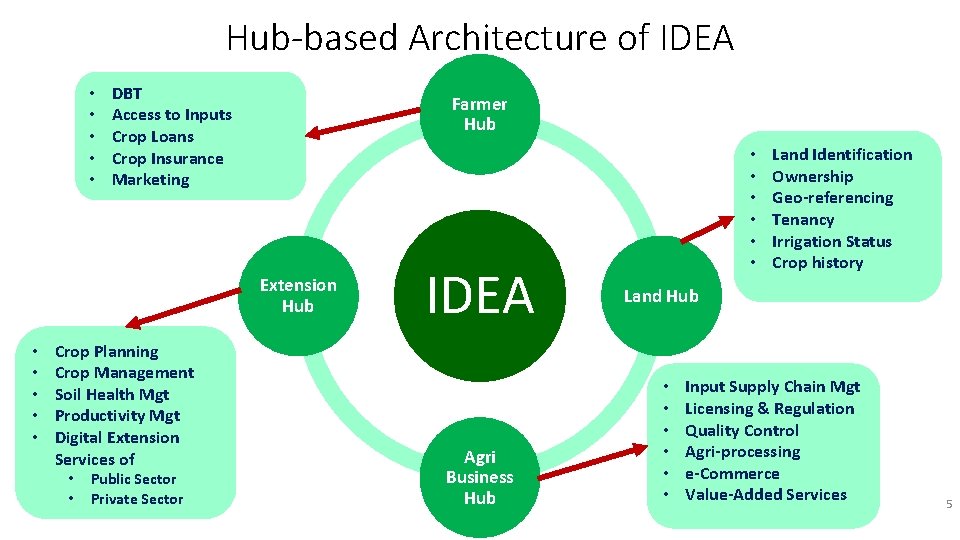
Hub-based Architecture of IDEA • • • DBT Access to Inputs Crop Loans Crop Insurance Marketing Farmer Hub Extension Hub • • • Crop Planning Crop Management Soil Health Mgt Productivity Mgt Digital Extension Services of • • Public Sector Private Sector IDEA Agri Business Hub • • • Land Identification Ownership Geo-referencing Tenancy Irrigation Status Crop history Land Hub • • • Input Supply Chain Mgt Licensing & Regulation Quality Control Agri-processing e-Commerce Value-Added Services 5
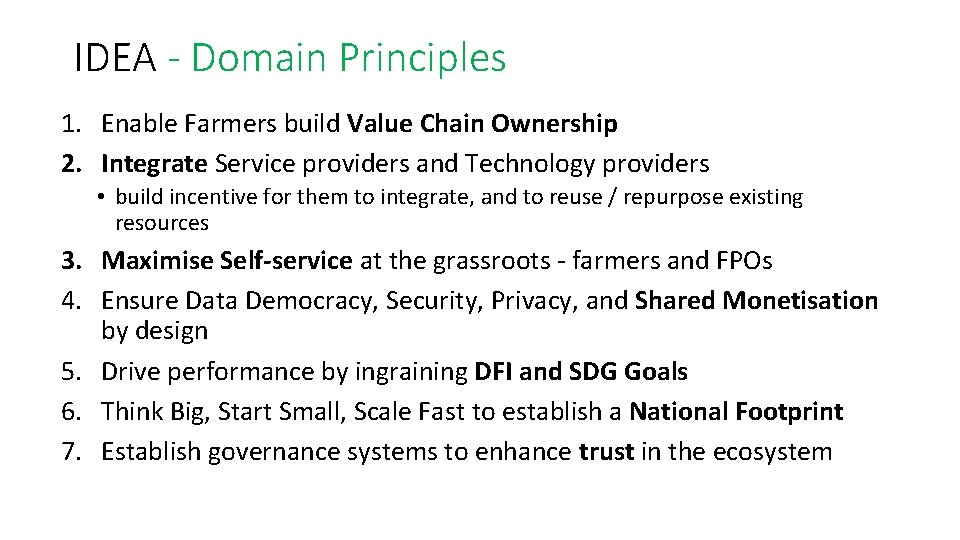
IDEA - Domain Principles 1. Enable Farmers build Value Chain Ownership 2. Integrate Service providers and Technology providers • build incentive for them to integrate, and to reuse / repurpose existing resources 3. Maximise Self-service at the grassroots - farmers and FPOs 4. Ensure Data Democracy, Security, Privacy, and Shared Monetisation by design 5. Drive performance by ingraining DFI and SDG Goals 6. Think Big, Start Small, Scale Fast to establish a National Footprint 7. Establish governance systems to enhance trust in the ecosystem
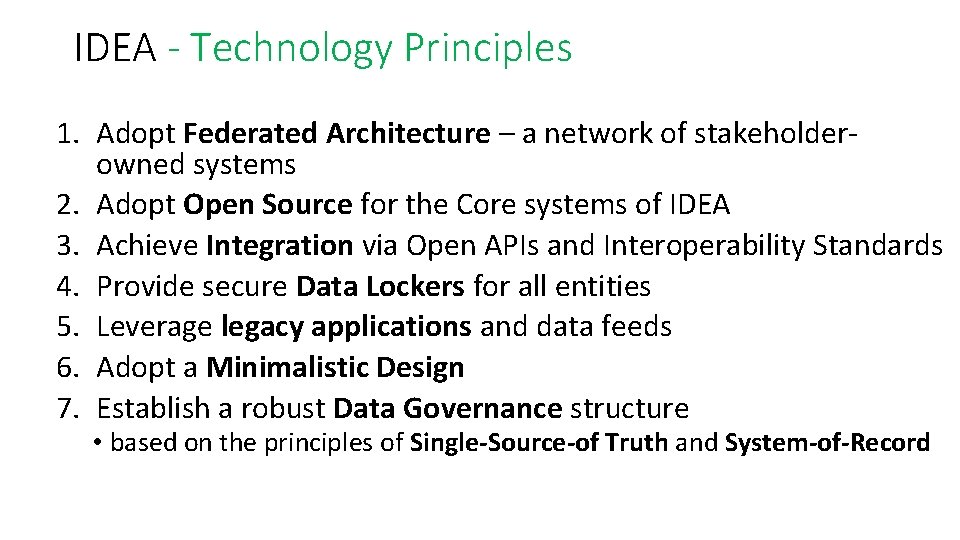
IDEA - Technology Principles 1. Adopt Federated Architecture – a network of stakeholderowned systems 2. Adopt Open Source for the Core systems of IDEA 3. Achieve Integration via Open APIs and Interoperability Standards 4. Provide secure Data Lockers for all entities 5. Leverage legacy applications and data feeds 6. Adopt a Minimalistic Design 7. Establish a robust Data Governance structure • based on the principles of Single-Source-of Truth and System-of-Record
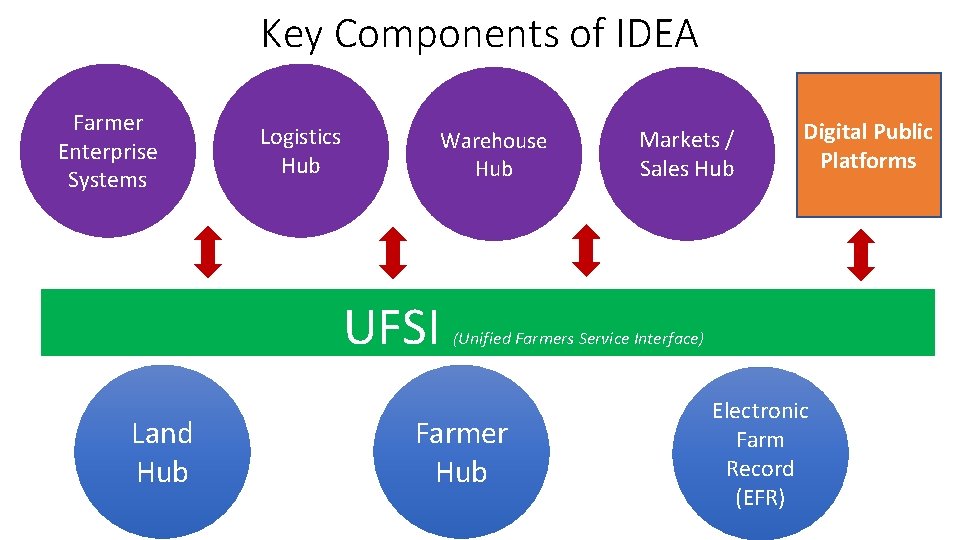
Key Components of IDEA Farmer Enterprise Systems Logistics Hub Warehouse Hub UFSI Land Hub Markets / Sales Hub Digital Public Platforms (Unified Farmers Service Interface) Farmer Hub Electronic Farm Record (EFR)
Unified Farmers Service Interface UFSI to be the Gamechanger in Agri-ecosystem
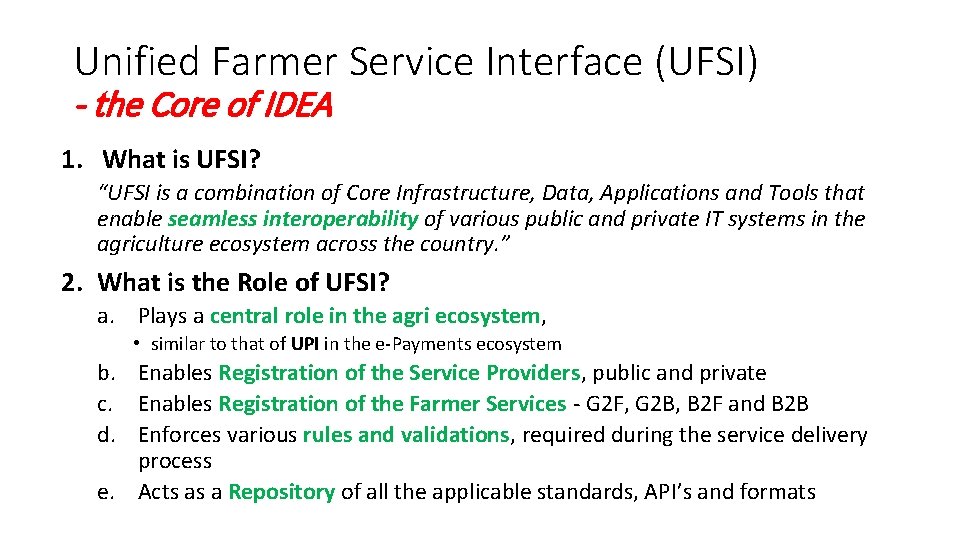
Unified Farmer Service Interface (UFSI) - the Core of IDEA 1. What is UFSI? “UFSI is a combination of Core Infrastructure, Data, Applications and Tools that enable seamless interoperability of various public and private IT systems in the agriculture ecosystem across the country. ” 2. What is the Role of UFSI? a. Plays a central role in the agri ecosystem, • similar to that of UPI in the e-Payments ecosystem b. Enables Registration of the Service Providers, public and private c. Enables Registration of the Farmer Services - G 2 F, G 2 B, B 2 F and B 2 B d. Enforces various rules and validations, required during the service delivery process e. Acts as a Repository of all the applicable standards, API’s and formats
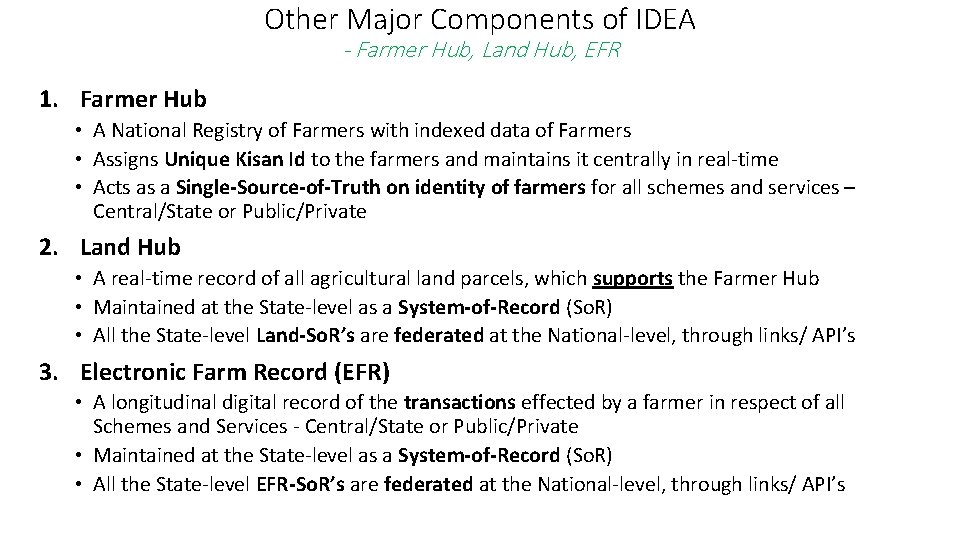
Other Major Components of IDEA - Farmer Hub, Land Hub, EFR 1. Farmer Hub • A National Registry of Farmers with indexed data of Farmers • Assigns Unique Kisan Id to the farmers and maintains it centrally in real-time • Acts as a Single-Source-of-Truth on identity of farmers for all schemes and services – Central/State or Public/Private 2. Land Hub • A real-time record of all agricultural land parcels, which supports the Farmer Hub • Maintained at the State-level as a System-of-Record (So. R) • All the State-level Land-So. R’s are federated at the National-level, through links/ API’s 3. Electronic Farm Record (EFR) • A longitudinal digital record of the transactions effected by a farmer in respect of all Schemes and Services - Central/State or Public/Private • Maintained at the State-level as a System-of-Record (So. R) • All the State-level EFR-So. R’s are federated at the National-level, through links/ API’s
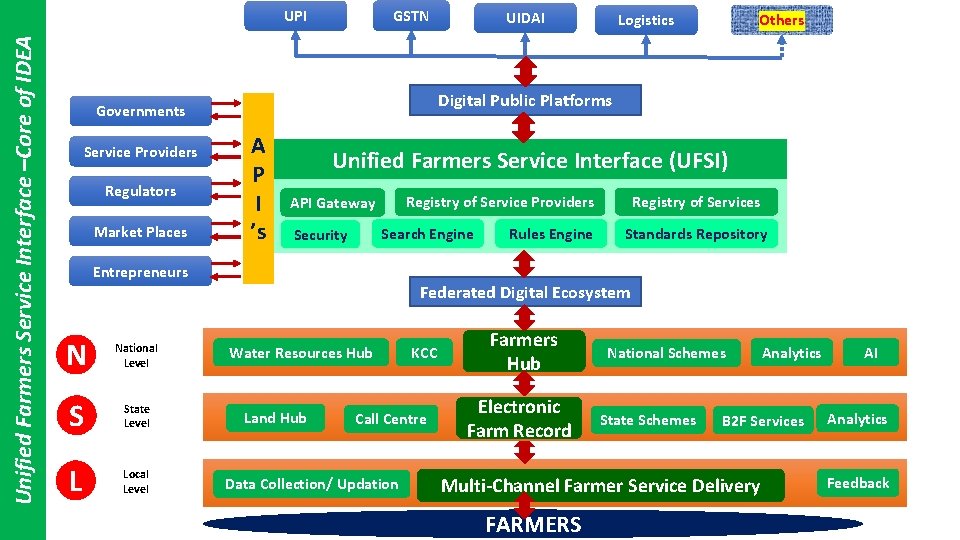
GSTN Unified Farmers Service Interface –Core of IDEA UPI Regulators Market Places A P I ’s N S State Level L Local Level Others Unified Farmers Service Interface (UFSI) Search Engine Security Registry of Services Registry of Service Providers API Gateway Entrepreneurs National Level Logistics Digital Public Platforms Governments Service Providers UIDAI Rules Engine Standards Repository Federated Digital Ecosystem Water Resources Hub Land Hub KCC Call Centre Data Collection/ Updation Farmers Hub Electronic Farm Record National Schemes State Schemes B 2 F Services Multi-Channel Farmer Service Delivery FARMERS Analytics AI Analytics Feedback
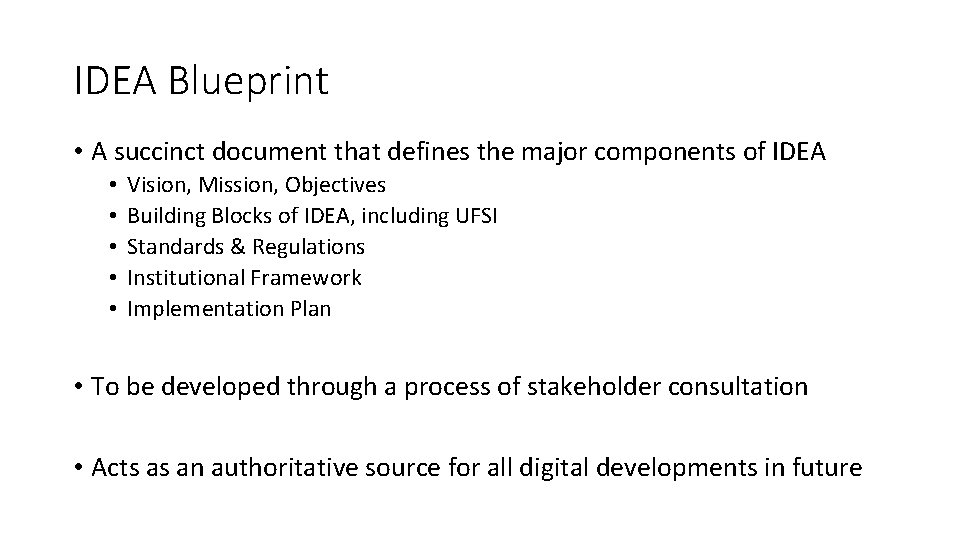
IDEA Blueprint • A succinct document that defines the major components of IDEA • • • Vision, Mission, Objectives Building Blocks of IDEA, including UFSI Standards & Regulations Institutional Framework Implementation Plan • To be developed through a process of stakeholder consultation • Acts as an authoritative source for all digital developments in future
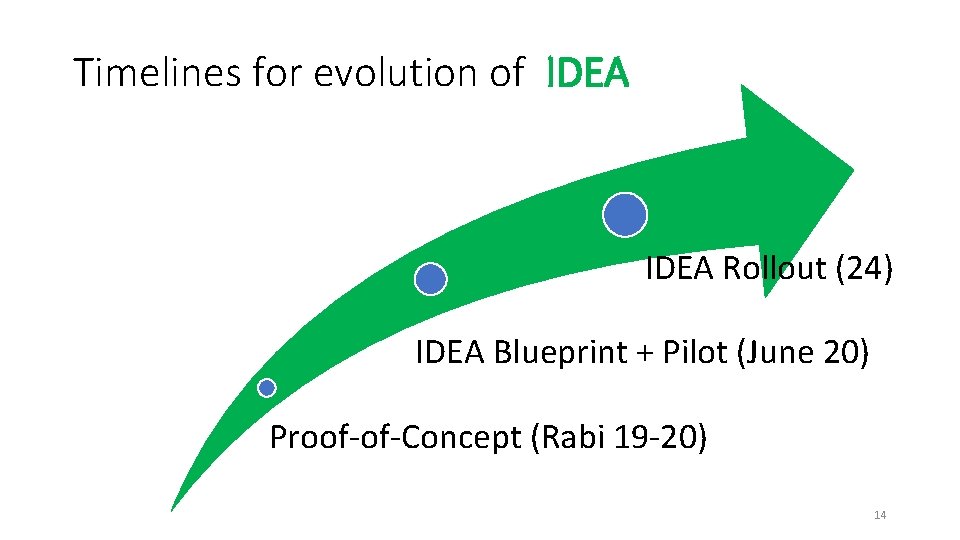
Timelines for evolution of IDEA Rollout (24) IDEA Blueprint + Pilot (June 20) Proof-of-Concept (Rabi 19 -20) 14
Way forward on Blueprint • Establish a Sub-committee of the TF to prepare the Blueprint • Define milestones and timelines • Review progress regularly at the level of TF and SC
Thank You j. satya@nic. in
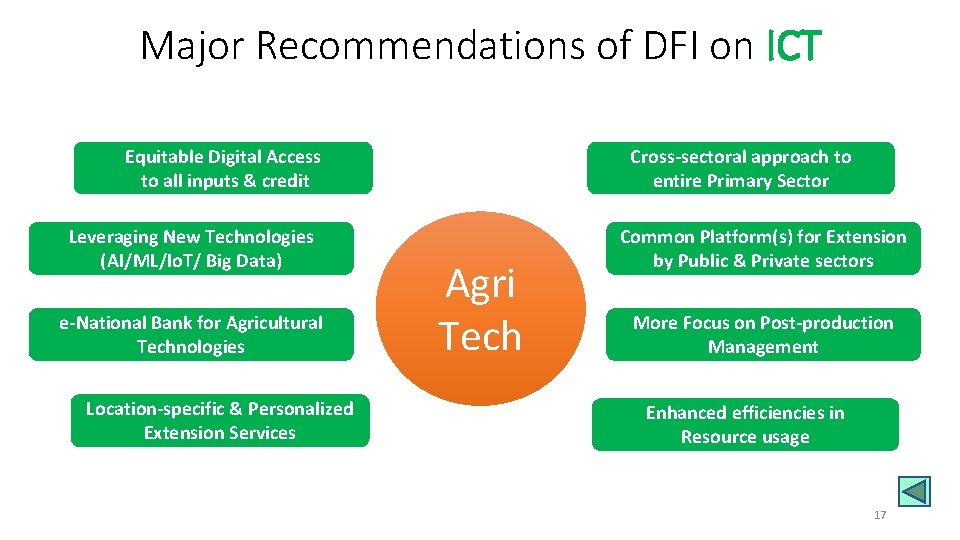
Major Recommendations of DFI on ICT Equitable Digital Access to all inputs & credit Leveraging New Technologies (AI/ML/Io. T/ Big Data) e-National Bank for Agricultural Technologies Location-specific & Personalized Extension Services Cross-sectoral approach to entire Primary Sector Agri Tech Common Platform(s) for Extension by Public & Private sectors More Focus on Post-production Management Enhanced efficiencies in Resource usage 17
SDG Goals for Agriculture (relating to ICT) • 2. 3 Double Agricultural Productivity through access to • Land, Inputs, Knowledge, Financial Services, Markets. . • 2. 4 Sustainable production through • adoption to Climate Change, Drought, Flooding and other Disasters • Improvement in Land Soil Quality • 2 c Proper functioning of food commodity markets and timely access to Market Information 18
Operational Principles of IDEA 1. UFSI acts as the fulcrum around which all the ecosystem players operate. 2. UFSI, in tandem with Farmer Hub, holds only the core data to UNIQULY IDENTIFY Farmers, Schemes, Service Providers and Services. 3. UFSI DOES NOT HOLD any Transaction Data – the ecosystem players hold and be responsible for transaction data 4. Farmers Hub and EFR are designed, developed and managed on a FEDERATED ARCHITECTURAL MODEL, with no centralization. 5. IDEA leverages the Digital Public Platforms already available • UPI, UIDAI, GSTN etc and can leverage other platforms to be developed in future 6. EFRs provide a comprehensive view that enables • A better Crop Planning and Management by the farmer • More effective delivery of benefits and services to Farmers by Private and Public sector players 7. All interactions between ecosystem players shall be through API’s 8. UFSI shall publish API’s relating to all the generic services it provides • Ecosystem players develop fresh applications/ modify legacy applications so as to consume the API’s published by UFSI