
Idaho Cleanup Project Update Leadership in Nuclear Energy
- Slides: 14
Idaho Cleanup Project Update Leadership in Nuclear Energy Commission Jack Zimmerman Deputy Manager Idaho Cleanup Project Oct. 4, 2017 www. energy. gov/EM 1
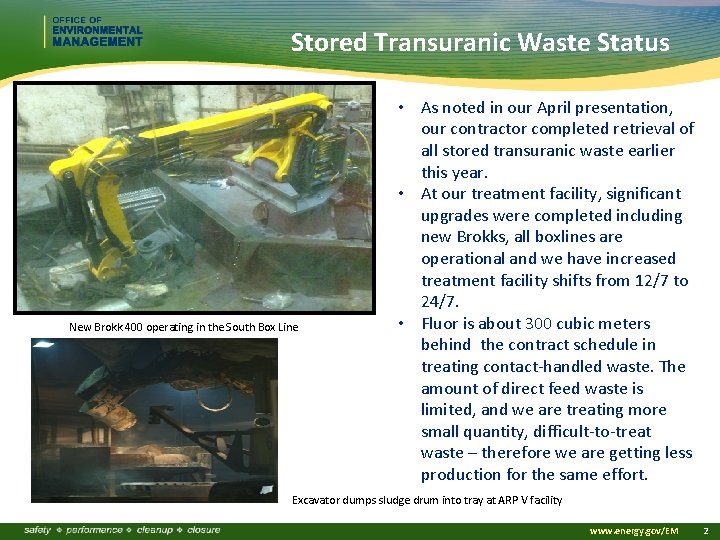
Stored Transuranic Waste Status New Brokk 400 operating in the South Box Line • As noted in our April presentation, our contractor completed retrieval of all stored transuranic waste earlier this year. • At our treatment facility, significant upgrades were completed including new Brokks, all boxlines are operational and we have increased treatment facility shifts from 12/7 to 24/7. • Fluor is about 300 cubic meters behind the contract schedule in treating contact-handled waste. The amount of direct feed waste is limited, and we are treating more small quantity, difficult-to-treat waste – therefore we are getting less production for the same effort. Excavator dumps sludge drum into tray at ARP V facility www. energy. gov/EM 2
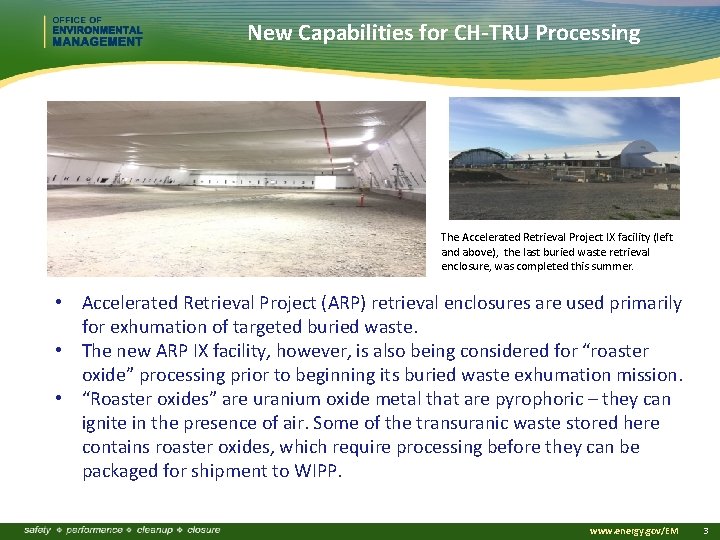
New Capabilities for CH-TRU Processing The Accelerated Retrieval Project IX facility (left and above), the last buried waste retrieval enclosure, was completed this summer. • Accelerated Retrieval Project (ARP) retrieval enclosures are used primarily for exhumation of targeted buried waste. • The new ARP IX facility, however, is also being considered for “roaster oxide” processing prior to beginning its buried waste exhumation mission. • “Roaster oxides” are uranium oxide metal that are pyrophoric – they can ignite in the presence of air. Some of the transuranic waste stored here contains roaster oxides, which require processing before they can be packaged for shipment to WIPP. www. energy. gov/EM 3
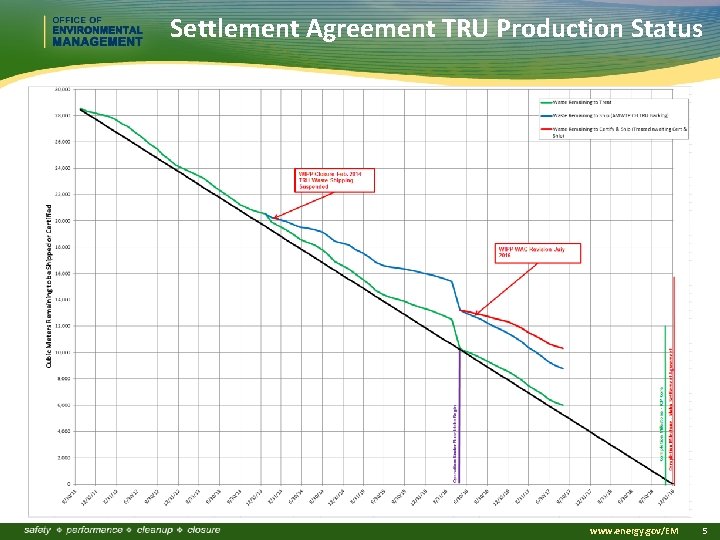
Shipping and Certification AMWTP Certified Program: • Starting the week of Sept. 18, Idaho Cleanup Project shipments of transuranic waste to WIPP increased from two to four per week. • Completed 46 shipments to date since shipping resumed April 6, 2017. • We have shipped about 54, 000 cubic meters of transuranic and mixed low-level waste from the original 65, 000 cubic meter Settlement Agreement inventory to out-of-state disposal facilities. • The next AMWTP Recertification Audit will be in early December, 2017 • Expect to demonstrate complete process now that the Basis of Knowledge has been released. • The Generator Site Technical Review is complete. www. energy. gov/EM 4
Settlement Agreement TRU Production Status www. energy. gov/EM 5
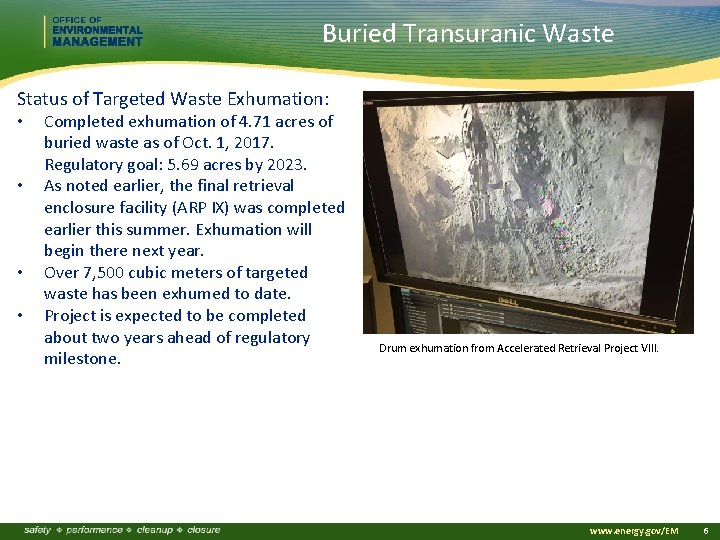
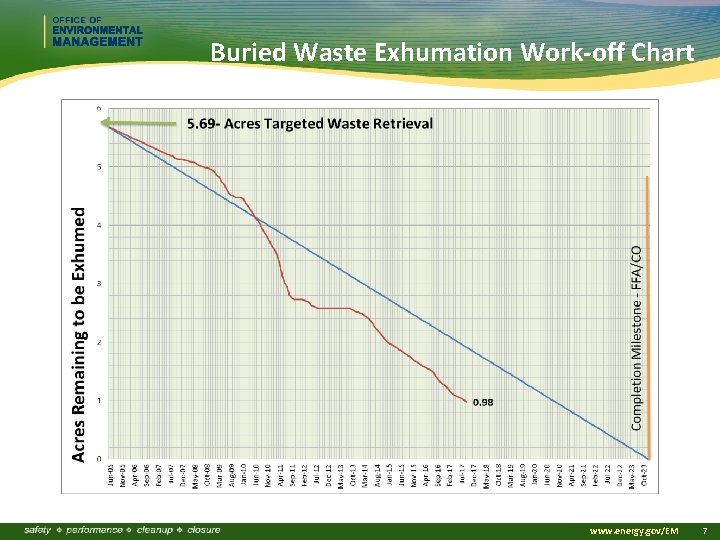
Buried Transuranic Waste Status of Targeted Waste Exhumation: • • Completed exhumation of 4. 71 acres of buried waste as of Oct. 1, 2017. Regulatory goal: 5. 69 acres by 2023. As noted earlier, the final retrieval enclosure facility (ARP IX) was completed earlier this summer. Exhumation will begin there next year. Over 7, 500 cubic meters of targeted waste has been exhumed to date. Project is expected to be completed about two years ahead of regulatory milestone. Drum exhumation from Accelerated Retrieval Project VIII. www. energy. gov/EM 6
Buried Waste Exhumation Work-off Chart www. energy. gov/EM 7
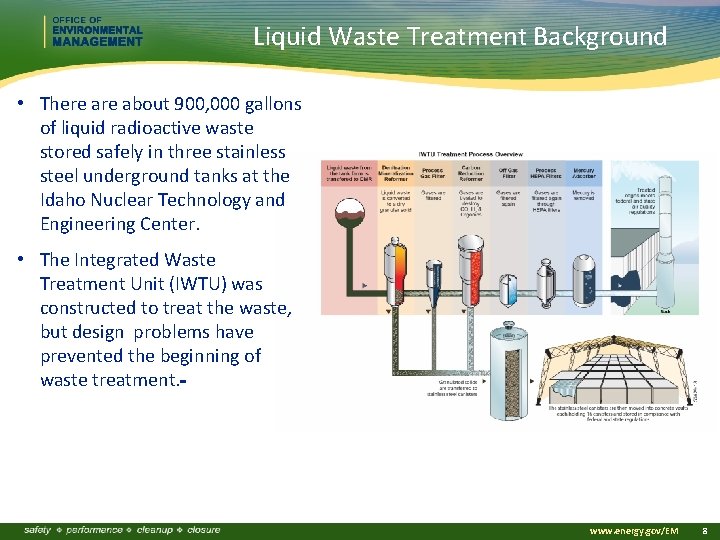
Liquid Waste Treatment Background • There about 900, 000 gallons of liquid radioactive waste stored safely in three stainless steel underground tanks at the Idaho Nuclear Technology and Engineering Center. • The Integrated Waste Treatment Unit (IWTU) was constructed to treat the waste, but design problems have prevented the beginning of waste treatment. www. energy. gov/EM 8
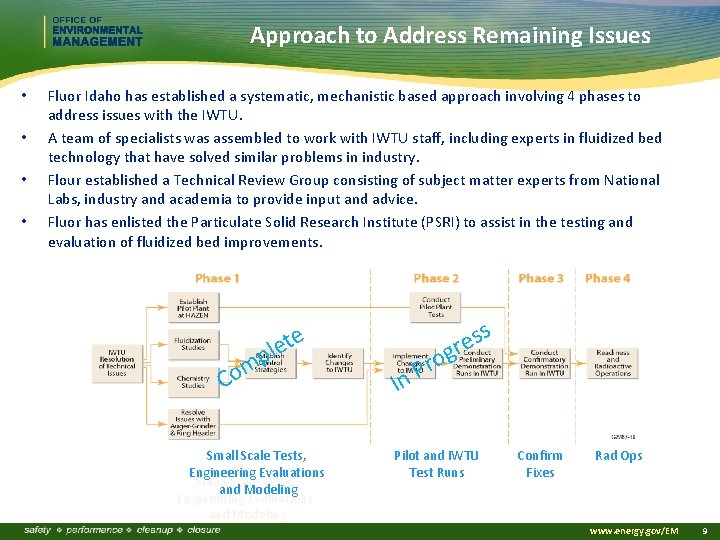
Approach to Address Remaining Issues • • Fluor Idaho has established a systematic, mechanistic based approach involving 4 phases to address issues with the IWTU. A team of specialists was assembled to work with IWTU staff, including experts in fluidized bed technology that have solved similar problems in industry. Flour established a Technical Review Group consisting of subject matter experts from National Labs, industry and academia to provide input and advice. Fluor has enlisted the Particulate Solid Research Institute (PSRI) to assist in the testing and evaluation of fluidized bed improvements. e let C p m o Small Scale Tests, Engineering Evaluations Small Scale Tests, and Modeling Engineering Evaluations and Modeling In s s e r g o Pr Pilot and IWTU Test Runs Confirm Fixes Rad Ops www. energy. gov/EM 9
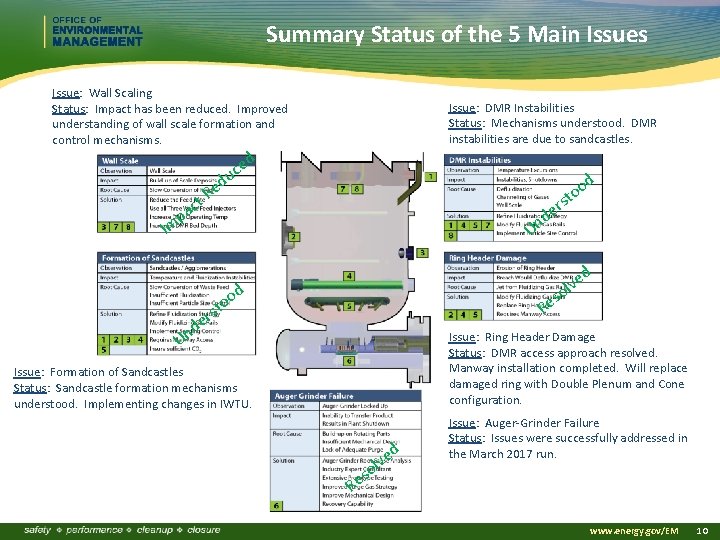
Summary Status of the 5 Main Issues Issue: Wall Scaling Status: Impact has been reduced. Improved understanding of wall scale formation and control mechanisms. Issue: DMR Instabilities Status: Mechanisms understood. DMR instabilities are due to sandcastles. d e uc t Im c pa d d Re o sto r e nd U d o o t s s Re r de n U d e v ol Issue: Ring Header Damage Status: DMR access approach resolved. Manway installation completed. Will replace damaged ring with Double Plenum and Cone configuration. Issue: Formation of Sandcastles Status: Sandcastle formation mechanisms understood. Implementing changes in IWTU. d e olv Issue: Auger-Grinder Failure Status: Issues were successfully addressed in the March 2017 run. s Re www. energy. gov/EM 10
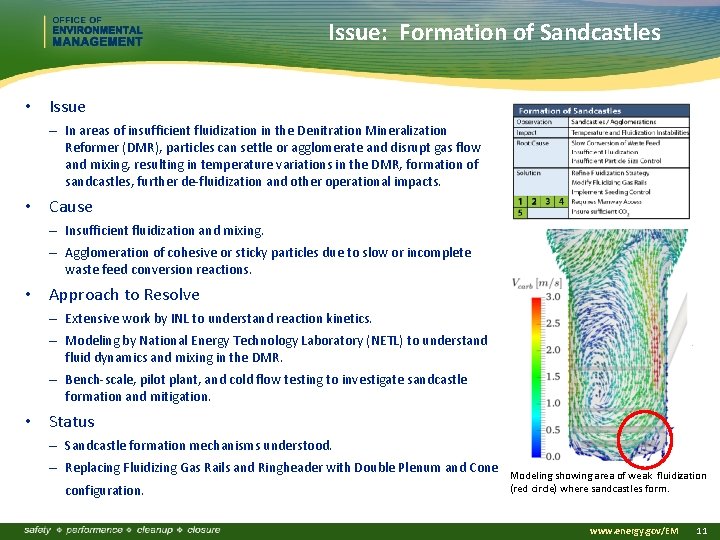
Issue: Formation of Sandcastles • Issue – In areas of insufficient fluidization in the Denitration Mineralization Reformer (DMR), particles can settle or agglomerate and disrupt gas flow and mixing, resulting in temperature variations in the DMR, formation of sandcastles, further de-fluidization and other operational impacts. • Cause – Insufficient fluidization and mixing. – Agglomeration of cohesive or sticky particles due to slow or incomplete waste feed conversion reactions. • Approach to Resolve – Extensive work by INL to understand reaction kinetics. – Modeling by National Energy Technology Laboratory (NETL) to understand fluid dynamics and mixing in the DMR. – Bench-scale, pilot plant, and cold flow testing to investigate sandcastle formation and mitigation. • Status – Sandcastle formation mechanisms understood. – Replacing Fluidizing Gas Rails and Ringheader with Double Plenum and Cone configuration. Modeling showing area of weak fluidization (red circle) where sandcastles form. www. energy. gov/EM 11
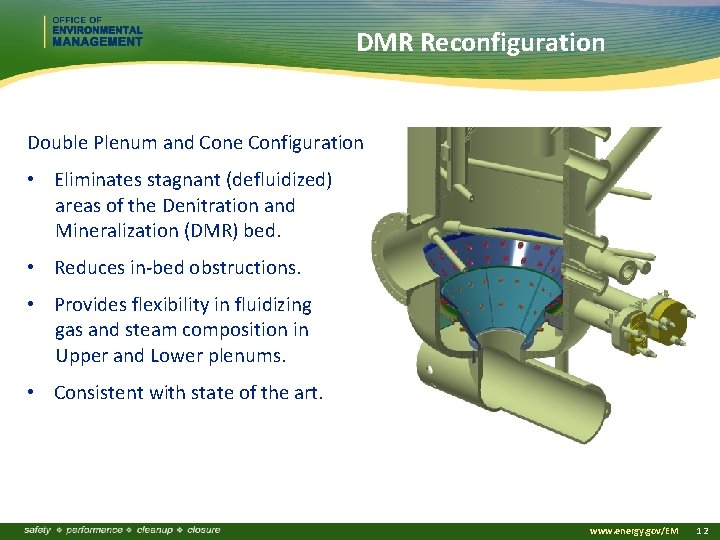
DMR Reconfiguration Double Plenum and Cone Configuration • Eliminates stagnant (defluidized) areas of the Denitration and Mineralization (DMR) bed. • Reduces in-bed obstructions. • Provides flexibility in fluidizing gas and steam composition in Upper and Lower plenums. • Consistent with state of the art. www. energy. gov/EM 12
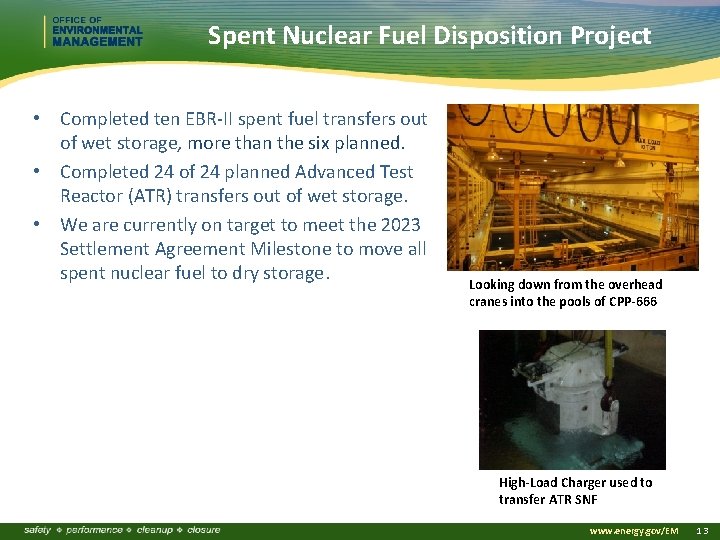
Spent Nuclear Fuel Disposition Project • Completed ten EBR-II spent fuel transfers out of wet storage, more than the six planned. • Completed 24 of 24 planned Advanced Test Reactor (ATR) transfers out of wet storage. • We are currently on target to meet the 2023 Settlement Agreement Milestone to move all spent nuclear fuel to dry storage. Looking down from the overhead cranes into the pools of CPP-666 High-Load Charger used to transfer ATR SNF www. energy. gov/EM 13
Summary of Accomplishments in FY 17 • Fluor completed retrieval of remaining stored transuranic waste. • Exhumed. 40 acre of targeted buried waste. • Shipments of transuranic waste resumed to the Waste Isolation Pilot Plant, completing 46 since April, 2017. • Completed 45 transfers of spent nuclear fuel from wet to dry. • Resolved important issues related to start-up of the Integrated Waste Treatment Unit (IWTU). • On the road to resolving the critical issue of fluidization in the IWTU main processing cell. 14 www. energy. gov/EM 14