
ID 3 Algorithm Michael Crawford Overview ID 3
- Slides: 28
ID 3 Algorithm Michael Crawford
Overview ID 3 Background n Entropy n Shannon Entropy n Information Gain n ID 3 Algorithm n ID 3 Example n Closing Notes n
ID 3 Background “Iterative Dichotomizer 3”. n Invented by Ross Quinlan in 1979. n Generates Decision Trees using Shannon Entropy. n Succeeded by Quinlan’s C 4. 5 and C 5. 0 algorithms. n
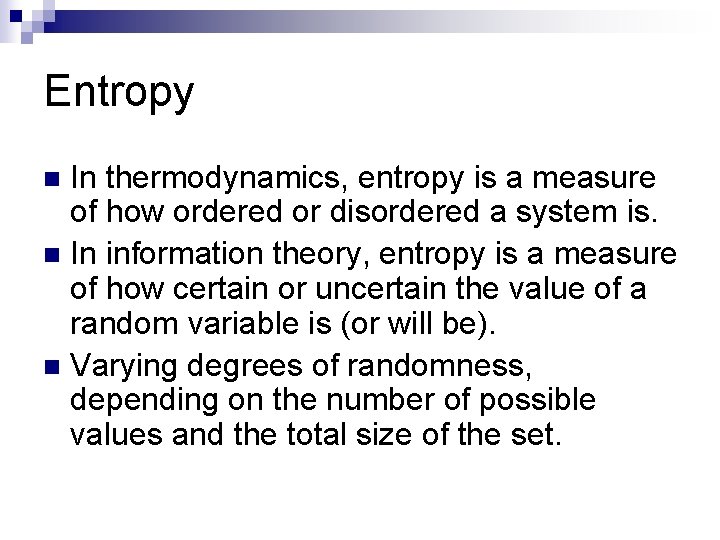
Entropy In thermodynamics, entropy is a measure of how ordered or disordered a system is. n In information theory, entropy is a measure of how certain or uncertain the value of a random variable is (or will be). n Varying degrees of randomness, depending on the number of possible values and the total size of the set. n
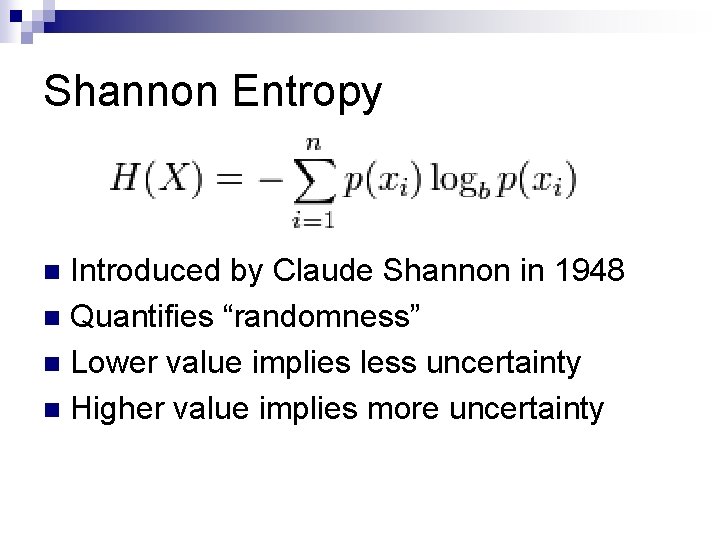
Shannon Entropy Introduced by Claude Shannon in 1948 n Quantifies “randomness” n Lower value implies less uncertainty n Higher value implies more uncertainty n
Information Gain Uses Shannon Entropy n IG calculates effective change in entropy after making a decision based on the value of an attribute. n For decision trees, it’s ideal to base decisions on the attribute that provides the largest change in entropy, the attribute with the highest gain. n
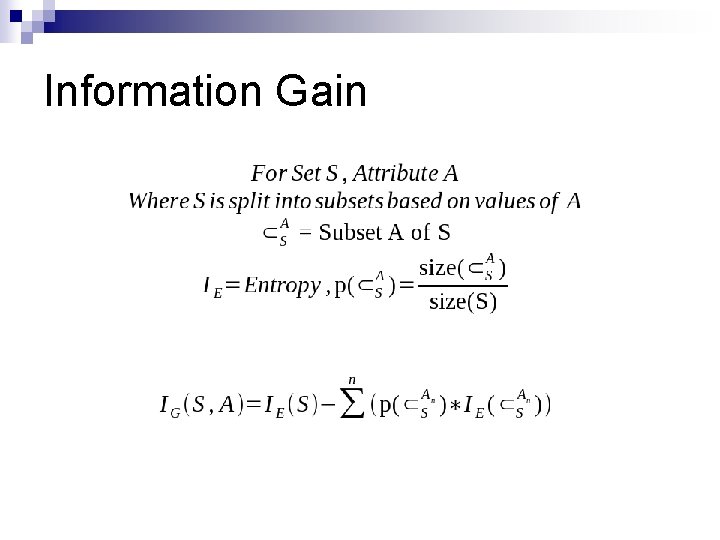
Information Gain
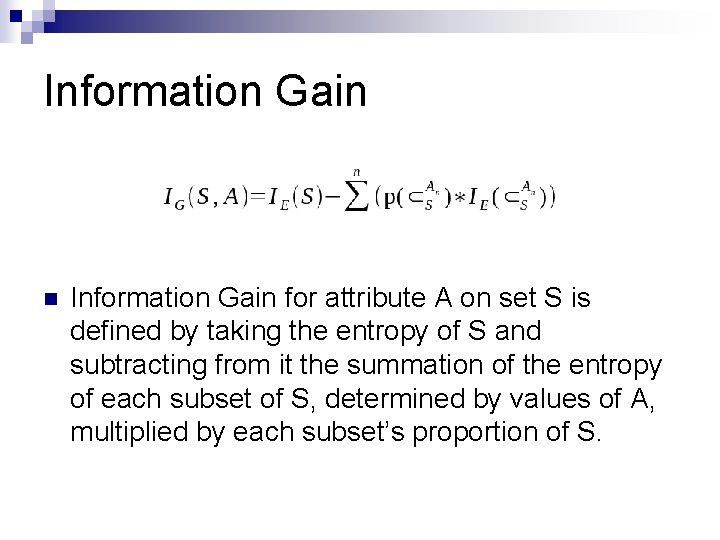
Information Gain n Information Gain for attribute A on set S is defined by taking the entropy of S and subtracting from it the summation of the entropy of each subset of S, determined by values of A, multiplied by each subset’s proportion of S.
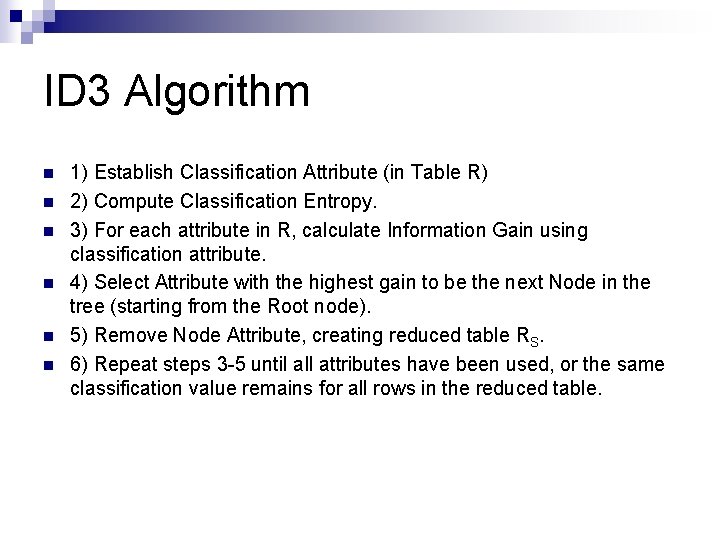
ID 3 Algorithm n n n 1) Establish Classification Attribute (in Table R) 2) Compute Classification Entropy. 3) For each attribute in R, calculate Information Gain using classification attribute. 4) Select Attribute with the highest gain to be the next Node in the tree (starting from the Root node). 5) Remove Node Attribute, creating reduced table RS. 6) Repeat steps 3 -5 until all attributes have been used, or the same classification value remains for all rows in the reduced table.
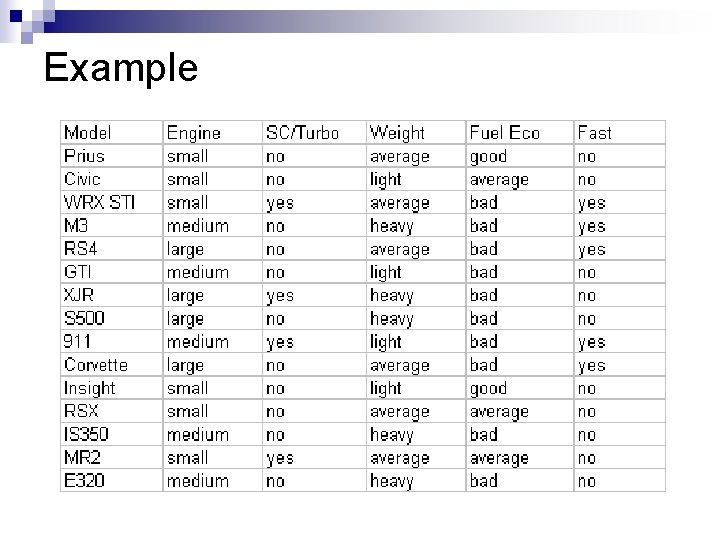
Example
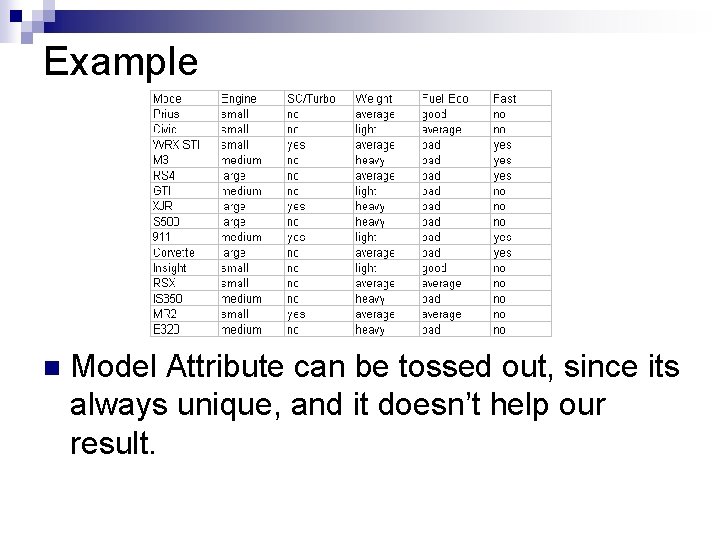
Example n Model Attribute can be tossed out, since its always unique, and it doesn’t help our result.
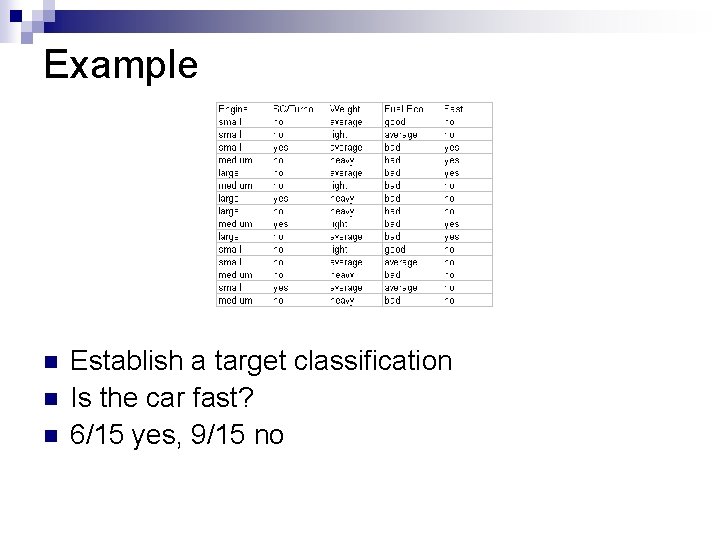
Example n n n Establish a target classification Is the car fast? 6/15 yes, 9/15 no
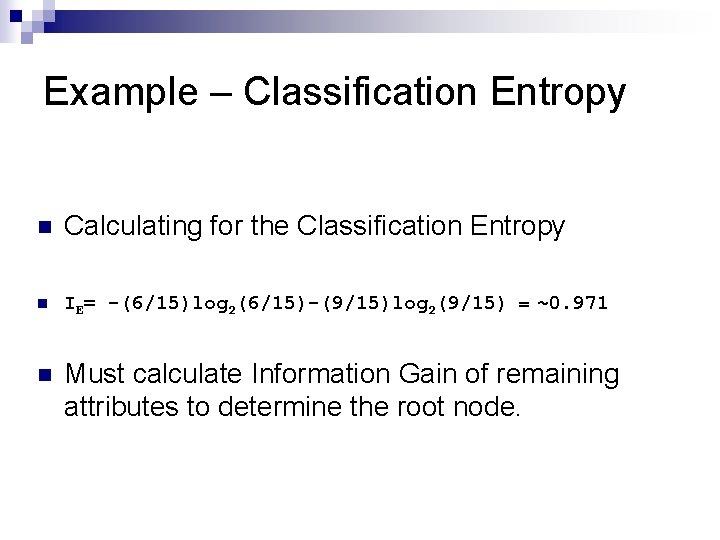
Example – Classification Entropy n Calculating for the Classification Entropy n IE= -(6/15)log 2(6/15)-(9/15)log 2(9/15) = ~0. 971 n Must calculate Information Gain of remaining attributes to determine the root node.
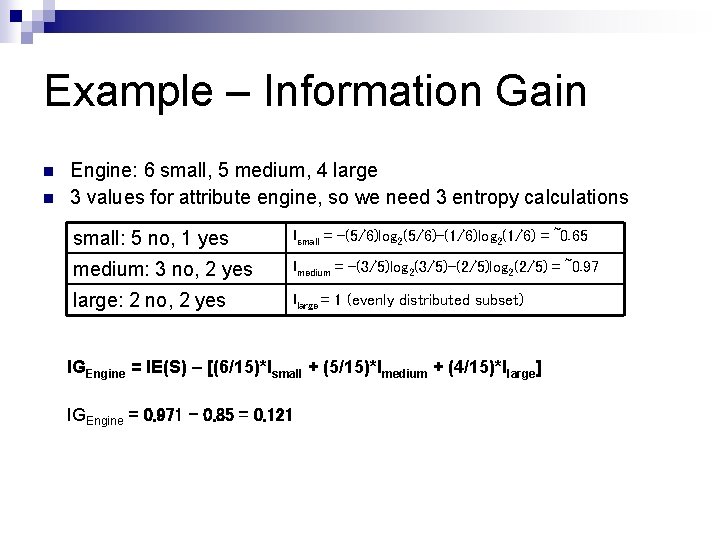
Example – Information Gain n n Engine: 6 small, 5 medium, 4 large 3 values for attribute engine, so we need 3 entropy calculations small: 5 no, 1 yes Ismall = -(5/6)log 2(5/6)-(1/6)log 2(1/6) = ~0. 65 medium: 3 no, 2 yes Imedium = -(3/5)log 2(3/5)-(2/5)log 2(2/5) = ~0. 97 large: 2 no, 2 yes Ilarge = 1 (evenly distributed subset) IGEngine = IE(S) – [(6/15)*Ismall + (5/15)*Imedium + (4/15)*Ilarge] IGEngine = 0. 971 – 0. 85 = 0. 121
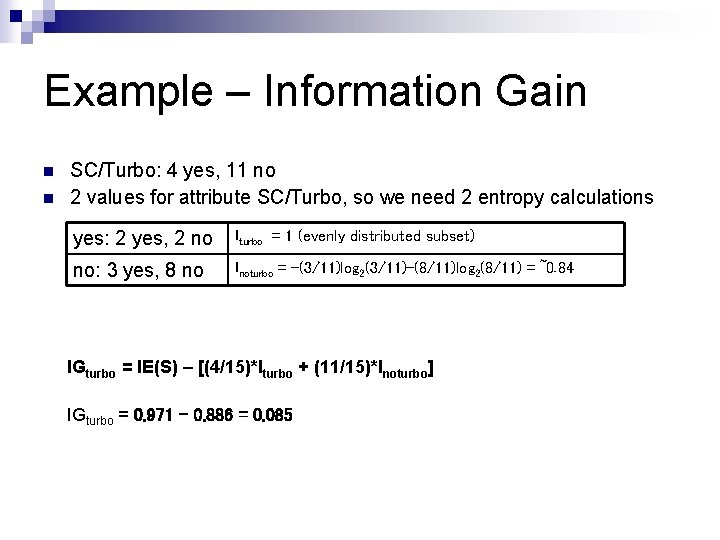
Example – Information Gain n n SC/Turbo: 4 yes, 11 no 2 values for attribute SC/Turbo, so we need 2 entropy calculations yes: 2 yes, 2 no Iturbo = 1 (evenly distributed subset) no: 3 yes, 8 no Inoturbo = -(3/11)log 2(3/11)-(8/11)log 2(8/11) = ~0. 84 IGturbo = IE(S) – [(4/15)*Iturbo + (11/15)*Inoturbo] IGturbo = 0. 971 – 0. 886 = 0. 085
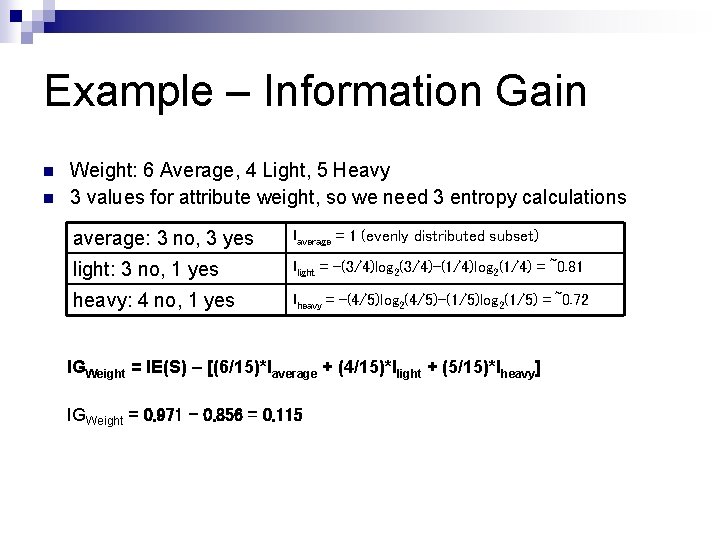
Example – Information Gain n n Weight: 6 Average, 4 Light, 5 Heavy 3 values for attribute weight, so we need 3 entropy calculations average: 3 no, 3 yes Iaverage = 1 (evenly distributed subset) light: 3 no, 1 yes Ilight = -(3/4)log 2(3/4)-(1/4)log 2(1/4) = ~0. 81 heavy: 4 no, 1 yes Iheavy = -(4/5)log 2(4/5)-(1/5)log 2(1/5) = ~0. 72 IGWeight = IE(S) – [(6/15)*Iaverage + (4/15)*Ilight + (5/15)*Iheavy] IGWeight = 0. 971 – 0. 856 = 0. 115
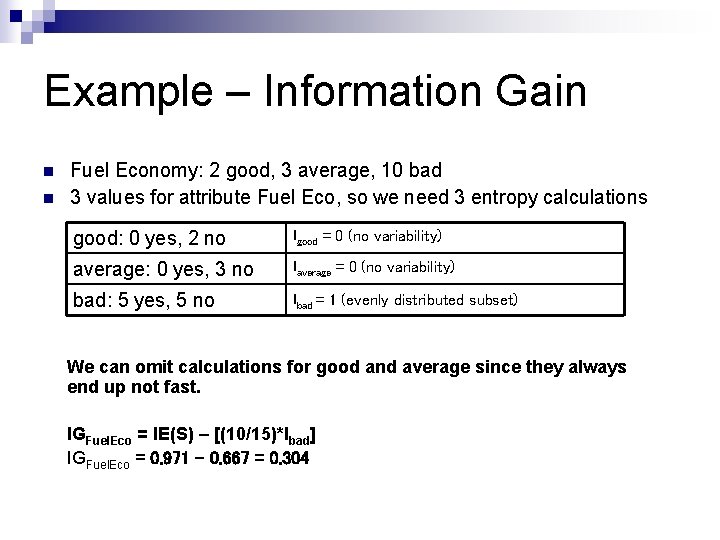
Example – Information Gain n n Fuel Economy: 2 good, 3 average, 10 bad 3 values for attribute Fuel Eco, so we need 3 entropy calculations good: 0 yes, 2 no Igood = 0 (no variability) average: 0 yes, 3 no Iaverage = 0 (no variability) bad: 5 yes, 5 no Ibad = 1 (evenly distributed subset) We can omit calculations for good and average since they always end up not fast. IGFuel. Eco = IE(S) – [(10/15)*Ibad] IGFuel. Eco = 0. 971 – 0. 667 = 0. 304
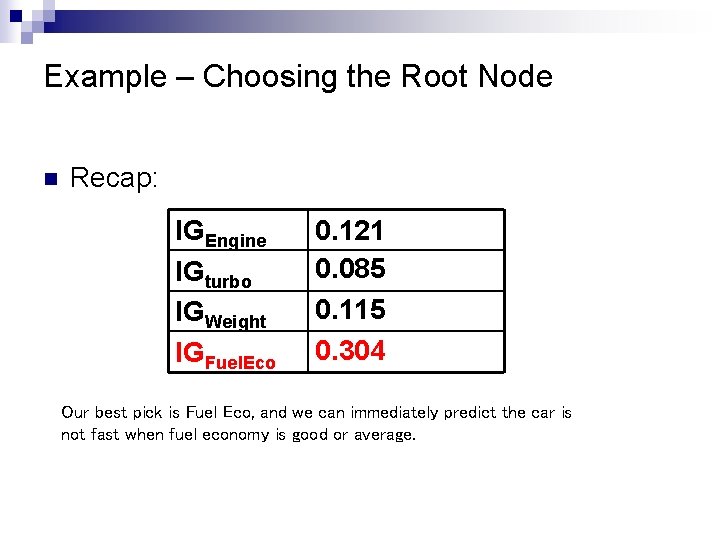
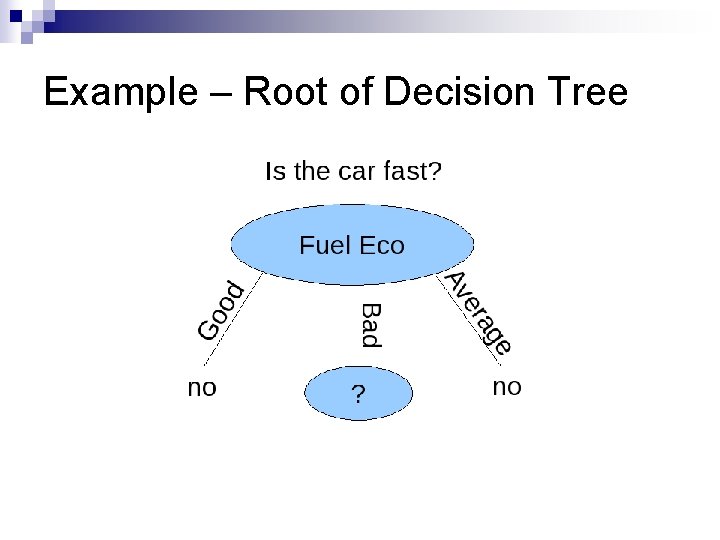
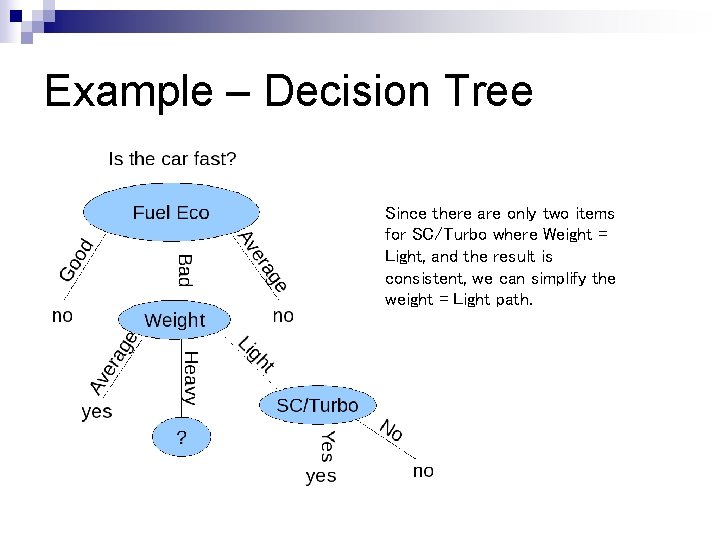
Example – Choosing the Root Node n Recap: IGEngine IGturbo IGWeight IGFuel. Eco 0. 121 0. 085 0. 115 0. 304 Our best pick is Fuel Eco, and we can immediately predict the car is not fast when fuel economy is good or average.
Example – Root of Decision Tree
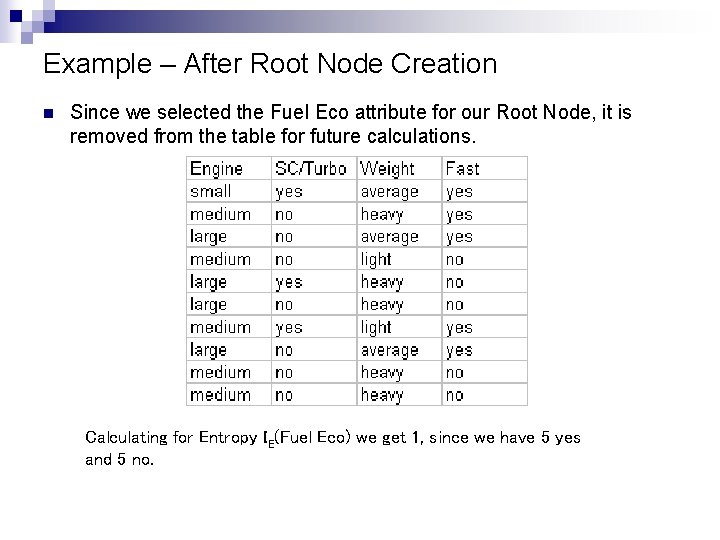
Example – After Root Node Creation n Since we selected the Fuel Eco attribute for our Root Node, it is removed from the table for future calculations. Calculating for Entropy IE(Fuel Eco) we get 1, since we have 5 yes and 5 no.
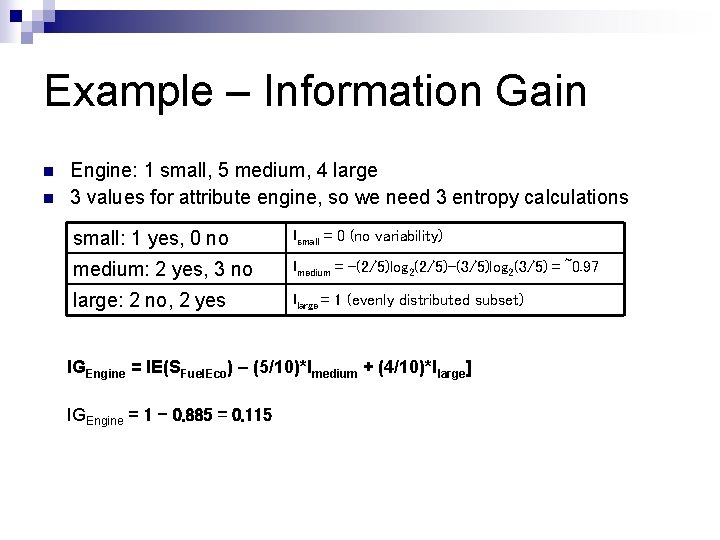
Example – Information Gain n n Engine: 1 small, 5 medium, 4 large 3 values for attribute engine, so we need 3 entropy calculations small: 1 yes, 0 no Ismall = 0 (no variability) medium: 2 yes, 3 no Imedium = -(2/5)log 2(2/5)-(3/5)log 2(3/5) = ~0. 97 large: 2 no, 2 yes Ilarge = 1 (evenly distributed subset) IGEngine = IE(SFuel. Eco) – (5/10)*Imedium + (4/10)*Ilarge] IGEngine = 1 – 0. 885 = 0. 115
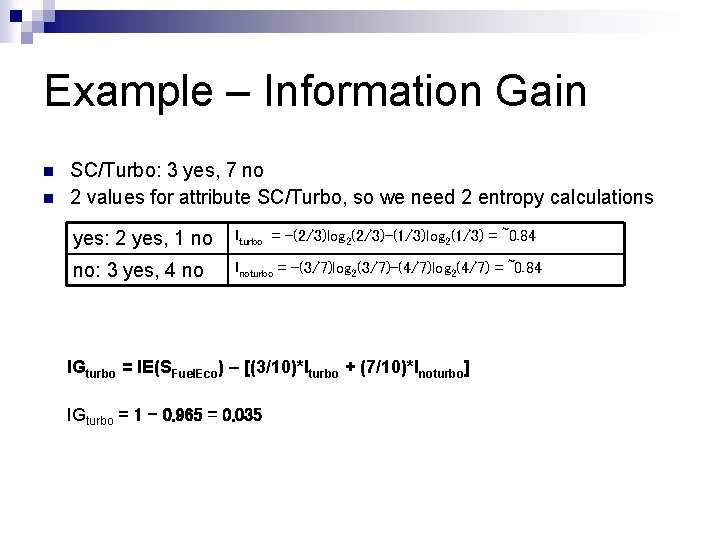
Example – Information Gain n n SC/Turbo: 3 yes, 7 no 2 values for attribute SC/Turbo, so we need 2 entropy calculations yes: 2 yes, 1 no Iturbo = -(2/3)log 2(2/3)-(1/3)log 2(1/3) = ~0. 84 no: 3 yes, 4 no Inoturbo = -(3/7)log 2(3/7)-(4/7)log 2(4/7) = ~0. 84 IGturbo = IE(SFuel. Eco) – [(3/10)*Iturbo + (7/10)*Inoturbo] IGturbo = 1 – 0. 965 = 0. 035
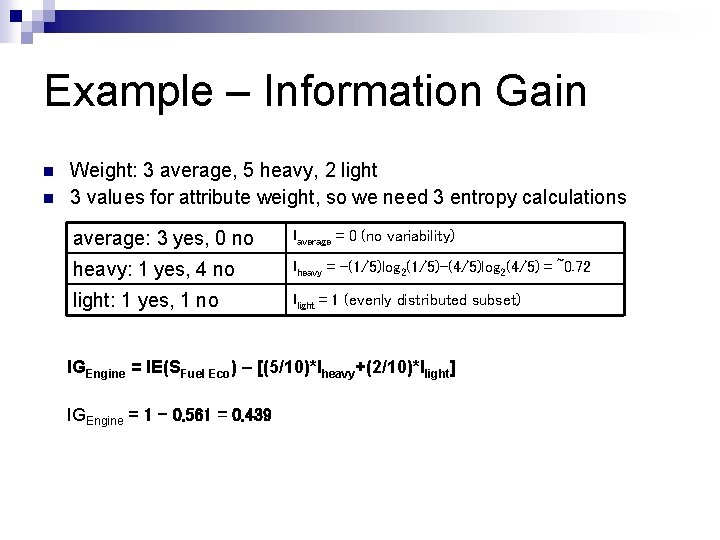
Example – Information Gain n n Weight: 3 average, 5 heavy, 2 light 3 values for attribute weight, so we need 3 entropy calculations average: 3 yes, 0 no Iaverage = 0 (no variability) heavy: 1 yes, 4 no Iheavy = -(1/5)log 2(1/5)-(4/5)log 2(4/5) = ~0. 72 light: 1 yes, 1 no Ilight = 1 (evenly distributed subset) IGEngine = IE(SFuel Eco) – [(5/10)*Iheavy+(2/10)*Ilight] IGEngine = 1 – 0. 561 = 0. 439
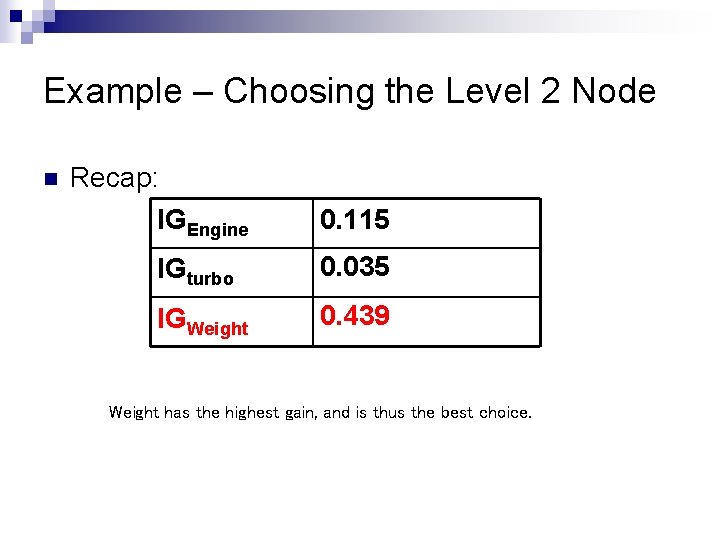
Example – Choosing the Level 2 Node n Recap: IGEngine 0. 115 IGturbo 0. 035 IGWeight 0. 439 Weight has the highest gain, and is thus the best choice.
Example – Decision Tree Since there are only two items for SC/Turbo where Weight = Light, and the result is consistent, we can simplify the weight = Light path.
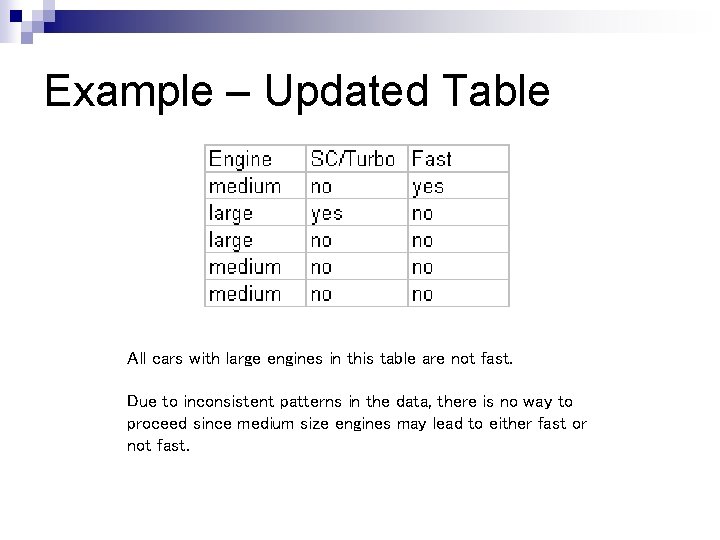
Example – Updated Table All cars with large engines in this table are not fast. Due to inconsistent patterns in the data, there is no way to proceed since medium size engines may lead to either fast or not fast.
Closing Notes n ID 3 attempts to make the shortest decision tree out of a set of learning data, shortest is not always the best classification. n Requires learning data to have completely consistent patterns with no uncertainty.
References n n n Quinlan, J. R (1985). Induction of Decision Trees, Machine Learning 1: 81106, 1986. Ross, Peter (10/30/2000). Rule Induction: Ross Quinlan’s ID 3 Algorithm (Retrieved 04/23/2010). http: //www. dcs. napier. ac. uk/~peter/vldb/dm/node 11. html Author Unknown. (Fall 1997). The ID 3 Algorithm. Retrieved (Retrieved 04/23/2010). http: //www. cise. ufl. edu/~ddd/cap 6635/Fall-97/Shortpapers/2. htm Elmasri, Navathe (2007). Fundamentals of Database Systems (5 th Edition), 975 -977. Shannon, Claude E. Prediction and Entropy of Printed English. (Retrieved 04/23/2010). http: //languagelog. ldc. upenn. edu/myl/Shannon 1950. pdf