
ICUZambia Project Title CBMS An investigation on Education
ICU-Zambia Project Title: CBMS An investigation on Education System in Zambia: A Case of Buseko Ward of Kasama Central Constituency Name: Rabbecca Mwemena SIN: 1702151600 Province: Northern Province. Program: Bachelor of Science in Agriculture with Education Course: CBMS. Lecturer: Mr. Chibomba K
Table of Contents: Data Presentation from Pupils Responses………………. 3 Data Presentation from Teachers Responses……………. 3 Discussion of the findings…………………. Slide 19 Recommendations………………………. . Slide 23 Conclusion: …………………………. 27 Slide
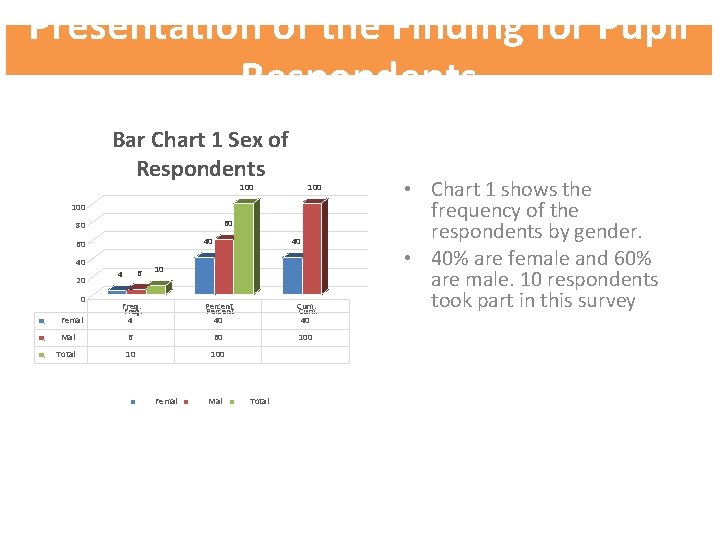
Presentation of the Finding for Pupil Respondents Bar Chart 1 Sex of Respondents 100 100 60 80 40 60 40 20 0 6 4 40 10 Freq. 4 Percent 40 Cum. 40 Mal 6 60 100 Total 10 100 Femal Mal Total • Chart 1 shows the frequency of the respondents by gender. • 40% are female and 60% are male. 10 respondents took part in this survey
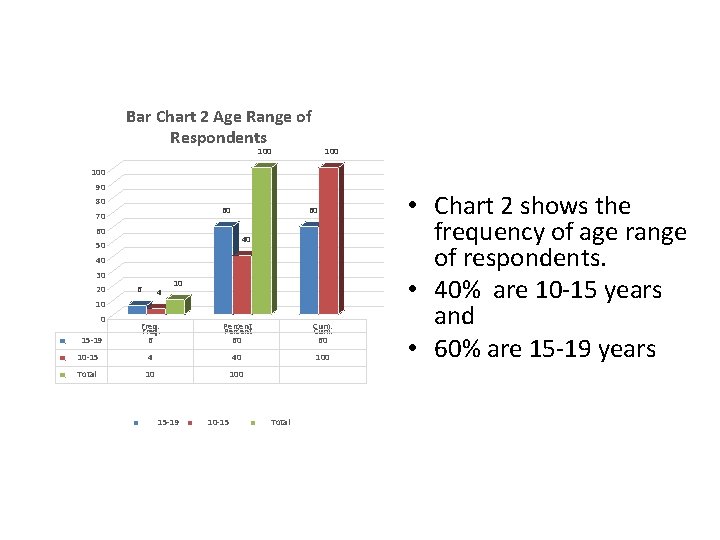
Bar Chart 2 Age Range of Respondents 100 100 90 80 60 70 60 60 40 50 40 30 20 6 4 10 10 0 Freq. 6 Percent 60 Cum. 60 10 -15 4 40 100 Total 10 100 15 -19 10 -15 Total • Chart 2 shows the frequency of age range of respondents. • 40% are 10 -15 years and • 60% are 15 -19 years
• Pie chart 1. is a representation of parental status of respondents. • 10% represents for both double and single orphans where as 80% have both parents

Pie Chart 2. Level of edu. of Parent or Guardian 1, 10% 3, 30% 5, 50% Never been to school Primary Secondary Tertiary • Pie Chart 2 indicates the level of education of parents or guardians of the respondents. • 10% represents both parents or guardians who have never been to school and those who only have primary education. • 30% represents those with tertiary education and • 50% represents those with secondary education.
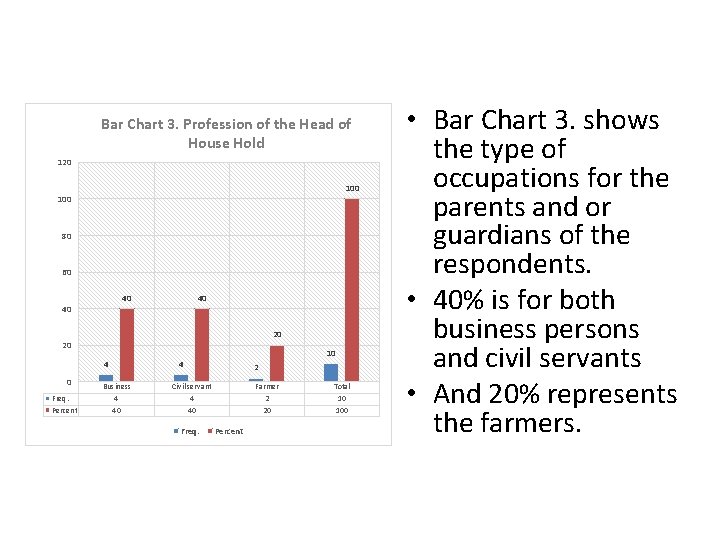
Bar Chart 3. Profession of the Head of House Hold 120 100 80 60 40 40 40 20 20 4 0 Freq. Percent Business 4 40 10 4 2 Civil servant 4 40 Freq. Farmer 2 20 Percent Total 10 100 • Bar Chart 3. shows the type of occupations for the parents and or guardians of the respondents. • 40% is for both business persons and civil servants • And 20% represents the farmers.
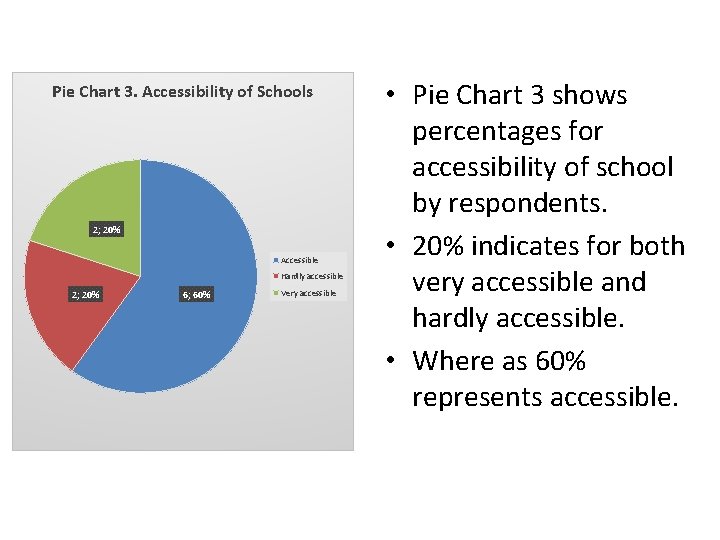
Pie Chart 3. Accessibility of Schools 2; 20% Accessible Hardly accessible 2; 20% 6; 60% Very accessible • Pie Chart 3 shows percentages for accessibility of school by respondents. • 20% indicates for both very accessible and hardly accessible. • Where as 60% represents accessible.
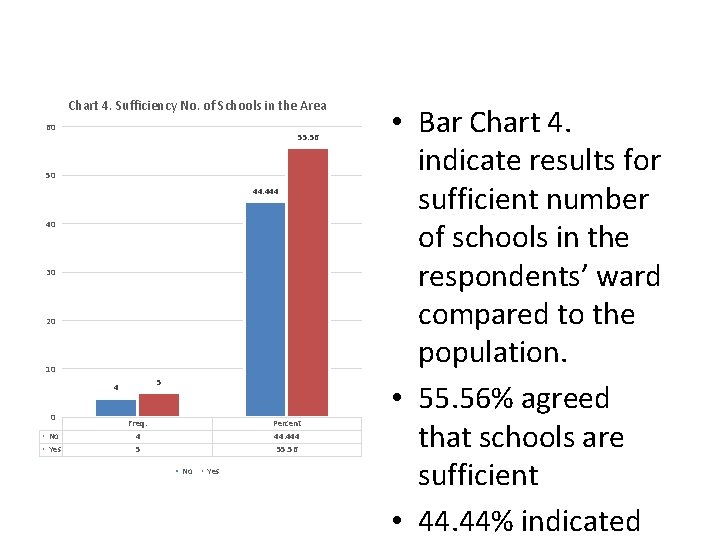
Chart 4. Sufficiency No. of Schools in the Area 60 55. 56 50 44. 444 40 30 20 10 5 4 0 No Yes Freq. 4 5 Percent 44. 444 55. 56 No Yes • Bar Chart 4. indicate results for sufficient number of schools in the respondents’ ward compared to the population. • 55. 56% agreed that schools are sufficient • 44. 44% indicated
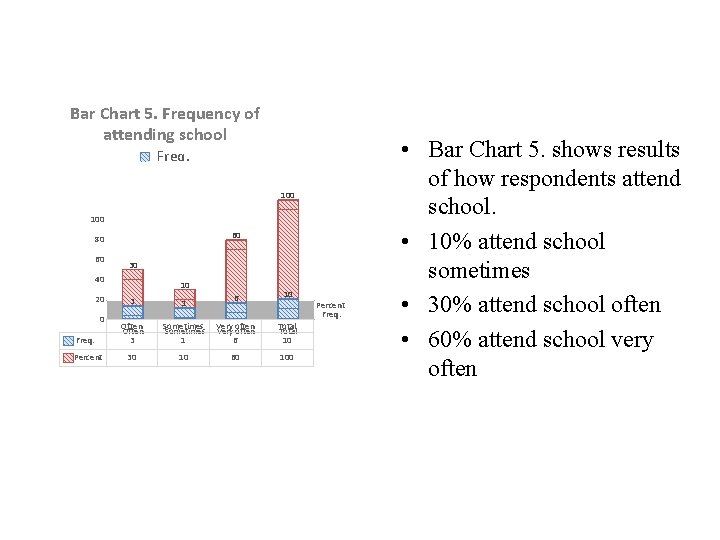
Bar Chart 5. Frequency of attending school Freq. Percent 100 60 80 60 30 40 20 0 Freq. Percent 10 6 10 Sometimes 1 Very often 6 Total 10 10 60 100 3 1 Often 3 30 Percent Freq. • Bar Chart 5. shows results of how respondents attend school. • 10% attend school sometimes • 30% attend school often • 60% attend school very often
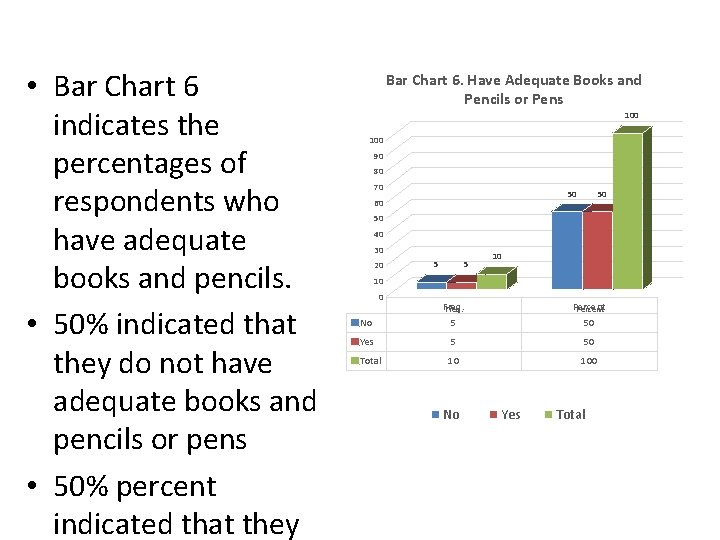
• Bar Chart 6 indicates the percentages of respondents who have adequate books and pencils. • 50% indicated that they do not have adequate books and pencils or pens • 50% percent indicated that they Bar Chart 6. Have Adequate Books and Pencils or Pens 100 90 80 70 50 60 50 50 40 30 20 5 5 10 10 0 Freq. Percent No 5 50 Yes 5 50 Total 10 100 No Yes Total
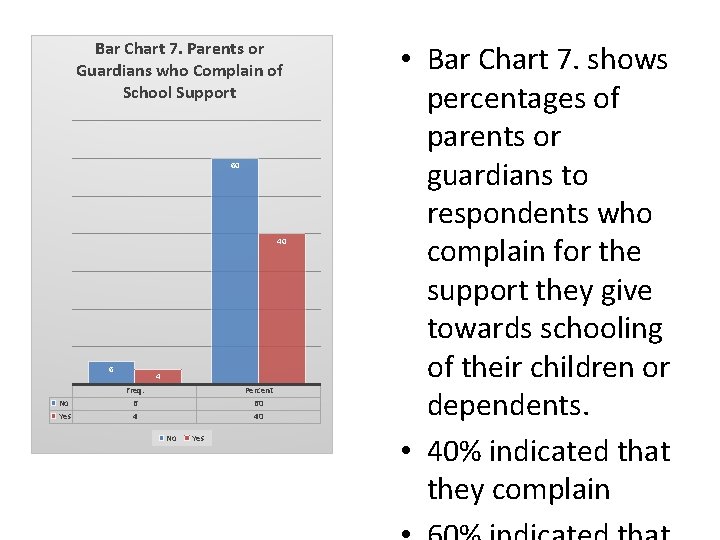
Bar Chart 7. Parents or Guardians who Complain of School Support 60 40 6 No Yes 4 Freq. 6 4 Percent 60 40 No Yes • Bar Chart 7. shows percentages of parents or guardians to respondents who complain for the support they give towards schooling of their children or dependents. • 40% indicated that they complain
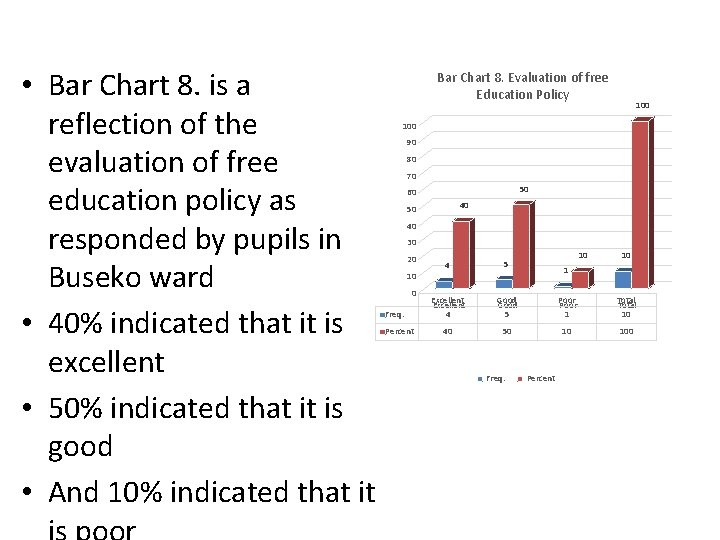
• Bar Chart 8. is a reflection of the evaluation of free education policy as responded by pupils in Buseko ward • 40% indicated that it is excellent • 50% indicated that it is good • And 10% indicated that it Bar Chart 8. Evaluation of free Education Policy 100 90 80 70 50 60 40 50 40 30 20 10 5 Excellent 4 Good 5 Poor 1 Total 10 40 50 10 100 1 10 0 Freq. Percent 10 4 Freq. Percent
• Bar chart 4. indicate the most predominant spoken local language in schools of Buseko ward. • 70% indicated Bemba and 30% indicated English.
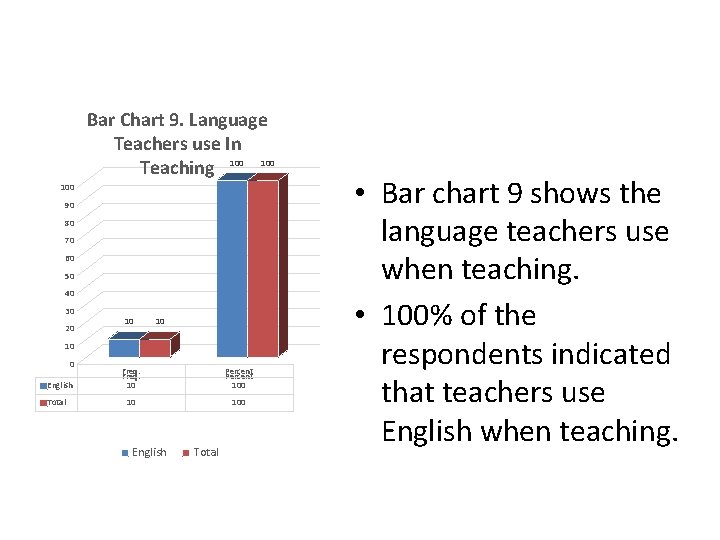
Bar Chart 9. Language Teachers use In Teaching 100 100 90 80 70 60 50 40 30 20 10 10 10 0 English Total Freq. 10 Percent 100 10 100 English Total • Bar chart 9 shows the language teachers use when teaching. • 100% of the respondents indicated that teachers use English when teaching.
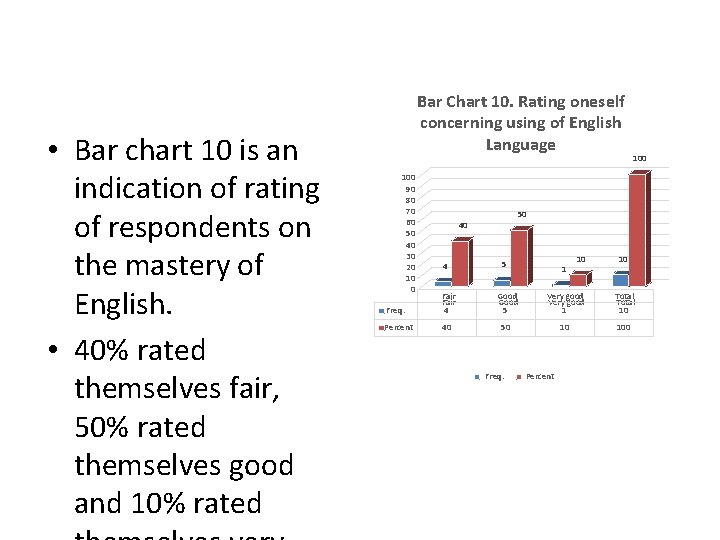
• Bar chart 10 is an indication of rating of respondents on the mastery of English. • 40% rated themselves fair, 50% rated themselves good and 10% rated Bar Chart 10. Rating oneself concerning using of English Language 100 90 80 70 60 50 40 30 20 100 50 40 4 5 1 10 10 Freq. Fair 4 Good 5 Very good 1 Total 10 Percent 40 50 10 100 Freq. Percent
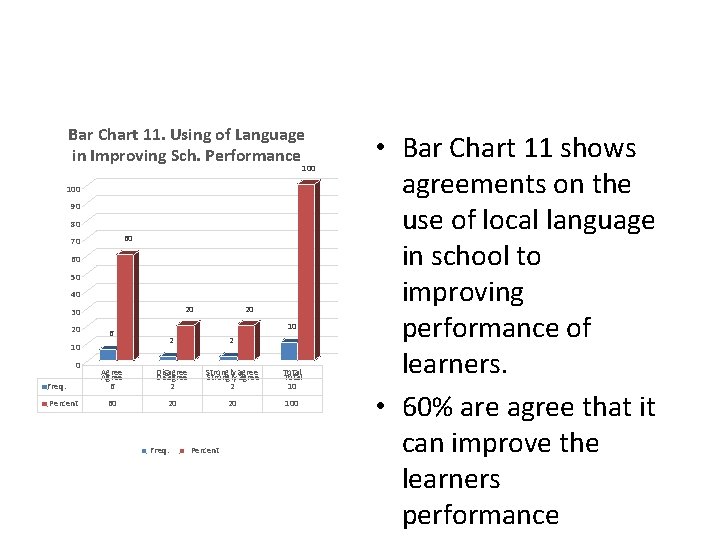
Bar Chart 11. Using of Language in Improving Sch. Performance 100 90 80 60 70 60 50 40 20 30 20 10 6 2 2 Agree 6 Disagree 2 Strongly agree 2 Total 10 60 20 20 10 0 Freq. Percent 20 Freq. Percent • Bar Chart 11 shows agreements on the use of local language in school to improving performance of learners. • 60% are agree that it can improve the learners performance
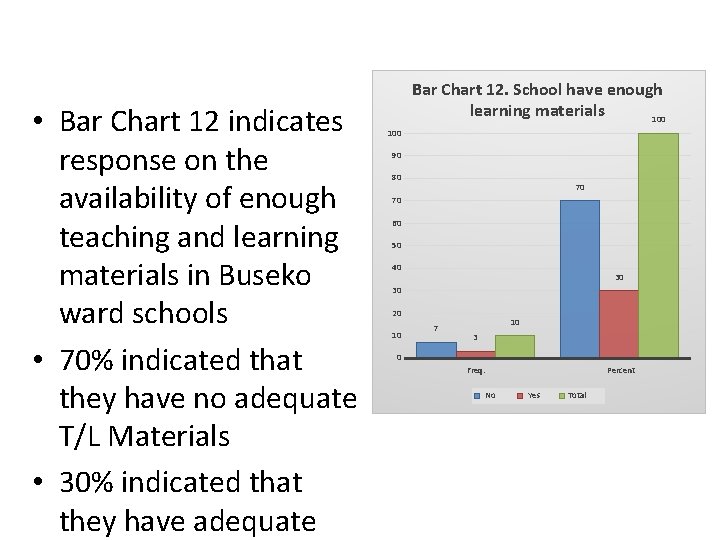
• Bar Chart 12 indicates response on the availability of enough teaching and learning materials in Buseko ward schools • 70% indicated that they have no adequate T/L Materials • 30% indicated that they have adequate Bar Chart 12. School have enough learning materials 100 90 80 70 70 60 50 40 30 30 20 10 7 10 3 0 Freq. No Percent Yes Total
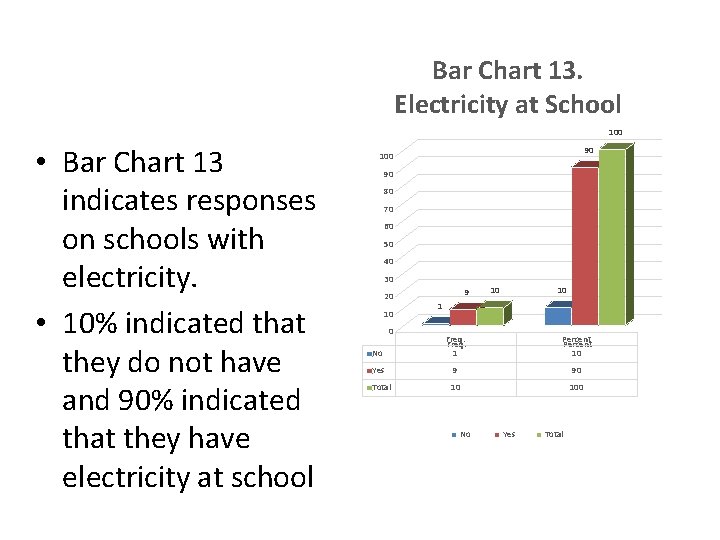
Bar Chart 13. Electricity at School 100 • Bar Chart 13 indicates responses on schools with electricity. • 10% indicated that they do not have and 90% indicated that they have electricity at school 90 100 90 80 70 60 50 40 30 20 10 0 9 10 10 1 No Freq. 1 Percent 10 Yes 9 90 Total 10 100 No Yes Total
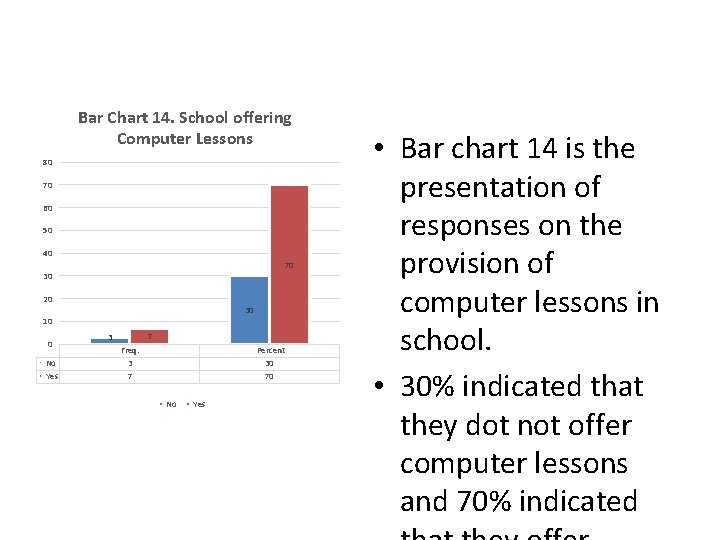
Bar Chart 14. School offering Computer Lessons 80 70 60 50 40 70 30 20 30 10 0 No Yes 7 3 Freq. 3 7 Percent 30 70 No Yes • Bar chart 14 is the presentation of responses on the provision of computer lessons in school. • 30% indicated that they dot not offer computer lessons and 70% indicated
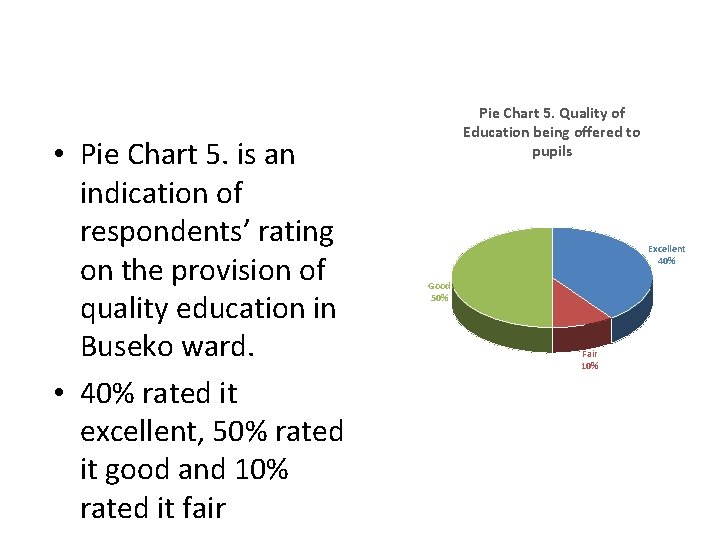
• Pie Chart 5. is an indication of respondents’ rating on the provision of quality education in Buseko ward. • 40% rated it excellent, 50% rated it good and 10% rated it fair Pie Chart 5. Quality of Education being offered to pupils Excellent 40% Good 50% Fair 10%
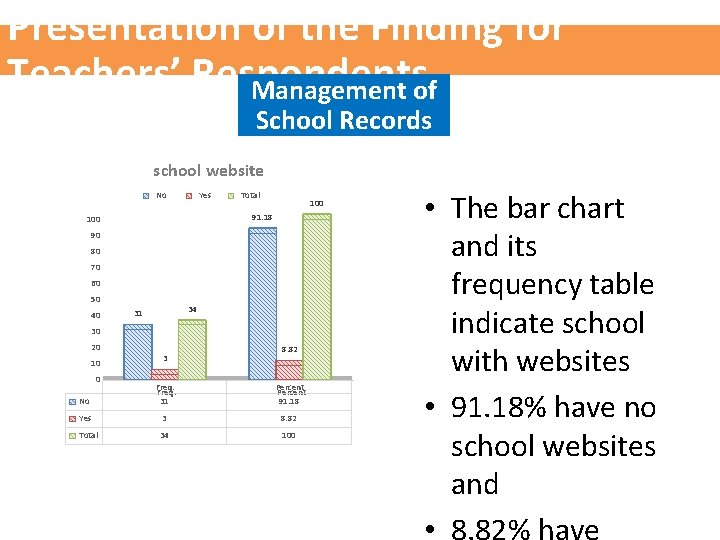
Presentation of the Finding for Teachers’ Respondents Management of School Records school website No Yes Total 100 91. 18 100 90 80 70 60 50 40 34 31 30 20 10 0 3 8. 82 No Freq. 31 Percent 91. 18 Yes 3 8. 82 Total 34 100 • The bar chart and its frequency table indicate school with websites • 91. 18% have no school websites and
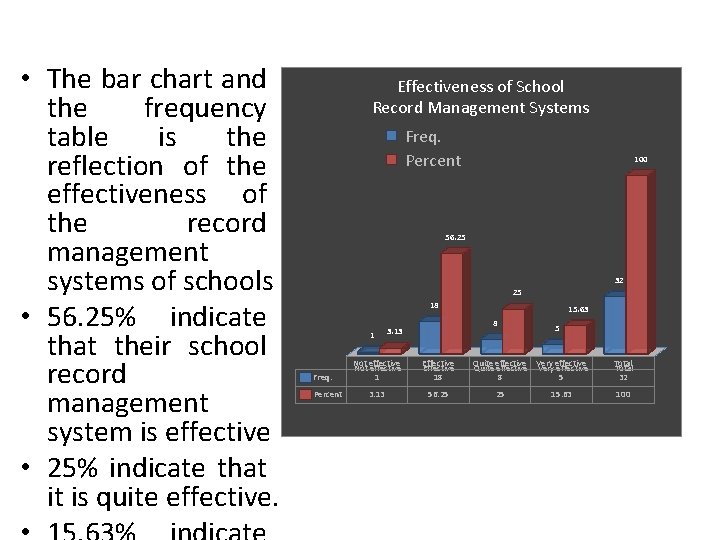
• The bar chart and the frequency table is the reflection of the effectiveness of the record management systems of schools • 56. 25% indicate that their school record management system is effective • 25% indicate that it is quite effective. Effectiveness of School Record Management Systems Freq. Percent 100 56. 25 32 25 18 1 Freq. Percent 15. 63 8 3. 13 Not effective 1 Effective 18 3. 13 56. 25 5 Quite effective Very effective 8 5 25 15. 63 Total 32 100
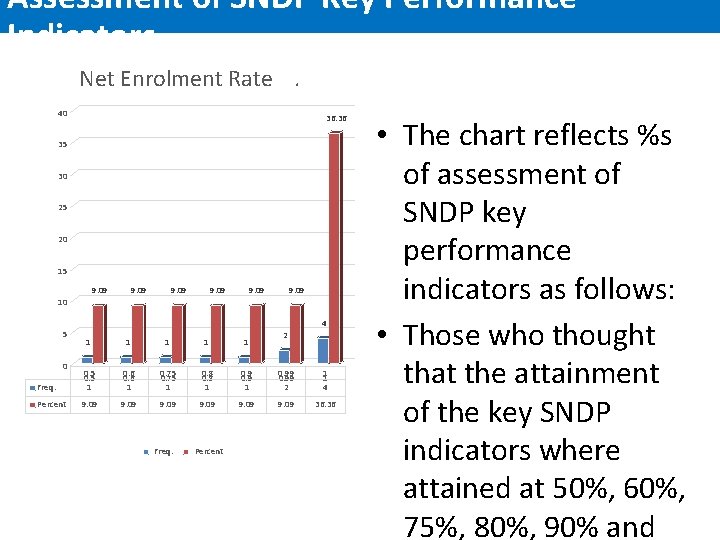
Assessment of SNDP Key Performance Indicators Net Enrolment Rate. 40 36. 36 35 30 25 20 15 9. 09 10 4 5 2 1 1 1 Freq. 0. 5 1 0. 6 1 0. 75 1 0. 8 1 0. 99 2 1 1 4 Percent 9. 09 36. 36 0 Freq. Percent • The chart reflects %s of assessment of SNDP key performance indicators as follows: • Those who thought that the attainment of the key SNDP indicators where attained at 50%, 60%, 75%, 80%, 90% and
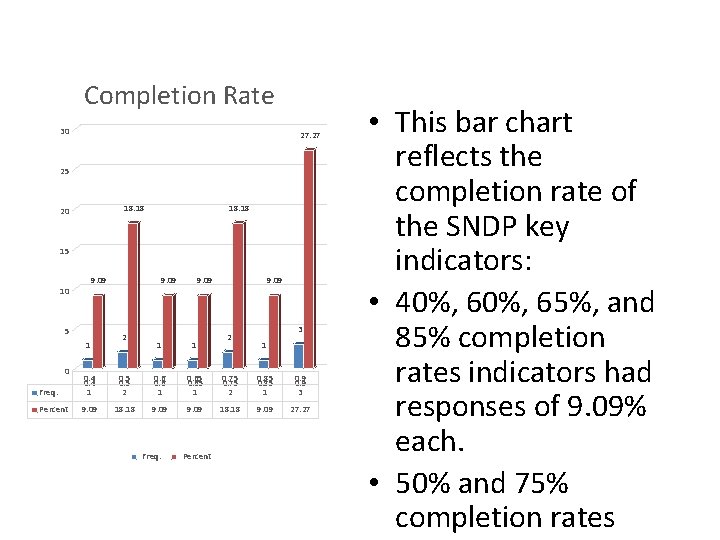
Completion Rate 30 27. 27 25 18. 18 20 18. 18 15 9. 09 10 5 1 0 2 1 1 2 3 1 Freq. 0. 4 1 0. 5 2 0. 6 1 0. 65 1 0. 75 2 0. 85 1 0. 9 3 Percent 9. 09 18. 18 9. 09 27. 27 Freq. Percent • This bar chart reflects the completion rate of the SNDP key indicators: • 40%, 65%, and 85% completion rates indicators had responses of 9. 09% each. • 50% and 75% completion rates
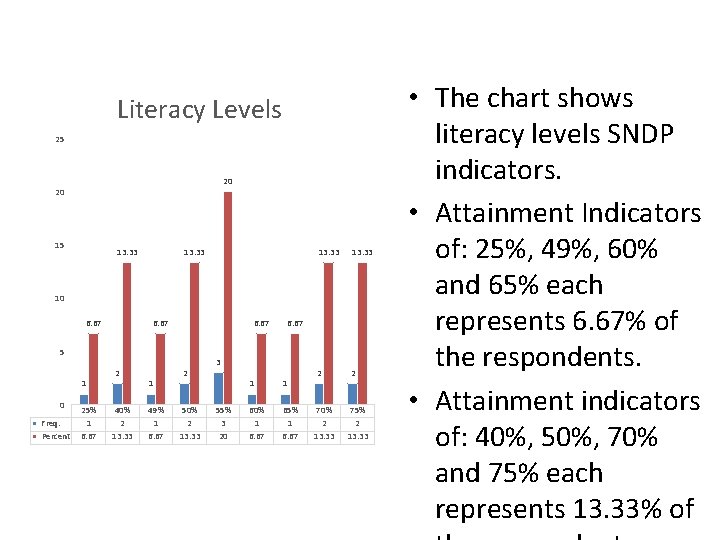
Literacy Levels 25 20 20 15 13. 33 2 2 10 6. 67 5 1 0 Freq. Percent 25% 1 6. 67 2 40% 2 13. 33 1 49% 1 6. 67 2 50% 2 13. 33 6. 67 3 55% 3 20 1 1 60% 1 6. 67 65% 1 6. 67 70% 2 13. 33 75% 2 13. 33 • The chart shows literacy levels SNDP indicators. • Attainment Indicators of: 25%, 49%, 60% and 65% each represents 6. 67% of the respondents. • Attainment indicators of: 40%, 50%, 70% and 75% each represents 13. 33% of
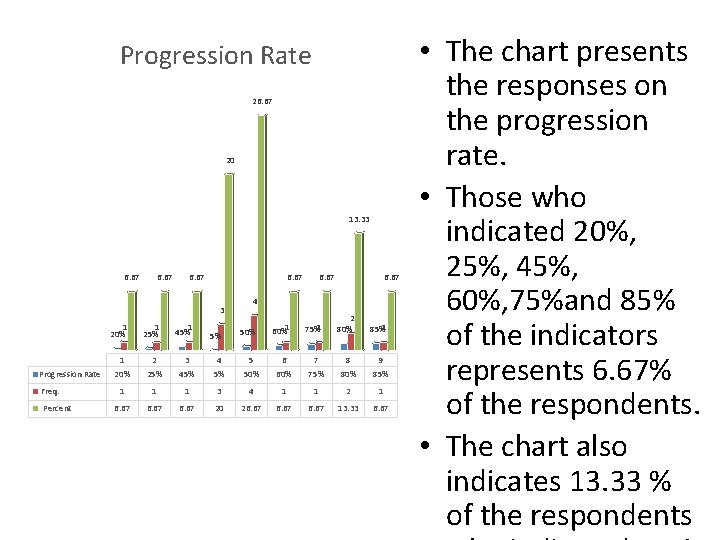
Progression Rate 26. 67 20 13. 33 6. 67 3 1 20% Progression Rate Freq. Percent 1 25% 1 45% 6. 67 4 5% 50% 60%1 75%1 2 80% 85%1 1 2 3 4 5 6 7 8 9 20% 25% 45% 5% 50% 60% 75% 80% 85% 1 1 1 3 4 1 1 2 1 6. 67 20 26. 67 13. 33 6. 67 • The chart presents the responses on the progression rate. • Those who indicated 20%, 25%, 45%, 60%, 75%and 85% of the indicators represents 6. 67% of the respondents. • The chart also indicates 13. 33 % of the respondents
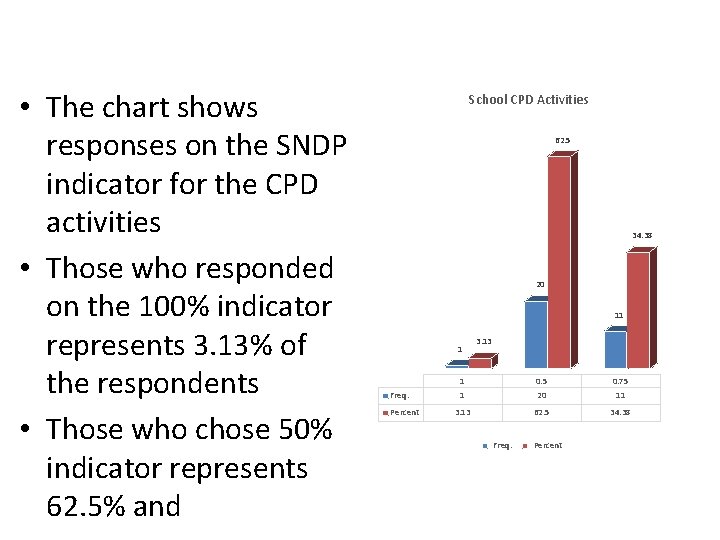
• The chart shows responses on the SNDP indicator for the CPD activities • Those who responded on the 100% indicator represents 3. 13% of the respondents • Those who chose 50% indicator represents 62. 5% and School CPD Activities 62. 5 34. 38 20 11 1 Freq. Percent 3. 13 1 0. 5 0. 75 1 20 11 3. 13 62. 5 34. 38 Freq. Percent
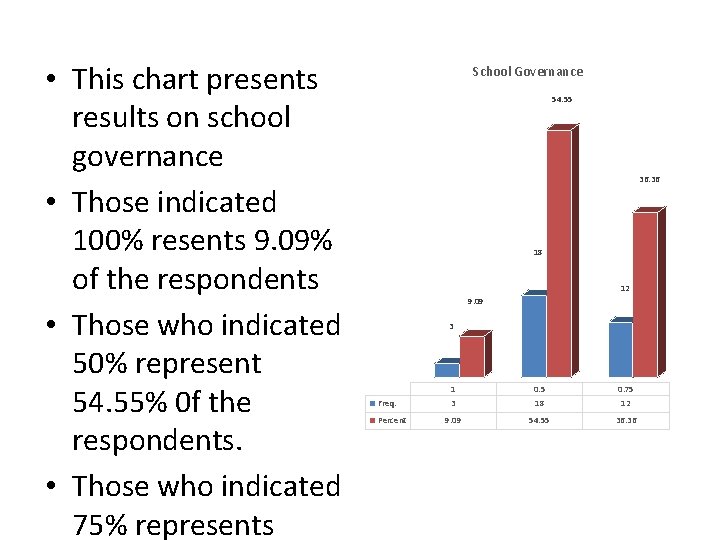
• This chart presents results on school governance • Those indicated 100% resents 9. 09% of the respondents • Those who indicated 50% represent 54. 55% 0 f the respondents. • Those who indicated 75% represents School Governance 54. 55 36. 36 18 12 9. 09 3 Freq. Percent 1 0. 5 0. 75 3 18 12 9. 09 54. 55 36. 36
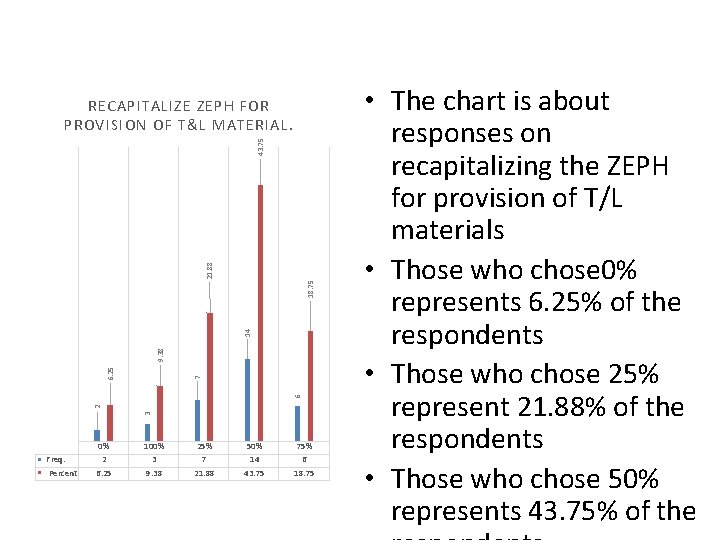
3 2 6 7 6. 25 9. 38 14 18. 75 21. 88 43. 75 RECAPITALIZE ZEPH FOR PROVISION OF T&L MATERIAL. Freq. Percent 0% 2 6. 25 100% 3 9. 38 25% 7 21. 88 50% 14 43. 75 75% 6 18. 75 • The chart is about responses on recapitalizing the ZEPH for provision of T/L materials • Those who chose 0% represents 6. 25% of the respondents • Those who chose 25% represent 21. 88% of the respondents • Those who chose 50% represents 43. 75% of the
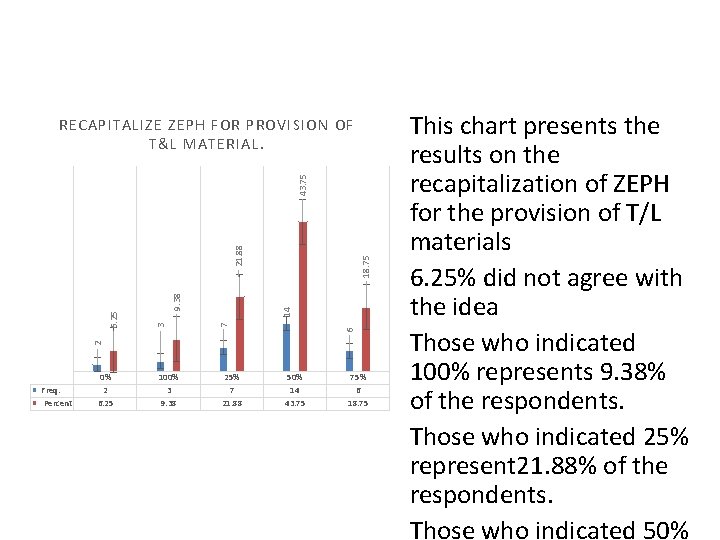
18. 75 6 7 14 9. 38 3 2 6. 25 21. 88 43. 75 RECAPITALIZE ZEPH FOR PROVISION OF T&L MATERIAL. Freq. Percent 0% 2 6. 25 100% 3 9. 38 25% 7 21. 88 50% 14 43. 75 75% 6 18. 75 This chart presents the results on the recapitalization of ZEPH for the provision of T/L materials 6. 25% did not agree with the idea Those who indicated 100% represents 9. 38% of the respondents. Those who indicated 25% represent 21. 88% of the respondents. Those who indicated 50%
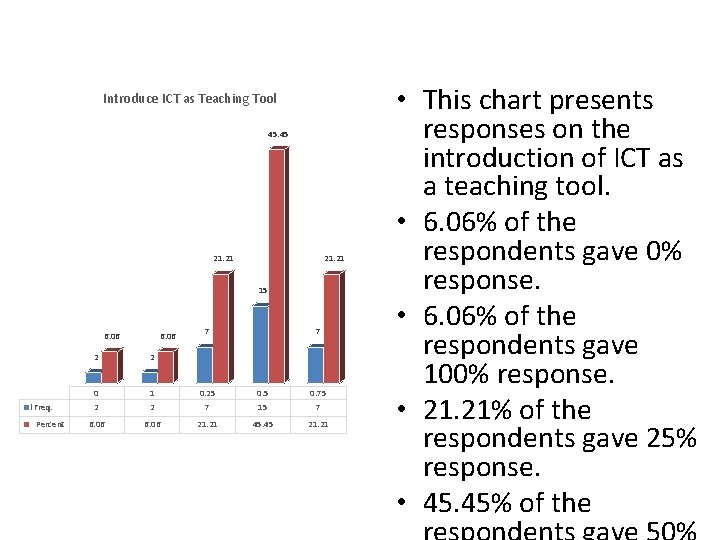
Introduce ICT as Teaching Tool 45. 45 21. 21 15 6. 06 2 l Freq. Percent 6. 06 7 7 2 0 1 0. 25 0. 75 2 2 7 15 7 6. 06 21. 21 45. 45 21. 21 • This chart presents responses on the introduction of ICT as a teaching tool. • 6. 06% of the respondents gave 0% response. • 6. 06% of the respondents gave 100% response. • 21. 21% of the respondents gave 25% response. • 45. 45% of the
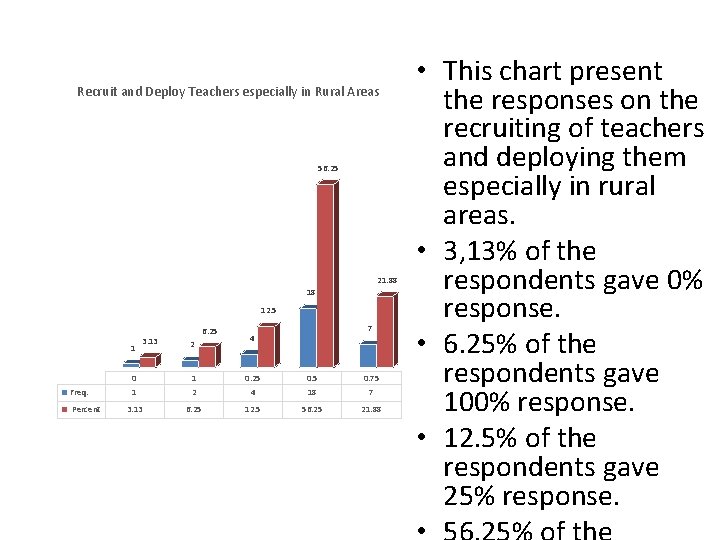
Recruit and Deploy Teachers especially in Rural Areas 56. 25 21. 88 18 12. 5 1 Freq. Percent 3. 13 6. 25 2 7 4 0 1 0. 25 0. 75 1 2 4 18 7 3. 13 6. 25 12. 5 56. 25 21. 88 • This chart present the responses on the recruiting of teachers and deploying them especially in rural areas. • 3, 13% of the respondents gave 0% response. • 6. 25% of the respondents gave 100% response. • 12. 5% of the respondents gave 25% response.
- Slides: 33