
ICTs for Development ICT 4 D Multimedia Training
- Slides: 31
ICTs for Development (ICT 4 D) Multimedia Training Kit <www. itrainonline. org>
Aims for this session Participants will be able to: § § § Explain the general issues and engage in debate about the role of ICTs in development Describe challenges of implementing ICTs in developing countries Be able to access, assess and use basic ICT indicators ICT Policy for Civil Society
Defining the digital divide The term digital divide refers to the increasing access gap between those who have and those who do not have: § § access to information and communication technologies; access to content that benefits them socially and economically; skills to take advantage of ICT services; the ability to afford to pay for digital services. ICT Policy for Civil Society
What is ICT 4 D? § ICT 4 D is concerned with using new and existing technologies to extend the reach of communication and information resources. § Facilitating access to ICT resources, and promoting their effective use makes these information and communication initiatives much more complex and dynamic. ICT Policy for Civil Society
Drivers of ICT 4 D § § The Missing Link (extending basic telecom infrastructure to all) Rise of Civil Society Communication Rights Globalization and Information Networks ICT Policy for Civil Society
APC internet rights charter § § § § The Right to Communicate Freedom of expression and information exchange Diversity, ownership and control of content Free/open source software, technology development and intellectual property rights Privacy Global, regional and national governance of the Internet Awareness, protection and realisation of rights ICT Policy for Civil Society
Four pillars of the CRIS campaign Communication Rights in the Information Society: § § Creating spaces for democratic environments; Reclaiming the use of knowledge and the public domain; Reclaiming civil and political rights in the information society; and Securing equitable and affordable access. <www. crisinfo. org> ICT Policy for Civil Society
Different ICT 4 D components access to ICTs ability to use ICTs actual use of ICTs impact of using ICTs. ICT Policy for Civil Society
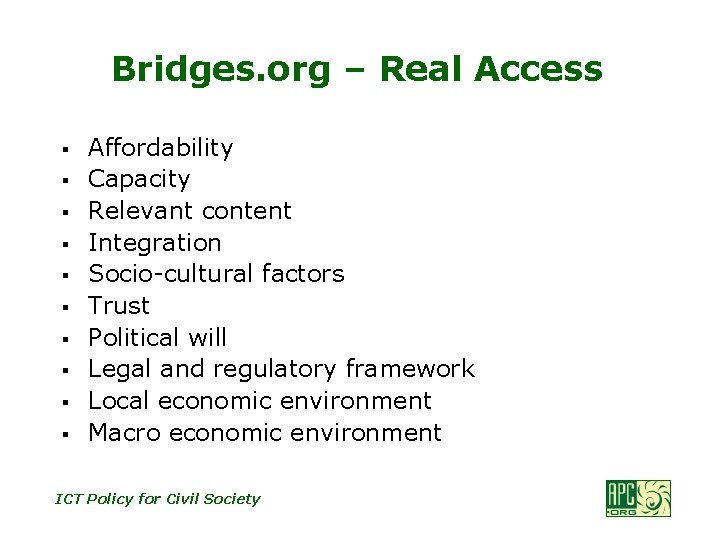
Bridges. org – Real Access § § § § § Affordability Capacity Relevant content Integration Socio-cultural factors Trust Political will Legal and regulatory framework Local economic environment Macro economic environment ICT Policy for Civil Society
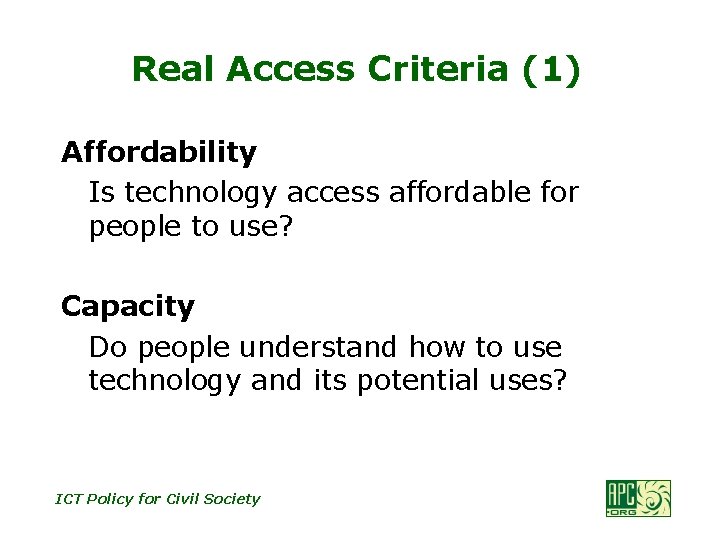
Real Access Criteria (1) Affordability Is technology access affordable for people to use? Capacity Do people understand how to use technology and its potential uses? ICT Policy for Civil Society
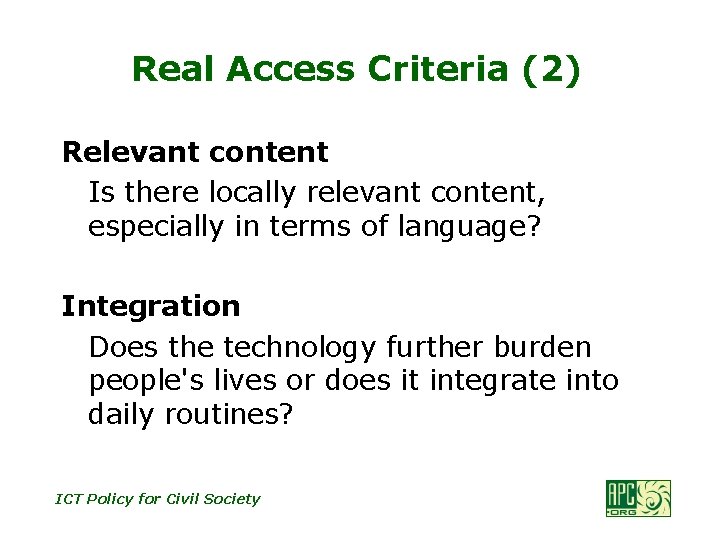
Real Access Criteria (2) Relevant content Is there locally relevant content, especially in terms of language? Integration Does the technology further burden people's lives or does it integrate into daily routines? ICT Policy for Civil Society
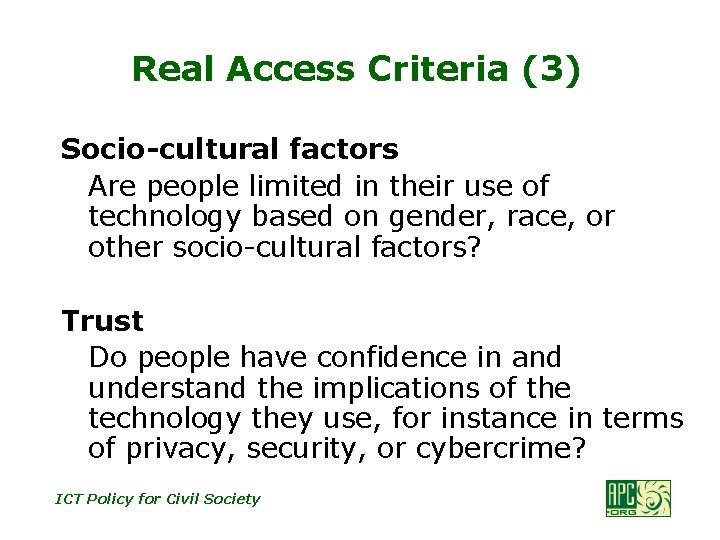
Real Access Criteria (3) Socio-cultural factors Are people limited in their use of technology based on gender, race, or other socio-cultural factors? Trust Do people have confidence in and understand the implications of the technology they use, for instance in terms of privacy, security, or cybercrime? ICT Policy for Civil Society
Real Access Criteria (4) Political will Is there political will in government to do what is needed to enable the integration of technology throughout society? Legal and regulatory framework How do laws and regulations affect technology use and what changes are needed to create an environment that fosters its use? ICT Policy for Civil Society
Real Access Criteria (5) Local economic environment Is there a local economy that can and will sustain technology use? Macro economic environment Is national economic policy conducive to widespread technology use, for example, in terms of transparency, deregulation, investment, and labour issues? ICT Policy for Civil Society
Debate on the priority of ICTs for development – against Critics argue: § ICTs are a waste of money § Funding should be directed to more important areas of impact and real need § There is the risk of disillusionment § ICTs will not necessarily provide benefits and may infact open people up to new forms of harm ICT Policy for Civil Society
Debate on the priority of ICTs for development – pro Supporters argue: § The digital divide will become perilously wider if ICTs are not promoted § ICTs can support other social and economic goals to improve peoples lives § Access to ICTs and participation in the Information Society will have far reaching benefits ICT Policy for Civil Society
United Nations Millennium Development Goals 1. Eradicate extreme poverty and hunger 2. Achieve universal primary education 3. Promote gender equality and empower women 4. Reduce child mortality 5. Improve maternal health 6. Combat HIV/AIDS, malaria and other diseases 7. Ensure environmental sustainability 8. Develop a global partnership for development ICT Policy for Civil Society
United Nations Millennium Development Goals Goal 8: Develop a global partnership for development. Target 18: In cooperation with the private sector make available the benefits of new technologies, specifically information and communications. Indicator 47: Telephone lines and cellular subscribers per 100 population. Indicator 48: Personal computers in use per 100 population and Internet users per 100 population. ICT Policy for Civil Society
ICTs and development goals (education) § § ICTs as a subject: information literacy, programming and other related skills. Computer-based training and distance education Access to learning communities Access to increased and up-to-date information ICT Policy for Civil Society
ICTs and development goals (health) § § Telemedicine: broadband applications – from health clinic to hospital Telehealth: phone and computer support for clinic management and information flows Information sharing: information and exchange on health priorities, e. g. HIV / AIDS, TB, cholera Epidemiology: statistics and information to support knowledge and disease management ICT Policy for Civil Society
ICTs and development goals (SMMEs) § § § ICTs can support routine business operations: accounts, letters, plans ICTs can be an opportunity themselves: training, support, sale, program, web Linking suppliers directly to markets: reducing role of intermediaries Info for tenders, linking SMMEs, support & funding, supply and sales chain E-Commerce opportunities ICT Policy for Civil Society
ICTs and development goals (governance) § § Access to government information, services and processes Transparency of governance Mitigation of corruption Access to representatives: constituents direct link to members of Parliament ICT Policy for Civil Society
Review of the debate on ICT for development (1) § § Although the costs of new information infrastructure are high, the future costs of not doing so are much higher ICT is a priority for development but requires national level strategies and support ICTs should be development focused A best practice formula is not possible because of developing countries diversity ICT Policy for Civil Society
Review of the debate on ICT for development (2) There is general agreement that ICTs are a powerful tool for development and there is commitment from international institutions. What are some best practices for ICT implementation with a development focus? ICT Policy for Civil Society
Models for ICT 4 D implementation § § Community driven initiatives Private Public Partnerships Pro poor, pro market strategies Public service models ICT Policy for Civil Society
Regulatory issues § § § § Universal service Consumer advocacy Pricing policies Interconnection agreements Efficient use of resources Licencing for internet service providers Spectrum licencing ICT Policy for Civil Society
Indicators § What are indicators? § What kind of information do indicators provide? § Where can indicators be obtained? ICT Policy for Civil Society
What do indicators measure? § Infrastructure roll-out § teledensity, computers per household, waiting lists, etc. § ICT use § number of internet hosts, international telephone traffic, etc. § Other factors § literacy, school completion rates, demographics, etc. ICT Policy for Civil Society
What kind of information do indicators provide? § § Quantitative indicators Qualitative information Relative terms Absolute terms ICT Policy for Civil Society
Where can indicators be obtained? International Telecommunication Union (ITU) http: //www. itu. int/ITU-D/ict/statistics/ Measuring the Information Society website (UNCTAD) http: //measuring-ict. unctad. org/ World Bank Data and Statistics http: //www. worldbank. org/data/countrydata. html National Regulatory Authorities Regional Regulatory Organisations Research Organisation ICT Policy for Civil Society
Summary § Access to and opportunities for productive use of ICTs, engenders economic and social empowerment and facilitates participation and democracy. § ICTs are fundamental for achieving development goals. § It is important to set goals and to chart progress – at local to international levels. ICT Policy for Civil Society