
ICTenhanced Collaboration Promise and Potential Wayne Lutters NSF
ICT-enhanced Collaboration: Promise and Potential Wayne Lutters NSF, CISE/IIS/HCC UMBC, College of Engineering & IT
The Information Age Explosive growth of information technology in response to core business problems. How to… • handle the complexity of regional, national, global expansion? • coordinate large, diverse workforce distributed across the planet? • manage vast quantities of information? • organize, store and retrieve that information efficiently? • orchestrate increased network communication? • survive in the face of ever rising communication expectations?
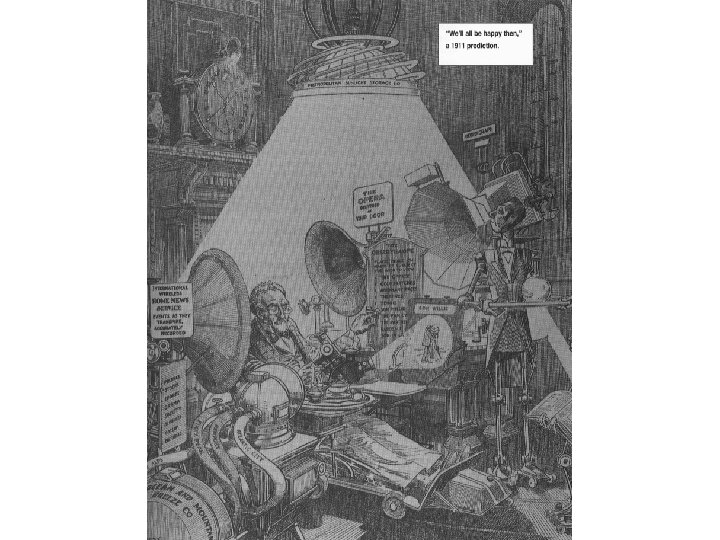
1911
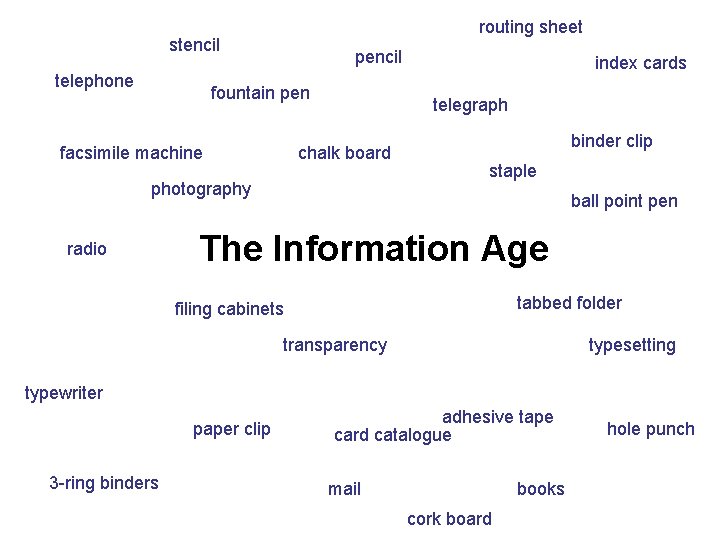
routing sheet stencil telephone pencil fountain pen facsimile machine telegraph chalk board photography radio index cards binder clip staple ball point pen The Information Age tabbed folder filing cabinets transparency typesetting typewriter paper clip 3 -ring binders adhesive tape card catalogue mail books cork board hole punch
Fundamentals of Collaboration • .
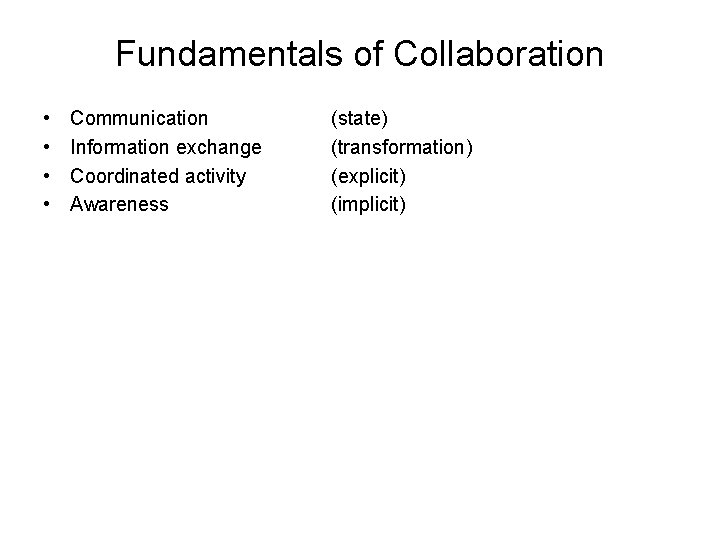
Fundamentals of Collaboration • • Communication Information exchange Coordinated activity Awareness (state) (transformation) (explicit) (implicit)
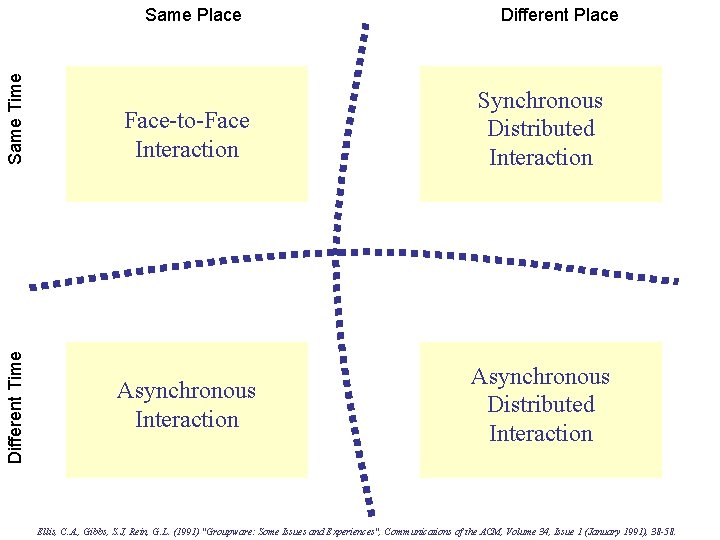
Different Time Same Place Different Place Face-to-Face Interaction Synchronous Distributed Interaction Asynchronous Distributed Interaction Ellis, C. A. , Gibbs, S. J, Rein, G. L. (1991) "Groupware: Some Issues and Experiences", Communications of the ACM, Volume 34, Issue 1 (January 1991), 38 -58.
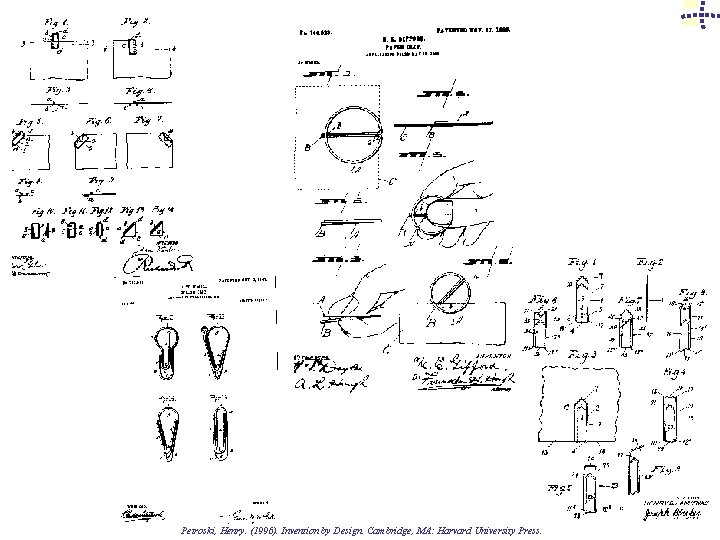
Petroski, Henry. (1996). Invention by Design. Cambridge, MA: Harvard University Press.
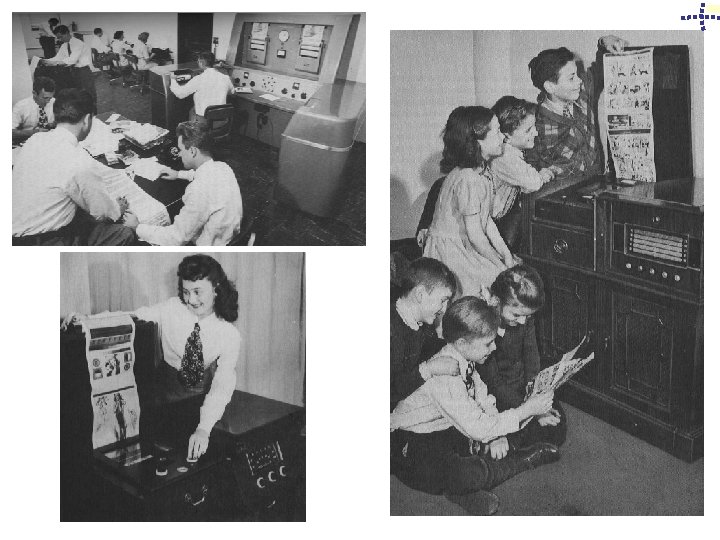
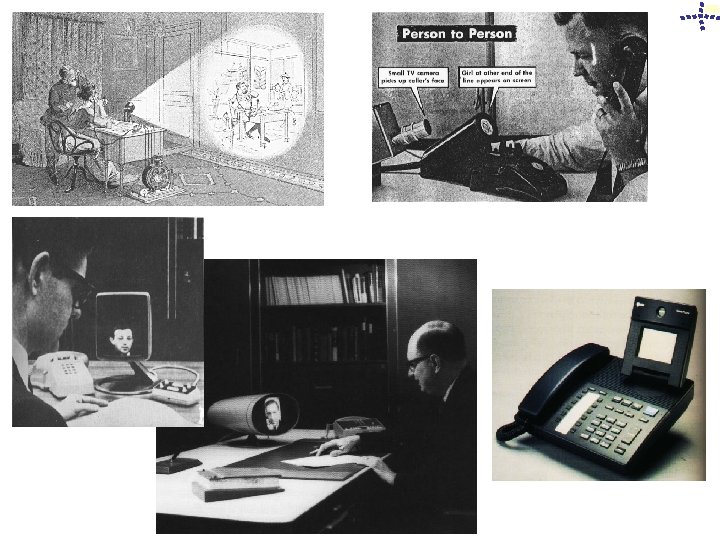
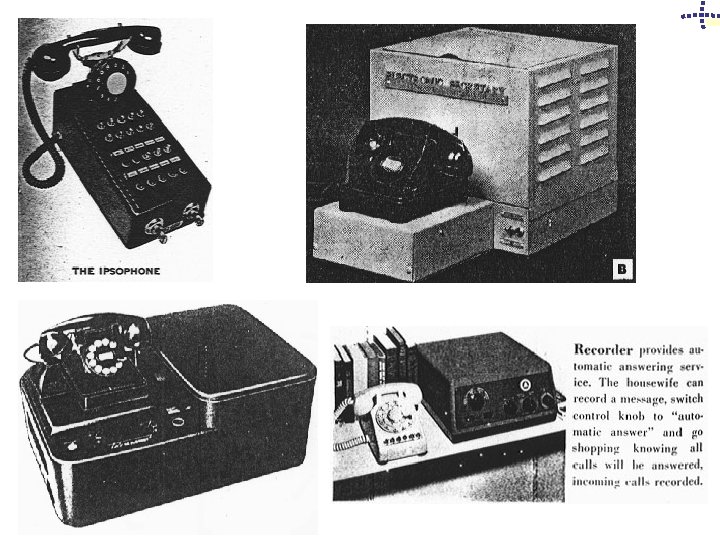
So, what’s really different now in 2007? • .
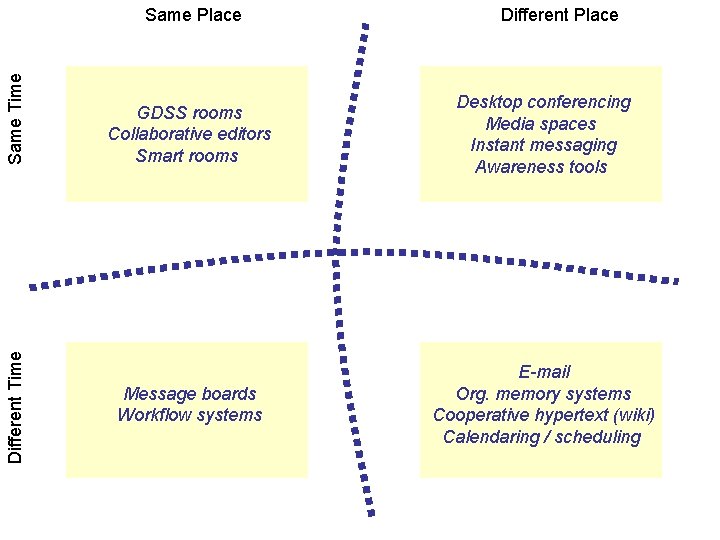
Different Time Same Place Different Place GDSS rooms Collaborative editors Smart rooms Desktop conferencing Media spaces Instant messaging Awareness tools Message boards Workflow systems E-mail Org. memory systems Cooperative hypertext (wiki) Calendaring / scheduling
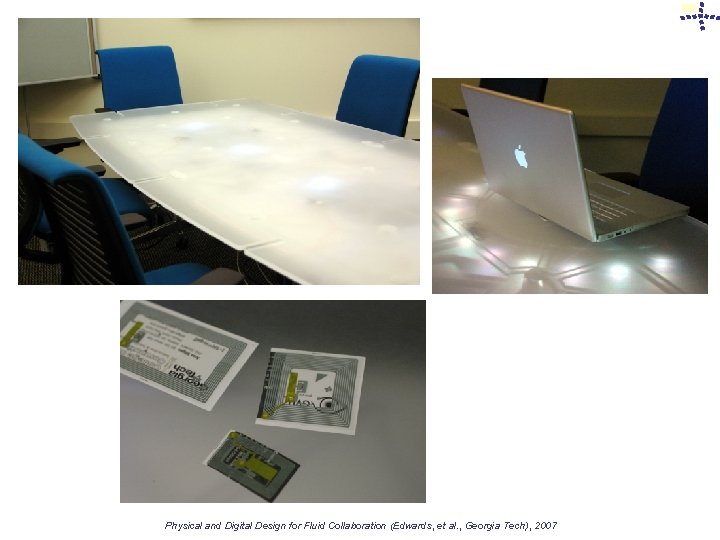
Physical and Digital Design for Fluid Collaboration (Edwards, et al. , Georgia Tech), 2007
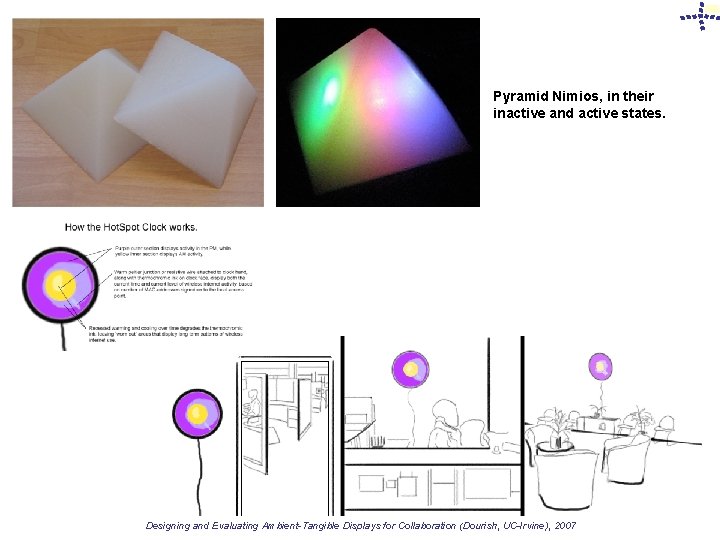
Pyramid Nimios, in their inactive and active states. Designing and Evaluating Ambient-Tangible Displays for Collaboration (Dourish, UC-Irvine), 2007
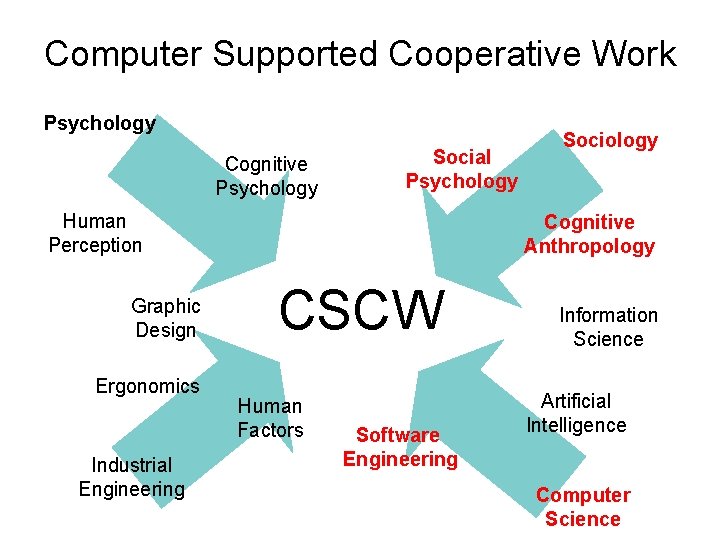
Computer Supported Cooperative Work Psychology Cognitive Psychology Social Psychology Human Perception Graphic Design Ergonomics Industrial Engineering Sociology Cognitive Anthropology CSCW Human Factors Software Engineering Information Science Artificial Intelligence Computer Science
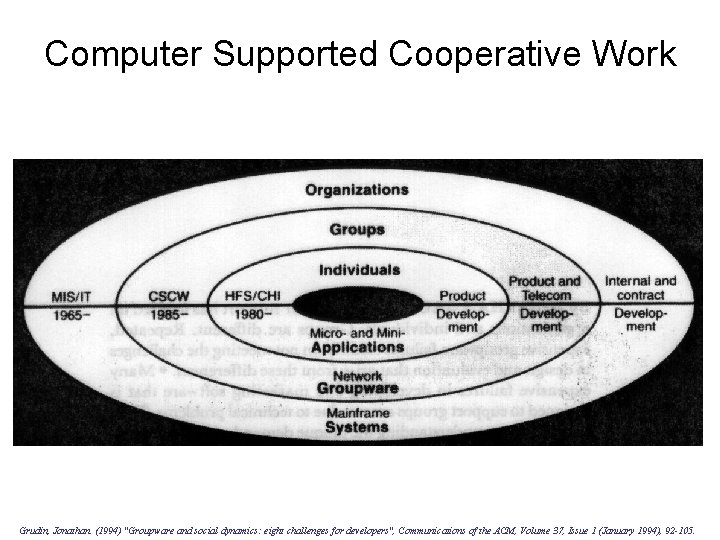
Computer Supported Cooperative Work Grudin, Jonathan. (1994) "Groupware and social dynamics: eight challenges for developers", Communications of the ACM, Volume 37, Issue 1 (January 1994), 92 -105.
Socio-Technical Systems • Understanding that collaborative systems emerge from – social systems (individual, group, organization, culture) – technical systems (application, architecture, infrastructure) – dynamic interplay between them, situated in a particular context • Context of interaction is critical. • Socio-technical design circle.
Sample CSCW Research Themes • • • Communication through artifacts Coordination / concurrency control Exception handling WYSIWIS Shared context / common ground Awareness Group dynamics Roles and norm formation Privacy Official processes, conventions, and routine work-arounds Immersion, “place-ness”
Sample CSCW Design Insights • • Disparity in work and benefit Critical mass Disruption of social processes (culture/norms) Exception handling (work arounds) Unobtrusive accessibility (seamless integration) Difficulty of evaluation Failure of intuition in design Adoption process (need to manage) Corporate Calendaring System Grudin, Jonathan. (1994) "Groupware and social dynamics: eight challenges for developers", Communications of the ACM, Volume 37, Issue 1 (January 1994), 92 -105.
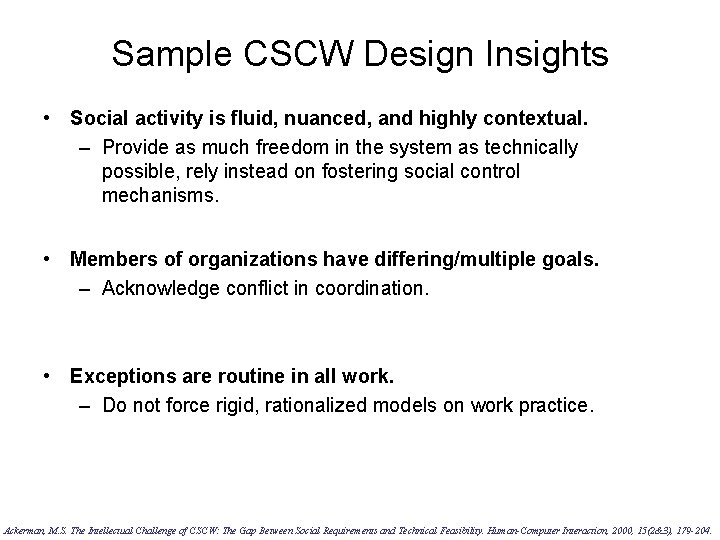
Sample CSCW Design Insights • Social activity is fluid, nuanced, and highly contextual. – Provide as much freedom in the system as technically possible, rely instead on fostering social control mechanisms. • Members of organizations have differing/multiple goals. – Acknowledge conflict in coordination. • Exceptions are routine in all work. – Do not force rigid, rationalized models on work practice. Ackerman, M. S. The Intellectual Challenge of CSCW: The Gap Between Social Requirements and Technical Feasibility. Human-Computer Interaction, 2000, 15(2&3), 179 -204.
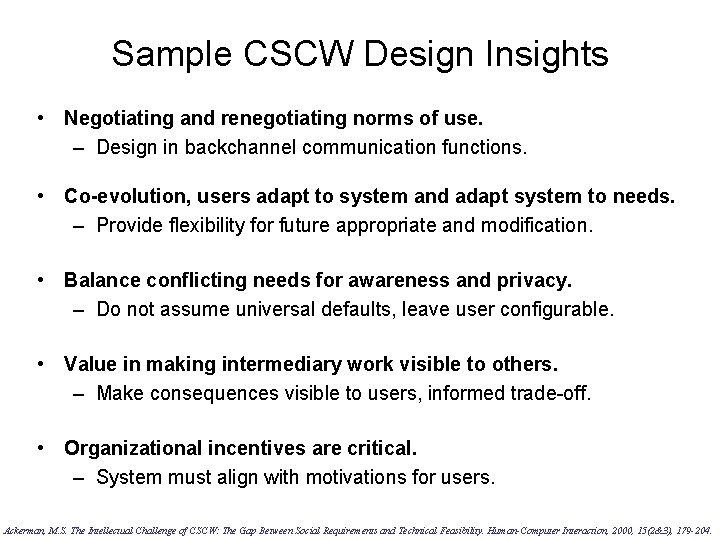
Sample CSCW Design Insights • Negotiating and renegotiating norms of use. – Design in backchannel communication functions. • Co-evolution, users adapt to system and adapt system to needs. – Provide flexibility for future appropriate and modification. • Balance conflicting needs for awareness and privacy. – Do not assume universal defaults, leave user configurable. • Value in making intermediary work visible to others. – Make consequences visible to users, informed trade-off. • Organizational incentives are critical. – System must align with motivations for users. Ackerman, M. S. The Intellectual Challenge of CSCW: The Gap Between Social Requirements and Technical Feasibility. Human-Computer Interaction, 2000, 15(2&3), 179 -204.
Collaborative Virtual Environments Communications Research Group @ Nottingham (UK): http: //www. crg. cs. nott. ac. uk/

So, what about…?
- Slides: 24