
ICT RD and standards From experience to prospects
- Slides: 26
ICT R&D and standards: From experience to prospects Bernard BARANI EC INFSO D Directorate “Network and Communication Technologies” STANDARDS AND INTEROPERABILITY IN ICT ETP’s ETSI, 23 -24 October 2006 - Sophia Antipolis - France
The Importance of Standardisation From a policy perspective Support Internal Market and deployment of pan EU systems/services; Open standards facilitate competition and consumer protection; Promote global solutions, and support emergence of EU positions on global issues; From a research perspective a powerful consensus making instrument; an instrument to catalyse exploitation of research results; an efficient co-operation platform with other regions of the world; A natural link to research for those issue that are system oriented From the inception of the Framework Programme in the 80’s, ICT R&D has been systematically encouraged to generate standardisation spinn offs, especially in the telecom, broadcasting, and audio visual domains, mainly through ETSI, DVB and MPEG groups.
EU R&D: Broadband Technologies OFDM on copper pair, ADSL, then VDSL: RACE, ACTS ADSL deployment success worldwide, EU companies at the forefront; BRAN, Hiper. Lan, Hiper. MAN: RACE, ACTS Wi. Fi and Wi. Max deployments/prospects; Fiber to the Cabinet/curb/…/Home: from RACE to IST FP 6 prospects for FTTH are now becoming real, European deployment initiatives and clarification of regulatory regime 3 G/UMTS: RACE, ACTS EU success at standardisation level; Y 2005: significant take off of UMTS world-wide, exceeding EV-DO. Strong position of EU industry leveraging the “GSM expertise” B 3 G/4 G: ACTS, IST FP 5, IST FP 6 issue still developing, EU FP actions support partnership with Asia (CJK, m. ITF, Fu. TURE, NGMC) Broadband Satellite: ACTS, IST FP 5, IST FP 6 High expectations, high investments, still niche markets. Availability of DVB-RCS and DVB S 2 standard DTV-HDTV: from RACE to IST FP 5 world-wide success of DVB standard; promising prospects for EU led technology like MPEG 4 for HDTV; MHP gaining momentum. Strong EU industrial leaders. Mobile TV, DVB-H: from ACTS to IST FP 6 promising technology developed in the EU, need to progress on the regulatory/spectrum front. PLC: IST FP 6 consolidated EU expertise, even if PLC at the access level may be less prominent UWB: IST FP 5, FP 6 better positioning of EU industry and regulatory regime being clarified
Resulting landscape Competition bearing fruits. 15% (of EU population) penetration. Incumbents: less than 50% of the access share. Costs of LLU and shared access have dropped by more than 30% between 2002 and 2005. Access rates in the DSL range, FTTx plans. Uneven situation across MS.
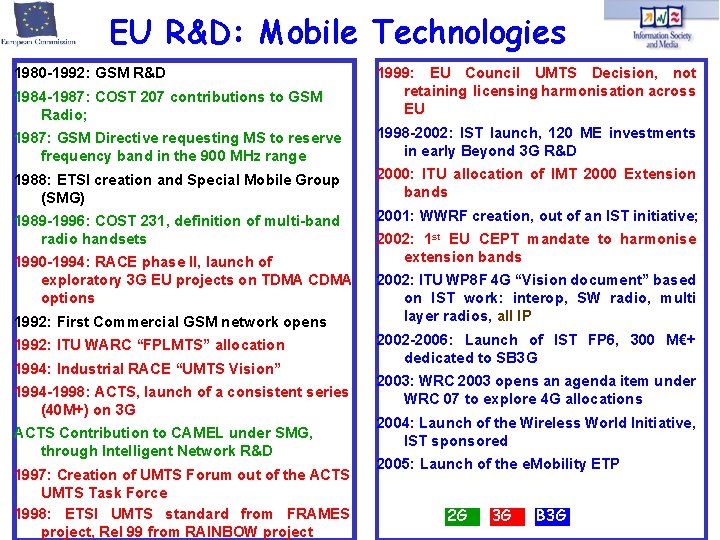
EU R&D: Mobile Technologies 1980 -1992: GSM R&D 1984 -1987: COST 207 contributions to GSM Radio; 1999: EU Council UMTS Decision, not retaining licensing harmonisation across EU 1987: GSM Directive requesting MS to reserve frequency band in the 900 MHz range 1998 -2002: IST launch, 120 ME investments in early Beyond 3 G R&D 1988: ETSI creation and Special Mobile Group (SMG) 2000: ITU allocation of IMT 2000 Extension bands 1989 -1996: COST 231, definition of multi-band radio handsets 2001: WWRF creation, out of an IST initiative; 1990 -1994: RACE phase II, launch of exploratory 3 G EU projects on TDMA CDMA options 1992: First Commercial GSM network opens 1992: ITU WARC “FPLMTS” allocation 1994: Industrial RACE “UMTS Vision” 1994 -1998: ACTS, launch of a consistent series (40 M+) on 3 G ACTS Contribution to CAMEL under SMG, through Intelligent Network R&D 1997: Creation of UMTS Forum out of the ACTS UMTS Task Force 1998: ETSI UMTS standard from FRAMES project, Rel 99 from RAINBOW project 2002: 1 st EU CEPT mandate to harmonise extension bands 2002: ITU WP 8 F 4 G “Vision document” based on IST work: interop, SW radio, multi layer radios, all IP 2002 -2006: Launch of IST FP 6, 300 M€+ dedicated to SB 3 G 2003: WRC 2003 opens an agenda item under WRC 07 to explore 4 G allocations 2004: Launch of the Wireless World Initiative, IST sponsored 2005: Launch of the e. Mobility ETP 2 G 3 G B 3 G
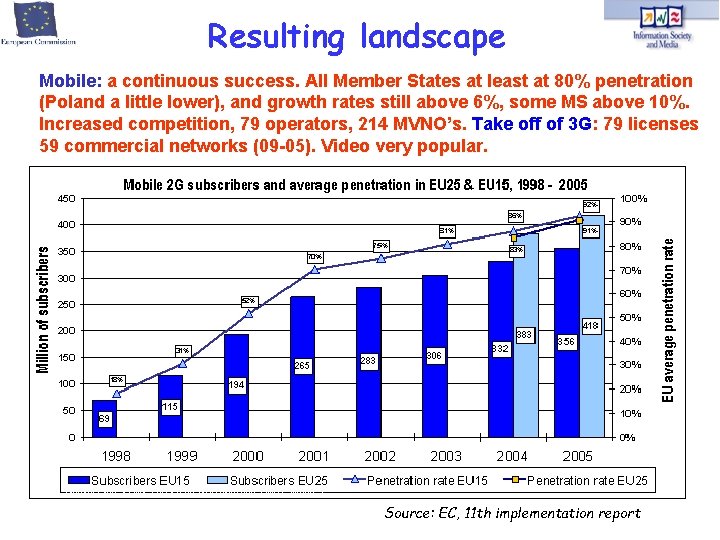
Resulting landscape Mobile: a continuous success. All Member States at least at 80% penetration (Poland a little lower), and growth rates still above 6%, some MS above 10%. Increased competition, 79 operators, 214 MVNO’s. Take off of 3 G: 79 licenses 59 commercial networks (09 -05). Video very popular. Source: EC, 11 th implementation report
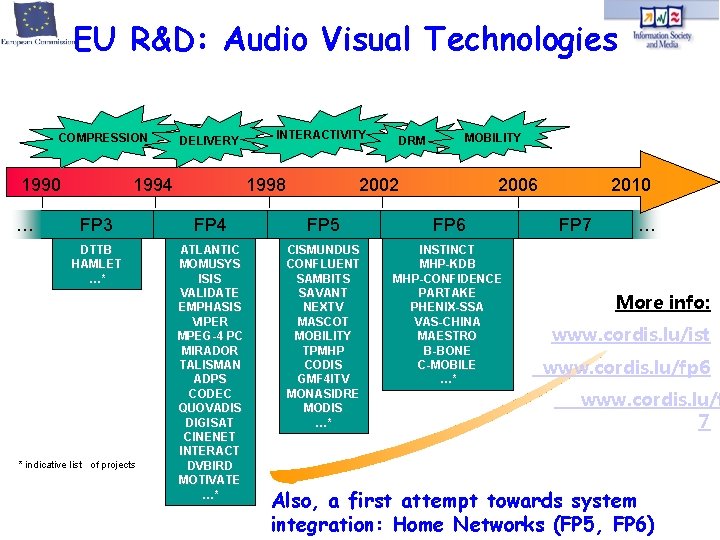
EU R&D: Audio Visual Technologies COMPRESSION 1990 … DELIVERY 1994 INTERACTIVITY 1998 DRM MOBILITY 2002 2006 FP 3 FP 4 FP 5 FP 6 DTTB HAMLET …* ATLANTIC MOMUSYS ISIS VALIDATE EMPHASIS VIPER MPEG-4 PC MIRADOR TALISMAN ADPS CODEC QUOVADIS DIGISAT CINENET INTERACT DVBIRD MOTIVATE …* CISMUNDUS CONFLUENT SAMBITS SAVANT NEXTV MASCOT MOBILITY TPMHP CODIS GMF 4 ITV MONASIDRE MODIS …* INSTINCT MHP-KDB MHP-CONFIDENCE PARTAKE PHENIX-SSA VAS-CHINA MAESTRO B-BONE C-MOBILE …* * indicative list of projects 2010 FP 7 … More info: www. cordis. lu/ist www. cordis. lu/fp 6 www. cordis. lu/f 7 Also, a first attempt towards system integration: Home Networks (FP 5, FP 6)
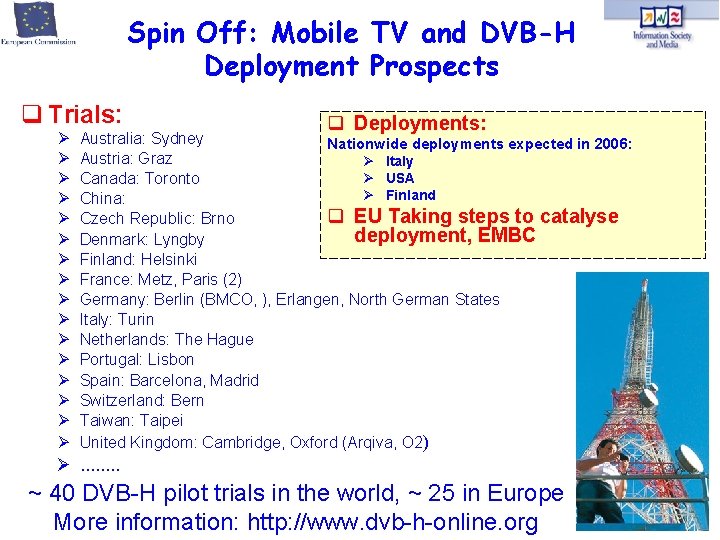
Spin Off: Mobile TV and DVB-H Deployment Prospects Trials: Ø Ø Ø Ø Deployments: Australia: Sydney Nationwide deployments expected in 2006: Austria: Graz Ø Italy Ø USA Canada: Toronto Ø Finland China: EU Taking steps to catalyse Czech Republic: Brno deployment, EMBC Denmark: Lyngby Finland: Helsinki France: Metz, Paris (2) Germany: Berlin (BMCO, ), Erlangen, North German States Italy: Turin Netherlands: The Hague Portugal: Lisbon Spain: Barcelona, Madrid Switzerland: Bern Taiwan: Taipei United Kingdom: Cambridge, Oxford (Arqiva, O 2) Ø. . . . ~ 40 DVB-H pilot trials in the world, ~ 25 in Europe More information: http: //www. dvb-h-online. org
Context for Future Research Reducing churn, Capex, Opex and opening new “Networked” business opportunities From Single technologies as business, social and growth enablers to integrated complex systems as enablers; Converged systems and offers have become integral part of the evolution strategies put forward by ICT players and are getting increased recognition from the markets; Convergence has been recognised as an important trend and policy enabler under the i 2010 ICT Policy Framework proposed by the EC. It cuts across the 3 pillars (Information space, Innovation, Inclusion); In other regions of the world, this trend has also been recognised as a driver for R&D policies (839 initiative of Korea, u_Japan…) - Cross cutting issues become more systematic; - Impact on the siloed networks, and on the siloed standards
Pervasive Networking: a sample of R&D Technological Drivers Proliferation of connected devices, from passive RFID to active sensors; Edge networking, context awareness, event filtering, event management through distributed middleware; Service architectures, from syntactic description and static programmed services to semantic modelling and dynamic service discovery; Networked distributed computing platforms, Grid computing Content explosion, long tail, Web 2. 0. From content search protection and delivery to (user ctrld) content management; Trust in the Net Wireless, from “last mile” to last meter: multiplicity of topologies, ad-hoc, meshed. . Cognitive radio, spectrum. Internet limitations + Regional Initiatives: GENI, Broadband, broadband. . . u_Korea, u_Japan, 863. .
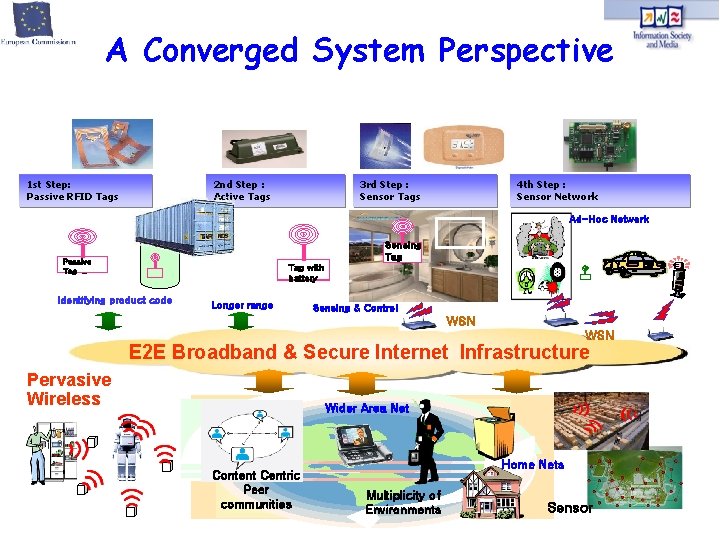
A Converged System Perspective 단계 Step 22 nd : : 이력 1 st Step: Passive RFID Tags 관리 Active Tags 3 rd Step : Sensor Tags 4 th Step : Sensor Network Ad-Hoc Network Products Sensing 센싱형 Tag Passive 센싱형 Tag 센싱형 Tag with Tag battery Identifying product code Longer range Sensing & Control WSN E 2 E Broadband & Secure Internet Infrastructure Pervasive Wireless Wider Area Net Content Centric Peer communities Home Nets Multiplicity of Environments Sensor
Implications and Challenges Consumer “control” Access to advertising budgets with value models valuing the addressed customer base; Telco models vs Internet models; Cellular models vs Fixed-mobile convergence models; Access to spectrum, broadcast vs mobile vs satcom; Access to content owners; Open models vs closed models Making the various models possible whilst ensuring level playing competition and customer protection are at the heart of the EC technological and regulatory actions. Standards have a role to play in making possible a variety of converged business models These are possible topics for X Platform issues
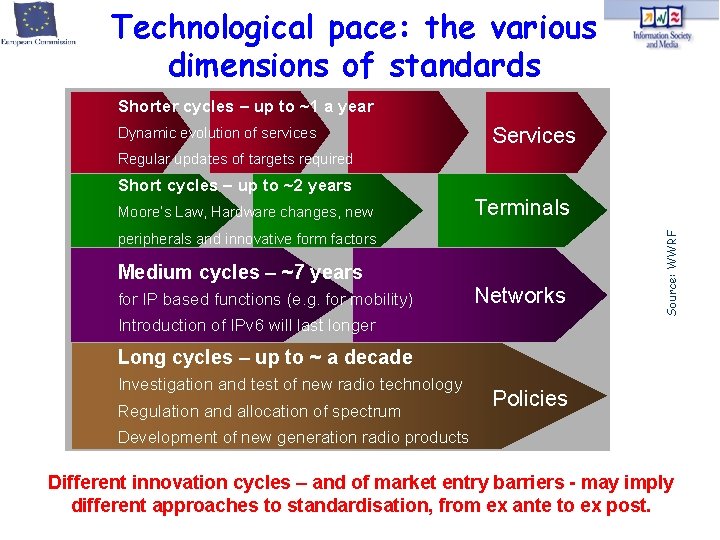
Technological pace: the various dimensions of standards Shorter cycles – up to ~1 a year Dynamic evolution of services Services Regular updates of targets required Short cycles – up to ~2 years Terminals peripherals and innovative form factors Medium cycles – ~7 years for IP based functions (e. g. for mobility) Networks Introduction of IPv 6 will last longer Source: WWRF Moore’s Law, Hardware changes, new Long cycles – up to ~ a decade Investigation and test of new radio technology Regulation and allocation of spectrum Policies Development of new generation radio products Different innovation cycles – and of market entry barriers - may imply different approaches to standardisation, from ex ante to ex post.
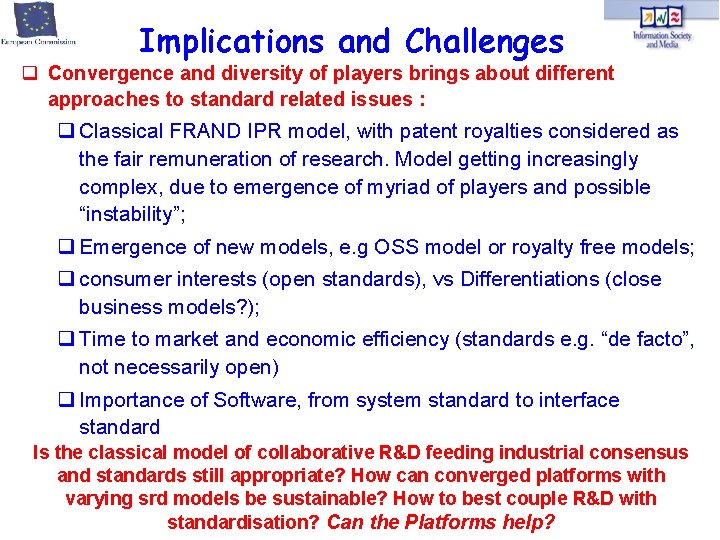
Implications and Challenges Convergence and diversity of players brings about different approaches to standard related issues : Classical FRAND IPR model, with patent royalties considered as the fair remuneration of research. Model getting increasingly complex, due to emergence of myriad of players and possible “instability”; Emergence of new models, e. g OSS model or royalty free models; consumer interests (open standards), vs Differentiations (close business models? ); Time to market and economic efficiency (standards e. g. “de facto”, not necessarily open) Importance of Software, from system standard to interface standard Is the classical model of collaborative R&D feeding industrial consensus and standards still appropriate? How can converged platforms with varying srd models be sustainable? How to best couple R&D with standardisation? Can the Platforms help?
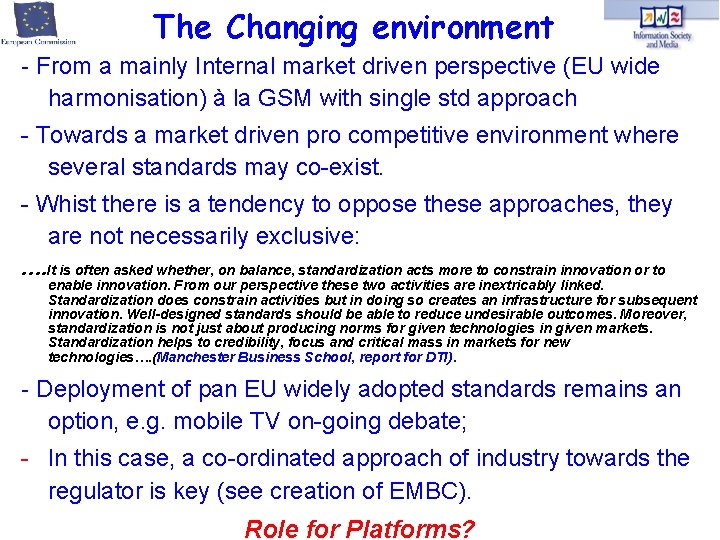
The Changing environment - From a mainly Internal market driven perspective (EU wide harmonisation) à la GSM with single std approach - Towards a market driven pro competitive environment where several standards may co-exist. - Whist there is a tendency to oppose these approaches, they are not necessarily exclusive: …. It is often asked whether, on balance, standardization acts more to constrain innovation or to enable innovation. From our perspective these two activities are inextricably linked. Standardization does constrain activities but in doing so creates an infrastructure for subsequent innovation. Well-designed standards should be able to reduce undesirable outcomes. Moreover, standardization is not just about producing norms for given technologies in given markets. Standardization helps to credibility, focus and critical mass in markets for new technologies…. (Manchester Business School, report for DTI). - Deployment of pan EU widely adopted standards remains an option, e. g. mobile TV on-going debate; - In this case, a co-ordinated approach of industry towards the regulator is key (see creation of EMBC). Role for Platforms?
Standards, R&D and International Co-operation IST FP 6: a significant effort has been devoted to cooperation with third countries; In standard related areas, Asia and South America have received particular attention (e. g IST call 6); Several approaches to standards co-operation: ex ante (std not yet existing), ex post (existing standard); Varying levels of results and experiences; A solid approach to International co-operation and standards is required for IST FP 7. ETP contribution in this field would be very desirable.
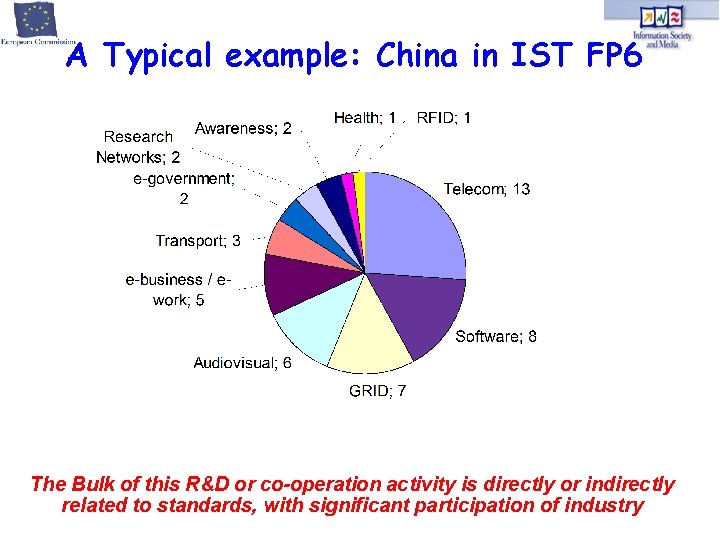
A Typical example: China in IST FP 6 The Bulk of this R&D or co-operation activity is directly or indirectly related to standards, with significant participation of industry
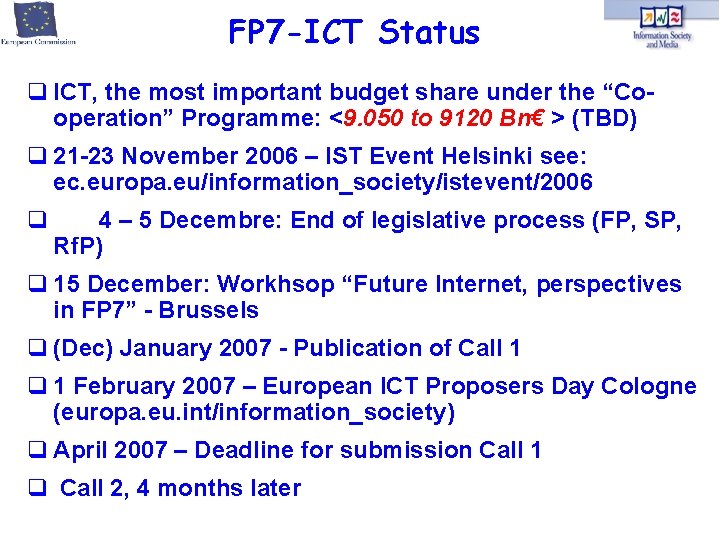
FP 7 -ICT Status ICT, the most important budget share under the “Cooperation” Programme: <9. 050 to 9120 Bn€ > (TBD) 21 -23 November 2006 – IST Event Helsinki see: ec. europa. eu/information_society/istevent/2006 4 – 5 Decembre: End of legislative process (FP, SP, Rf. P) 15 December: Workhsop “Future Internet, perspectives in FP 7” - Brussels (Dec) January 2007 - Publication of Call 1 1 February 2007 – European ICT Proposers Day Cologne (europa. eu. int/information_society) April 2007 – Deadline for submission Call 1 Call 2, 4 months later
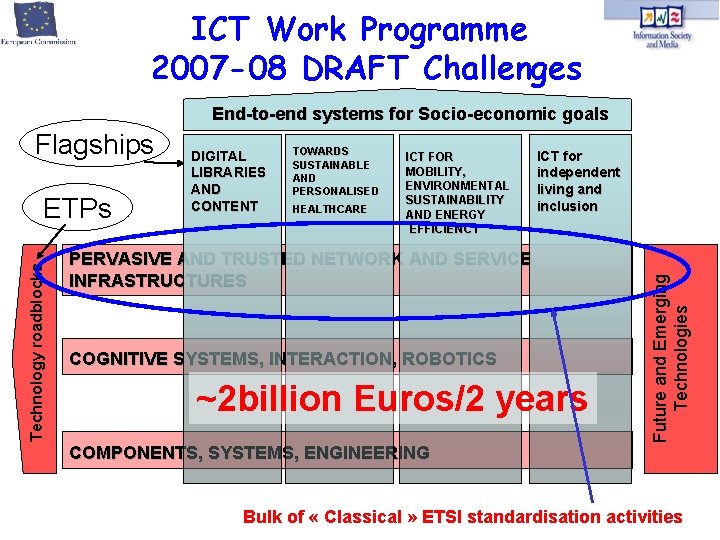
ICT Work Programme 2007 -08 DRAFT Challenges End-to-end systems for Socio-economic goals Technology roadblocks ETPs DIGITAL LIBRARIES AND CONTENT TOWARDS SUSTAINABLE AND PERSONALISED HEALTHCARE ICT FOR MOBILITY, ENVIRONMENTAL SUSTAINABILITY AND ENERGY EFFICIENCY ICT for independent living and inclusion PERVASIVE AND TRUSTED NETWORK AND SERVICE INFRASTRUCTURES COGNITIVE SYSTEMS, INTERACTION, ROBOTICS ~2 billion Euros/2 years COMPONENTS, SYSTEMS, ENGINEERING Future and Emerging Technologies Flagships Bulk of « Classical » ETSI standardisation activities
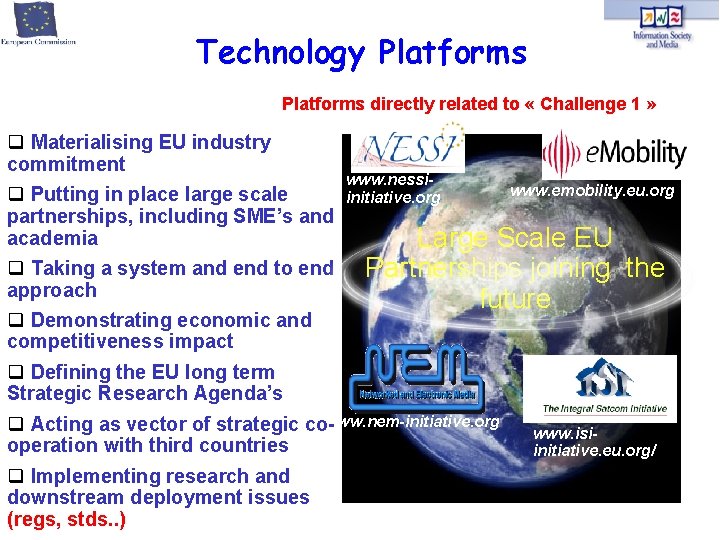
Technology Platforms directly related to « Challenge 1 » Materialising EU industry commitment www. nessiwww. emobility. eu. org Putting in place large scale initiative. org partnerships, including SME’s and academia Large Scale EU Taking a system and end to end Partnerships joining the approach future Demonstrating economic and competitiveness impact Defining the EU long term Strategic Research Agenda’s www. nem-initiative. org Acting as vector of strategic cowww. isioperation with third countries initiative. eu. org/ Implementing research and downstream deployment issues (regs, stds. . )
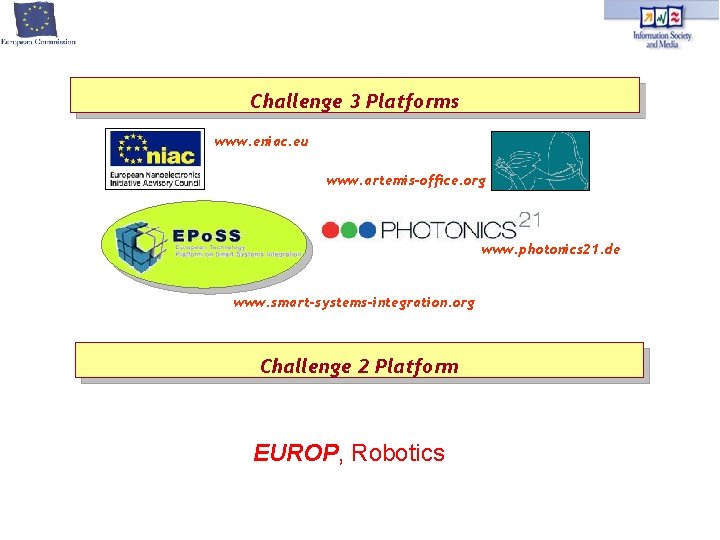
Challenge 3 Platforms www. eniac. eu www. artemis-office. org www. photonics 21. de www. smart-systems-integration. org Challenge 2 Platform EUROP, Robotics
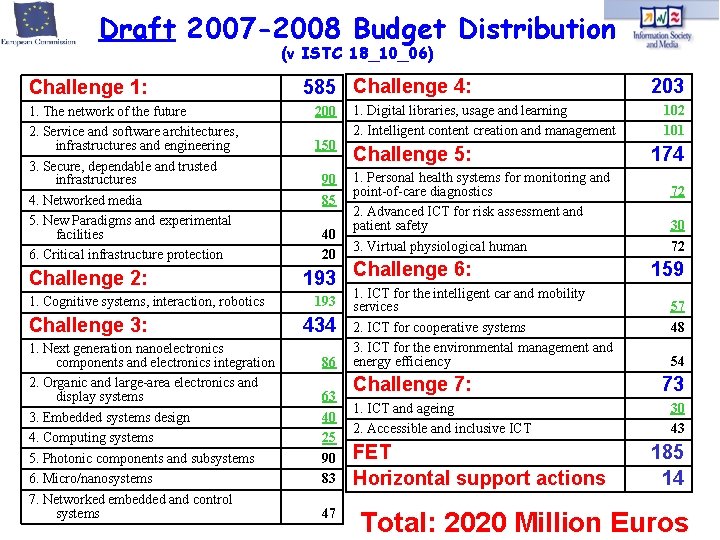
Draft 2007 -2008 Budget Distribution (v ISTC 18_10_06) Challenge 1: 1. The network of the future 2. Service and software architectures, infrastructures and engineering 3. Secure, dependable and trusted infrastructures 4. Networked media 5. New Paradigms and experimental facilities 6. Critical infrastructure protection Challenge 2: 1. Cognitive systems, interaction, robotics Challenge 3: 1. Next generation nanoelectronics components and electronics integration 2. Organic and large-area electronics and display systems 3. Embedded systems design 4. Computing systems 5. Photonic components and subsystems 6. Micro/nanosystems 7. Networked embedded and control systems 585 Challenge 4: 200 150 90 85 40 20 1. Digital libraries, usage and learning 2. Intelligent content creation and management Challenge 5: 1. Personal health systems for monitoring and point-of-care diagnostics 2. Advanced ICT for risk assessment and patient safety 3. Virtual physiological human 193 Challenge 6: 193 434 86 63 40 25 90 83 47 1. ICT for the intelligent car and mobility services 2. ICT for cooperative systems 3. ICT for the environmental management and energy efficiency Challenge 7: 1. ICT and ageing 2. Accessible and inclusive ICT FET Horizontal support actions 203 102 101 174 72 30 72 159 57 48 54 73 30 43 185 14 Total: 2020 Million Euros
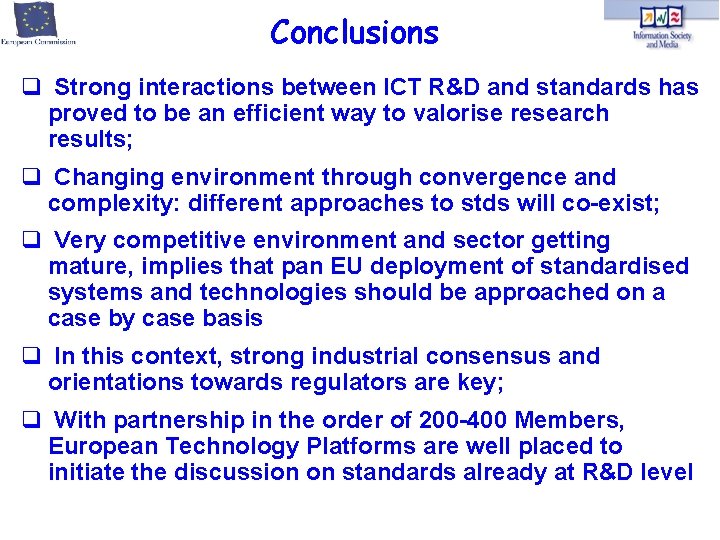
Conclusions Strong interactions between ICT R&D and standards has proved to be an efficient way to valorise research results; Changing environment through convergence and complexity: different approaches to stds will co-exist; Very competitive environment and sector getting mature, implies that pan EU deployment of standardised systems and technologies should be approached on a case by case basis In this context, strong industrial consensus and orientations towards regulators are key; With partnership in the order of 200 -400 Members, European Technology Platforms are well placed to initiate the discussion on standards already at R&D level
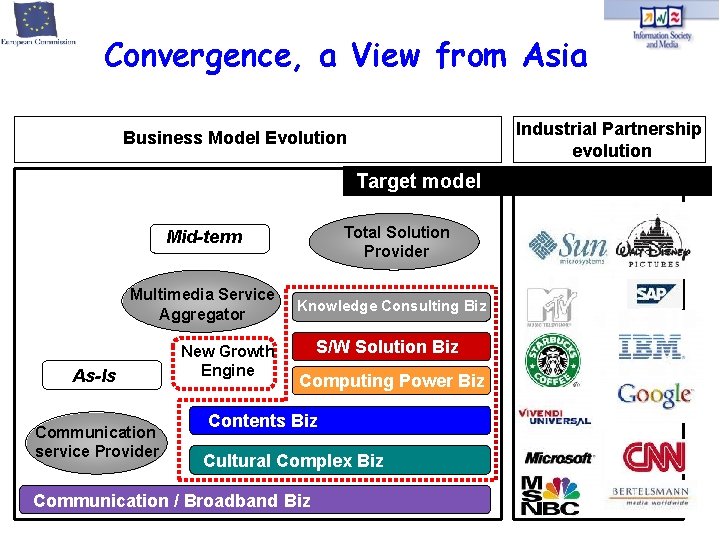
Convergence, a View from Asia Industrial Partnership evolution Business Model Evolution Target model Total Solution Provider Mid-term Multimedia Service Aggregator As-Is Communication service Provider New Growth Engine Knowledge Consulting Biz S/W Solution Biz Computing Power Biz Contents Biz Cultural Complex Biz Communication / Broadband Biz
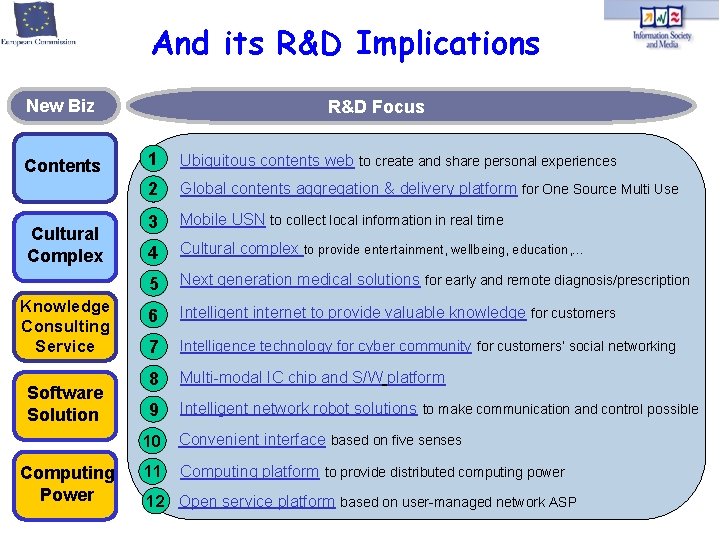
And its R&D Implications New Biz Contents Cultural Complex Knowledge Consulting Service Software Solution Computing Power R&D Focus 1 Ubiquitous contents web to create and share personal experiences 2 Global contents aggregation & delivery platform for One Source Multi Use 3 Mobile USN to collect local information in real time 4 Cultural complex to provide entertainment, wellbeing, education, … 5 Next generation medical solutions for early and remote diagnosis/prescription 6 Intelligent internet to provide valuable knowledge for customers 7 Intelligence technology for cyber community for customers’ social networking 8 Multi-modal IC chip and S/W platform 9 Intelligent network robot solutions to make communication and control possible 10 Convenient interface based on five senses 11 Computing platform to provide distributed computing power 12 Open service platform based on user-managed network ASP
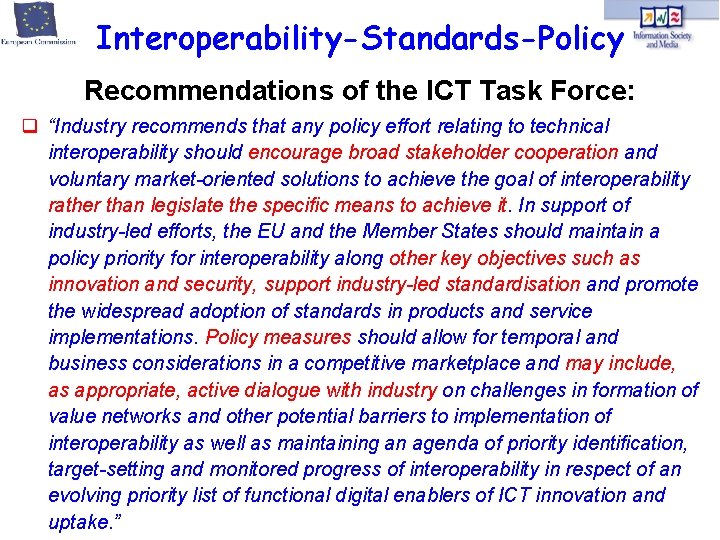
Interoperability-Standards-Policy Recommendations of the ICT Task Force: “Industry recommends that any policy effort relating to technical interoperability should encourage broad stakeholder cooperation and voluntary market-oriented solutions to achieve the goal of interoperability rather than legislate the specific means to achieve it. In support of industry-led efforts, the EU and the Member States should maintain a policy priority for interoperability along other key objectives such as innovation and security, support industry-led standardisation and promote the widespread adoption of standards in products and service implementations. Policy measures should allow for temporal and business considerations in a competitive marketplace and may include, as appropriate, active dialogue with industry on challenges in formation of value networks and other potential barriers to implementation of interoperability as well as maintaining an agenda of priority identification, target-setting and monitored progress of interoperability in respect of an evolving priority list of functional digital enablers of ICT innovation and uptake. ”