
ICT Indicators and Capacity building for ICT measurement
ICT Indicators and Capacity building for ICT measurement in the Arab Region Amman, 25 -26 September 2010 UNCTAD’s work on Measuring the Information Economy Torbjörn Fredriksson, UNCTAD (torbjorn. fredriksson@unctad. org)

UNCTAD and ICT statistics UNCTAD Partnership revised core list of ICT indicators • Infrastructure (9) • Household and individuals (13) • Businesses (12) • ICT sector and ICT trade (4) • ICT in education (9) 2
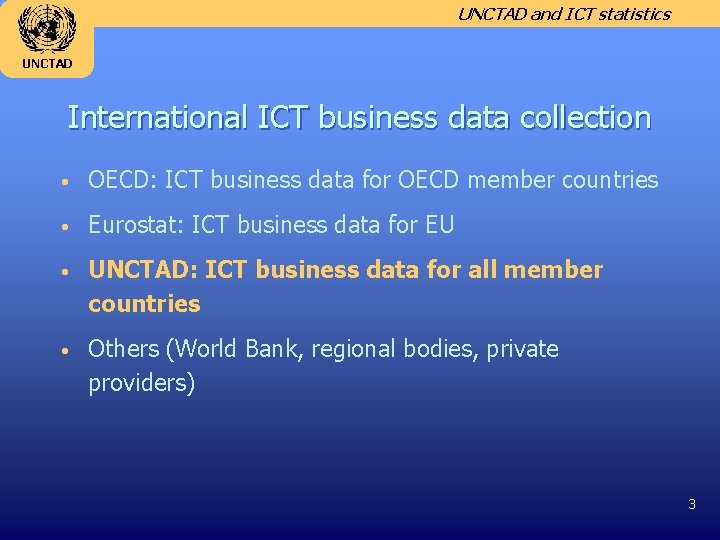
UNCTAD and ICT statistics UNCTAD International ICT business data collection • OECD: ICT business data for OECD member countries • Eurostat: ICT business data for EU • UNCTAD: ICT business data for all member countries • Others (World Bank, regional bodies, private providers) 3
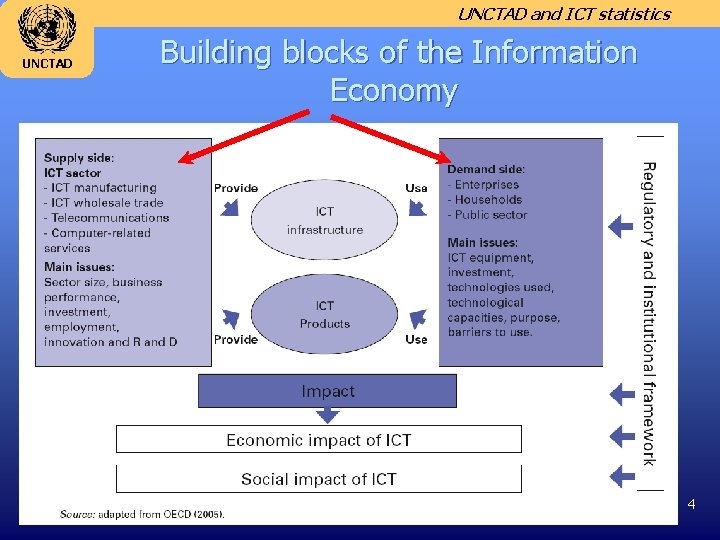
UNCTAD and ICT statistics UNCTAD Building blocks of the Information Economy 4
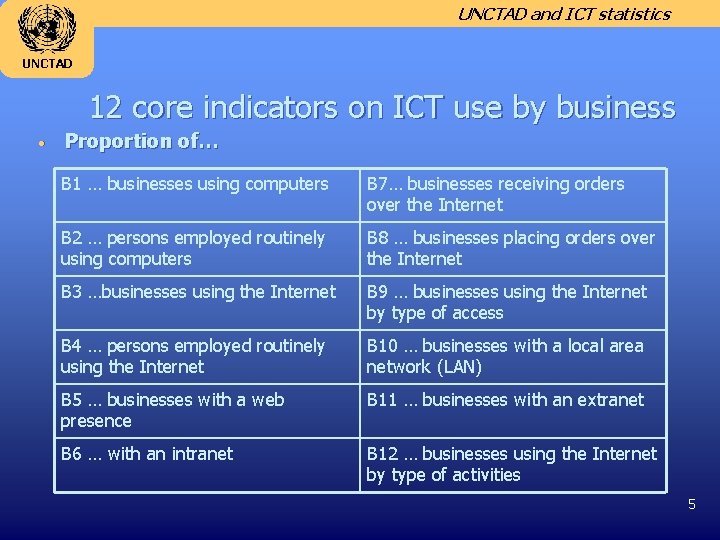
UNCTAD and ICT statistics UNCTAD 12 core indicators on ICT use by business • Proportion of… B 1 … businesses using computers B 7… businesses receiving orders over the Internet B 2 … persons employed routinely using computers B 8 … businesses placing orders over the Internet B 3 …businesses using the Internet B 9 … businesses using the Internet by type of access B 4 … persons employed routinely using the Internet B 10 … businesses with a local area network (LAN) B 5 … businesses with a web presence B 11 … businesses with an extranet B 6 … with an intranet B 12 … businesses using the Internet by type of activities 5
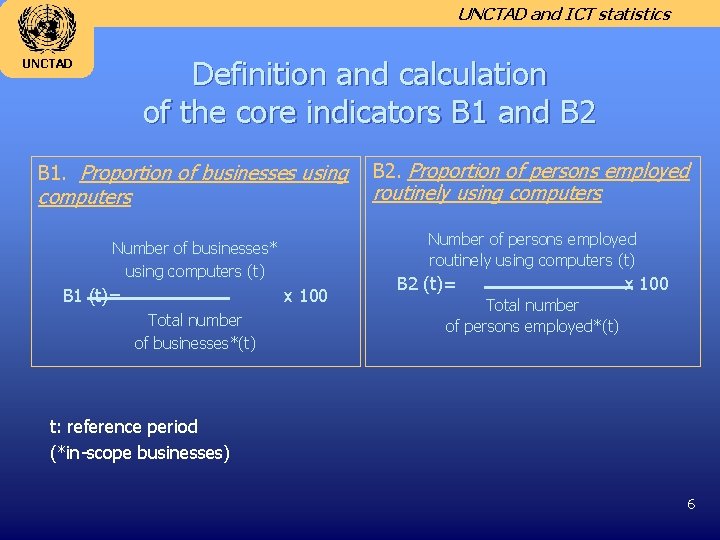
UNCTAD and ICT statistics Definition and calculation of the core indicators B 1 and B 2 UNCTAD B 1. Proportion of businesses using computers x 100 Total number of businesses*(t) routinely using computers Number of persons employed routinely using computers (t) Number of businesses* using computers (t) B 1 (t)= B 2. Proportion of persons employed B 2 (t)= x 100 Total number of persons employed*(t) t: reference period (*in-scope businesses) 6
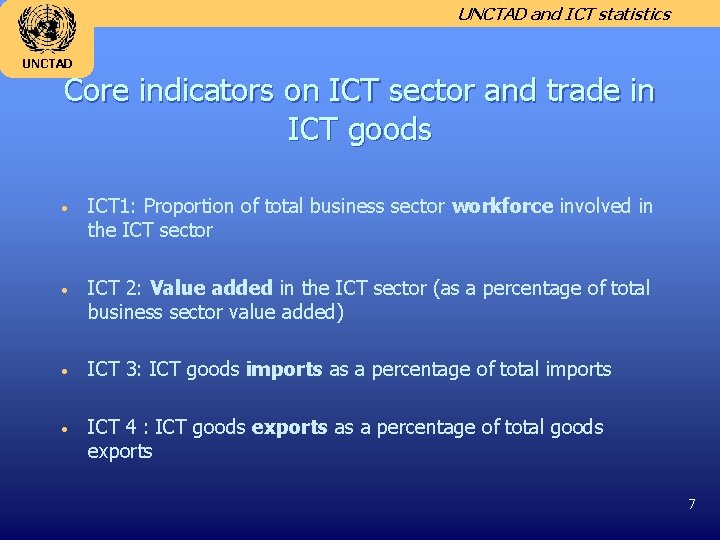
UNCTAD and ICT statistics UNCTAD Core indicators on ICT sector and trade in ICT goods • ICT 1: Proportion of total business sector workforce involved in the ICT sector • ICT 2: Value added in the ICT sector (as a percentage of total business sector value added) • ICT 3: ICT goods imports as a percentage of total imports • ICT 4 : ICT goods exports as a percentage of total goods exports 7
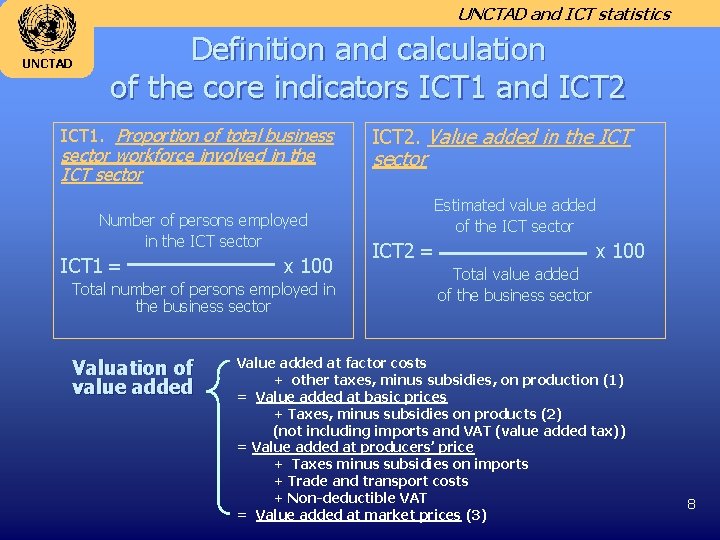
UNCTAD and ICT statistics UNCTAD Definition and calculation of the core indicators ICT 1 and ICT 2 ICT 1. Proportion of total business sector workforce involved in the ICT sector Number of persons employed in the ICT sector ICT 1 = x 100 Total number of persons employed in the business sector Valuation of value added ICT 2. Value added in the ICT sector Estimated value added of the ICT sector ICT 2 = x 100 Total value added of the business sector Value added at factor costs + other taxes, minus subsidies, on production (1) = Value added at basic prices + Taxes, minus subsidies on products (2) (not including imports and VAT (value added tax)) = Value added at producers’ price + Taxes minus subsidies on imports + Trade and transport costs + Non-deductible VAT = Value added at market prices (3) 8
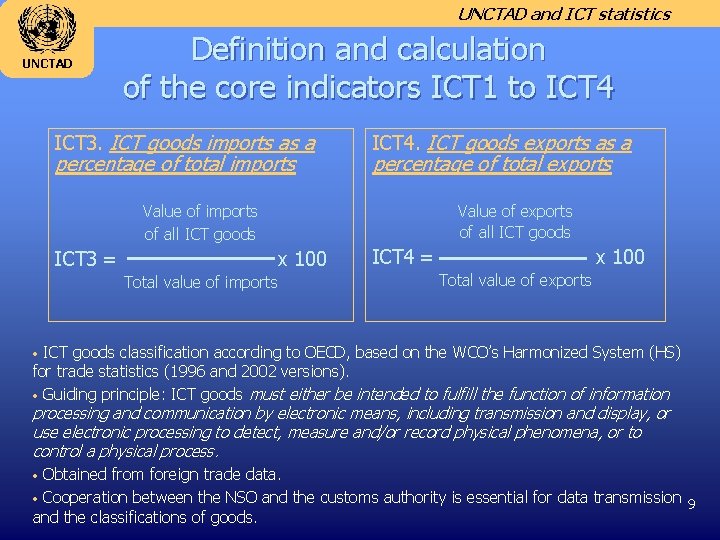
UNCTAD and ICT statistics UNCTAD Definition and calculation of the core indicators ICT 1 to ICT 4 ICT 3. ICT goods imports as a percentage of total imports ICT 4. ICT goods exports as a percentage of total exports Value of imports of all ICT goods ICT 3 = Value of exports of all ICT goods x 100 Total value of imports ICT 4 = x 100 Total value of exports ICT goods classification according to OECD, based on the WCO’s Harmonized System (HS) for trade statistics (1996 and 2002 versions). • Guiding principle: ICT goods must either be intended to fulfill the function of information • processing and communication by electronic means, including transmission and display, or use electronic processing to detect, measure and/or record physical phenomena, or to control a physical process. Obtained from foreign trade data. • Cooperation between the NSO and the customs authority is essential for data transmission 9 and the classifications of goods. •
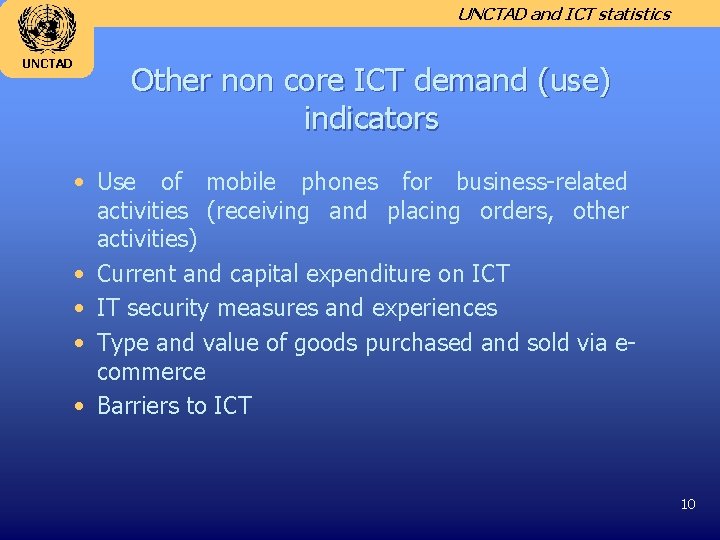
UNCTAD and ICT statistics UNCTAD Other non core ICT demand (use) indicators • Use of mobile phones for business-related activities (receiving and placing orders, other activities) • Current and capital expenditure on ICT • IT security measures and experiences • Type and value of goods purchased and sold via ecommerce • Barriers to ICT 10
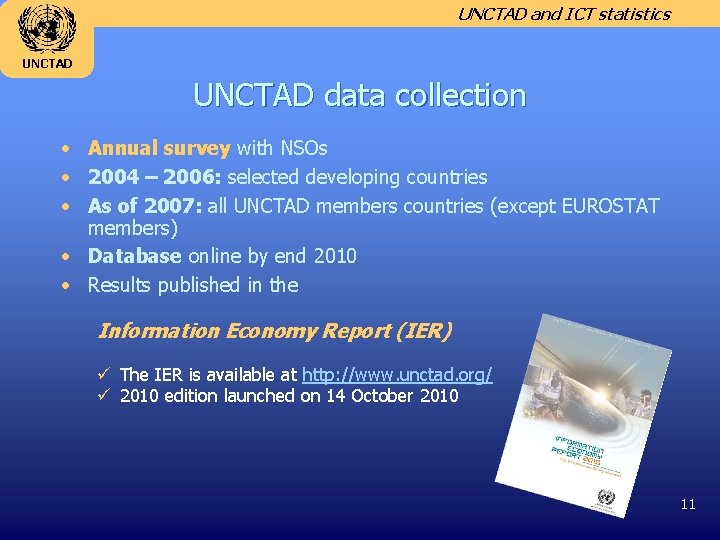
UNCTAD and ICT statistics UNCTAD data collection • Annual survey with NSOs • 2004 – 2006: selected developing countries • As of 2007: all UNCTAD members countries (except EUROSTAT members) • Database online by end 2010 • Results published in the Information Economy Report (IER) ü The IER is available at http: //www. unctad. org/ ü 2010 edition launched on 14 October 2010 11
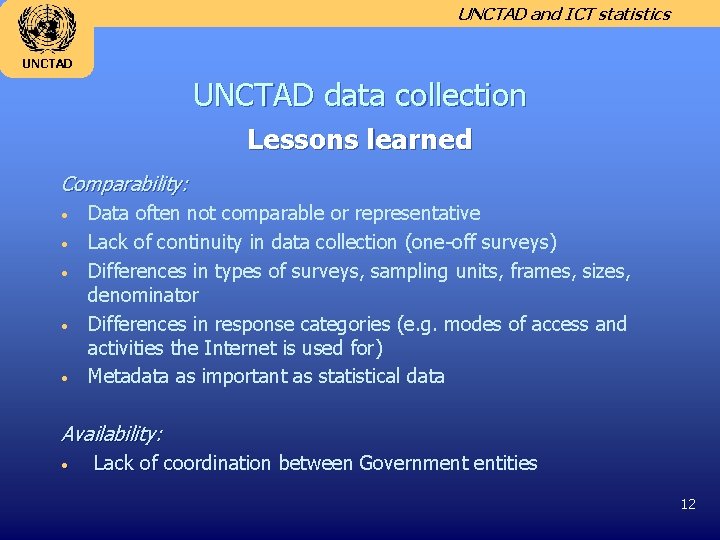
UNCTAD and ICT statistics UNCTAD data collection Lessons learned Comparability: • • • Data often not comparable or representative Lack of continuity in data collection (one-off surveys) Differences in types of surveys, sampling units, frames, sizes, denominator Differences in response categories (e. g. modes of access and activities the Internet is used for) Metadata as important as statistical data Availability: • Lack of coordination between Government entities c 12
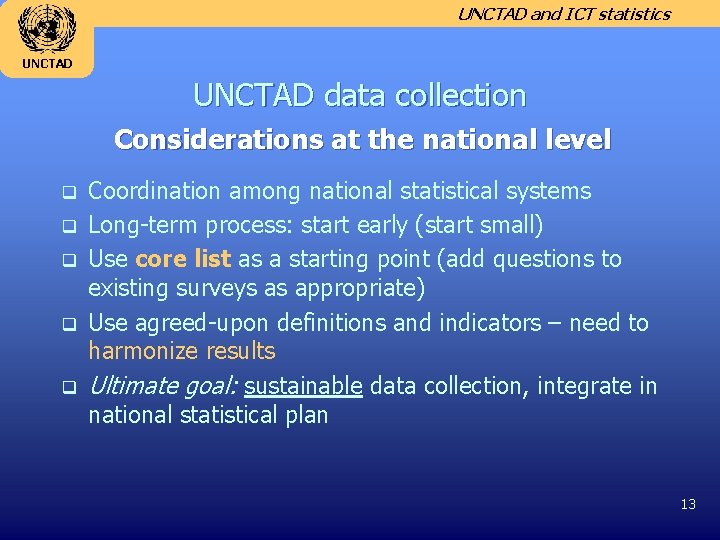
UNCTAD and ICT statistics UNCTAD data collection Considerations at the national level q q q Coordination among national statistical systems Long-term process: start early (start small) Use core list as a starting point (add questions to existing surveys as appropriate) Use agreed-upon definitions and indicators – need to harmonize results Ultimate goal: sustainable data collection, integrate in national statistical plan 13
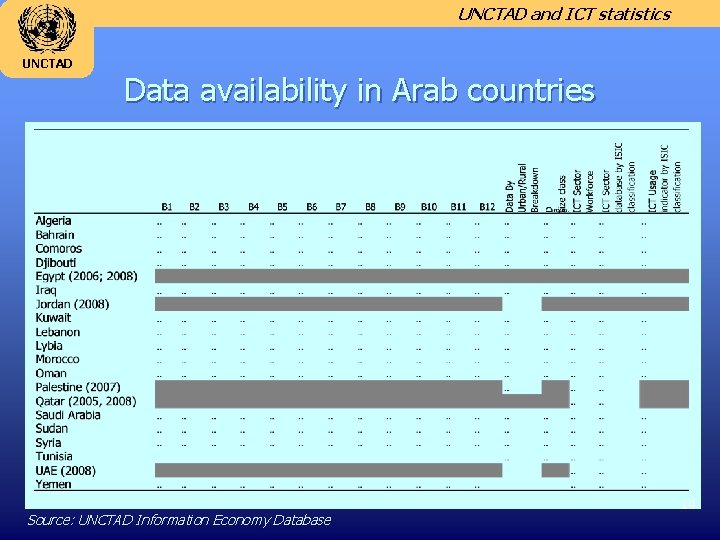
UNCTAD and ICT statistics UNCTAD Data availability in Arab countries Source: UNCTAD Information Economy Database 14
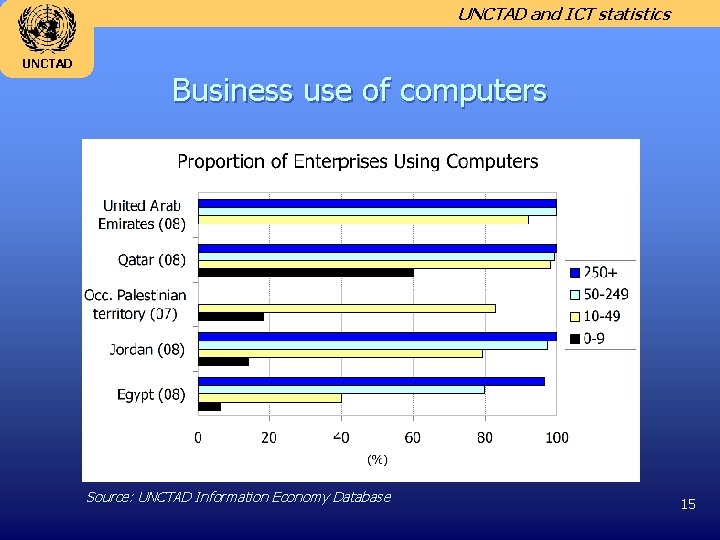
UNCTAD and ICT statistics UNCTAD Business use of computers Source: UNCTAD Information Economy Database 15
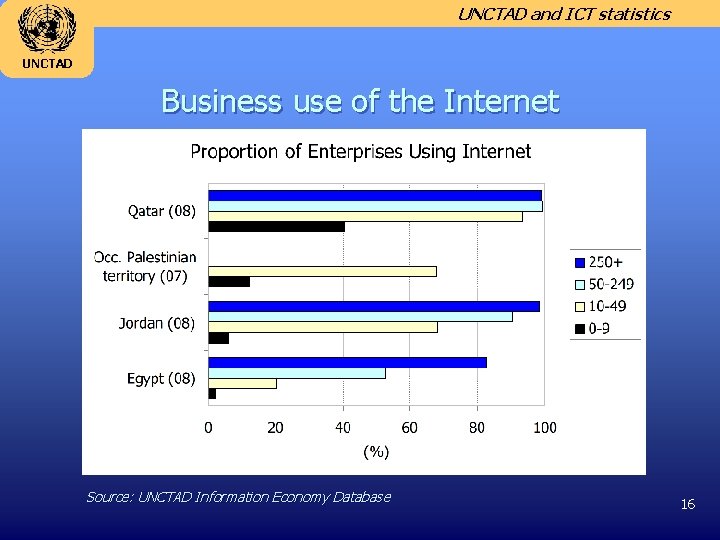
UNCTAD and ICT statistics UNCTAD Business use of the Internet Source: UNCTAD Information Economy Database 16
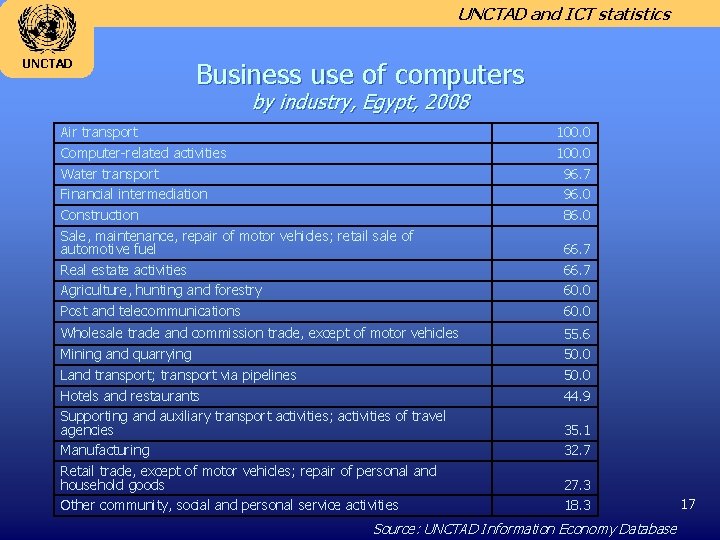
UNCTAD and ICT statistics UNCTAD Business use of computers by industry, Egypt, 2008 Air transport Computer-related activities Water transport Financial intermediation Construction Sale, maintenance, repair of motor vehicles; retail sale of automotive fuel Real estate activities Agriculture, hunting and forestry Post and telecommunications Wholesale trade and commission trade, except of motor vehicles Mining and quarrying Land transport; transport via pipelines Hotels and restaurants Supporting and auxiliary transport activities; activities of travel agencies Manufacturing Retail trade, except of motor vehicles; repair of personal and household goods Other community, social and personal service activities 100. 0 96. 7 96. 0 86. 0 66. 7 60. 0 55. 6 50. 0 44. 9 35. 1 32. 7 27. 3 18. 3 Source: UNCTAD Information Economy Database 17
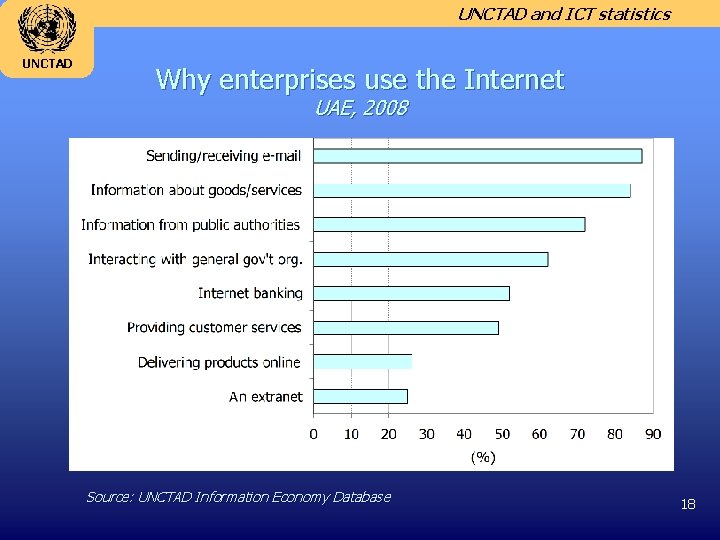
UNCTAD and ICT statistics UNCTAD Why enterprises use the Internet UAE, 2008 Source: UNCTAD Information Economy Database 18
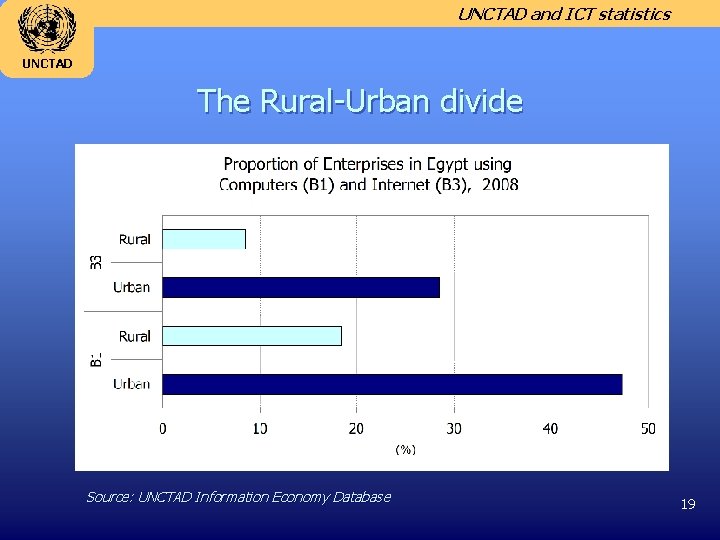
UNCTAD and ICT statistics UNCTAD The Rural-Urban divide Source: UNCTAD Information Economy Database 19
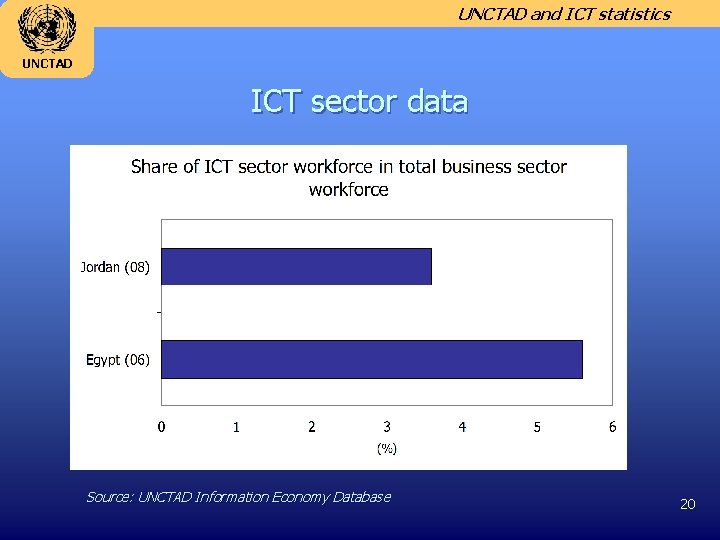
UNCTAD and ICT statistics UNCTAD ICT sector data Source: UNCTAD Information Economy Database 20
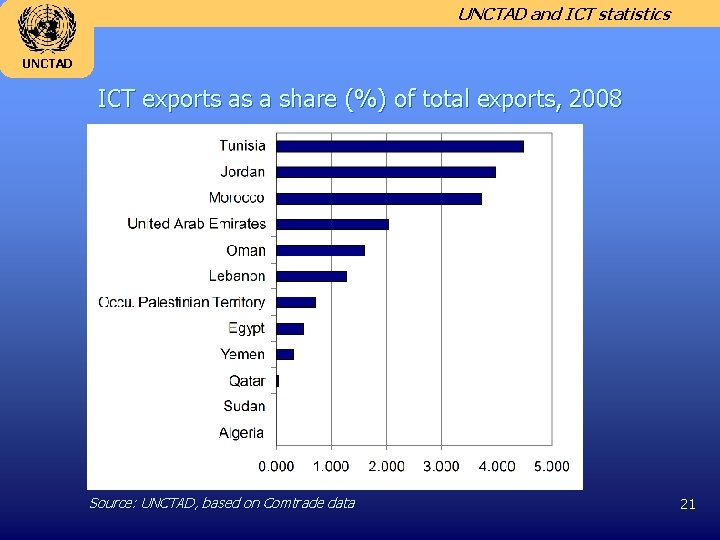
UNCTAD and ICT statistics UNCTAD ICT exports as a share (%) of total exports, 2008 Source: UNCTAD, based on Comtrade data 21
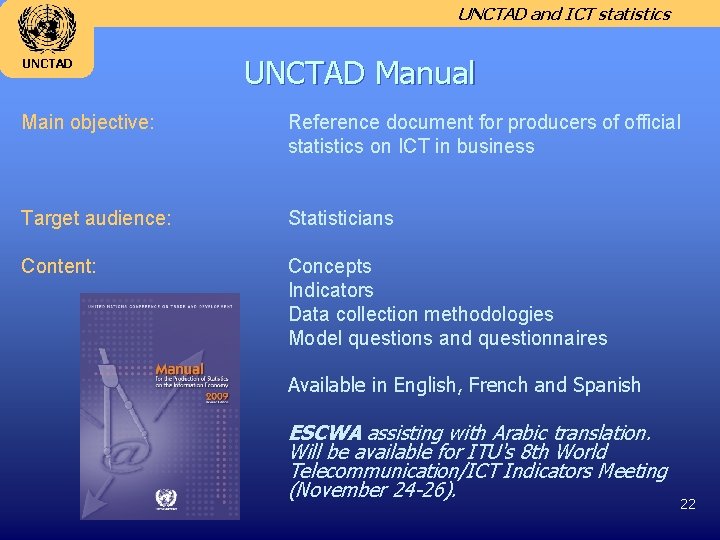
UNCTAD and ICT statistics UNCTAD Manual Main objective: Reference document for producers of official statistics on ICT in business Target audience: Statisticians Content: Concepts Indicators Data collection methodologies Model questions and questionnaires Available in English, French and Spanish ESCWA assisting with Arabic translation. Will be available for ITU's 8 th World Telecommunication/ICT Indicators Meeting (November 24 -26). 22
UNCTAD and ICT statistics UNCTAD Manual • Promotes methodology that should ensure internationally comparable ICT statistics • Takes users through all the concrete steps of ICT data collection: 1. 2. 3. 4. 5. 6. 7. Conceptual framework Standards for indicators on ICT use by business, the ICT sector and trade in ICT goods Data sources and data collection methods Model questions and questionnaires Designing surveys and processing data Dissemination (metadata) Institutional cooperation and coordination 23
UNCTAD and ICT statistics UNCTAD • UNCTAD Manual Practical tool for the production of ICT statistics: ü Step by step approach ü Includes many country examples and best practices ü Technical points further developed into details in separate boxes ü Presents existing survey questionnaires (OECD, Eurostat as well as model tables for presentation, model questions, etc. ) 24
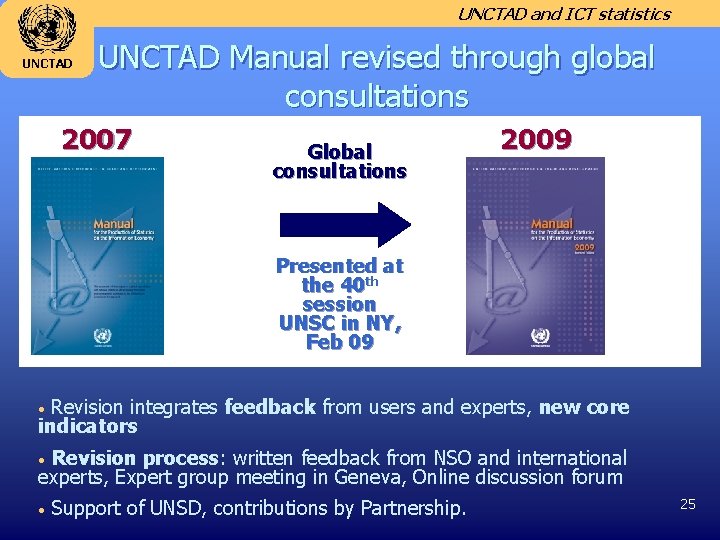
UNCTAD and ICT statistics UNCTAD Manual revised through global consultations 2007 Global consultations 2009 Presented at the 40 th session UNSC in NY, Feb 09 Revision integrates feedback from users and experts, new core indicators • Revision process: written feedback from NSO and international experts, Expert group meeting in Geneva, Online discussion forum • • Support of UNSD, contributions by Partnership. 25
UNCTAD and ICT statistics UNCTAD training course • Course delivered five times (Colombia 2007, Rep. of Korea 2008, and Trinidad in 2009, Addis Ababa and Rabat, 2009), next course for French-speaking Africa in October 2010. • Based on Manual. Uses UNCTAD’s pedagogical methodology: TRAINFORTRADE. • Targets statisticians from NSOs or other national entities in charge of the collection and dissemination of ICT use in business data at the national level. • Technical content: Relatively small groups (25 max) to encourage maximum interaction among specialists. • Arab countries a priority, awaiting Arabic translation of Manual. 26
UNCTAD and ICT statistics UNCTAD country-level technical assistance • UNCTAD follows up with countries that request TA in the area of ICT business/ICT sector statistics (advisory services, training) • In particular, countries that plan an ICT business survey for current and next year • Example: assistance provided to NSOs (Nepal, Tunisia) involved in the designing or processing of an ICT business survey • Extra-budgetary funding is required • Requests should be made to emeasurement@unctad. org 27
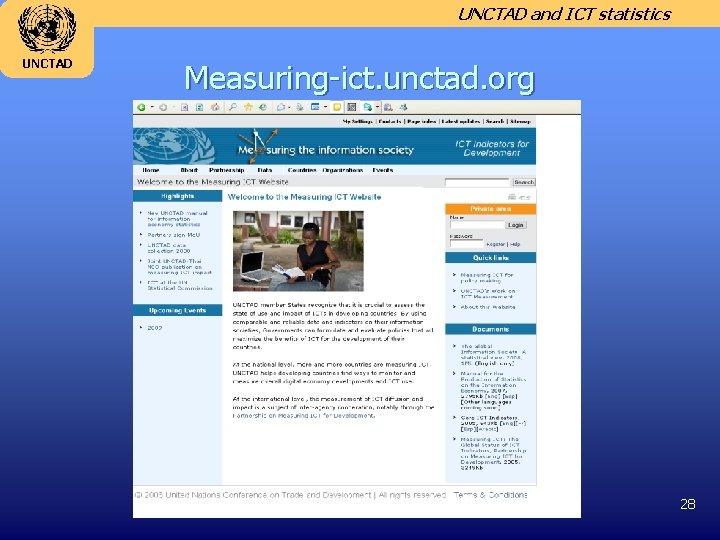
UNCTAD and ICT statistics UNCTAD Measuring-ict. unctad. org 28
ICT Indicators and Capacity building for ICT measurement in the Arab Region Thank you for your attention! Contact us at Emeasurement@unctad. org
- Slides: 29