
ICT IGCSE Theory Revision Presentation 2 2 Direct
- Slides: 5
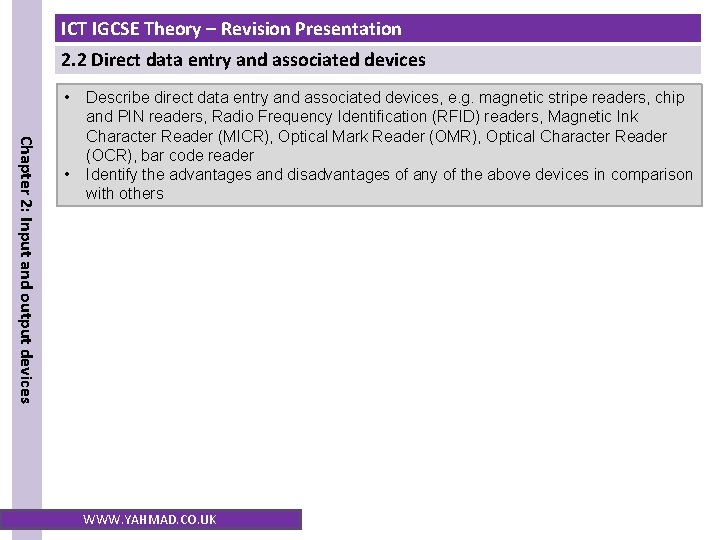
ICT IGCSE Theory – Revision Presentation 2. 2 Direct data entry and associated devices • Chapter 2: Input and output devices • Describe direct data entry and associated devices, e. g. magnetic stripe readers, chip and PIN readers, Radio Frequency Identification (RFID) readers, Magnetic Ink Character Reader (MICR), Optical Mark Reader (OMR), Optical Character Reader (OCR), bar code reader Identify the advantages and disadvantages of any of the above devices in comparison with others WWW. YAHMAD. CO. UK
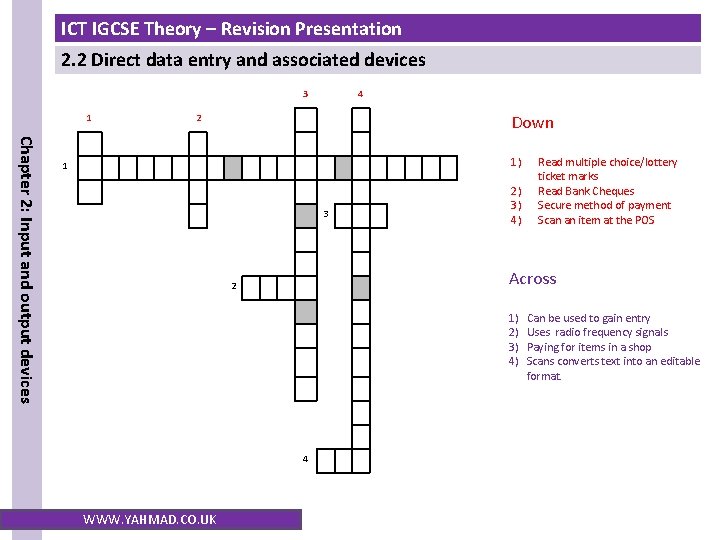
ICT IGCSE Theory – Revision Presentation 2. 2 Direct data entry and associated devices 3 1 4 Down 2 Chapter 2: Input and output devices 1) 1 3 2) 3) 4) Across 2 1) 2) 3) 4) 4 WWW. YAHMAD. CO. UK Read multiple choice/lottery ticket marks Read Bank Cheques Secure method of payment Scan an item at the POS Can be used to gain entry Uses radio frequency signals Paying for items in a shop Scans converts text into an editable format.
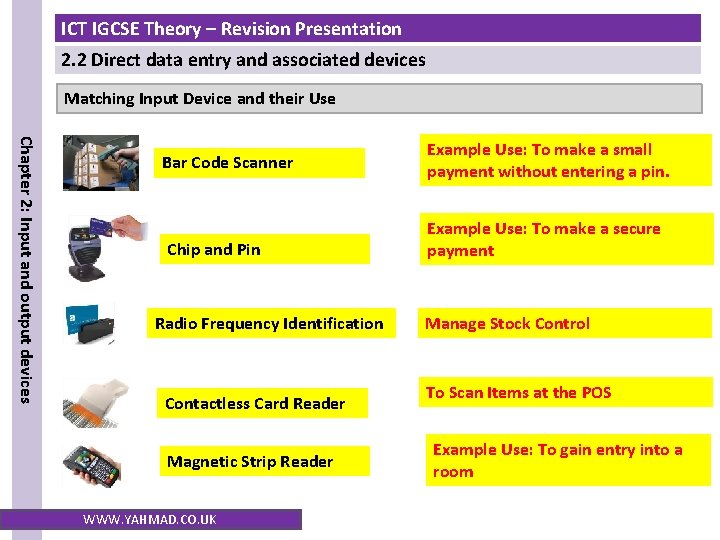
ICT IGCSE Theory – Revision Presentation 2. 2 Direct data entry and associated devices Matching Input Device and their Use Chapter 2: Input and output devices Bar Code Scanner Example Use: To make a small payment without entering a pin. Chip and Pin Example Use: To make a secure payment Radio Frequency Identification Contactless Card Reader Magnetic Strip Reader WWW. YAHMAD. CO. UK Manage Stock Control To Scan Items at the POS Example Use: To gain entry into a room
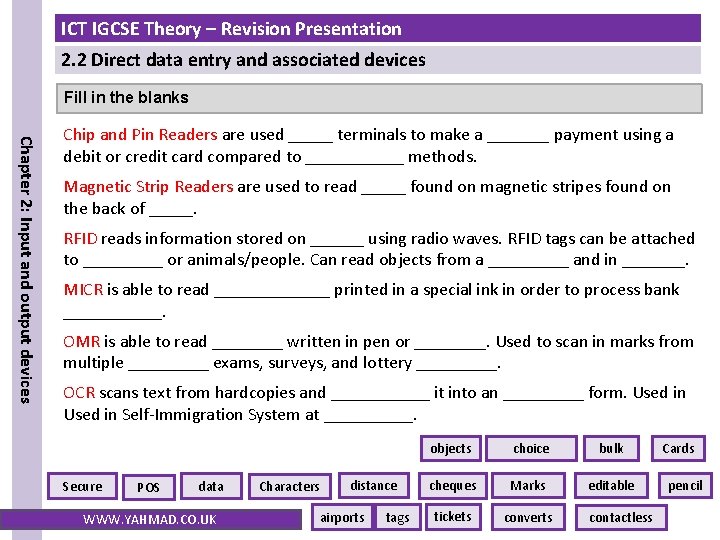
ICT IGCSE Theory – Revision Presentation 2. 2 Direct data entry and associated devices Fill in the blanks Chapter 2: Input and output devices Chip and Pin Readers are used _____ terminals to make a _______ payment using a debit or credit card compared to ______ methods. Magnetic Strip Readers are used to read _____ found on magnetic stripes found on the back of _____. RFID reads information stored on ______ using radio waves. RFID tags can be attached to _____ or animals/people. Can read objects from a _____ and in _______. MICR is able to read _______ printed in a special ink in order to process bank ______. OMR is able to read ____ written in pen or ____. Used to scan in marks from multiple _____ exams, surveys, and lottery _____. OCR scans text from hardcopies and ______ it into an _____ form. Used in Self-Immigration System at _____. Secure POS data WWW. YAHMAD. CO. UK Characters distance airports tags objects choice bulk cheques Marks editable tickets converts contactless Cards pencil
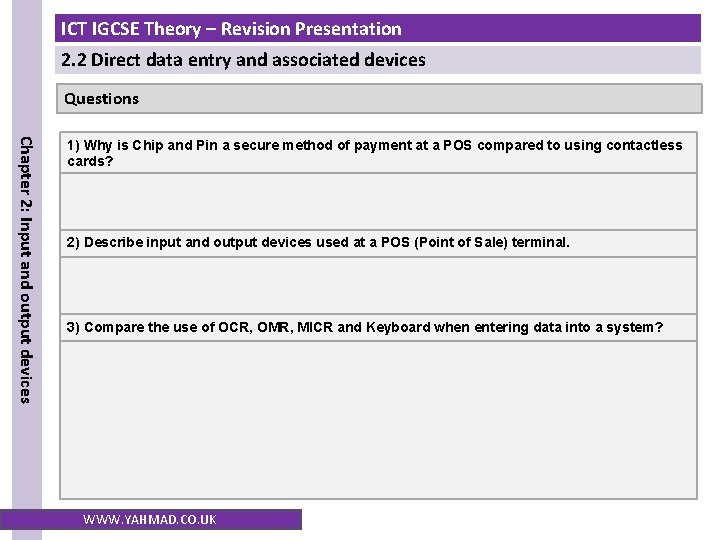
ICT IGCSE Theory – Revision Presentation 2. 2 Direct data entry and associated devices Questions Chapter 2: Input and output devices 1) Why is Chip and Pin a secure method of payment at a POS compared to using contactless cards? 2) Describe input and output devices used at a POS (Point of Sale) terminal. 3) Compare the use of OCR, OMR, MICR and Keyboard when entering data into a system? WWW. YAHMAD. CO. UK