
ICT IGCSE Theory Revision Presentation 2 2 Direct

- Slides: 9
ICT IGCSE Theory – Revision Presentation 2. 2 Direct data entry and associated devices • Chapter 2: Input and output devices • Describe direct data entry and associated devices, e. g. magnetic stripe readers, chip and PIN readers, Radio Frequency Identification (RFID) readers, Magnetic Ink Character Reader (MICR), Optical Mark Reader (OMR), Optical Character Reader (OCR), bar code reader Identify the advantages and disadvantages of any of the above devices in comparison with others WWW. YAHMAD. CO. UK
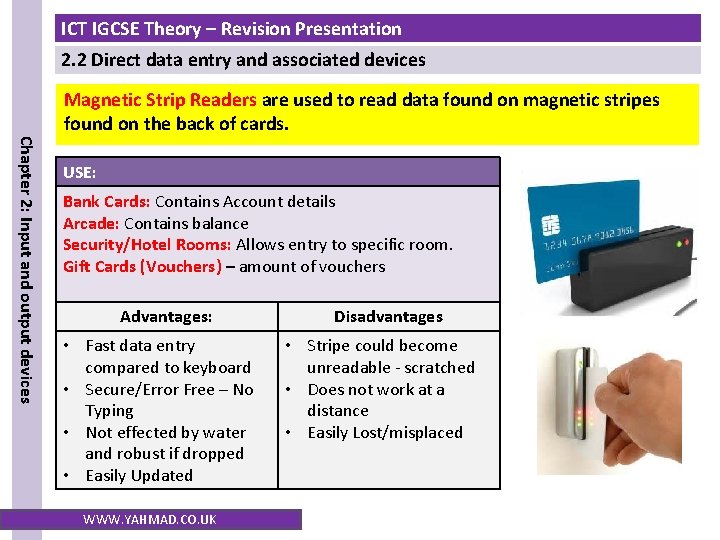
ICT IGCSE Theory – Revision Presentation 2. 2 Direct data entry and associated devices Chapter 2: Input and output devices Magnetic Strip Readers are used to read data found on magnetic stripes found on the back of cards. USE: Bank Cards: Contains Account details Arcade: Contains balance Security/Hotel Rooms: Allows entry to specific room. Gift Cards (Vouchers) – amount of vouchers Advantages: • Fast data entry compared to keyboard • Secure/Error Free – No Typing • Not effected by water and robust if dropped • Easily Updated WWW. YAHMAD. CO. UK Disadvantages • Stripe could become unreadable - scratched • Does not work at a distance • Easily Lost/misplaced
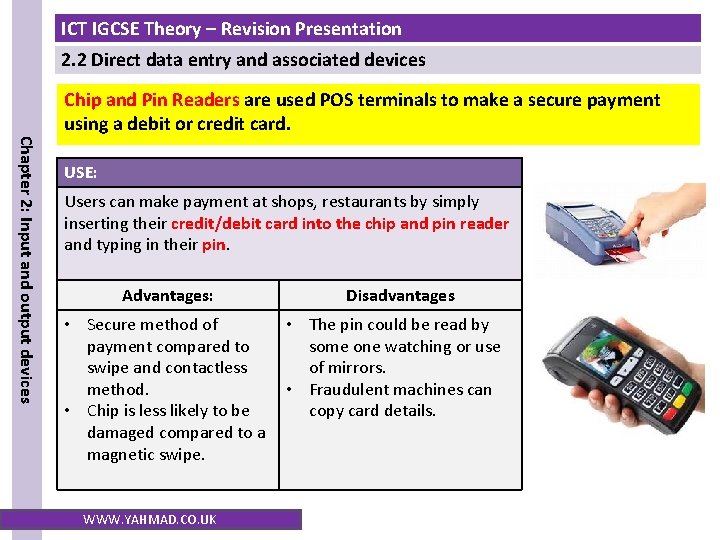
ICT IGCSE Theory – Revision Presentation 2. 2 Direct data entry and associated devices Chapter 2: Input and output devices Chip and Pin Readers are used POS terminals to make a secure payment using a debit or credit card. USE: Users can make payment at shops, restaurants by simply inserting their credit/debit card into the chip and pin reader and typing in their pin. Advantages: • Secure method of payment compared to swipe and contactless method. • Chip is less likely to be damaged compared to a magnetic swipe. WWW. YAHMAD. CO. UK Disadvantages • The pin could be read by some one watching or use of mirrors. • Fraudulent machines can copy card details.
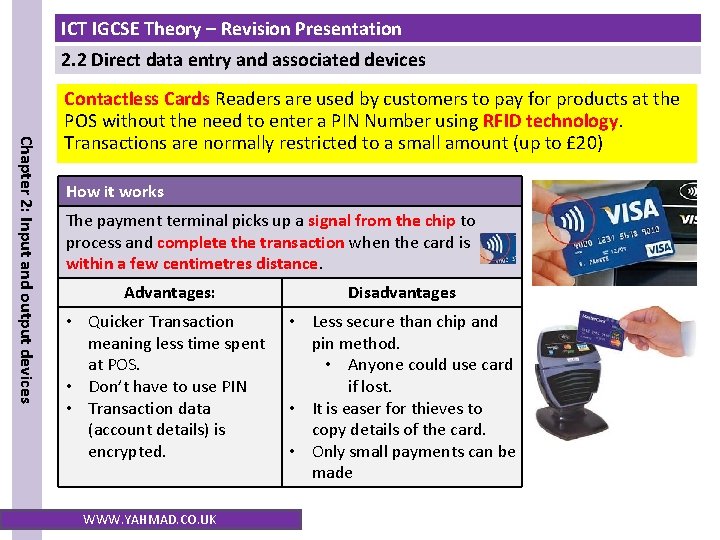
ICT IGCSE Theory – Revision Presentation 2. 2 Direct data entry and associated devices Chapter 2: Input and output devices Contactless Cards Readers are used by customers to pay for products at the POS without the need to enter a PIN Number using RFID technology. Transactions are normally restricted to a small amount (up to £ 20) How it works The payment terminal picks up a signal from the chip to process and complete the transaction when the card is within a few centimetres distance. Advantages: Disadvantages • Quicker Transaction meaning less time spent at POS. • Don’t have to use PIN • Transaction data (account details) is encrypted. • Less secure than chip and pin method. • Anyone could use card if lost. • It is easer for thieves to copy details of the card. • Only small payments can be made WWW. YAHMAD. CO. UK
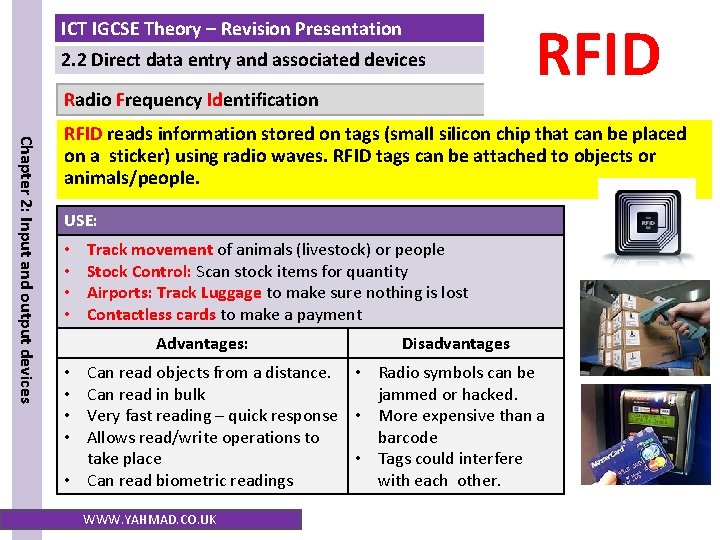
ICT IGCSE Theory – Revision Presentation 2. 2 Direct data entry and associated devices Radio Frequency Identification RFID Chapter 2: Input and output devices RFID reads information stored on tags (small silicon chip that can be placed on a sticker) using radio waves. RFID tags can be attached to objects or animals/people. USE: • • Track movement of animals (livestock) or people Stock Control: Scan stock items for quantity Airports: Track Luggage to make sure nothing is lost Contactless cards to make a payment Advantages: Disadvantages Can read objects from a distance. • Radio symbols can be Can read in bulk jammed or hacked. Very fast reading – quick response • More expensive than a Allows read/write operations to barcode take place • Tags could interfere • Can read biometric readings with each other. • • WWW. YAHMAD. CO. UK
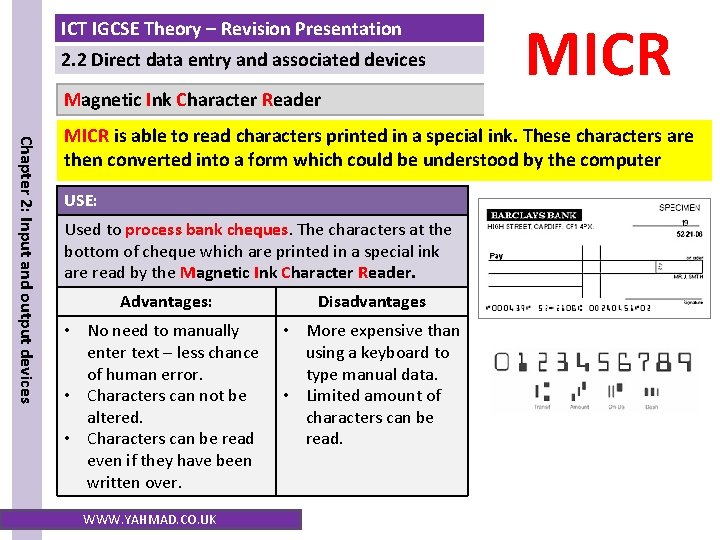
ICT IGCSE Theory – Revision Presentation 2. 2 Direct data entry and associated devices Magnetic Ink Character Reader MICR Chapter 2: Input and output devices MICR is able to read characters printed in a special ink. These characters are then converted into a form which could be understood by the computer USE: Used to process bank cheques. The characters at the bottom of cheque which are printed in a special ink are read by the Magnetic Ink Character Reader. Advantages: Disadvantages • No need to manually enter text – less chance of human error. • Characters can not be altered. • Characters can be read even if they have been written over. • More expensive than using a keyboard to type manual data. • Limited amount of characters can be read. WWW. YAHMAD. CO. UK
ICT IGCSE Theory – Revision Presentation 2. 2 Direct data entry and associated devices Optical Mark Reader OMR Chapter 2: Input and output devices OMR is able to read marks written in pen or pencil. The position of the mark is stored in the computers memory. USE: Used to scan in marks from multiple choice exams, surveys, and lottery tickets. Advantages: Disadvantages • Very fast method of • Forms have to be inputting data as no user completed correctly to has to manually enter avoid manual checks which results. would waste time. • More accurate than OCR • Less chance of errors WWW. YAHMAD. CO. UK
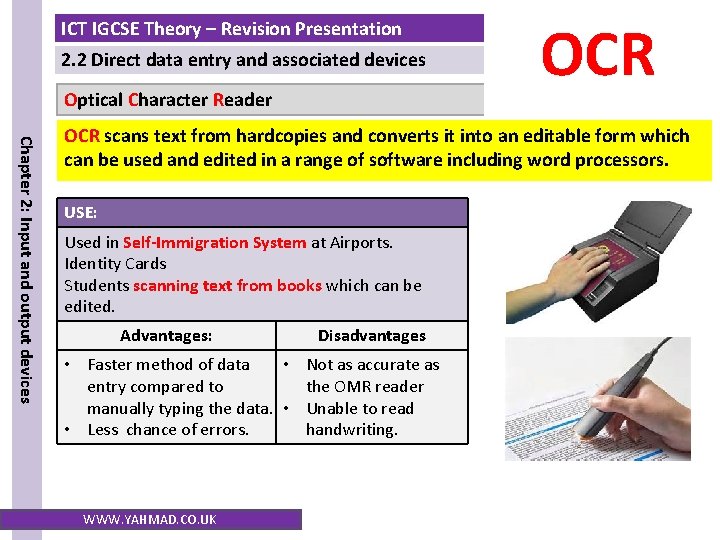
ICT IGCSE Theory – Revision Presentation 2. 2 Direct data entry and associated devices Optical Character Reader OCR Chapter 2: Input and output devices OCR scans text from hardcopies and converts it into an editable form which can be used and edited in a range of software including word processors. USE: Used in Self-Immigration System at Airports. Identity Cards Students scanning text from books which can be edited. Advantages: Disadvantages • Faster method of data • Not as accurate as entry compared to the OMR reader manually typing the data. • Unable to read • Less chance of errors. handwriting. WWW. YAHMAD. CO. UK
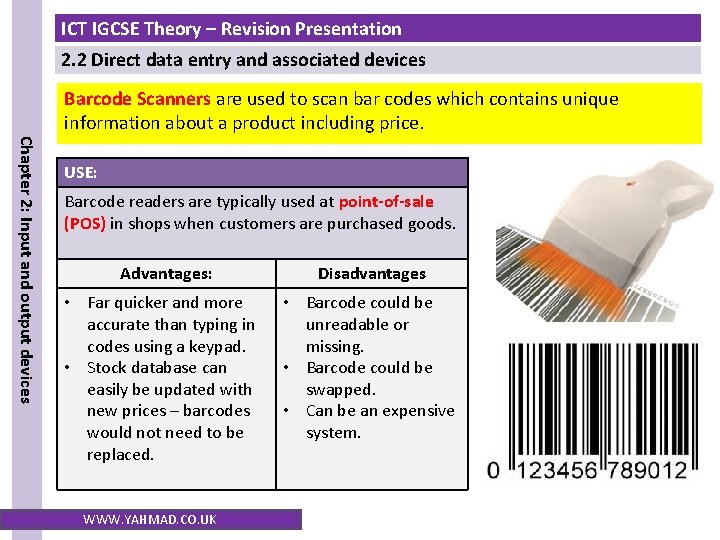
ICT IGCSE Theory – Revision Presentation 2. 2 Direct data entry and associated devices Barcode Scanners are used to scan bar codes which contains unique information about a product including price. Chapter 2: Input and output devices USE: Barcode readers are typically used at point-of-sale (POS) in shops when customers are purchased goods. Advantages: • Far quicker and more accurate than typing in codes using a keypad. • Stock database can easily be updated with new prices – barcodes would not need to be replaced. WWW. YAHMAD. CO. UK Disadvantages • Barcode could be unreadable or missing. • Barcode could be swapped. • Can be an expensive system.