
ICT for Evaluation Socit Luxembourgeoise dvaluation et de
ICT for Evaluation Société Luxembourgeoise d’évaluation et de prospective Oscar A. Garcia Director Independent Office of Evaluation IFAD
Context • 4 th industrial revolution • Demographic explosion • Climate change • Increasing disparities • SDGs: people, planet, prosperity, peace, partnerships 2
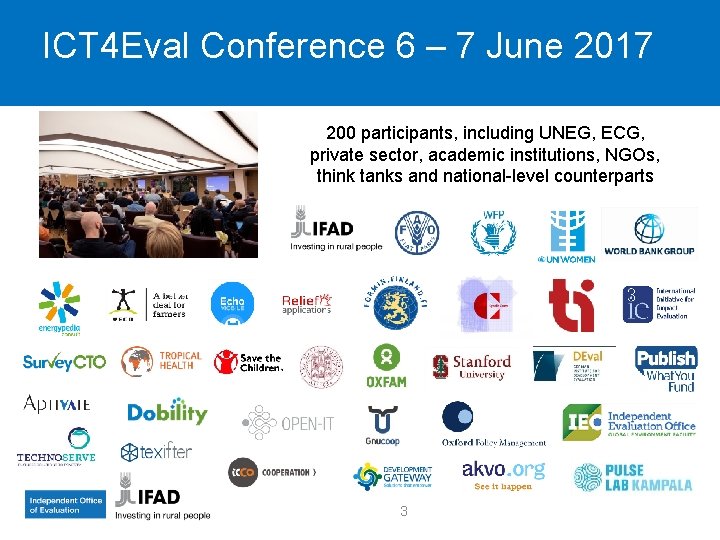
ICT 4 Eval Conference 6 – 7 June 2017 200 participants, including UNEG, ECG, private sector, academic institutions, NGOs, think tanks and national-level counterparts 3
SDGs and Challenges for evaluators • 145 out of 232 indicators of SDGs cannot be measured as of today (UNDP Guidance note, September 2017) • What can be measured is a result traditional approaches to: - Data collection - Data analysis - Dissemination of evaluation results 4
Technology and new data • Newer avenues and sources of data – e. g. Remote sensing • Better analysis of existing data – e. g. Machine learning and big data analytics • Better Feedback loops to stakeholders, especially beneficiaries in the field 5
Examples of frontrunners - Save the Children, Somalia -> Conflict and lack of mobility -> Use of satellite data for infrastructure, Skype and email for remote audits and verification -> Possibility of evaluations in midst of deteriorating security environment - GEF-IEO and DEval -> Evaluations -> Lack of counterfactual for environment impacts -> Remote Sensing -> Readily available impact and counterfactual for low cost combined with other sources - 3 ie -> Systematic reviews -> Time and labour consuming review process -> Machine learning -> Reducing review time by up to 70% - Oxfam GB -> Impact evaluations in Zambia and Thailand -> Lack of feedback to beneficiaries -> Mobile phones for data collection and dissemination -> Real time feedback to beneficiaries and validation of impact data collected 6
Results • Increased effectiveness and efficiency - Better - Faster - Cheaper • Augmented bias • Disproportionally available (political economy) 7
Reflections for the future • Technology not a panacea but means to an end • Evaluations need to be grounded in theory • Ethics of paramount importance • Evaluation needs to remain human centric • Partnerships – Tapping into complementary capacities 8
- Slides: 8