
ICT Architectures 2 ICT Strategy Bas Kruiswijk Leiden
ICT Architectures 2 – ICT Strategy Bas Kruiswijk | Leiden February 14, 2017 1
Contents 1. The impact of ICT • 5 levels of IT-induced reconfiguration • Information intensity matrix • Trends that reshape the business 2. How to develop an ICT strategy? 3. Strategic Alignment • Strategic Alignment Model (Henderson and Venkatraman) 2
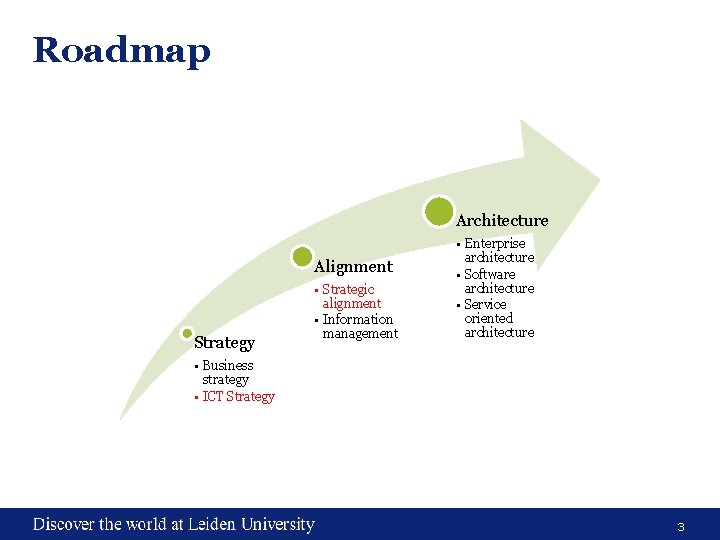
Roadmap Architecture Alignment Strategy • Strategic alignment • Information management • Enterprise architecture • Software architecture • Service oriented architecture • Business strategy • ICT Strategy 3
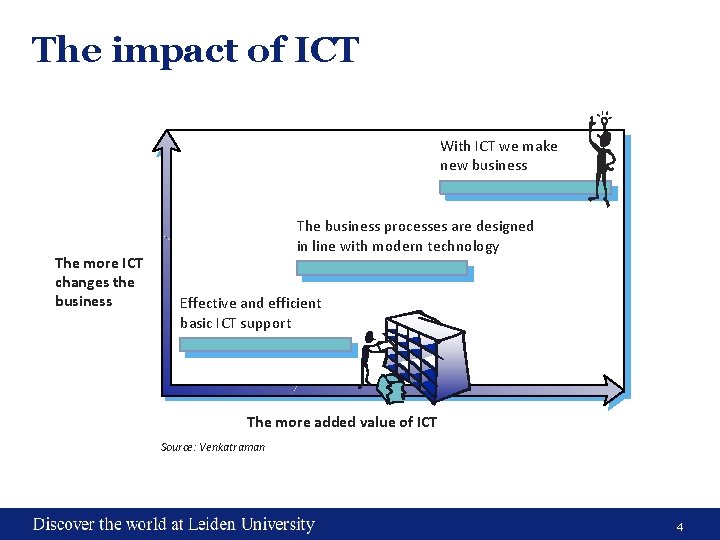
The impact of ICT With ICT we make new business The more ICT changes the business The business processes are designed in line with modern technology Effective and efficient basic ICT support The more added value of ICT Source: Venkatraman 4
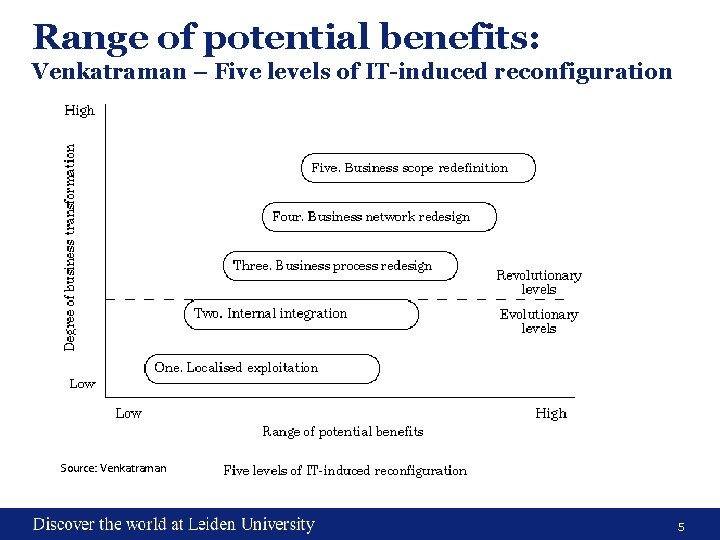
Range of potential benefits: Venkatraman – Five levels of IT-induced reconfiguration Source: Venkatraman 5
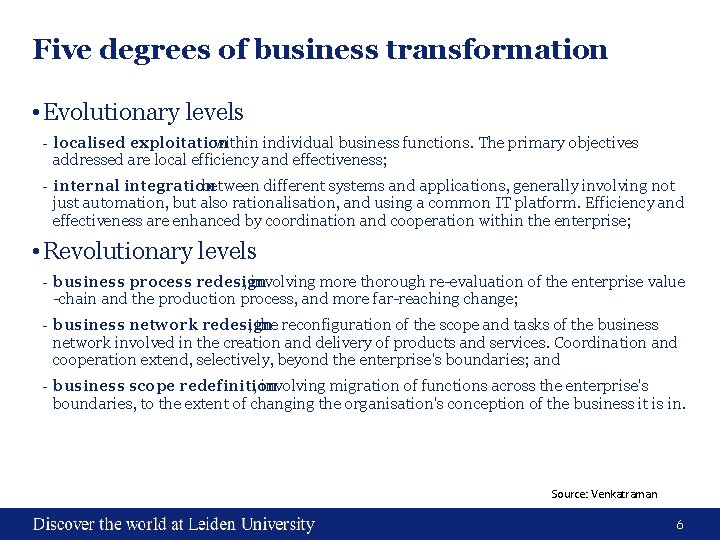
Five degrees of business transformation • Evolutionary levels - localised exploitation within individual business functions. The primary objectives addressed are local efficiency and effectiveness; - internal integration between different systems and applications, generally involving not just automation, but also rationalisation, and using a common IT platform. Efficiency and effectiveness are enhanced by coordination and cooperation within the enterprise; • Revolutionary levels - business process redesign , involving more thorough re-evaluation of the enterprise value -chain and the production process, and more far-reaching change; - business network redesign , the reconfiguration of the scope and tasks of the business network involved in the creation and delivery of products and services. Coordination and cooperation extend, selectively, beyond the enterprise's boundaries; and - business scope redefinition , involving migration of functions across the enterprise's boundaries, to the extent of changing the organisation's conception of the business it is in. Source: Venkatraman 6
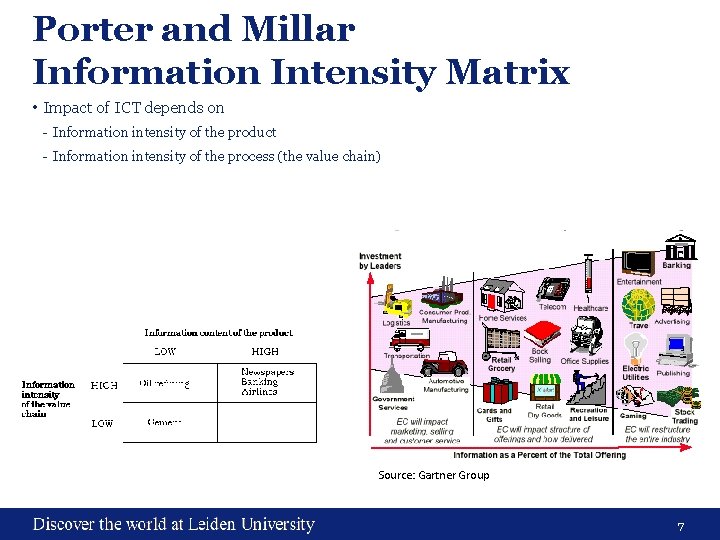
Porter and Millar Information Intensity Matrix • Impact of ICT depends on - Information intensity of the product - Information intensity of the process (the value chain) Source: Gartner Group 7
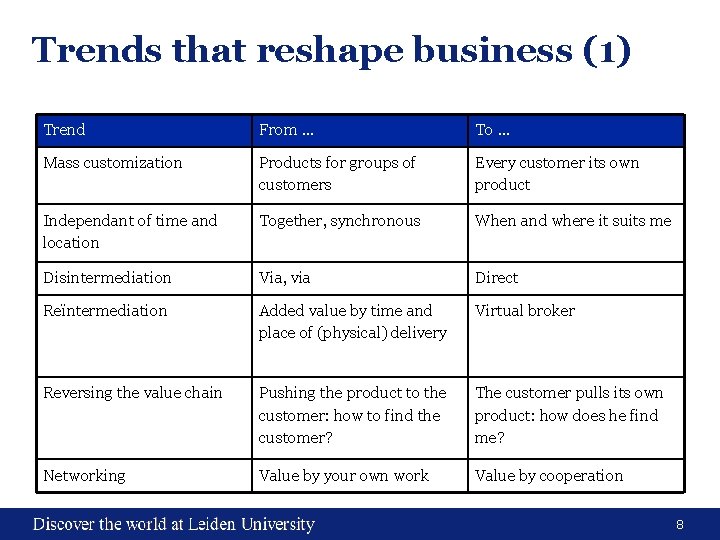
Trends that reshape business (1) Trend From. . . To. . . Mass customization Products for groups of customers Every customer its own product Independant of time and location Together, synchronous When and where it suits me Disintermediation Via, via Direct Reïntermediation Added value by time and place of (physical) delivery Virtual broker Reversing the value chain Pushing the product to the customer: how to find the customer? The customer pulls its own product: how does he find me? Networking Value by your own work Value by cooperation 8
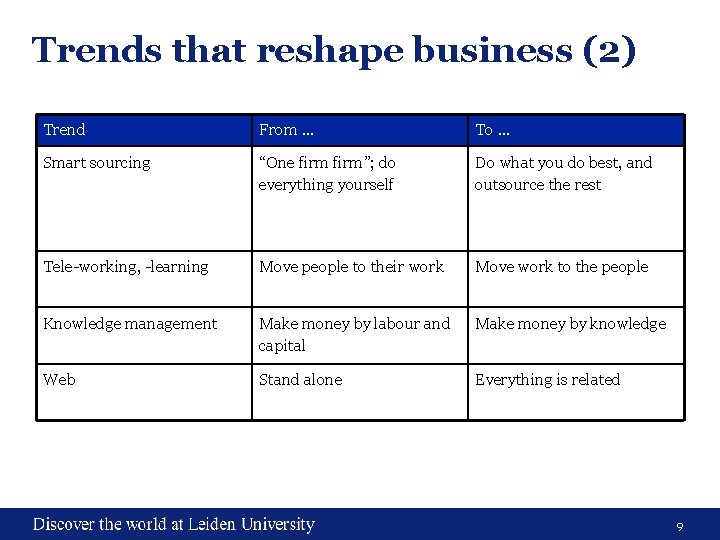
Trends that reshape business (2) Trend From. . . To. . . Smart sourcing “One firm”; do everything yourself Do what you do best, and outsource the rest Tele-working, -learning Move people to their work Move work to the people Knowledge management Make money by labour and capital Make money by knowledge Web Stand alone Everything is related 9
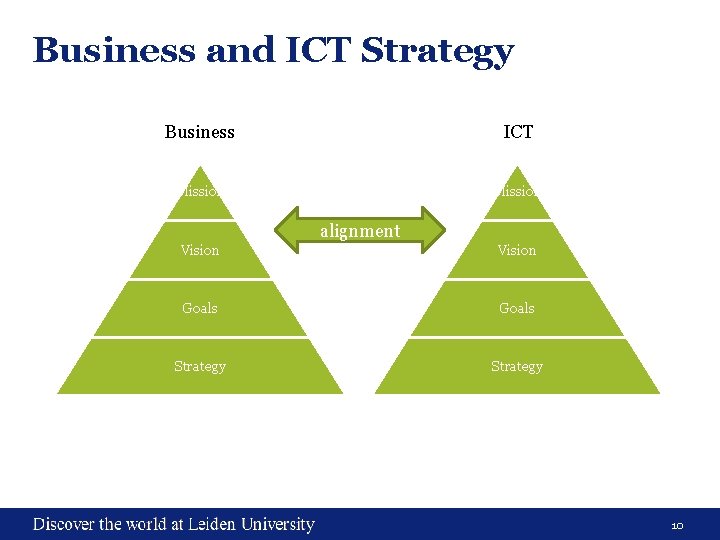
Business and ICT Strategy Business ICT Mission alignment Vision Goals Strategy 10

Business and ICT Strategy Alignment Business ICT Mission Contribute to the innovative power of the Dutch service industries on the European market, by improving efficiency and effectiveness Supply ICT services that support the primary business, with acceptable costs and conforming to an agreed service level Vision We are on our way to become a network-organisation All employees within and close to the organisation will have access to the business information, any time, any place and always with appropriate authorisation Goals One and a half years from now, we will have our first virtual co-operation with one of our customers, consisting of three partners offering a package of employee benefits Within a year from now, we will have a webportal that enables our partner organisations to access our business information. Our systems will be accessable through multiple technologies and channels Strategy We start out with a virtual conference on the internet, on the subject of employee benefits and we build a structure for a virtual organisation in which partners can join evolutionary. As soon as we have two partnerships, we will start selling this concept The next two months, we will run a pilot to prove the usability of webenabling as integration technology After this pilot, a second pilot is started with a webportal If both pilots are successful, all our business applications will be migrated to a web interface and connected to a webportal 11
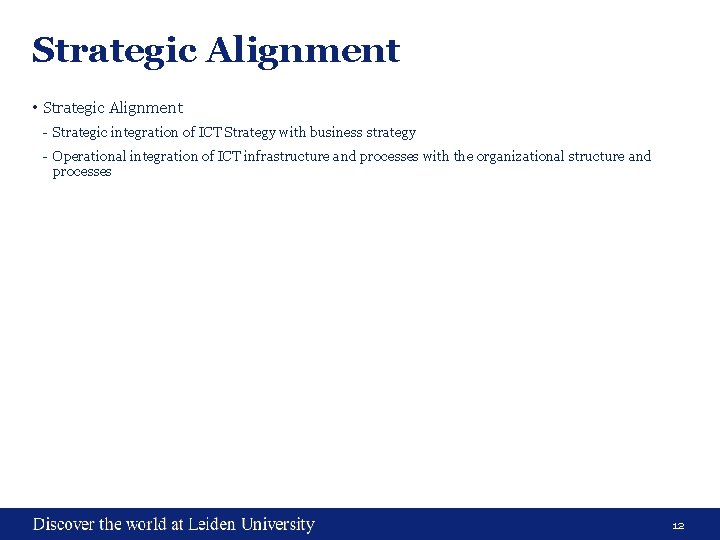
Strategic Alignment • Strategic Alignment - Strategic integration of ICT Strategy with business strategy - Operational integration of ICT infrastructure and processes with the organizational structure and processes 12
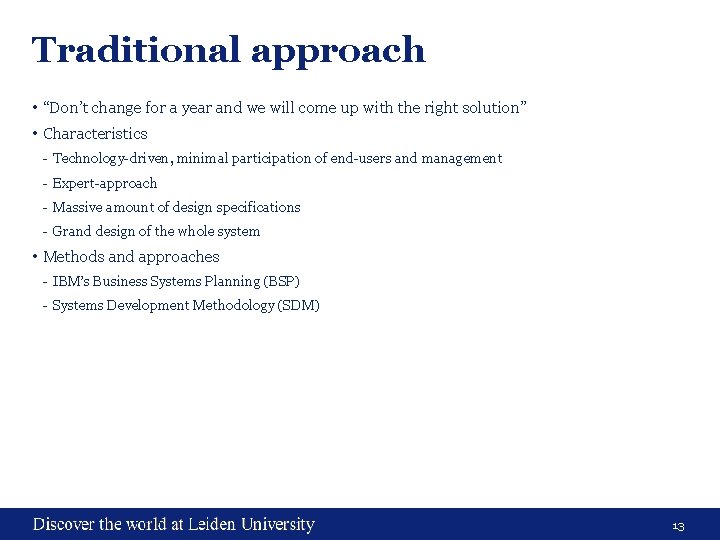
Traditional approach • “Don’t change for a year and we will come up with the right solution” • Characteristics - Technology-driven, minimal participation of end-users and management - Expert-approach - Massive amount of design specifications - Grand design of the whole system • Methods and approaches - IBM’s Business Systems Planning (BSP) - Systems Development Methodology (SDM) 13
A different approach is necessary • Large availability of standard packages for the support of the primary proces (ERP) and generic purposes (middleware, portals, security) • Management and end-users are more involved • ICT is an enabler for new business • Constantly changing environment does not accept long-running projects • Dynamic business process design, stable business rules • Increasing complexity 14

Business strategy and ICT strategy are interrelated From To Bus ines s Business Strategy IC T Operation ICT Business drives ICT Strategy Operation Business- and ICT strategies are interrelated 15
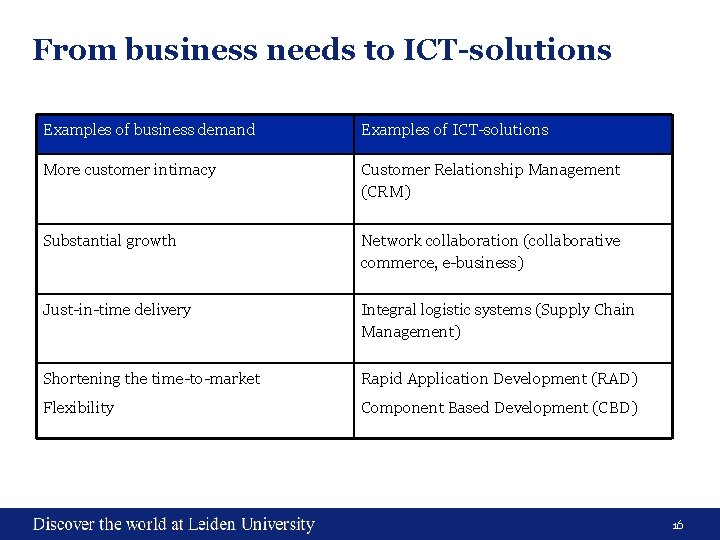
From business needs to ICT-solutions Examples of business demand Examples of ICT-solutions More customer intimacy Customer Relationship Management (CRM) Substantial growth Network collaboration (collaborative commerce, e-business) Just-in-time delivery Integral logistic systems (Supply Chain Management) Shortening the time-to-market Rapid Application Development (RAD) Flexibility Component Based Development (CBD) 16
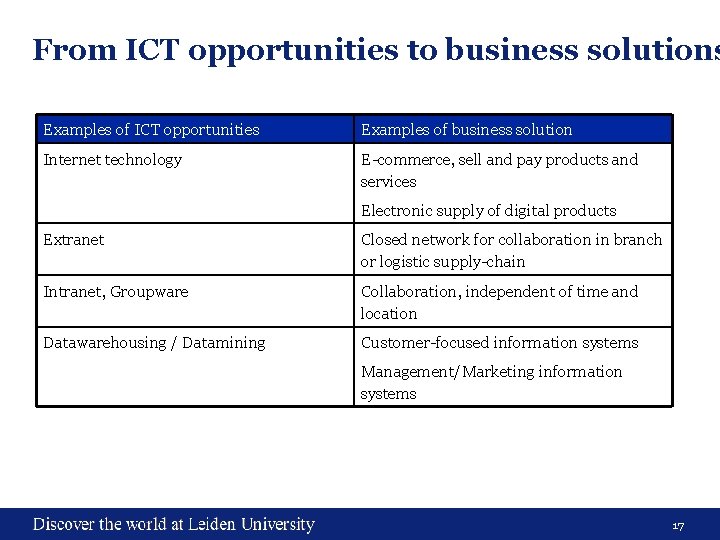
From ICT opportunities to business solutions Examples of ICT opportunities Examples of business solution Internet technology E-commerce, sell and pay products and services Electronic supply of digital products Extranet Closed network for collaboration in branch or logistic supply-chain Intranet, Groupware Collaboration, independent of time and location Datawarehousing / Datamining Customer-focused information systems Management/Marketing information systems 17
Strategic Alignment Model • Henderson, Venkatraman, IBM Systems Journal, 1993 • Not the traditional approach; ICT is more than administrative support • Four alignment perspectives - Dominant alignment aspect: business or ICT - Functional integration and strategic fit • Functional integration of ICT strategy and operations with business strategy and operations • Strategic fit between external positioning and internal arrangements, both on the business and ICT side 18
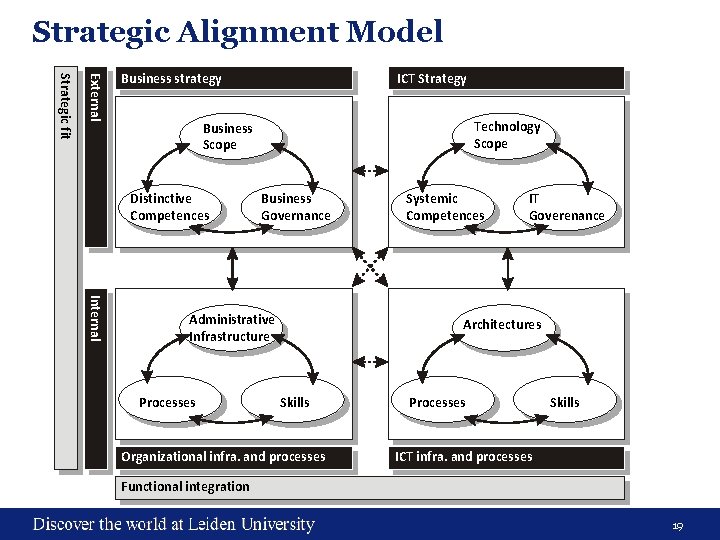
Strategic Alignment Model External Strategic fit Business strategy ICT Strategy Technology Scope Business Scope Distinctive Competences Business Governance Internal Administrative Infrastructure Processes Systemic Competences IT Goverenance Architectures Skills Organizational infra. and processes Processes Skills ICT infra. and processes Functional integration 19
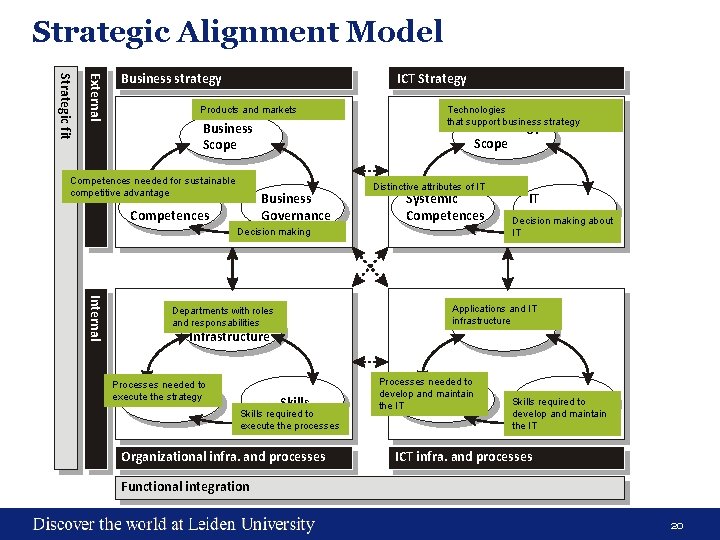
Strategic Alignment Model External Strategic fit Business strategy ICT Strategy Products and markets Technology Scope Business Scope Competences needed for sustainable competitive advantage Distinctive Competences Technologies that support business strategy Business Governance Distinctive attributes of IT Systemic Competences Decision making Internal Architectures Infrastructure Processes IT Applications and IT infrastructure Departments with roles and Administrative responsabilities Processes needed to execute the strategy IT Goverenance Decision making about Skills required to execute the processes Organizational infra. and processes Processes needed to develop and maintain the IT Processes Skills required Skillsto develop and maintain the IT ICT infra. and processes Functional integration 20
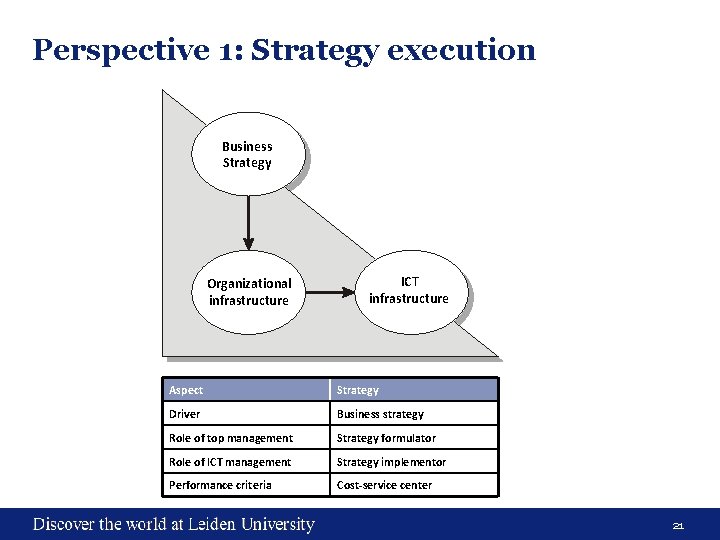
Perspective 1: Strategy execution Business Strategy Organizational infrastructure ICT infrastructure Aspect Strategy Driver Business strategy Role of top management Strategy formulator Role of ICT management Strategy implementor Performance criteria Cost-service center 21
Strategy execution • Business strategy is leading • Top management defines overall strategy • ICT implements this strategy in an effective en efficient way • Performance is measured by cost and service 22
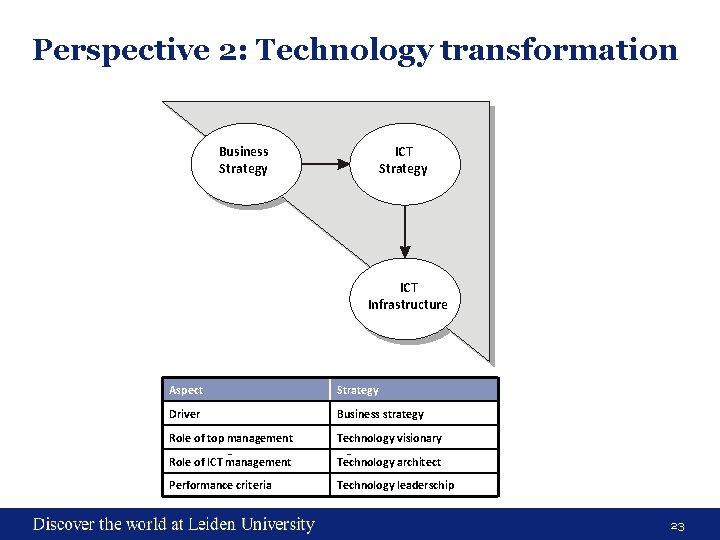
Perspective 2: Technology transformation ICT Strategy Business Strategy ICT Infrastructure Aspect Strategy Driver Business strategy Role of top management Technology visionary Role of ICT management Technology architect Performance criteria Technology leaderschip 23
Technology transformation • Implement the business strategy by using ICT as a strategic instrument • Do not focus an current business processes but on ICT opportunities • Top management develops a technology vision that supports the business strategy • Performance is measured by technology leadership 24
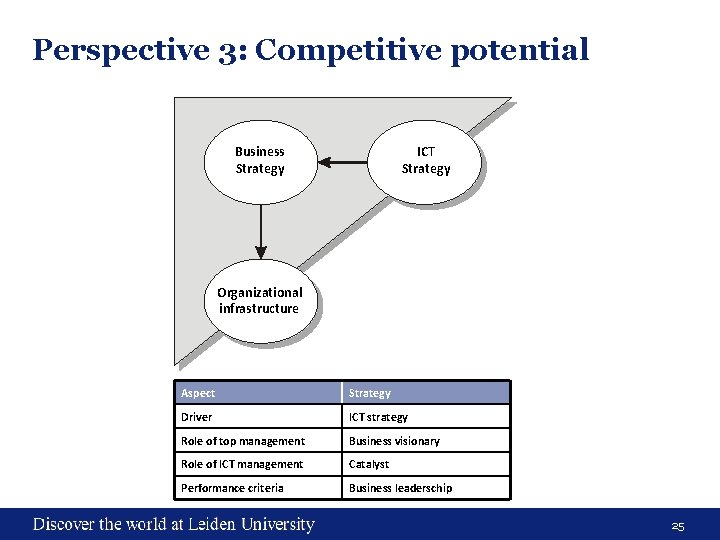
Perspective 3: Competitive potential ICT Strategy Business Strategy Organizational infrastructure Aspect Strategy Driver ICT strategy Role of top management Business visionary Role of ICT management Catalyst Performance criteria Business leaderschip 25
Competitive potential • ICT enables changes and new business • ICT developments are translated into competitive potential • Different organizational infrastructure and processes driven by technology • Top management includes ICT developments in business strategy • Performance is measured by market leadership 26
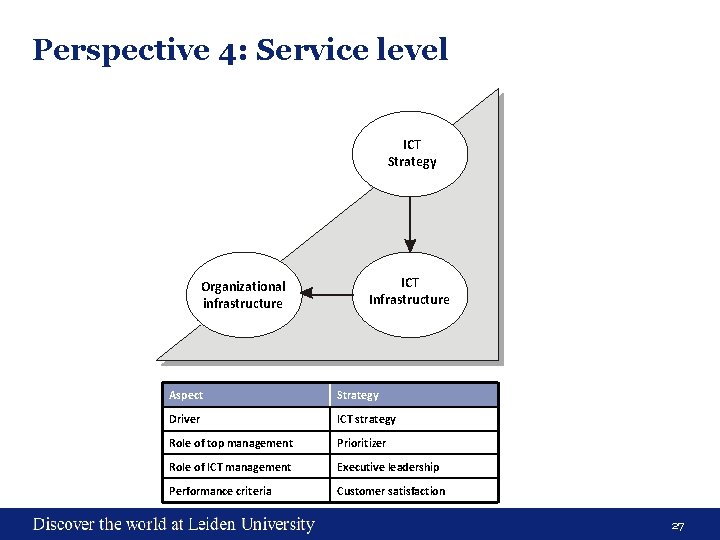
Perspective 4: Service level ICT Strategy Organizational infrastructure ICT Infrastructure Aspect Strategy Driver ICT strategy Role of top management Prioritizer Role of ICT management Executive leadership Performance criteria Customer satisfaction 27
Service level • Optimization of ICT service organisation • Indirect link with business strategy (stimulates customer demand) • Top management prioritises • ICT management is entrepreneur that builds a successful service organisation • Performance is measured by customer satisfaction 28
Strategic alignment Discussion – • Alignment the “traditional way” • Traditional linkage compared to strategic alignment • Which alignment perspective is the best? • Academic criticism on the Strategic Alignment Model • What about the different executive roles – information management? • What about outsourcing? 29
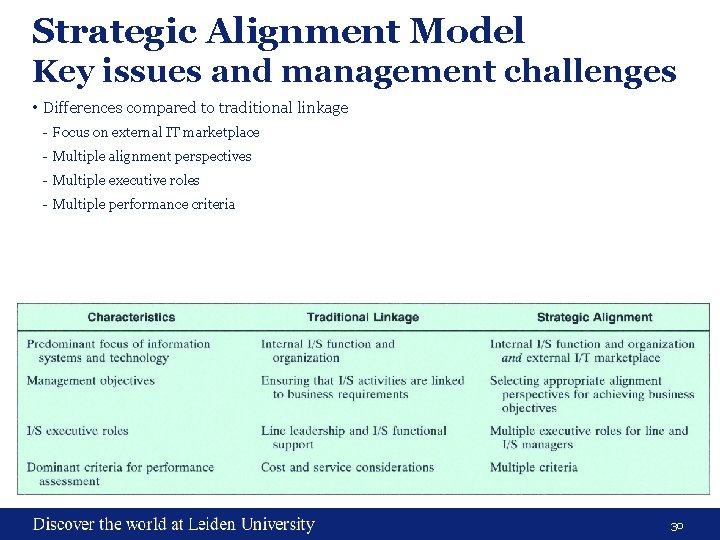
Strategic Alignment Model Key issues and management challenges • Differences compared to traditional linkage - Focus on external IT marketplace - Multiple alignment perspectives - Multiple executive roles - Multiple performance criteria 30
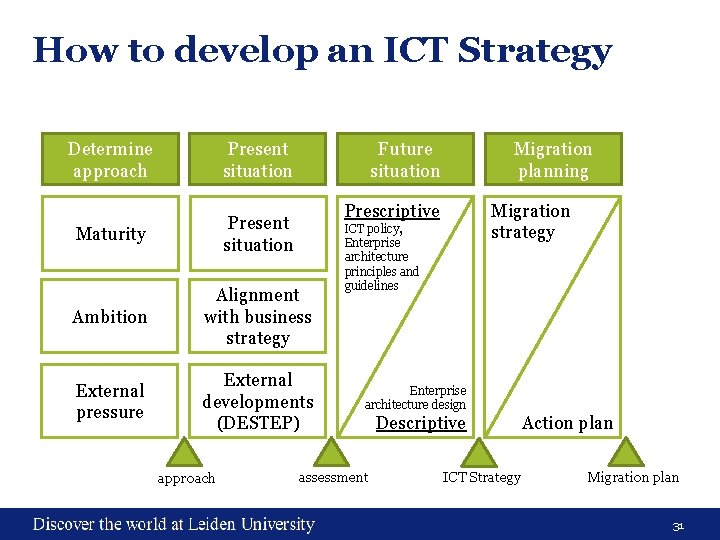
How to develop an ICT Strategy Determine approach Present situation Maturity Present situation Ambition Alignment with business strategy External pressure External developments (DESTEP) approach Future situation Migration planning Prescriptive Migration strategy ICT policy, Enterprise architecture principles and guidelines Enterprise architecture design assessment Descriptive ICT Strategy Action plan Migration plan 31
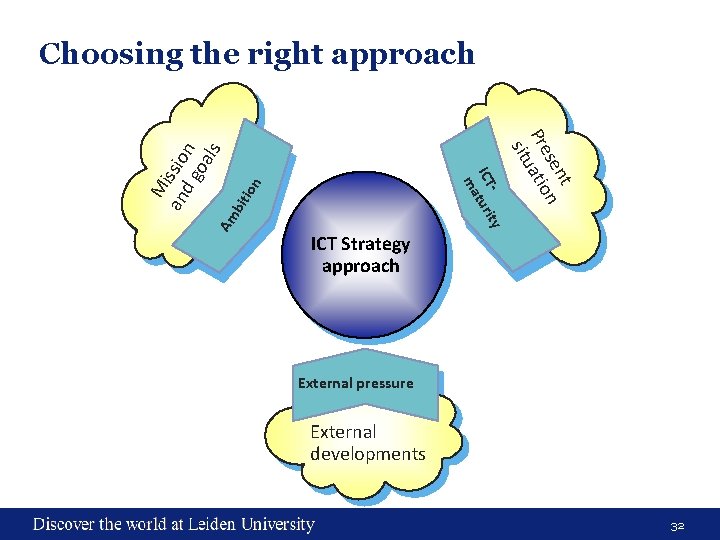
ion bit Am t sen n Pre uatio sit ty ICT turi ma Mi an ssio dg n oa ls Choosing the right approach ICT Strategy approach External pressure External developments 32
ICT Architectures 2 – ICT Strategy 33
- Slides: 33