
ICT 619 Intelligent Systems Topic 8 Intelligent Agents
- Slides: 33
ICT 619 Intelligent Systems Topic 8: Intelligent Agents ICT 619 S 2 -05
Intelligent Agents § § § § What is an intelligent agent? Why intelligent agents? What intelligent agents can do for us Characteristics of a good agent Types of agents Building intelligent agents Intelligent agents in E-Commerce Intelligent agent design - state-of-the-art and future ICT 619 S 2 -05 2
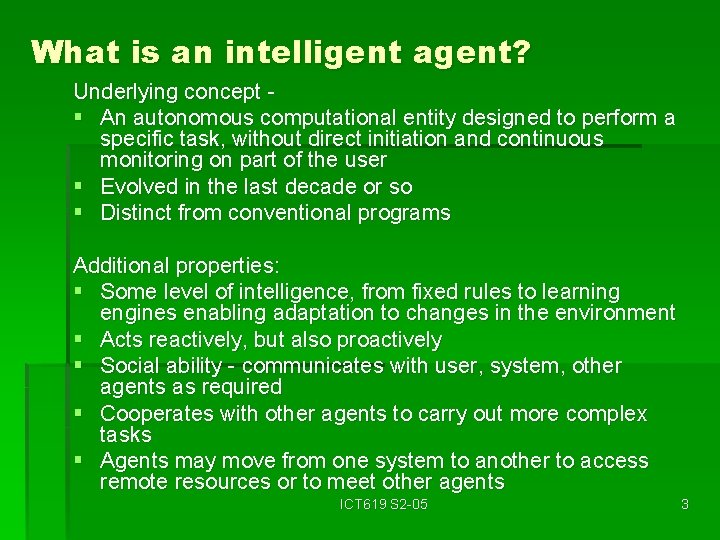
What is an intelligent agent? Underlying concept § An autonomous computational entity designed to perform a specific task, without direct initiation and continuous monitoring on part of the user § Evolved in the last decade or so § Distinct from conventional programs Additional properties: § Some level of intelligence, from fixed rules to learning engines enabling adaptation to changes in the environment § Acts reactively, but also proactively § Social ability - communicates with user, system, other agents as required § Cooperates with other agents to carry out more complex tasks § Agents may move from one system to another to access remote resources or to meet other agents ICT 619 S 2 -05 3
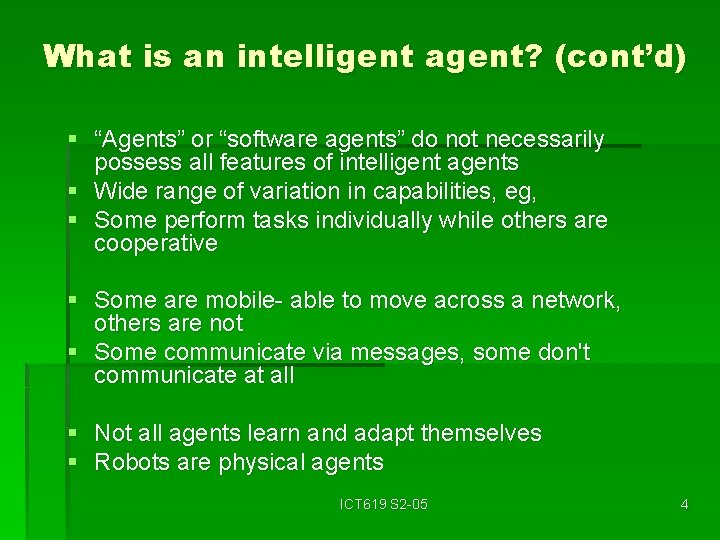
What is an intelligent agent? (cont’d) § “Agents” or “software agents” do not necessarily possess all features of intelligent agents § Wide range of variation in capabilities, eg, § Some perform tasks individually while others are cooperative § Some are mobile- able to move across a network, others are not § Some communicate via messages, some don't communicate at all § Not all agents learn and adapt themselves § Robots are physical agents ICT 619 S 2 -05 4
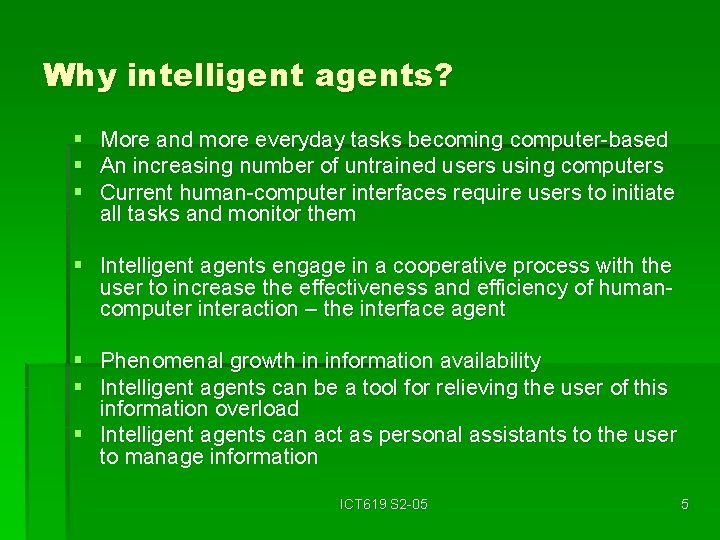
Why intelligent agents? § § § More and more everyday tasks becoming computer-based An increasing number of untrained users using computers Current human-computer interfaces require users to initiate all tasks and monitor them § Intelligent agents engage in a cooperative process with the user to increase the effectiveness and efficiency of humancomputer interaction – the interface agent § Phenomenal growth in information availability § Intelligent agents can be a tool for relieving the user of this information overload § Intelligent agents can act as personal assistants to the user to manage information ICT 619 S 2 -05 5
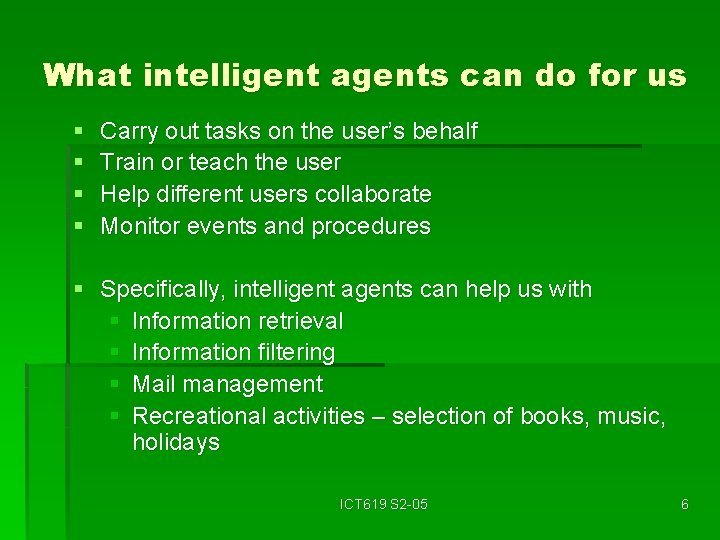
What intelligent agents can do for us § § Carry out tasks on the user’s behalf Train or teach the user Help different users collaborate Monitor events and procedures § Specifically, intelligent agents can help us with § Information retrieval § Information filtering § Mail management § Recreational activities – selection of books, music, holidays ICT 619 S 2 -05 6
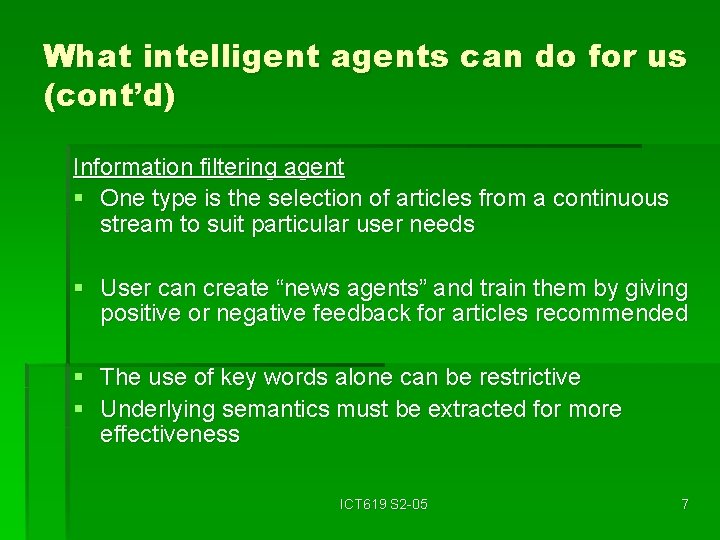
What intelligent agents can do for us (cont’d) Information filtering agent § One type is the selection of articles from a continuous stream to suit particular user needs § User can create “news agents” and train them by giving positive or negative feedback for articles recommended § The use of key words alone can be restrictive § Underlying semantics must be extracted for more effectiveness ICT 619 S 2 -05 7
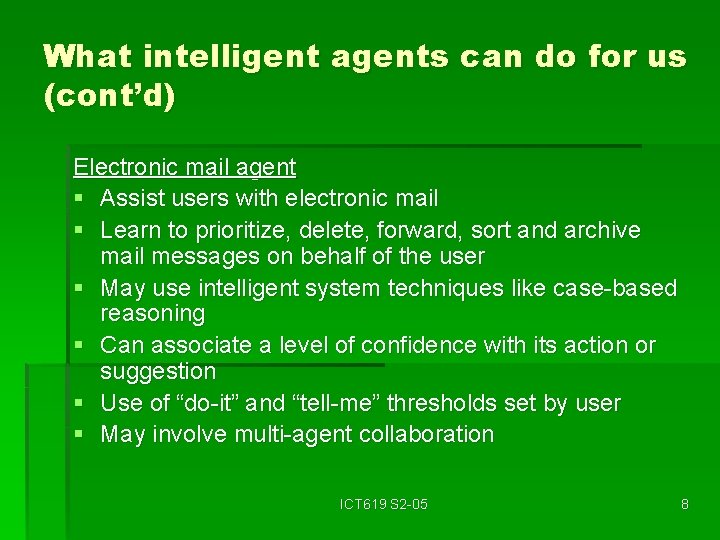
What intelligent agents can do for us (cont’d) Electronic mail agent § Assist users with electronic mail § Learn to prioritize, delete, forward, sort and archive mail messages on behalf of the user § May use intelligent system techniques like case-based reasoning § Can associate a level of confidence with its action or suggestion § Use of “do-it” and “tell-me” thresholds set by user § May involve multi-agent collaboration ICT 619 S 2 -05 8
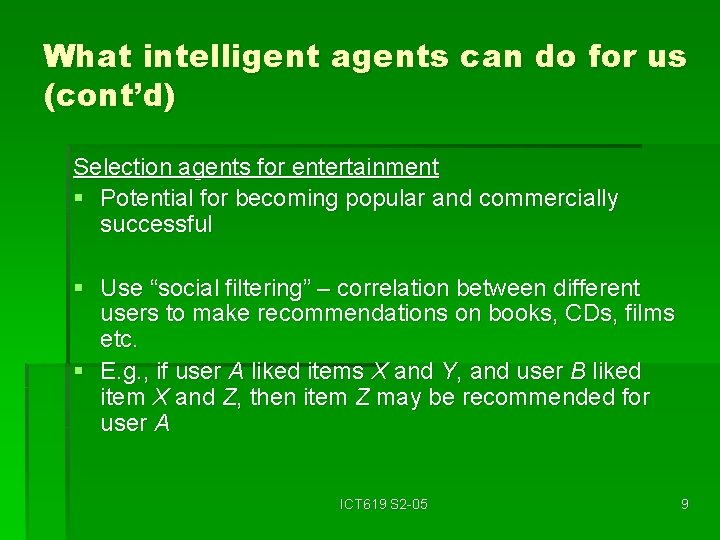
What intelligent agents can do for us (cont’d) Selection agents for entertainment § Potential for becoming popular and commercially successful § Use “social filtering” – correlation between different users to make recommendations on books, CDs, films etc. § E. g. , if user A liked items X and Y, and user B liked item X and Z, then item Z may be recommended for user A ICT 619 S 2 -05 9
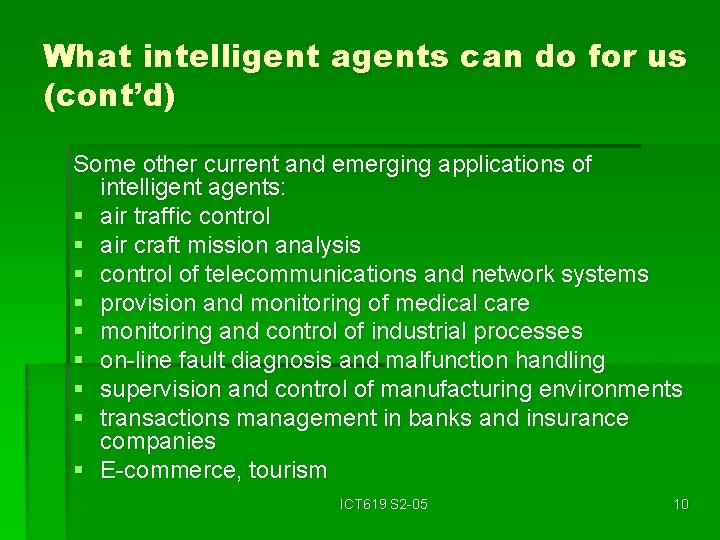
What intelligent agents can do for us (cont’d) Some other current and emerging applications of intelligent agents: § air traffic control § air craft mission analysis § control of telecommunications and network systems § provision and monitoring of medical care § monitoring and control of industrial processes § on-line fault diagnosis and malfunction handling § supervision and control of manufacturing environments § transactions management in banks and insurance companies § E-commerce, tourism ICT 619 S 2 -05 10
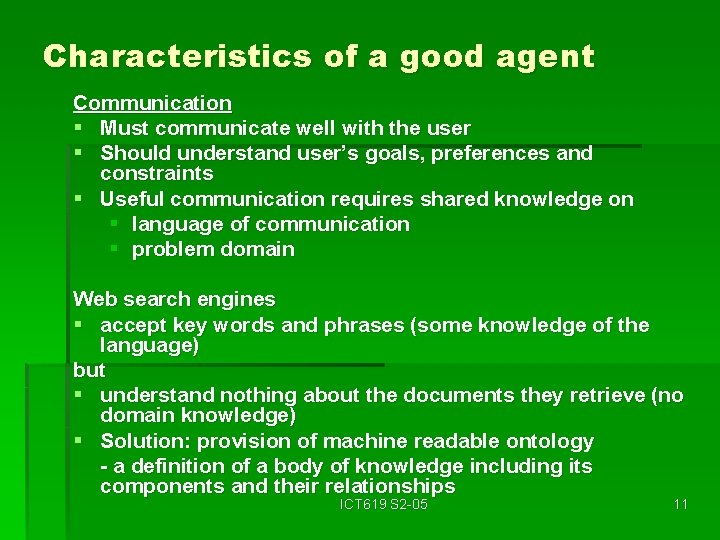
Characteristics of a good agent Communication § Must communicate well with the user § Should understand user’s goals, preferences and constraints § Useful communication requires shared knowledge on § language of communication § problem domain Web search engines § accept key words and phrases (some knowledge of the language) but § understand nothing about the documents they retrieve (no domain knowledge) § Solution: provision of machine readable ontology - a definition of a body of knowledge including its components and their relationships ICT 619 S 2 -05 11
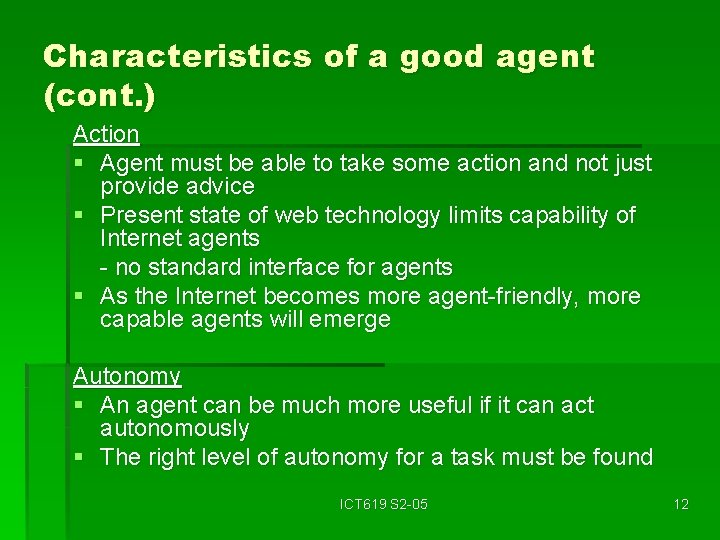
Characteristics of a good agent (cont. ) Action § Agent must be able to take some action and not just provide advice § Present state of web technology limits capability of Internet agents - no standard interface for agents § As the Internet becomes more agent-friendly, more capable agents will emerge Autonomy § An agent can be much more useful if it can act autonomously § The right level of autonomy for a task must be found ICT 619 S 2 -05 12
Characteristics of a good agent (cont. ) Adaptation § Can gain user confidence by learning user preferences § An agent unable to adapt to changing environment, is of limited utility. § Adapting to user needs and preferences can be achieved by using data mining techniques such as clustering § Agent forms clusters of users with similar features § User's expectations can then be anticipated by placing the user in one of these clusters and analysing the cluster ICT 619 S 2 -05 13
Types of agents § Based on operational characteristics and functional objectives: § Collaborative agents § Collaborate to - integrate information and - negotiate with other agents to resolve conflict - Provide solutions to inherently distributed problems, e. g. , air traffic control § Reactive agents § Act by stimulus-response to the current state of the environment § Each reactive agent is simple and interacts with others in a basic way § Complex patterns of behaviour emerge from collective interaction. ICT 619 S 2 -05 14
Types of agents (cont’d) Interface agents § Provide user support and assistance § Cooperate with user in accomplishing some task in an application. § Interface agents learn: § § by observing and imitating the user through receiving feedback from the user by receiving explicit instructions by asking other agents for advice (from peers) § Examples: § Personal assistants performing information filtering, mail management. ICT 619 S 2 -05 15
Types of agents (cont. ) Mobile agents § Programs that migrate from one machine to another. § Execute in a platform-independent execution environment § Example, Java applets running on a Java virtual machine. § Practical but non-functional advantages: § Reduced communication cost § Asynchronous computing (when you are not connected) ICT 619 S 2 -05 16
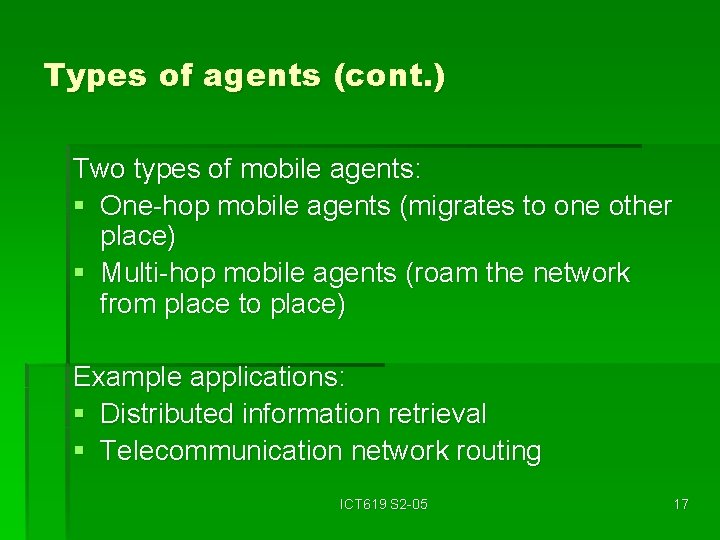
Types of agents (cont. ) Two types of mobile agents: § One-hop mobile agents (migrates to one other place) § Multi-hop mobile agents (roam the network from place to place) Example applications: § Distributed information retrieval § Telecommunication network routing ICT 619 S 2 -05 17
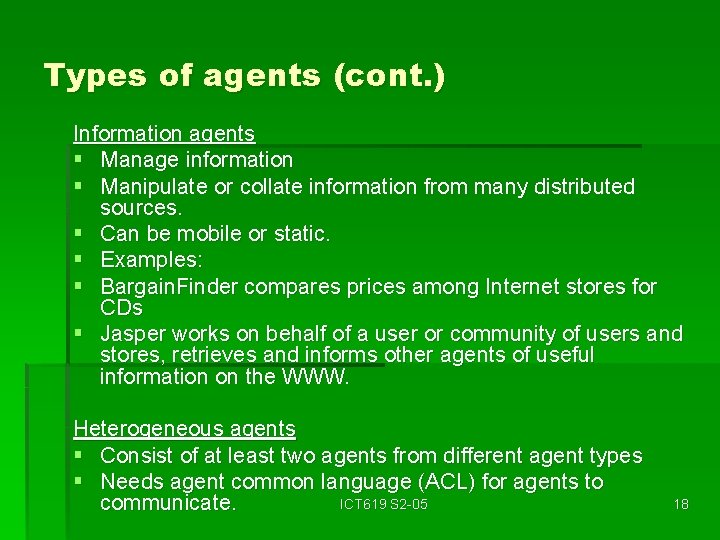
Types of agents (cont. ) Information agents § Manage information § Manipulate or collate information from many distributed sources. § Can be mobile or static. § Examples: § Bargain. Finder compares prices among Internet stores for CDs § Jasper works on behalf of a user or community of users and stores, retrieves and informs other agents of useful information on the WWW. Heterogeneous agents § Consist of at least two agents from different agent types § Needs agent common language (ACL) for agents to ICT 619 S 2 -05 communicate. 18
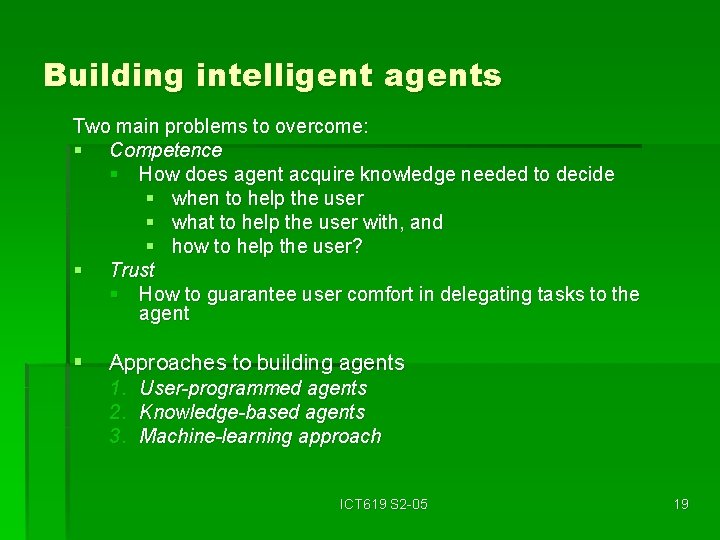
Building intelligent agents Two main problems to overcome: § Competence § How does agent acquire knowledge needed to decide § when to help the user § what to help the user with, and § how to help the user? § Trust § How to guarantee user comfort in delegating tasks to the agent § Approaches to building agents 1. User-programmed agents 2. Knowledge-based agents 3. Machine-learning approach ICT 619 S 2 -05 19
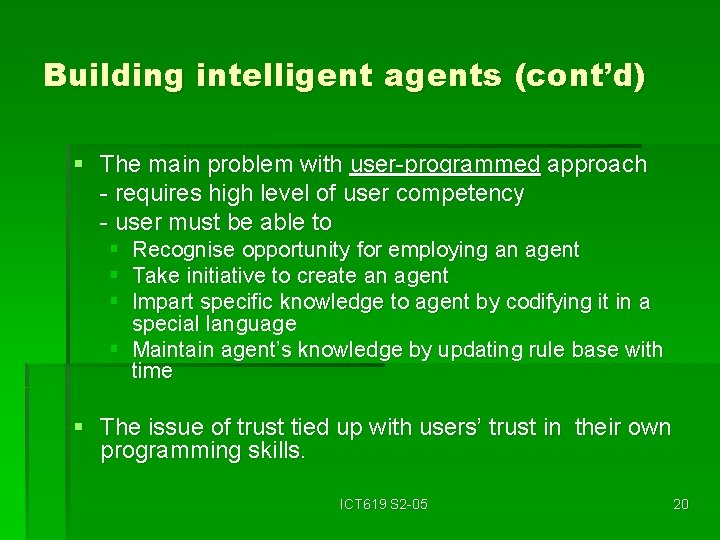
Building intelligent agents (cont’d) § The main problem with user-programmed approach - requires high level of user competency - user must be able to § Recognise opportunity for employing an agent § Take initiative to create an agent § Impart specific knowledge to agent by codifying it in a special language § Maintain agent’s knowledge by updating rule base with time § The issue of trust tied up with users’ trust in their own programming skills. ICT 619 S 2 -05 20
Building intelligent agents (cont. ) In the knowledge-based approach, § The agent is endowed with knowledge about application and user § At run-time, agent uses the knowledge to recognise user’s plans and find opportunities to contribute to them § Example of knowledge-based agent: the UCEgo designed to help users solve problems in using the UNIX operating system. ICT 619 S 2 -05 21
Building intelligent agents (cont. ) Problems with knowledge-based approach § Both competence and trust are issues of concern § The problem of competence relates to the competence of the knowledge engineer § Knowledge-base is fixed and cannot be customised to specific user needs § User’s trust is affected as agent is programmed by someone else ICT 619 S 2 -05 22
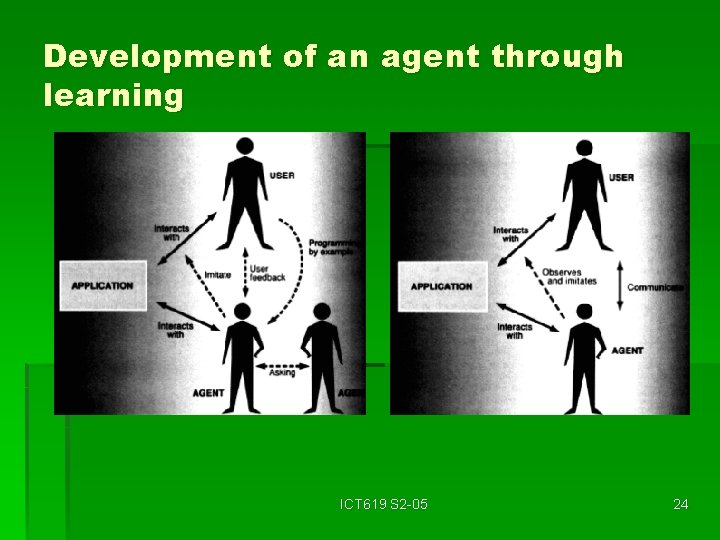
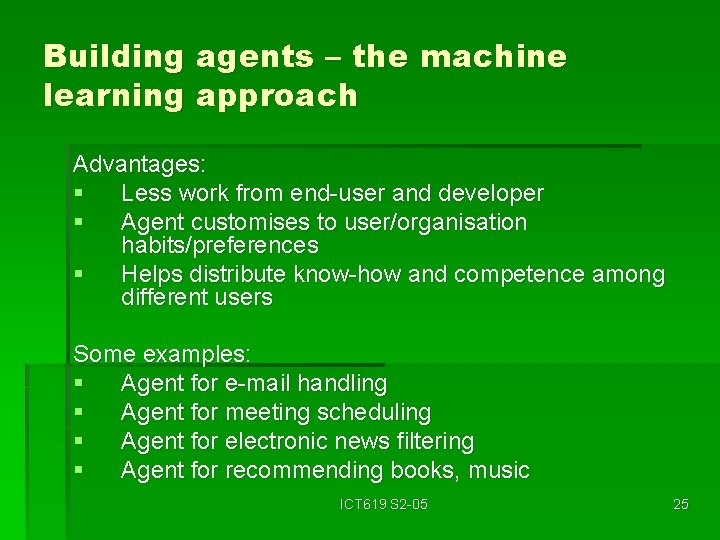
Building agents – the machine learning approach § § Metaphor of a personal office assistant Agents start with minimum knowledge and learn from: 1. 2. 3. 4. § § Observation and imitation of user User feedback – direct, indirect Training by user Other agents User can build up model of agent decision making – more trust Agent capable of explanation ICT 619 S 2 -05 23
Development of an agent through learning ICT 619 S 2 -05 24
Building agents – the machine learning approach Advantages: § Less work from end-user and developer § Agent customises to user/organisation habits/preferences § Helps distribute know-how and competence among different users Some examples: § Agent for e-mail handling § Agent for meeting scheduling § Agent for electronic news filtering § Agent for recommending books, music ICT 619 S 2 -05 25
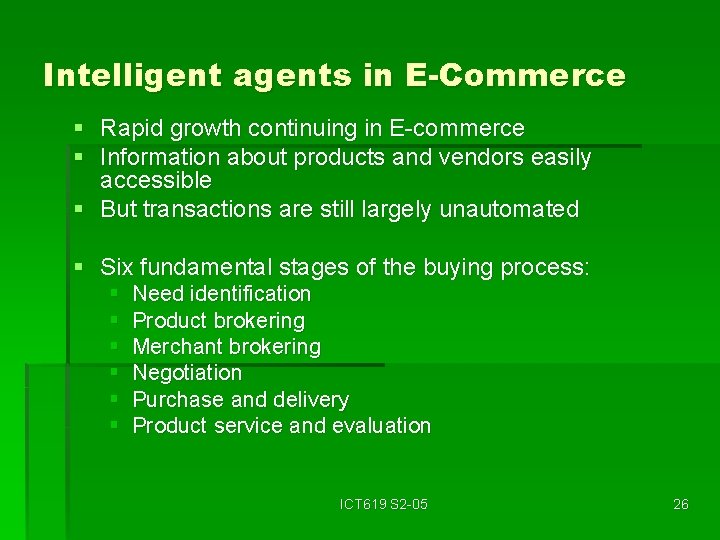
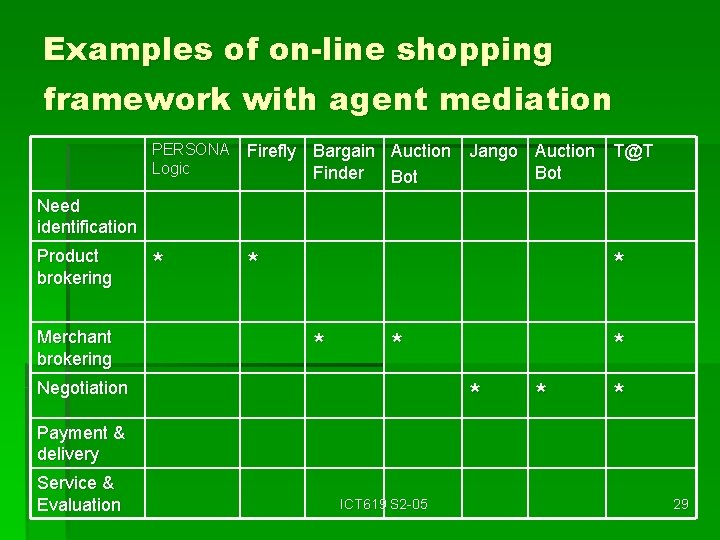
Intelligent agents in E-Commerce § Rapid growth continuing in E-commerce § Information about products and vendors easily accessible § But transactions are still largely unautomated § Six fundamental stages of the buying process: § § § Need identification Product brokering Merchant brokering Negotiation Purchase and delivery Product service and evaluation ICT 619 S 2 -05 26
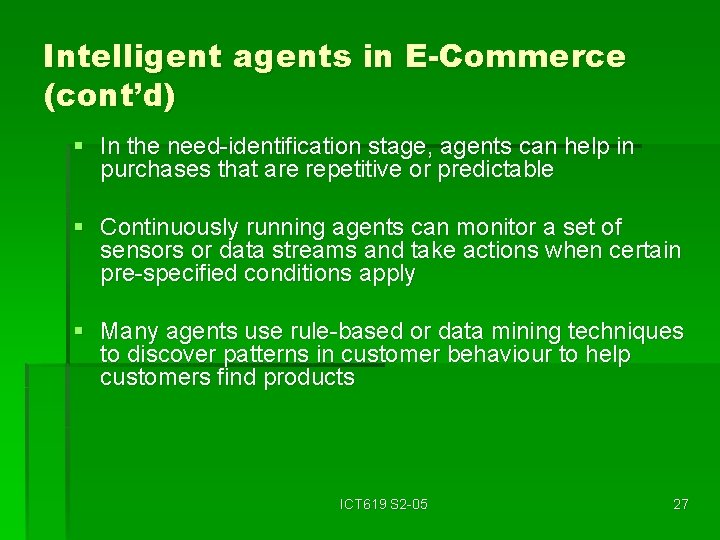
Intelligent agents in E-Commerce (cont’d) § In the need-identification stage, agents can help in purchases that are repetitive or predictable § Continuously running agents can monitor a set of sensors or data streams and take actions when certain pre-specified conditions apply § Many agents use rule-based or data mining techniques to discover patterns in customer behaviour to help customers find products ICT 619 S 2 -05 27
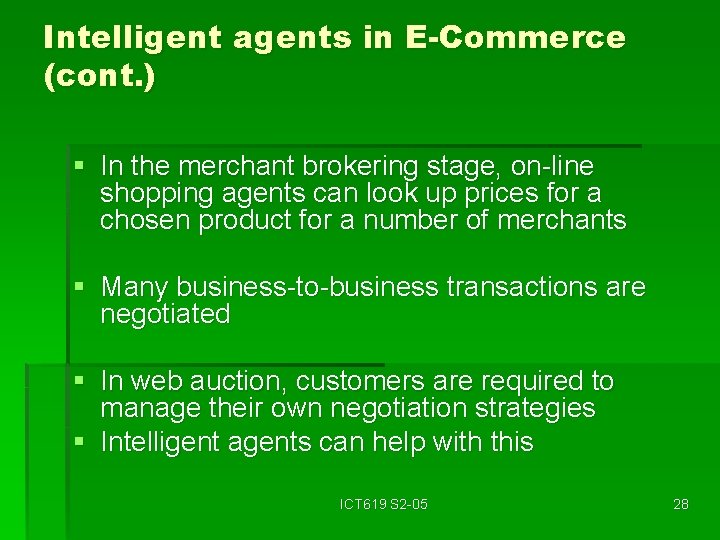
Intelligent agents in E-Commerce (cont. ) § In the merchant brokering stage, on-line shopping agents can look up prices for a chosen product for a number of merchants § Many business-to-business transactions are negotiated § In web auction, customers are required to manage their own negotiation strategies § Intelligent agents can help with this ICT 619 S 2 -05 28
Examples of on-line shopping framework with agent mediation PERSONA Logic Firefly Bargain Auction Jango Auction T@T Finder Bot * * Need identification Product brokering Merchant brokering * * * Negotiation * * Payment & delivery Service & Evaluation ICT 619 S 2 -05 29
Examples of on-line shopping framework with agent mediation (cont’d) § Software agents are helping buyers and sellers cope with information overload and expedite the online buying process § Agents are creating new markets (eg, low-cost consumer goods) and reducing transaction costs § Use of agents in e-commerce still at an early stage § Visit http: //agents. umbc. edu/Applications_and_Software/Ap plications/Electronic_Commerce/index. shtml for more ICT 619 S 2 -05 30
Intelligent agent design - state-ofthe-art and future § Few agents are available with all the desired characteristics § Agent technology still in experimental stage § § Autonomy and mobility already achievable Example: Java applets which execute independently across networks § But autonomy limited so far in practical use due to the agent-unfriendliness of the current web technology ICT 619 S 2 -05 31
Intelligent agent design - state-ofthe-art and future (cont’d) § A major limiting factor is lack of ontologies essential for effective communication § Building and maintaining ontologies remains a major challenge § Some of the proposed capabilities to be developed in future intelligent agents include: § Learning as well as reasoning, which are characteristics of machine intelligence § Interacting with the external environment through sensors ICT 619 S 2 -05 32
REFERENCES § Chin, D. , Intelligent Interfaces as Agents. In Intelligent User Interfaces, J. Sullivan and S. Tyler(eds), ACM Press, New York, 1991. § Hendler, J. , Making Sense out of Agents, IEEE Intelligent Systems, March/April 1999, pp. 32 -37. § Hendler, J. , Is There an intelligent Agent in Your Future? http//www. nature. com/nature/webmatters/agents. html § Maes, P. , Agents that Reduce Work and Information Overload, Communications of the ACM, Volume 37 , Issue 7 (July 1994), pp. 30 -40. § Maes, P. , Agents that Buy and Sell, Communications of the ACM, Volume 42 , Issue 3 (March 1999), pp. 81 -91. § Sheth, B. and Maes, P. Evolving Agents for Personalized Information Filtering. In Proceedings of the Ninth Conf. on Artificial Intelligence for Applications. IEEE Computer Society Press, 1993 § UMBC Agent News http: //agents. umbc. edu/agentnews/current/ § http: //www. agentland. com/ ICT 619 S 2 -05 33