
ICS Structure Update Developed with funding from the

- Slides: 42
ICS Structure Update Developed with funding from the Multi-State Partnership for Security in Agriculture
Workshop Objectives Present overview of the Multi-State Partnership for Security in Agriculture project Review lessons learned from the HPAI outbreak
Workshop Objectives (continued) Review ICS structures Update the organization’s ICS structure Develop job prerequisites for key ICS positions
2015 Highly Pathogenic Avian Influenza December 21 2014 - June 2015 states impacted 211 commercial and 21 backyard premises Depopulation of 7. 5 million turkeys and 42. 1 million egglayer and pullet chickens Cost over $950 million
Who Responded to HPAI? United States Department of Agriculture State Departments of Agriculture Local Emergency Management Industry Others
MSPSA After Action Review Project Lessons learned from 10 states Interviews or reviews of written After Action Reports Focus on state and local challenges that could be addressed through facilitated discussion
MSPSA After Action Review Project (cont. ) Project identified four priority topics for states ICS structure improvements Local communication State contracting improvements This workshop deals with ICS structure improvements
ICS Lessons Learned ICS training needed prior to response Several states indicated that many of their personnel had not attended basic ICS training Other state agencies provided personnel not familiar with ICS
ICS Lessons Learned (continued) Additional needed States positions/personnel needed more people Start large to assist with management Increase use of deputy positions, especially for Planning and Operations Case Managers needed to assist with farms Create task forces or strike teams Depopulation examples and disposal were two
ICS Lessons Learned (continued) Job descriptions and required skills Positions were difficult to fill because individuals were not familiar with the requirements for the position (i. e. , which positions require agriculture experience and which do not) Key players in the ICS structure should be pre-identified. These individuals should exercise and train together.
ICS Structure Review
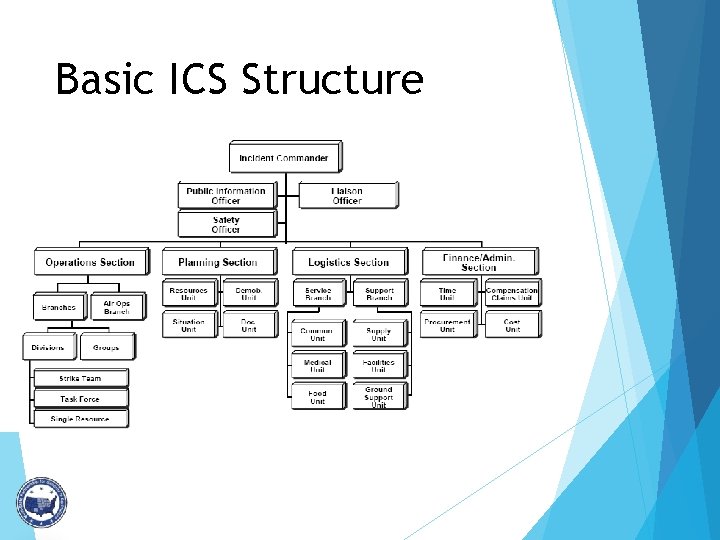
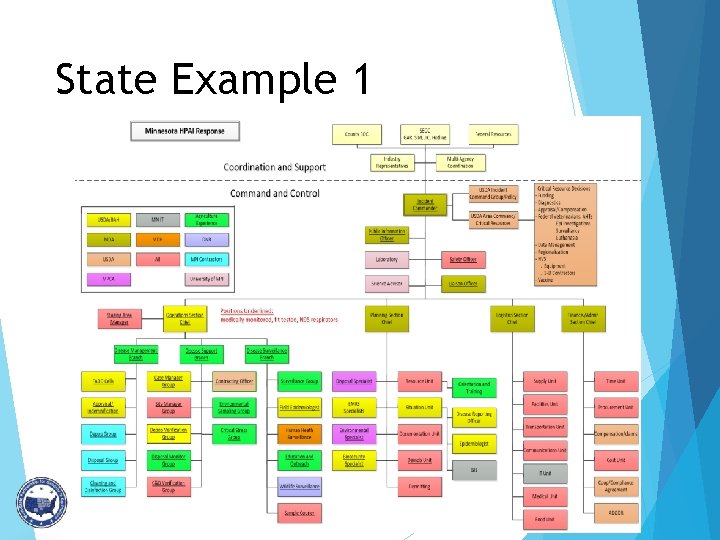
Section Objectives Review Basic example ICS structures structure Agriculture examples Review the Department’s current structure Discuss updates
Basic ICS Structure
State Example 1
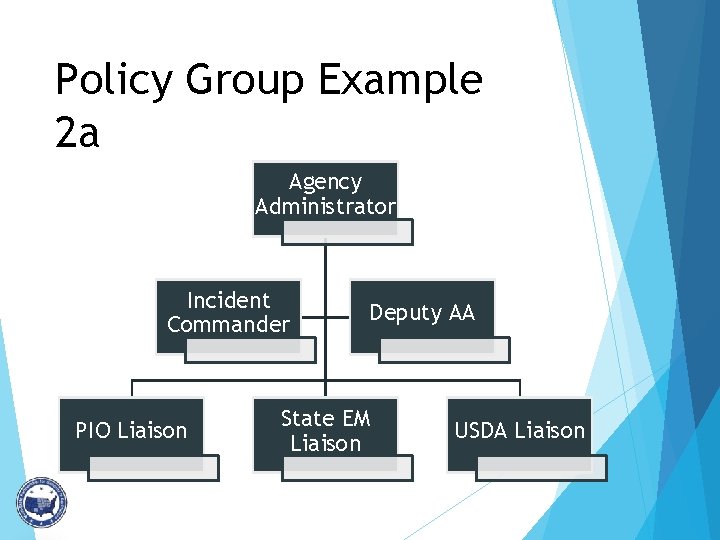
Policy Group Example 2 a Agency Administrator Incident Commander PIO Liaison Deputy AA State EM Liaison USDA Liaison
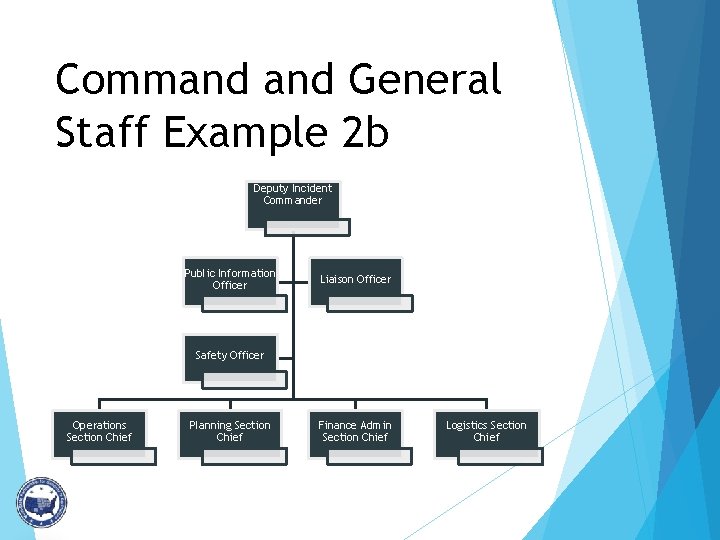
Command General Staff Example 2 b Deputy Incident Commander Public Information Officer Liaison Officer Safety Officer Operations Section Chief Planning Section Chief Finance Admin Section Chief Logistics Section Chief
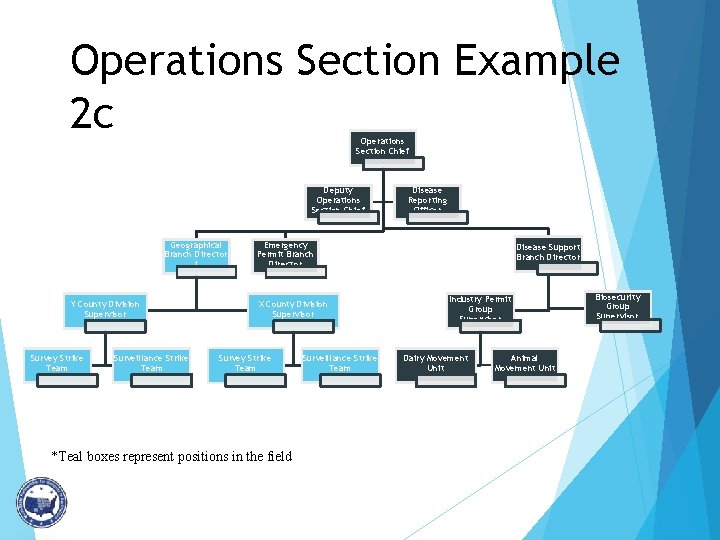
Operations Section Example 2 c Operations Section Chief Deputy Operations Section Chief Geographical Branch Director 1 Y County Division Supervisor Survey Strike Team Surveillance Strike Team Disease Reporting Officer Emergency Permit Branch Director X County Division Supervisor Survey Strike Team *Teal boxes represent positions in the field Surveillance Strike Team Disease Support Branch Director Industry Permit Group Supervisor Dairy Movement Unit Animal Movement Unit Biosecurity Group Supervisor
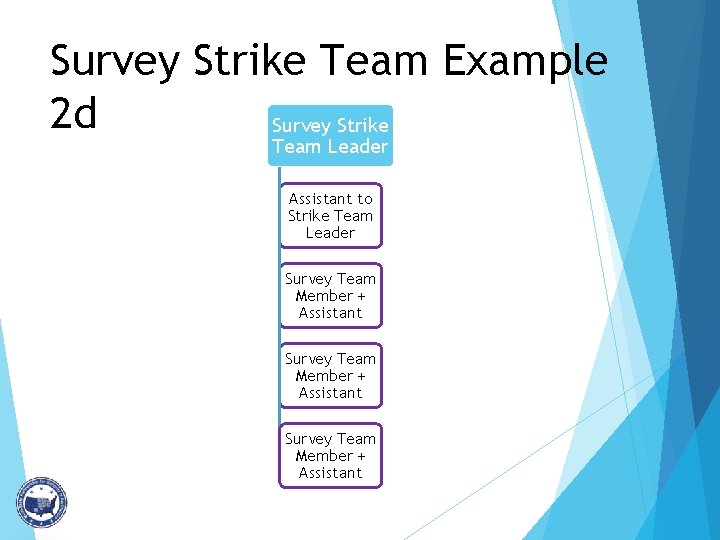
Survey Strike Team Example 2 d Survey Strike Team Leader Assistant to Strike Team Leader Survey Team Member + Assistant
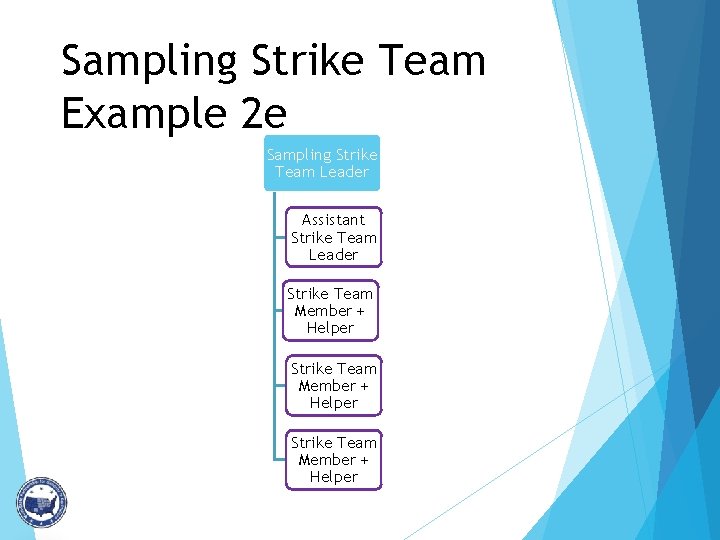
Sampling Strike Team Example 2 e Sampling Strike Team Leader Assistant Strike Team Leader Strike Team Member + Helper
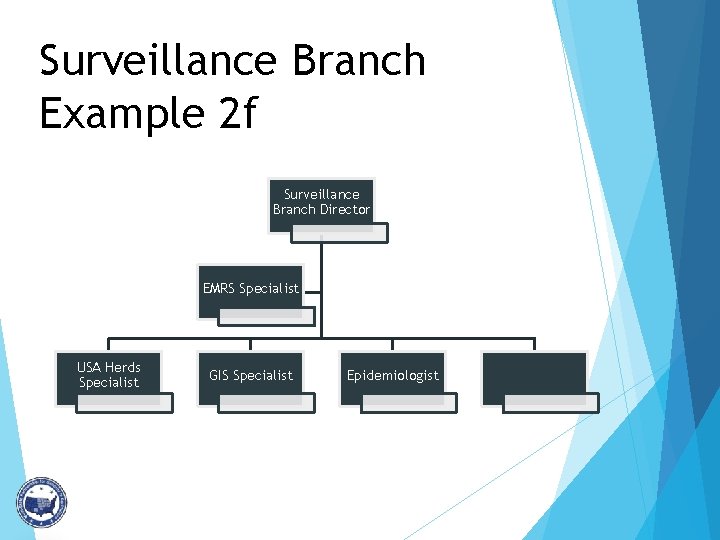
Surveillance Branch Example 2 f Surveillance Branch Director EMRS Specialist USA Herds Specialist GIS Specialist Epidemiologist
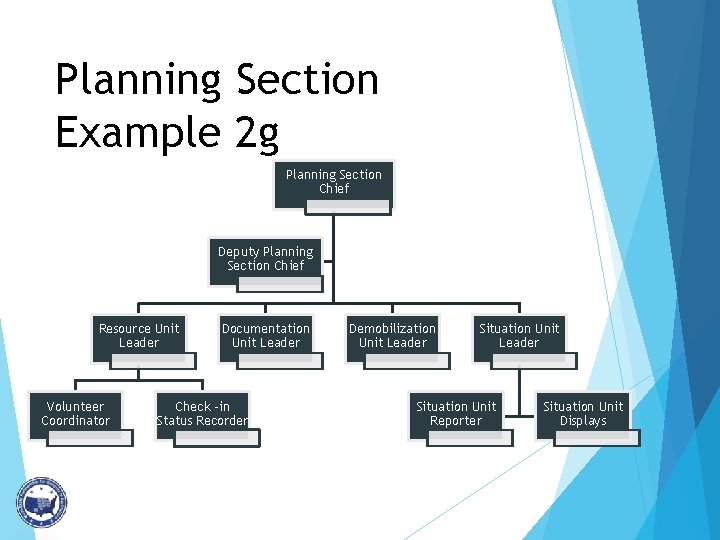
Planning Section Example 2 g Planning Section Chief Deputy Planning Section Chief Resource Unit Leader Volunteer Coordinator Documentation Unit Leader Check -in Status Recorder Demobilization Unit Leader Situation Unit Reporter Situation Unit Displays
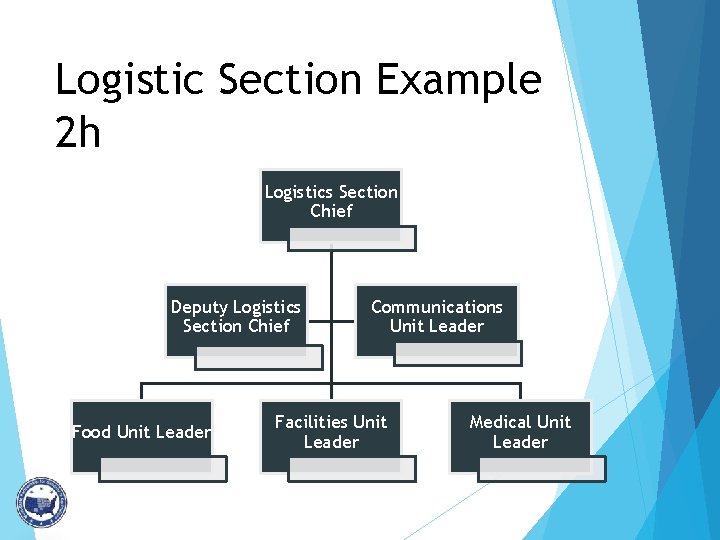
Logistic Section Example 2 h Logistics Section Chief Deputy Logistics Section Chief Food Unit Leader Communications Unit Leader Facilities Unit Leader Medical Unit Leader
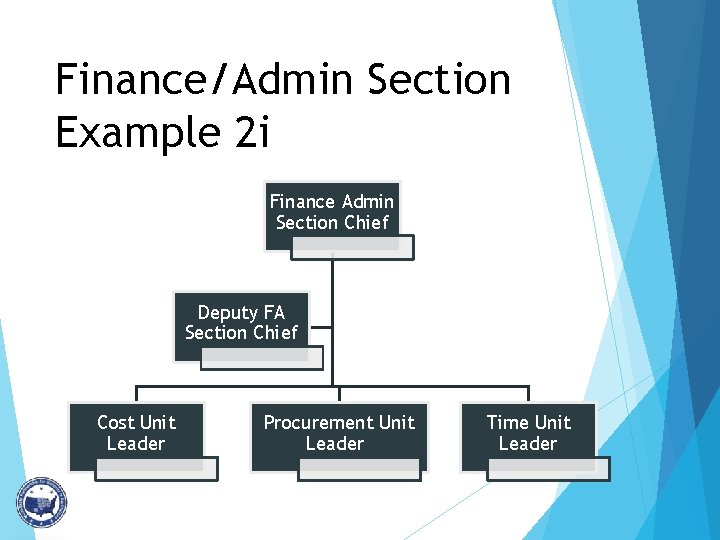
Finance/Admin Section Example 2 i Finance Admin Section Chief Deputy FA Section Chief Cost Unit Leader Procurement Unit Leader Time Unit Leader
Our Current ICS Structure Insert an example of your current structure
Updating Your ICS Structure If your state responded to HPAI or other agricultural emergency, what gaps have you identified in your planned ICS structure? If your state has not responded to an agriculture emergency, based on the discussion of lessons learned from the HPAI response or other factors, what gaps have you identified in your planned ICS structure?
Updating Your ICS Structure (continued) Should the positions identified in the first two questions be added to the Department’s ICS structure? How should they be included in your structure? Under what section, branch, etc. ?
Updating Your ICS Structure (continued) Is the ICS structure disease specific (i. e. , will there be a different structure for HPAI versus FMD)?
Updating Your ICS Structure (continued) Are there standing task forces and/or strike teams that should be established? If so, what tasks should they be assigned? How will the task force or strike team be structured?
Updating Your ICS Structure (continued) Are there special requirements for the staff on the task force and/or strike team? Will they need any special infrastructure to complete their task?
Updating Your ICS Structure (continued) Can individuals be preidentified to fill the new or revised ICS roles? Does the group have suggestions? What personnel would be used to staff these new or revised positions?
Updating Your ICS Structure (continued) Who will determine who will fill these roles? How can other agencies within the Department be engaged? What authorities exist to access these additional personnel?
Updating Your ICS Structure (continued) What training prerequisites are needed for staff assigned to these new or revised positions? Which agencies can assist by conducting training?
Developing Job Prerequisites and Descriptions
Importance of Job Prerequisites/Descriptions During a long term response, volunteers from other organizations may be engaged to help support the response. Job prerequisites/descriptions will assist in pre-identifying individuals for various positions. Will also assist in assigning volunteers during a response.
Importance of Job Descriptions (continued) Job descriptions will allow training and effective exercise evaluation. Example job prerequisites on the next slides.
Environmental Sampling Group (HPAI) Example 1 ICS 100, 200, 300 Online Avian Influenza Field Safety Course Task specific just-in-time training Respiratory protection training, medical clearance, and fit testing (N 95 respirator) Able to don and doff personal protective equipment Understanding/experience in field sampling methods/techniques Able to effectively manage several tactical field operations simultaneously Able to work a 14 -day rotation
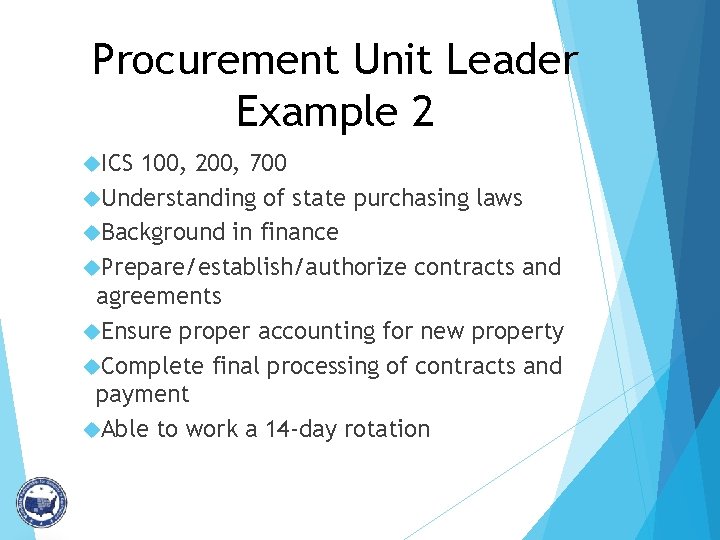
Procurement Unit Leader Example 2 ICS 100, 200, 700 Understanding of state purchasing laws Background in finance Prepare/establish/authorize contracts and agreements Ensure proper accounting for new property Complete final processing of contracts and payment Able to work a 14 -day rotation
Developing Job Prerequisites What baseline training should be required for personnel? What positions require agriculture knowledge? What task-specific knowledge or training is unique to the job?
Developing Job Prerequisites (continued) Which positions should be staffed by personnel from within your agency? Which positions could be filled by someone outside your agency?
Developing Job Prerequisites (continued) What barriers exist to using state personnel to support a response (e. g. , when job is outside normal job description) What is the rotation timeframe for each position (i. e. , 14 days)?
Developing Job Prerequisites (continued) Who will put together job requirements for each position? How will prerequisites/qualifications be monitored?
Additional Discussion