
ICS for Single Resource and Initial Action Incidents
- Slides: 40
ICS for Single Resource and Initial Action Incidents IS 200 Visual 2. 1 Leadership & Management
Unit 2: Leadership & Management Visual 2. 2 Leadership & Management
Unit Objectives § Describe chain of command formal communication relationships. § Identify common leadership responsibilities. § Describe span of control and modular development. § Describe the use of position titles. Visual 2. 3 Leadership & Management
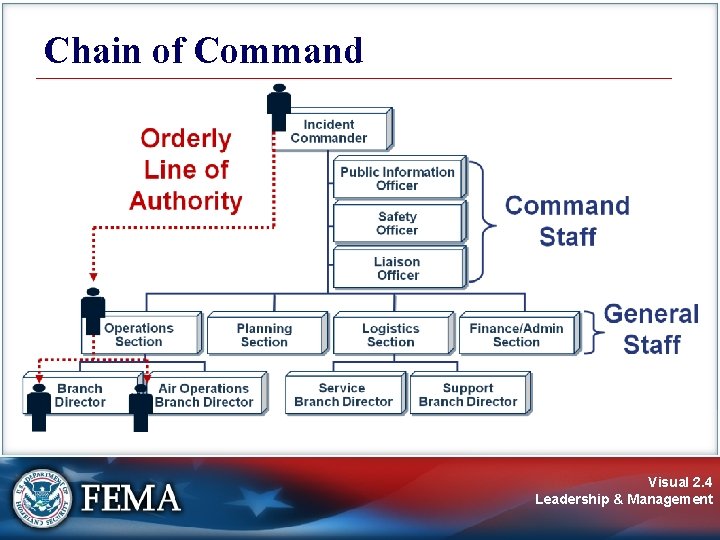
Chain of Command Visual 2. 4 Leadership & Management
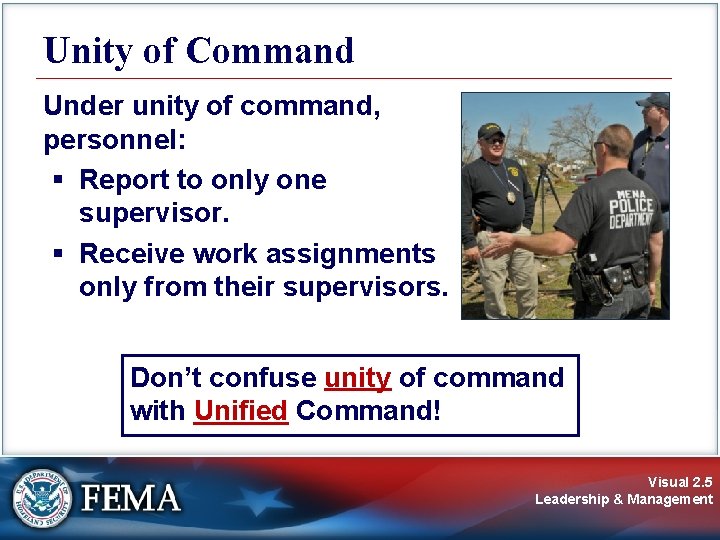
Unity of Command Under unity of command, personnel: § Report to only one supervisor. § Receive work assignments only from their supervisors. Don’t confuse unity of command with Unified Command! Visual 2. 5 Leadership & Management
“Unity” vs. “Unified” What is the difference between unity of command Unified Command? Visual 2. 6 Leadership & Management
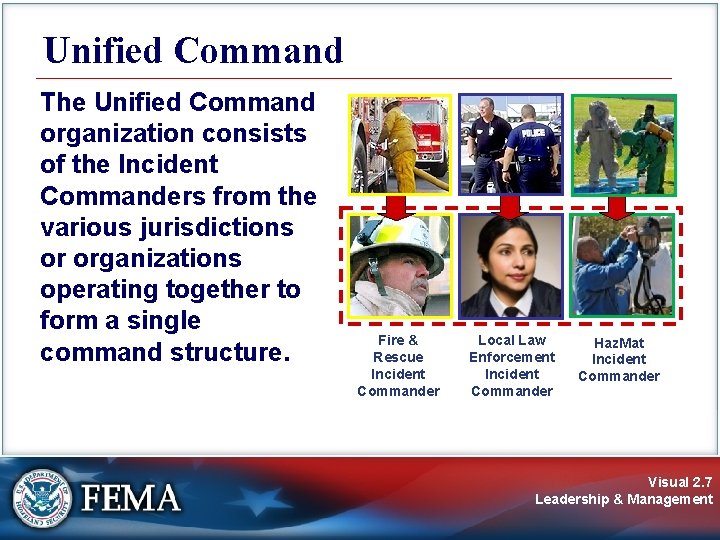
Unified Command The Unified Command organization consists of the Incident Commanders from the various jurisdictions or organizations operating together to form a single command structure. Fire & Rescue Incident Commander Local Law Enforcement Incident Commander Haz. Mat Incident Commander Visual 2. 7 Leadership & Management
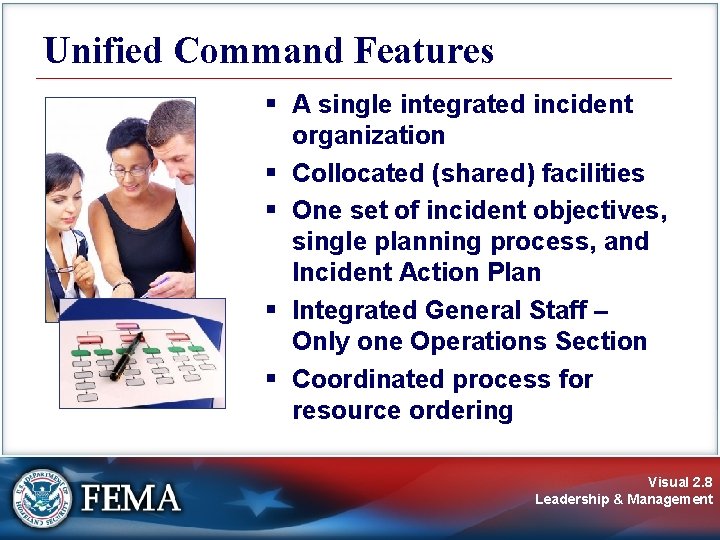
Unified Command Features § A single integrated incident organization § Collocated (shared) facilities § One set of incident objectives, single planning process, and Incident Action Plan § Integrated General Staff – Only one Operations Section § Coordinated process for resource ordering Visual 2. 8 Leadership & Management
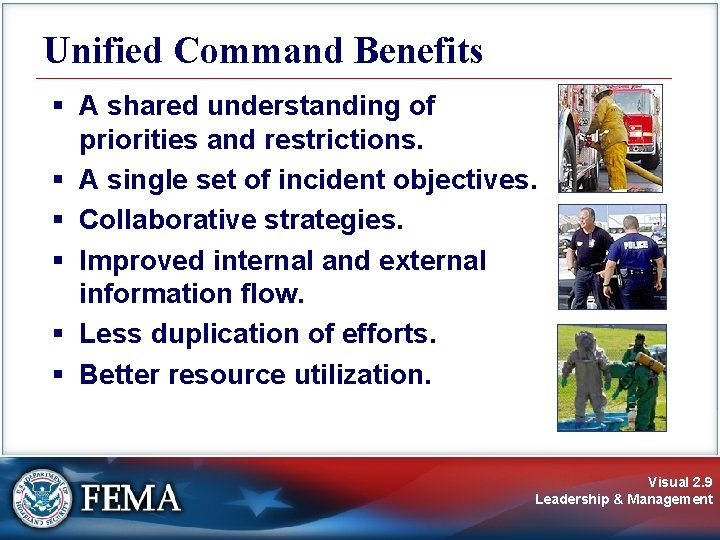
Unified Command Benefits § A shared understanding of priorities and restrictions. § A single set of incident objectives. § Collaborative strategies. § Improved internal and external information flow. § Less duplication of efforts. § Better resource utilization. Visual 2. 9 Leadership & Management
Activity: Unified Command Instructions: 1. Identify the potential incident management issues. A tornado collapsed a building, trapping 15 people in its basement. Fire department officers immediately designated a fire station located directly across from the incident site as the Incident Command Post (ICP). However, the fire station’s confined location and immediate proximity to the incident made it ill-suited for directing the large-scale response effort. As police officers arrived on the scene, they decided to establish their Command Center at a school, several blocks away from the immediate response activities. As response operations progressed and a mobile command vehicle became available, the Incident Command Post (ICP) was established in that vehicle just north of the hospital. Other agencies involved, such as the fire department and emergency medical services, began operating near the new ICP location and Incident Commander. The police department continued to operate from the school. Visual 2. 10 Leadership & Management
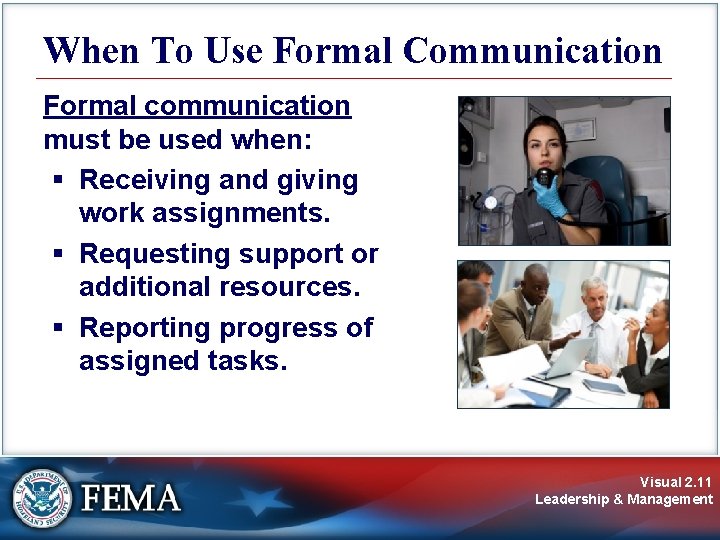
When To Use Formal Communication Formal communication must be used when: § Receiving and giving work assignments. § Requesting support or additional resources. § Reporting progress of assigned tasks. Visual 2. 11 Leadership & Management
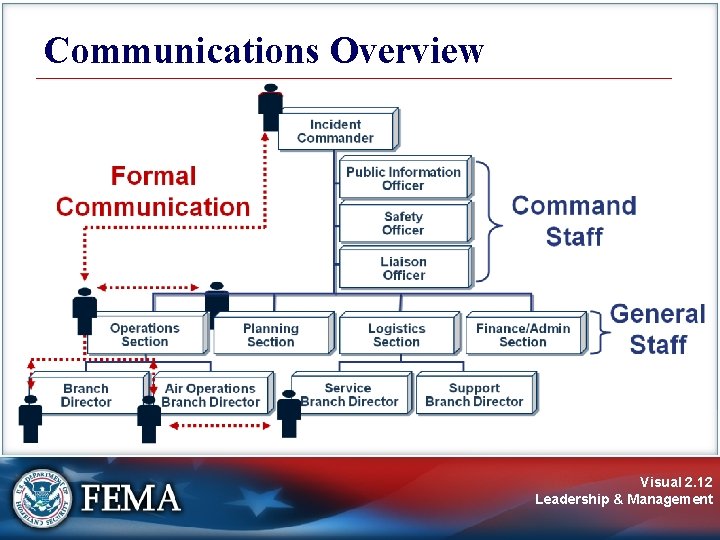
Communications Overview Visual 2. 12 Leadership & Management
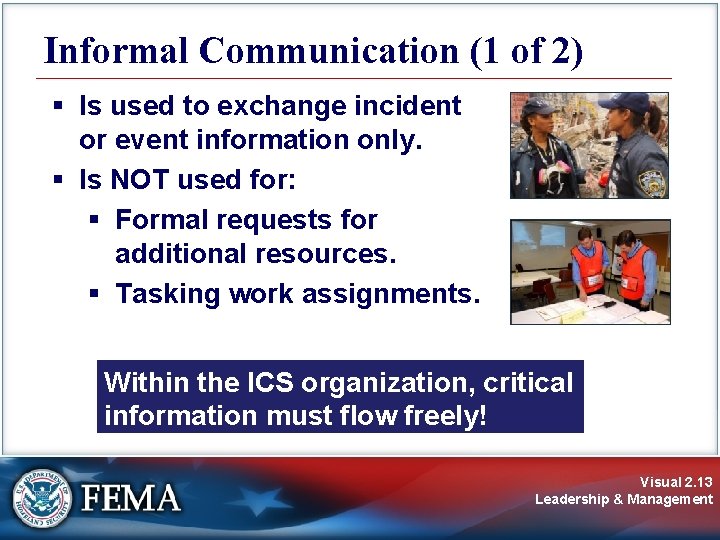
Informal Communication (1 of 2) § Is used to exchange incident or event information only. § Is NOT used for: § Formal requests for additional resources. § Tasking work assignments. Within the ICS organization, critical information must flow freely! Visual 2. 13 Leadership & Management
Informal Communication (2 of 2) Examples of informal communication are: § The Communications Unit Leader may directly contact the Resources Unit Leader to determine the number of persons requiring communications devices. § The Cost Unit Leader may directly discuss and share information on alternative strategies with the Planning Section Chief. Visual 2. 14 Leadership & Management
Discussion Question Why is leadership an essential element of successful incident management? Visual 2. 15 Leadership & Management
Activity: Incident Leadership Instructions: 1. Identify a highly effective leaders you have known or know about. 2. List the main leadership qualities that such an individual must possess. 3. State how these qualities relate to leadership in incident response. Visual 2. 16 Leadership & Management
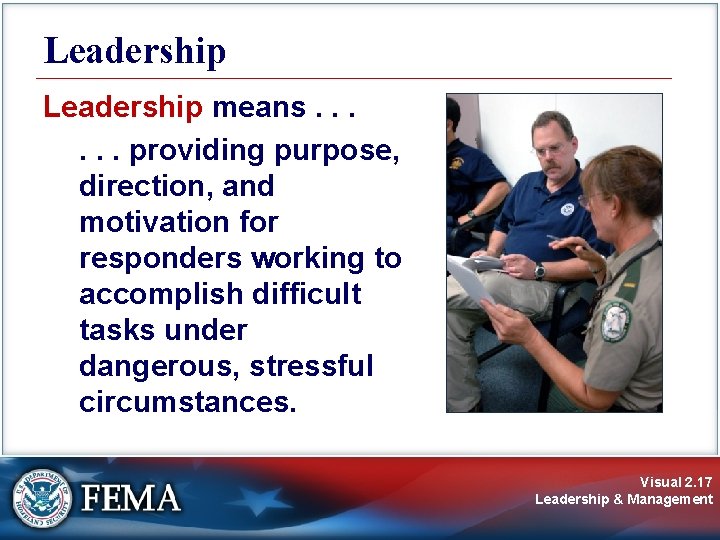
Leadership means. . . providing purpose, direction, and motivation for responders working to accomplish difficult tasks under dangerous, stressful circumstances. Visual 2. 17 Leadership & Management
Common Leadership Responsibilities A good operational leader: § Communicates by giving specific instructions and asking for feedback. § Supervises the scene of action. § Evaluates the effectiveness of the plan. § Understands and accepts the need to modify plans or instructions. § Ensures safe work practices. § Takes command of assigned resources. § Motivates with a “can do safely” attitude. § Demonstrates initiative by taking action. Visual 2. 18 Leadership & Management
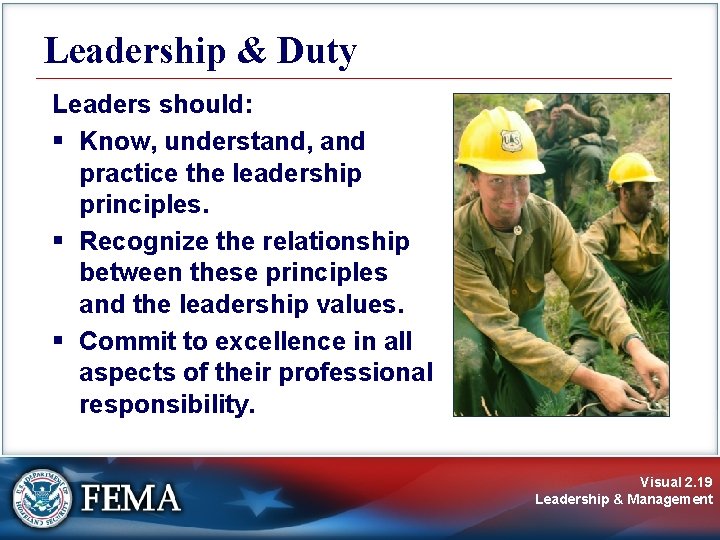
Leadership & Duty Leaders should: § Know, understand, and practice the leadership principles. § Recognize the relationship between these principles and the leadership values. § Commit to excellence in all aspects of their professional responsibility. Visual 2. 19 Leadership & Management
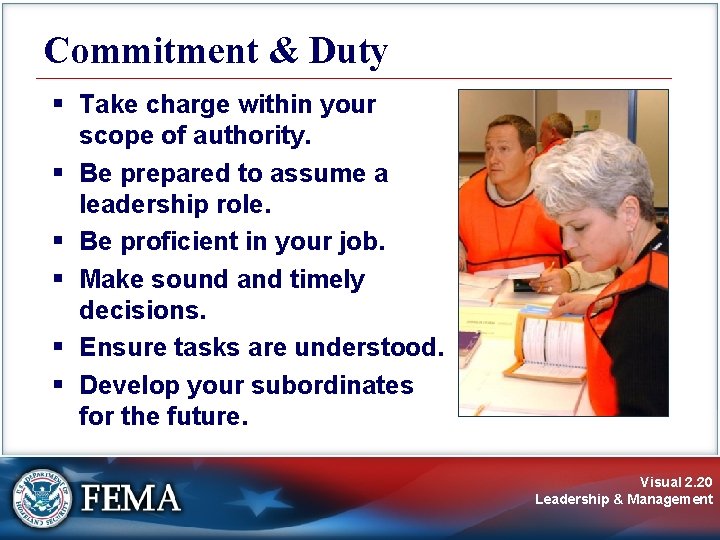
Commitment & Duty § Take charge within your scope of authority. § Be prepared to assume a leadership role. § Be proficient in your job. § Make sound and timely decisions. § Ensure tasks are understood. § Develop your subordinates for the future. Visual 2. 20 Leadership & Management
Discussion Question What can you do to demonstrate your commitment to duty to those you lead? Visual 2. 21 Leadership & Management
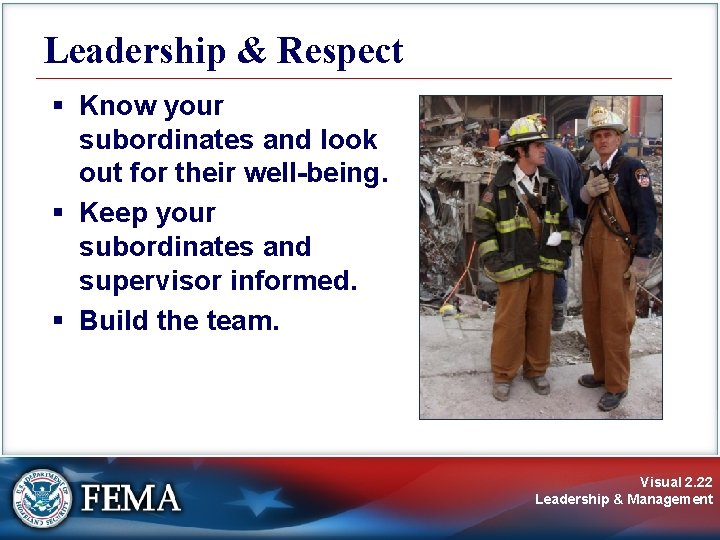
Leadership & Respect § Know your subordinates and look out for their well-being. § Keep your subordinates and supervisor informed. § Build the team. Visual 2. 22 Leadership & Management
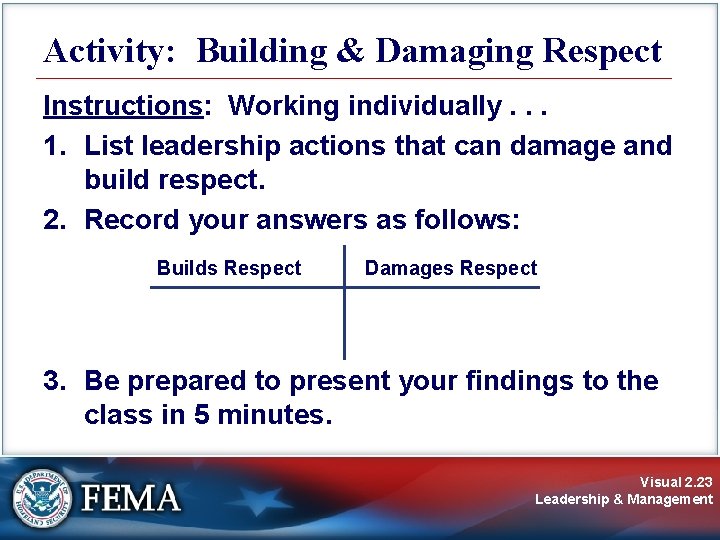
Activity: Building & Damaging Respect Instructions: Working individually. . . 1. List leadership actions that can damage and build respect. 2. Record your answers as follows: Builds Respect Damages Respect 3. Be prepared to present your findings to the class in 5 minutes. Visual 2. 23 Leadership & Management
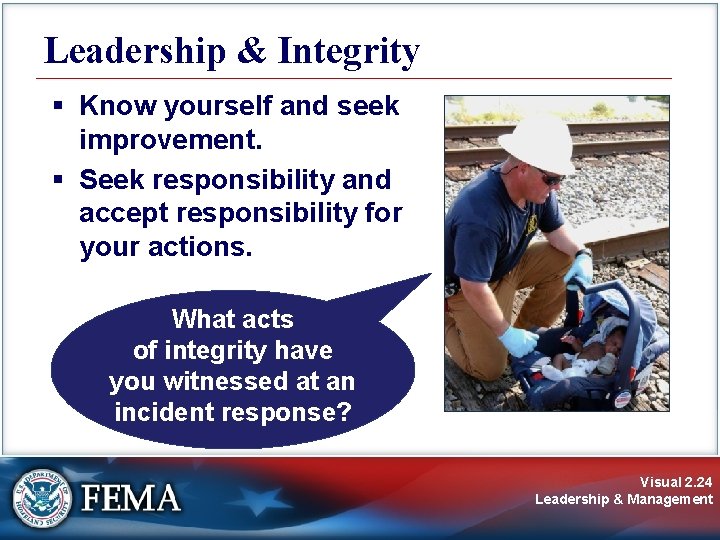
Leadership & Integrity § Know yourself and seek improvement. § Seek responsibility and accept responsibility for your actions. What acts of integrity have you witnessed at an incident response? Visual 2. 24 Leadership & Management
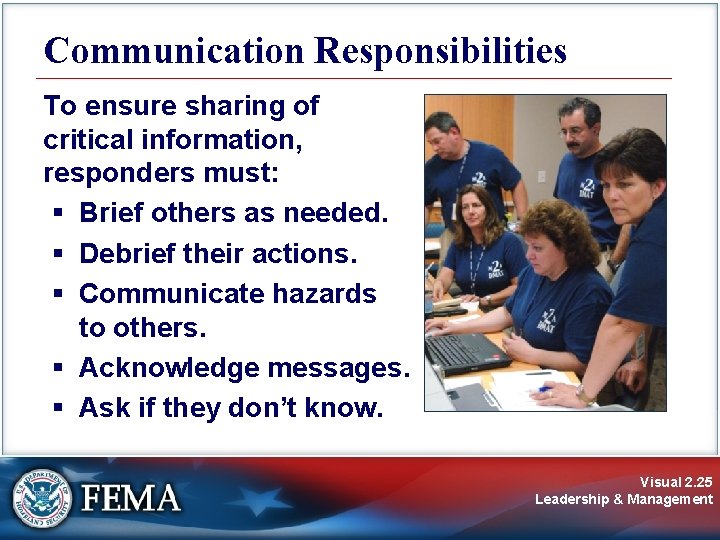
Communication Responsibilities To ensure sharing of critical information, responders must: § Brief others as needed. § Debrief their actions. § Communicate hazards to others. § Acknowledge messages. § Ask if they don’t know. Visual 2. 25 Leadership & Management
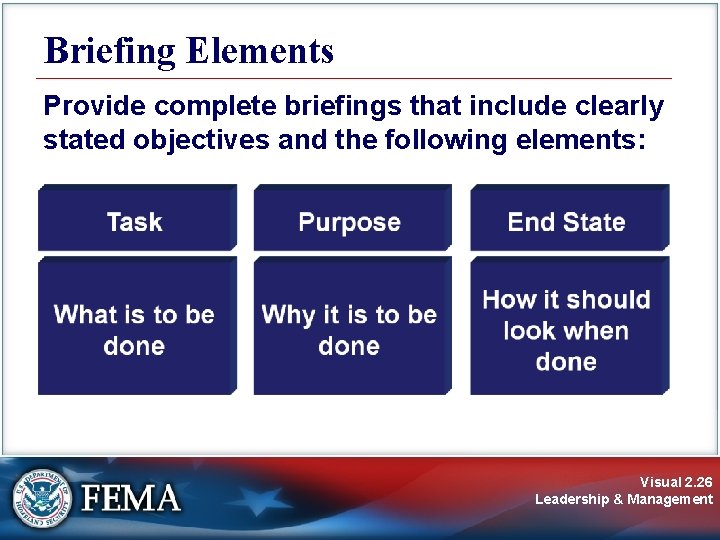
Briefing Elements Provide complete briefings that include clearly stated objectives and the following elements: Visual 2. 26 Leadership & Management
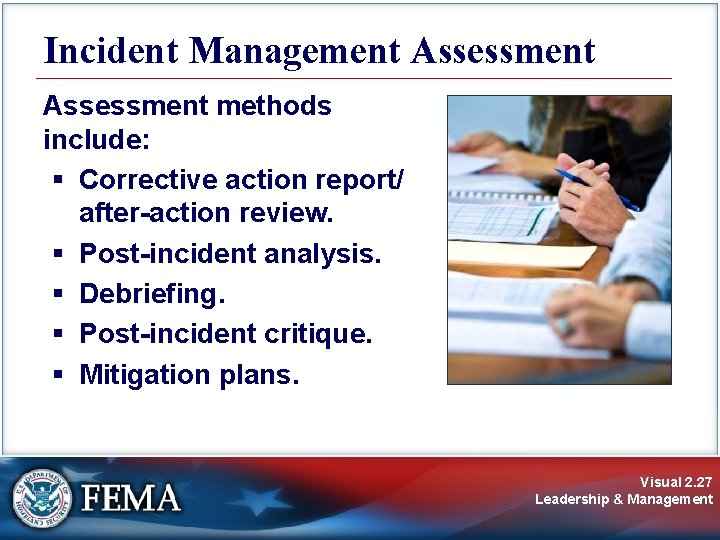
Incident Management Assessment methods include: § Corrective action report/ after-action review. § Post-incident analysis. § Debriefing. § Post-incident critique. § Mitigation plans. Visual 2. 27 Leadership & Management
Discussion Question What questions would you use to assess the effectiveness of incident management? Visual 2. 28 Leadership & Management
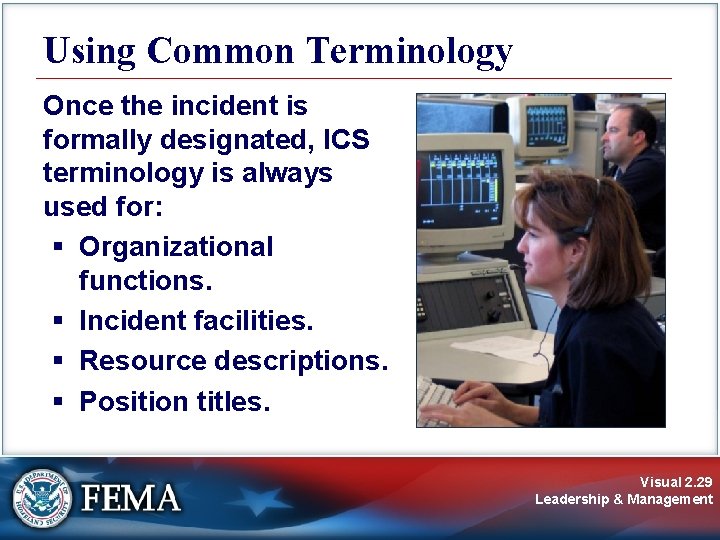
Using Common Terminology Once the incident is formally designated, ICS terminology is always used for: § Organizational functions. § Incident facilities. § Resource descriptions. § Position titles. Visual 2. 29 Leadership & Management
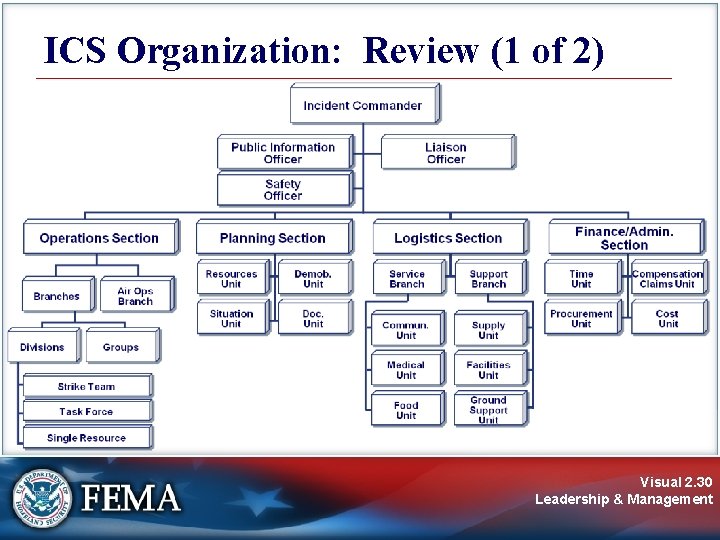
ICS Organization: Review (1 of 2) Visual 2. 30 Leadership & Management
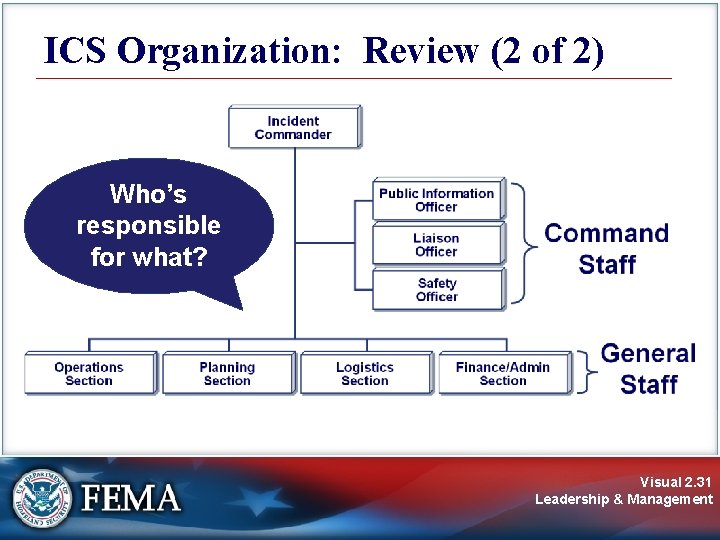
ICS Organization: Review (2 of 2) Who’s responsible for what? Visual 2. 31 Leadership & Management
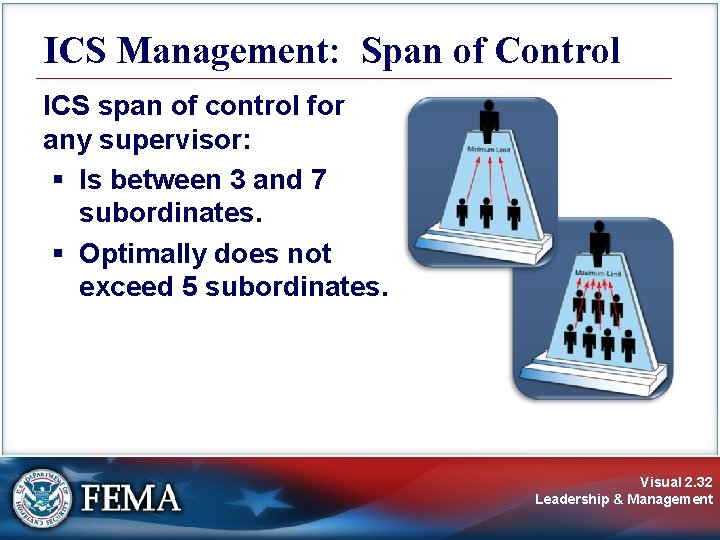
ICS Management: Span of Control ICS span of control for any supervisor: § Is between 3 and 7 subordinates. § Optimally does not exceed 5 subordinates. Visual 2. 32 Leadership & Management
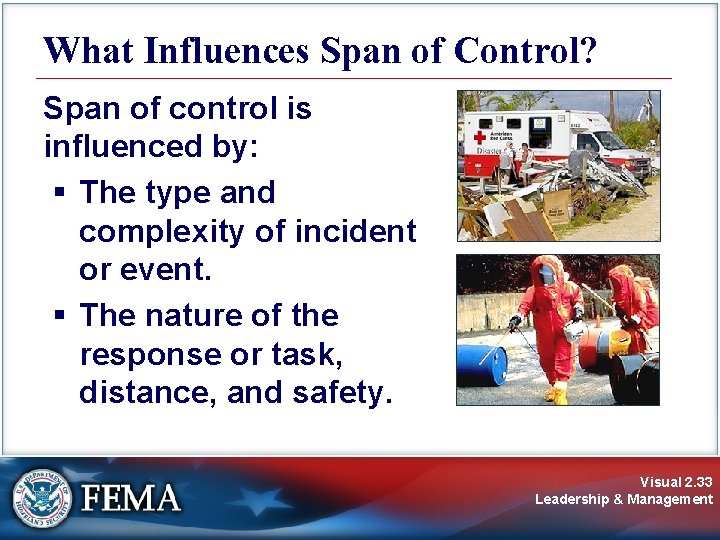
What Influences Span of Control? Span of control is influenced by: § The type and complexity of incident or event. § The nature of the response or task, distance, and safety. Visual 2. 33 Leadership & Management
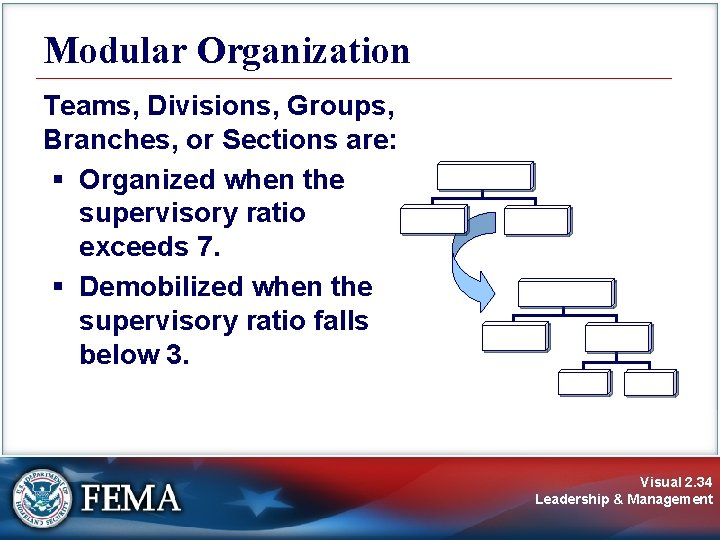
Modular Organization Teams, Divisions, Groups, Branches, or Sections are: § Organized when the supervisory ratio exceeds 7. § Demobilized when the supervisory ratio falls below 3. Visual 2. 34 Leadership & Management
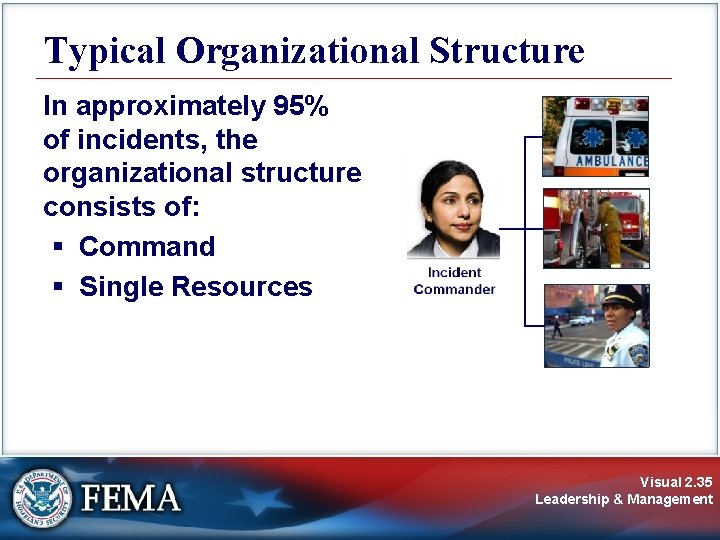
Typical Organizational Structure In approximately 95% of incidents, the organizational structure consists of: § Command § Single Resources Visual 2. 35 Leadership & Management
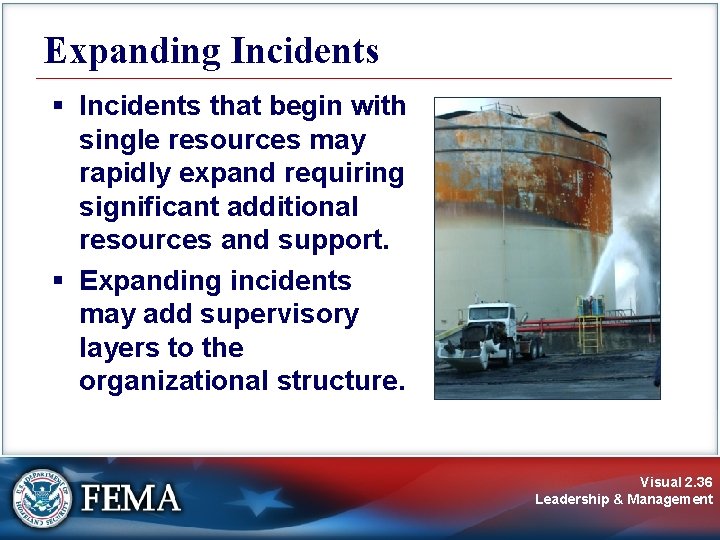
Expanding Incidents § Incidents that begin with single resources may rapidly expand requiring significant additional resources and support. § Expanding incidents may add supervisory layers to the organizational structure. Visual 2. 36 Leadership & Management
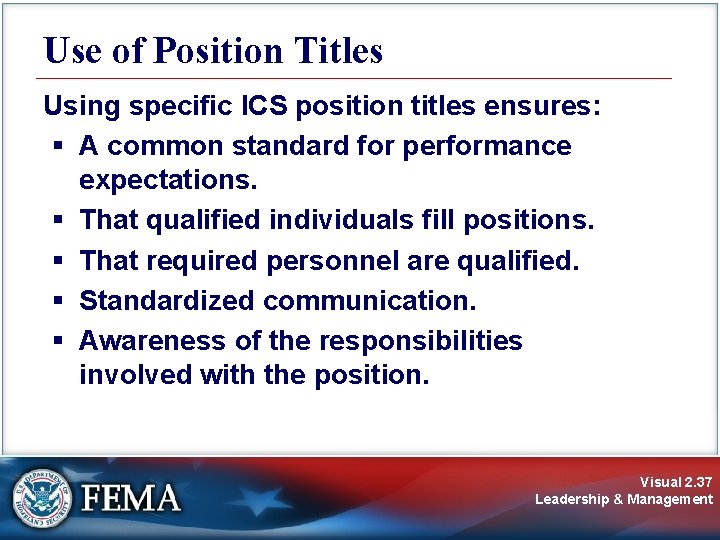
Use of Position Titles Using specific ICS position titles ensures: § A common standard for performance expectations. § That qualified individuals fill positions. § That required personnel are qualified. § Standardized communication. § Awareness of the responsibilities involved with the position. Visual 2. 37 Leadership & Management
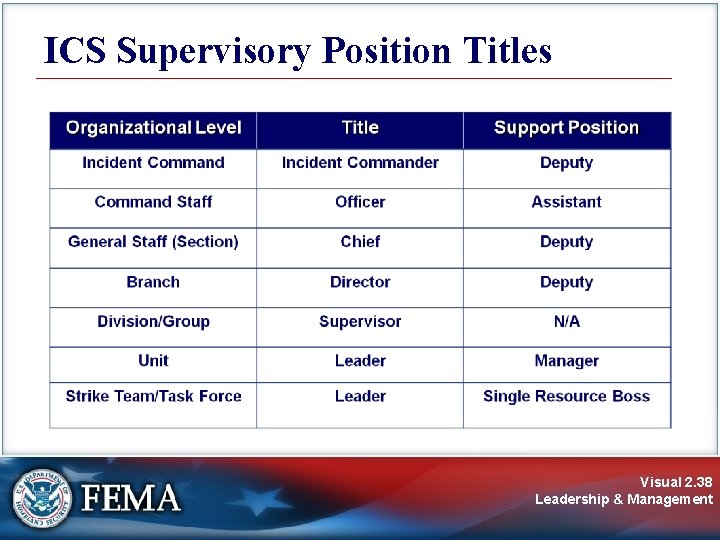
ICS Supervisory Position Titles Visual 2. 38 Leadership & Management
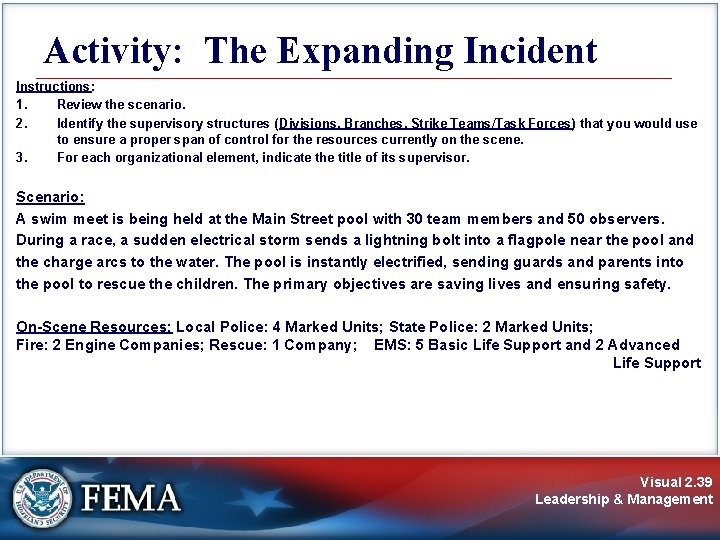
Activity: The Expanding Incident Instructions: 1. Review the scenario. 2. Identify the supervisory structures (Divisions, Branches, Strike Teams/Task Forces) that you would use to ensure a proper span of control for the resources currently on the scene. 3. For each organizational element, indicate the title of its supervisor. Scenario: A swim meet is being held at the Main Street pool with 30 team members and 50 observers. During a race, a sudden electrical storm sends a lightning bolt into a flagpole near the pool and the charge arcs to the water. The pool is instantly electrified, sending guards and parents into the pool to rescue the children. The primary objectives are saving lives and ensuring safety. On-Scene Resources: Local Police: 4 Marked Units; State Police: 2 Marked Units; Fire: 2 Engine Companies; Rescue: 1 Company; EMS: 5 Basic Life Support and 2 Advanced Life Support Visual 2. 39 Leadership & Management
Summary Are you now able to: § Describe chain of command formal communication relationships? § Identify common leadership responsibilities? § Describe span of control and modular development? § Describe the use of position titles? Visual 2. 40 Leadership & Management