
ICS 804 Theory of Computation Ibrahim Otieno iotienouonbi
: : ICS 804: : Theory of Computation - Ibrahim Otieno iotieno@uonbi. ac. ke +254 -0722 -429297 SCI/ICT Building Rm. G 15
Course Outline Mathematical Preliminaries Turing Machines Recursion Theory Markov Algorithms Register Machines Regular Languages and finite-state automata Aspects of Computability
Last Time: Turing Machines What is Computation? Informal Description of Turing Machines Formal Description of Turing Machines as Language acceptors and Language recognizers Turing Machines as Computers of number-theoretic functions Modular Turing Machines Complexity Theory
Course Outline Mathematical Preliminaries Turing Machines ◦ Additional Varieties of Turing Machines Recursion Theory Markov Algorithms Register Machines Regular Languages and finite-state automata Aspects of Computability
Additional Varieties of Turing Machines Turing Machines with One-Way-Infinite tape Turing Machines that accept by terminal state Multitape Turing Machines Encoding of Turing Machines Universal Turing Machines Nondeterministic Turing Machines Turing-Computability Turing Machines and Artificial Intelligence Turing Machines and Cognitive Science
Turing Machines with One-Way-Infinite Tape
Tapes So far: Turing machines with two-way infinite tape Turing (1936): one-way infinite tape No difference in computational power A function Turing computable in a 2 -way infinite tape setup is also Turing computable with a 1 -way infinite tape
Turing Machines with One-Way-Infinite Tape Machine tape infinite only to the right Leftmost tape square containing left endmarker (use , in Deus Ex Machina) What happens on reaching left most square? One-way function computation One-way language acceptance (recognition)
Equivalence Result Central to theory of computability Let f be a k-ary number-theoretic function: Then there exists a Turing Machine with two-way-infinite tape that two-way computes f if and only if there exists a Turing machine with one-way-infinite tape that one-way computes f
Turing Machines that accept by terminal state
Acceptance (Recap) Word acceptance: Deterministic Turing Machine M accepts nonempty word w if, when started scanning the leftmost symbol of w on an input tape that contains w and is otherwise blank, M ultimately halts scanning a 1 on an otherwise blank tape. “Acceptance by 1”
Terminal State A single terminal state qt ( “one or more”) Sex-tuple Q, S, G, qinit, qt , ◦ qt Q ◦ is undefined for pairs of the form < qt , > ◦ Turing Machine M can still halt in any other state ◦ Not necessarily distinct from qinit ◦ Exercise: Draw a TM that accepts L = { (abc)n | n >=1} by terminal state
Language Acceptance by Terminal State M accepts w if halts in qt M accepts language L by terminal state provided that M accepts, by terminal state, all and only the words of L ◦ Tape content upon halting in state qt is not defined ◦ No requirement that M has read word w completely
Equivalence Result Theorem: Let L be a language over alphabet S. Then there exists a Turing machine that accepts L “by 1” if and only if there exists a Turing machine that accepts L by terminal state. Equivalence result: forward and reverse proof involve maintaining new end markers and
Multitape Turing Machines
Multitape Turing Machines Has K+2 tapes where K >= 0 (Possibly read-only) input tape at top (Possibly write-only) output tape at bottom 0 or more worktapes in between Referred to as offline TM
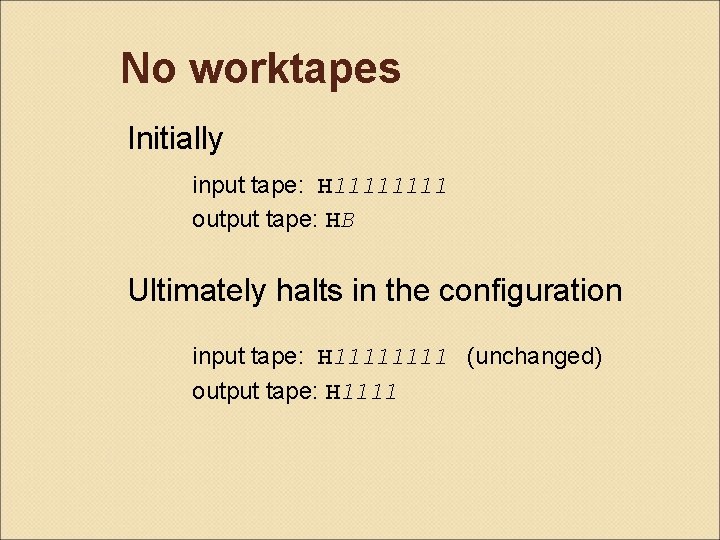
No worktapes Initially input tape: H 1111 output tape: HB Ultimately halts in the configuration input tape: H 1111 (unchanged) output tape: H 1111
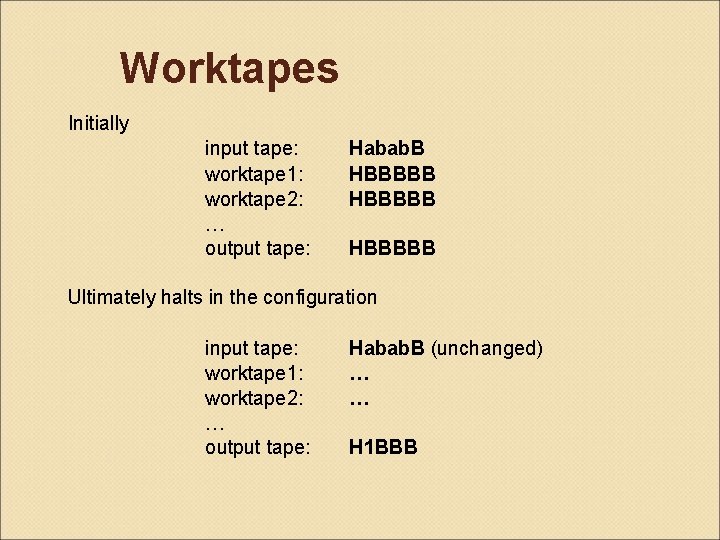
Worktapes Initially input tape: worktape 1: worktape 2: … output tape: Habab. B HBBBBB Ultimately halts in the configuration input tape: worktape 1: worktape 2: … output tape: Habab. B (unchanged) … … H 1 BBB
Clarification Let M be a multitape Turing machine. Suppose that tape t is one of M’s k + 2 tapes. In general, determination of which action is to be taken by the read/write head on tape t will depend on the symbols currently being scanned on tapes other than t and not merely on the symbol currently being scanned on tape t itself.
Language Acceptance Suppose that (k+2)-tape Turing Machine M is started scanning the leftmost symbol of nonempty input word w on its input tape, which is otherwise blank initially. Suppose all the other tapes are blank as well. Then if M halts with its first readhead scanning the leftmost symbol of w on its input tape, which is otherwise blank, and scanning a single 1 on its output tape, which is otherwise blank, then we shall say that M accepts word w
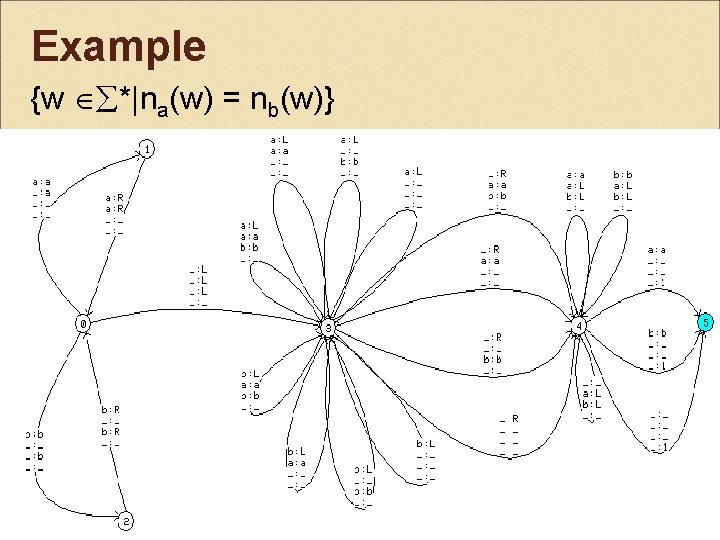
Example {w *|na(w) = nb(w)}
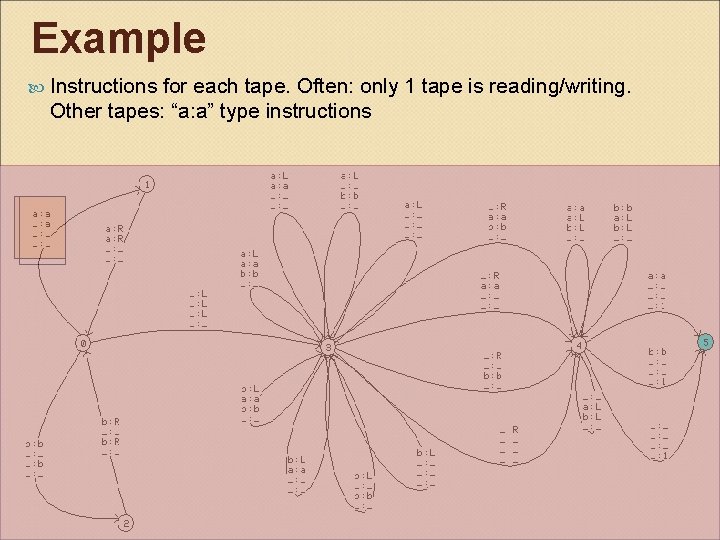
Example Instructions for each tape. Often: only 1 tape is reading/writing. Other tapes: “a: a” type instructions
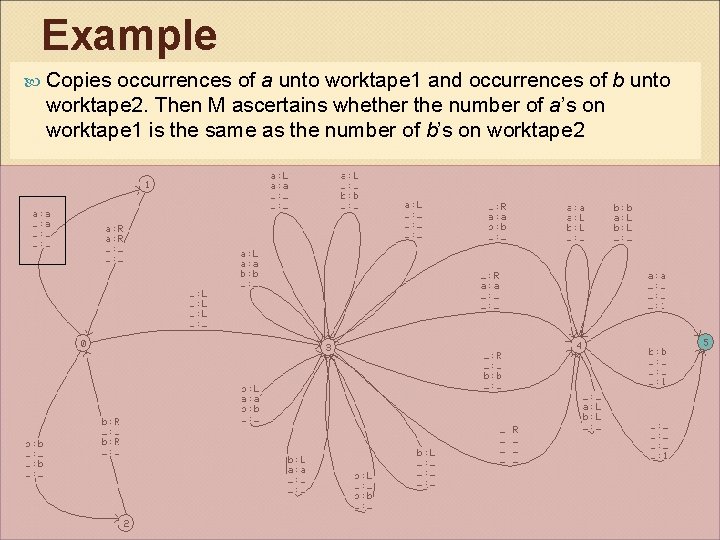
Example Copies occurrences of a unto worktape 1 and occurrences of b unto worktape 2. Then M ascertains whether the number of a’s on worktape 1 is the same as the number of b’s on worktape 2
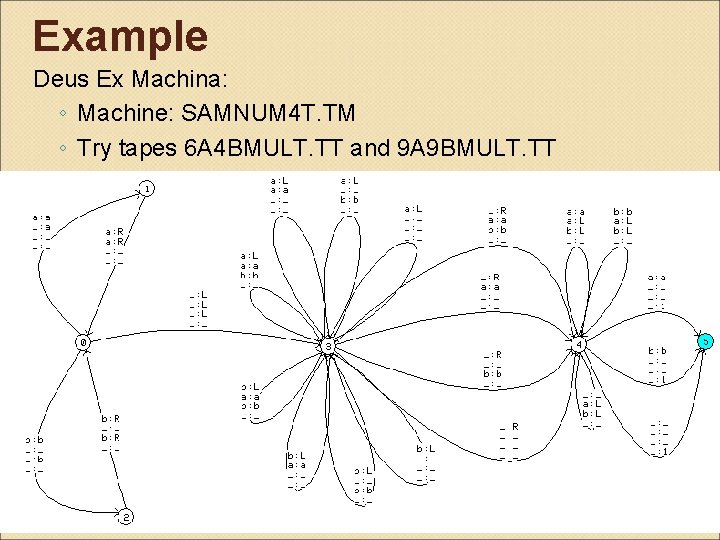
Example Deus Ex Machina: ◦ Machine: SAMNUM 4 T. TM ◦ Try tapes 6 A 4 BMULT. TT and 9 A 9 BMULT. TT
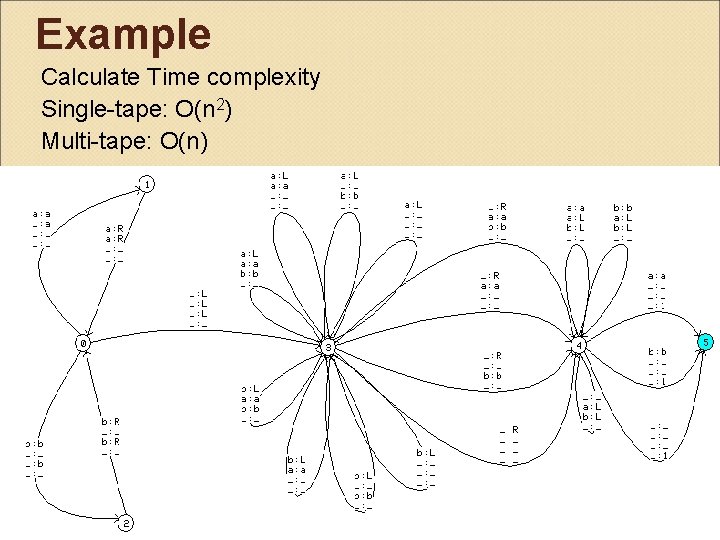
Example Calculate Time complexity Single-tape: O(n 2) Multi-tape: O(n)
Parallel Computation? Let M be a multitape Turing Machine. Suppose that tape t is one of M’s k+2 tapes. In general, determination of which action is to be taken by the read/write head on tape t will depend on the symbols currently being scanned on tapes other than t and not merely on the symbol currently being scanned No individual processors: no parallel computation Single processor controlling multiple tape heads
Exercise Develop a TM that accepts L = { (an | n is prime}
Time/Space trade-off time. M(n) space. M(n) Adding tapes increases space. M but generally decreases time. M
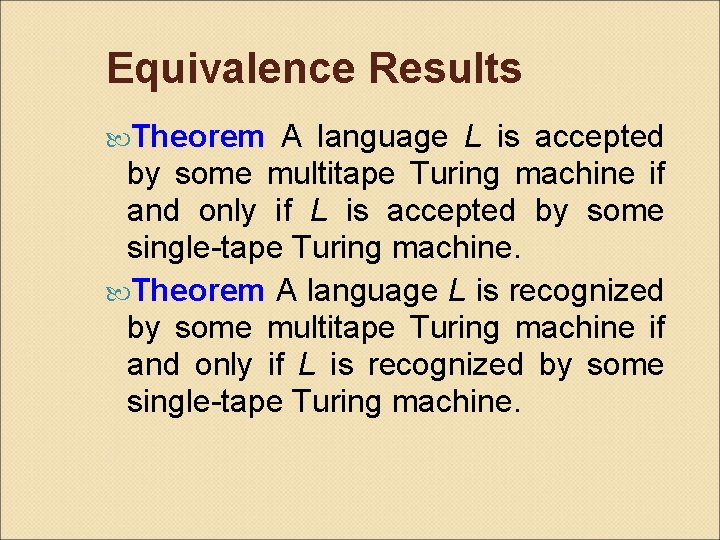
Equivalence Results Theorem A language L is accepted by some multitape Turing machine if and only if L is accepted by some single-tape Turing machine. Theorem A language L is recognized by some multitape Turing machine if and only if L is recognized by some single-tape Turing machine.
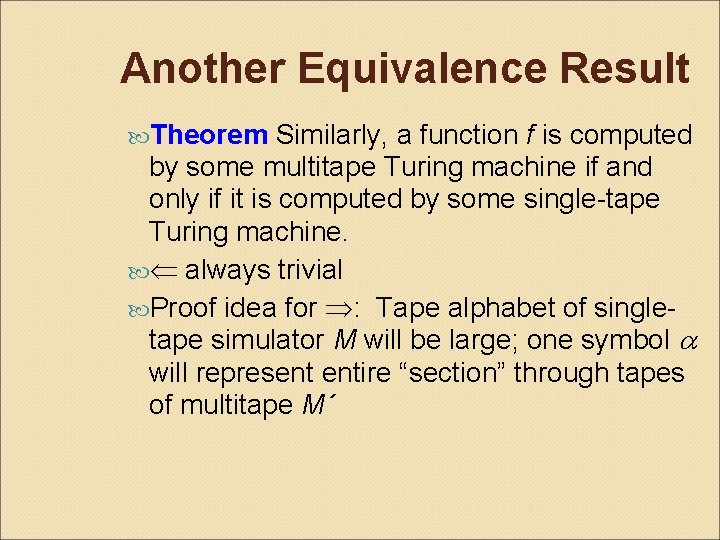
Another Equivalence Result Theorem Similarly, a function f is computed by some multitape Turing machine if and only if it is computed by some single-tape Turing machine. always trivial Proof idea for : Tape alphabet of singletape simulator M will be large; one symbol will represent entire “section” through tapes of multitape M´
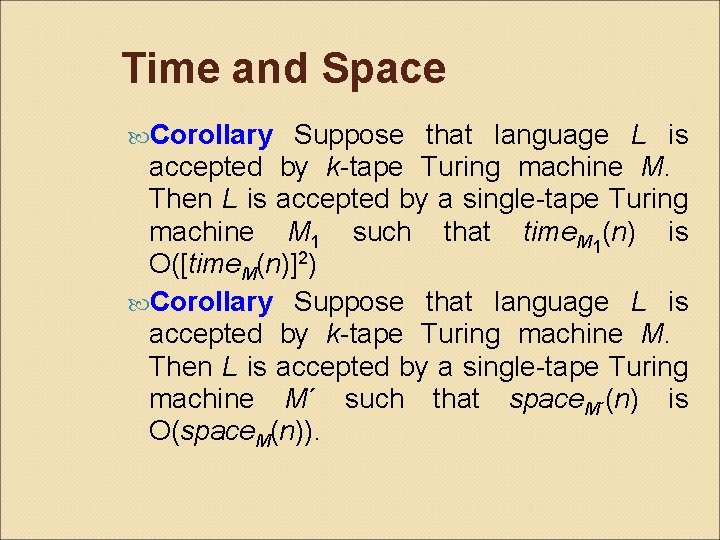
Time and Space Corollary Suppose that language L is accepted by k-tape Turing machine M. Then L is accepted by a single-tape Turing machine M 1 such that time. M 1(n) is O([time. M(n)]2) Corollary Suppose that language L is accepted by k-tape Turing machine M. Then L is accepted by a single-tape Turing machine M´ such that space. M´(n) is O(space. M(n)).
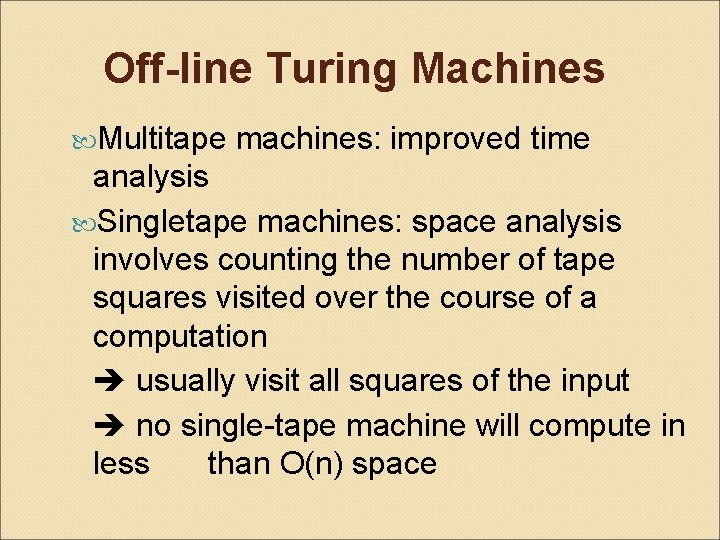
Off-line Turing Machines Multitape machines: improved time analysis Singletape machines: space analysis involves counting the number of tape squares visited over the course of a computation usually visit all squares of the input no single-tape machine will compute in less than O(n) space
Encoding of Turing Machines
Encoding of Turing Machines Any Turing machine can be represented by a natural number code 1. ASCII-style encoding 2. Euler-Gödel encoding
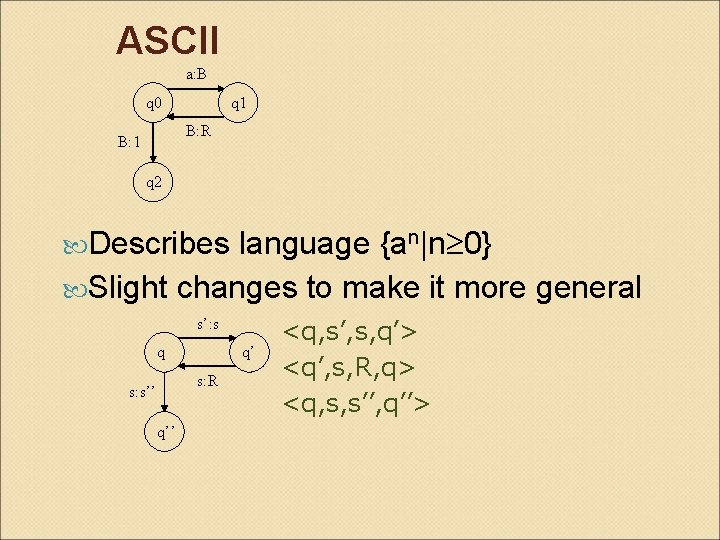
ASCII a: B q 0 q 1 B: R B: 1 q 2 Describes language {an|n 0} Slight changes to make it more general s’: s q q’ s: R s: s’’ q’’ <q, s’, s, q’> <q’, s, R, q> <q, s, s’’, q’’>
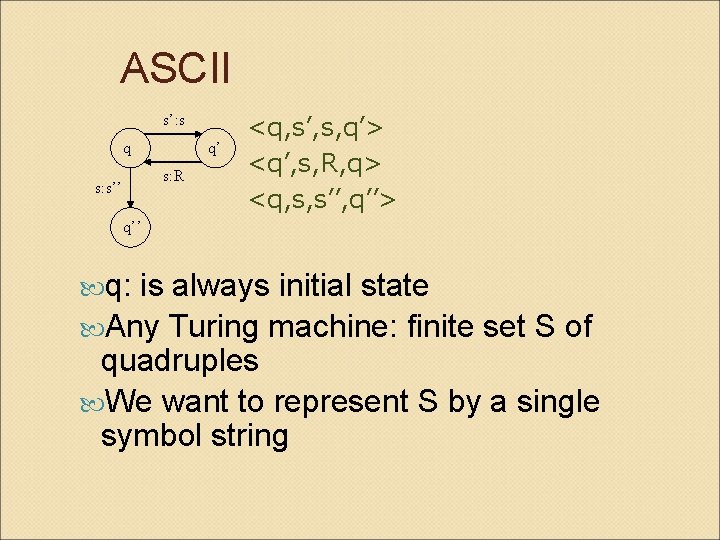
ASCII s’: s q q’ s: R s: s’’ <q, s’, s, q’> <q’, s, R, q> <q, s, s’’, q’’> q’’ q: is always initial state Any Turing machine: finite set S of quadruples We want to represent S by a single symbol string
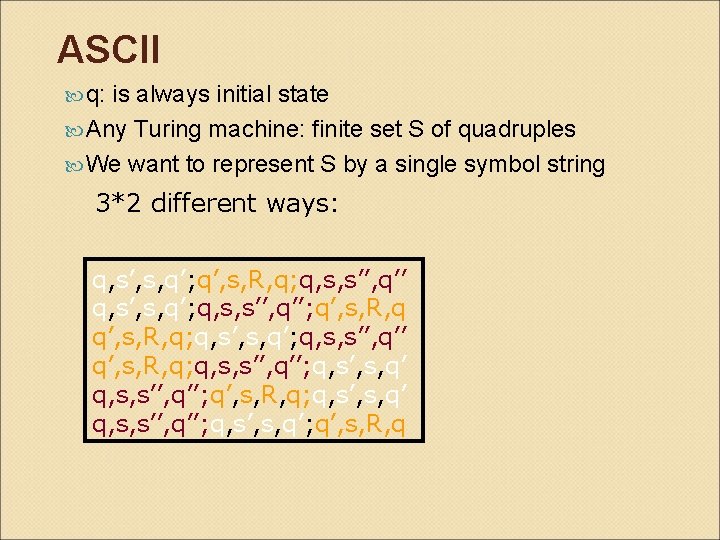
ASCII q: is always initial state Any Turing machine: finite set S of quadruples We want to represent S by a single symbol string 3*2 different ways: q, s’, s, q’; q’, s, R, q; q, s, s’’, q’’ q, s’, s, q’; q, s, s’’, q’’; q’, s, R, q; q, s’, s, q’; q, s, s’’, q’’ q’, s, R, q; q, s, s’’, q’’; q, s’, s, q’ q, s, s’’, q’’; q’, s, R, q; q, s’, s, q’ q, s, s’’, q’’; q, s’, s, q’; q’, s, R, q
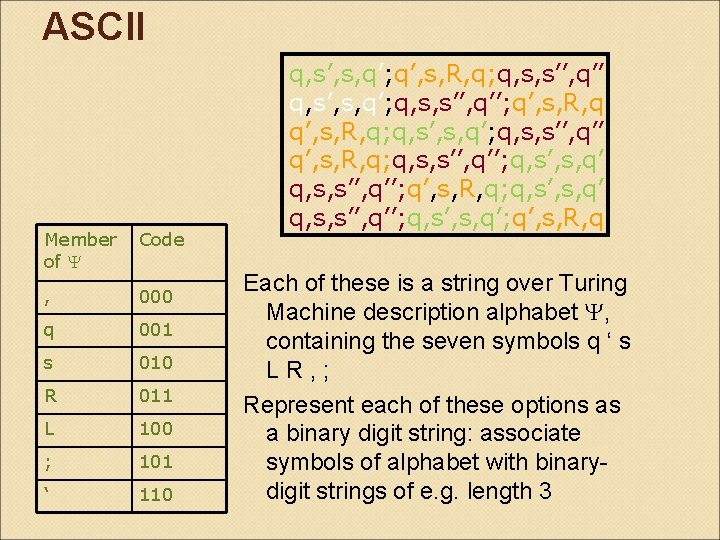
ASCII Member of Code , 000 q 001 s 010 R 011 L 100 ; 101 ‘ 110 q, s’, s, q’; q’, s, R, q; q, s, s’’, q’’ q, s’, s, q’; q, s, s’’, q’’; q’, s, R, q; q, s’, s, q’; q, s, s’’, q’’ q’, s, R, q; q, s, s’’, q’’; q, s’, s, q’ q, s, s’’, q’’; q’, s, R, q; q, s’, s, q’ q, s, s’’, q’’; q, s’, s, q’; q’, s, R, q Each of these is a string over Turing Machine description alphabet , containing the seven symbols q ‘ s LR, ; Represent each of these options as a binary digit string: associate symbols of alphabet with binarydigit strings of e. g. length 3
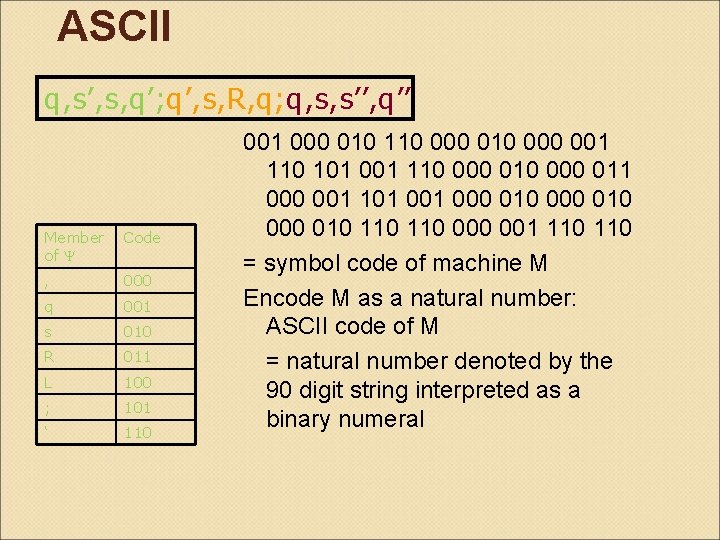
ASCII q, s’, s, q’; q’, s, R, q; q, s, s’’, q’’ Member of Code , 000 q 001 s 010 R 011 L 100 ; 101 ‘ 110 001 000 010 110 000 001 110 101 001 110 000 011 000 001 101 000 010 110 001 110 = symbol code of machine M Encode M as a natural number: ASCII code of M = natural number denoted by the 90 digit string interpreted as a binary numeral
ASCII Turing machines will not have unique ASCII codes No natural number that encodes a Turing machine will be the ASCII code of more than one Turing machine Most natural numbers are not ASCII codes If n is a code, then it is the code of a unique machine (retrievability property).
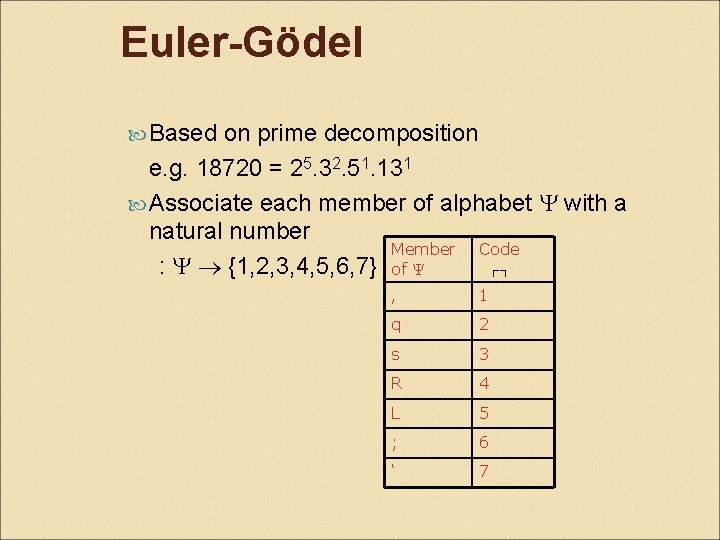
Euler-Gödel Based on prime decomposition e. g. 18720 = 25. 32. 51. 131 Associate each member of alphabet with a natural number Member Code : {1, 2, 3, 4, 5, 6, 7} of , 1 q 2 s 3 R 4 L 5 ; 6 ‘ 7
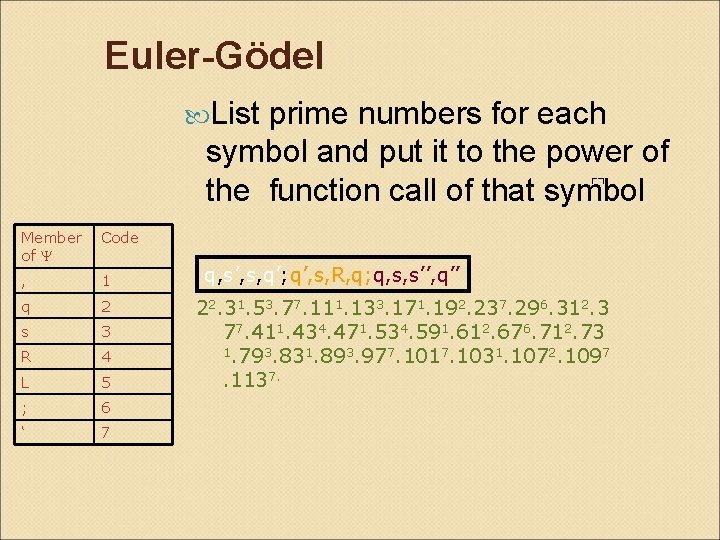
Euler-Gödel List prime numbers for each symbol and put it to the power of the function call of that symbol Member of Code , 1 q 2 s 3 R 4 L 5 ; 6 ‘ 7 q, s’, s, q’; q’, s, R, q; q, s, s’’, q’’ 22. 31. 53. 77. 111. 133. 171. 192. 237. 296. 312. 3 77. 411. 434. 471. 534. 591. 612. 676. 712. 73 1. 793. 831. 893. 977. 1017. 1031. 1072. 1097. 1137.
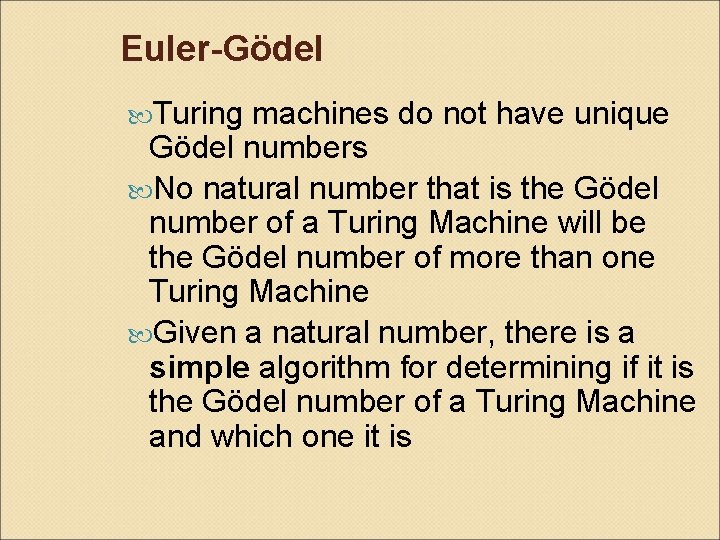
Euler-Gödel Turing machines do not have unique Gödel numbers No natural number that is the Gödel number of a Turing Machine will be the Gödel number of more than one Turing Machine Given a natural number, there is a simple algorithm for determining if it is the Gödel number of a Turing Machine and which one it is
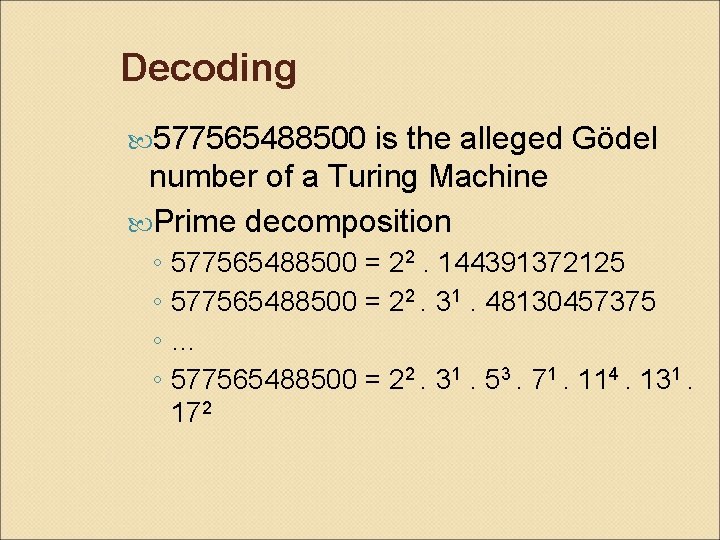
Decoding 577565488500 is the alleged Gödel number of a Turing Machine Prime decomposition ◦ 577565488500 = 22. 144391372125 ◦ 577565488500 = 22. 31. 48130457375 ◦… ◦ 577565488500 = 22. 31. 53. 71. 114. 131. 172
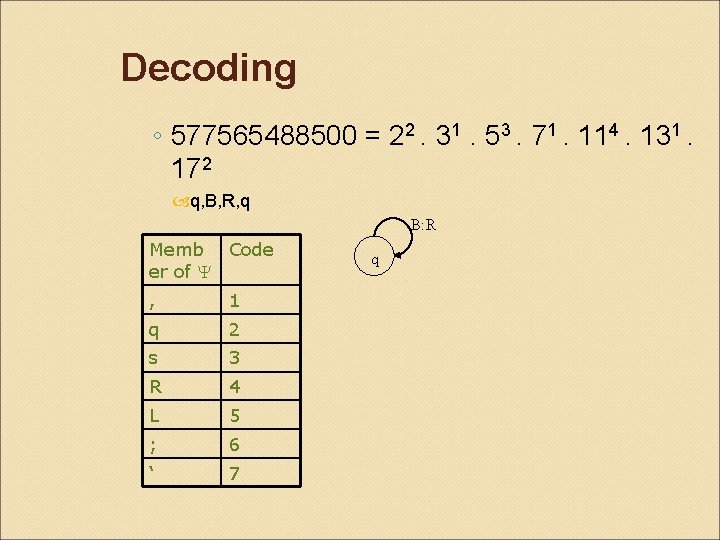
Decoding ◦ 577565488500 = 22. 31. 53. 71. 114. 131. 172 q, B, R, q B: R Memb Code er of , 1 q 2 s 3 R 4 L 5 ; 6 ‘ 7 q
Universal Turing Machines
Universal Turing machines So far: machines in a peculiar sense Single program, single set of instructions Change 1 instruction change the machine Can our TM be programmed to simulate behavior of any TM whatsoever?
Universal Turing machines Usual sense of a machine: machine (hardware) that can run several programs (software) Digital Computer: Universal Computing device that - suitably programmed (and ignoring resource limits) - can compute any function that is in principle computable
Definition Turing Machine M* is universal if, for any Turing Machine M with input alphabet , when M* is started scanning the leftmost 1 in an unbroken string of n 0+1 1 s (n 0 being the encoding of machine M) followed by a single blank followed by word w over , M* transforms w exactly as machine M would transform it
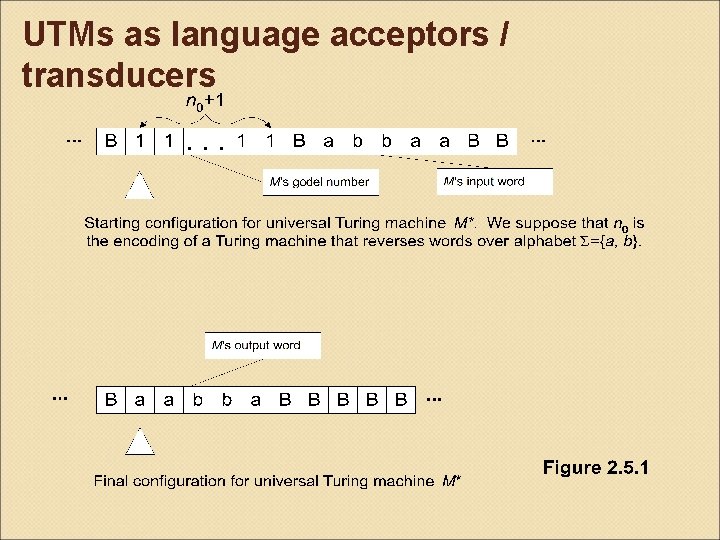
UTMs as language acceptors / transducers
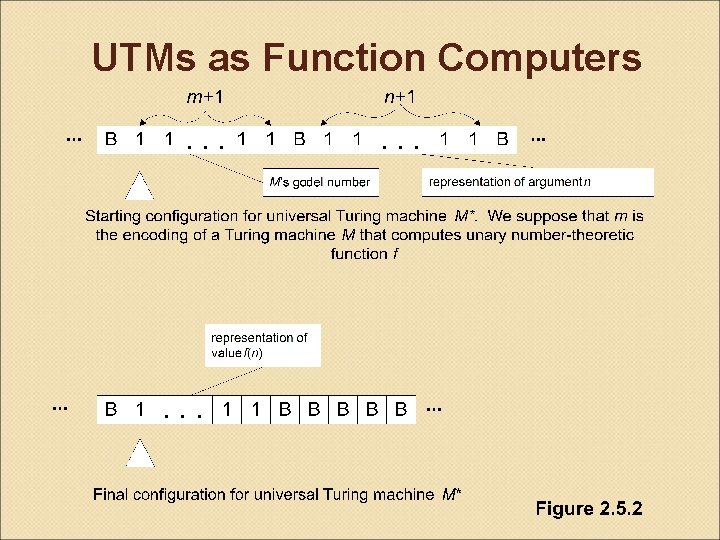
UTMs as Function Computers
UTMs Exist Turing (1936) proved this Decode/encoding of Turing Machine and copy it to one or more worktapes Arguments are copied to worktape(s) Then the program is executed Proving that UTM exists different from actually constructing it!
UTMs Exist ENIAC (1943): programmed manually by setting flip-flops and plugging wires into circuit boards Store these instructions in the manner of input data Stored-program computers (EDVAC/1946) Also ACE (Turing, London) General-purpose, executive programs: operating systems ◦ Accept other programs as input and execute it hardware plasticity: ability of one general-purpose machine architecture to mimic other, diverse machine architectures by means of dedicated software (cf. emulators)
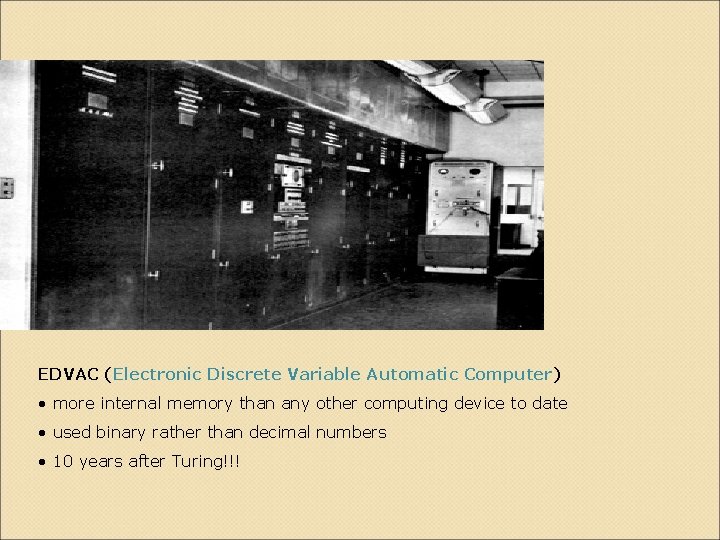
EDVAC (Electronic Discrete Variable Automatic Computer) • more internal memory than any other computing device to date • used binary rather than decimal numbers • 10 years after Turing!!!
History of Computing on the Internet Charles Babbage Institute http: //www. cbi. umn. edu/photo/cbi/gallery. htm EDVAC site at http: //www. ifi. unizh. ch/se/people/hoyle/Lecture/ edvac. html Most highly recommended is the Smithsonian Institute site (Landmarks in Digital Computing) at http: //www. nasm. edu/NASMDOCS/DSH/LDC/ld c_contents. html
Nondeterministic Turing Machines
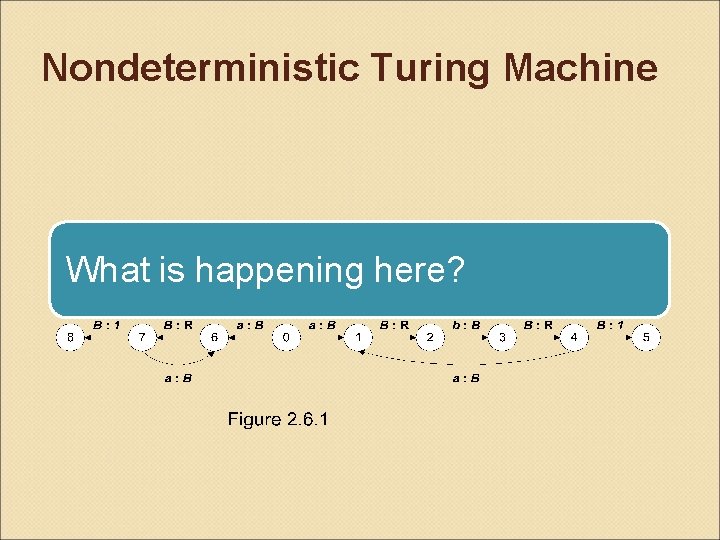
Nondeterministic Turing Machine What is happening here?
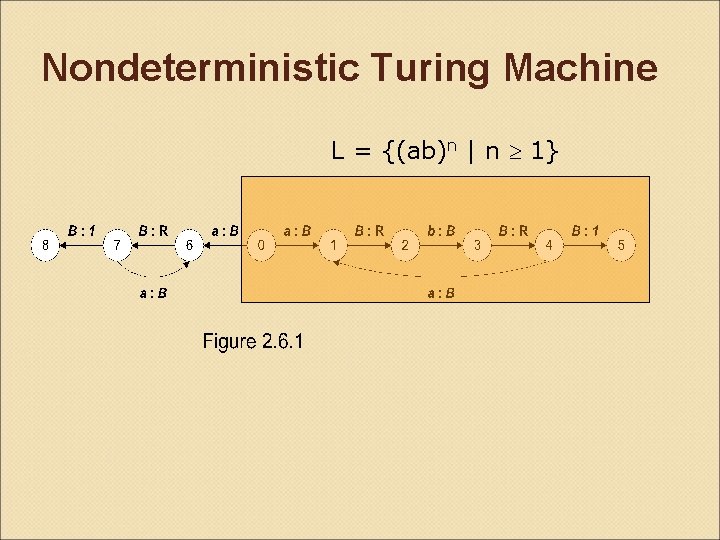
Nondeterministic Turing Machine L = {(ab)n | n 1}
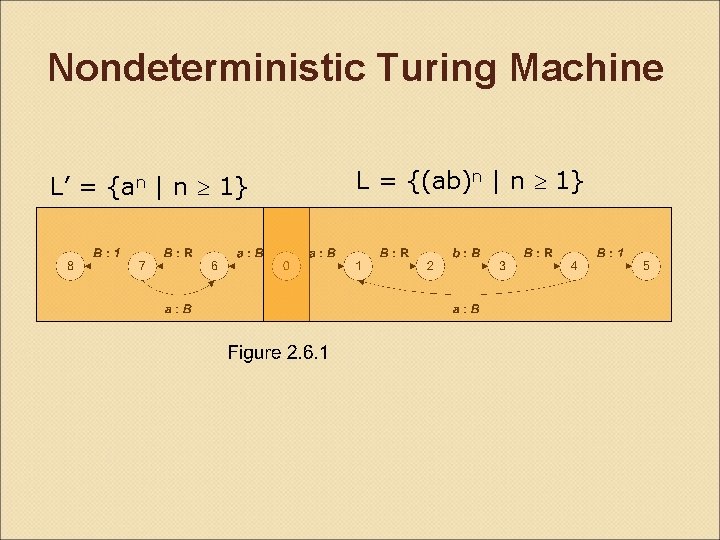
Nondeterministic Turing Machine L’ = {an | n 1} L = {(ab)n | n 1}
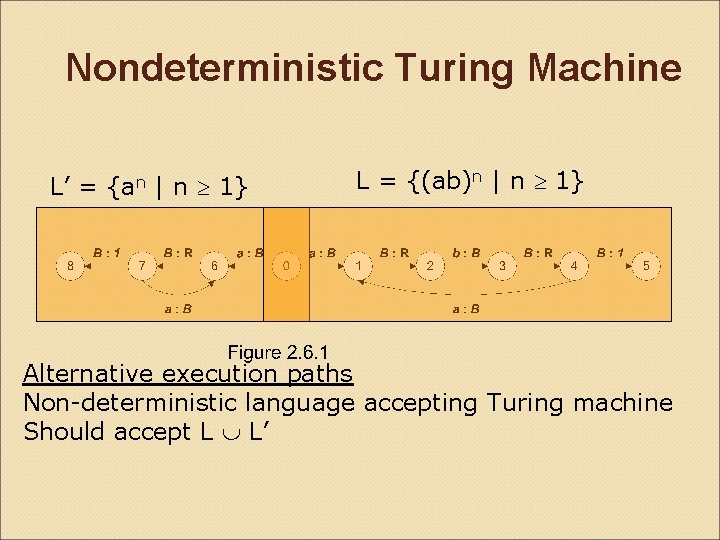
Nondeterministic Turing Machine L’ = {an | n 1} L = {(ab)n | n 1} Alternative execution paths Non-deterministic language accepting Turing machine Should accept L L’
Language Acceptance Accepts w if some computation of M results in an accepting 1 In general there will be “nonaccepting” computations even in the case of an accepted w M accepts L if and only if M accepts all and only the words of L
Transition Functions In the case of a nondeterministic M, we have that M is not single-valued, e. g. , M(q 0, a) = (B, q 1) and M(q 0, a) = (B, q 6). We speak of a transition mapping, instead of transition function Deterministic machines of those among the nondeterministic machines with single -valued transitions mappings. Determinism = a special case of nondeterminism.
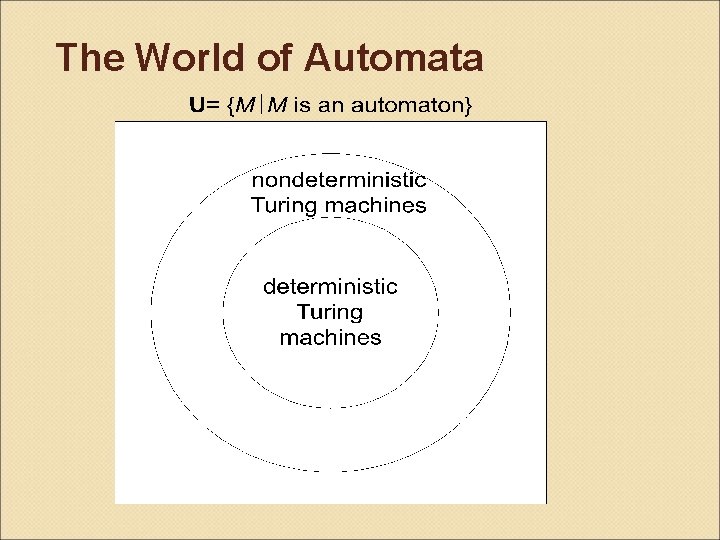
The World of Automata
Turing-Computability Theorem Let f be a numbertheoretic function. Then f is computed by some nondeterministic Mnd if and only if f is computed by some deterministic Md.
Time complexity (recap) Complexity class P: class of all languages accepted in polynomial time by some Turing Machine L = {w *| na(w) = nb(w) } is a member of complexity class P A language L over alphabet is said to be polynomial-time Turing-acceptable if there exist both a deterministic TM M and a polynomial p(n) such that for any w *, we have w L if and only if M accepts w in O(p(|w|)) steps.
A New Complexity Class NP = class of polynomial-time nondeterministically Turing-acceptable languages P NP trivially Every language in NP is Turingacceptable
P NP? Is something that is easy to check, also easy to compute? Open problem worth $1 M http: //www. claymath. org/millennium/P_vs_NP/ Suppose that you are organizing housing accommodations for a group of four hundred university students. Space is limited and only one hundred of the students will receive places in the dormitory. To complicate matters, the Dean has provided you with a list of pairs of incompatible students, and requested that no pair from this list appear in your final choice. This is an example of what computer scientists call an NP-problem, since it is easy to check if a given choice of one hundred students proposed by a coworker is satisfactory (i. e. , no pair taken from your coworker's list also appears on the list from the Dean's office), however the task of generating such a list from scratch seems to be so hard as to be completely impractical. Indeed, the total number of ways of choosing one hundred students from the four hundred applicants is greater than the number of atoms in the known universe! Thus no future civilization could ever hope to build a supercomputer capable of solving the problem by brute force; that is, by checking every possible combination of 100 students. However, this apparent difficulty may only reflect the lack of ingenuity of your programmer. In fact, one of the outstanding problems in computer science is determining whether questions exist whose answer can be quickly checked, but which require an impossibly long time to solve by any direct procedure. Problems like the one listed above certainly seem to be of this kind, but so far no one has managed to prove that any of them really are so hard as they appear, i. e. , that there really is no feasible way to generate an answer with the help of a computer. Stephen Cook and Leonid Levin formulated the P (i. e. , easy to find) versus NP (i. e. , easy to check) problem independently in 1971.
P NP? Probable answer: yes NP-complete problems: problems that are most likely not to be in P NP-hard problems: NP problems that can be reduced in polynomial time Traveling salesman: NP-complete problem. If this problem turns out to be in P, P=NP So far: no one has been able to find a polynomial time solution to an NP-hard problem Inherent problem of computation? Or human intelligence problem?
Turing Machines and Artificial Intelligence
Machine Intelligence Descartes Test: intelligence = a machine’s ability to use language: ◦ More than language recognition? ◦ Communication with humans? ◦ Weizenbaum’s ELIZA?
Turing Test Computing Machinery and Intelligence (1950) 3 participants: 2 men (man. A and man. B) and 1 woman play imitation game: ◦ Room 1: man. A as the interrogator ◦ Room 2: man. B + woman ◦ Communication through networked computers ◦ Goal: interrogator needs to identify male or female in room 2 through questioning (questions to player X and player Y (predefined by man. B and woman)) ◦ If the interrogator correctly identifies them, interrogator and woman win Woman has to help interrogator by answering like a woman man. B has to confuse the interrogator by answering like a woman
Turing Test Interrogator has to ask intelligent questions: ◦ Name a shoe manufacturer ◦ Name a football team ◦ What is your shoe size If the 3 participants are of the same intelligence, the interrogator will end up merely guessing ◦ Woman+Interrogator wins half the games
Turing Test What if the role of man. B is played by a computer? Interrogator needs to guess who is the computer and who is the woman Woman will help the interrogator and computer needs to confuse him If the number of games won by the computer is at least as great as that of man. B, we pronounce the computer intelligent Computer’s knowledge of the world is just as important as its knowledge of human knowledge limitations But: anthropocentric (cf. extraterrestrial intelligence)
Block’s critique Given 60 minutes of Imitation Game, 88 characters, … the class of imitation game conversations is finite A machine Aunt Bubbles has access to all of these conversation and simply searches for the most appropriate next answer Is this machine intelligence? “Intelligence of a jukebox” Deep Blue?
Turing Machines and Cognitive Science
Cognition Sensory perception, natural language processing, reasoning, judgment, memory, … Computation = one sort of human cognitive activity Cognitive scientists: seek plausible models of cognitive activity Theory of computability can make a contribution to cognitive science
Cognition and Turing Machines Strong claim: Universal Turing Machines model human cognition? ◦ Is human cognition goal-oriented? ◦ Is everything we think about computation? Weak claim: every genuinely cognitive aspect of the human mind can be modeled with a Turing Machine, given the correct tape representation. The rest is noise
Cognition and Turing Machines Competence models of cognition: formal analysis of overall input/output relations Performance models of cognition: includes modeling of noise Turing Machine modeling: only competence!
Exercise 4 Use Deus ex Machina to design a 3 -tape turing machine that accepts the language {w * | w = w R}
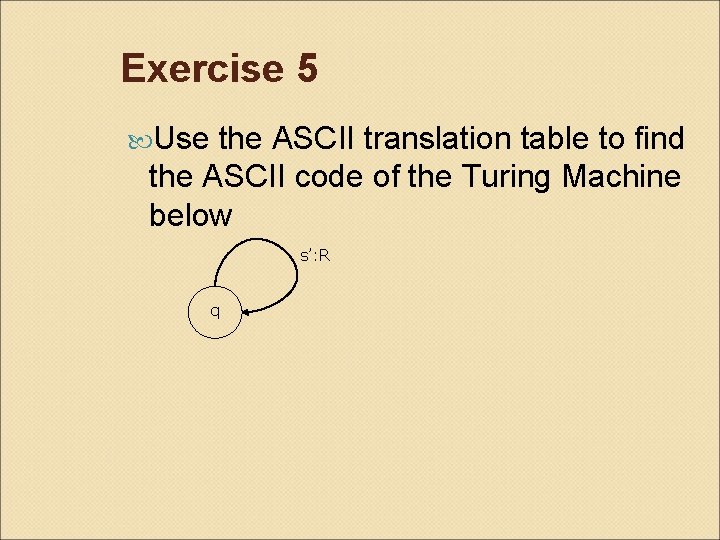
Exercise 5 Use the ASCII translation table to find the ASCII code of the Turing Machine below s’: R q
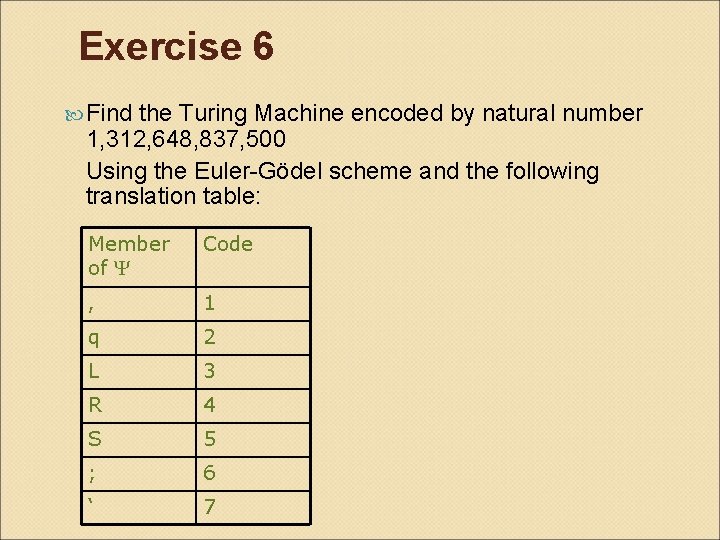
Exercise 6 Find the Turing Machine encoded by natural number 1, 312, 648, 837, 500 Using the Euler-Gödel scheme and the following translation table: Member of Code , 1 q 2 L 3 R 4 S 5 ; 6 ‘ 7
Exercise 7 (difficult) Use Deus Ex Machina to design a non-deterministic Turing Machine that accepts language {ww|w *} with = {a, b} hint: design a machine that nondeterministically selects a candidate midpoint within its input word and then proceeds to compare its front half with its back half, one character at the time
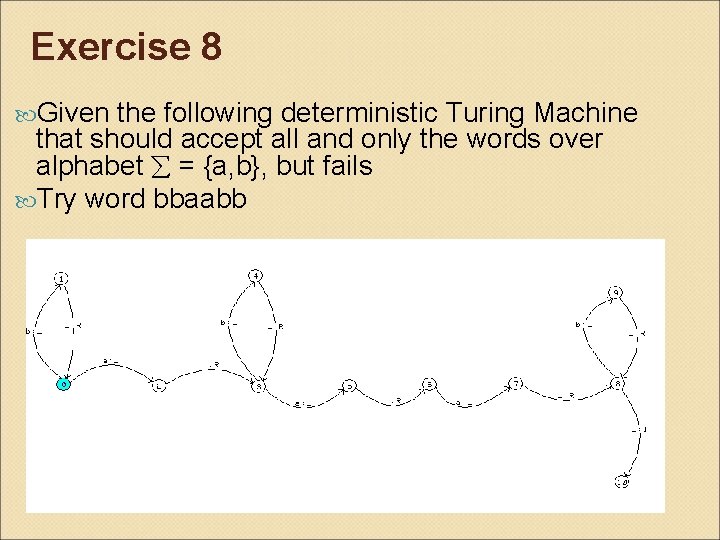
Exercise 8 Given the following deterministic Turing Machine that should accept all and only the words over alphabet = {a, b}, but fails Try word bbaabb
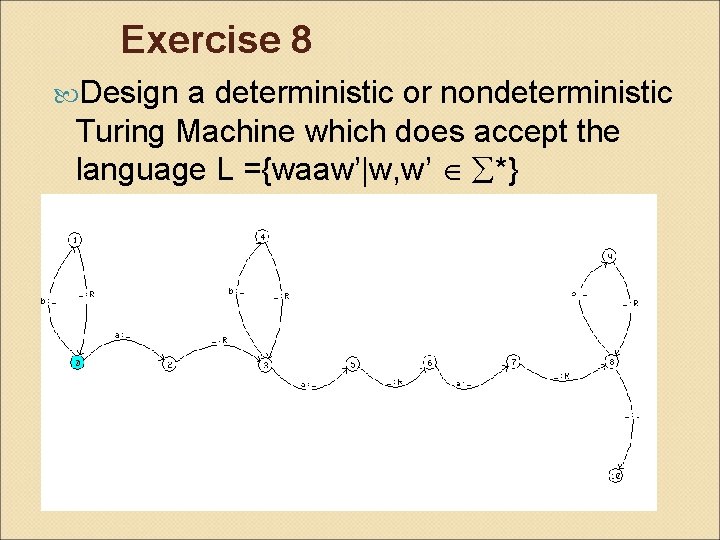
Exercise 8 Design a deterministic or nondeterministic Turing Machine which does accept the language L ={waaw’|w, w’ *}
- Slides: 84