
ICS 252 Introduction to Computer Design Routing Fall
![References and Copyright • Textbooks referred (none required) – [Mic 94] G. De Micheli](https://slidetodoc.com/presentation_image/e93233ae83019db90f787fa0cc0f76fb/image-2.jpg "References and Copyright • Textbooks referred (none required) – [Mic 94] G. De Micheli")
![Global Routing [©Sarrafzadeh] • Stages – Routing region definition – Routing region ordering –](https://slidetodoc.com/presentation_image/e93233ae83019db90f787fa0cc0f76fb/image-10.jpg "Global Routing [©Sarrafzadeh] • Stages – Routing region definition – Routing region ordering –")
- Slides: 18
ICS 252 Introduction to Computer Design Routing Fall 2007 Eli Bozorgzadeh Computer Science Department-UCI Fall 2007 ICS 252 -Intro to Computer Design
References and Copyright • Textbooks referred (none required) – [Mic 94] G. De Micheli “Synthesis and Optimization of Digital Circuits” Mc. Graw-Hill, 1994. – [CLR 90] T. H. Cormen, C. E. Leiserson, R. L. Rivest “Introduction to Algorithms” MIT Press, 1990. – [Sar 96] M. Sarrafzadeh, C. K. Wong “An Introduction to VLSI Physical Design” Mc. Graw-Hill, 1996. – [She 99] N. Sherwani “Algorithms For VLSI Physical Design Automation” Kluwer Academic Publishers, 3 rd edition, 1999. Fall 2007 ICS 252 -Intro to Computer Design 2
References and Copyright (cont. ) • Slides: http: //www. ece. umn. edu/users/kia/Courses/EE 5301/ – Slides used: (Modified by Kia when necessary) • [©Sarrafzadeh] © Majid Sarrafzadeh, 2001; Department of Computer Science, UCLA • [©Sherwani] © Naveed A. Sherwani, 1992 (companion slides to [She 99]) • [©Keutzer] © Kurt Keutzer, Dept. of EECS, UC-Berekeley http: //www-cad. eecs. berkeley. edu/~niraj/ee 244/index. htm • [©Gupta] © Rajesh Gupta UC-Irvine http: //www. ics. uci. edu/~rgupta/ics 280. html • [©Kang] © Steve Kang UIUC http: //www. ece. uiuc. edu/ece 482/ Fall 2007 ICS 252 -Intro to Computer Design 3
Routing • Problem – Given a placement, and a fixed number of metal layers, find a valid pattern of horizontal and vertical wires that connect the terminals of the nets – Levels of abstraction: • Global routing • Detailed routing • Objectives – Cost components: • Area (channel width) – min congestion in prev levels helped • Wire delays – timing minimization in previous levels • Number of layers (less layers less expensive) • Additional cost components: number of bends, vias Fall 2007 ICS 252 -Intro to Computer Design 4
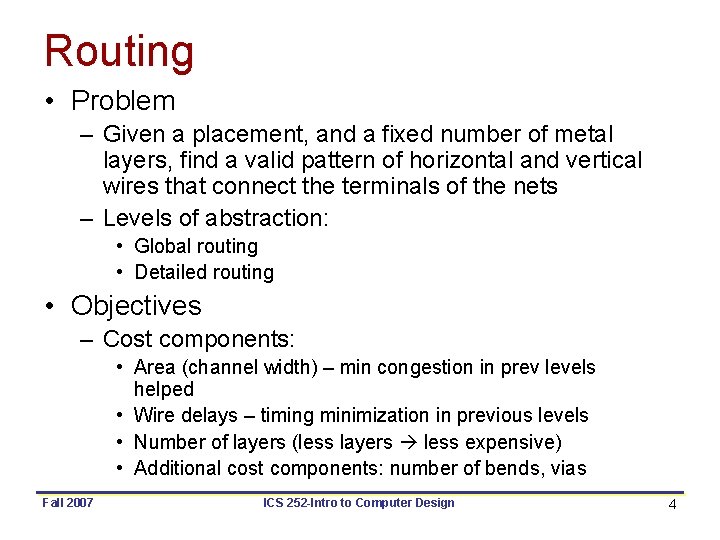
Routing Anatomy Top view Symbolic Layout Fall 2007 3 D view Metal layer 3 Via Metal layer 2 Metal layer 1 ICS 252 -Intro to Computer Design Note: Colors used in this slide are not standard 5
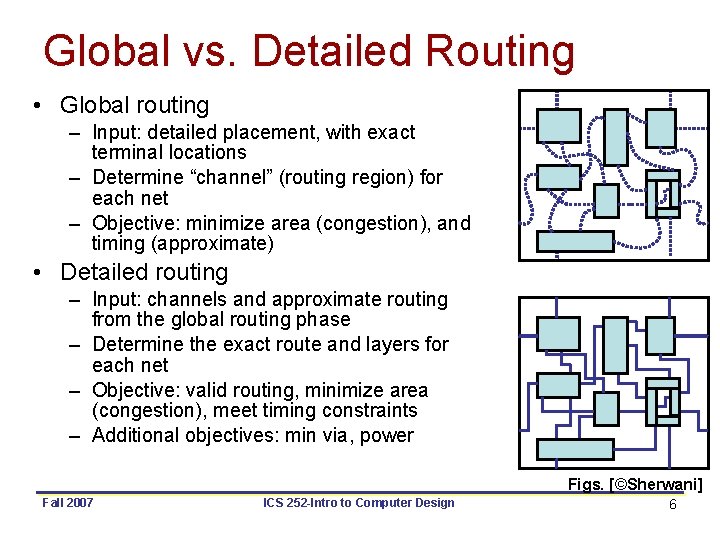
Global vs. Detailed Routing • Global routing – Input: detailed placement, with exact terminal locations – Determine “channel” (routing region) for each net – Objective: minimize area (congestion), and timing (approximate) • Detailed routing – Input: channels and approximate routing from the global routing phase – Determine the exact route and layers for each net – Objective: valid routing, minimize area (congestion), meet timing constraints – Additional objectives: min via, power Figs. [©Sherwani] Fall 2007 ICS 252 -Intro to Computer Design 6
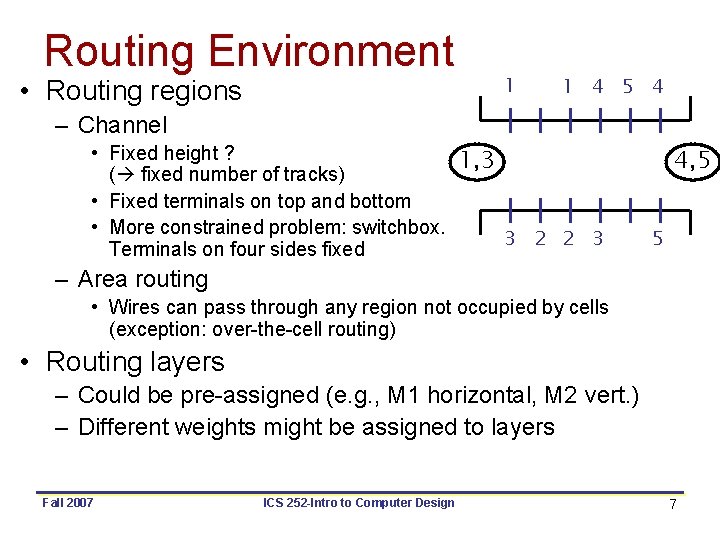
Routing Environment • Routing regions 1 1 4 5 4 – Channel • Fixed height ? 1, 3 ( fixed number of tracks) • Fixed terminals on top and bottom • More constrained problem: switchbox. 3 2 2 3 Terminals on four sides fixed 4, 5 5 – Area routing • Wires can pass through any region not occupied by cells (exception: over-the-cell routing) • Routing layers – Could be pre-assigned (e. g. , M 1 horizontal, M 2 vert. ) – Different weights might be assigned to layers Fall 2007 ICS 252 -Intro to Computer Design 7
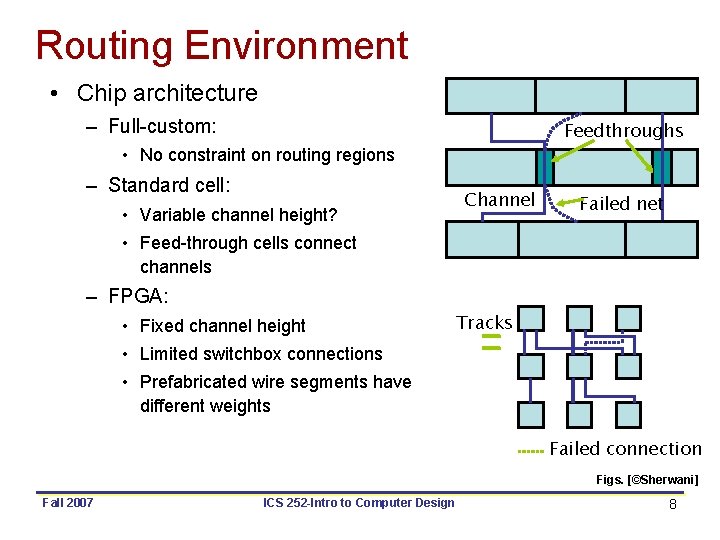
Routing Environment • Chip architecture – Full-custom: Feedthroughs • No constraint on routing regions – Standard cell: • Variable channel height? Channel Failed net • Feed-through cells connect channels – FPGA: • Fixed channel height Tracks • Limited switchbox connections • Prefabricated wire segments have different weights Failed connection Figs. [©Sherwani] Fall 2007 ICS 252 -Intro to Computer Design 8
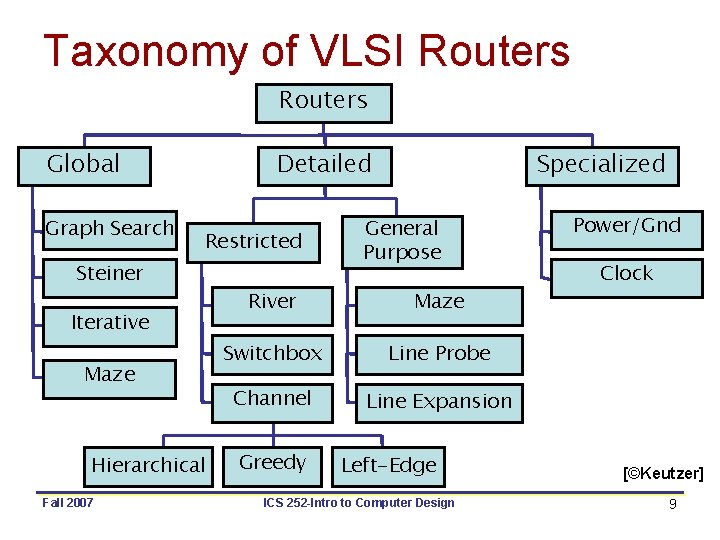
Taxonomy of VLSI Routers Global Graph Search Detailed Restricted Steiner Iterative Maze Hierarchical Fall 2007 Specialized General Purpose River Maze Switchbox Line Probe Channel Line Expansion Greedy Left-Edge ICS 252 -Intro to Computer Design Power/Gnd Clock [©Keutzer] 9
Global Routing [©Sarrafzadeh] • Stages – Routing region definition – Routing region ordering – Steiner-tree / area routing • Grid – Tiles super-imposed on placement – Regular or irregular – Smaller problem to solve, higher level of abstraction – Terminals at center of grid tiles M 2 M 1 M 3 • Edge capacity – Number of nets that can pass a certain grid edge (aka congestion) – On edge Eij, – Fall 2007 Capacity(Eij) Congestion(Eij) ICS 252 -Intro to Computer Design 10
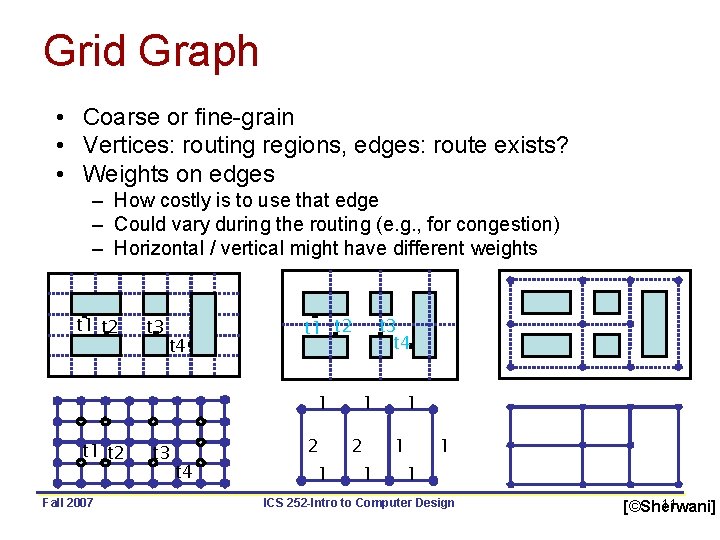
Grid Graph • Coarse or fine-grain • Vertices: routing regions, edges: route exists? • Weights on edges – How costly is to use that edge – Could vary during the routing (e. g. , for congestion) – Horizontal / vertical might have different weights t 1 t 2 t 3 t 4 t 1 t 2 Fall 2007 t 3 t 4 2 1 t 3 t 4 1 2 1 1 1 ICS 252 -Intro to Computer Design 11 [©Sherwani]
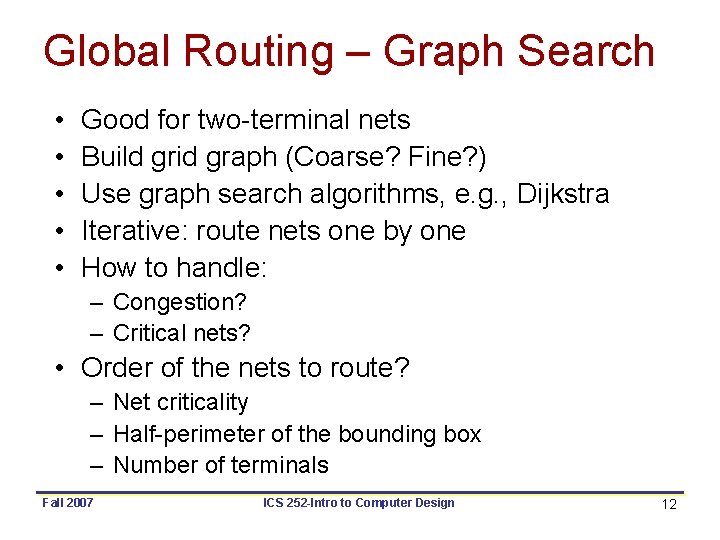
Global Routing – Graph Search • • • Good for two-terminal nets Build grid graph (Coarse? Fine? ) Use graph search algorithms, e. g. , Dijkstra Iterative: route nets one by one How to handle: – Congestion? – Critical nets? • Order of the nets to route? – Net criticality – Half-perimeter of the bounding box – Number of terminals Fall 2007 ICS 252 -Intro to Computer Design 12
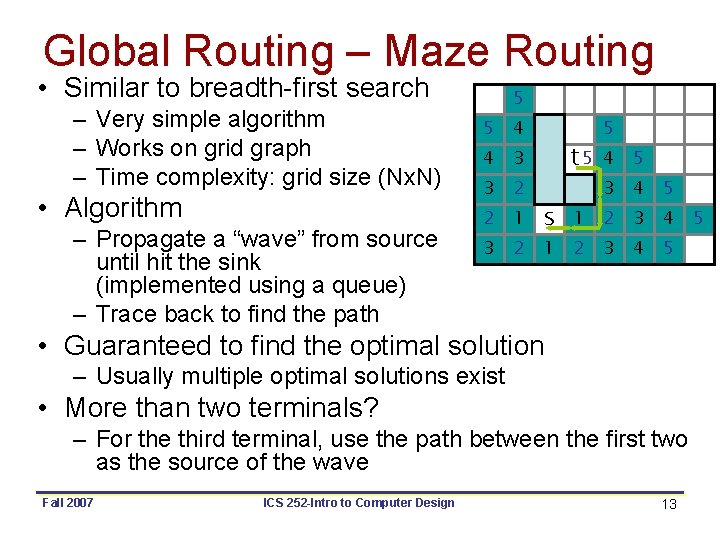
Global Routing – Maze Routing • Similar to breadth-first search – Very simple algorithm – Works on grid graph – Time complexity: grid size (Nx. N) • Algorithm – Propagate a “wave” from source until hit the sink (implemented using a queue) – Trace back to find the path 5 5 4 4 3 3 2 2 1 3 2 t 5 s 1 5 4 5 3 4 5 1 2 3 4 5 • Guaranteed to find the optimal solution – Usually multiple optimal solutions exist • More than two terminals? – For the third terminal, use the path between the first two as the source of the wave Fall 2007 ICS 252 -Intro to Computer Design 13 5
Maze Routing • Key to popularity: – Simplicity – Guaranteed to find the optimal solution – Can realize more complex cost functions too (e. g. , number of bends in a path) • Weakness: – Multiple terminals not handled efficiently – Dependent on grid, a two dimensional data structure • Different variations exist – Soukup’s alg: • First use DFS, when get to an obstacle, use BFS to get around • No guarantee to find the shortest path Fall 2007 ICS 252 -Intro to Computer Design 14
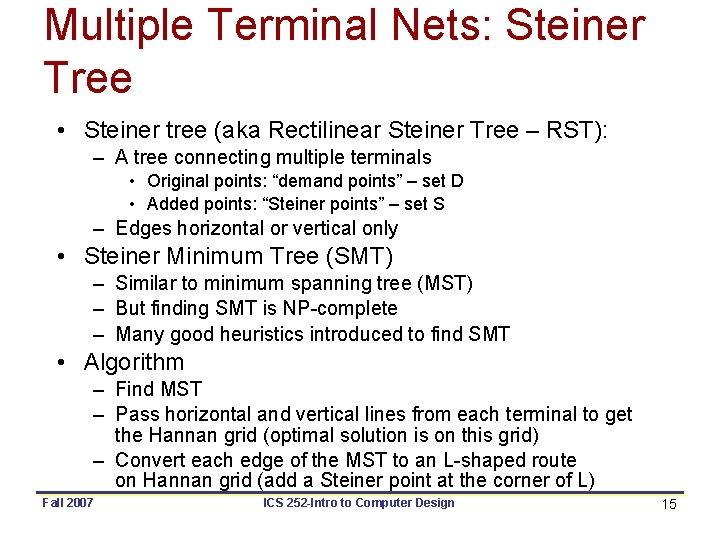
Multiple Terminal Nets: Steiner Tree • Steiner tree (aka Rectilinear Steiner Tree – RST): – A tree connecting multiple terminals • Original points: “demand points” – set D • Added points: “Steiner points” – set S – Edges horizontal or vertical only • Steiner Minimum Tree (SMT) – Similar to minimum spanning tree (MST) – But finding SMT is NP-complete – Many good heuristics introduced to find SMT • Algorithm – Find MST – Pass horizontal and vertical lines from each terminal to get the Hannan grid (optimal solution is on this grid) – Convert each edge of the MST to an L-shaped route on Hannan grid (add a Steiner point at the corner of L) Fall 2007 ICS 252 -Intro to Computer Design 15
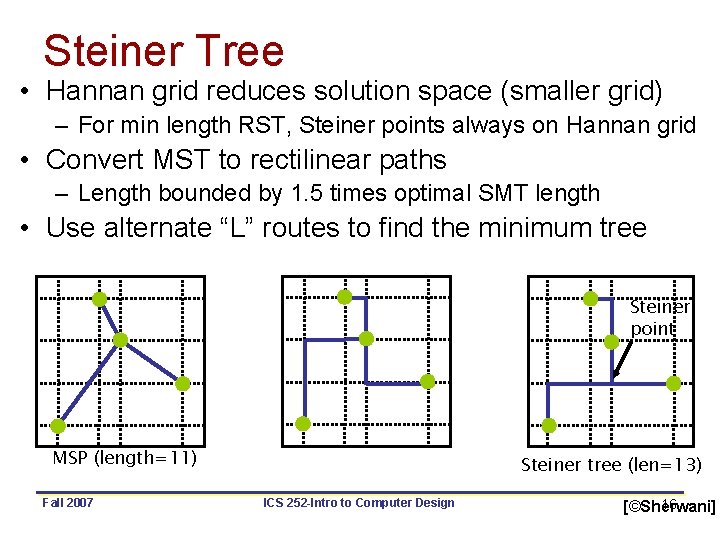
Steiner Tree • Hannan grid reduces solution space (smaller grid) – For min length RST, Steiner points always on Hannan grid • Convert MST to rectilinear paths – Length bounded by 1. 5 times optimal SMT length • Use alternate “L” routes to find the minimum tree Steiner point MSP (length=11) Fall 2007 Steiner tree (len=13) ICS 252 -Intro to Computer Design 16 [©Sherwani]
Steiner Tree Routing • Can apply different costs to different regions (or horizontal/vertical preference) • Order of the nets – Sequential • Use # of terminals, criticality, etc. to determine order – Parallel • Divide the chip into large regions, perform the routing in parallel • Key to popularity – Fast (not theoretically, but practically) – Bounded solution quality • Shortcomings – Difficult to predict or avoid congestion Fall 2007 ICS 252 -Intro to Computer Design 17
Global Routing Approaches • A combination of different approaches might be used in chip-level routing – Route simple nets (2 -3 pins in local area) directly (e. g. , L-shaped or Z-shaped) – Use a “close to optimal” Steiner Tree algorithms to route nets of intermediate length – Route remaining “big” nets using a maze router • Ordering – Some ordering is chosen, if can route all, then done, otherwise: – Rip-up and Re-route [©Keutzer] Fall 2007 ICS 252 -Intro to Computer Design 18