
ICS 252 Introduction to Computer Design Partitioning Eli


- Slides: 30
ICS 252 Introduction to Computer Design Partitioning Eli Bozorgzadeh Computer Science Department-UCI Fall 2007 ICS 252 -Intro to Computer Design
Partitioning • Decomposition of a complex system into smaller subsystems – Done hierarchically – Partitioning done until each subsystem has manageable size – Each subsystem can be designed independently • Interconnections between partitions minimized – Less hassle interfacing the subsystems – Communication between subsystems usually costly Fall 2007 ICS 252 -Intro to Computer Design 2
Example: Partitioning of a Circuit Input size: 48 Cut 1=4 Size 1=15 Fall 2007 Cut 2=4 Size 2=16 Size 3=17 ICS 252 -Intro to Computer Design [©Sherwani] 3
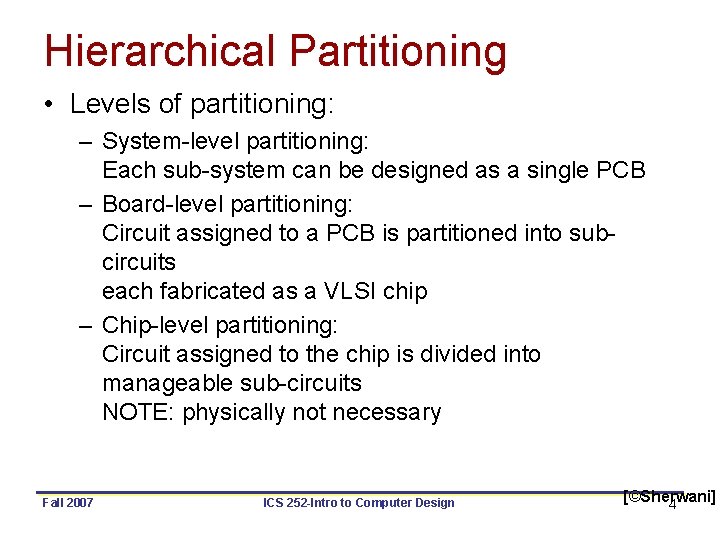
Hierarchical Partitioning • Levels of partitioning: – System-level partitioning: Each sub-system can be designed as a single PCB – Board-level partitioning: Circuit assigned to a PCB is partitioned into subcircuits each fabricated as a VLSI chip – Chip-level partitioning: Circuit assigned to the chip is divided into manageable sub-circuits NOTE: physically not necessary Fall 2007 ICS 252 -Intro to Computer Design [©Sherwani] 4
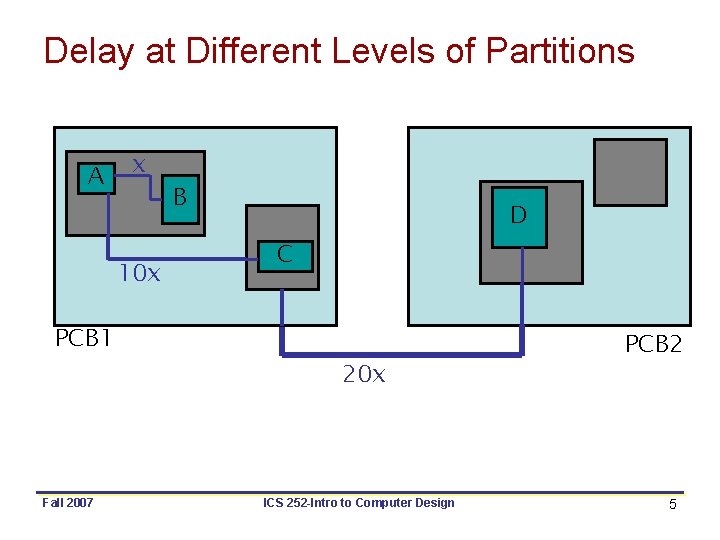
Delay at Different Levels of Partitions A x 10 x PCB 1 Fall 2007 B D C 20 x ICS 252 -Intro to Computer Design PCB 2 5
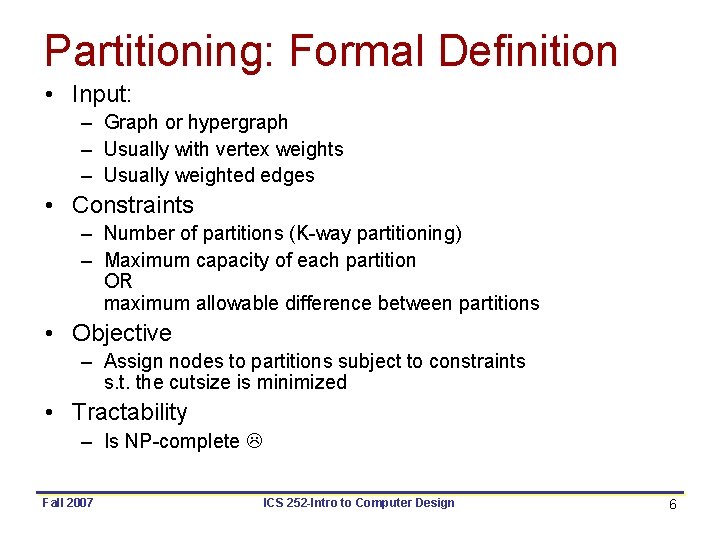
Partitioning: Formal Definition • Input: – Graph or hypergraph – Usually with vertex weights – Usually weighted edges • Constraints – Number of partitions (K-way partitioning) – Maximum capacity of each partition OR maximum allowable difference between partitions • Objective – Assign nodes to partitions subject to constraints s. t. the cutsize is minimized • Tractability – Is NP-complete Fall 2007 ICS 252 -Intro to Computer Design 6
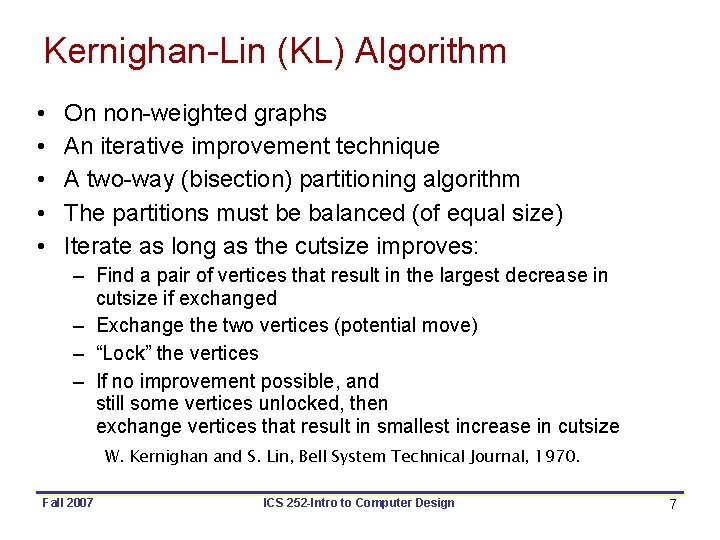
Kernighan-Lin (KL) Algorithm • • • On non-weighted graphs An iterative improvement technique A two-way (bisection) partitioning algorithm The partitions must be balanced (of equal size) Iterate as long as the cutsize improves: – Find a pair of vertices that result in the largest decrease in cutsize if exchanged – Exchange the two vertices (potential move) – “Lock” the vertices – If no improvement possible, and still some vertices unlocked, then exchange vertices that result in smallest increase in cutsize W. Kernighan and S. Lin, Bell System Technical Journal, 1970. Fall 2007 ICS 252 -Intro to Computer Design 7
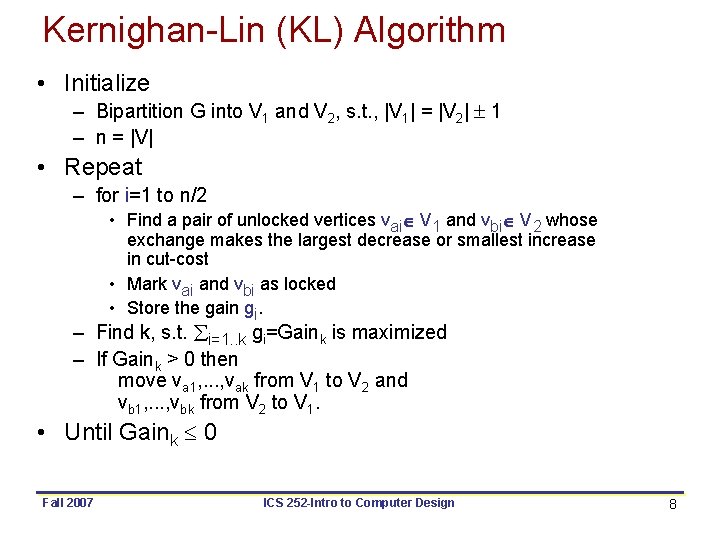
Kernighan-Lin (KL) Algorithm • Initialize – Bipartition G into V 1 and V 2, s. t. , |V 1| = |V 2| 1 – n = |V| • Repeat – for i=1 to n/2 • Find a pair of unlocked vertices vai V 1 and vbi V 2 whose exchange makes the largest decrease or smallest increase in cut-cost • Mark vai and vbi as locked • Store the gain gi. – Find k, s. t. i=1. . k gi=Gaink is maximized – If Gaink > 0 then move va 1, . . . , vak from V 1 to V 2 and vb 1, . . . , vbk from V 2 to V 1. • Until Gaink 0 Fall 2007 ICS 252 -Intro to Computer Design 8
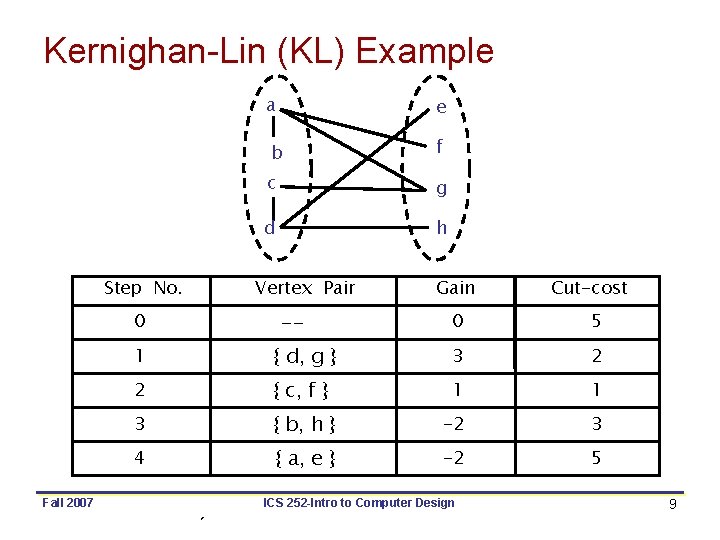
Kernighan-Lin (KL) Example Step No. 0 Fall 2007 a e b f c g d h Vertex Pair -- Gain Cut-cost 0 5 1 { d, g } 3 2 2 { c, f } 1 1 3 { b, h } -2 3 4 { a, e } -2 5 ICS 252 -Intro to Computer Design 9
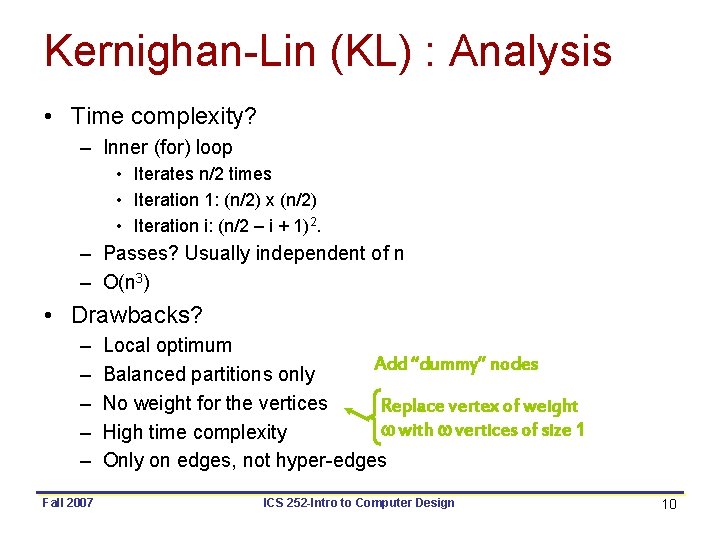
Kernighan-Lin (KL) : Analysis • Time complexity? – Inner (for) loop • Iterates n/2 times • Iteration 1: (n/2) x (n/2) • Iteration i: (n/2 – i + 1)2. – Passes? Usually independent of n – O(n 3) • Drawbacks? – – – Fall 2007 Local optimum Add “dummy” nodes Balanced partitions only No weight for the vertices Replace vertex of weight w with w vertices of size 1 High time complexity Only on edges, not hyper-edges ICS 252 -Intro to Computer Design 10
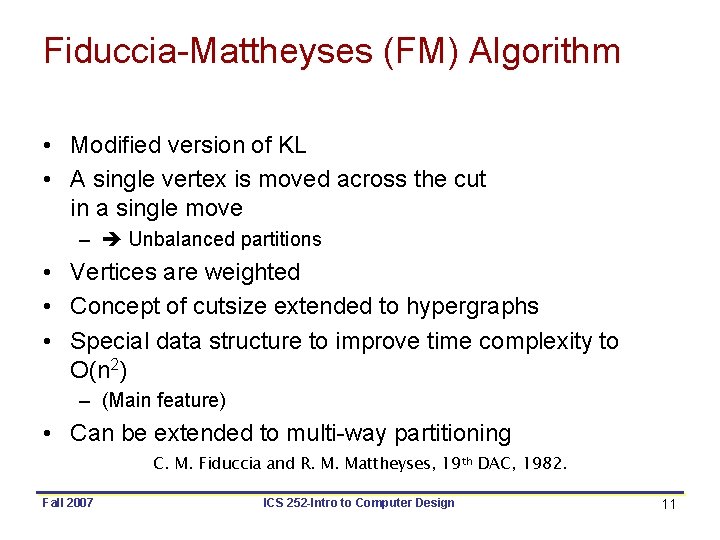
Fiduccia-Mattheyses (FM) Algorithm • Modified version of KL • A single vertex is moved across the cut in a single move – Unbalanced partitions • Vertices are weighted • Concept of cutsize extended to hypergraphs • Special data structure to improve time complexity to O(n 2) – (Main feature) • Can be extended to multi-way partitioning C. M. Fiduccia and R. M. Mattheyses, 19 th DAC, 1982. Fall 2007 ICS 252 -Intro to Computer Design 11
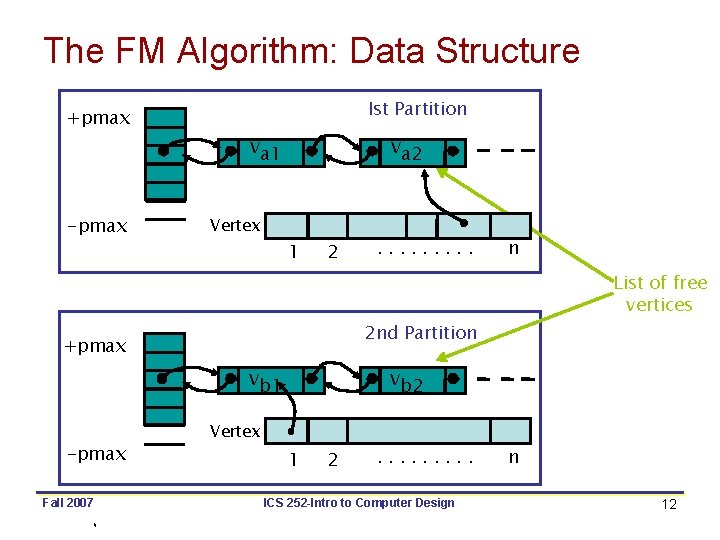
The FM Algorithm: Data Structure +pmax -pmax Ist Partition va 1 va 2 Vertex 1 2 vb 1 Fall 2007 n List of free vertices 2 nd Partition +pmax -pmax . . vb 2 Vertex 1 2 . . ICS 252 -Intro to Computer Design n 12
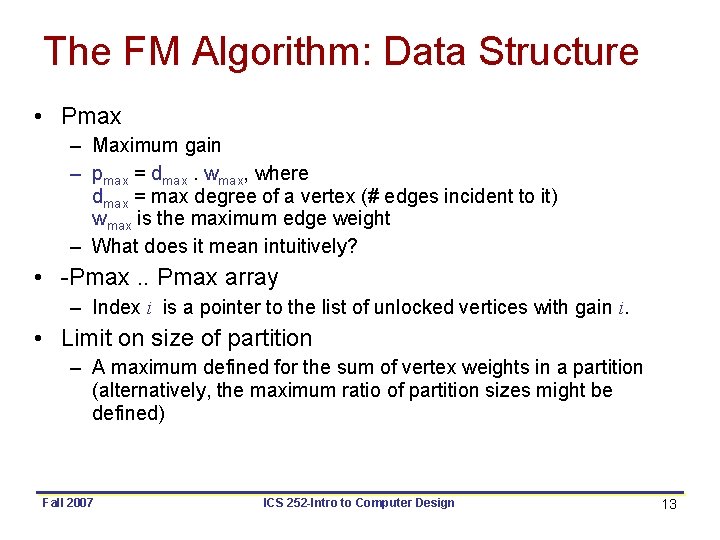
The FM Algorithm: Data Structure • Pmax – Maximum gain – pmax = dmax. wmax, where dmax = max degree of a vertex (# edges incident to it) wmax is the maximum edge weight – What does it mean intuitively? • -Pmax. . Pmax array – Index i is a pointer to the list of unlocked vertices with gain i. • Limit on size of partition – A maximum defined for the sum of vertex weights in a partition (alternatively, the maximum ratio of partition sizes might be defined) Fall 2007 ICS 252 -Intro to Computer Design 13
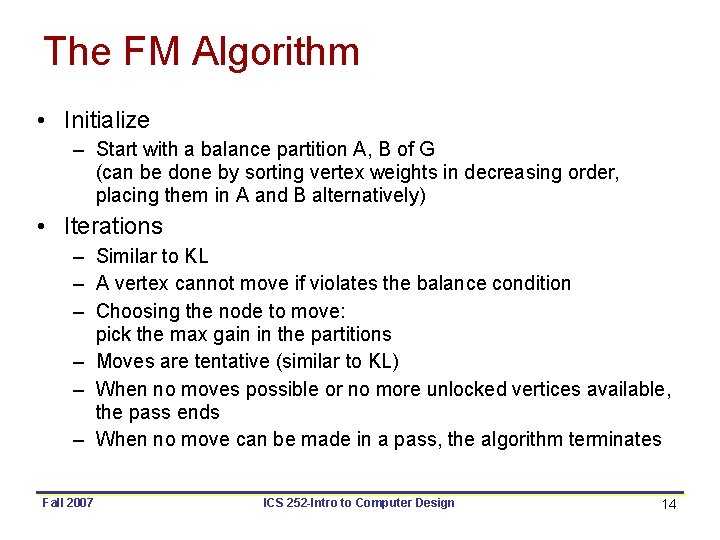
The FM Algorithm • Initialize – Start with a balance partition A, B of G (can be done by sorting vertex weights in decreasing order, placing them in A and B alternatively) • Iterations – Similar to KL – A vertex cannot move if violates the balance condition – Choosing the node to move: pick the max gain in the partitions – Moves are tentative (similar to KL) – When no moves possible or no more unlocked vertices available, the pass ends – When no move can be made in a pass, the algorithm terminates Fall 2007 ICS 252 -Intro to Computer Design 14
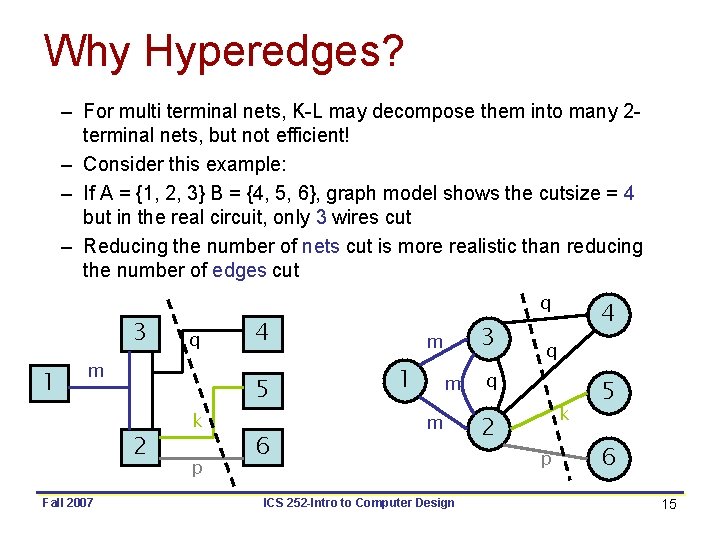
Why Hyperedges? – For multi terminal nets, K-L may decompose them into many 2 terminal nets, but not efficient! – Consider this example: – If A = {1, 2, 3} B = {4, 5, 6}, graph model shows the cutsize = 4 but in the real circuit, only 3 wires cut – Reducing the number of nets cut is more realistic than reducing the number of edges cut 3 1 q m 2 Fall 2007 k p q 4 5 6 3 m 1 m m ICS 252 -Intro to Computer Design 4 q q 2 k p 5 6 15
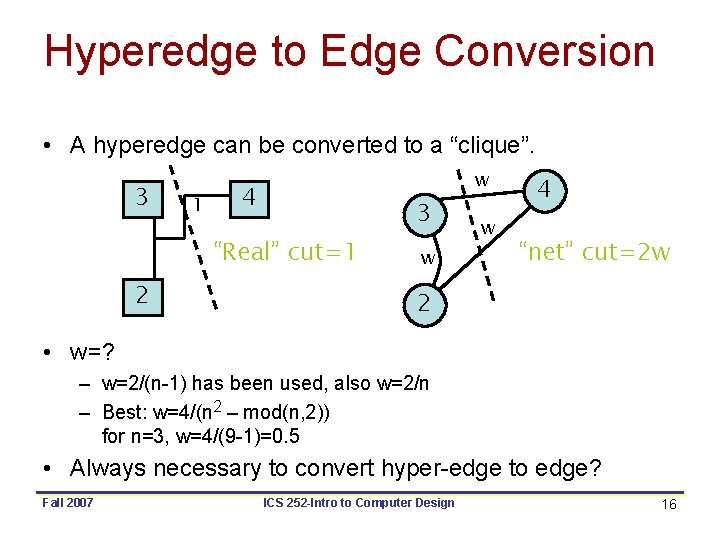
Hyperedge to Edge Conversion • A hyperedge can be converted to a “clique”. 3 1 w 4 3 “Real” cut=1 2 w w 4 “net” cut=2 w 2 • w=? – w=2/(n-1) has been used, also w=2/n – Best: w=4/(n 2 – mod(n, 2)) for n=3, w=4/(9 -1)=0. 5 • Always necessary to convert hyper-edge to edge? Fall 2007 ICS 252 -Intro to Computer Design 16
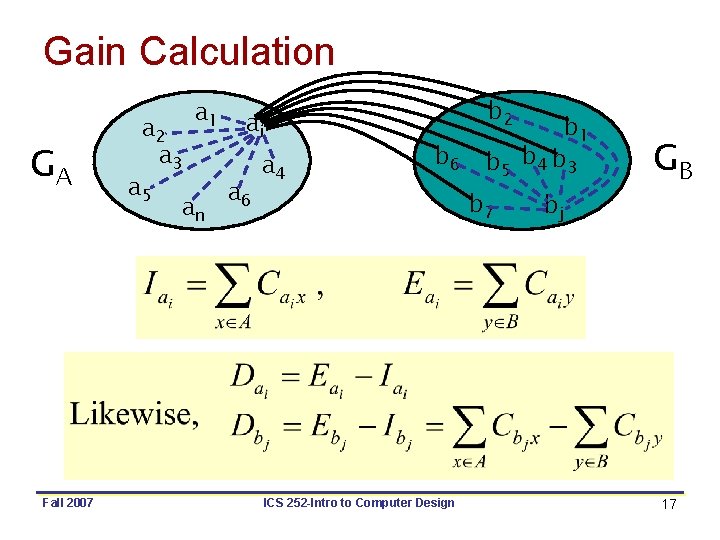
Gain Calculation GA a 2 a 3 a 5 a 1 an b 2 ai a 6 a 4 b 6 b 7 bj GB External cost Internal cost Fall 2007 b 1 b 5 b 4 b 3 ICS 252 -Intro to Computer Design 17
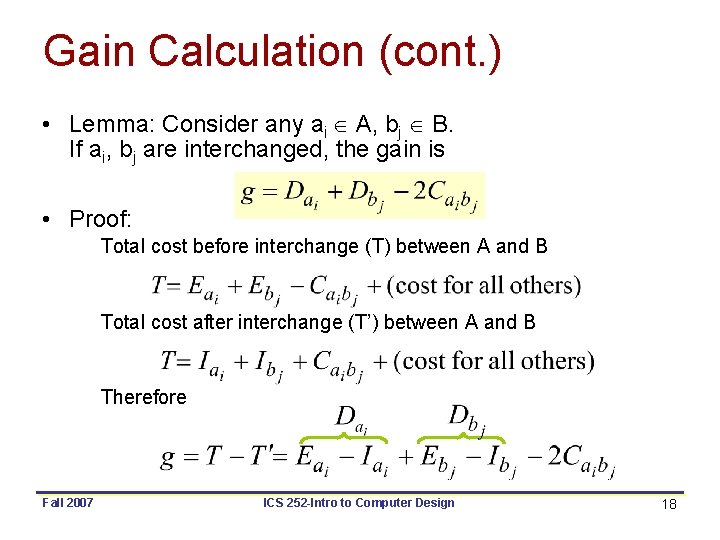
Gain Calculation (cont. ) • Lemma: Consider any ai A, bj B. If ai, bj are interchanged, the gain is • Proof: Total cost before interchange (T) between A and B Total cost after interchange (T’) between A and B Therefore Fall 2007 ICS 252 -Intro to Computer Design 18
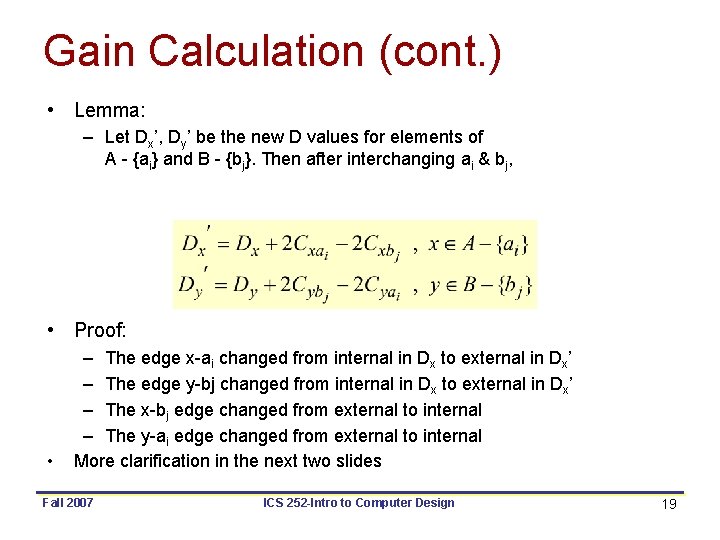
Gain Calculation (cont. ) • Lemma: – Let Dx’, Dy’ be the new D values for elements of A - {ai} and B - {bj}. Then after interchanging ai & bj, • Proof: • – The edge x-ai changed from internal in Dx to external in Dx’ – The edge y-bj changed from internal in Dx to external in Dx’ – The x-bj edge changed from external to internal – The y-ai edge changed from external to internal More clarification in the next two slides Fall 2007 ICS 252 -Intro to Computer Design 19
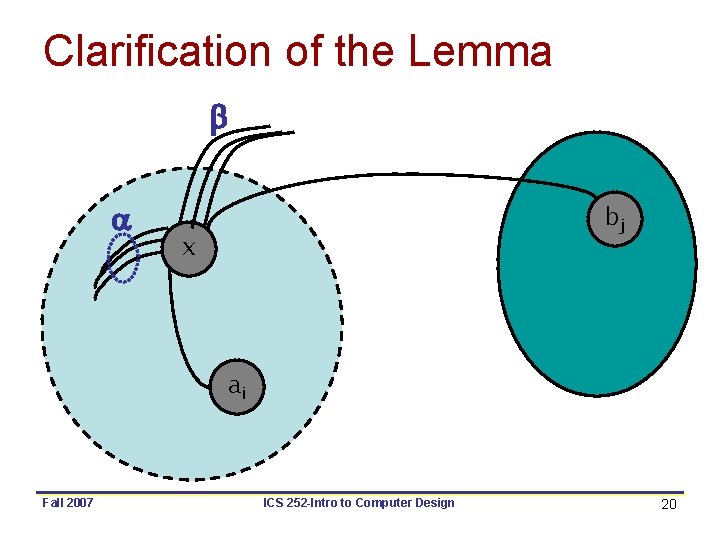
Clarification of the Lemma b a bj x ai Fall 2007 ICS 252 -Intro to Computer Design 20
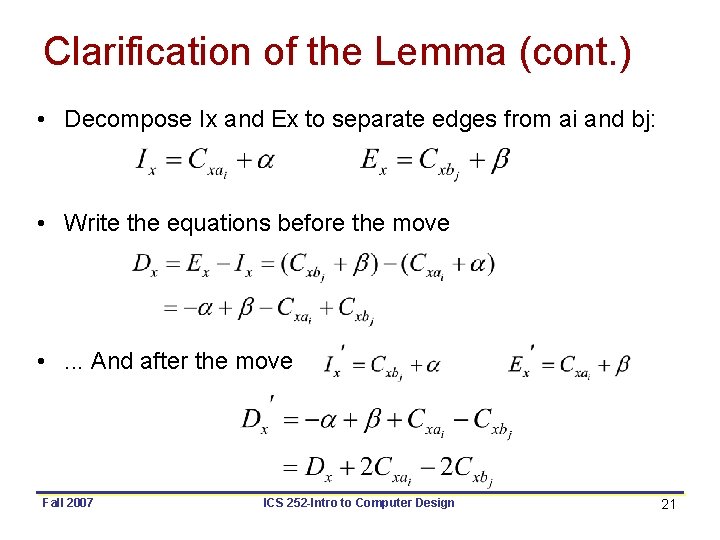
Clarification of the Lemma (cont. ) • Decompose Ix and Ex to separate edges from ai and bj: • Write the equations before the move • . . . And after the move Fall 2007 ICS 252 -Intro to Computer Design 21
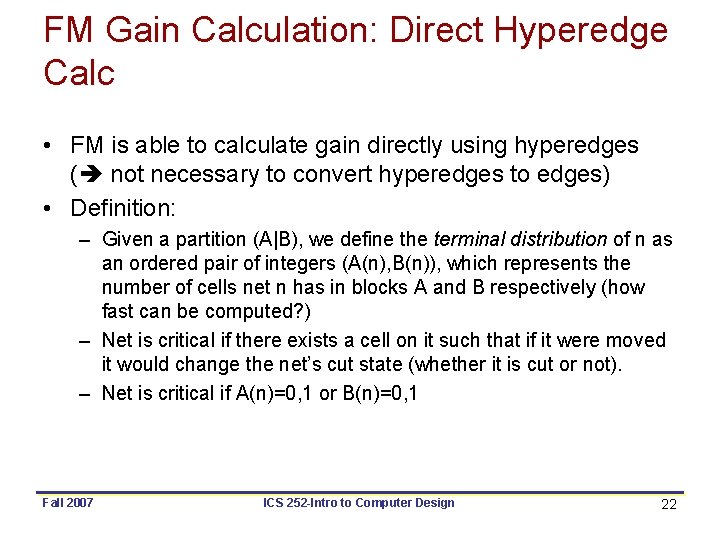
FM Gain Calculation: Direct Hyperedge Calc • FM is able to calculate gain directly using hyperedges ( not necessary to convert hyperedges to edges) • Definition: – Given a partition (A|B), we define the terminal distribution of n as an ordered pair of integers (A(n), B(n)), which represents the number of cells net n has in blocks A and B respectively (how fast can be computed? ) – Net is critical if there exists a cell on it such that if it were moved it would change the net’s cut state (whether it is cut or not). – Net is critical if A(n)=0, 1 or B(n)=0, 1 Fall 2007 ICS 252 -Intro to Computer Design 22
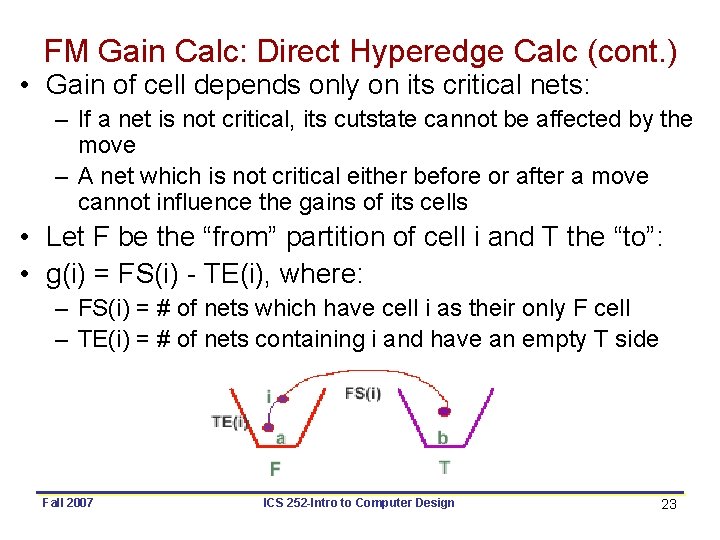
FM Gain Calc: Direct Hyperedge Calc (cont. ) • Gain of cell depends only on its critical nets: – If a net is not critical, its cutstate cannot be affected by the move – A net which is not critical either before or after a move cannot influence the gains of its cells • Let F be the “from” partition of cell i and T the “to”: • g(i) = FS(i) - TE(i), where: – FS(i) = # of nets which have cell i as their only F cell – TE(i) = # of nets containing i and have an empty T side Fall 2007 ICS 252 -Intro to Computer Design 23
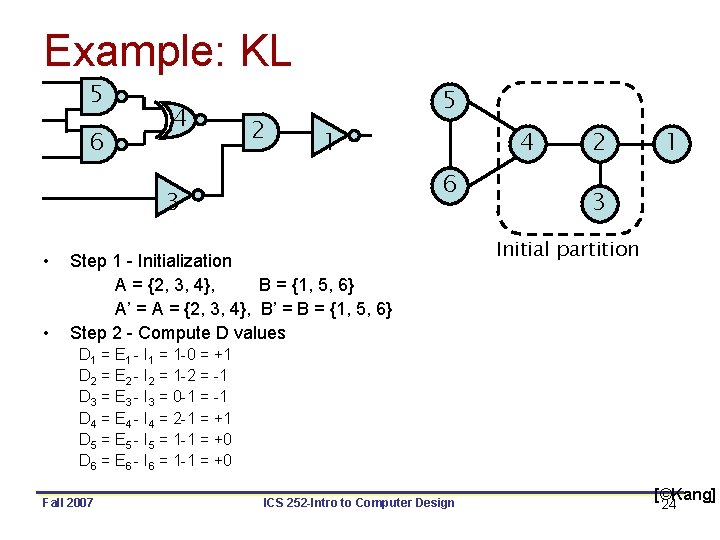
Example: KL 5 6 4 2 5 1 6 3 • • 4 Step 1 - Initialization A = {2, 3, 4}, B = {1, 5, 6} A’ = A = {2, 3, 4}, B’ = B = {1, 5, 6} Step 2 - Compute D values 2 1 3 Initial partition D 1 = E 1 - I 1 = 1 -0 = +1 D 2 = E 2 - I 2 = 1 -2 = -1 D 3 = E 3 - I 3 = 0 -1 = -1 D 4 = E 4 - I 4 = 2 -1 = +1 D 5 = E 5 - I 5 = 1 -1 = +0 D 6 = E 6 - I 6 = 1 -1 = +0 Fall 2007 ICS 252 -Intro to Computer Design [©Kang] 24
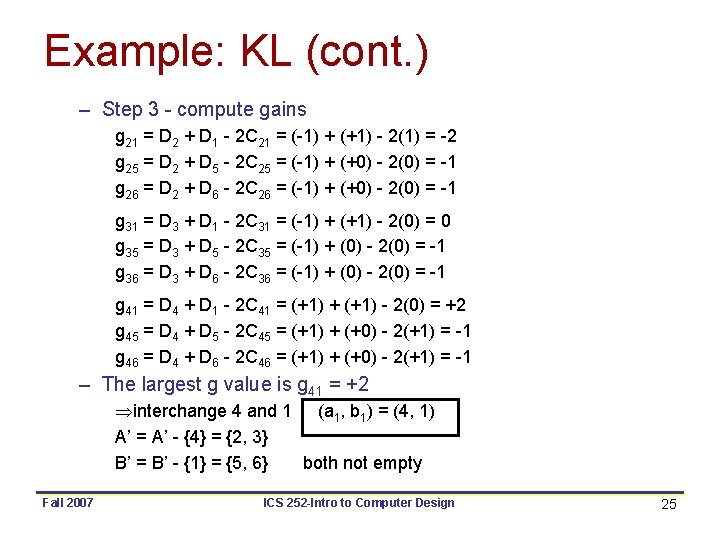
Example: KL (cont. ) – Step 3 - compute gains g 21 = D 2 + D 1 - 2 C 21 = (-1) + (+1) - 2(1) = -2 g 25 = D 2 + D 5 - 2 C 25 = (-1) + (+0) - 2(0) = -1 g 26 = D 2 + D 6 - 2 C 26 = (-1) + (+0) - 2(0) = -1 g 31 = D 3 + D 1 - 2 C 31 = (-1) + (+1) - 2(0) = 0 g 35 = D 3 + D 5 - 2 C 35 = (-1) + (0) - 2(0) = -1 g 36 = D 3 + D 6 - 2 C 36 = (-1) + (0) - 2(0) = -1 g 41 = D 4 + D 1 - 2 C 41 = (+1) + (+1) - 2(0) = +2 g 45 = D 4 + D 5 - 2 C 45 = (+1) + (+0) - 2(+1) = -1 g 46 = D 4 + D 6 - 2 C 46 = (+1) + (+0) - 2(+1) = -1 – The largest g value is g 41 = +2 Þinterchange 4 and 1 (a 1, b 1) = (4, 1) A’ = A’ - {4} = {2, 3} B’ = B’ - {1} = {5, 6} both not empty Fall 2007 ICS 252 -Intro to Computer Design 25
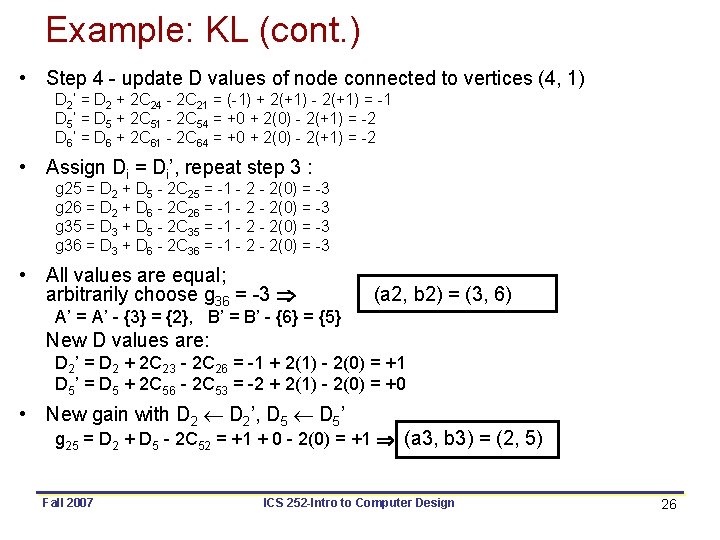
Example: KL (cont. ) • Step 4 - update D values of node connected to vertices (4, 1) D 2’ = D 2 + 2 C 24 - 2 C 21 = (-1) + 2(+1) - 2(+1) = -1 D 5’ = D 5 + 2 C 51 - 2 C 54 = +0 + 2(0) - 2(+1) = -2 D 6’ = D 6 + 2 C 61 - 2 C 64 = +0 + 2(0) - 2(+1) = -2 • Assign Di = Di’, repeat step 3 : g 25 = D 2 + D 5 - 2 C 25 = -1 - 2(0) = -3 g 26 = D 2 + D 6 - 2 C 26 = -1 - 2(0) = -3 g 35 = D 3 + D 5 - 2 C 35 = -1 - 2(0) = -3 g 36 = D 3 + D 6 - 2 C 36 = -1 - 2(0) = -3 • All values are equal; arbitrarily choose g 36 = -3 (a 2, b 2) = (3, 6) A’ = A’ - {3} = {2}, B’ = B’ - {6} = {5} New D values are: D 2’ = D 2 + 2 C 23 - 2 C 26 = -1 + 2(1) - 2(0) = +1 D 5’ = D 5 + 2 C 56 - 2 C 53 = -2 + 2(1) - 2(0) = +0 • New gain with D 2’, D 5’ g 25 = D 2 + D 5 - 2 C 52 = +1 + 0 - 2(0) = +1 (a 3, b 3) = (2, 5) Fall 2007 ICS 252 -Intro to Computer Design 26
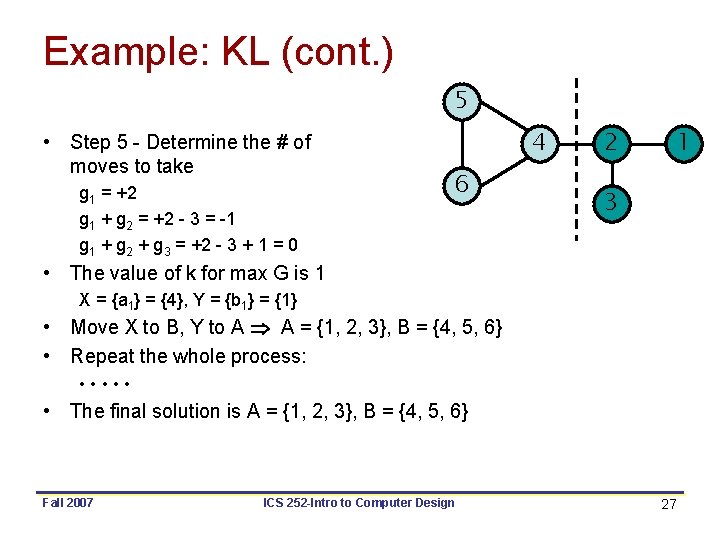
Example: KL (cont. ) 5 • Step 5 - Determine the # of moves to take g 1 = +2 g 1 + g 2 = +2 - 3 = -1 g 1 + g 2 + g 3 = +2 - 3 + 1 = 0 4 6 2 1 3 • The value of k for max G is 1 X = {a 1} = {4}, Y = {b 1} = {1} • Move X to B, Y to A A = {1, 2, 3}, B = {4, 5, 6} • Repeat the whole process: • • • • The final solution is A = {1, 2, 3}, B = {4, 5, 6} Fall 2007 ICS 252 -Intro to Computer Design 27
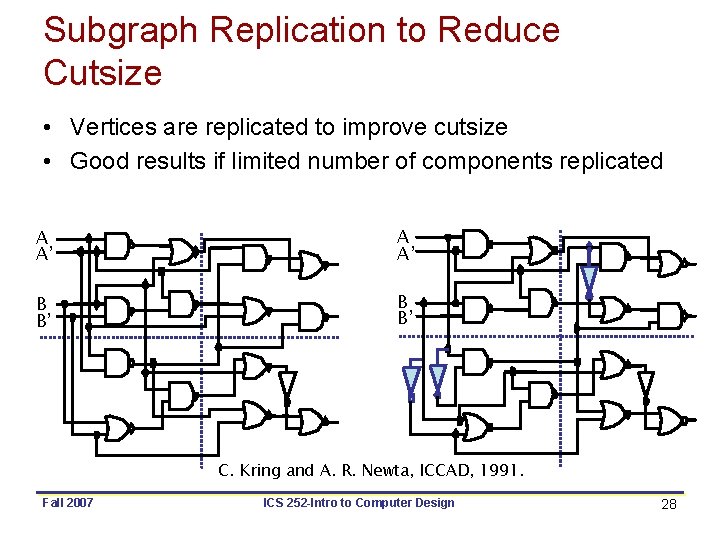
Subgraph Replication to Reduce Cutsize • Vertices are replicated to improve cutsize • Good results if limited number of components replicated A A’ B B’ C. Kring and A. R. Newta, ICCAD, 1991. Fall 2007 ICS 252 -Intro to Computer Design 28
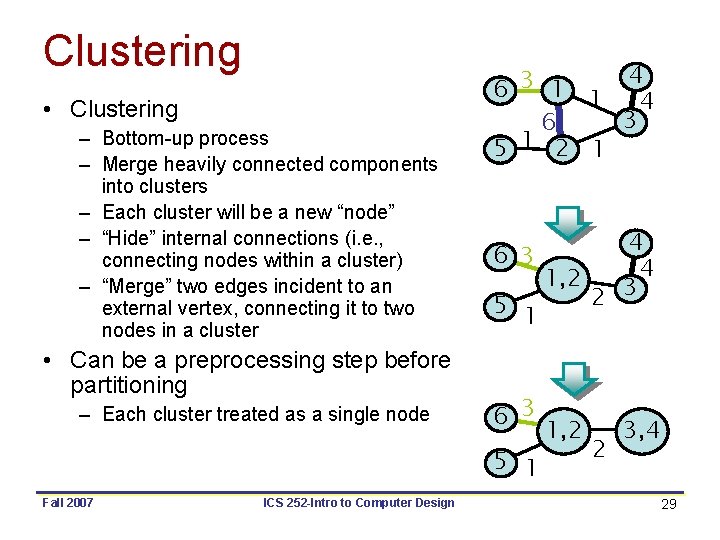
Clustering • Clustering – Bottom-up process – Merge heavily connected components into clusters – Each cluster will be a new “node” – “Hide” internal connections (i. e. , connecting nodes within a cluster) – “Merge” two edges incident to an external vertex, connecting it to two nodes in a cluster • Can be a preprocessing step before partitioning – Each cluster treated as a single node 4 3 6 1 1 4 3 6 5 1 2 1 6 3 5 1 Fall 2007 ICS 252 -Intro to Computer Design 4 4 1, 2 2 3, 4 29
Other Partitioning Methods • KL and FM have each held up very well • Min-cut / max-flow algorithms – Ford-Fulkerson – for unconstrained partitions • Ratio cut • Genetic algorithm • Simulated annealing Fall 2007 ICS 252 -Intro to Computer Design 30