
ICS 252 Introduction to Computer Design Lecture 6
![References • Lecture notes by Kia Bazargan on High level Synthesis [©Bazargan] – http:](https://slidetodoc.com/presentation_image_h2/16249fb9fb41047aa030a5e2cb4ce218/image-2.jpg "References • Lecture notes by Kia Bazargan on High level Synthesis [©Bazargan] – http:")
![Hu’s Algorithm: Example [©Gupta] Winter 2004 ICS 252 -Intro to Computer Design 16](https://slidetodoc.com/presentation_image_h2/16249fb9fb41047aa030a5e2cb4ce218/image-16.jpg "Hu’s Algorithm: Example [©Gupta] Winter 2004 ICS 252 -Intro to Computer Design 16")
![List Scheduling Example [©Gupta] Winter 2004 ICS 252 -Intro to Computer Design 19](https://slidetodoc.com/presentation_image_h2/16249fb9fb41047aa030a5e2cb4ce218/image-19.jpg "List Scheduling Example [©Gupta] Winter 2004 ICS 252 -Intro to Computer Design 19")
- Slides: 24
ICS 252 Introduction to Computer Design Lecture 6 Winter 2004 Eli Bozorgzadeh Computer Science Department-UCI Winter 2004 ICS 252 -Intro to Computer Design
References • Lecture notes by Kia Bazargan on High level Synthesis [©Bazargan] – http: //www. ece. umn. edu/users/kia/Courses/EE 5301 • Lecture note by Rajesh Gupta on scheduling [©Gupta] – http: //www. ics. uci. edu/~rgupta/ics 280. html • Chapter 6 of the textbook Winter 2004 ICS 252 -Intro to Computer Design 2
Resource Constraint Scheduling • Constrained scheduling – General case NP-complete – Minimize latency given constraints on area or the resources (ML-RCS) – Minimize resources subject to bound on latency (MRLCS) • Exact solution methods: – Integer linear programming (ILP) model – Hu’s algorithm • Heuristics: – List scheduling – Force-directed scheduling [©Bazargan] Winter 2004 ICS 252 -Intro to Computer Design 3
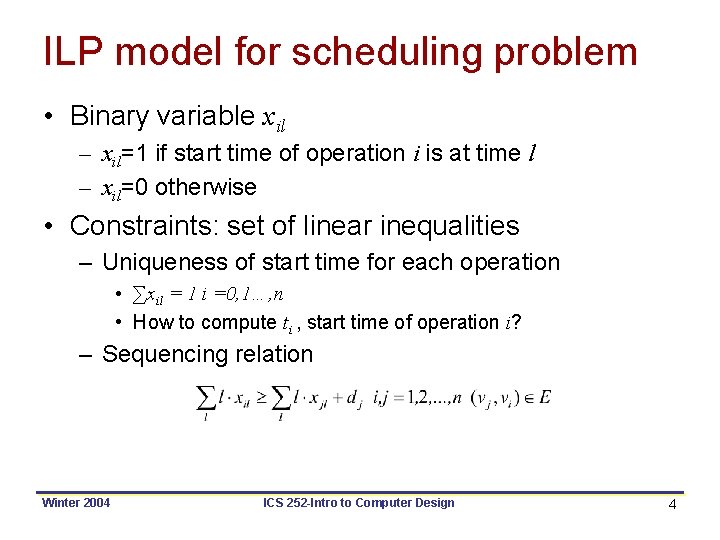
ILP model for scheduling problem • Binary variable xil – xil=1 if start time of operation i is at time l – xil=0 otherwise • Constraints: set of linear inequalities – Uniqueness of start time for each operation • ∑xil = 1 i =0, 1…, n • How to compute ti , start time of operation i? – Sequencing relation Winter 2004 ICS 252 -Intro to Computer Design 4
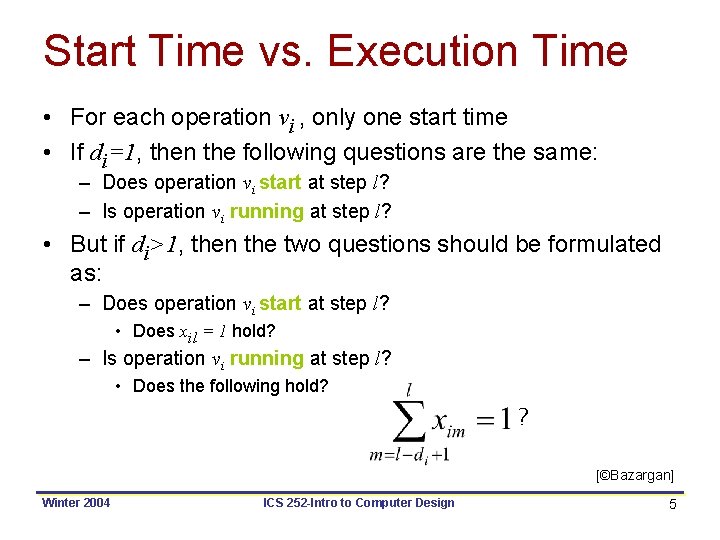
Start Time vs. Execution Time • For each operation vi , only one start time • If di=1, then the following questions are the same: – Does operation vi start at step l? – Is operation vi running at step l? • But if di>1, then the two questions should be formulated as: – Does operation vi start at step l? • Does xil = 1 hold? – Is operation vi running at step l? • Does the following hold? ? [©Bazargan] Winter 2004 ICS 252 -Intro to Computer Design 5
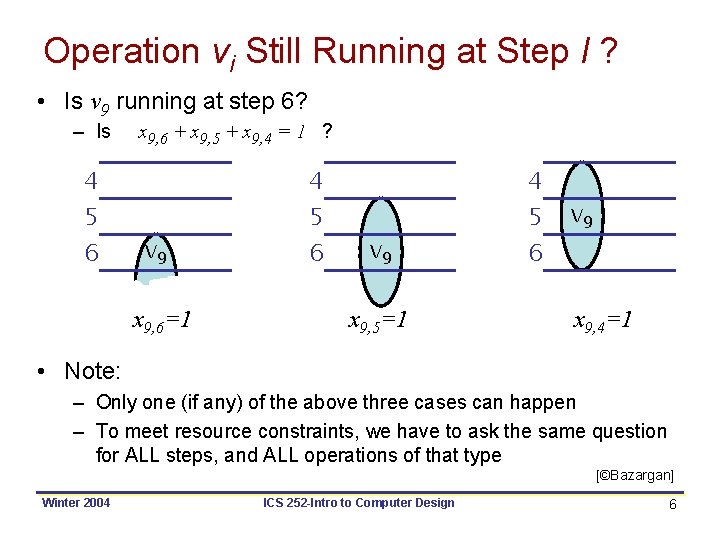
Operation vi Still Running at Step l ? • Is v 9 running at step 6? – Is 4 5 6 x 9, 6 + x 9, 5 + x 9, 4 = 1 ? v 9 x 9, 6=1 4 5 6 v 9 x 9, 5=1 4 5 6 v 9 x 9, 4=1 • Note: – Only one (if any) of the above three cases can happen – To meet resource constraints, we have to ask the same question for ALL steps, and ALL operations of that type [©Bazargan] Winter 2004 ICS 252 -Intro to Computer Design 6
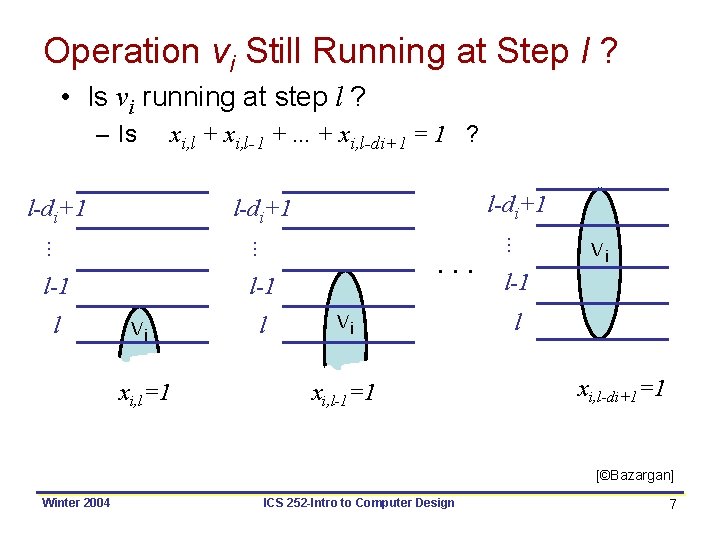
Operation vi Still Running at Step l ? • Is vi running at step l ? – Is xi, l + xi, l-1 +. . . + xi, l-di+1 = 1 ? l-di+1 . . . l-1 vi xi, l=1 l . . . vi xi, l-1=1 . . . l-1 l l-di+1 vi l-1 l xi, l-di+1=1 [©Bazargan] Winter 2004 ICS 252 -Intro to Computer Design 7
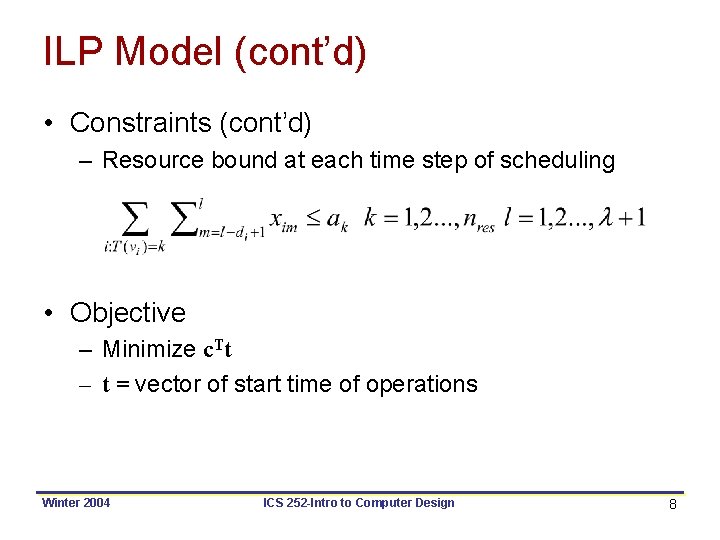
ILP Model (cont’d) • Constraints (cont’d) – Resource bound at each time step of scheduling • Objective – Minimize c. Tt – t = vector of start time of operations Winter 2004 ICS 252 -Intro to Computer Design 8
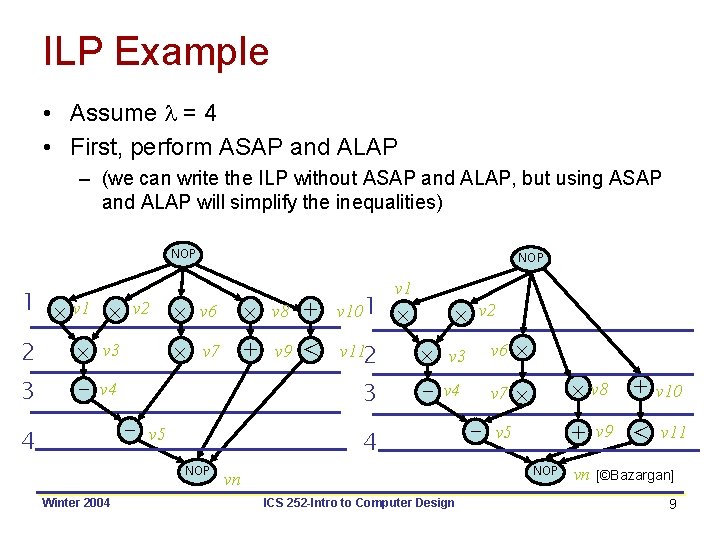
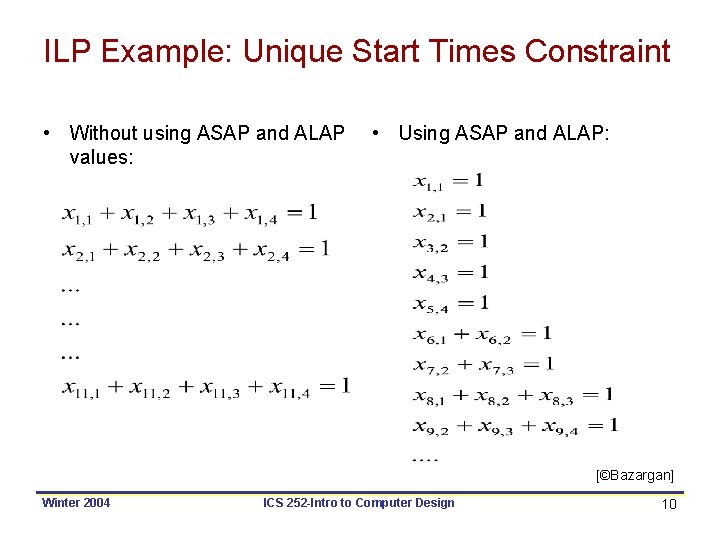
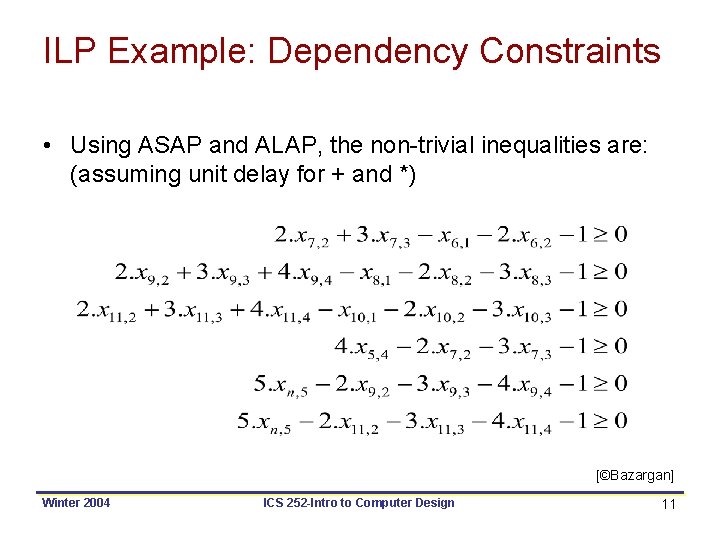
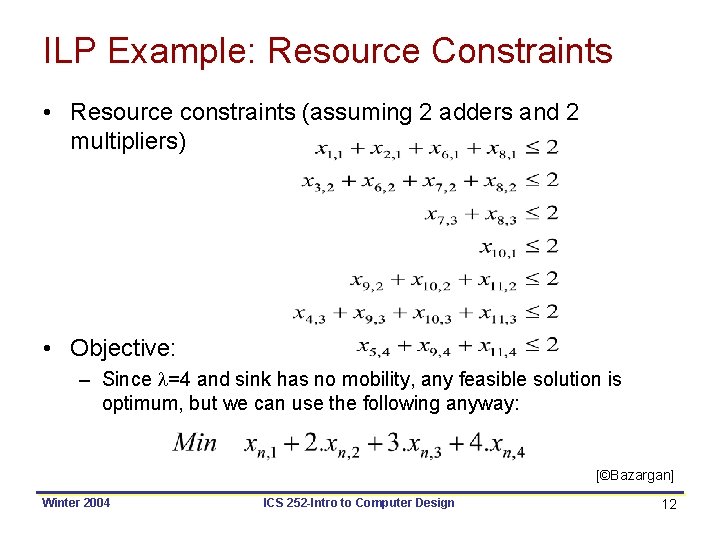
ILP Example • Assume l = 4 • First, perform ASAP and ALAP – (we can write the ILP without ASAP and ALAP, but using ASAP and ALAP will simplify the inequalities) NOP 1 v 1 2 3 v 3 - v 4 v 2 - 4 NOP v 6 v 8 + v 101 v 7 + v 9 < v 112 3 v 5 v 2 v 3 v 6 - v 4 v 7 4 NOP Winter 2004 v 1 - v 8 + v 10 + v 5 NOP vn ICS 252 -Intro to Computer Design vn v 9 < v 11 [©Bazargan] 9
ILP Example: Unique Start Times Constraint • Without using ASAP and ALAP values: • Using ASAP and ALAP: [©Bazargan] Winter 2004 ICS 252 -Intro to Computer Design 10
ILP Example: Dependency Constraints • Using ASAP and ALAP, the non-trivial inequalities are: (assuming unit delay for + and *) [©Bazargan] Winter 2004 ICS 252 -Intro to Computer Design 11
ILP Example: Resource Constraints • Resource constraints (assuming 2 adders and 2 multipliers) • Objective: – Since l=4 and sink has no mobility, any feasible solution is optimum, but we can use the following anyway: [©Bazargan] Winter 2004 ICS 252 -Intro to Computer Design 12
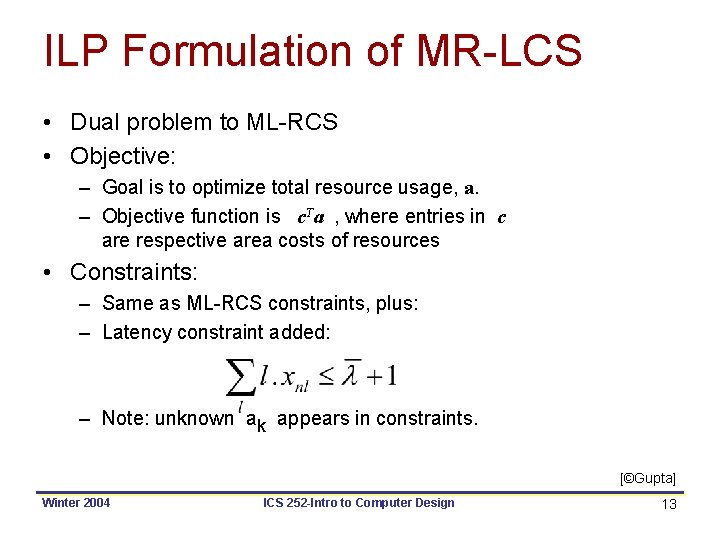
ILP Formulation of MR-LCS • Dual problem to ML-RCS • Objective: – Goal is to optimize total resource usage, a. – Objective function is c. Ta , where entries in c are respective area costs of resources • Constraints: – Same as ML-RCS constraints, plus: – Latency constraint added: – Note: unknown ak appears in constraints. [©Gupta] Winter 2004 ICS 252 -Intro to Computer Design 13
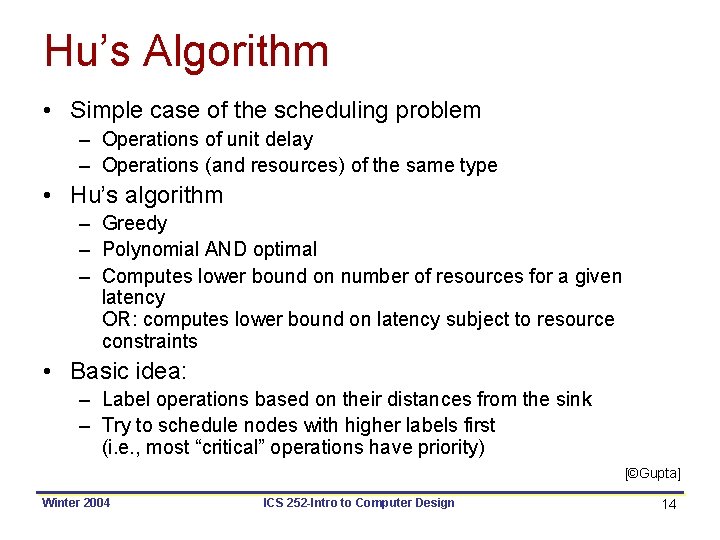
Hu’s Algorithm • Simple case of the scheduling problem – Operations of unit delay – Operations (and resources) of the same type • Hu’s algorithm – Greedy – Polynomial AND optimal – Computes lower bound on number of resources for a given latency OR: computes lower bound on latency subject to resource constraints • Basic idea: – Label operations based on their distances from the sink – Try to schedule nodes with higher labels first (i. e. , most “critical” operations have priority) [©Gupta] Winter 2004 ICS 252 -Intro to Computer Design 14
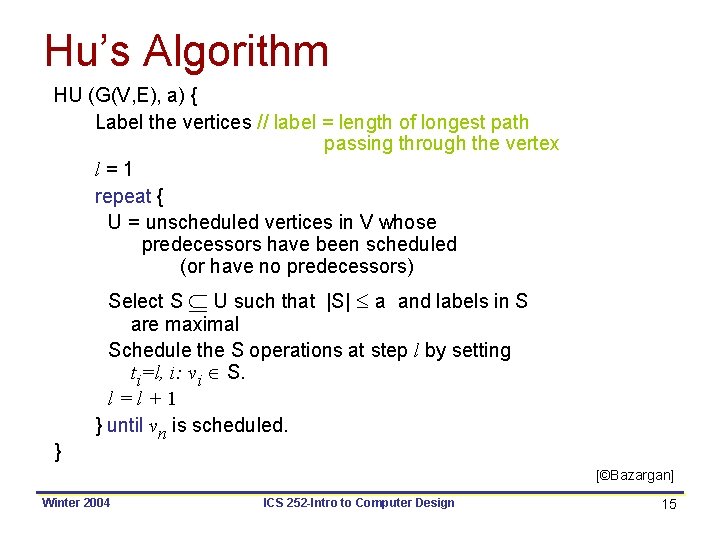
Hu’s Algorithm HU (G(V, E), a) { Label the vertices // label = length of longest path passing through the vertex l=1 repeat { U = unscheduled vertices in V whose predecessors have been scheduled (or have no predecessors) } Select S U such that |S| a and labels in S are maximal Schedule the S operations at step l by setting ti=l, i: vi S. l=l+1 } until vn is scheduled. [©Bazargan] Winter 2004 ICS 252 -Intro to Computer Design 15
Hu’s Algorithm: Example [©Gupta] Winter 2004 ICS 252 -Intro to Computer Design 16
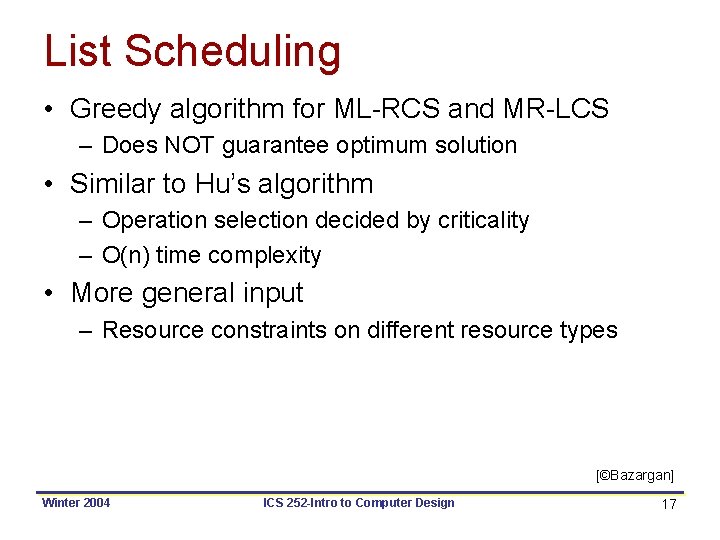
List Scheduling • Greedy algorithm for ML-RCS and MR-LCS – Does NOT guarantee optimum solution • Similar to Hu’s algorithm – Operation selection decided by criticality – O(n) time complexity • More general input – Resource constraints on different resource types [©Bazargan] Winter 2004 ICS 252 -Intro to Computer Design 17
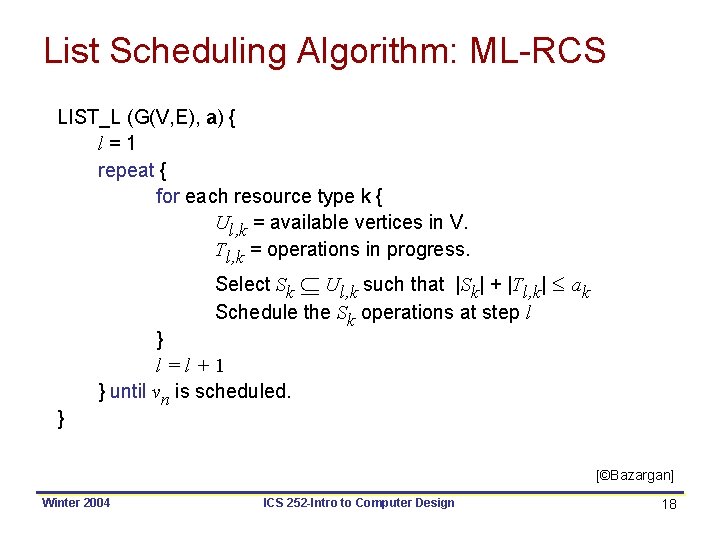
List Scheduling Algorithm: ML-RCS LIST_L (G(V, E), a) { l=1 repeat { for each resource type k { Ul, k = available vertices in V. Tl, k = operations in progress. Select Sk Ul, k such that |Sk| + |Tl, k| ak Schedule the Sk operations at step l } } l=l+1 } until vn is scheduled. [©Bazargan] Winter 2004 ICS 252 -Intro to Computer Design 18
List Scheduling Example [©Gupta] Winter 2004 ICS 252 -Intro to Computer Design 19
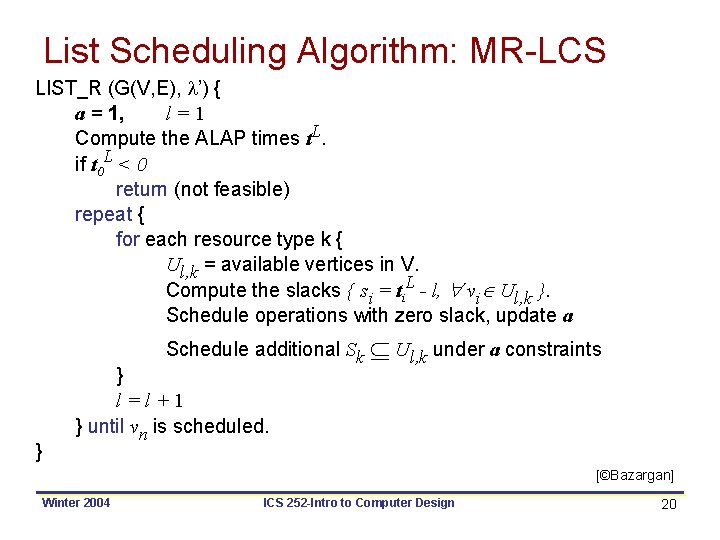
List Scheduling Algorithm: MR-LCS LIST_R (G(V, E), l’) { a = 1, l=1 Compute the ALAP times t. L. if t 0 L < 0 return (not feasible) repeat { for each resource type k { Ul, k = available vertices in V. Compute the slacks { si = ti. L - l, vi Ul, k }. Schedule operations with zero slack, update a Schedule additional Sk Ul, k under a constraints } } l=l+1 } until vn is scheduled. [©Bazargan] Winter 2004 ICS 252 -Intro to Computer Design 20
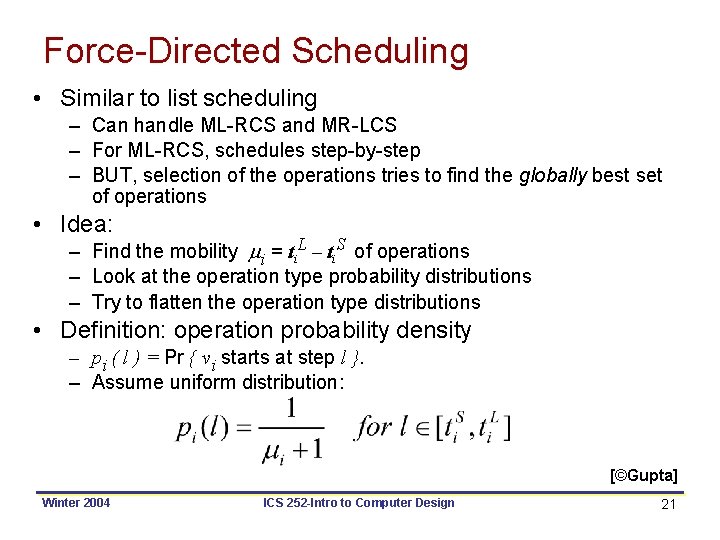
Force-Directed Scheduling • Similar to list scheduling – Can handle ML-RCS and MR-LCS – For ML-RCS, schedules step-by-step – BUT, selection of the operations tries to find the globally best set of operations • Idea: – Find the mobility mi = ti. L – ti. S of operations – Look at the operation type probability distributions – Try to flatten the operation type distributions • Definition: operation probability density – pi ( l ) = Pr { vi starts at step l }. – Assume uniform distribution: [©Gupta] Winter 2004 ICS 252 -Intro to Computer Design 21
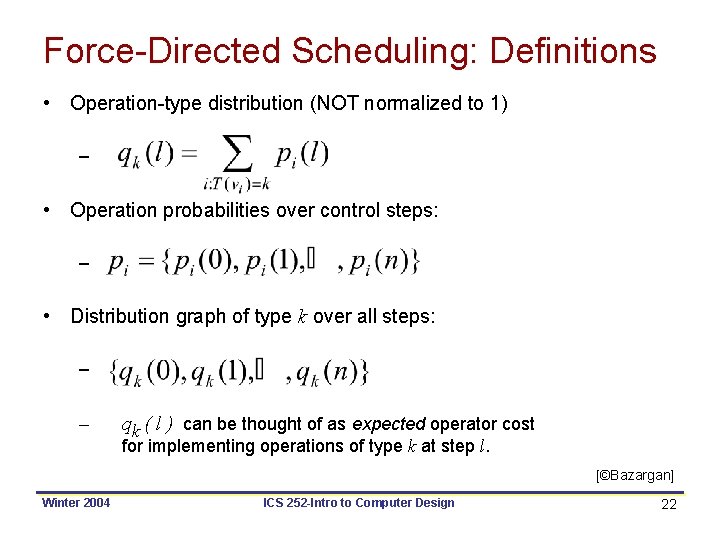
Force-Directed Scheduling: Definitions • Operation-type distribution (NOT normalized to 1) – • Operation probabilities over control steps: – • Distribution graph of type k over all steps: – – qk ( l ) can be thought of as expected operator cost for implementing operations of type k at step l. [©Bazargan] Winter 2004 ICS 252 -Intro to Computer Design 22
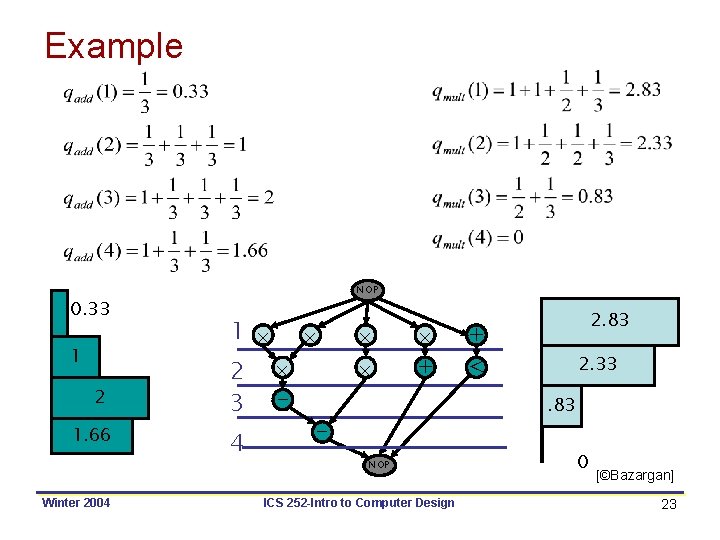
Example 0. 33 1 2 1. 66 Winter 2004 NOP 1 2 3 4 + 2. 83 + < 2. 33. 83 NOP ICS 252 -Intro to Computer Design 0 [©Bazargan] 23
Force-Directed Scheduling Algorithm: Idea • Very similar to LIST_L(G(V, E), a) – – – Compute mobility of operations using ASAP and ALAP Computer operation probabilities and type distributions Select and schedule operations Update operation probabilities and type distributions Go to next control step • Difference with list scheduling in selecting operations – Select operations with least force – Consider the effect on the type distribution – Consider the effect on successor nodes and their type distributions [©Bazargan] Winter 2004 ICS 252 -Intro to Computer Design 24